Installing New Composite Doors and Windows at Period Properties
By Housey · Last reviewed 4th of May 2026
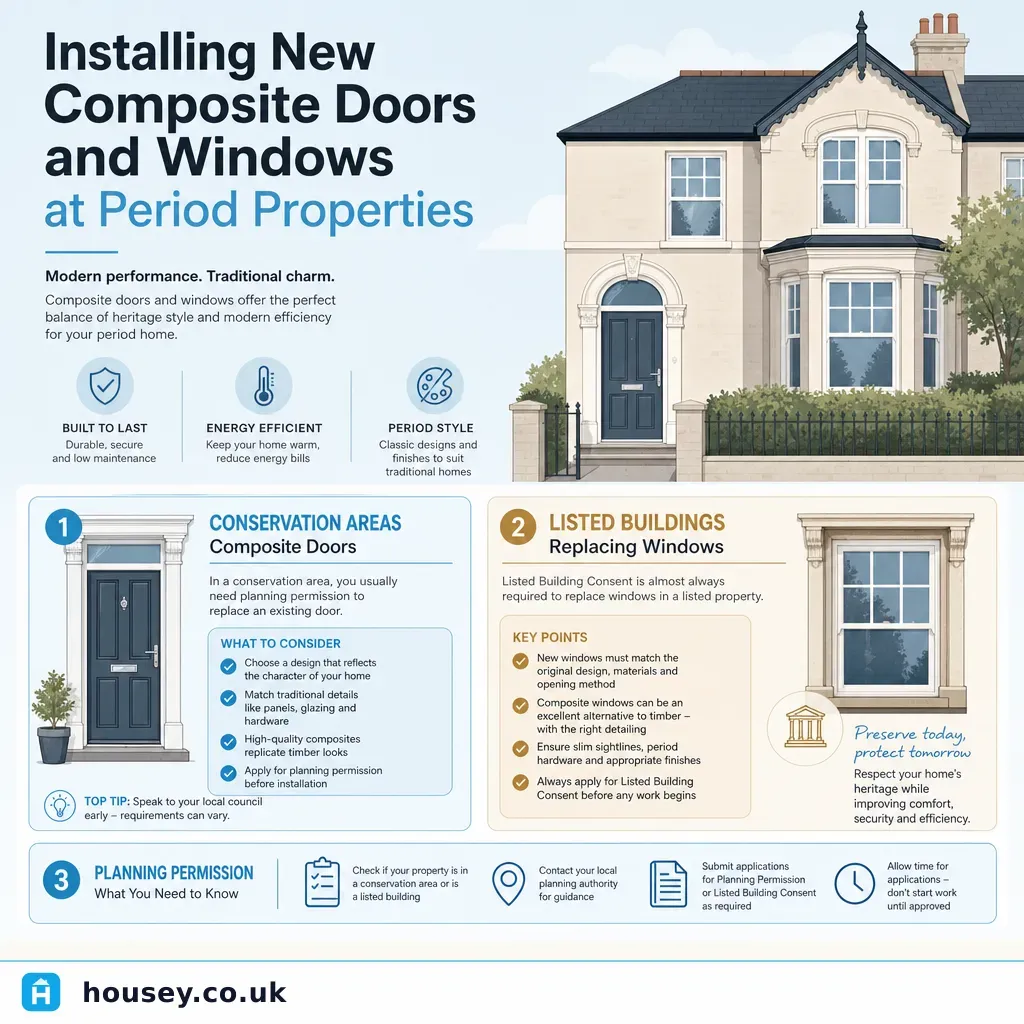
Installing New Composite Doors and Windows at Period Properties
Victorian terraces, Edwardian semis, Georgian townhouses, and pre-war cottages present particular challenges when owners want to upgrade doors and windows. The combination of non-standard opening sizes, planning designations that restrict material choices, and the need to balance meaningful thermal improvement with architectural character means this project benefits from careful preparation well before any product is ordered. Getting the planning position confirmed first can prevent costly changes or enforcement action later.
Key points
- Listed buildings require Listed Building Consent (LBC) before replacing any external door or window, regardless of material — including composite. Proceeding without consent is a criminal offence under the Planning (Listed Buildings and Conservation Areas) Act 1990.
- Conservation areas may restrict material changes for doors and windows; where an Article 4 Direction has removed permitted development rights, a planning application is required before replacement.
- Building Regulations Approved Document L1B (2022 edition, existing dwellings in England) sets maximum U-values of 1.4 W/m²K for windows and highly-glazed doors, and 1.6 W/m²K for doors with 60% or less glazed area.
- FENSA- or CERTASS-registered installers can self-certify Building Regulations compliance; the certificate should be retained with your title documents.
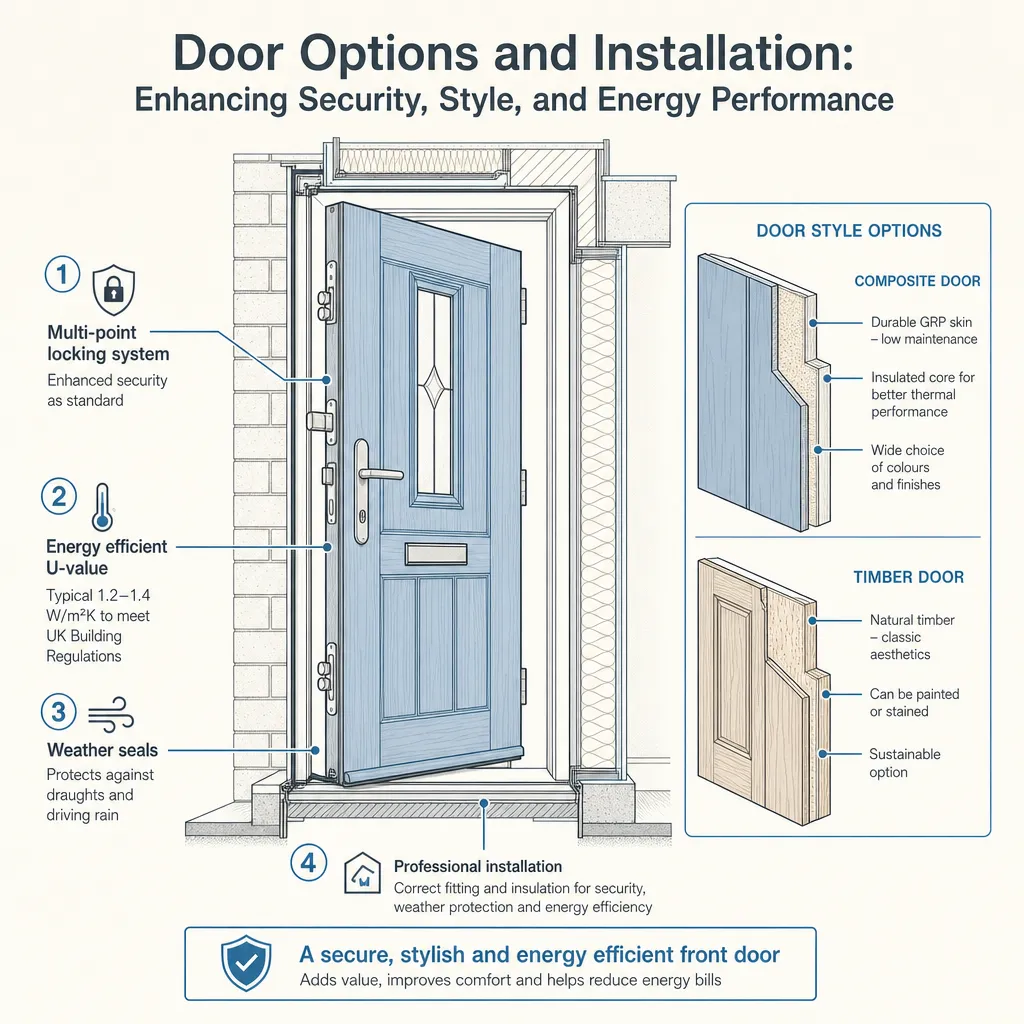
- Composite doors use a rigid foam or engineered timber core clad in a GRP (glass-reinforced plastic) skin, offering thermal performance broadly comparable to modern timber — but visual compatibility with period character varies significantly by product profile and design.
What is a composite door, and why consider one for a period property?
A composite door combines multiple materials to achieve performance that traditional solid timber or uPVC cannot match on all fronts simultaneously:
- Core: rigid polyurethane (PUR) foam, laminated veneer lumber (LVL), or a combination — provides thermal mass and structural stability.
- Outer skin: GRP moulded to replicate timber grain, smooth finish, or bespoke panel profiles.
- Frame: typically uPVC, timber, or aluminium subframe.
- Sealing: multi-point locking with compression seals on all four sides.
For period properties, the appeal is a door that can resemble a painted timber panel door, resists warping and cracking over time, and requires little maintenance beyond occasional cleaning. Many manufacturers offer heritage-style composite doors with period panel layouts, side light glazing options, and colour choices suited to Victorian, Edwardian, or Georgian contexts.
However, not all composite doors are visually appropriate for period settings. A smooth, contemporary-profile composite on a Victorian terrace can look conspicuously out of place. Selecting the right profile depth, panel configuration, glazing bar style, and finish is as important as the thermal specification — and is exactly the detail conservation officers scrutinise.
Do you need planning permission at a period property?
Decision tree: planning and consent for doors and windows
- Is the property listed (any grade — I, II*, or II)? → You need Listed Building Consent before replacing any external door or window. Contact your local planning authority. A conservation architect or heritage consultant can advise on acceptable specifications before you apply.
- Is the property in a conservation area? → Check whether an Article 4 Direction applies to your street or property. Contact your LPA or check their website.
- Article 4 Direction applies → Replacing windows or doors — especially if changing material (e.g., timber to composite or uPVC) — likely requires planning permission. A pre-application enquiry to the LPA is recommended before ordering.
- No Article 4 Direction → Replacement with a product of similar appearance is usually permitted development. Check your LPA's conservation area appraisal for guidance on acceptable materials.
- Standard residential property, no designations, not a flat? → Replacement doors and windows are generally permitted development in England, subject to Building Regulations compliance.
- Flat or maisonette? → Permitted development rights for windows and doors are more restricted than for houses. Check with your LPA before proceeding.
Conservation areas are designated by local authorities under the Planning (Listed Buildings and Conservation Areas) Act 1990. You can check listing status via the Historic England National Heritage List for England and conservation area boundaries via your LPA's website or the MAGIC mapping tool.
Building Regulations requirements for replacement windows and doors
All replacement windows and doors in existing dwellings in England must comply with Approved Document L1B (Conservation of fuel and power: existing dwellings, 2022 edition). Key thresholds:
Component | Maximum U-value (whole unit) | Notes |
|---|---|---|
Windows | 1.4 W/m²K | Assessed as a complete unit including frames |
Doors (more than 60% glazed area) | 1.4 W/m²K | e.g., full-light composite or French doors |
Doors (60% or less glazed area) | 1.6 W/m²K | Most composite front doors fall in this category |
Exception: where meeting the required standard would unacceptably alter the character of a listed building, the regulations allow a more limited improvement to thermal performance. Your Building Control officer, FENSA-registered installer, or conservation architect can advise on what applies to your specific property.
A FENSA or CERTASS registered installer self-certifies compliance and issues a certificate. If the installer is not registered, apply to your local authority Building Control department before work starts. Retain the certificate with your title documents — it is routinely requested during conveyancing.
Composite vs timber: which is right for a period property?
| Composite door | Engineered timber door | Solid hardwood door |
|---|---|---|---|
Typical U-value | 0.8–1.6 W/m²K | 1.2–2.0 W/m²K | 2.0–3.0 W/m²K |
Maintenance | Low — clean only | Low–moderate, redecorate every 5–7 years | Moderate–high, redecorate every 3–5 years |
Authentic period appearance | Moderate to good, depends heavily on profile choice | Good to excellent | Excellent |
Suitability for listed buildings | Conditional — LBC required; conservation officer may prefer timber | Conditional — LBC required | Usually preferred by conservation officers |
Indicative supply cost | £600–£2,500+ | £800–£3,000+ | £1,200–£5,000+ |
Typical lifespan | 30–50 years | 25–40 years | 50–100+ years |
Indicative UK costs, last reviewed 2026-05-04. Costs vary by supplier, specification, size, and finish. Obtain at least three quotes before committing.
Windows at period properties: key considerations
When replacing windows — whether with composite-framed units, slim aluminium, or engineered timber — keep these factors in mind for period buildings:
- Sliding sash windows: original sliding sash windows are a defining feature of Victorian and Edwardian terraces. Conservation officers in designated areas often expect like-for-like replacement in timber or slimline aluminium rather than casement or tilt-turn alternatives.
- Sight-line dimensions: original single-glazed sash windows have very slim sight lines. Modern double-glazed sash replacements can replicate this, but verify the sight-line dimensions precisely before specifying — a chunky uPVC frame can significantly alter the facade proportion.
- Secondary glazing: in listed buildings or sensitive conservation areas where full replacement is not acceptable, secondary glazing (an inner pane fitted on the room side) can substantially improve thermal performance without affecting the historic exterior.
- Glazing bars: original period windows often have true glazing bars (astragals). Surface-applied glazing bars bonded to a single sheet of glass look noticeably different from true divided-light windows — conservation officers can usually tell the difference.
Red flags to watch for
Be cautious if:
- An installer dismisses planning or Listed Building Consent requirements without checking the designation status of your property.
- A quote omits the FENSA or CERTASS certificate from the written scope of work.
- Composite doors are supplied with a smooth, featureless skin that will look out of place on a period façade.
- The installer cannot supply whole-unit U-value data (not just centre-pane figures) for the specific product being quoted.
- A salesperson claims secondary glazing will satisfy Part L for replacement windows — secondary glazing is a separate category under the regulations.
- The quote contains no detail on making good around frames, plaster or pointing repairs, or draught-sealing at reveals.
- There is pressure to sign before you have confirmed the planning position with your LPA.
Important limitations
This article is general information only. Planning rules — including Article 4 Directions, conservation area appraisals, and the conditions attached to individual listing entries — vary significantly by property, street, and local planning authority, and can change over time. Nothing in this guide should be treated as a substitute for a pre-application enquiry to your local planning authority, or for advice from a conservation architect or planning consultant where listed buildings or sensitive conservation areas are involved. Rules in Scotland, Wales, and Northern Ireland differ from those in England; check with the relevant devolved planning authority.
What to ask a qualified professional
Before commissioning composite doors or windows at a period property, ask your installer, conservation architect, or planning adviser:
- Is this property listed, in a conservation area, or subject to an Article 4 Direction?
- Do I need Listed Building Consent or planning permission before ordering, and if so, what is the likely determination timeline?
- What whole-unit U-value does the proposed product achieve, and is this sufficient to meet Approved Document L1B for this property type?
- Are you FENSA- or CERTASS-registered, and will you issue a Building Regulations compliance certificate on completion?
- Can you provide samples, drawings, or photographs of comparable installations at period properties before I commit to a specification?
- If the original windows are deteriorating, is there a repair option that would preserve the original fabric and satisfy the LPA?
When to get professional help
Always use a FENSA- or CERTASS-registered installer for replacement windows and doors. Beyond this, seek additional professional input when:
- The property is listed at any grade — engage a conservation architect or heritage consultant to review the specification before applying for Listed Building Consent.
- You are unsure whether an Article 4 Direction applies — contact your LPA or a planning consultant for a pre-application opinion.
- Existing frames are deteriorating and have damaged lintels, reveals, or sills — a structural engineer or chartered building surveyor may need to assess the opening before works begin.
- You are upgrading multiple windows and doors as part of a wider retrofit programme — a PAS 2035 retrofit coordinator can ensure measures are properly sequenced and do not introduce condensation or ventilation risks.
How Housey can help
Housey can help you find experienced window and door installers who work with period properties across the UK. Submit a quote request to compare proposals from FENSA-registered installers familiar with conservation area requirements, heritage-sensitive specifications, and the relevant provisions of Approved Document L1B.
Frequently asked questions
Can I install composite doors in a conservation area?
It depends on whether an Article 4 Direction applies to your property. Without one, replacing doors under permitted development is generally allowed, though the local planning authority may still expect materials to match the original character. Where an Article 4 Direction applies, you will likely need planning permission. Always contact your LPA before ordering, as rules vary significantly between authorities.
Do I need Listed Building Consent to replace a door on a listed property?
Yes. Any replacement of external doors or windows on a listed building requires Listed Building Consent, regardless of what material you intend to use. Carrying out work without consent is a criminal offence under the Planning (Listed Buildings and Conservation Areas) Act 1990. Apply through your local planning authority before committing to any specification.
Will composite windows be approved in a conservation area?
Some local planning authorities and conservation officers accept well-designed composite or slim aluminium windows that closely replicate the originals in appearance; others require timber. There is no universal rule — outcomes depend on your LPA's conservation area appraisal and the specific product proposed. A pre-application enquiry to your LPA before ordering is usually worthwhile.
How do I check whether my property is listed or in a conservation area?
Check listed building status via the Historic England National Heritage List for England. For conservation area boundaries, visit your local authority's website or planning portal, or use the MAGIC mapping tool at magic.defra.gov.uk. Your LPA's planning department can also confirm designation and any Article 4 Directions that apply to your street.
Does replacing windows affect my EPC rating?
Yes. Replacing single-glazed windows with double or triple glazing, or improving door thermal performance, can improve your property's Energy Performance Certificate (EPC) rating. For rented properties subject to Minimum Energy Efficiency Standards (currently a minimum band E for most tenancies), window and door upgrades may contribute alongside wall and loft insulation measures.
Sources and further reading
- Building Regulations Approved Document L1B — GOV.UK / DLUHC
- Planning (Listed Buildings and Conservation Areas) Act 1990 — legislation.gov.uk
- Historic England: guidance on windows in listed buildings — Historic England
- Historic England: National Heritage List for England — Historic England
- FENSA: homeowner guidance — FENSA
- Energy Saving Trust: windows and doors — Energy Saving Trust
Useful next reads
 Improvement & Build
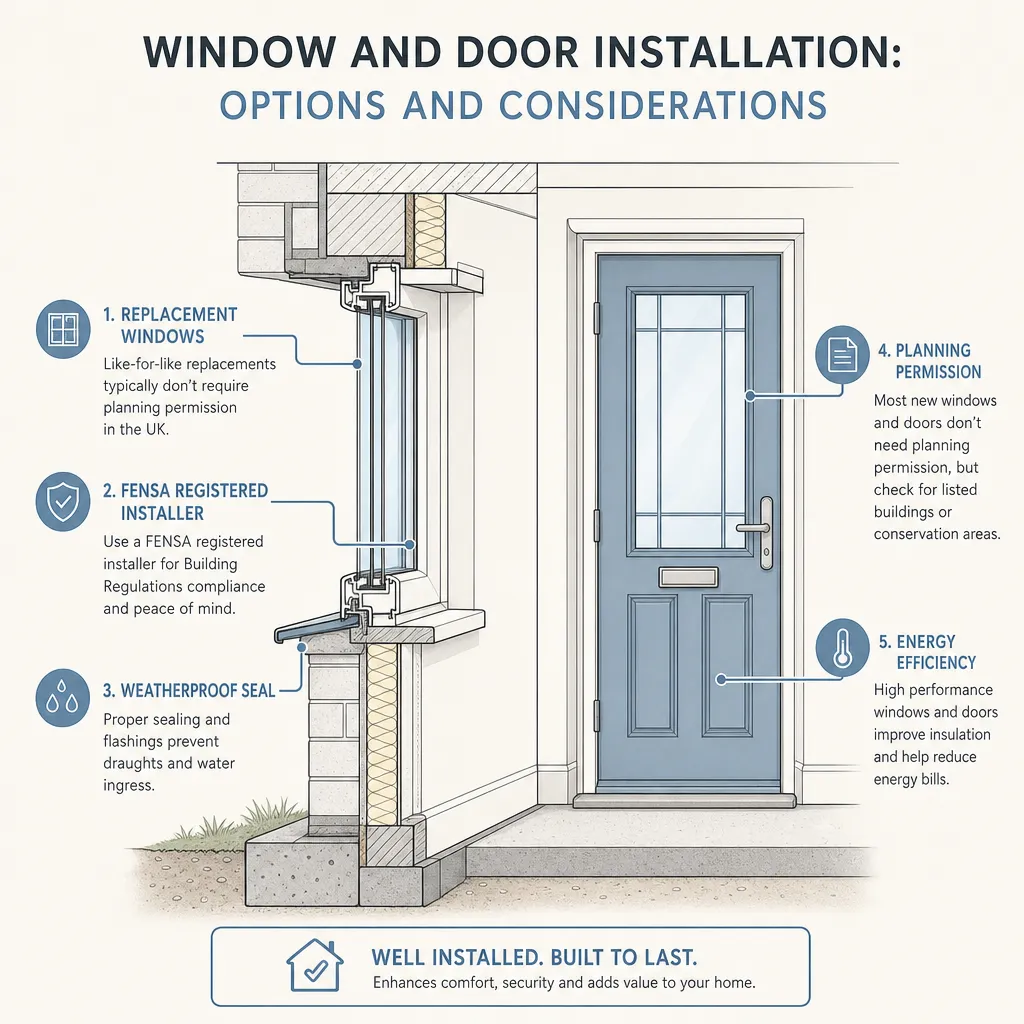
Window and Door Installation: Options and Considerations
Replacing windows and external doors in the UK requires compliance with Building Regulations Part L (thermal performance) and Part K (safety glazing).
 Improvement & Build
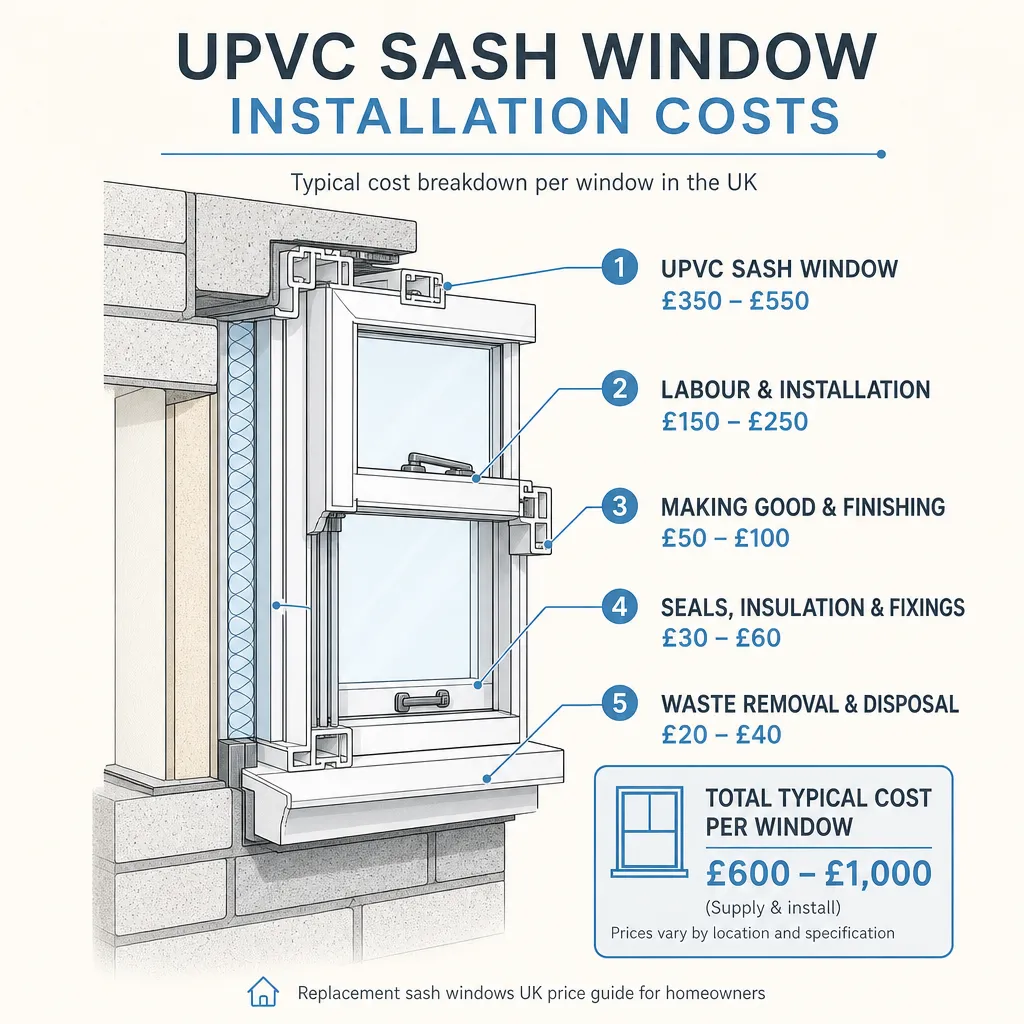
UPVC Sash Window Installation Costs
UPVC sash windows typically cost between £400 and £1,200 per window installed in the UK, depending on size, glazing specification, and access.
 Improvement & Build
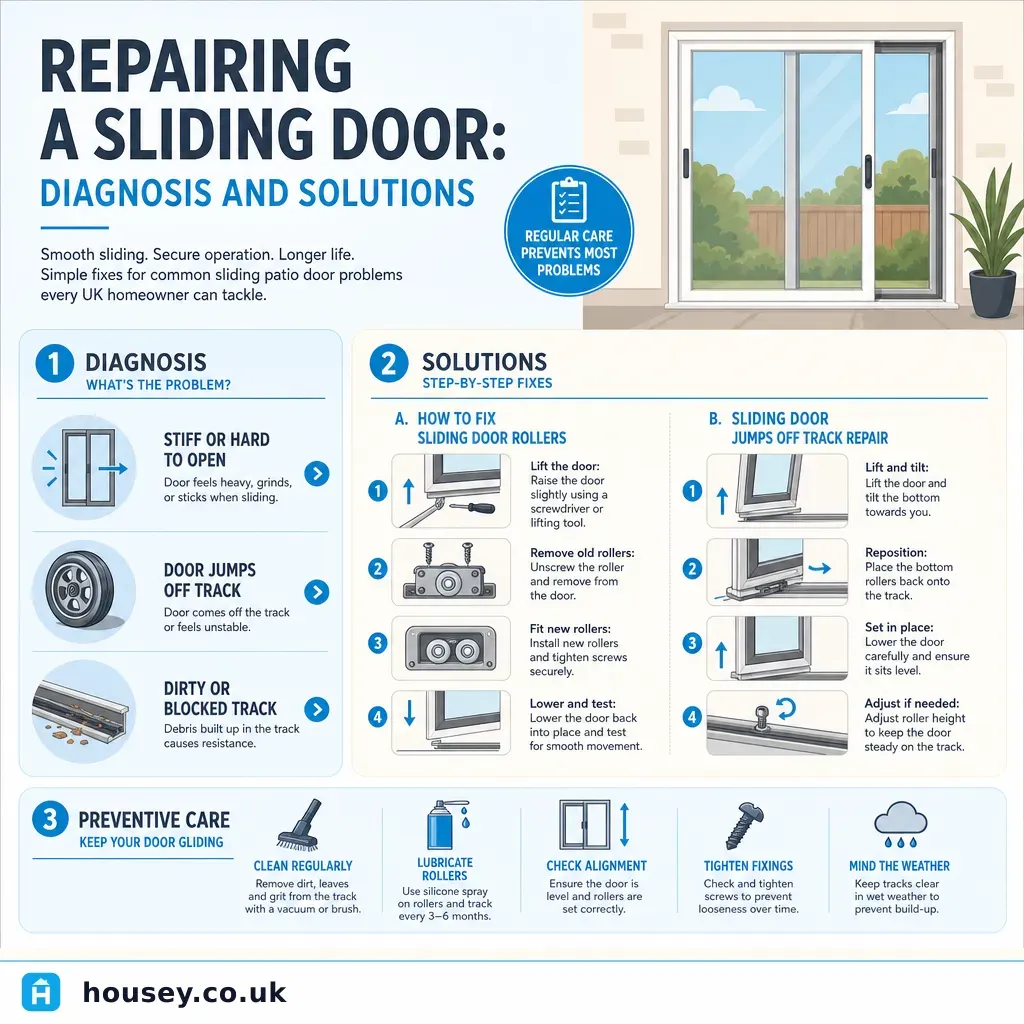
Repairing a Sliding Door: Diagnosis and Solutions
Most sliding door problems — stiffness, jumping off track, or draughts — are caused by dirty tracks, worn rollers, or misaligned guides.
 Improvement & Build
Door Options and Installation: Enhancing Security, Style, and Energy Performance
Choosing a new external door involves balancing security ratings, thermal performance, and style.
 Improvement & Build
Repairing Failed Window Seals and Condensation Issues
Condensation between double-glazed panes means the hermetic seal on the insulated glass unit has failed.