Composite Stable Doors: A Buyer's Guide to Selection and Installation
By Housey · Last reviewed 11th of May 2026
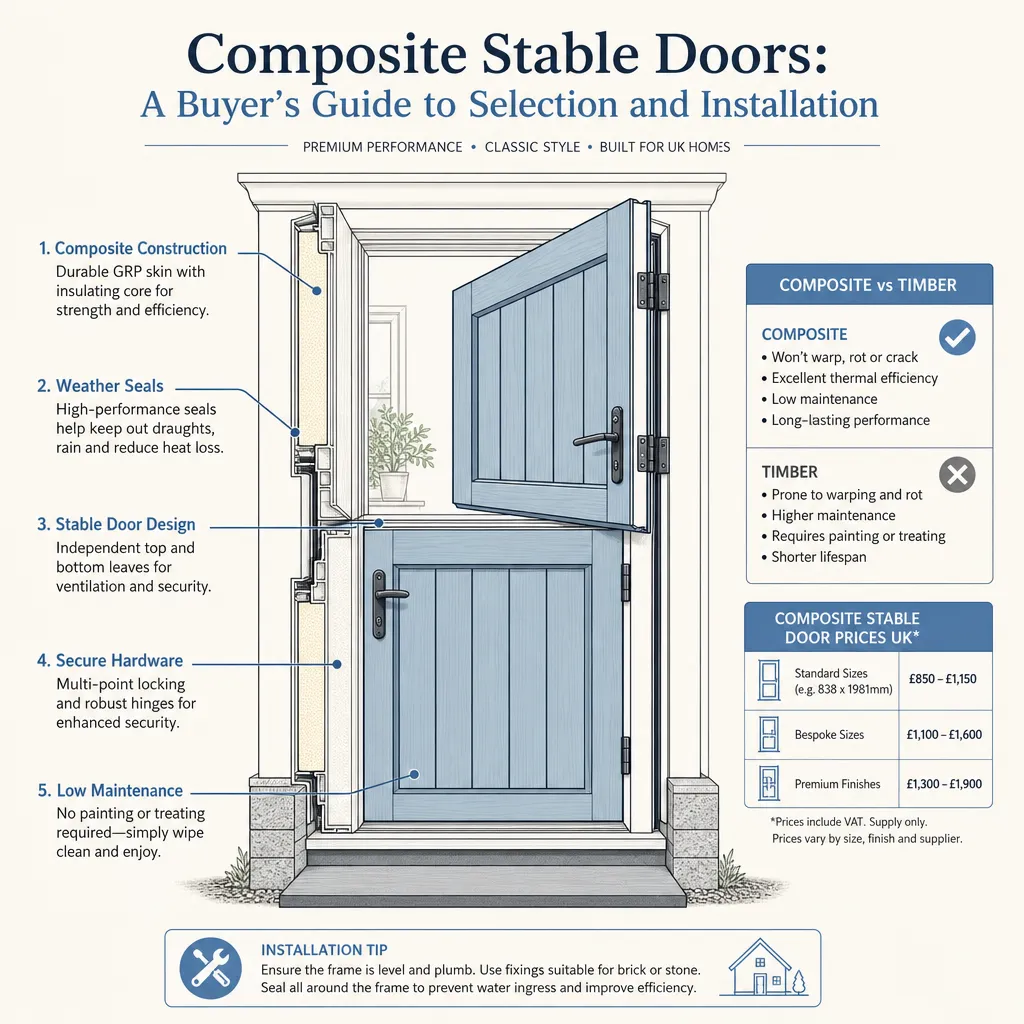
Composite Stable Doors: A Buyer's Guide to Selection and Installation
Stable doors have enjoyed a sustained resurgence in UK homes, from traditional country cottages to modern kitchen extensions opening onto rear gardens. The split-door design—allowing the top half to open independently of the bottom—offers ventilation and light while keeping children and pets safely inside. Today, the majority of stable doors sold in the UK are composite: an engineered construction that combines a solid foam or timber core with GRP (glass-reinforced plastic) outer skins, offering improved thermal performance and low maintenance compared with traditional timber. Selecting the right composite stable door means balancing thermal efficiency, security ratings, style, and installation requirements—and understanding when FENSA certification applies.
Key points
- Most composite stable doors achieve a doorset U-value of 1.4–1.8 W/m²K; higher-specification models with triple-glazed upper panels can reach below 1.2 W/m²K, meeting or exceeding Building Regulations Part L requirements for replacement doors in England.
- Replacing an external door in England requires either a FENSA-registered or CERTASS-registered installer (who self-certifies compliance and issues a certificate) or a local authority building regulations application—the certificate is required evidence on sale.
- Composite stable doors in a listed building or a property in a conservation area may require planning permission or listed building consent before installation; check with your local planning authority before ordering.
- Look for doors tested to PAS 24:2022 (enhanced security performance requirements) or carrying Secured by Design accreditation for police-preferred security standards.
- The centre bolt mechanism locking both halves together when closed is a critical security and weathertight component—ensure any door set includes a quality multipoint locking system on both leaves and a robust centre bolt.
Composite vs timber vs uPVC: which is right for you?
Option | Best for | Not ideal for | Maintenance | Indicative supply and fit cost | Security potential |
|---|---|---|---|---|---|
Composite (GRP skin) | Most UK homes; low-maintenance priority | Very period-specific listed properties | Minimal: wipe-clean, no repainting | £1,500–£3,500 | High (PAS 24 available) |
Timber (hardwood) | Listed buildings, conservation areas, period character | Budget-conscious buyers; high-rainfall areas without shelter | High: annual painting or oiling | £2,000–£5,000+ | High if correctly specified |
uPVC | Budget replacement; low maintenance | Heritage settings; premium aesthetics | Low: wipe-clean | £700–£1,800 | Moderate to high |
Indicative UK costs (supply and fit, single door set), last reviewed 2026-05-11. Prices vary by region, specification, and installer. Always obtain at least two quotes.
How composite stable doors are constructed
A composite door is an engineered assembly, not a single material. The main components are:
- Core: High-density polyurethane foam (most common, best thermal insulation) or a solid laminated veneer lumber (LVL) core (higher strength, more traditional feel under the skin).
- Outer skins: GRP or ABS thermoplastic, moulded to replicate timber grain or smooth contemporary finishes. GRP is more durable and scratch-resistant.
- Frame: Most composite stable doors arrive with a uPVC or timber sub-frame. The frame specification affects both thermal performance and longevity.
- Glazing unit (upper leaf): Double or triple-glazed panels in a range of styles—clear, obscure, or decorative leaded. The glazing U-value forms part of the overall doorset performance figure.
- Hardware: Multipoint locking system, centre bolt, hinges, handle set, and letterbox if specified.
The rebated split line between upper and lower leaves has a factory-fitted weatherseal to prevent draughts and rain ingress when both halves are closed. This junction is a key quality indicator—ask manufacturers whether the seal is field-replaceable and what the expected service interval is.
Style and colour selection
Composite stable doors are available in a wide range of RAL and BS colour matches. Popular choices in UK homes include:
- Anthracite grey (RAL 7016): suits contemporary and modern farmhouse settings.
- Racing green or heritage green: a classic choice for rural and period properties.
- Cream or Chartwell green: common in traditional settings, often replacing painted timber originals.
- Black (RAL 9005): suits Victorian, Georgian, and modern high-contrast schemes.
- French grey or slate: increasingly popular in Scandi-influenced kitchen and utility settings.
Many manufacturers allow the inner and outer faces to be specified in different colours—useful if you want a contemporary exterior tone and a warmer interior finish that complements the kitchen.
Buyer's checklist: what to look for
What to ask before accepting a quote
- What U-value will the complete doorset achieve, and will it meet Part L of the Building Regulations?
- Is the door tested to PAS 24:2022, and does it carry Secured by Design accreditation?
- Are you FENSA-registered or CERTASS-registered, and will you provide a certificate after installation?
- What does the guarantee cover, and who honours it if the installer ceases trading?
- Is the frame included in the quoted price, or will the existing sub-frame be reused?
- What happens if the opening is out of square or the floor level is uneven?
- Is VAT included in the quoted price?
- What is the process if a panel, seal, or hardware item fails within the guarantee period?
Installation: what to expect
Most composite stable doors are installed as a complete door set—door, frame, and hardware pre-assembled or ready to assemble on site. A like-for-like replacement typically takes 3–5 hours. The installer should:
- Remove and dispose of the existing door and frame (confirm disposal is included in the quote).
- Check the opening for square, level, and plumb; adjust reveals if out of true.
- Fit the new frame, packed and sealed as required.
- Hang and adjust both door leaves for smooth, rattle-free operation.
- Test all locking points, the centre bolt, and the weatherseals.
- Apply external sealant around the frame perimeter.
- Provide the FENSA or CERTASS certificate and any manufacturer documentation.
If the work involves a new or enlarged opening rather than a like-for-like replacement, and the property is in a conservation area, planning permission may be required. Check with your local planning authority before ordering.
When to get professional help
Installing a composite stable door is not a suitable DIY task—composite door sets are heavy, and precise frame setting is critical for security, weathertightness, and long-term operation. Always use:
- A FENSA-registered or CERTASS-registered installer for any replacement external door set.
- A company that can evidence PAS 24:2022 testing if security performance matters.
- A listed building or heritage specialist if the property is listed or in a conservation area with specific restrictions.
If the opening requires structural alteration—widening, heightening, or partial wall removal—engage a structural engineer before instructing any door supplier.
How Housey can help
Housey can connect you with window and door installers who are FENSA-registered and experienced with composite stable door installations across the UK. Request quotes from vetted local installers and compare options before committing to a supplier.
Frequently asked questions
Do composite stable doors need FENSA certification?
If you are replacing an existing external door in England or Wales, the installation must comply with Building Regulations Part L (energy efficiency) and Part N (glazing safety). This can be achieved using a FENSA-registered or CERTASS-registered installer who self-certifies and issues a certificate, or by submitting a building regulations application to your local authority. The certificate is important evidence when you come to sell the property.
How energy-efficient are composite stable doors?
Most composite stable doors achieve a doorset U-value of 1.4 to 1.8 W/m²K depending on core material, frame specification, and glazing. Building Regulations Part L (2022) in England requires replacement doors to achieve no worse than 1.4 W/m²K for the complete doorset. Higher-specification models with triple-glazed upper panels can reach below 1.2 W/m²K. Always ask for the full doorset U-value, not just the slab figure.
Can composite stable doors be fitted to any opening?
Most composite stable doors are manufactured to order within a range of standard and bespoke sizes. Non-standard openings can usually be accommodated, though at higher cost and with longer lead times. If the opening needs structural alteration to fit a wider or taller door, a lintel assessment may be required. Consult a structural engineer or a builder experienced in opening-up works before ordering in that scenario.
How long do composite stable doors last?
Most reputable manufacturers offer 10-year guarantees on composite door slabs and hardware. The GRP skin is fade-resistant and does not require repainting. Weatherseals at the split line may need replacing after 10–15 years. A well-specified, correctly installed composite stable door can reasonably be expected to remain serviceable for 25–35 years with minimal maintenance beyond occasional cleaning.
Sources and further reading
- Approved Document L: conservation of fuel and power — GOV.UK
- FENSA glazing compliance scheme — FENSA
- Secured by Design door security guidance — Police CPI / Secured by Design
- Conserving and enhancing the historic environment — GOV.UK / Historic England
Useful next reads
 Improvement & Build
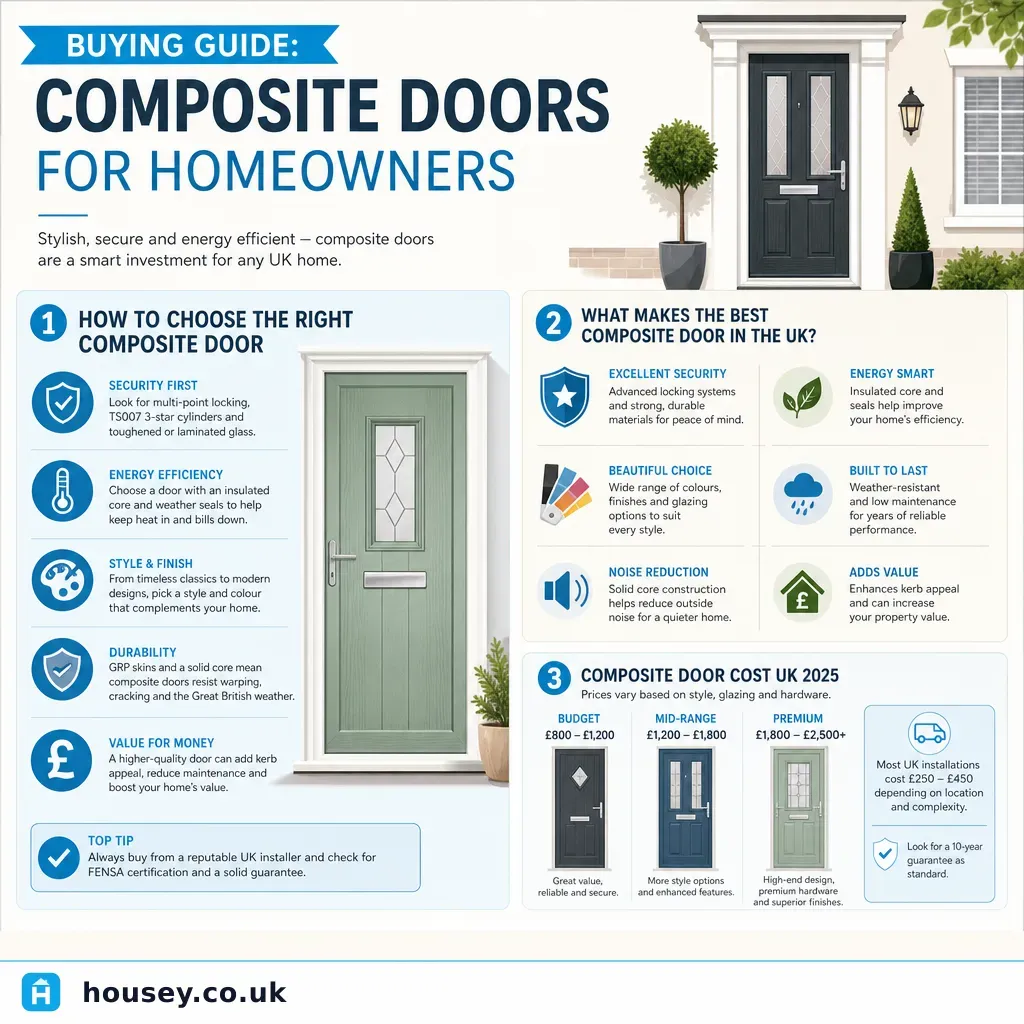
Buying guide: composite doors for homeowners
A composite door is a multi-layer product with a glass reinforced plastic outer skin, solid foam core, and multipoint locking as standard.
 Improvement & Build
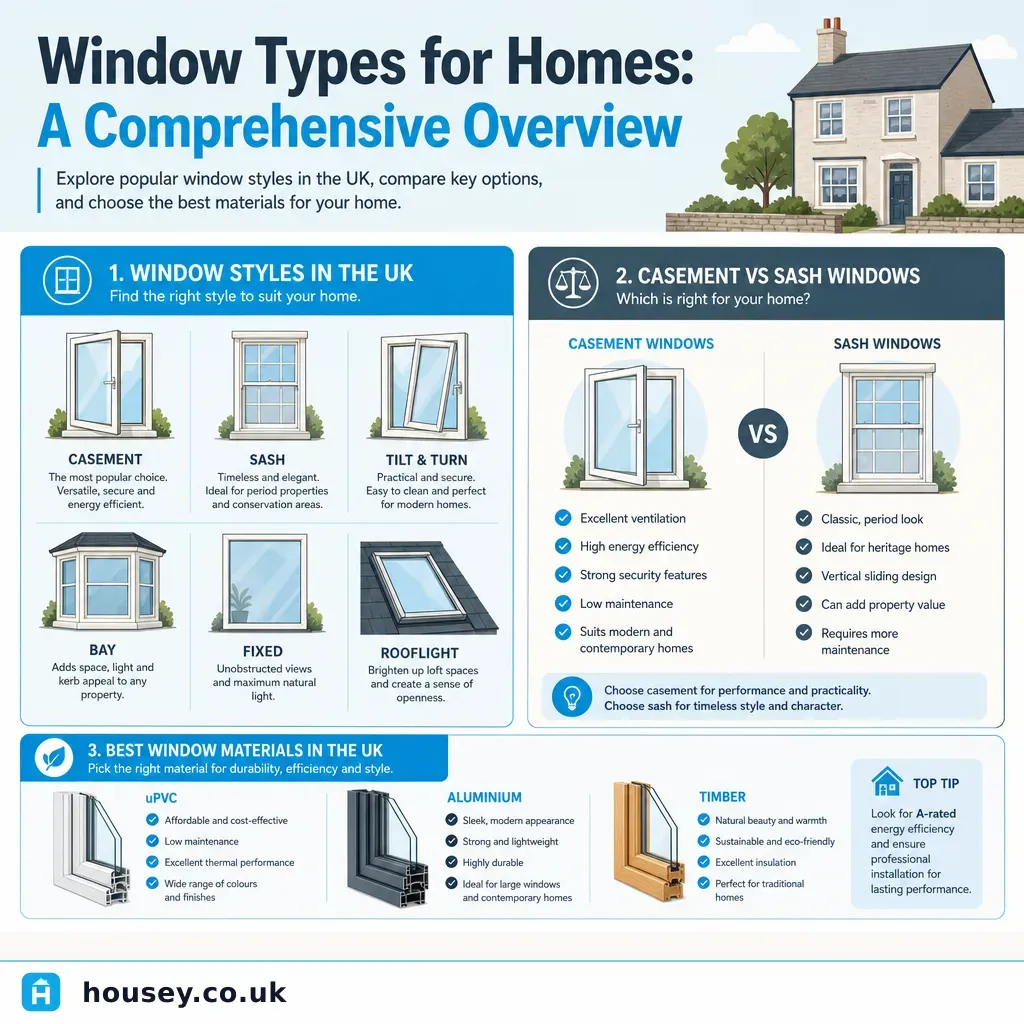
Window Types for Homes: A Comprehensive Overview
UK homes use several main window styles: casement (outward-swinging), sash (vertically sliding), tilt-and-turn, fixed light, and bay or bow.
 Improvement & Build
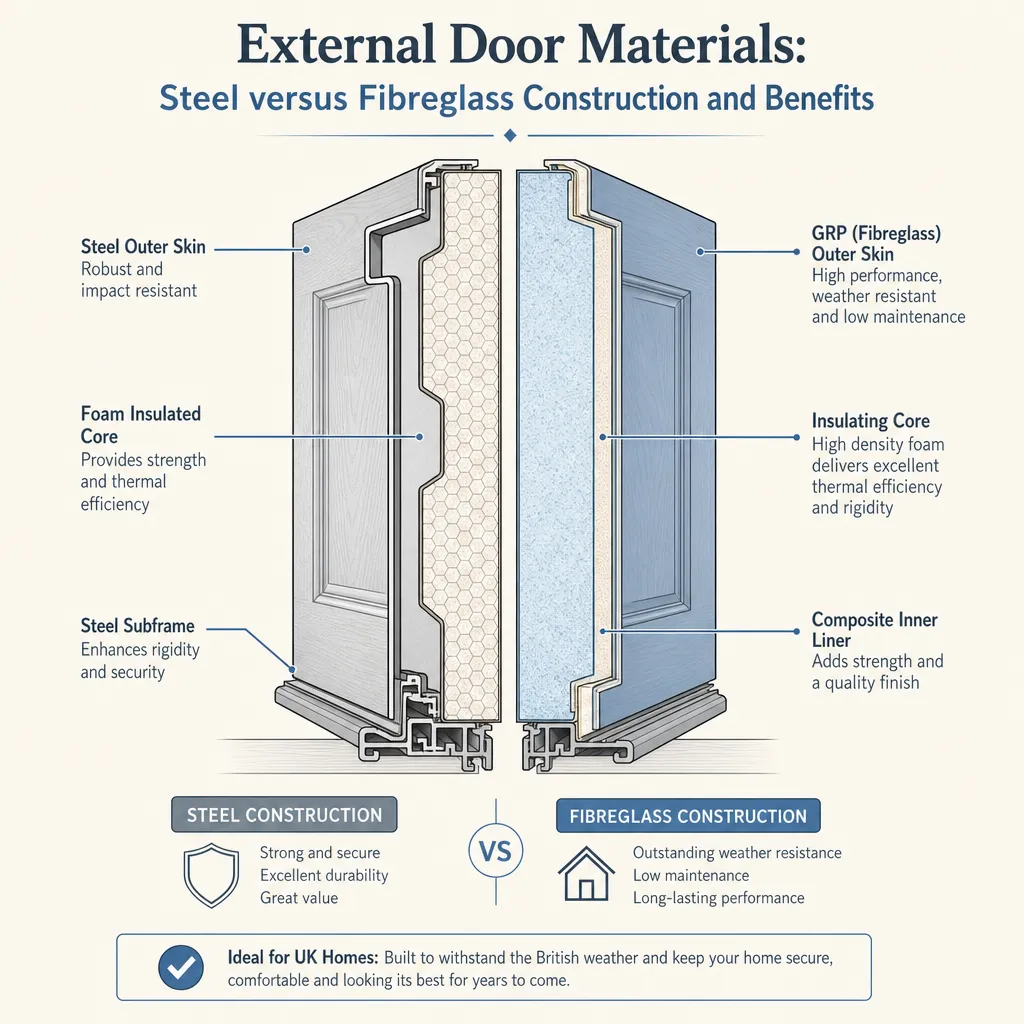
External Door Materials: Steel versus Fibreglass Construction and Benefits
Steel external doors use a cold-rolled steel skin over a foam-filled frame and offer high rigidity and security.
 Improvement & Build
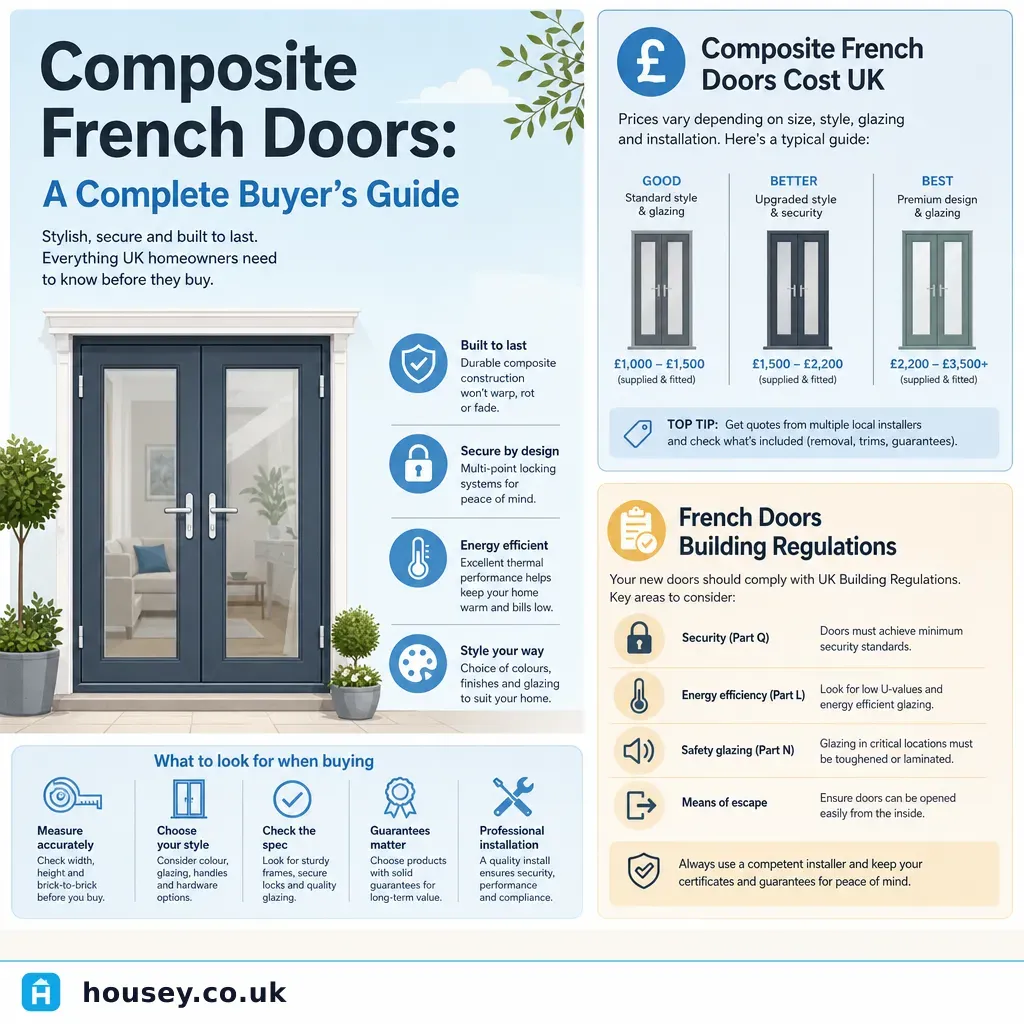
Composite French Doors: A Complete Buyer's Guide
Composite French doors combine a GRP or timber-effect outer skin with a solid insulated core, offering durability and low maintenance suited to UK weather.
 Improvement & Build
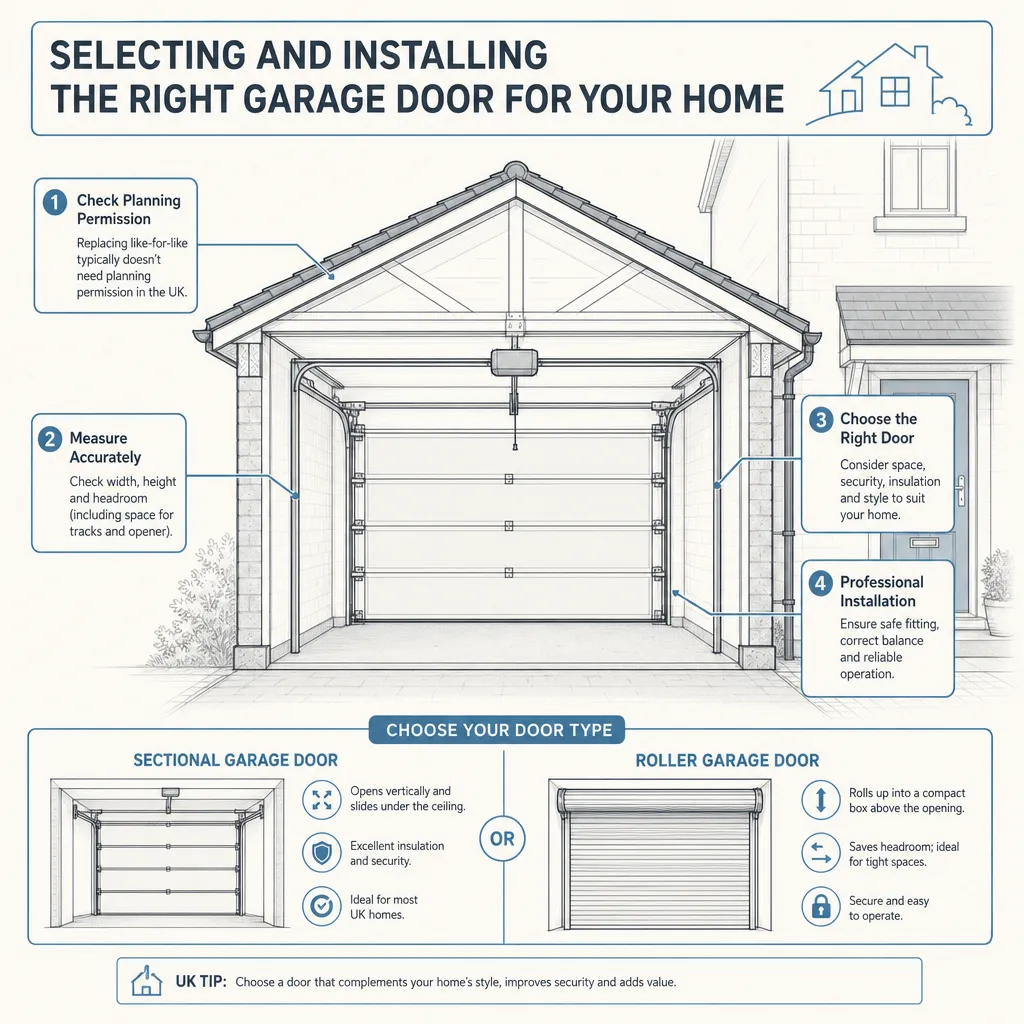
Selecting and Installing the Right Garage Door for Your Home
Choosing the right garage door depends on available headroom, opening width, security needs, and budget.