Selecting and Installing the Right Garage Door for Your Home
By Housey · Last reviewed 8th of May 2026
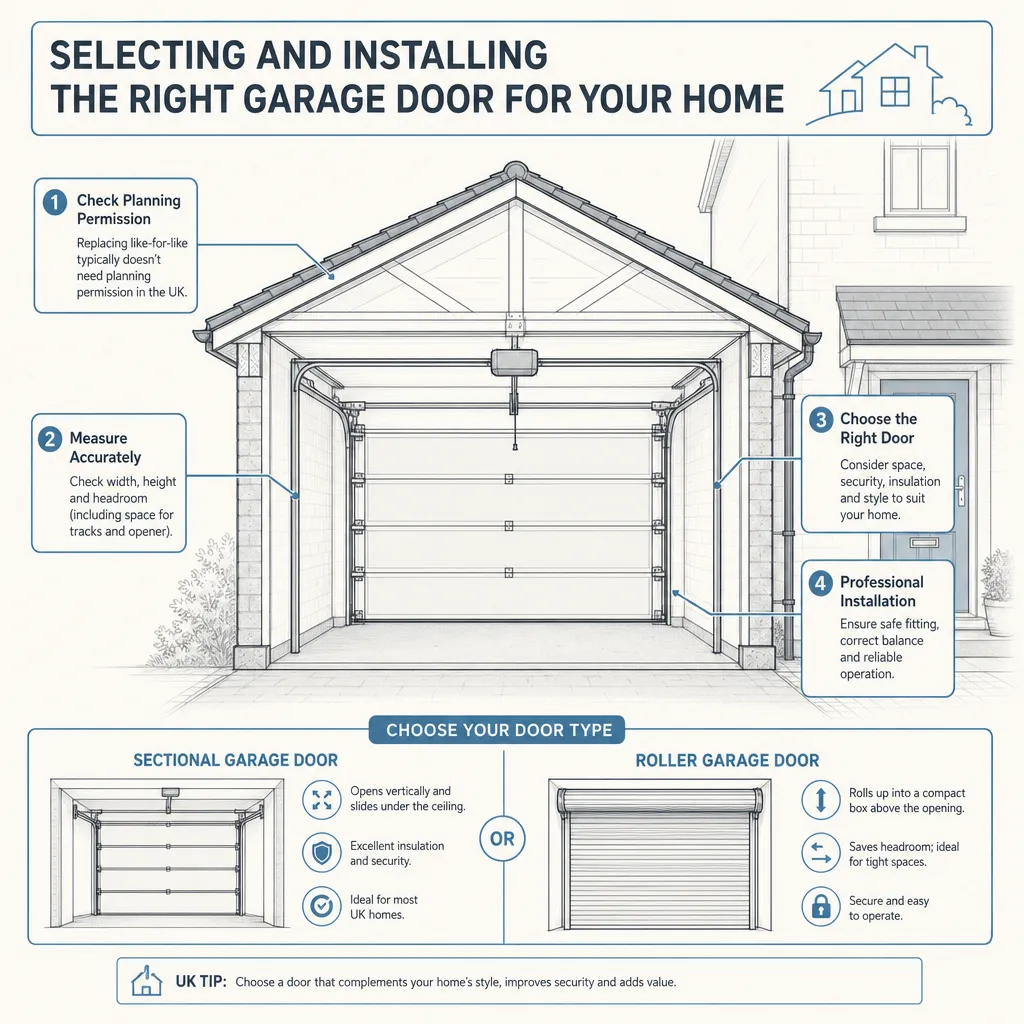
Selecting and Installing the Right Garage Door for Your Home
Replacing or upgrading a garage door affects kerb appeal, home security, and daily convenience simultaneously — yet the decision is more nuanced than most homeowners expect. The mechanism, material, and security specification all interact with the specific dimensions and structural constraints of the opening. Getting the wrong combination can mean a door that fouls on the ceiling, a motor incompatible with the door's weight, or a product that falls short of current UK security standards.
Key points
- PAS 24:2022 is the UK security performance standard for externally accessible domestic garage doors; doors certified to this standard offer enhanced resistance to physical attack and are endorsed by the Secured by Design scheme.
- Headroom above the opening is the primary physical constraint: canopy up-and-over doors need 200–250mm; sectional doors need 80–100mm; roller doors need as little as 50mm.
- Replacing a garage door on a like-for-like basis is generally permitted development in England and does not require planning permission under Schedule 2, Part 1 of the Town and Country Planning (General Permitted Development) (England) Order 2015.
- Electric operators must comply with EN 12453, which requires anti-entrapment sensors and automatic reverse functionality as standard.
- Building Regulations Approved Document L applies where a replacement door forms part of the thermal envelope of an integral (attached) garage; a maximum U-value of 1.6 W/m²K is required for that element.
Choosing the right door type
The five main residential garage door mechanisms each suit different property configurations and usage patterns.
Door type | Mechanism | Headroom needed | Best for | Main limitation |
|---|---|---|---|---|
Up-and-over (canopy) | Single panel pivots up; one third protrudes outside | 200–250mm | Low-cost standard openings | Cannot be automated; panel obstructs driveway entry |
Up-and-over (retractable) | Single panel lifts fully inside the garage | 250–300mm | Standard openings with automation | Most headroom required of all panel types |
Sectional (vertical lift) | Horizontal sections stack above the opening | 80–100mm | Double garages; limited headroom | Higher cost; structural track required |
Roller | Door coils into a compact box above the opening | 50mm | Maximum driveway space; tight headroom | Internal box visible; wide openings need heavier motor |
Side-hinged | Two leaves open outward | Minimal | Frequent pedestrian access; workshop use | Requires clear front space; full-width vehicle entry only with both leaves open |
Which door type should you choose?
- Choose a roller door if headroom is less than 200mm or you need to park immediately in front of the door as it opens — it retracts into the smallest footprint of any mechanism.
- Choose a sectional door if you want automation and good thermal performance with limited headroom, or if the opening is double-width.
- Choose a retractable up-and-over door if you want a reliable automated solution at a moderate price point and have at least 250mm of clear headroom.
- Choose a side-hinged door if the garage is used frequently on foot — as a workshop, storage room, or cycle store — and full-width vehicle access is secondary.
- Ask a specialist installer if the opening is non-standard (arched, unusually wide, or within a listed building), or if the lintel above shows signs of cracking or movement that should be assessed before fitting.
Materials and insulation
Steel is the most widely used material in UK residential garage doors — durable, low-maintenance, and available in a broad range of finishes. Galvanised steel with polyester powder-coat finish resists rust and fading well in the UK climate.
GRP (glass-reinforced plastic) offers a realistic timber-grain appearance without the maintenance requirement of real wood. It does not warp, rot, or require periodic treatment, making it a practical choice for period-style homes.
Timber suits heritage properties and conservation areas but requires oiling or painting every 2–3 years to prevent warping and rot. Solid hardwood doors are heavier, which affects automation motor selection.
Aluminium is lightweight and fully rust-proof — popular for contemporary roller and sectional designs and for coastal locations where salt air accelerates steel corrosion.
Insulation: For integral garages, an insulated door with a polyurethane foam core (typically 40–45mm thick) reduces heat loss and condensation. A well-specified insulated sectional door can achieve a U-value of around 1.0–1.2 W/m²K, compared with 5.0–6.0 W/m²K for an uninsulated steel panel. Where Approved Document L applies, the replacement element must achieve a minimum U-value of 1.6 W/m²K.
Indicative UK costs, last reviewed 2026-05-08. Supply and installation costs vary significantly by door type, size, material, and automation — obtain at least three comparable quotes.
Security
The Secured by Design scheme, operated by UK Police, endorses garage doors tested to PAS 24:2022. This standard covers physical attack resistance, anti-lift protection, and resistance to manipulation. Multi-point locking and reinforced panels are common features on certified products.
For automated doors, rolling-code encryption in the remote control prevents signal cloning — a method used in vehicle thefts from otherwise secure garages. Verify this technology is included when comparing operators.
Also assess the internal access door between the garage and the house. If it is lightweight or poorly locked, it remains a weak point regardless of the main door's security rating.
Planning permission and building regulations
Planning permission: Like-for-like replacement is permitted development in England for most properties. Check with your local planning authority if the property is listed, in a conservation area, or subject to an Article 4 direction, as permitted development rights may be removed. Equivalent rules in Scotland, Wales, and Northern Ireland differ — check with the relevant authority.
Building regulations: A straightforward like-for-like replacement does not normally require building control notification. If the garage is integral to the dwelling and the replacement door forms part of the insulated envelope, Approved Document L U-value requirements apply. If the opening is being widened or the lintel altered, building control notification and inspection are required. A new or upgraded electrical circuit for the motor must be installed or certified by a Part P-registered electrician.
What to ask before accepting a quote
- Is installation included, and who carries it out? What trade accreditation does the installer hold?
- Is the existing lintel adequate for the new door's weight and mechanism, or does it need assessing or replacing?
- What is the warranty on the door panel and the electric operator separately?
- Are the safety sensors compliant with EN 12453? How is the anti-entrapment system tested?
- Does the door or locking system hold a PAS 24:2022 or Secured by Design certification?
- Is VAT included in the quoted price?
- What could change the price after survey — lintel work, a new electrical supply, or disposal of the old door?
When to get professional help
A competent DIYer can manage a basic canopy up-and-over or side-hinged replacement in a sound, standard-dimension opening. For all other types, or where any of the following apply, use a specialist installer:
- The lintel is cracked, deflecting, or shows movement — inspect and rectify before hanging a new door
- The opening requires widening or structural alteration
- A new or upgraded electrical supply is needed — requires a Part P-registered electrician
- The property is listed or in a conservation area
- The opening dimensions are non-standard and require made-to-measure manufacture
How Housey can help
If your garage door project is part of a broader improvement — a garage conversion, extension, or structural work to the opening — Housey can connect you with vetted local extension builders who can advise on structural openings, coordinate trades, and manage building control applications. Use Housey to compare quotes from local specialists.
Frequently asked questions
Do I need planning permission to replace a garage door in the UK?
In most cases, no. Replacing a garage door on a like-for-like basis is permitted development in England under the Town and Country Planning (General Permitted Development) (England) Order 2015. Exceptions apply to listed buildings, conservation areas, and Article 4 direction areas. Always confirm with your local planning authority if you are unsure, particularly if the design or materials are changing significantly.
Can I automate an existing garage door?
Many retractable up-and-over doors can be retrofitted with an automation kit. Canopy-type and side-hinged doors are more difficult to automate reliably. Sectional and roller doors are designed with automation in mind and are the most straightforward to motorise. Any operator fitted must comply with EN 12453 and include functioning anti-entrapment sensors with auto-reverse capability.
How long does a garage door installation typically take?
A straightforward supply-and-fit of a standard single garage door with a pre-existing electrical supply usually takes a half day to a full day for an experienced installer. Jobs requiring new electrical circuits, structural work to the lintel, or made-to-measure manufacture may take two days or more across multiple visits.
What is the difference between a canopy and a retractable up-and-over garage door?
A canopy door pivots from two side arms so approximately one third protrudes forward when open; it cannot be automated. A retractable door uses a parallel-arm mechanism to carry the panel fully inside the garage, making it compatible with electric operators and clearing the driveway completely. Retractable doors cost slightly more but offer significantly more versatility.
Sources and further reading
- Secured by Design: Garage door guidance and product searches — Secured by Design (UK Police)
- Planning Portal: Permitted development for garage alterations — Planning Portal
- Building Regulations Approved Document L: Conservation of fuel and power — GOV.UK / MHCLG
- Door and Hardware Federation: Consumer guidance on garage doors — Door and Hardware Federation
Useful next reads
 Improvement & Build
Garage Door Opener Installation and Repair
A garage door opener automates raising and lowering a garage door via an electric motor, drive rail, and remote or keypad control.
 Improvement & Build
Garage Door Installation and Repair: A UK Homeowner's Guide
Garage doors in the UK come in five main types — up-and-over, roller, sectional, side-hinged, and canopy variants.
 Improvement & Build
Aluminium Windows: Benefits, Specifications, and Installation Costs
Aluminium windows typically cost £600–£1,800 per window installed in the UK, depending on size and specification.
 Improvement & Build
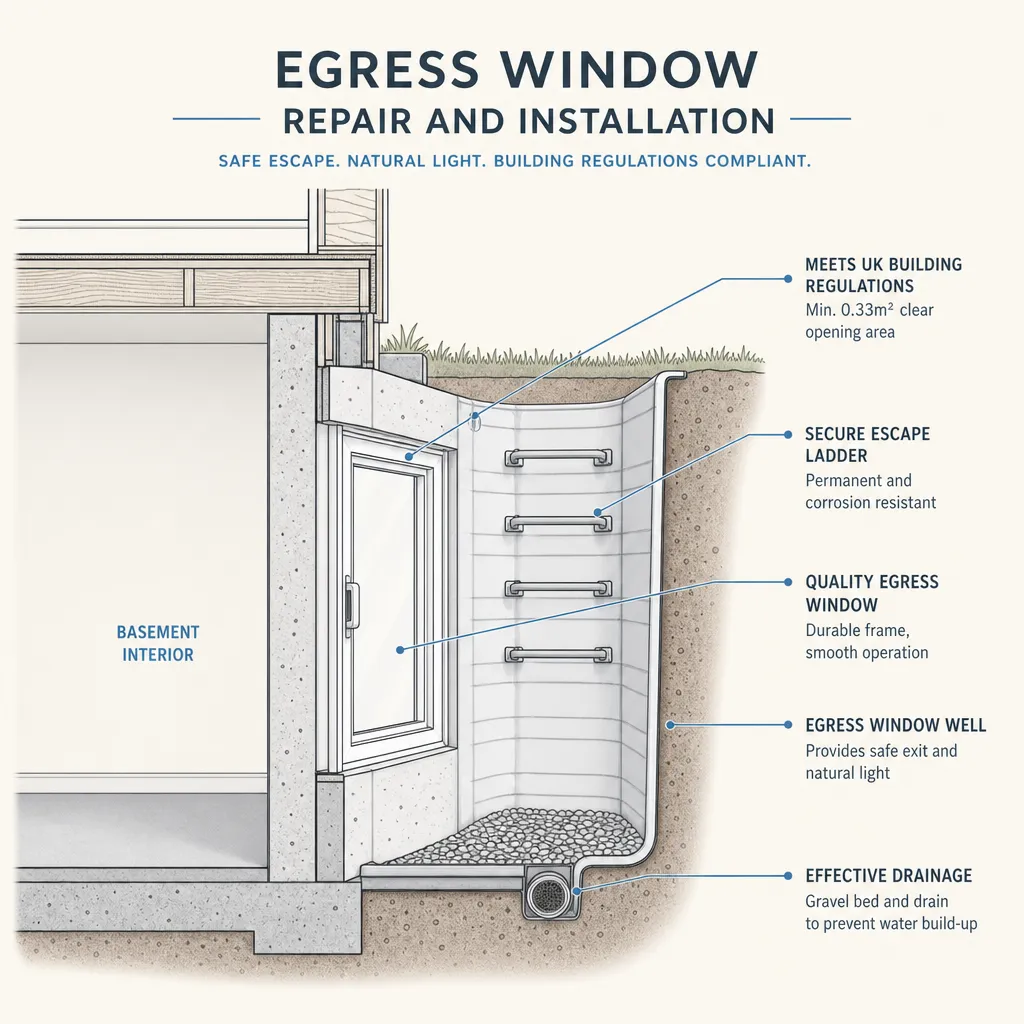
Egress Window Repair and Installation
An egress window is a window large enough to serve as an emergency escape route from a habitable room.
 Improvement & Build
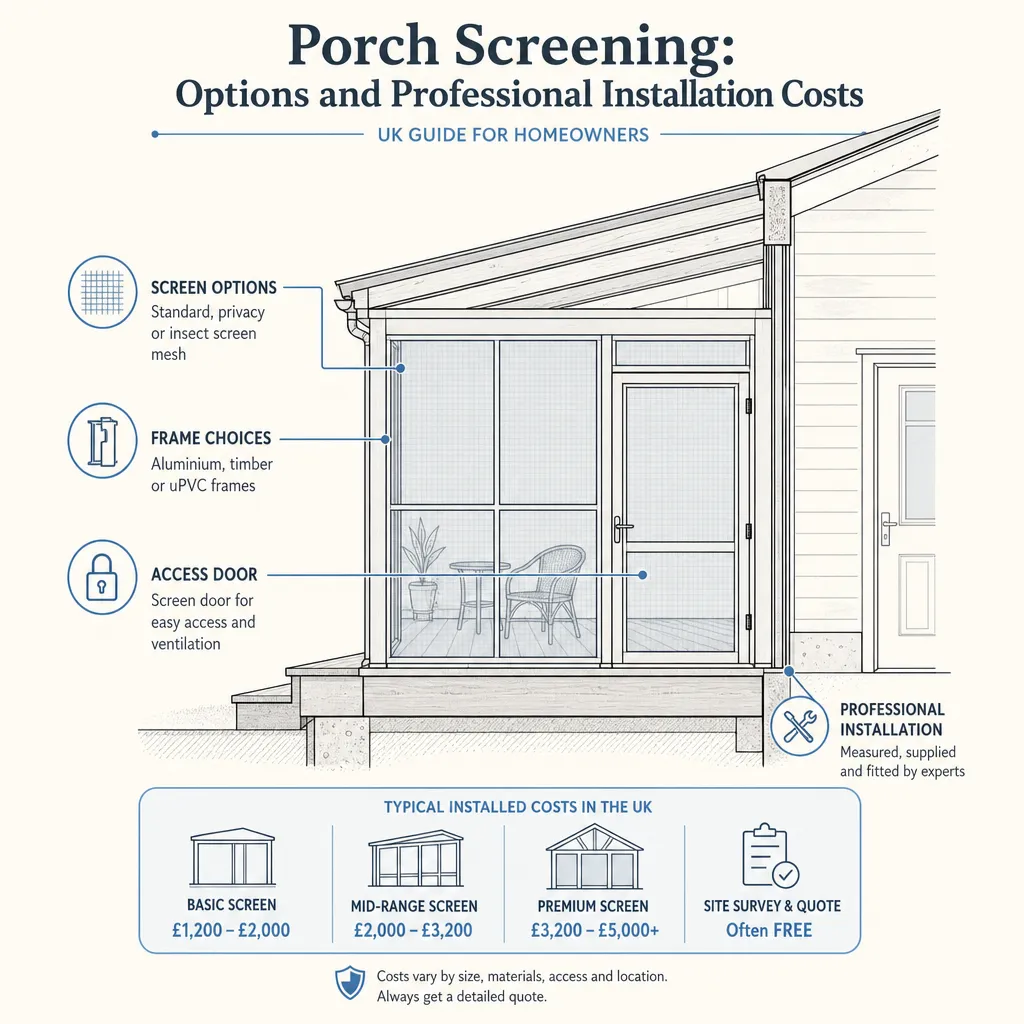
Porch Screening: Options and Professional Installation Costs
Porch screening ranges from simple insect mesh on a timber frame to bespoke aluminium-framed glazed enclosures.