External Door Materials: Steel versus Fibreglass Construction and Benefits
By Housey · Last reviewed 24th of May 2026
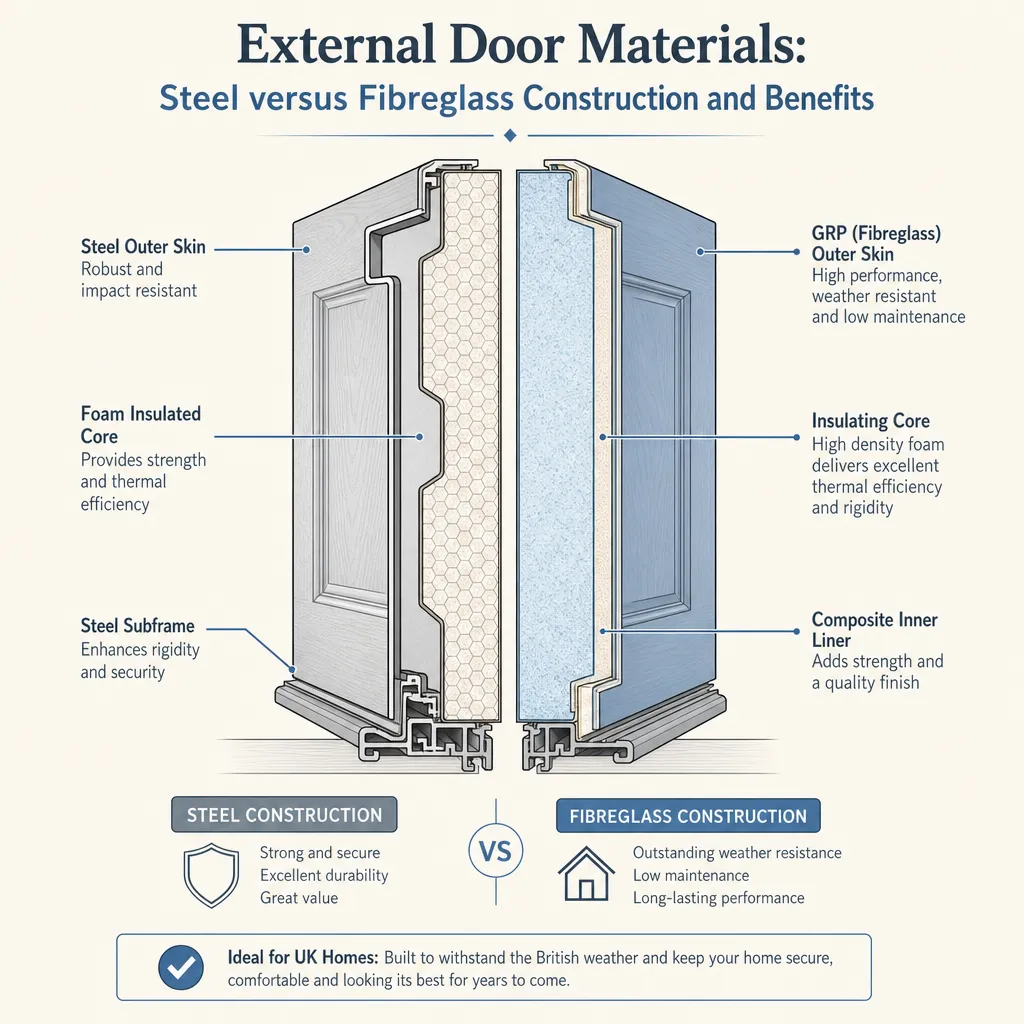
External Door Materials: Steel versus Fibreglass Construction and Benefits
An external door's material is one of the most consequential choices in a home improvement or renovation project — shaping security, thermal efficiency, maintenance requirements, and how the property presents from the street. Steel and fibreglass (glass-reinforced plastic, or GRP) are two of the most durable options available to UK homeowners, and they are made in fundamentally different ways that affect how they perform over decades of use. Understanding those construction differences helps you match the right material to your property type and specific requirements.
Key points
- Fibreglass (GRP) door skins are formed by curing glass-fibre matting in a mould, allowing highly accurate wood-grain surface detail that pressed steel cannot replicate — particularly relevant where planning conditions favour a period appearance.
- Steel door skins for domestic use typically range from 0.7 mm to 1.2 mm cold-rolled or galvanised sheet; commercial-grade doors use thicker gauge steel (up to 3 mm) with anti-jemmy reinforcement at hinge and locking zones.
- Both steel and GRP external doors can be supplied as PAS 24:2022-certified doorsets meeting the UK's enhanced security standard for external door assemblies.
- Building Regulations Part L (England) sets a minimum U-value of 1.4 W/m²K for replacement external doors — the doorset U-value (not just the panel) must meet this threshold.
- FENSA or CERTAS self-certification, or a building control completion certificate, is required for all replacement external door installations in England and Wales.
How steel external doors are constructed
A domestic steel external door is built around a square-section hollow steel inner frame with a skin of cold-rolled or galvanised steel sheet pressed or formed to the required profile — flat, smooth, panelled, or wood-grain embossed. Between the frame and skin, a polyurethane foam or polystyrene core provides insulation and rigidity. The outer surface is factory powder-coated in a wide range of RAL colours, or primed for site painting.
A critical construction detail is the thermal break — an insulating strip between the steel outer skin and the inner frame that interrupts the conductive heat pathway. Without a thermal break, steel doors can develop condensation on the inner face in cold weather and will underperform their stated U-value in real-world conditions. Always confirm that a domestic steel door includes a correctly specified thermal break before purchase.
Commercial-grade steel doors add welded construction, thicker gauge steel, anti-crowbar reinforcement at hinge and locking-bolt zones, and multi-point deadlocking as standard. These are rarely necessary for domestic applications but are available from specialist suppliers for high-value properties or environments with specific security requirements.
How fibreglass (GRP) external doors are constructed
Fibreglass external doors are manufactured by laying glass-fibre matting into a mould and applying polyester or vinyl ester resin — a process that cures into a rigid, dimensionally stable panel. Two GRP skins (inner and outer) are bonded to a timber or LVL (laminated veneer lumber) subframe with a polyurethane foam core. The completed door leaf is then fitted with multipoint locking hardware and hinges before being mounted in a PVC-U, timber, or composite frame.
The moulding process is the key to GRP's aesthetic advantage: it can reproduce wood-grain detail, moulded panels, and decorative profiles at a level of accuracy that pressed steel cannot easily match, particularly at mid-range price points. This is why GRP composite doors dominate the UK domestic market for front door replacements on Victorian, Edwardian, and 1930s properties where a traditional appearance is expected or required by the local planning authority.
GRP skins do not rust, warp, or require the same surface maintenance as painted timber. The factory finish on most GRP doors is expected to remain serviceable for 10–15 years before refinishing may be considered, though many manufacturers offer 25-year guarantees on surface colour retention.
Which material suits your property type?
Property type | Steel door considerations | Fibreglass (GRP) door considerations |
|---|---|---|
Victorian or Edwardian terrace | Can look industrial unless carefully specified; conservation area restrictions likely | GRP wood-grain finish often more appropriate; check local planning guidance |
1930s semi-detached | Steel better suited to garage or side-access doors; front door aesthetics may not match | Popular for period-sympathetic front door replacement; wide colour range |
Contemporary extension or new-build | Flush steel panels suit minimalist or industrial aesthetics | GRP achieves contemporary or traditional profiles with lower thermal bridging risk |
Listed building | Unlikely to be approved without specific consent — specialist joinery usually required | Same — always consult the local conservation officer before specifying |
Garage or utility access door | Traditional choice for garages; FD30 fire-rated steel doors widely available | Suitable for external garage doors; less common for internal fire-rated applications |
Coastal or high-exposure location | Requires marine-grade powder coating and stainless hardware to resist salt corrosion | Inherently corrosion-resistant; lower long-term maintenance in coastal settings |
Benefits of steel external doors
- High rigidity: Steel construction resists racking — twisting or distortion under load — better than most alternative door materials.
- Commercial-grade security availability: The highest-specification domestic and commercial security doors in the UK are manufactured in steel, using thick gauge sheet with welded construction and heavy-duty locking.
- Fire door availability: Timber-core, steel-faced FD30 and FD60 fire doors are the standard choice for internal fire-rated applications; GRP equivalents are far less common.
- Entry-level cost for outbuildings: Basic galvanised steel external doors for garages and outbuildings are typically lower cost than equivalent GRP products at the entry level.
Benefits of fibreglass (GRP) external doors
- Inherent corrosion resistance: GRP does not rust regardless of environment, making it the lower-maintenance choice for coastal, humid, or high-rainfall locations.
- Lower thermal conductivity: GRP skins conduct less heat than steel, reducing cold bridging at the door edge and the risk of condensation on interior surfaces in winter.
- Period-sympathetic appearance: High-fidelity moulded wood-grain finishes make GRP the most practical alternative to timber where appearance matters, without timber's ongoing maintenance burden.
- Lighter weight: GRP composite doors are typically lighter than comparable steel doors, reducing structural demands on the frame, hinges, and threshold.
- Dimensional stability: Neither GRP nor steel warps, swells, or shrinks the way solid timber does — a common cause of draught problems and operational difficulty in older wooden front doors.
Document checklist before specifying an external door
Before instructing an installer, confirm the following in writing:
- A copy of the doorset's PAS 24:2022 certificate (if enhanced security is required), confirming the complete assembly — not just the door leaf.
- The tested U-value for the complete doorset, for Building Regulations Part L compliance.
- Confirmation of the installer's FENSA or CERTAS membership, or written confirmation that building control notification will be made.
- Any planning permission or listed building consent if the property is in a conservation area or is listed.
- Written scope of works confirming whether the frame, threshold, cill, and ironmongery are included in the quoted price.
When to get professional help
External door replacement is a job for a competent, accredited installer for most UK homeowners. Seek additional professional advice if:
- The property is listed or in a conservation area — a conservation officer or planning consultant may need to approve the specification before work begins.
- The existing door opening shows structural concerns such as a cracked or deflecting lintel, bowing masonry, or signs of foundation settlement — a structural engineer should assess the opening before replacement.
- You need a fire-rated doorset — fire door installation and certification require a competent person familiar with Approved Document B and BS 9999 requirements.
- You are replacing multiple external doors as part of a wider energy retrofit and need to ensure overall dwelling energy compliance under Part L.
How Housey can help
Housey makes it straightforward to find and compare local, vetted window and door installers who are accredited, experienced with both steel and GRP products, and can advise on the right doorset specification for your property type and any local planning constraints.
Frequently asked questions
Is a fibreglass door stronger than a steel door?
Not in all respects. Commercial-grade steel generally offers higher resistance to cutting and drilling. GRP composite doors resist splitting and warping, and most domestic GRP composite doors meet or exceed standard security requirements under PAS 24:2022. For the highest-security applications — commercial or high-value properties — commercial steel doorsets are typically specified.
What is the difference between a composite door and a GRP door?
Composite door is a broad marketing term for any door made from more than one material. In the UK domestic market, most composite doors have a GRP outer skin over a timber or composite inner frame, so the terms are often used interchangeably. Some composite doors use a steel outer skin — always confirm the outer skin material when the specification matters.
How long do fibreglass external doors last?
Quality GRP composite doors from reputable UK manufacturers typically carry warranties of 10–25 years on the door leaf and surface finish. Practical lifespans of 25–35 years are common with correct installation and annual maintenance of seals, hinges, and locking hardware. The GRP surface itself rarely needs repainting over that period, unlike painted timber alternatives.
Do I need planning permission to install a new front door?
In most cases, replacing a front door like-for-like is permitted development in England. If the property is in a conservation area, is listed, or the new door materially changes the external appearance, you may need planning permission or listed building consent. Always check with your local planning authority before ordering or installing a replacement external door.
Sources and further reading
- Building Regulations Approved Document L — GOV.UK, thermal performance requirements for external doors
- Secured by Design: doors and windows — Secured by Design, police-preferred security specification
- FENSA: self-certification for replacement windows and doors — FENSA
- Planning Portal: permitted development guidance — Planning Portal
- Historic England: guidance on alterations to listed buildings — Historic England
Useful next reads
 Improvement & Build
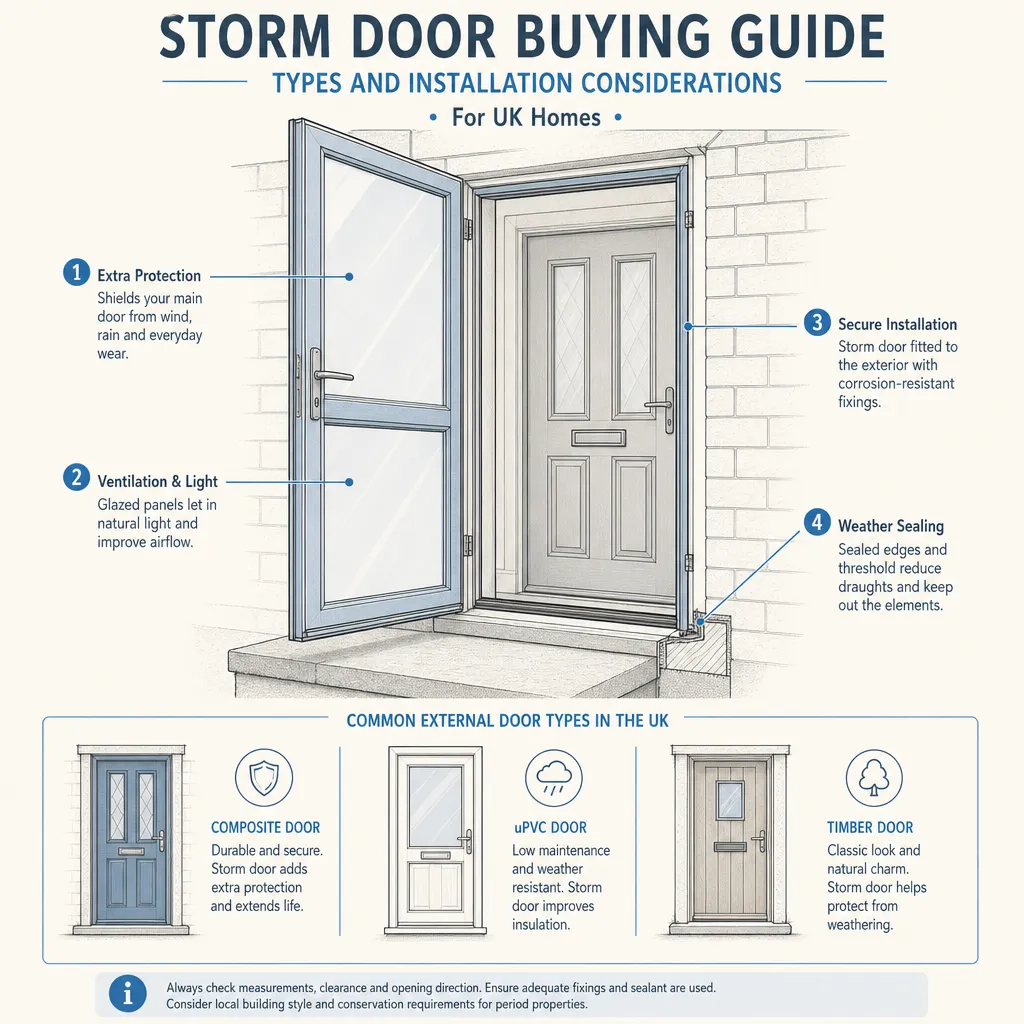
Storm Door Buying Guide: Types and Installation Considerations
In the UK, 'storm door' refers either to a secondary outer door forming a draught lobby in front of the main entrance, or to a robust composite, uPVC, or timber external door with enhanced weather sealing.
 Improvement & Build
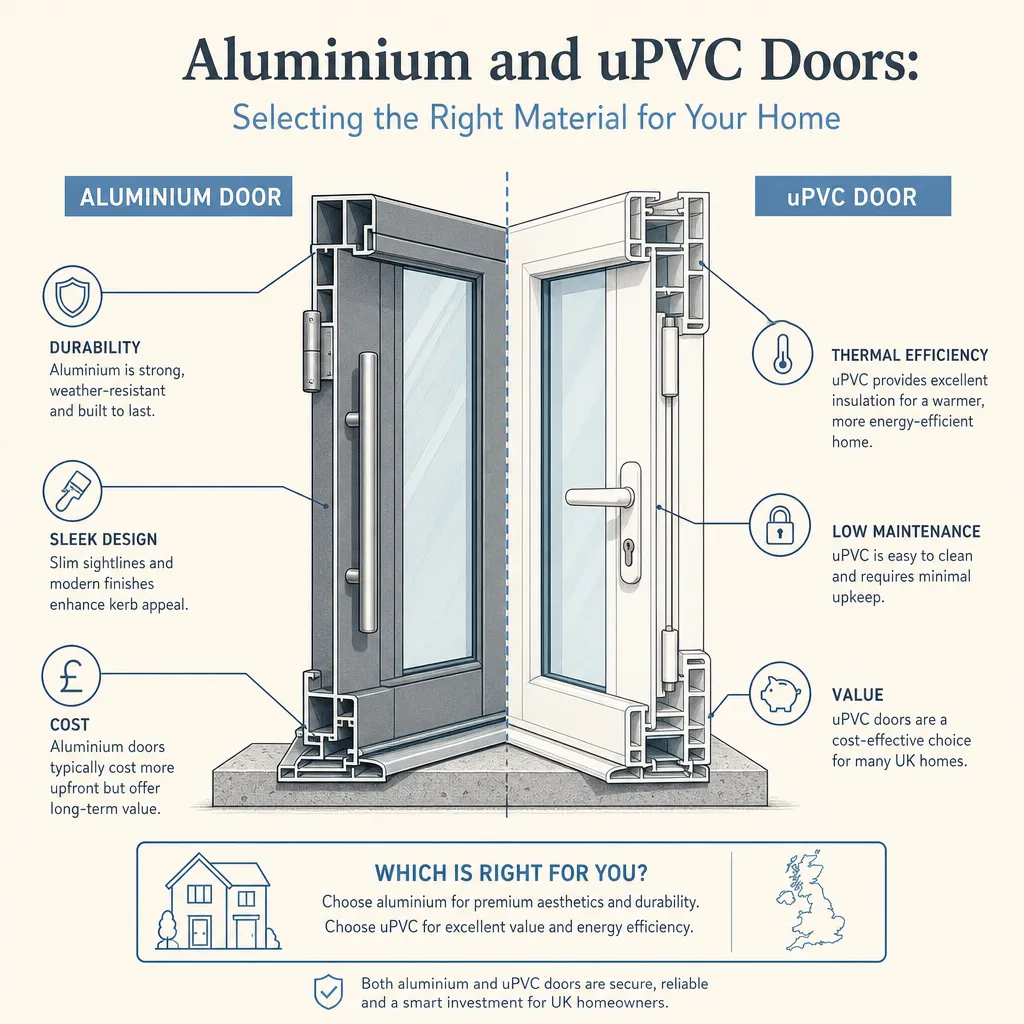
Aluminium and uPVC Doors: Selecting the Right Material for Your Home
uPVC doors are lower-cost and low-maintenance, making them a practical choice for most UK homes.
 Improvement & Build
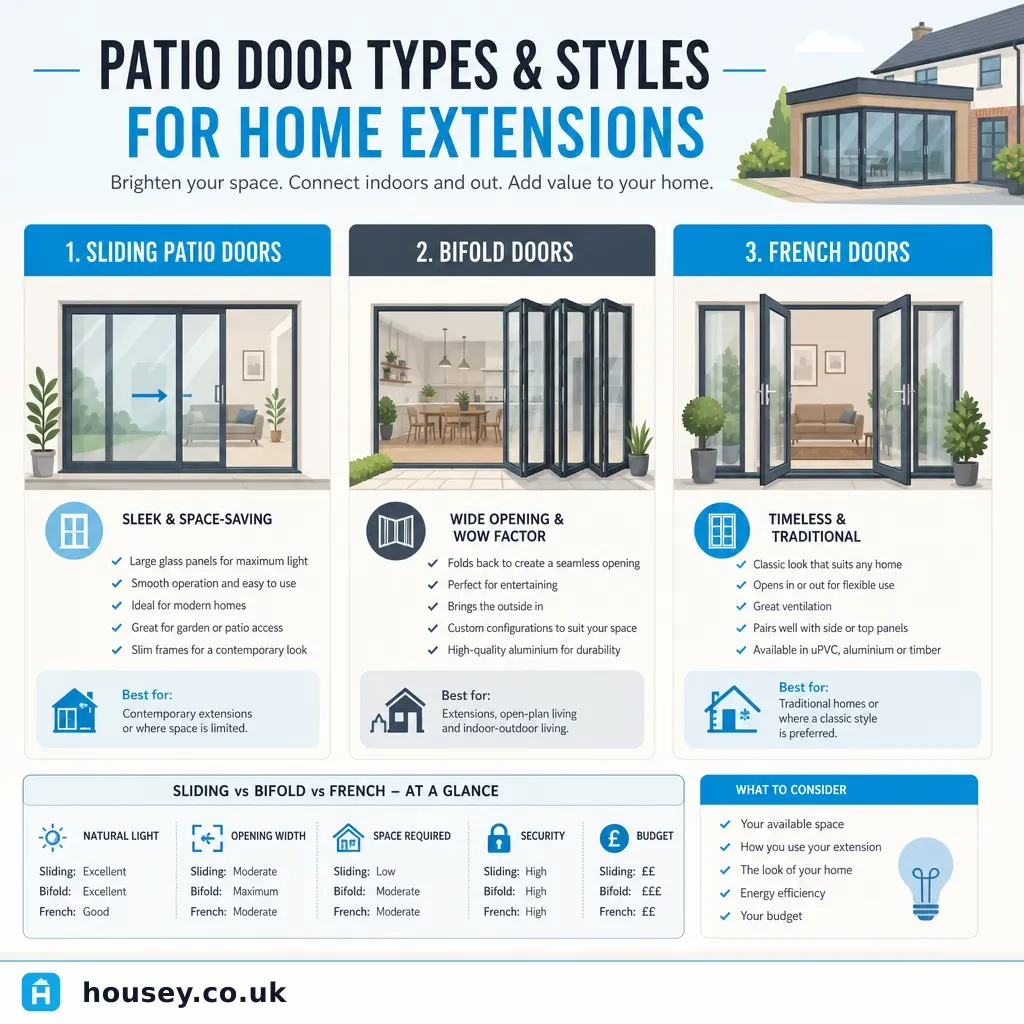
Patio Door Types and Styles for Home Extensions
For most UK home extensions, sliding doors suit openings up to 3.
 Improvement & Build
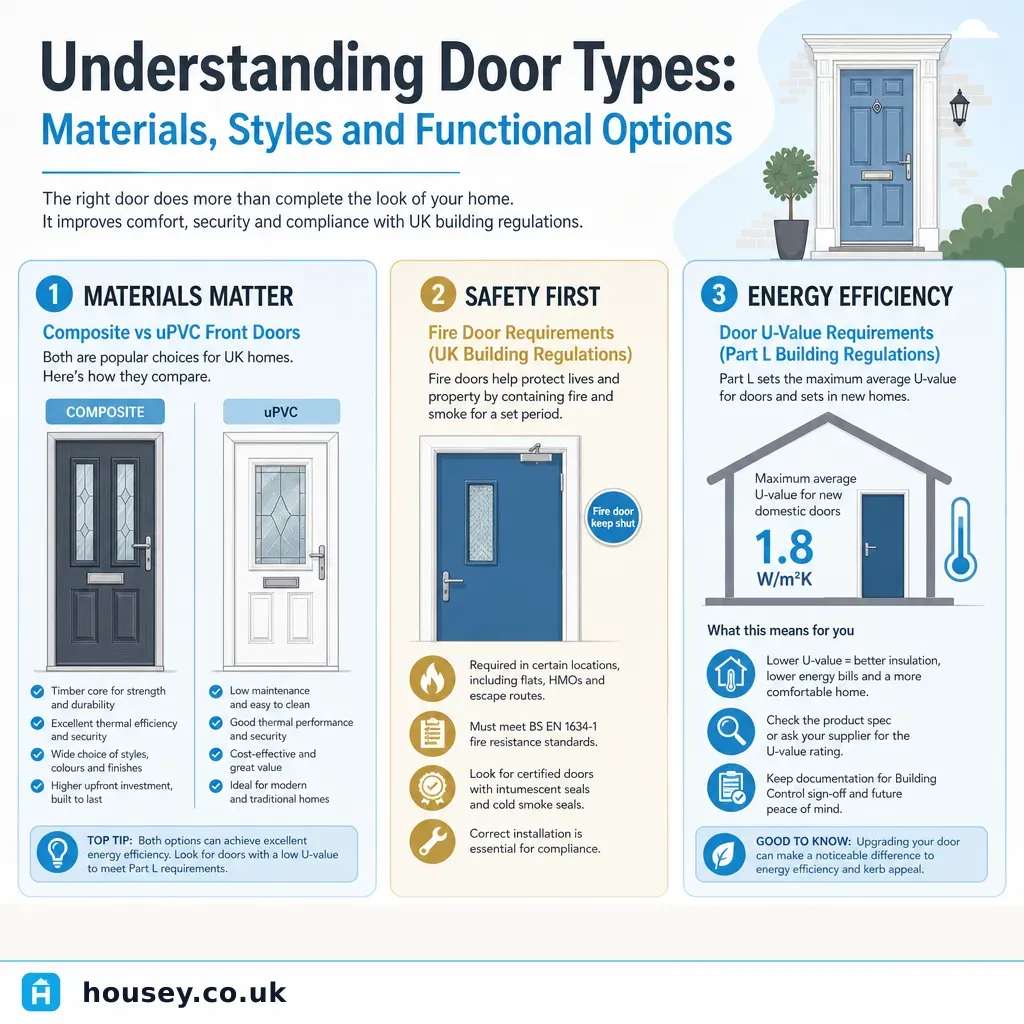
Understanding Door Types: Materials, Styles and Functional Options
Doors are available in timber, uPVC, aluminium, steel, and composite materials, each suited to different budgets, locations, and performance requirements.
 Improvement & Build
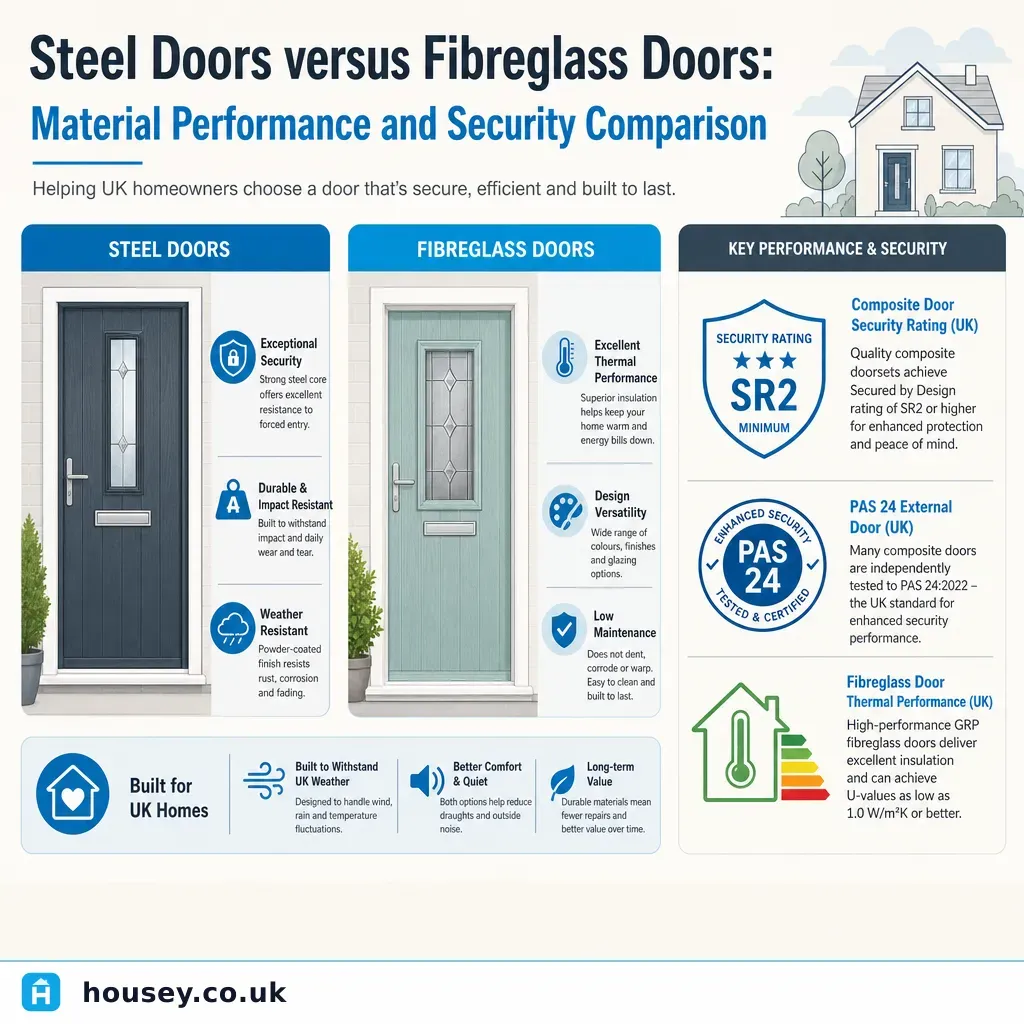
Steel Doors versus Fibreglass Doors: Material Performance and Security Comparison
Steel external doors offer higher forced-entry resistance and suit commercial-grade security requirements.