Concealing Exposed Internal Gas Pipes: Sleeve Installation and Compliance
By Housey · Last reviewed 3rd of May 2026
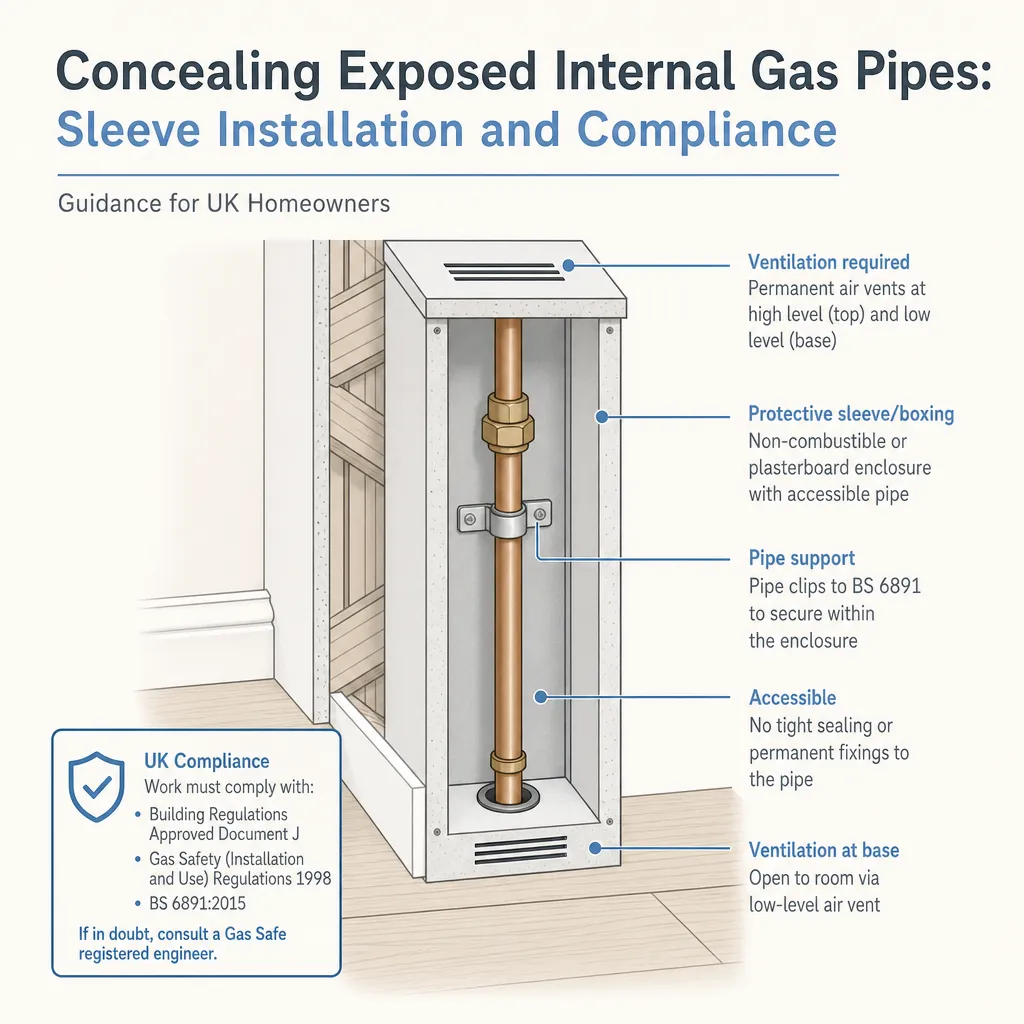
Concealing Exposed Internal Gas Pipes: Sleeve Installation and Compliance
Exposed gas pipes are a common feature in older UK properties — running along skirting boards, across kitchen walls, or through floors and ceilings. While homeowners often want to conceal them during kitchen refits, bathroom renovations, or full interior refurbishments, any work that encloses or re-routes a gas pipe carries strict safety requirements that go well beyond standard building work. The regulatory position is clear, but the practical options depend on the pipe material, routing, and existing fittings.
Key points
- Gas pipes enclosed in a sealed, airtight void are prohibited: any casing or duct around a gas pipe must be ventilated to prevent gas accumulation, under Regulation 18 of the Gas Safety (Installation and Use) Regulations 1998 (SI 1998/2451).
- A gas pipe passing through a solid wall or floor must be installed in an approved sleeve, sealed at the face of entry to prevent moisture ingress and open or vented at the inner end, following the principles set out in BS 6891:2005+A2:2008.
- All work involving gas pipework — including boxing in, chasing into walls, re-routing, sleeving, and testing — must be carried out by or under the direct supervision of a Gas Safe registered engineer.
- Boxed casings around gas pipes must incorporate removable access panels and ventilation openings; plasterboarded-over or fully sealed casings are not compliant.
- Building Regulations Approved Document J covers combustion appliances and associated pipework; any concealment work that affects a gas boiler, fire, or cooker supply line should be discussed with your building control body.
Why you cannot simply box in a gas pipe
Enclosing a gas pipe in a fully sealed void might seem like an efficient solution, but it creates a serious hazard. If a leak develops — even a slow seepage at a compression fitting — gas can accumulate in the enclosed space and reach an ignitable concentration. The Gas Safety (Installation and Use) Regulations 1998, Regulation 18, specifically prohibits the installation of a gas pipe in circumstances likely to result in gas accumulation.
The solution is not to leave pipes exposed, but to conceal them correctly: using ventilated casings, properly sleeved chases, or re-routed pipework carried out by a qualified Gas Safe registered engineer. The method chosen depends on the available space, the pipe material, and whether any joints or fittings exist in the section to be concealed.
Options for concealing internal gas pipes
1. Boxed casings (dry boxing)
A timber stud and plasterboard, or MDF, boxing is constructed around the pipe on the wall surface. The key compliance requirements are:
- The internal void must be ventilated — typically by grilles at the top and bottom of the casing, allowing air to circulate and any escaping gas to disperse.
- The panels must be removable for inspection and maintenance, secured with screws rather than permanently fixed with adhesive or plaster.
- The boxing must not restrict the pipe's ability to expand and contract thermally.
- A Gas Safe engineer should inspect the pipe condition and all fittings before the boxing is constructed, as concealing defective pipework adds risk.
2. Chasing into walls (pipe in a duct)
Where wall space is limited, pipes can be chased into the wall and the surface made good. The requirements are stricter than for surface boxing:
- Steel pipes may be embedded directly in plaster or render only if the section is made continuous — no joints within the concealed length.
- Copper pipes chased into a wall must be run inside a continuous sleeve (conduit or duct) with ventilated open ends at both terminations.
- No joints or fittings should be located within the concealed section — all connections must remain accessible.
- This work must be carried out by or under the direct supervision of a Gas Safe registered engineer.
3. Sleeving through walls and floors
Where a gas pipe passes through a wall, floor, or ceiling structure, it must be fitted with a correctly specified sleeve:
- The sleeve is sealed at the face where the pipe enters the structure (e.g., the external wall face or the underside of the floor) to prevent moisture, vermin, and external gas ingress.
- The opposite end — inside the room or underfloor void — is left open or fitted with a ventilation cap, allowing any gas leakage to disperse safely.
- The sleeve must be sized to allow the pipe to pass through without rigid contact with the surrounding structure, accommodating thermal movement.
Comparison table: methods for concealing internal gas pipes
Method | Best suited to | Key compliance requirement | Who must be involved |
|---|---|---|---|
Surface boxed casing (timber/plasterboard) | Surface runs along walls, above skirting, kitchen pipe runs | Ventilation grilles top and bottom; screwed removable panels; no sealed void | Gas Safe engineer to inspect pipe before boxing; joiner may construct casing |
Pipe chased into wall in a duct | Limited-space kitchen and bathroom refits | Continuous sleeve; no concealed joints; vented ends; steel pipe may be embedded without sleeve if no joints | Gas Safe engineer must supervise or carry out |
Sleeve through wall or floor penetration | Any structural penetration | Sealed external face; open/vented internal end; correct sleeve diameter for thermal movement | Gas Safe registered engineer |
In all cases, the Gas Safe engineer must confirm the existing pipework is in a satisfactory condition before any concealment work begins.
What the regulations say
The primary regulatory framework for this work is:
- Gas Safety (Installation and Use) Regulations 1998 (SI 1998/2451): Regulation 3 requires that only Gas Safe registered engineers work on gas fittings. Regulation 18 prohibits installations likely to result in accumulation of gas. This is the fundamental legal basis for all requirements around ventilation of enclosed pipes.
- BS 6891:2005+A2:2008: The British Standard for low-pressure domestic gas pipework installation. Sets out requirements for materials, pipe routing, sleeving at penetrations, jointing, and pressure testing.
- IGE/UP/2: Institution of Gas Engineers and Managers guidance on installation pipework, providing technical detail on ducting, sleeving, and ventilation requirements for concealed pipework.
- Building Regulations Approved Document J: Covers combustion appliances, flues, and associated pipework connections. Relevant where concealment work could affect the supply to a gas boiler, gas fire, or cooker.
Red flags: stop and call a Gas Safe engineer
Do not proceed with any concealment work — and call a Gas Safe engineer before doing anything — if you notice:
- A smell of gas near any existing pipework. Call the National Gas Emergency Service on 0800 111 999 immediately.
- Corrosion, rust staining, discolouration, or visible damage on existing gas pipes or fittings.
- Signs of previous amateur work — push-fit connectors not approved for gas, tape wrapped around joints, non-standard fittings, or evidence of DIY pipe runs.
- Pipework located close to a combustion appliance flue, electrical consumer unit, or other heat source.
- Any doubt about whether a particular pipe is active and carrying gas to an appliance.
What to ask a qualified Gas Safe engineer
Before instructing an engineer to assess or carry out pipe concealment work, ask:
- Can you inspect the pipe condition and all fittings in the section we want to conceal before we agree on the method?
- Are there any joints or compression fittings in the section, and if so, what are the options for dealing with them?
- Will you provide written confirmation on completion that the installation meets Gas Safe and BS 6891 requirements?
- For boxed casings: what size and location of ventilation grilles are required for the void volume involved?
- Are there any implications for my gas boiler warranty or appliance service agreements?
- Should I notify my building control body given the scale of the surrounding renovation works?
Important limitations
This article provides general information about regulatory requirements for concealing gas pipes in UK residential properties. The correct approach in any specific case depends on the pipe material, diameter, routing, existing fittings, property type, and surrounding construction. Nothing here constitutes gas engineering advice or is a substitute for assessment by a Gas Safe registered engineer. Requirements may vary depending on gas network, property type, and local building control practice.
When to get professional help
A Gas Safe registered engineer must be involved in any project where gas pipes are to be concealed. Even if the physical boxing work is being carried out by a builder or joiner, the engineer needs to inspect the pipe condition beforehand, confirm the proposed method is compliant, and sign off the work on completion.
If the concealment forms part of a larger kitchen or bathroom renovation, discuss it with your Gas Safe engineer at the outset — retrofitting compliant boxing into a completed kitchen fit-out is significantly more disruptive and expensive than planning it in from the start. For larger projects involving notifiable building work, a building control consultant can advise on whether the gas concealment work needs to be formally notified.
How Housey can help
If your renovation project involves gas pipe concealment alongside building control sign-off or compliance certification, Housey can help you find a qualified building control consultant to advise on your project requirements and support you through the approval process.
Frequently asked questions
Can a builder box in a gas pipe without involving a Gas Safe engineer?
No. While a joiner or builder can construct the physical casing, a Gas Safe registered engineer must inspect the pipework condition beforehand and confirm that the proposed enclosure method is compliant with the Gas Safety (Installation and Use) Regulations 1998 and BS 6891. The engineer should also sign off the completed work. Bypassing this step is both dangerous and potentially illegal.
Can gas pipes be plastered over?
Steel gas pipes can be embedded in plaster or render, provided the section is continuous with no joints concealed within the wall. Copper or other pipes chased into a wall must be run inside a sleeved duct with ventilated ends. No gas pipe of any material should be encased in a fully sealed, unventilated void, as this creates a risk of gas accumulation.
Do I need building regulations approval to box in a gas pipe?
Boxing in an existing gas pipe does not in itself typically require a separate building regulations application. However, the work must comply with the Gas Safety (Installation and Use) Regulations 1998 and BS 6891. If the concealment forms part of a larger notifiable project — such as a kitchen extension or loft conversion — building control should be informed of all gas-related work.
How should a gas pipe sleeve through a wall be installed?
The sleeve should be sealed at the outer face of the wall to prevent moisture and pest ingress, and left open or vented at the inner end so that any leaking gas can disperse safely rather than accumulate. The sleeve must be sized to allow the pipe to pass through without contact with the structure, allowing for thermal movement in the pipework.
Will concealing a gas pipe affect my boiler warranty?
It may, if the enclosure restricts access for annual servicing or affects the pipework in any way. Check your boiler manufacturer's warranty terms before proceeding. Most warranties require annual servicing by a Gas Safe registered engineer with accessible pipework. Retain a copy of the Gas Safe engineer's completion confirmation showing the enclosure is compliant.
Sources and further reading
- Gas Safety (Installation and Use) Regulations 1998 — legislation.gov.uk
- Gas Safe Register: Advice for homeowners — Gas Safe Register
- HSE: Gas safety in the home — Health and Safety Executive
- GOV.UK: Approved Document J — Combustion appliances and fuel storage systems — GOV.UK
- BSI: BS 6891 Installation of low pressure gas pipework in domestic premises — BSI Group
Useful next reads
 Planning & Pre-Build
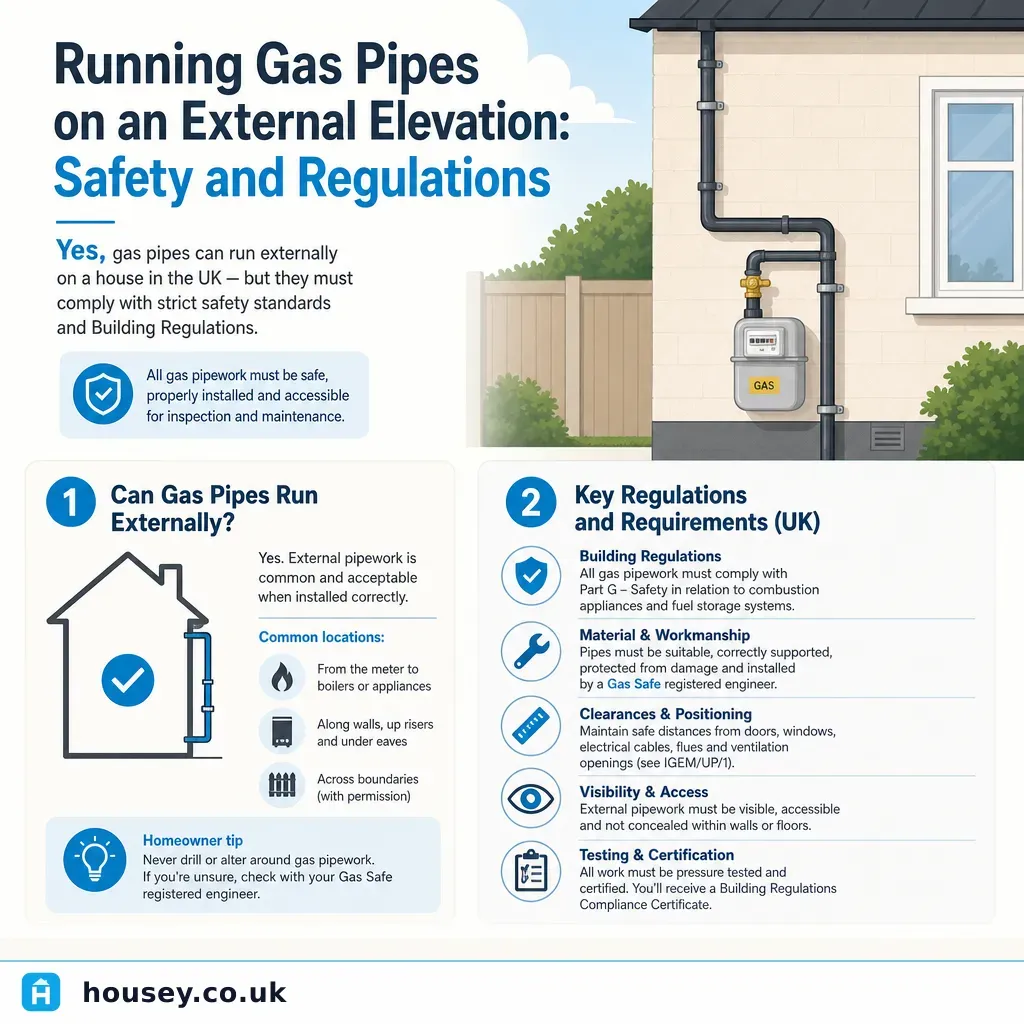
Running Gas Pipes on an External Elevation: Safety and Regulations
External gas pipework is permitted on UK property elevations and is often the preferred route when internal runs are impractical.
 Planning & Pre-Build
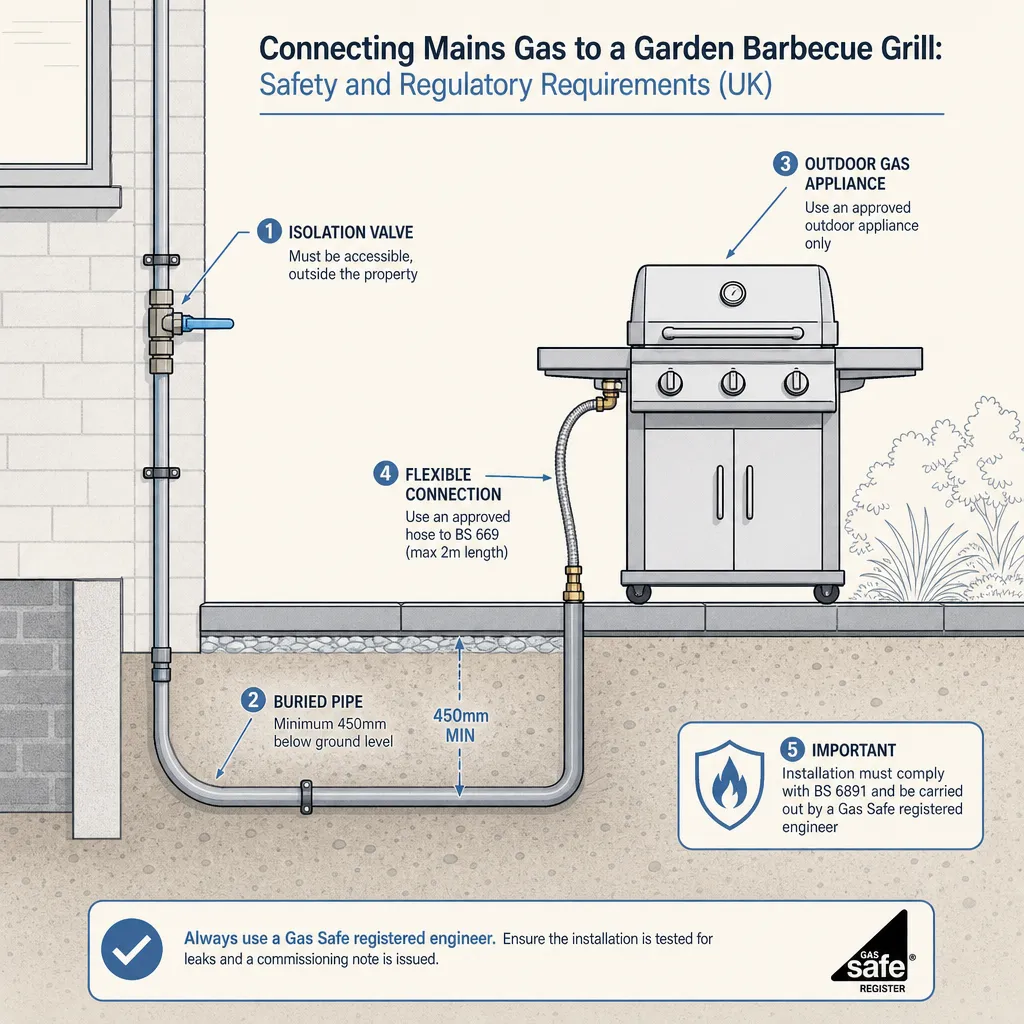
Connecting Mains Gas to a Garden Barbecue Grill: Safety and Regulatory Requirements
Connecting mains gas to a garden barbecue requires a Gas Safe registered engineer and must comply with the Gas Safety (Installation and Use) Regulations 1998.
 Planning & Pre-Build
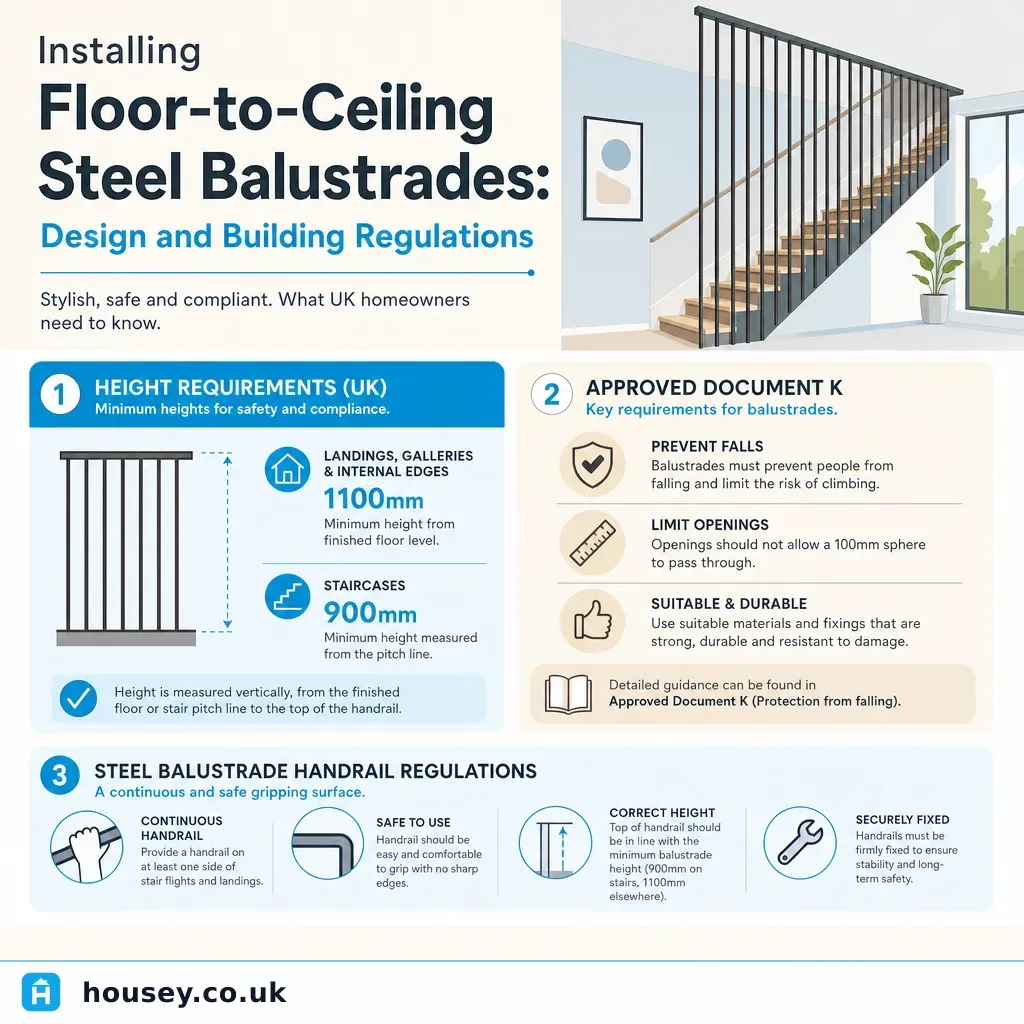
Installing Floor-to-Ceiling Steel Balustrades: Design and Building Regulations
Floor-to-ceiling steel balustrades must comply with Approved Document K, requiring a minimum height of 900mm alongside stairs and 1,100mm at floors and balconies.
 Planning & Pre-Build
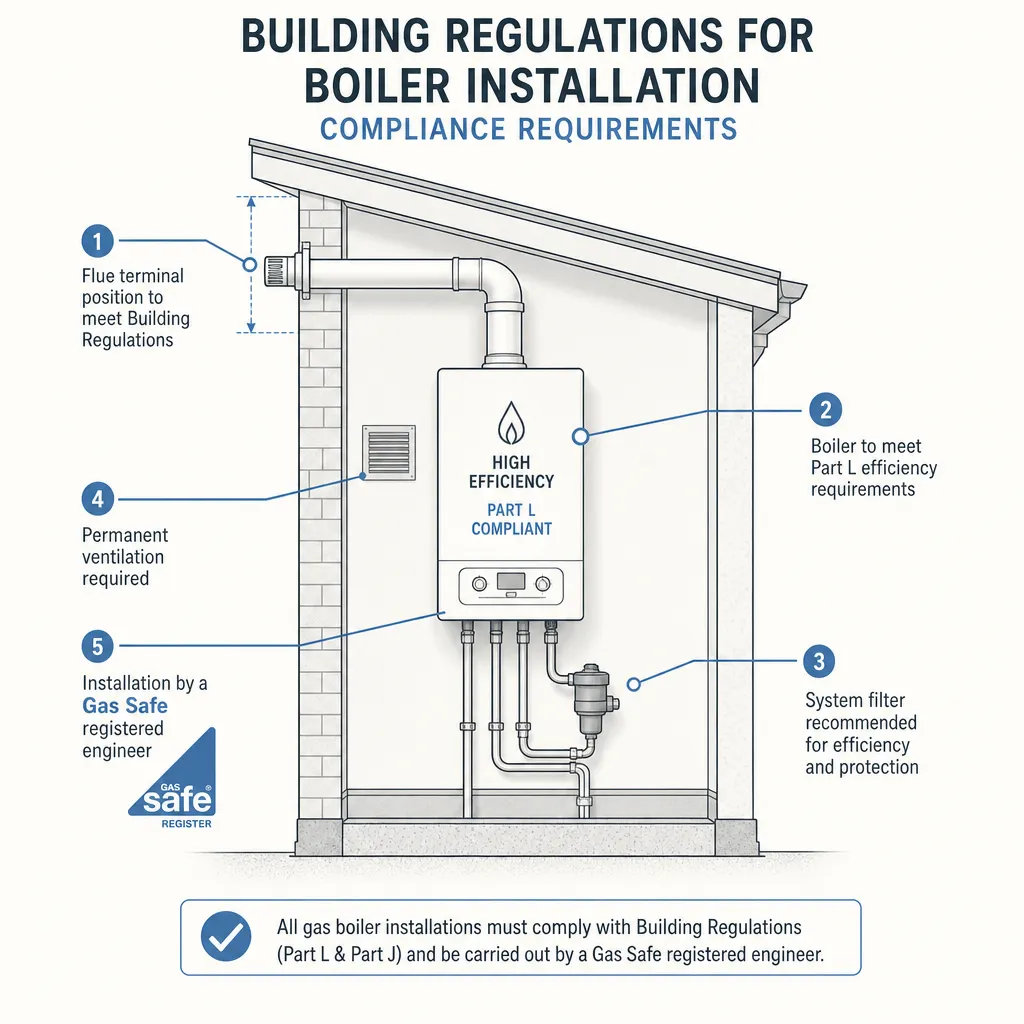
Building regulations for boiler installation: compliance requirements
Boiler installation is regulated under the Gas Safety (Installation and Use) Regulations 1998 and Building Regulations Parts J and L.
 Planning & Pre-Build
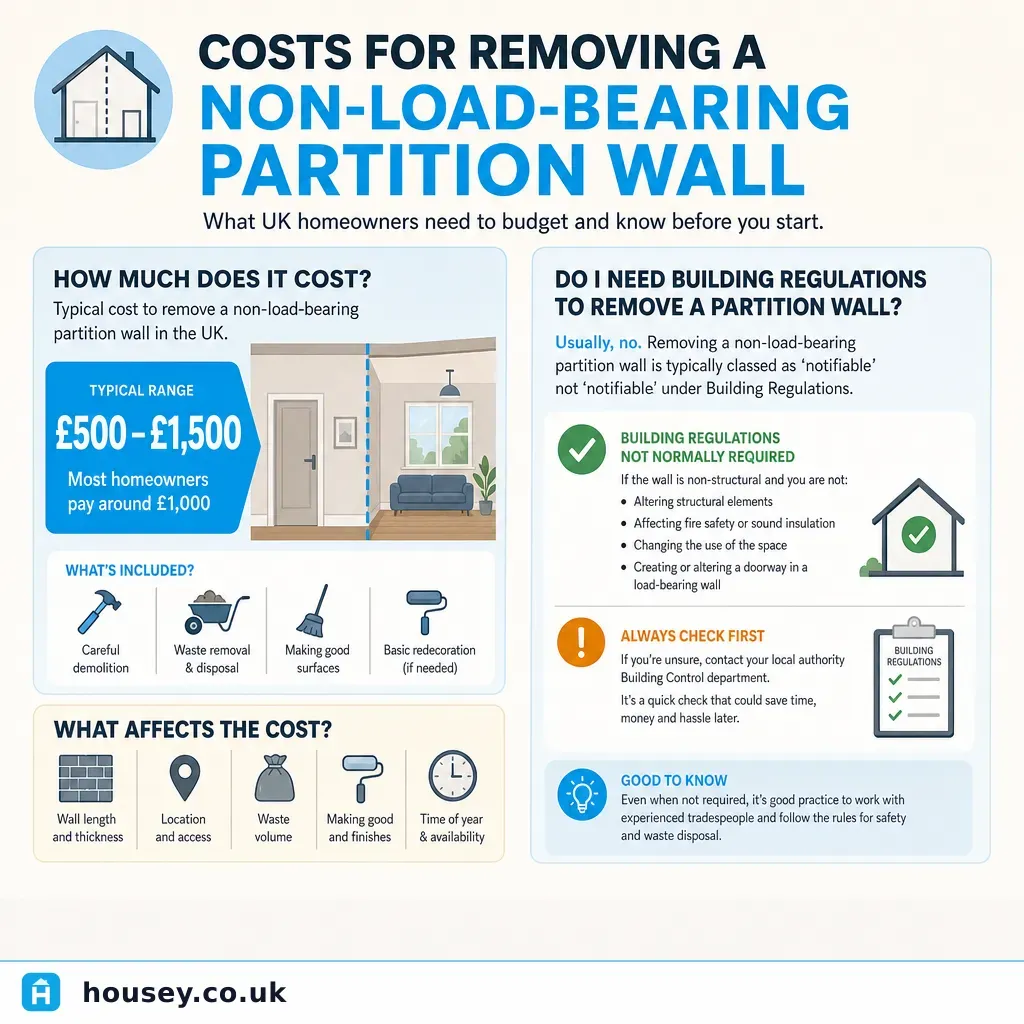
Costs for removing a non-load-bearing partition wall
Removing a non-load-bearing partition wall in a UK home typically costs £300–£1,500 in labour, plus £200–£600 or more for replastering and making good.