Connecting Mains Gas to a Garden Barbecue Grill: Safety and Regulatory Requirements
By Housey · Last reviewed 3rd of May 2026
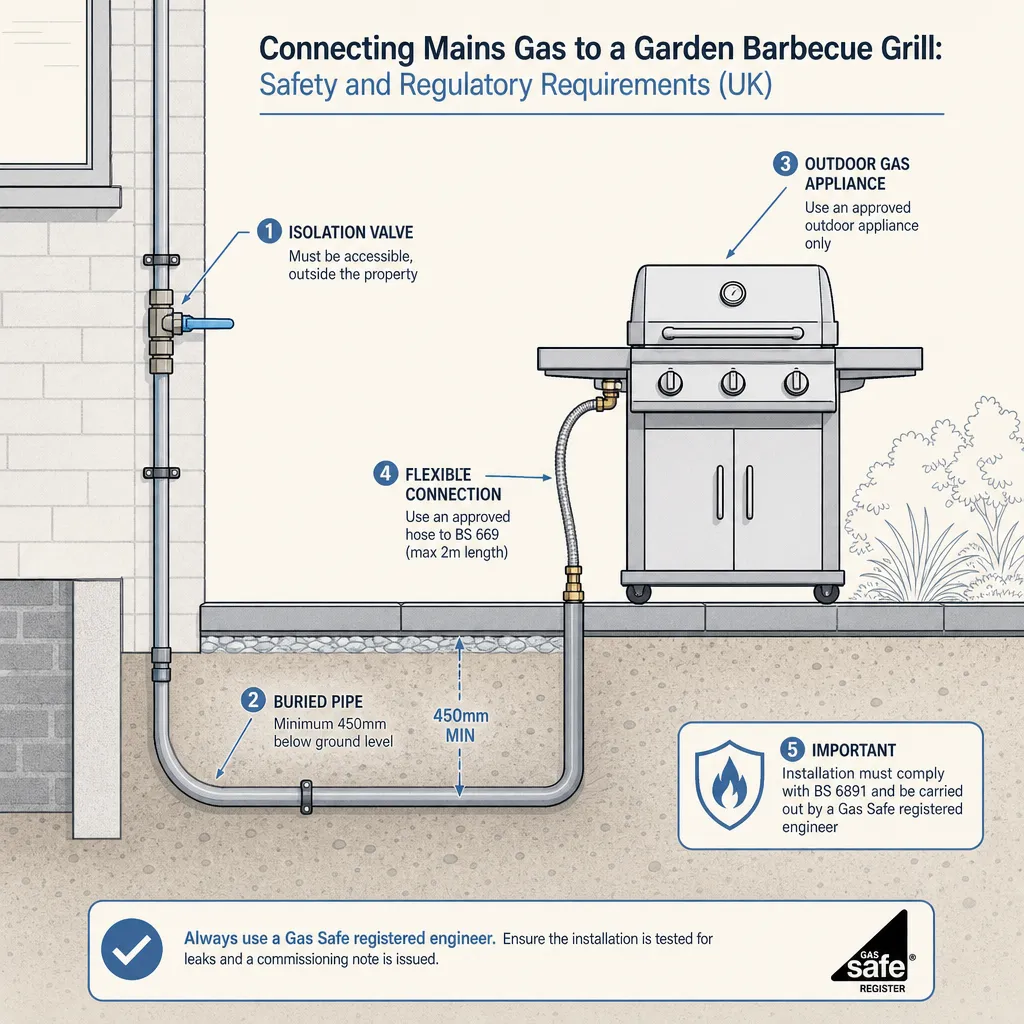
Connecting Mains Gas to a Garden Barbecue Grill: Safety and Regulatory Requirements
Outdoor cooking with mains gas has grown in popularity, but the installation of a permanent gas supply to a garden barbecue involves significantly more regulatory complexity than connecting a portable LPG cylinder. This question arises most often during garden renovation projects or when homeowners plan purpose-built outdoor kitchen areas — and getting the installation wrong carries serious legal and safety consequences under UK law.
Key points
- All work on mains gas installations, including running new external pipework to a garden barbecue, must be carried out by a Gas Safe registered engineer under the Gas Safety (Installation and Use) Regulations 1998 (SI 1998/2451).
- External below-ground gas pipework in domestic settings must comply with BS 6891:2005+A2:2008 and should generally be buried to a minimum depth of 375 mm in a domestic garden.
- The pipework must be pressure-tested on completion by the Gas Safe engineer — typically a 15-minute standing pressure test at 7 mbar or as specified in BS 6891 — before the supply is commissioned.
- Where the pipe passes through a wall or under a structure, a correctly fitted wall sleeve — sealed at the external face and open or vented at the internal end — is mandatory to prevent gas accumulation in enclosed voids.
- Planning permission is not usually required for running a gas supply pipe in a domestic garden, but any associated permanent structure (such as a built-in outdoor kitchen) may require planning consent depending on its size and proximity to boundaries.
Why mains gas is different from a portable LPG cylinder
Portable LPG cylinders can be connected and disconnected by the homeowner in normal circumstances. Mains natural gas is a permanent piped supply from the National Grid distribution network, operating at a regulated pressure that requires properly engineered connections throughout. Unlike a mobile LPG setup, a fixed mains gas run:
- Remains under pressure at all times unless isolated at an approved stopcock.
- Passes through soil, structures, and building fabric, all of which create risks of pipe damage, corrosion, and gas accumulation if incorrectly specified.
- Must be inspected, tested, and signed off by a Gas Safe registered engineer, with documentation retained.
Attempting this work without a Gas Safe registered engineer is a criminal offence under the Gas Safety (Installation and Use) Regulations 1998 and will invalidate standard home insurance policies.
What the Gas Safety Regulations require
The Gas Safety (Installation and Use) Regulations 1998 govern the installation, maintenance, and use of gas fittings in domestic premises. Key requirements include:
- Regulation 3: Only Gas Safe registered engineers may work on gas fittings in domestic premises.
- Regulation 18: Pipes must not be installed in a way that is likely to cause accumulation of gas — a particular concern for below-ground or enclosed external runs.
- Regulation 26: For rental properties, a Gas Safety Record (CP12) is required after each gas safety check. For owner-occupied homes, the engineer should still provide written confirmation that the installation meets the required standard.
The relevant installation standard is BS 6891:2005+A2:2008, which covers pipe materials, sizing, jointing, depth, wall penetrations, testing, and commissioning for low-pressure domestic gas pipework.
How external gas pipework to a garden barbecue is installed
A typical installation follows these stages:
- Design and pipe sizing: The Gas Safe engineer calculates the flow rate needed for the barbecue appliance(s) and sizes the pipework to ensure adequate pressure at the appliance.
- Route planning: The trench route is agreed, avoiding tree roots, other buried services (water, drainage, electrical), and areas subject to future disturbance.
- Excavation: A trench is dug to the required depth — typically a minimum of 375 mm in domestic garden areas, and greater depths under driveways or areas subject to vehicle traffic. Confirm the required depth with the engineer as local gas network operator requirements can vary.
- Pipework material: Yellow-banded polyethylene (PE) pipe is the standard material for below-ground domestic gas service. Above-ground sections typically use steel with corrosion-protective coating, or approved flexible hose at the final appliance connection point.
- Wall or structure penetrations: Where the pipe passes through a wall, it must be fitted with a purpose-made gas pipe wall sleeve, sealed at the external face to prevent moisture and external gas ingress, and open or vented at the internal end to allow any leaking gas to disperse safely.
- Isolation valve: A dedicated isolating valve (stopcock) should be installed in an accessible location close to the appliance, typically within a lockable enclosure to prevent tampering.
- Pressure test: Before backfilling, the completed pipework system must be pressure-tested (typically a standing pressure test at 7 mbar for 15 minutes, or as specified in BS 6891). The Gas Safe engineer records the result in writing.
- Commissioning: The appliance is connected, the system is purged of air, and the engineer confirms the barbecue ignites and operates correctly at the correct pressure.
- Documentation: The Gas Safe engineer issues an installation certificate confirming the work meets Gas Safe and BS 6891 requirements.
Do you need building regulations approval?
For domestic garden gas installations, a new external gas run to a permanently installed appliance is generally notifiable work. The Gas Safe registered engineer can self-certify the gas installation under the relevant self-certification scheme, providing the homeowner with a compliance certificate. However, if the work also involves a new structure — an outdoor kitchen unit, permanent roof, or canopy over the appliance — Building Regulations may apply more broadly to that structure.
You should also check:
- Whether your local gas network operator (e.g., Cadent, SGN, Wales & West Utilities) needs to be notified of the connection extension.
- Whether any trenching through shared surfaces or near the boundary requires party wall or neighbour notification.
- Whether a covered structure housing the barbecue triggers planning permission requirements (see above).
What to ask a qualified Gas Safe engineer
Before instructing an engineer, ask:
- Can I verify your Gas Safe registration number on the Gas Safe Register website before you start?
- What pipe material and installation depth will you specify for my site conditions and local network operator requirements?
- Will you carry out a pressure test and provide written certification on completion?
- Does the installation need to be notified to my gas network operator?
- Where will the isolation valve be located, and how do I access it in an emergency?
- Will the additional appliance load affect my existing gas meter rating or supply pressure?
- Are there any restrictions on which barbecue appliances can be connected to this supply?
Important limitations
This article provides general information about the regulatory framework for connecting mains gas to garden barbecue grills in the UK. Gas installations vary in complexity depending on property type, existing pipework condition, local ground conditions, and the appliance being connected. Nothing in this article constitutes gas engineering advice or is a substitute for assessment by a Gas Safe registered engineer. Requirements may also vary by gas network operator area.
When to get professional help
You must involve a Gas Safe registered engineer before any mains gas work begins — this is a legal requirement, not an optional precaution.
Call the National Gas Emergency Service on 0800 111 999 immediately if you smell gas at any point during or after an installation.
Also seek professional advice before proceeding if:
- You are unsure whether your existing gas meter can supply the additional connected load.
- The proposed route involves crossing a boundary, shared driveway, or area of public land.
- The barbecue will be located under a covered structure (pergola, canopy, or outdoor kitchen roof), which has specific ventilation and proximity requirements under gas installation standards.
- The existing external pipework or meter installation appears old, damaged, or non-standard.
How Housey can help
If your project involves a permanent outdoor structure connected to a mains gas supply, you may also need building regulations drawings or building control sign-off. Housey can help you find qualified building regulations drawings professionals and building control consultants to support your project from design through to completion.
Frequently asked questions
Can I connect my garden barbecue to mains gas myself?
No. All work on mains gas installations must be carried out by a Gas Safe registered engineer under the Gas Safety (Installation and Use) Regulations 1998. Carrying out gas work yourself is illegal, dangerous, and will invalidate your home insurance. Only a registered engineer may connect, modify, test, and commission gas pipework, including runs to external appliances such as garden barbecues.
How deep does a gas pipe need to be buried in a garden?
Under BS 6891, gas service pipes in domestic gardens should generally be buried to a minimum depth of 375 mm. Greater depths are typically required under driveways or areas subject to vehicle loads. Your Gas Safe engineer should confirm the required depth for your specific site conditions, as local gas network operator requirements can also influence the specification.
Do I need to notify my gas supplier about a new garden gas connection?
The Gas Safe engineer carrying out the work should notify the local gas network operator — such as Cadent, SGN, or Wales & West Utilities — where required. As the homeowner, you should also check with your gas supplier, as a significant increase in connected load may affect your meter rating or tariff. Do not assume notification will happen automatically.
Will connecting a garden BBQ affect my home insurance?
Potentially, yes. Insurers may require evidence that gas work has been carried out by a Gas Safe registered engineer and that a compliance certificate has been issued. Unlicensed gas work can void your home insurance policy entirely. Always inform your insurer of significant gas installation work and retain any documentation the engineer provides on completion.
Is planning permission needed for an outdoor gas connection?
The gas pipework itself does not usually require planning permission. However, if you are building an outdoor kitchen structure, covered area, or pergola to house the barbecue, planning permission may be required depending on size, height, and proximity to boundaries. Check with your local planning authority before constructing any associated permanent structure.
Sources and further reading
- Gas Safety (Installation and Use) Regulations 1998 — legislation.gov.uk
- Gas Safe Register: Find a registered engineer — Gas Safe Register
- HSE: Gas safety in the home — Health and Safety Executive
- GOV.UK: Building regulations approval — GOV.UK
- BSI: BS 6891 Installation of low pressure gas pipework in domestic premises — BSI Group
Useful next reads
 Planning & Pre-Build
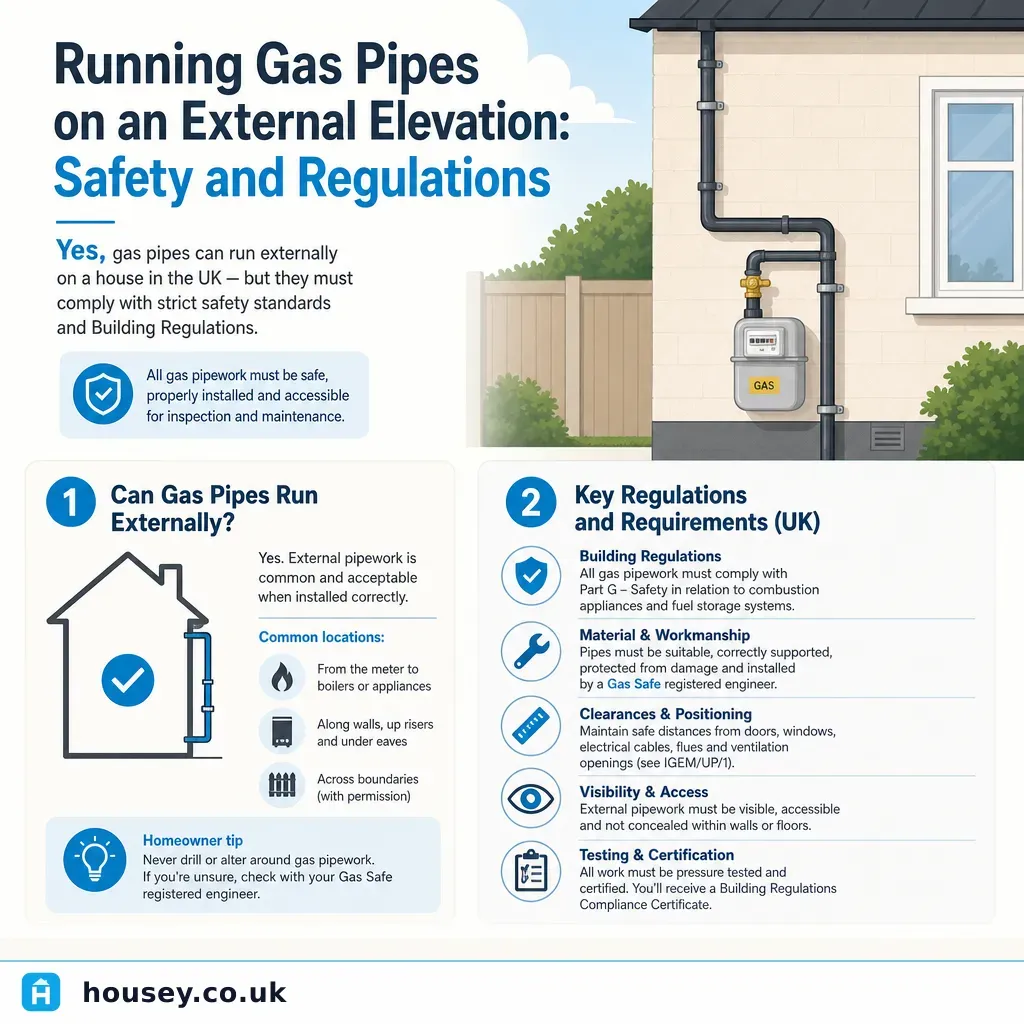
Running Gas Pipes on an External Elevation: Safety and Regulations
External gas pipework is permitted on UK property elevations and is often the preferred route when internal runs are impractical.
 Planning & Pre-Build
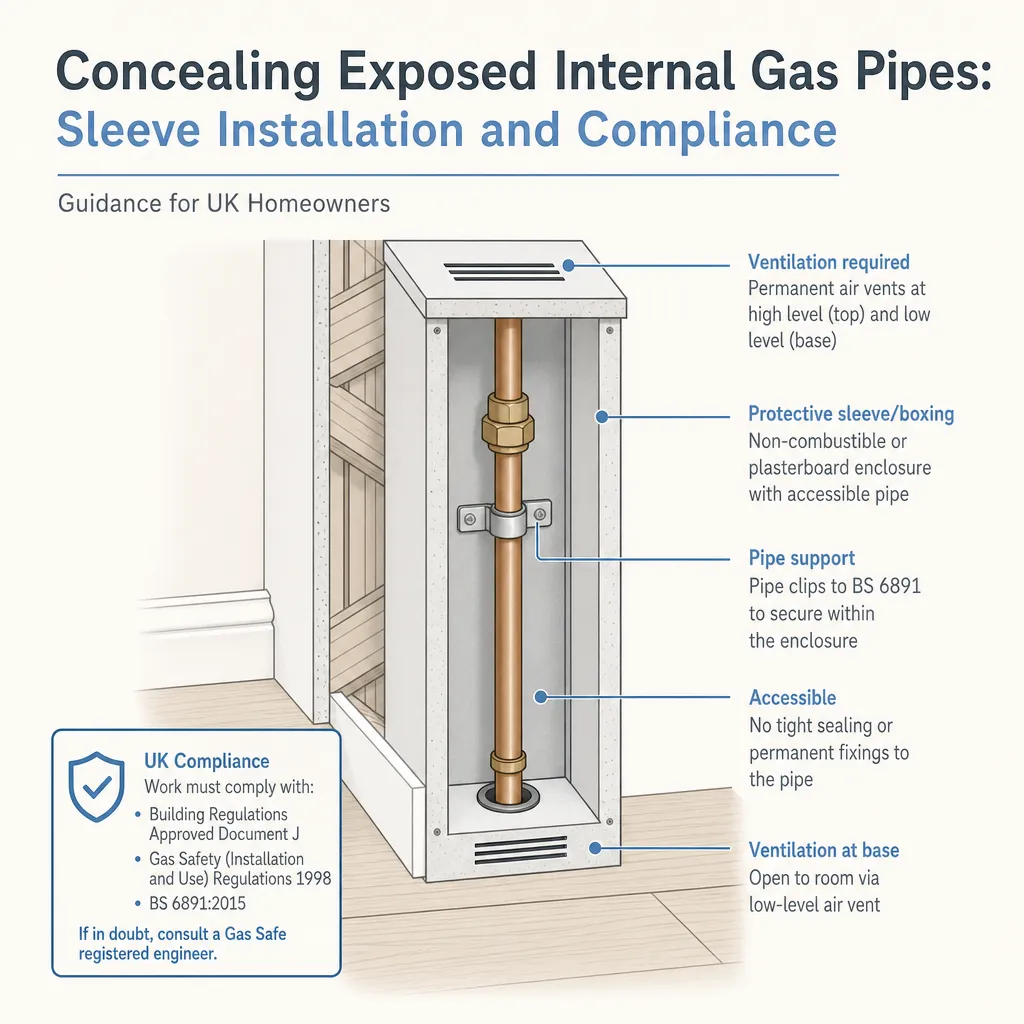
Concealing Exposed Internal Gas Pipes: Sleeve Installation and Compliance
Exposed internal gas pipes can be concealed using ventilated boxed casings or correctly sleeved chases, but only under the supervision of a Gas Safe registered engineer following the Gas Safety (Installation and Use) Regulations 1998.
 Planning & Pre-Build
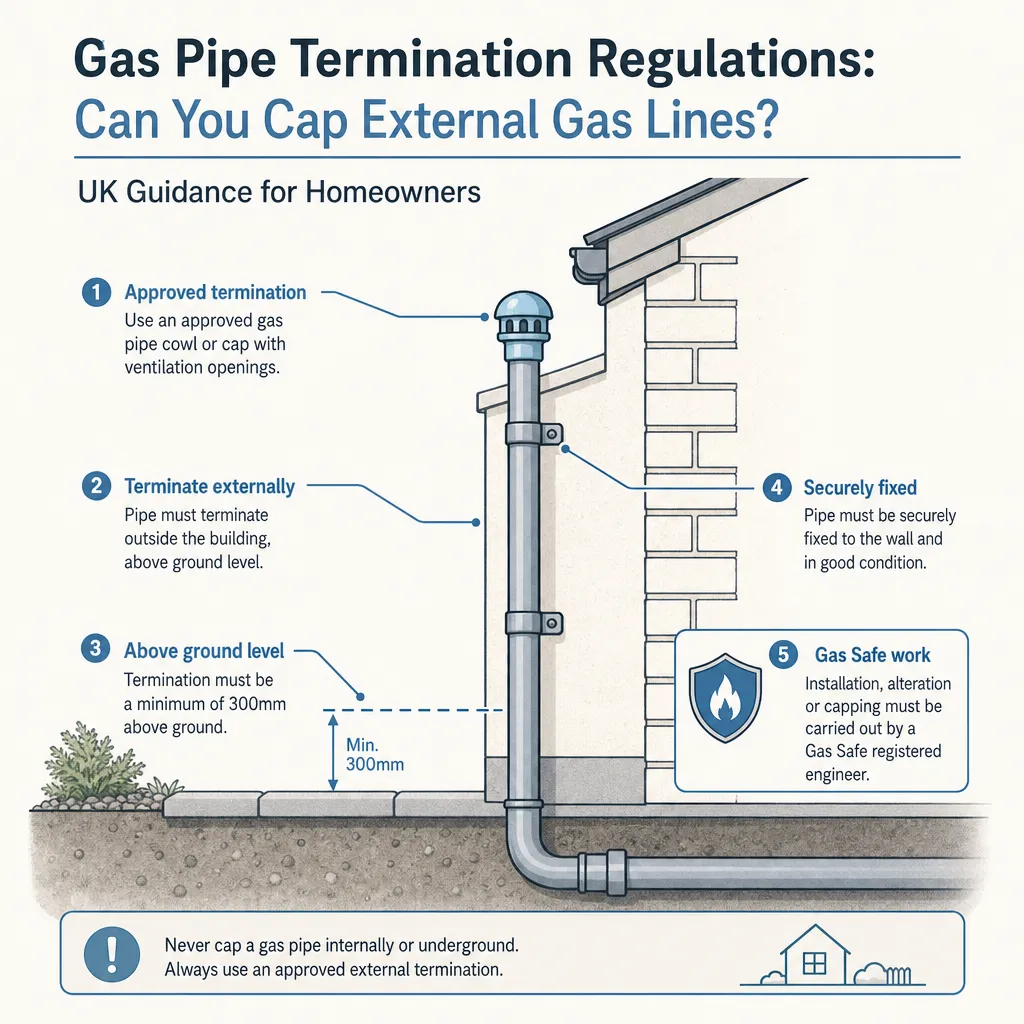
Gas Pipe Termination Regulations: Can You Cap External Gas Lines?
Only a Gas Safe registered engineer can legally cap external gas pipes in the UK under the Gas Safety (Installation and Use) Regulations 1998.
 Planning & Pre-Build
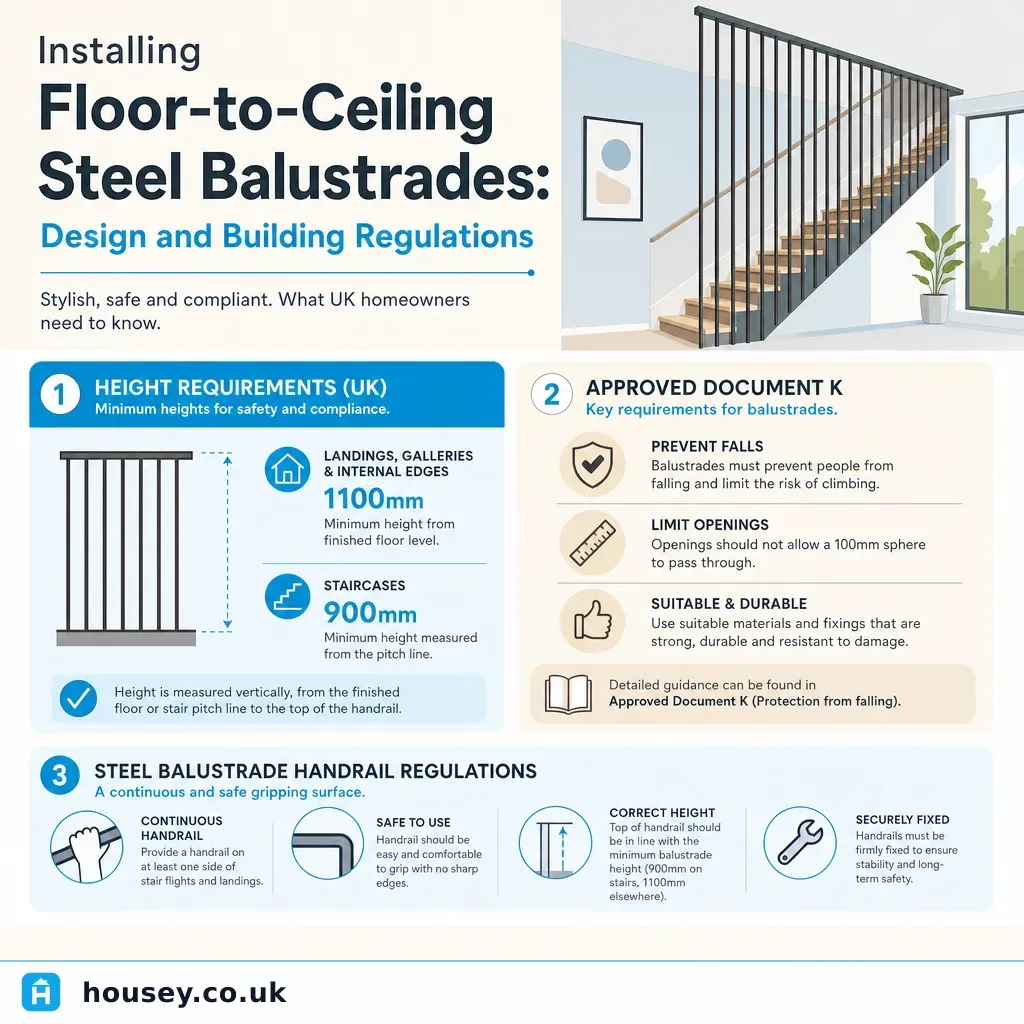
Installing Floor-to-Ceiling Steel Balustrades: Design and Building Regulations
Floor-to-ceiling steel balustrades must comply with Approved Document K, requiring a minimum height of 900mm alongside stairs and 1,100mm at floors and balconies.
 Planning & Pre-Build
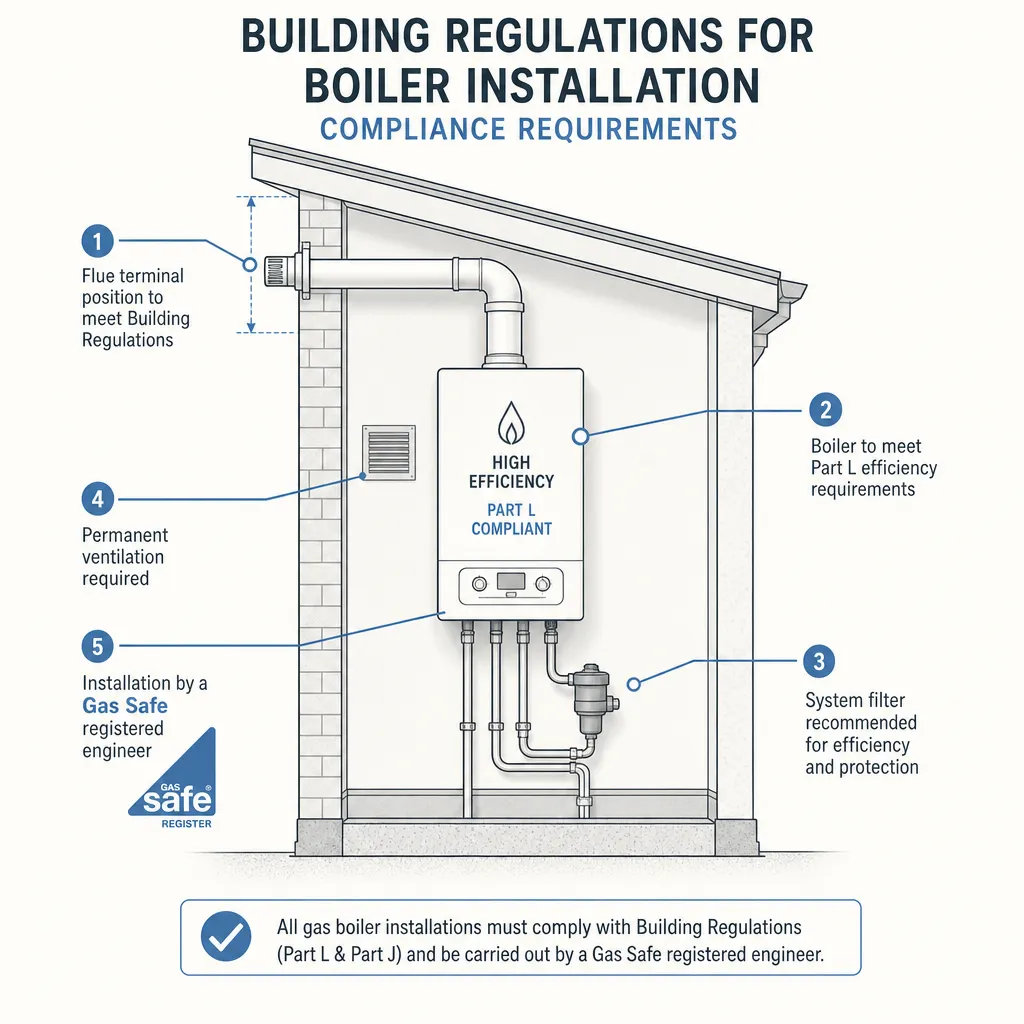
Building regulations for boiler installation: compliance requirements
Boiler installation is regulated under the Gas Safety (Installation and Use) Regulations 1998 and Building Regulations Parts J and L.