Concealing External Gas Pipes on Exterior Walls: Methods and Aesthetics
By Housey · Last reviewed 4th of May 2026
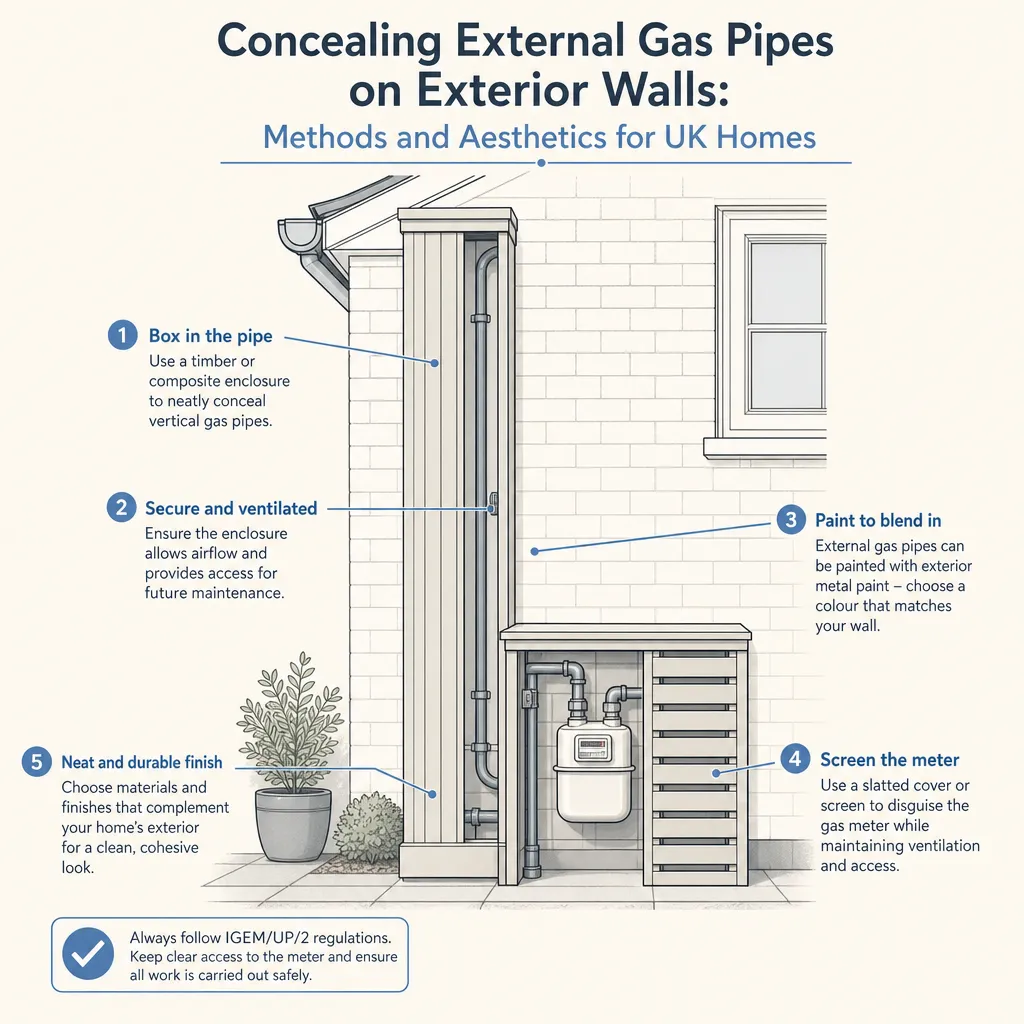
Concealing External Gas Pipes on Exterior Walls: Methods and Aesthetics
External gas pipes are a practical necessity in millions of UK homes, but their yellow-ochre finish and exposed runs can feel at odds with a freshly rendered wall or a recently landscaped front garden. The question of how to conceal or screen them typically arises during refurbishment projects — when a fresh coat of render or a new patio design draws attention to pipework that was previously easy to overlook. Getting the approach right matters, because gas pipework carries strict legal and safety obligations that apply regardless of the aesthetic goal.
Key points
- Any physical work on or directly connected to a gas pipe — including boxing it in with materials fixed to the pipe itself — must be carried out by a Gas Safe registered engineer.
- Approved Document J of the Building Regulations (England and Wales) sets requirements for combustion appliance installations and associated pipework; the Gas Safety (Installation and Use) Regulations 1998 govern the legal obligations of anyone working on a gas fitting.
- External gas pipes are typically painted yellow ochre in accordance with BS 1710 (identification of pipelines and services); any repainting must use a compatible, corrosion-resistant product agreed with your gas network operator (Cadent, SGN, Northern Gas Networks, or Wales & West Utilities).
- Timber or UPVC boxing can conceal pipes running along an external wall, but the enclosure must include adequate ventilation openings — top and bottom — to prevent gas accumulation if a minor leak occurs.
- The meter box and emergency control valve (ECV) must remain physically accessible and operable at all times; any screening that prevents immediate access is not permitted.
What the regulations say
The Gas Safety (Installation and Use) Regulations 1998 (as amended) define "work" on a gas fitting broadly — it includes any activity that could affect the integrity of the pipework. Physically clamping a box to a gas pipe, drilling into a wall where a gas pipe runs, or altering the route of pipework all fall within this definition and must be carried out by a Gas Safe registered engineer.
Approved Document J (Combustion Appliances and Fuel Storage Systems) and the associated British Standard BS 6891 (installation of low-pressure gas pipework) provide technical guidance on pipe runs, separation distances, and ventilation requirements. Your gas transporter may also publish network-specific technical standards; Cadent, for example, has requirements governing how meters and service pipes can be enclosed or screened.
Concealment of the pipe run between the meter and the appliance is generally permissible provided the design meets safety requirements. The meter itself and the ECV — the yellow-handled valve immediately before the meter — must remain clearly visible and physically accessible for emergency isolation at all times.
Methods for concealing external gas pipes
Timber or UPVC boxing
Constructing a rectangular enclosure from treated softwood or UV-stabilised UPVC ducting is one of the most common approaches on UK terraced and semi-detached homes. The boxing sits around the pipe but is fixed to the wall — not to the pipe itself.
Key requirements:
- Fix the boxing to the wall, maintaining a clearance around the pipe.
- Include ventilation slots at the top and bottom so that any leaked gas cannot accumulate inside the enclosure — your Gas Safe engineer can specify the minimum free ventilation area required.
- Use materials rated for external exposure: treated timber with a weatherproof paint or stain, or UV-stabilised UPVC.
- Use screwed (not glued) fixings so the panel can be removed for future inspection or maintenance.
Trellis and planting
A timber or metal trellis fixed to the wall beside the pipe, with climbing plants trained to conceal it, avoids enclosing the pipe entirely and allows free air circulation around the pipework.
Key requirements:
- Maintain a minimum clearance from the pipe — typically 25 mm — to allow inspection and prevent mechanical pressure from plant stems.
- Plants must not grow onto gas fittings, the meter, or the ECV.
- Avoid plants that shed dense debris (berries, heavy leaf-fall) near the meter or that could block ventilation slots in the meter box.
- The trellis must not obstruct access to the meter or ECV.
Painting or colour-matching
If the pipe is structurally sound and the aim is simply to make it less prominent, repainting is an option. However, there are important constraints:
- The yellow ochre colour of gas pipes serves a safety-identification purpose under BS 1710. Completely overcoating to match a render or wall finish removes this identification.
- Discuss any colour change with your gas network operator before starting. Many operators will accept a neutral colour on the condition that "GAS" marker labels are applied at regular intervals — typically every 1–2 metres.
- Use a rust-inhibiting primer followed by a weatherproof topcoat compatible with the pipe material (usually steel or medium-density polyethylene). Advice on a suitable paint system should come from a Gas Safe registered engineer or the network operator.
Recessing into render or cladding
On new-build or major refurbishment projects, some homeowners ask for pipes to be embedded within external wall construction. This is the most complex option and requires Gas Safe input from the design stage:
- Any embedded section must be a continuous pipe run with no joints within the wall.
- An inspection access point must be provided at each change of direction.
- This approach typically requires notification to the gas transporter and may affect the building regulations application for the wider project.
Comparison: external gas pipe concealment methods
Method | Best suited to | Key safety requirement | Partial DIY feasible? |
|---|---|---|---|
Timber or UPVC boxing | Pipe runs along an external wall | Ventilation slots top and bottom; removable panel; fixed to wall not pipe | Wall fixings only — pipework assessment by Gas Safe engineer |
Trellis and planting | Meters in gardens; long exposed pipe runs | 25 mm clearance from pipe; no plant growth onto fittings | Yes — but Gas Safe engineer should approve the design |
Repainting | Sound steel pipes needing visual softening | Compatible paint system; identification labels retained | No — Gas Safe engineer or network operator to advise |
Recessing into render or cladding | New build or major refurbishment | Continuous pipe; no in-wall joints; access points at every direction change | No — Gas Safe design input required from outset |
Always consult a Gas Safe registered engineer before starting any concealment work near gas pipework.
Important limitations
This article provides general information only. Gas pipework and fittings are subject to strict legal and safety requirements in the UK, and the consequences of getting things wrong can be serious. Do not carry out any work that involves touching, fixing to, cutting near, or altering gas pipework unless you are a Gas Safe registered engineer. Acceptable methods, materials, and ventilation clearances vary depending on your gas network operator, the age and material of the pipework, your local planning authority, and the specific construction of your property. Seek professional advice before starting any concealment work.
Red flags: when to stop and call a professional
- You can smell gas anywhere near the pipe, meter, or any existing boxing — call the National Gas Emergency Service on 0800 111 999 immediately.
- The pipe shows signs of corrosion, pitting, rust staining, or physical damage.
- The meter or ECV is already difficult to access or operate before any screening work begins.
- A previous owner has boxed in pipework in a way that blocks ventilation openings or prevents access to the meter.
- Your property is a listed building or in a conservation area — screening works may require listed building consent or planning permission from your local planning authority.
- The pipe run passes through or close to a cavity wall — any drilling in that zone requires careful investigation to avoid damaging pipework.
What to ask a qualified professional
Before instructing a Gas Safe registered engineer or contractor, ask the following:
- Does the existing pipework show any defects, corrosion, or signs of deterioration that should be addressed before any screening is installed?
- What minimum ventilation free area is required for any boxing I plan to install around this pipe run?
- Does my gas network operator have specific restrictions on screening, enclosure, or colour changes for pipework in this area?
- Will this work require a gas tightness test or notification to the network operator?
- Do I need planning permission or listed building consent for any of the concealment options I am considering?
- Can you provide written confirmation or a Gas Safe certificate once the inspection or any associated work is completed?
When to get professional help
A Gas Safe registered engineer should be involved from the outset whenever you plan any boxing or screening that will sit close to gas pipework. While a confident DIYer can erect a garden trellis at a sensible distance from a pipe, anything involving fixing materials near the pipe, assessing the pipe's condition, advising on paint specification, or any alteration to the meter installation must be handled by a registered professional.
If you smell gas at any point — before, during, or after any work — stop immediately, avoid operating electrical switches, ventilate the area, and call the National Gas Emergency Service on 0800 111 999.
How Housey can help
Housey connects UK homeowners with vetted tradespeople for home improvement and renovation projects. For external wall aesthetics — rendering, cladding, or painting around pipework — a qualified building contractor can work alongside your Gas Safe engineer to achieve a neat, regulation-compliant finish. Visit the Housey services directory to find qualified tradespeople in your area.
Frequently asked questions
Can I box in my external gas pipe myself?
You can construct a timber or UPVC enclosure around the pipe provided it is fixed to the wall — not the pipe itself — and includes adequate ventilation openings. However, a Gas Safe registered engineer should inspect the pipework condition before you start and confirm that your boxing design meets safety requirements. Do not drill into walls near gas pipes without knowing exactly where the pipe runs.
Does boxing in a gas pipe need building regulations approval?
Minor cosmetic boxing is unlikely to require a formal building regulations application, but the work must still comply with Approved Document J and the Gas Safety (Installation and Use) Regulations 1998. If the screening forms part of a larger project involving structural changes or new building work, building regulations may apply to those elements. Always check with your local building control authority if you are unsure.
Can I paint my external gas pipe a different colour?
Gas pipes are coloured yellow ochre for safety identification under BS 1710. Repainting is possible, but the pipe must remain identifiable as a gas-carrying pipe — typically by applying 'GAS' marker labels at intervals of 1–2 metres. Discuss any colour change with your gas network operator first and use a compatible, corrosion-resistant paint system agreed with a Gas Safe registered engineer.
Do I need planning permission to screen external gas pipes?
In most cases, minor screening with boxing or trellis does not require planning permission under permitted development rights. However, if your property is listed, in a conservation area, or the screening forms part of a larger external alteration, check with your local planning authority before starting work. Listed building consent may be required in addition to any Gas Safe requirements.
Who is responsible for the external gas pipe on my property?
Pipework from the gas main up to and including the meter is owned and maintained by your gas network operator — Cadent, SGN, Wales & West Utilities, or Northern Gas Networks, depending on your region. The pipework from the meter into your home is generally the property owner's responsibility. Contact your network operator if you are unsure about the boundary of responsibility for your specific installation.
Sources and further reading
- Gas Safety (Installation and Use) Regulations 1998 — legislation.gov.uk
- Approved Document J: Combustion Appliances and Fuel Storage Systems — GOV.UK
- Gas Safe Register: Find a registered engineer — Gas Safe Register
- BS 1710: Identification of pipelines and services — BSI Group
- National Gas Emergency Service — National Gas (0800 111 999)
Useful next reads
 Improvement & Build
Evaluating And Planning Renovations For Properties Requiring Modernisation
Start by commissioning a condition survey — RICS Level 3 for pre-1919 properties — to identify structural defects, damp, and services issues before finalising a budget.
 Improvement & Build
Expanding Doorways: Planning, Costs, and Building Requirements
Expanding a doorway in a load-bearing wall requires Building Regulations Part A approval and a structural engineer's lintel design.
 Improvement & Build
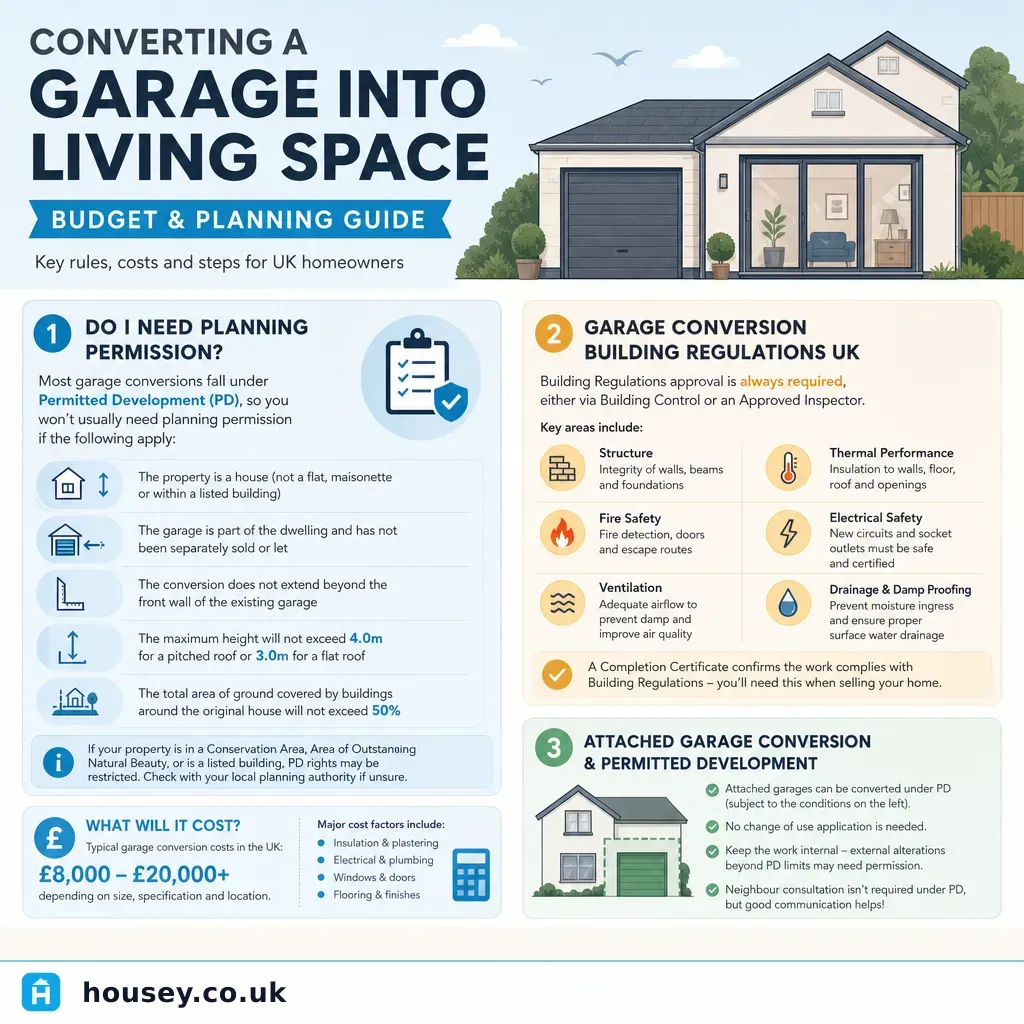
Converting a Garage into Living Space: Budget and Planning Guide
A single-garage conversion typically costs £8,000–£20,000 in the UK.
 Improvement & Build
Professional Installation Requirements for Velux Roof Windows
Velux roof windows installed as replacements in the same opening usually fall under permitted development, but new openings or changes on listed buildings or in conservation areas require planning permission.
 Improvement & Build
Budget Guide for Two-Storey House Extensions
A two-storey house extension in the UK typically costs £1,800–£3,000+ per square metre for the build alone.