Concrete Basement Construction: Waterproofing Standards for Residential Foundations
By Housey · Last reviewed 24th of May 2026
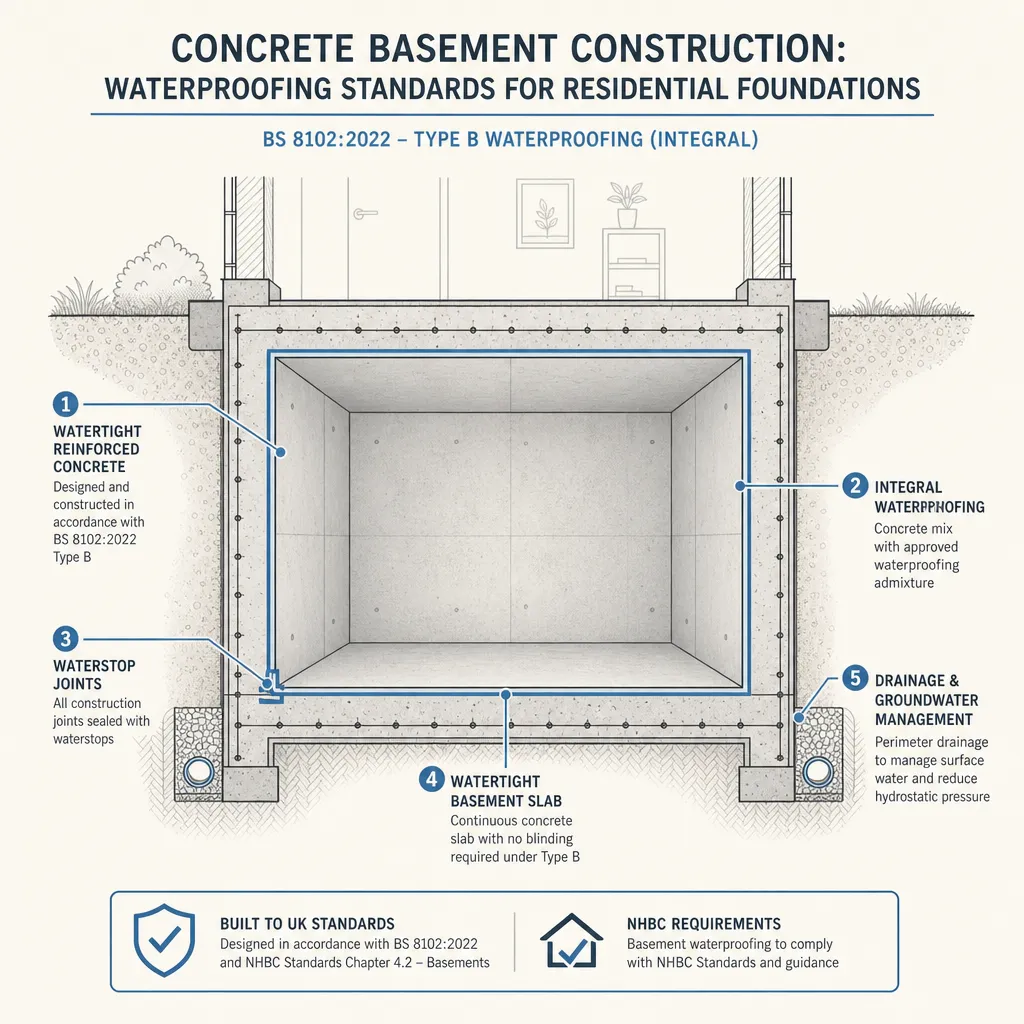
Concrete Basement Construction: Waterproofing Standards for Residential Foundations
Concrete basements are increasingly common in UK new-build and extension projects, particularly where plot sizes are constrained and owners want to maximise floor area below ground. Getting the waterproofing specification right during construction costs significantly less than rectifying failures afterwards — yet the choices made during and immediately after the concrete pour have lasting consequences for the space's habitability and structural performance.
Key points
- BS 8102:2022 (Code of Practice for Protection of Below Ground Structures Against Water from the Ground) is the controlling British Standard for concrete basement waterproofing design in the UK.
- Building Regulations Part C (Site preparation and resistance to contaminants and moisture) requires that floors and walls in contact with the ground resist the passage of moisture into the building.
- NHBC Standards Chapter 5.4 (Waterproofing of basements and other below-ground structures) sets out technical requirements that new-build residential projects must meet to obtain an NHBC Buildmark warranty.
- Type B waterproofing — structurally integral concrete — relies on a low water/cement ratio (typically 0.45 or below), adequate cement content, and careful construction joint detailing; joints are the most critical vulnerability in any poured concrete basement.
- Concrete basement construction almost always requires building regulations approval, a structural engineer's design, and — where works adjoin a neighbouring structure — party wall notices under the Party Wall etc. Act 1996.
What the regulations require
Building Regulations Part C requires that floors and walls in contact with the ground resist the passage of moisture to the inside of the building. For below-ground concrete structures, this obligation is typically discharged by complying with BS 8102:2022.
The NHBC — the most widely used warranty provider for new residential construction in the UK — requires compliance with Chapter 5.4 of the NHBC Standards for any below-ground structure on projects seeking a Buildmark warranty. Where NHBC is not involved, a specialist structural waterproofing engineer should certify compliance with BS 8102:2022 directly.
Building regulations approval will be required in virtually all cases. A full plans application — rather than a building notice — is generally preferable for basement construction, as it allows the structural and waterproofing design to be reviewed and approved before the pour commences.
Type B waterproofing: how structural integral concrete works
In new-build concrete basements, Type B waterproofing is typically the primary system. Rather than applying a separate membrane after construction, the concrete itself is designed to resist water penetration through:
- Low water/cement ratio (0.45 w/c or below): Reduces capillary porosity in the hardened concrete matrix, limiting pathways through which water can travel.
- Minimum cement content: Typically 325–350 kg/m³ for ground-retaining structural concrete in UK residential projects.
- Waterproof admixtures: Crystalline admixtures meeting EN 934-2, or hydrophilic waterstop strips embedded at construction joints, can seal capillary paths over time.
- Reinforcement cover: Typically 50 mm minimum for concrete exposed to ground conditions, to prevent carbonation and corrosion that could create water migration paths.
- Construction joint treatment: The weakest points in any poured concrete structure. Options include hydrophilic waterstop strips, post-pour injection hoses, or cast-in waterstop profiles — the correct detail depends on joint geometry, access, and groundwater pressure.
Type B alone is generally suitable for Grade 1 (car parking) and Grade 2 (storage) environments. For Grade 3 habitable spaces, BS 8102:2022 recommends combining Type B with a Type C cavity drain system to manage any residual moisture passing through construction joints.
Waterproofing system comparison
System type | How it works | Grade suitability | Main vulnerability | Typical residential use |
|---|---|---|---|---|
Type A — tanking / cementitious | Applied barrier coat or membrane blocks water entry at the surface | Grade 1–2 alone; Grade 3 with secondary system | Substrate movement or poor adhesion causes failure | Retrofit masonry or older brick cellar walls |
Type B — structural integral concrete | Designed low w/c mix with admixtures resists water penetration through the concrete | Grade 1–2 alone; Grade 3 with Type C | Construction joints and tie holes are the critical weak points | New-build reinforced concrete basements |
Type C — cavity drain membrane | Manages water into a drainage void; sump pump expels it | Grade 2–3; Grade 4 with additional measures | Sump pump failure; requires ongoing maintenance | Retrofit projects and combined new-build systems |
Combined B + C | Type B as primary structure; Type C as secondary management layer | Grade 3–4 habitable space | More complex specification and quality control required | New-build habitable basement accommodation |
Which system is right for your project?
Decision tree
- Choose Type B alone if you are building a new reinforced concrete basement for Grade 1 (car parking) or Grade 2 (storage or plant room) use and the mix specification has been prepared by a structural engineer.
- Choose combined Type B + Type C if the space is intended as Grade 3 habitable accommodation — this is the approach recommended by BS 8102:2022 for reliable moisture management in living spaces.
- Choose Type A or Type C (or a combination) if you are retrofitting waterproofing into an existing brick or stone cellar where the original construction is not reinforced concrete.
- Consult a geotechnical engineer if the site has a high or variable water table, a history of flooding, or made-ground — the hydrostatic pressure design must reflect actual groundwater conditions, which may not be apparent from a desk study alone.
- Check with your local planning authority if the property is listed or in a conservation area, as internal and external works may require listed building consent or planning permission in addition to building regulations approval.
Construction quality: critical inspection points
Concrete basement waterproofing is highly dependent on construction quality, not just the specification on paper. These are the stages at which problems most commonly occur:
- Construction joint preparation: Joints must be clean and free of laitance (the weak surface layer) before the next concrete pour. Mechanical preparation such as grit-blasting or bush-hammering is standard practice on well-managed projects.
- Waterstop installation: Hydrophilic waterstop strips must be positioned at the correct depth — typically mid-depth of the joint — not pressed against the formed face where they are ineffective.
- Formwork tie holes: All tie holes must be filled with a waterproof plugging compound immediately after formwork is stripped, before any backfilling commences.
- Reinforcement cover check: A cover inspection by the structural engineer before and during the pour is standard on properly managed basement contracts.
- Concrete curing: Concrete should be cured for a minimum of seven days under normal UK conditions — longer in cold weather — to develop adequate strength and reduce early plastic shrinkage cracking.
An independent clerk of works or stage inspection by the structural engineer at key milestones is strongly advisable for any residential basement construction project.
Important limitations
This article provides general guidance on waterproofing approaches for concrete basements based on BS 8102:2022, NHBC Standards Chapter 5.4, and Building Regulations Part C. Concrete basement construction is technically complex, site-specific, and regulated. The waterproofing specification for any individual project must be prepared or reviewed by a qualified structural engineer and a structural waterproofing specialist. This article does not constitute engineering or legal advice and should not replace professional design and assessment.
When this becomes urgent
Seek immediate professional input if:
- Water is visibly entering a newly constructed concrete basement before finishing works are complete — the source must be identified and remedied before insulation, linings, or floor finishes proceed.
- A structural crack has appeared in the basement slab or walls during or after construction.
- Building control has issued a non-compliance notice relating to the waterproofing specification or concrete cover.
- A contractor has proposed omitting construction joint waterstops on cost grounds — this should not be accepted without written sign-off from the structural engineer of record.
- You are approaching exchange of contracts on a new-build property with a concrete basement and have not seen the waterproofing specification or the structural engineer's sign-off.
What to ask a qualified professional
Before specifying or commissioning a concrete basement waterproofing system:
- Who is preparing the waterproofing specification — is it a CSSW-qualified specialist and/or a chartered structural engineer?
- Which BS 8102:2022 system type or combination is being specified, and what Grade of internal environment are you designing to?
- How will construction joints be detailed, and who will inspect them before the next pour?
- What quality assurance process is in place during the concrete pour — will an engineer be present on site?
- Does the specification comply with NHBC Standards Chapter 5.4, where an NHBC warranty is required?
- Will the completed system be independently certified, and is the certification backed by an insured structural waterproofing warranty?
- What remediation provisions apply if water ingress is discovered within the defects liability period?
- Have party wall notices been served under the Party Wall etc. Act 1996 where required?
How Housey can help
Housey can connect you with experienced groundworkers familiar with below-ground concrete construction, damp proofing specialists who can design and certify a BS 8102:2022-compliant waterproofing system, and damp and timber surveys to inspect and document the structure before finishing works commence.
Frequently asked questions
Does a concrete basement always need building regulations approval?
In virtually all cases, yes. New concrete basement construction involves structural alterations, potential material change of use, and below-ground drainage — all of which require building regulations approval. A full plans application is generally preferable to a building notice for basement projects, as it allows the structural and waterproofing design to be reviewed before the pour commences.
What concrete mix should be used for a waterproof basement?
A water/cement ratio of 0.45 or below with a minimum cement content of around 325–350 kg/m³ is typically specified for ground-retaining structural concrete in UK residential basements. The specific mix should be designed by a structural engineer to suit site conditions and pour volume. Ready-mix suppliers can produce compliant mixes to BS EN 206 with appropriate waterproofing admixtures.
What role does the party wall surveyor play in basement construction?
Where a basement is excavated adjacent to a neighbouring property, the Party Wall etc. Act 1996 typically requires the building owner to serve notice before work begins. If the neighbour does not consent, a party wall award must be prepared by appointed surveyors. This is entirely separate from the building regulations and planning processes and must be addressed before construction starts.
How do I check that a waterproofing contractor is competent for concrete basement work?
Look for Property Care Association membership and ask whether the system designer holds the CSSW qualification. Request references from completed residential basement projects, confirm a structural engineer is overseeing the works, and ensure the warranty provider has accepted the specification in writing before you commit to the contractor.
Sources and further reading
- BS 8102:2022 — Code of Practice for Protection of Below Ground Structures Against Water from the Ground — BSI
- NHBC Standards Chapter 5.4 — Waterproofing of Basements and Other Below Ground Structures — NHBC
- Approved Document C — Site preparation and resistance to contaminants and moisture — HM Government
- Party Wall etc. Act 1996 — legislation.gov.uk
- Property Care Association — Structural Waterproofing — Property Care Association
Useful next reads
 Surveys & Inspections
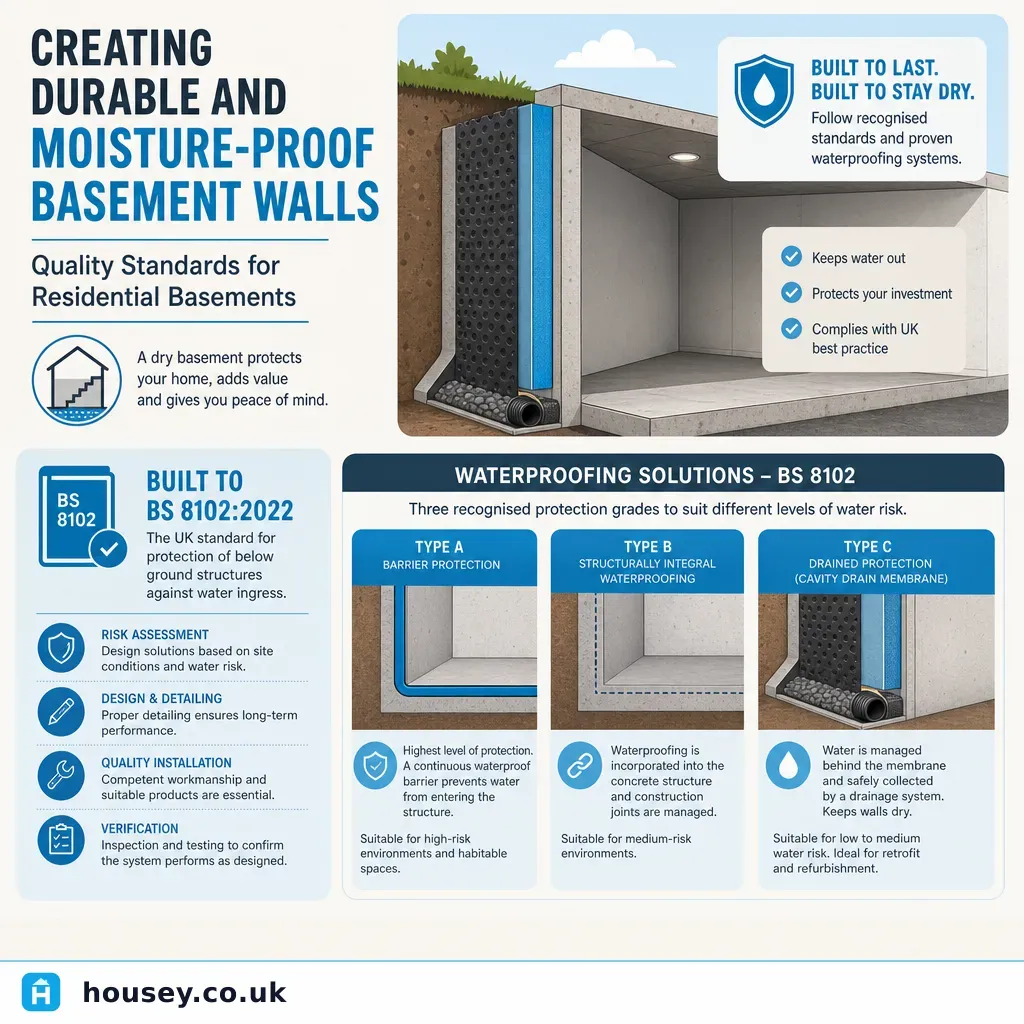
Creating Durable and Moisture-Proof Basement Walls: Quality Standards for Residential Basements
Basement waterproofing in UK homes must meet BS 8102:2022 requirements.
 Surveys & Inspections
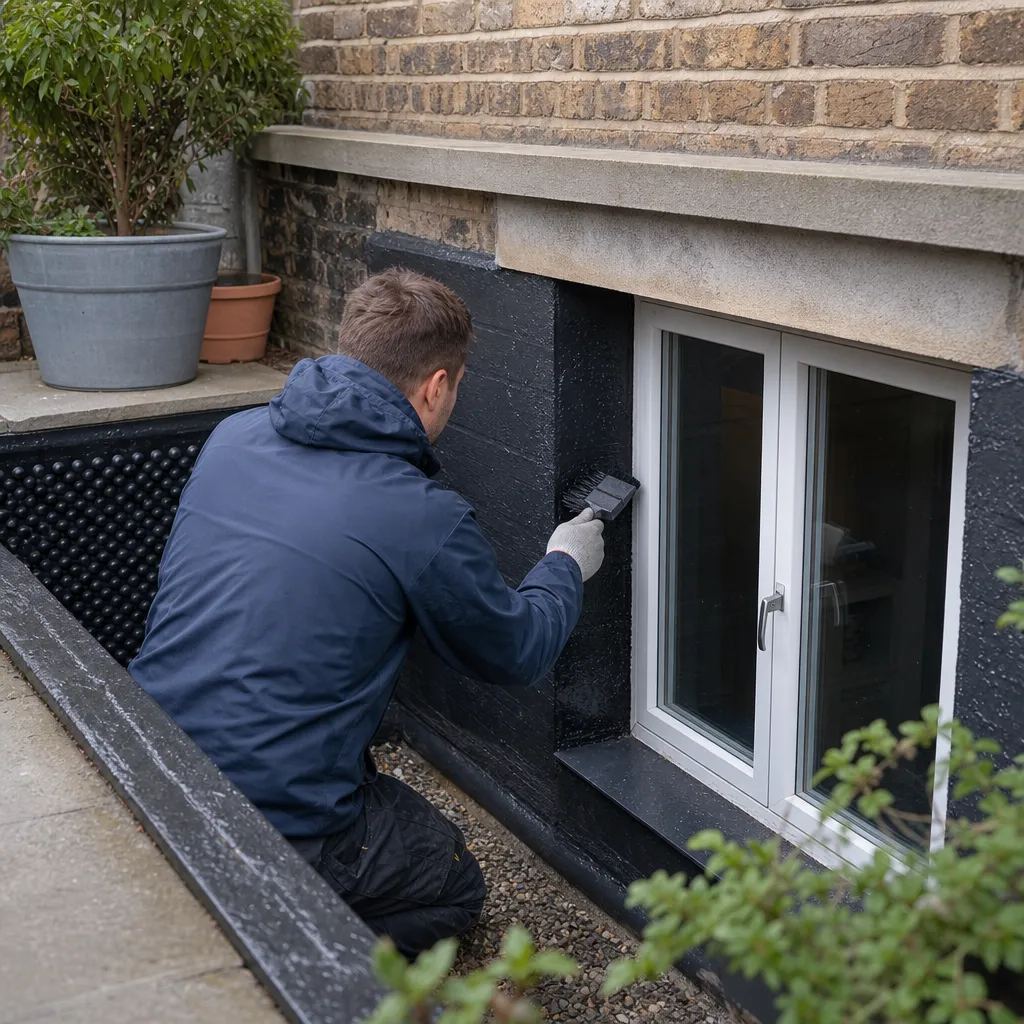
Securing Dry Basements: How to Prevent Moisture Intrusion
Preventing basement moisture starts with identifying the source: penetrating damp, rising damp, and condensation each need different fixes.
 Surveys & Inspections
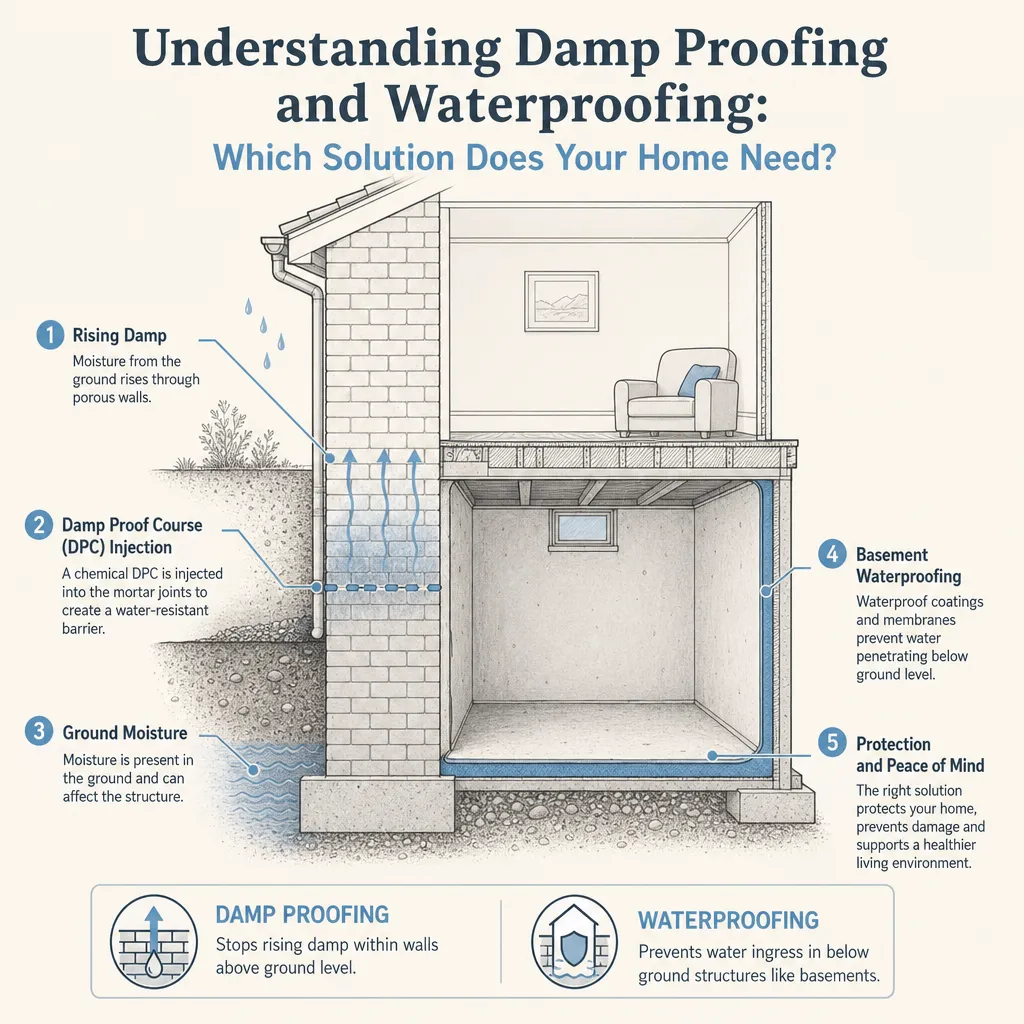
Understanding Damp Proofing and Waterproofing: Which Solution Does Your Home Need?
Damp proofing controls moisture movement through above-ground walls, while waterproofing excludes groundwater from below-ground structures.
 Surveys & Inspections
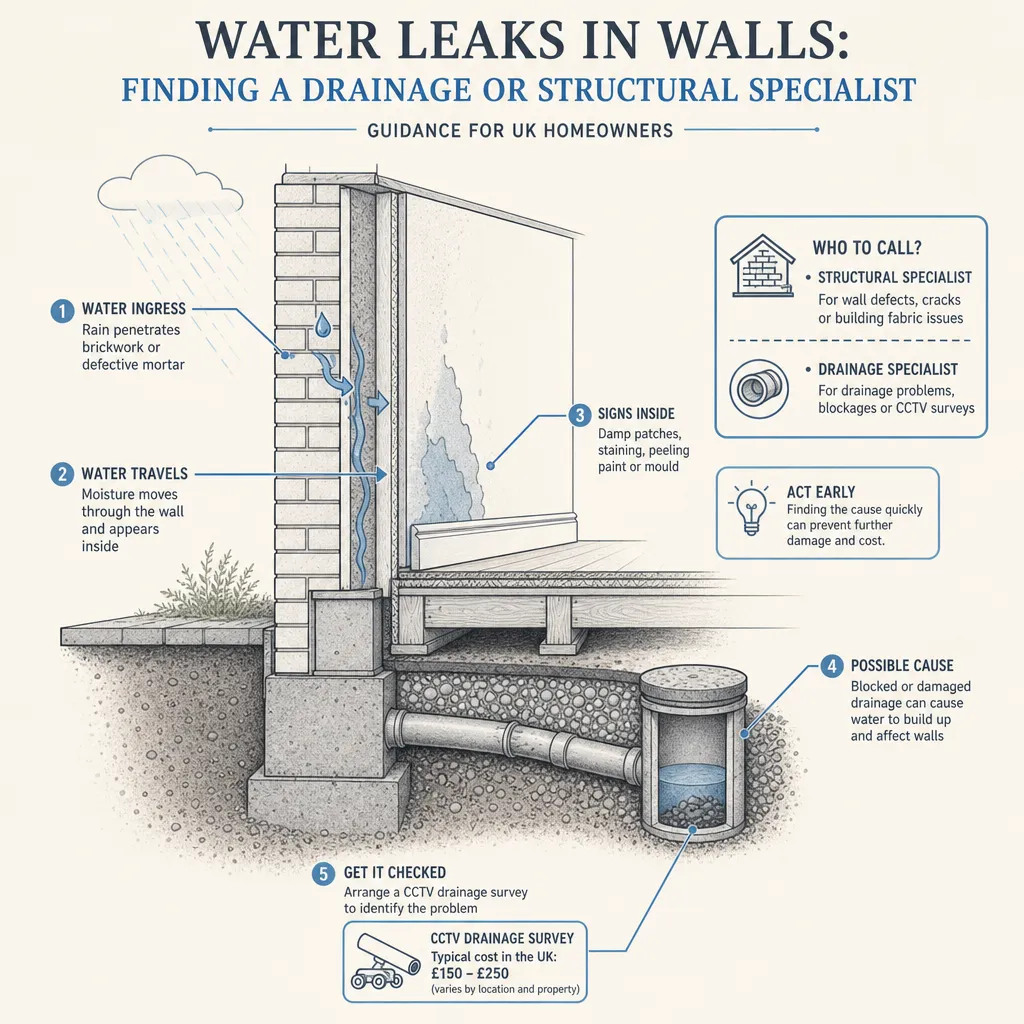
Water Leaks in Walls: Finding a Drainage or Structural Specialist
Water leaking through a wall can originate from a burst or leaking pipe, failed drainage, penetrating damp, a roof defect, or structural cracking.
 Surveys & Inspections
Fixing a Wet Garage Floor: Moisture Problems and Solutions
A wet garage floor in the UK is most commonly caused by condensation, rising damp through an unprotected concrete slab, or lateral groundwater ingress.