Water Leaks in Walls: Finding a Drainage or Structural Specialist
By Housey · Last reviewed 31st of May 2026
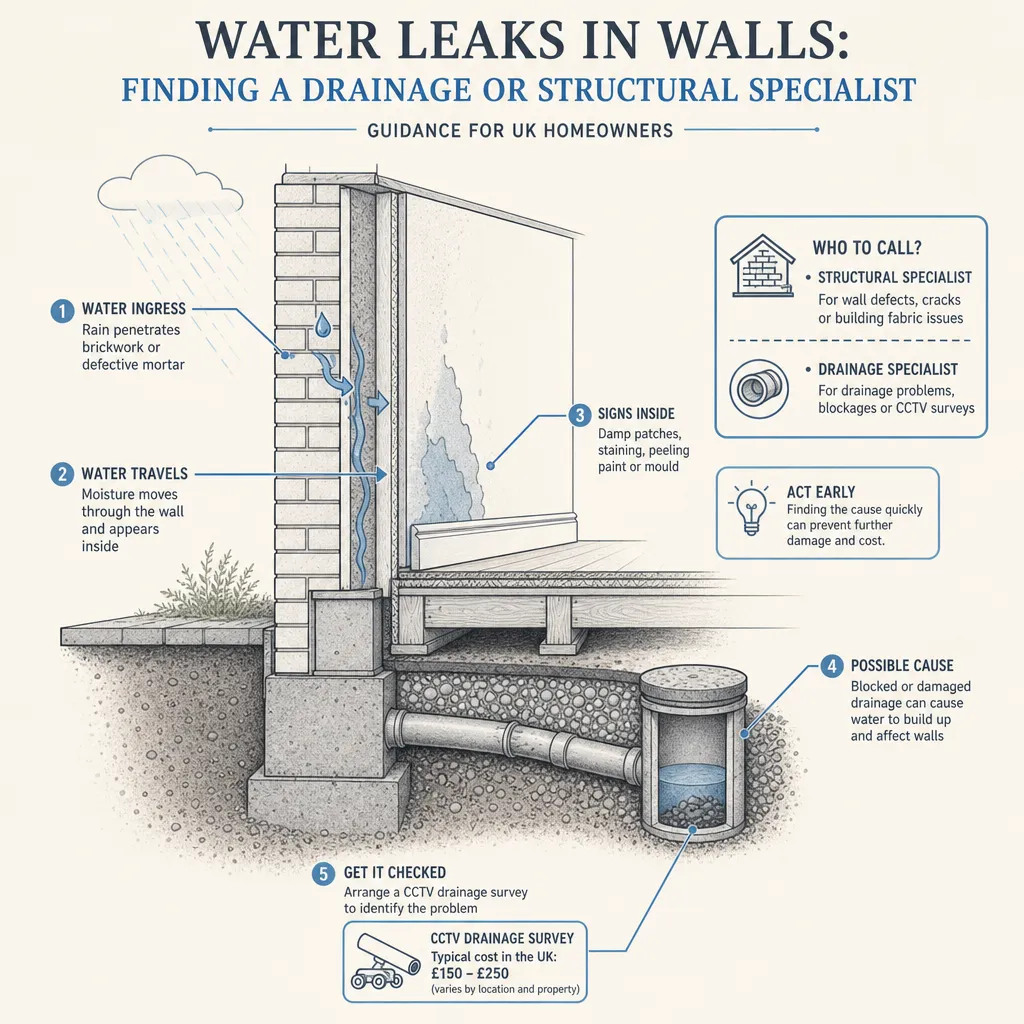
Water Leaks in Walls: Finding a Drainage or Structural Specialist
A spreading damp stain on an internal wall or ceiling carries real financial and structural consequences if left unaddressed. The difficulty for most UK homeowners is not deciding whether to act, but knowing which type of specialist to call first—and calling the wrong one can mean weeks of delay, unnecessary investigative costs, and a problem that continues to worsen. The water's origin determines everything, and it is rarely obvious from the stain alone.
Key points
- CCTV drainage surveys use camera equipment to inspect underground or concealed pipe runs and produce a condition report using industry-standard WRc defect coding; a typical domestic survey takes 2–4 hours.
- Horizontal wall cracks or cracks wider than 5 mm alongside a damp area warrant structural assessment before any repair work—they can indicate structural movement rather than simple moisture ingress.
- Building Regulations Approved Document H covers drainage design and repair; alterations to an existing drainage run that change its route or capacity may require building control notification.
- Leak detection specialists use thermal imaging cameras, acoustic correlators, and tracer gas to locate concealed pipe leaks without destructive investigation; many work directly with loss adjusters under building insurance trace-and-access cover.
- Water ingress behind plasterboard can trigger dry rot (Serpula lacrymans) within weeks in warm, poorly ventilated conditions; once established, dry rot spreads through masonry and must be treated by a specialist contractor.
What type of water ingress do I have?
Identifying the probable source is the most important first step, and it determines which specialist to contact.
Source | Typical signs | Worse after... | Likely specialist |
|---|---|---|---|
Leaking water or heating pipe | Wet patch present in all weather; water meter movement with taps off; warm damp area near hot pipe | Constantly present | Leak detection specialist or plumber |
Failed or blocked drainage | Damp at low level near a manhole or soil pipe; sewage smell | Heavy rainfall or heavy usage | Drainage engineer (CCTV survey) |
Penetrating damp or masonry failure | Damp linked to rainfall; appears on external wall; worse after prolonged rain | Heavy or prolonged rain | Damp and timber surveyor; structural surveyor |
Structural crack | Visible crack in masonry alongside damp; stepped or horizontal cracking; crack widens seasonally | Winter and spring | Structural surveyor or chartered building surveyor |
Decision tree: which specialist should I call first?
- Call a leak detection specialist if: the damp patch is on an internal wall with no external exposure, you suspect a concealed pipe, or your water meter continues to tick with all taps turned off.
- Commission a CCTV drainage survey if: the leak is near a soil pipe, manhole, or low-level ground-floor wall, there is a sewage smell, or the problem worsens significantly after heavy rainfall or heavy flushing.
- Instruct a structural surveyor if: there are visible cracks running through the affected area, the wall shows signs of movement (sticking doors, sloping floors), or the property is over 50 years old with no recent structural assessment.
- Start with a damp and timber survey if: you are unsure of the source, the problem has been ongoing for several weeks, or you want an independent triage report before committing to more specialist investigations.
- Contact your insurer first if: the damage is extensive, you suspect a sudden escape of water, or you want to confirm trace-and-access cover before instructing any professional.
What each specialist does
Drainage surveys
A drainage surveyor pushes a CCTV camera through the drainage system to inspect the internal condition of underground pipes, joints, and connections. The camera records video of the pipe interior, and the surveyor produces a condition report using WRc defect coding, identifying root ingress, collapsed sections, offset joints, and blockages. Where drainage failure is allowing water to saturate surrounding ground and migrate into wall foundations, a CCTV survey will confirm this clearly.
Indicative UK costs: £150–£350 for a standard CCTV drainage survey on a domestic property. Indicative costs, last reviewed 2026-05-31; quotes vary by drain length, access, and location.
Structural surveys
A chartered building surveyor or structural engineer assesses whether wall cracking or movement is the cause of water ingress, or a consequence of long-term water damage. A RICS Level 3 Home Survey includes structural assessment; a separate structural engineer's report provides more detailed load-path and movement analysis where a specific defect is suspected.
Leak detection
Specialist leak detection companies use thermal imaging, tracer gas, acoustic correlators, and endoscopic cameras to locate concealed leaks in pipework behind walls, under floors, or in roof voids without destructive opening up wherever possible. Many work directly with building insurance loss adjusters; trace-and-access clauses in building insurance policies often cover the cost of locating the leak source.
What not to assume
- Do not assume rising damp until penetrating damp and leaking pipes have been ruled out—rising damp is significantly less common than is often implied, and incorrect diagnosis results in unnecessary chemical injection works.
- Do not open up walls yourself before the source is confirmed—disturbing potentially dry rot-affected material releases spores and may create additional health hazards.
- Do not delay if cracks are present alongside the wet patch—water ingress and structural movement can reinforce each other rapidly in older masonry properties.
- Do not assume your insurer will cover drainage repair—most policies cover sudden escape of water but exclude gradual deterioration of drainage infrastructure. Read your policy schedule carefully before instructing anyone.
Important limitations
This article provides general guidance on identifying the type of professional needed for water leaks in walls. It does not constitute a structural assessment, drainage survey, or professional diagnosis for any specific property. Water ingress in walls can have multiple concurrent causes; a proper site inspection by a qualified professional is the only reliable way to confirm the source and appropriate remedy. Structural problems in particular can deteriorate rapidly and should always be assessed by a chartered building surveyor or structural engineer.
What to ask a qualified professional
Before instructing a drainage engineer, leak detection specialist, or structural surveyor:
- What method will you use to locate the source, and is the investigation non-destructive wherever possible?
- Are you a member of a recognised professional body such as RICS, NADC, TrustMark, or CHAS?
- Will you provide a written report with photographs and, where relevant, specific defect coding?
- If you identify the source, what does your repair process involve, and do you provide a guarantee?
- Can your report support a building insurance trace-and-access claim, and will you liaise directly with my insurer?
- If structural cracks are found, will you advise on whether a separate structural engineer's report is also needed?
When to get professional help
Act immediately if any of the following apply:
- The wet area is visibly growing day on day
- Cracks are running through the wet area of masonry—especially horizontal or stepped cracks through brickwork
- There is a sewage smell near the damp area
- Plasterboard has softened, bowed, or is showing signs of fungal growth—dry rot or wet rot may already be established
- The property is on the market and a buyer's survey is imminent
- You suspect water may be affecting a party wall—the Party Wall etc. Act 1996 may be relevant and adjacent properties could be at risk
How Housey can help
Housey matches you with qualified professionals for damp and timber surveys, CCTV drainage surveys, and structural surveys in your area. Describe your situation and receive quotes from vetted local specialists who can identify the source of your water ingress and advise on the right repair route.
Frequently asked questions
How much does it cost to find a water leak in a wall?
Leak detection surveys for concealed pipes typically cost £200–£500; CCTV drainage surveys cost £150–£350; and a RICS Level 3 Building Survey costs £600–£1,500 for a typical UK home. If your building insurance includes trace-and-access cover, the cost of locating (though not always repairing) the leak may be reimbursed. Indicative costs, last reviewed 2026-05-31.
Can I claim on building insurance for a water leak in a wall?
Building insurance typically covers sudden and unexpected escape of water—for example, a burst pipe. It generally does not cover gradual leaks, condensation, or drainage deterioration over time. Check your policy schedule for trace-and-access cover, which can pay for professional investigation when the leak source is concealed behind finishes.
How quickly can dry rot develop after a water leak?
Dry rot (Serpula lacrymans) can become established within weeks in warm, moist, poorly ventilated conditions. Once active, it spreads through masonry as well as timber and can cross non-wet material. Early intervention—fixing the moisture source and treating affected timber promptly—is considerably less expensive than remediating an advanced outbreak.
Do I need planning permission or building control approval to repair a leaking drain?
Like-for-like repair of a drain serving only your property does not generally require planning permission. Building Regulations Approved Document H may apply if the drainage run is altered, extended, or changed in capacity. For drains that cross property boundaries or are shared, consult your local authority building control team before beginning work.
Sources and further reading
- Building Regulations Approved Document H: drainage and waste disposal — GOV.UK
- RICS Home Survey Standard — Royal Institution of Chartered Surveyors
- Party Wall etc. Act 1996 — legislation.gov.uk
- HSE: timber decay guidance — Health and Safety Executive
- National Association of Drainage Contractors — NADC
Useful next reads
 Surveys & Inspections
Understanding Rodent Infestations and Property Damage
Rats and mice can cause significant property damage in UK homes, including gnawed electrical cables that create fire risk, damaged pipework causing hidden leaks, and burrowing near foundations in older properties.
 Surveys & Inspections
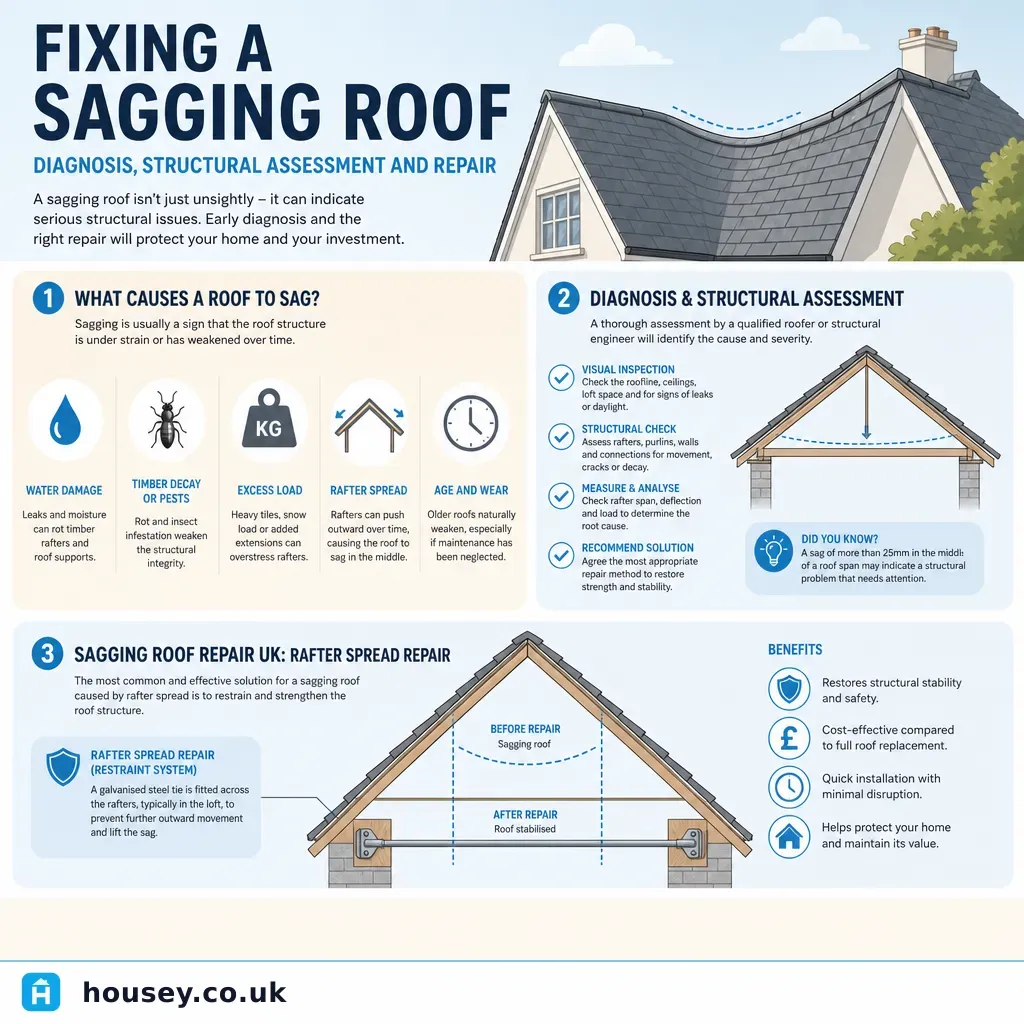
Fixing a Sagging Roof: Diagnosis, Structural Assessment and Repair
A sagging roof usually points to failed or overloaded roof timbers, rafter spread, or a compromised ridge board.
 Surveys & Inspections
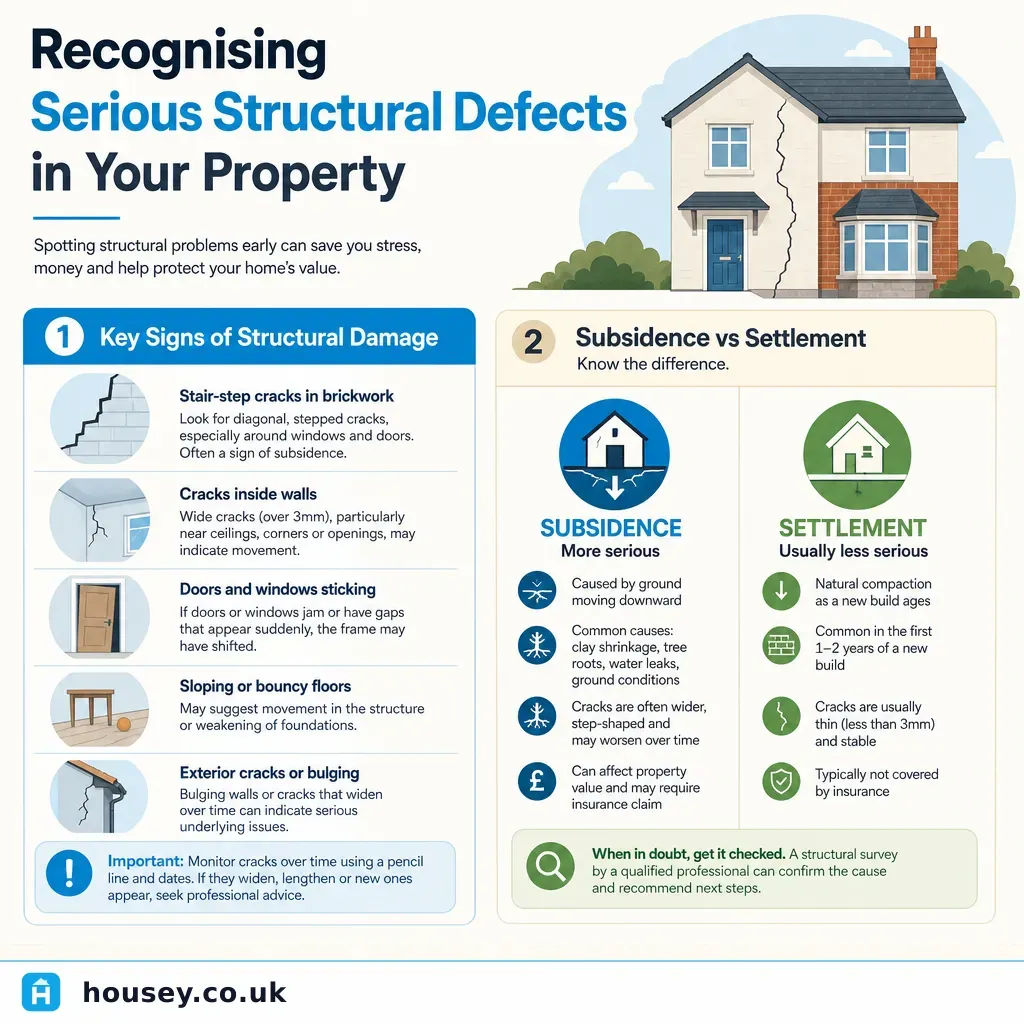
Recognising Serious Structural Defects in Your Property
Serious structural defects in UK homes include wide or diagonal cracks through brickwork, bowing or leaning walls, a sagging roof ridge, and floors or door frames notably out of level.
 Surveys & Inspections
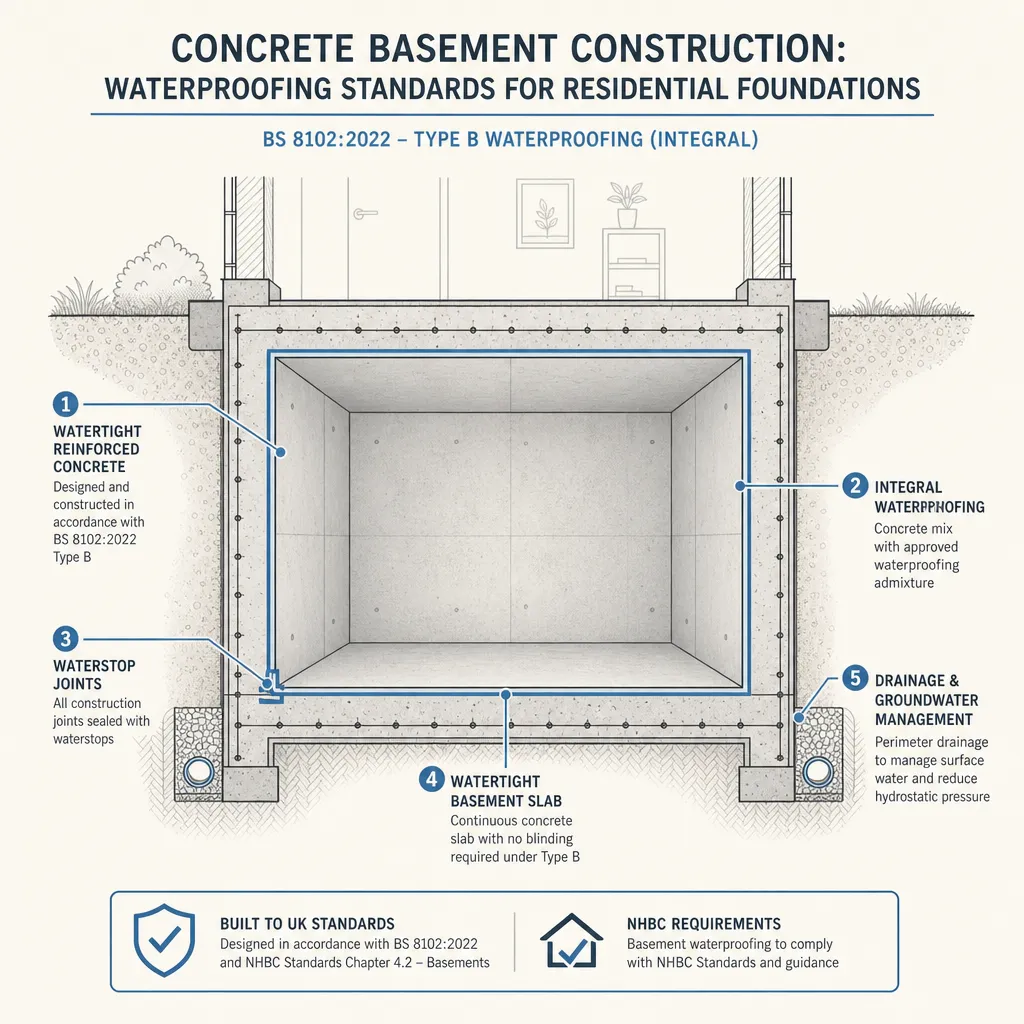
Concrete Basement Construction: Waterproofing Standards for Residential Foundations
Concrete basement waterproofing in the UK must comply with BS 8102:2022 and Building Regulations Part C.
 Surveys & Inspections
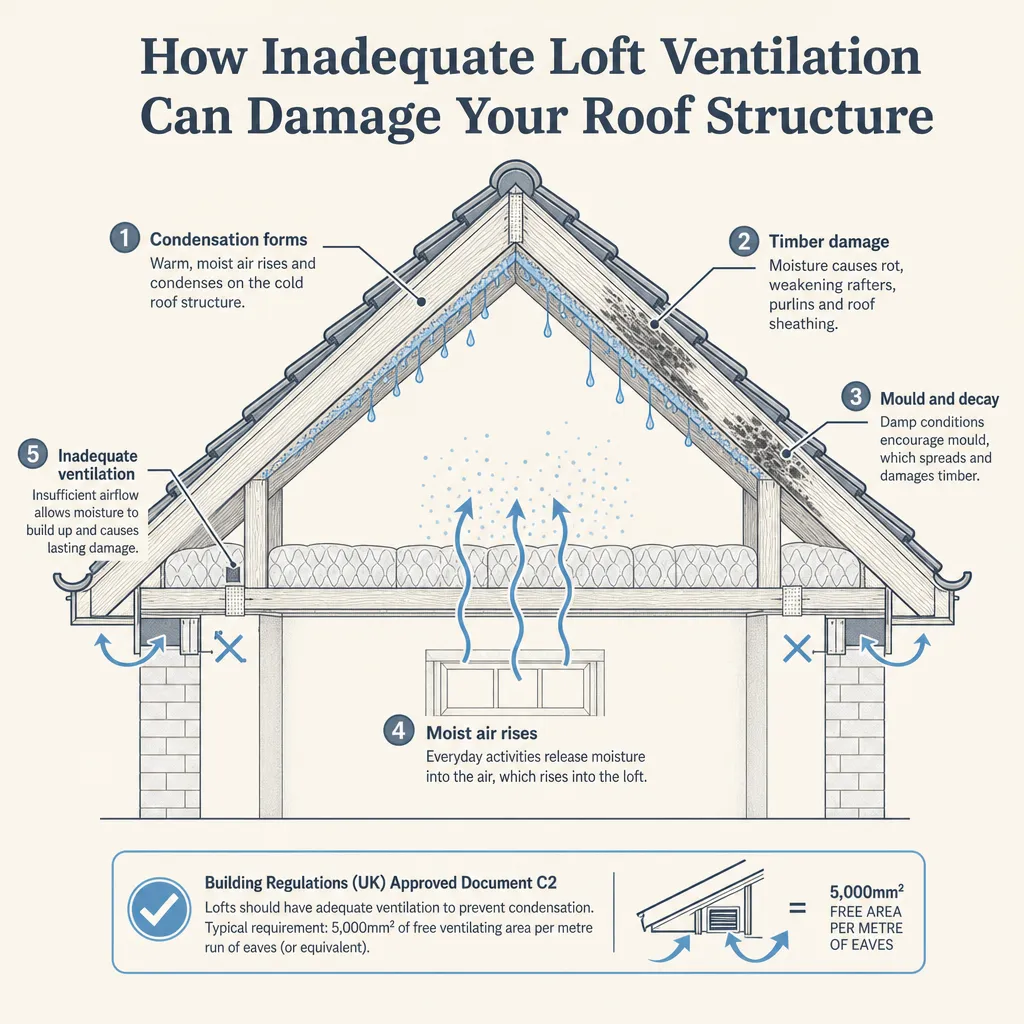
How Inadequate Loft Ventilation Can Damage Your Roof Structure
Inadequate loft ventilation allows warm, moist air to condense on cold roof timbers.