Understanding Damp Proofing and Waterproofing: Which Solution Does Your Home Need?
By Housey · Last reviewed 11th of May 2026
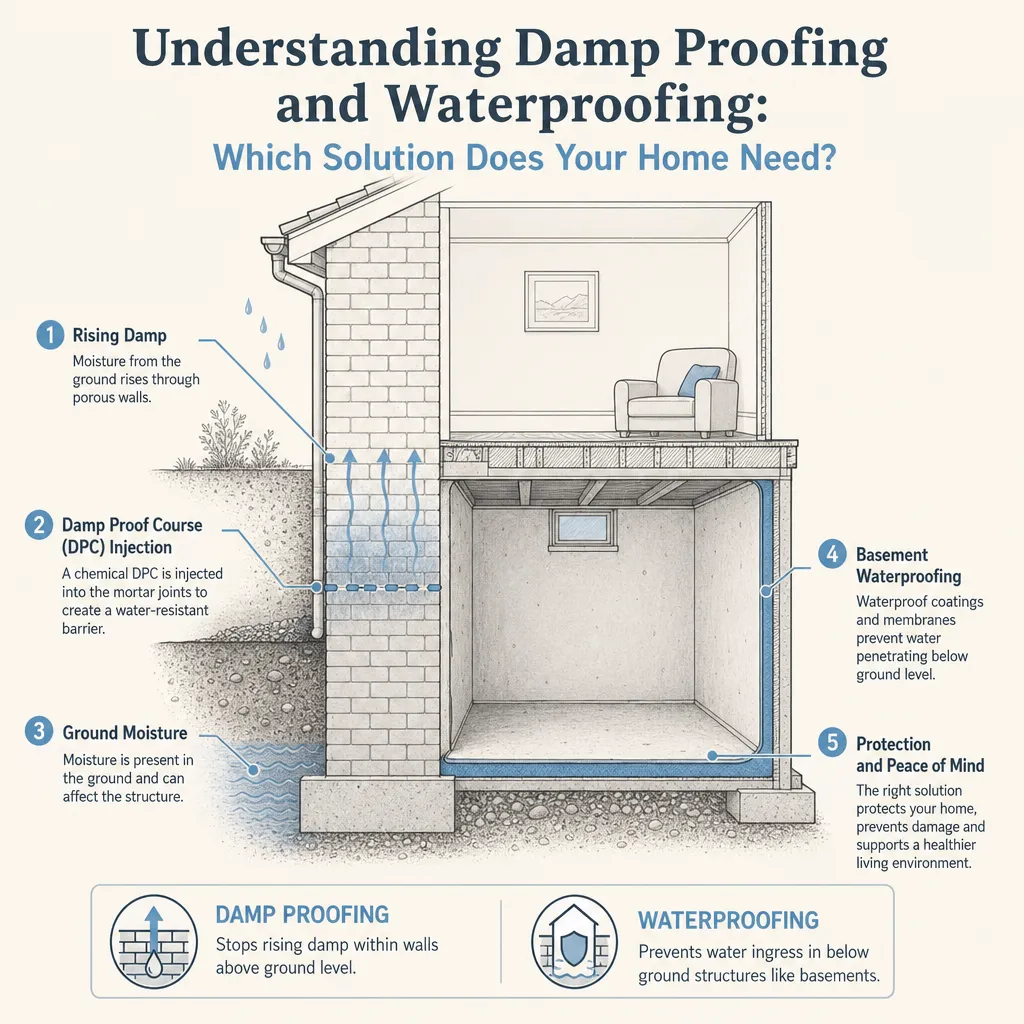
Understanding Damp Proofing and Waterproofing: Which Solution Does Your Home Need?
Damp is one of the most frequently misdiagnosed problems in UK housing. Older properties — Victorian terraces, Edwardian semis, pre-war solid-wall homes — are particularly prone, but the source of moisture and the appropriate remedy vary considerably depending on the damp type, the building's construction, and its history. Instructing the wrong treatment can be costly, ineffective, and in some cases cause more problems than it resolves.
Key points
- Rising damp (moisture travelling upward through masonry by capillary action) is relatively rare in practice; many properties diagnosed with rising damp are actually affected by penetrating damp, condensation, or a bridged damp proof course — each of which requires a different remedy.
- A damp proof course (DPC) is required under Building Regulations Approved Document C for all new-build properties; in homes built before approximately 1875 no DPC may exist, and in properties from 1875–1950 it may be slate, bitumen felt, or engineering bricks.
- The Property Care Association (PCA) is the principal trade body for specialist damp-proofing contractors in the UK; PCA-registered contractors can offer insurance-backed guarantees typically covering 20–30 years.
- Tanking (cementitious or resin-based slurry applied to wall and floor surfaces) and cavity drainage membrane systems are the two principal approaches to waterproofing a below-ground space such as a basement or cellar.
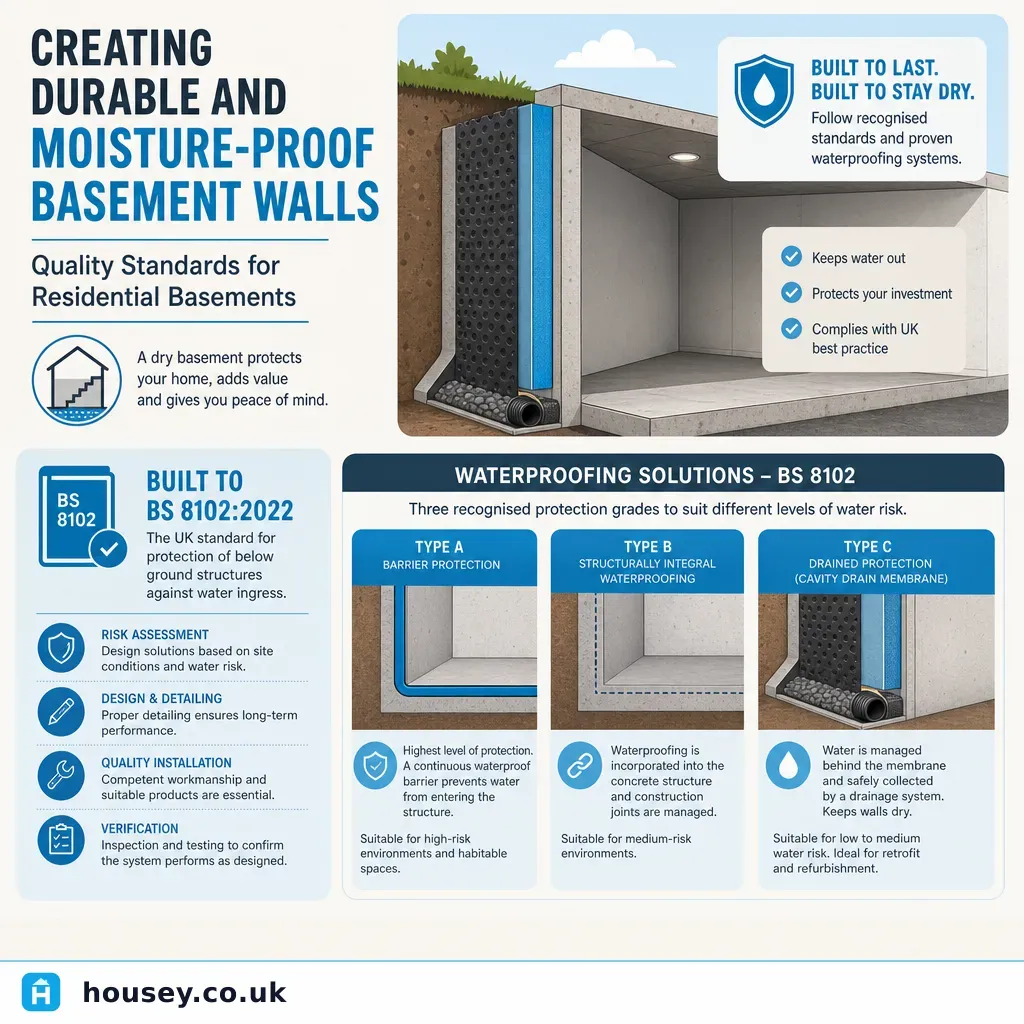
- British Standard BS 8102:2022 (Protection of below-ground structures against water from the ground) classifies waterproofing into Type A (barrier), Type B (structurally integral), and Type C (drained), and recommends combining types for Grade 3 (habitable) conditions.
Damp proofing vs waterproofing: what is the difference?
The terms are often used interchangeably, but they describe different interventions addressing different moisture problems.
| Damp proofing | Waterproofing |
|---|---|---|
Primary purpose | Controlling moisture movement through walls and floors at or above ground level | Excluding hydrostatic or groundwater pressure from below-ground or partly below-ground structures |
Typical applications | Rising damp treatment, DPC injection, DPC bridging remediation, surface replastering | Basement and cellar conversion, retaining walls, below-ground extensions |
Common methods | Chemical DPC injection, electro-osmotic DPC, DPC bridging correction | Tanking (Type A), cavity drain membrane (Type C), structural waterproof concrete (Type B) |
Relevant standard | BS 6576 (installation of chemical damp proof courses) | BS 8102:2022 (protection of below-ground structures) |
Typical professional | PCA-registered damp-proofing contractor | Specialist waterproofing contractor (CSSW qualified or equivalent) |
Building Regs notification | Not usually required for remedial work | Usually required for basement conversion and structural work |
Which type of damp does your home have?
Before any treatment is agreed, the type of damp must be correctly identified. Each has a different cause and a different remedy.
- Choose rising damp treatment only if a professional survey confirms upward capillary moisture movement, the existing DPC is absent or failed, and all other moisture sources have been ruled out. Genuine rising damp rarely rises more than 1–1.2 m above floor level.
- Choose penetrating damp remediation if moisture appears in localised patches on external walls and corresponds to areas of damaged pointing, failed flashings, defective guttering, or cracked render. Fix the external defect first — internal treatment without resolving the source will fail.
- Choose condensation management if moisture appears on cold surfaces (external walls, windows, north-facing rooms), is seasonal (worse in winter), and no external water source is evident. Condensation requires improved ventilation, insulation, or changes to heating patterns — not a chemical DPC.
- Choose basement waterproofing if a below-ground space has water ingress from ground or hydrostatic pressure and you wish to convert it to a usable dry space.
- Ask a specialist if you have multiple damp indicators, are planning a renovation, or a previous treatment has failed — several contributing factors often appear together in older UK properties.
What a professional damp survey involves
A credible professional damp survey should include:
- Visual inspection of all affected areas, plus an external inspection of the building envelope — gutters, flashings, pointing, render, and ground levels relative to the DPC.
- Moisture meter readings at multiple heights and across multiple wall surfaces; professional-grade instruments distinguish between different moisture profiles.
- Hygroscopic salt analysis where rising damp is suspected — the presence of chlorides and nitrates in the wall substrate indicates ground moisture movement.
- Review of property age and construction type — a pre-1919 solid-wall terraced house behaves differently from a 1970s cavity wall semi.
- Written report identifying moisture sources, probable causes, recommended treatment, and guarantee terms.
Be cautious of free surveys combined with a sales pitch for treatment — this is a well-documented issue in the damp-proofing sector, where condensation has historically been misdiagnosed as rising damp to justify more expensive remediation. An independent survey, where the surveyor does not carry out the remediation themselves, can provide a more objective view.
Damp proofing methods
Chemical DPC injection
A water-repellent chemical — typically silane, siloxane, or silicone-based — is injected or infused into a horizontal line of drilled holes in the masonry at DPC level, creating a hydrophobic barrier that resists capillary moisture movement. Governed by BS 6576. Work should be carried out by a PCA-registered contractor for the guarantee to be valid. Note that walls must be replastered with salt-resistant renovating plaster after injection — hygroscopic salts remain active in the substrate for 12–24 months after treatment.
DPC bridging remediation
In many UK properties the original DPC is intact but has been bridged — by raised external ground levels, patio slabs abutting the wall above DPC height, render applied below DPC level, or internal floor screed. Remediation involves lowering external ground levels, cutting back bridging render, or installing a French drain to the exterior. This is often more cost-effective than chemical injection and should always be investigated before chemical treatment is agreed.
Waterproofing methods
Type C — Cavity drainage membrane systems
A studded HDPE membrane is fixed to the internal wall and floor surfaces, creating a drainage cavity that channels any water entering the structure to a collection channel and sump pump. This is the most commonly used system for below-ground conversions in UK residential properties because it is tolerant of minor structural movement and manages water rather than attempting total exclusion. Design and specification should comply with BS 8102:2022.
Type A — Barrier (tanking)
A continuous waterproof membrane or cementitious slurry is applied to the internal or external face of the structure. The membrane must be fully continuous and properly tied into any floor waterproofing. A weakness of this approach is its reliance on substrate adhesion — ground movement or structural cracking can compromise the barrier.
Type B — Structural waterproofing
The structure itself — typically waterproof concrete to an engineered specification — is designed and built to exclude water. Used primarily in new-build basements and extensions. BS 8102:2022 recommends combining at least two protection types for basements used as habitable rooms (Grade 3), and at minimum a Type C system for storage use (Grade 1).
Red flags and common misdiagnoses
- Rising damp above 1.2 m — genuine rising damp almost never rises above approximately 1.2 m above floor level; moisture appearing higher is more likely penetrating damp or condensation.
- Damp appearing only in winter — typically condensation, which worsens in the heating season as warm moist air contacts cold surfaces; no DPC treatment will resolve this.
- Efflorescence on external walls — white salt deposits are most often a sign of penetrating damp or rainwater management failure, not rising damp.
- A survey recommending chemical injection without ruling out condensation or penetrating damp — always seek a second opinion before committing to treatment.
- Damp returning after replastering — hygroscopic salts remain in the substrate after DPC injection; salt-resistant renovating plaster must be used, not standard finishing plaster.
- Structural timbers showing discolouration near a damp zone — wet rot or dry rot can develop quickly in persistently damp conditions and must be assessed by a specialist.
When to get professional help
Always instruct a qualified professional before committing to any damp treatment. Incorrect diagnosis is common and can be expensive to undo.
Seek professional advice without delay if:
- You have visible mould growth on walls or ceilings — this may have health implications, particularly for vulnerable occupants, and the cause must be properly identified.
- Structural timbers such as floor joists, wall plates, or timber lintels are in or near the damp zone — wet rot and dry rot can cause serious structural damage if left unchecked.
- You are buying a property with a damp issue — a RICS Level 3 survey or specialist damp survey before exchange of contracts can identify extent and likely remediation cost.
- You are planning a basement conversion — a designed waterproofing system to BS 8102:2022 is required, and poorly specified work is a major source of long-term defects.
- A previous chemical DPC treatment has failed — re-treatment requires understanding why the original treatment did not hold.
How Housey can help
Housey can connect you with independent specialists for a damp and timber survey to identify the type and source of moisture before any work is agreed. Where treatment is confirmed as necessary, we can also match you with damp proofing specialists experienced in PCA-standard remediation across the UK.
Frequently asked questions
Is chemical DPC injection always the right fix for damp walls?
Not necessarily. Chemical injection is appropriate for confirmed rising damp where the DPC is absent or failed and all other moisture sources have been excluded. It is frequently over-prescribed where the real cause is condensation, penetrating damp, or a bridged DPC — each requiring a different, often less expensive, solution. An independent survey before agreeing treatment is strongly advisable.
How much does damp proofing cost in the UK?
Costs vary by method, extent, and property type. Chemical DPC injection for a typical terrace house may range from £800 to £2,500 including replastering. Basement waterproofing with a Type C cavity drainage system typically costs £4,000 to £15,000 or more depending on floor area and specification. Indicative UK costs, last reviewed 2026-05-11. Obtain at least two to three quotes from PCA-registered contractors.
Does damp proofing work require planning permission?
Remedial damp proofing — chemical injection, DPC bridging remediation, or internal replastering — does not normally require planning permission or building regulations approval. Basement conversion involving structural work, a change of use to habitable rooms, or significant excavation will typically require both planning permission and building regulations notification. Check with your local authority.
What is the difference between rising damp and penetrating damp?
Rising damp is moisture travelling upward through masonry by capillary action from ground-level water; it typically presents as a tide mark 0.5–1.2 m above floor level with hygroscopic salt contamination. Penetrating damp is moisture driven horizontally through the building fabric from an external defect — failed pointing, cracked render, blocked gutters, or defective flashings — and can appear at any height.
How do I find a trustworthy damp specialist?
Look for membership of the Property Care Association (PCA), which requires members to hold relevant qualifications, carry appropriate insurance, and comply with a code of conduct. PCA-registered contractors can offer insurance-backed guarantees. Be cautious of contractors offering free surveys combined with high-pressure recommendations for expensive chemical treatment without a written independent diagnosis.
Sources and further reading
- GOV.UK — Approved Document C: Site preparation and resistance to contaminants and moisture — GOV.UK
- Property Care Association — Property Care Association
- BS 8102:2022 — Protection of below-ground structures against water from the ground — BSI
- BS 6576 — Code of practice for installation of chemical damp proof courses — BSI
- RICS Home Survey Standard — RICS
- Citizens Advice — Problems with damp and mould — Citizens Advice
Useful next reads
 Surveys & Inspections
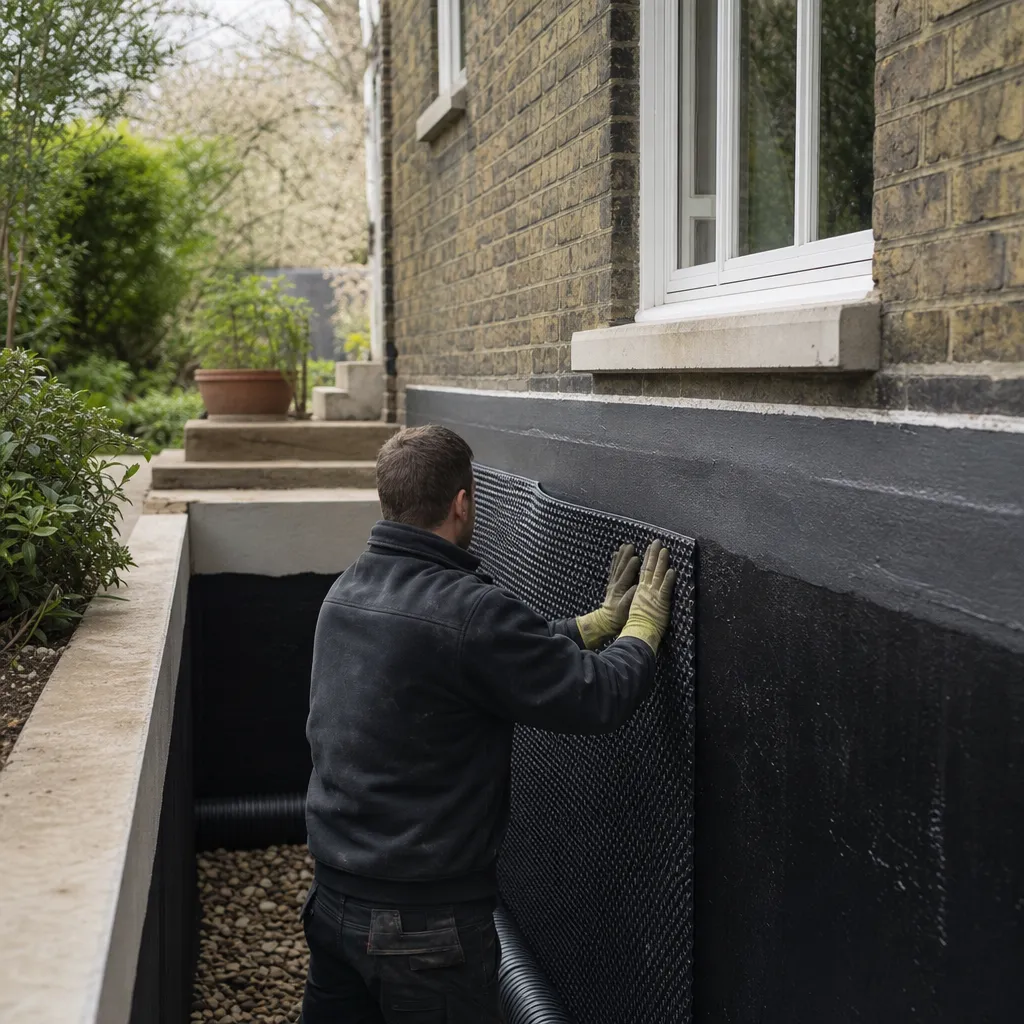
Basement Waterproofing Solutions for Damp Prevention
Basement waterproofing in the UK is governed by BS 8102:2022, which defines three system types: Type A (barrier coatings), Type B (structurally integral concrete), and Type C (cavity drain membrane with sump pump).
 Surveys & Inspections
Creating Durable and Moisture-Proof Basement Walls: Quality Standards for Residential Basements
Basement waterproofing in UK homes must meet BS 8102:2022 requirements.
 Surveys & Inspections
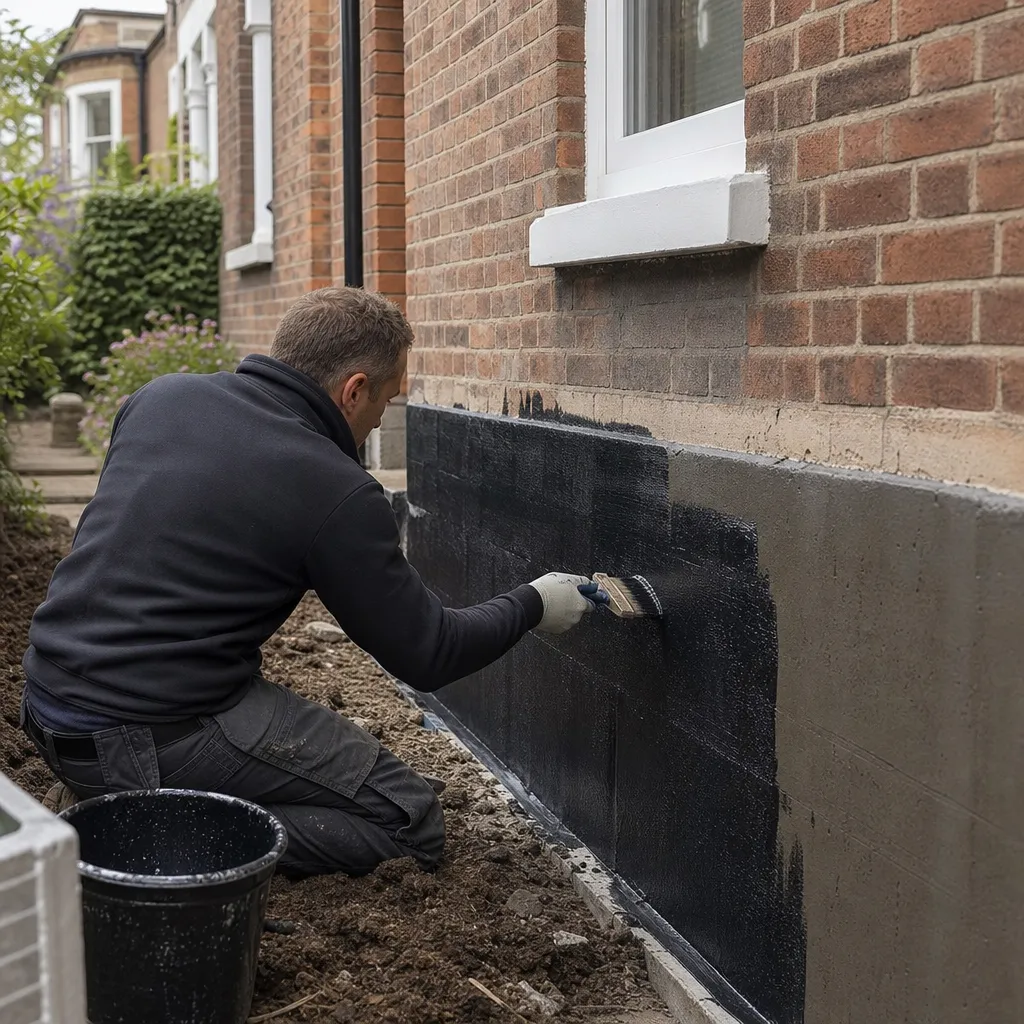
Creating Watertight Walls: Waterproofing Methods and Materials
Waterproofing walls correctly requires diagnosing the moisture source first — rising damp, penetrating damp, and condensation are treated very differently.
 Surveys & Inspections
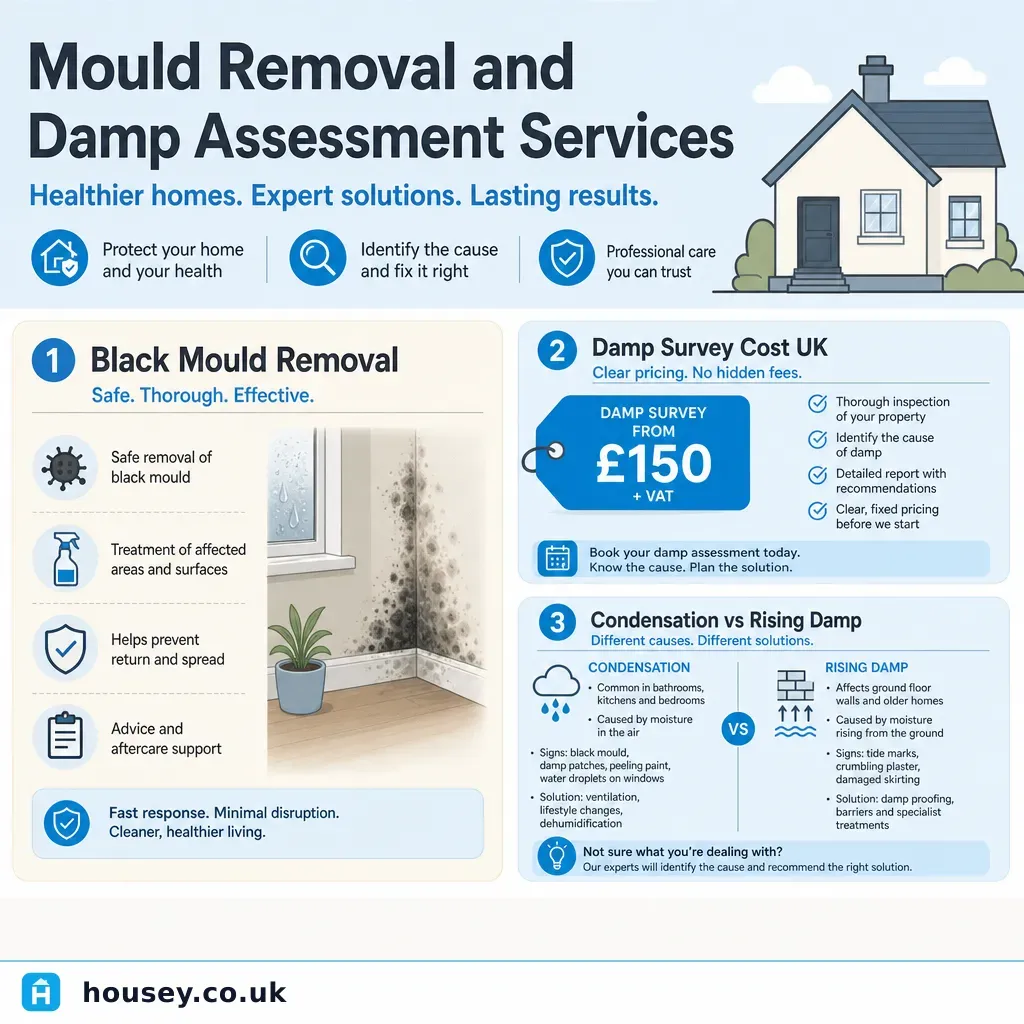
Mould Removal and Damp Assessment Services
Professional mould removal and damp assessment starts with identifying the moisture source—condensation, rising damp, or penetrating damp—before any treatment begins.
 Surveys & Inspections
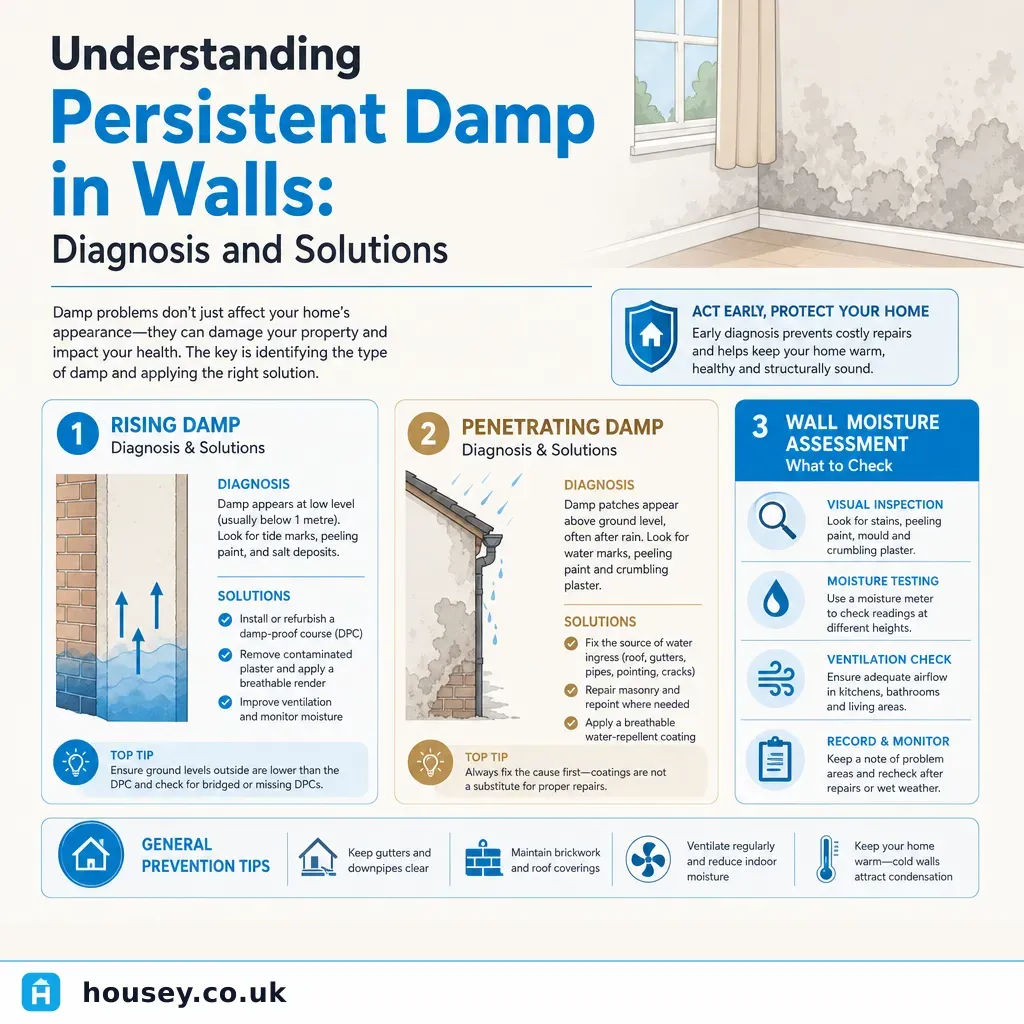
Understanding Persistent Damp in Walls: Diagnosis and Solutions
Persistent wall damp in UK homes most commonly stems from penetrating damp, rising damp, or condensation — and these are frequently confused with one another.