Securing Dry Basements: How to Prevent Moisture Intrusion
By Housey · Last reviewed 24th of May 2026
Securing Dry Basements: How to Prevent Moisture Intrusion
Basement moisture is one of the most misdiagnosed problems in UK homes. Whether you are planning a cellar conversion, investigating a persistent damp smell, or reviewing a survey report that has flagged water ingress, understanding what is actually causing the moisture matters more than the choice of product or treatment. Get the diagnosis wrong and even expensive waterproofing systems can fail within a few years.
Key points
- BS 8102:2022 (Code of Practice for Protection of Below Ground Structures Against Water from the Ground) is the British Standard governing basement waterproofing design and specification in the UK.
- The standard defines three system types: Type A (barrier protection, such as tanking slurry and cementitious coatings), Type B (structurally integral waterproofing within the concrete mix), and Type C (drained cavity membrane systems that manage water rather than block it).
- BS 8102:2022 defines four grades of internal environment — Grade 1 (car parking) through to Grade 4 (clean rooms and archives) — and the target grade must be established before any system is specified.
- Condensation is frequently misdiagnosed as penetrating damp; the two look similar but require completely different interventions.
- The Property Care Association (PCA) maintains a register of surveyors holding the CSSW qualification (Certificated Surveyor in Structural Waterproofing), who are trained to specify and sign off BS 8102-compliant systems.
What is actually causing your basement moisture?
Before any waterproofing work is commissioned, the source of moisture must be identified. Three distinct mechanisms produce similar-looking symptoms inside a basement:
Moisture source | Typical signs | Likely approach |
|---|---|---|
Penetrating damp (hydrostatic pressure) | Tide marks and wet patches after rainfall, white salt deposits (efflorescence), dampness concentrating at wall–floor junctions | Type A tanking or Type C cavity drain membrane |
Rising damp | Damp line typically up to around 1 m above floor level, salt deposits, deteriorating plaster at low level | Chemical damp-proof course injection, replastering with salt-resistant render |
Condensation | Mould at cold junctions such as corners and window reveals, no direct correlation with rainfall | Improved insulation, mechanical ventilation (MVHR or positive input ventilation) |
Active ingress through cracks or voids | Dripping water, visible tracking along cracks or through formwork tie holes | Crack injection, re-pointing, or Type C cavity drain system |
Applying tanking slurry over an active hydraulic leak without addressing the external drainage or structural crack is a common and expensive mistake — a diagnostic survey helps avoid it.
Understanding BS 8102:2022 waterproofing systems
Type A — Barrier protection (tanking)
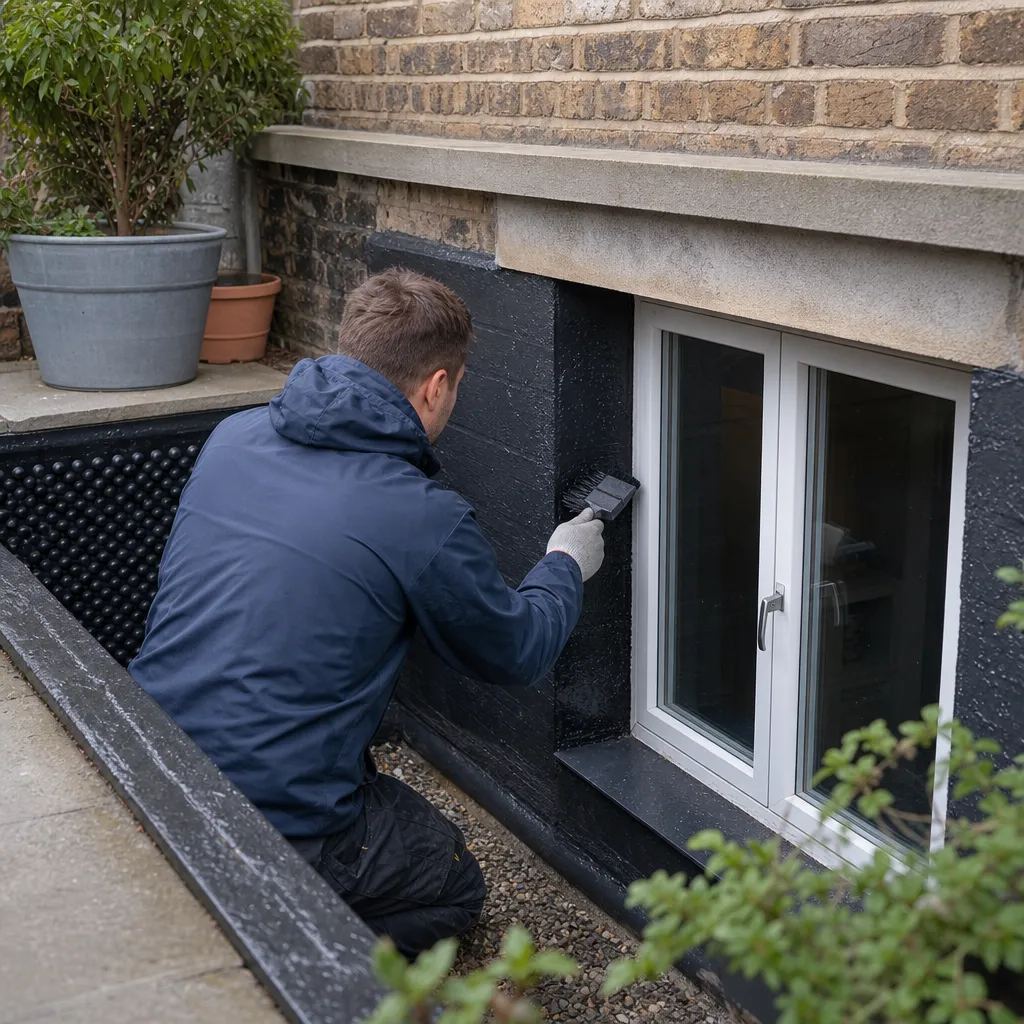
Type A systems physically block water from entering the structure using an applied membrane or coating. Common options in UK residential practice include cementitious tanking slurry, crystalline waterproofing compounds that penetrate the masonry matrix, and bitumen sheet membranes applied externally to new foundations.
Type A systems require the substrate to be structurally sound and capable of resisting hydrostatic pressure from behind. They are vulnerable if the structure cracks or if the coating is poorly applied over contaminated or honeycombed masonry. Generally best suited to moderate water tables and Grade 1–2 environments.
Type C — Drained cavity membrane systems
Rather than blocking water, Type C systems collect and manage it. A profiled high-density polyethylene (HDPE) membrane is fixed to internal walls and floor, creating a drainage void. Water that enters is channelled to a sump and expelled by a submersible pump fitted with a float switch and ideally a battery backup alarm.
Type C is the most commonly specified retrofit solution in UK below-ground basements. It tolerates minor structural movement, does not require a completely dry substrate before installation, and can contribute to Grade 3 habitable space when combined with insulation boards. BS 8102:2022 recommends that for Grade 3 habitable use, Type C is combined with Type A or Type B elements to reduce the volume of water entering the drainage void.
Homeowner moisture prevention checklist
These measures can reduce moisture risk before major works are needed. Check each item before commissioning a specialist:
Red flags: when to call a specialist
These signs indicate a problem beyond routine maintenance:
- Water entering visibly during or within hours of heavy rainfall — indicating fast-path ingress through cracks or failed pointing.
- Efflorescence reappearing after cleaning — confirming ongoing water movement through the wall structure.
- Structural cracking in the floor slab or walls, particularly stepped cracks through brick or blockwork joints, which may indicate foundation movement.
- A rising damp tide mark that has increased in height since the property was last inspected.
- Musty, sulphurous, or earthy odours persisting despite ventilation improvement.
- Visible failure of previous waterproofing — blistered membranes, debonded coatings, or rust staining beneath damp patches.
- Plans to convert the basement to habitable use — this typically requires a designed system and building regulations approval.
Important limitations
This article provides general information about basement moisture prevention based on BS 8102:2022 and guidance published by the Property Care Association. Basement moisture is a complex, site-specific problem. The appropriate specification depends on soil type, groundwater depth, structural construction, property age, and the intended use of the space. A qualified specialist should always survey the property and prepare the specification. This article is not a structural or waterproofing survey and should not replace professional assessment.
When this becomes urgent
Contact a qualified professional immediately if:
- Water is visibly entering a basement that you or a tenant occupy as habitable space.
- Structural cracking has appeared alongside moisture — movement must be professionally assessed before any waterproofing works proceed.
- A RICS-registered surveyor's report has classified basement moisture as a Category 3 defect requiring urgent investigation.
- You are approaching exchange of contracts on a property with a known basement moisture issue and have not yet obtained a specialist survey.
What to ask a qualified professional
Before instructing a waterproofing contractor or damp surveyor:
- What is the identified moisture source, and how was this determined?
- Which BS 8102:2022 waterproofing type are you specifying, and why is it appropriate for this property and water table?
- What Grade (1–4) of internal environment are you designing to?
- Are you a member of the Property Care Association and do you hold the CSSW qualification?
- Will the proposed works require building regulations approval?
- What guarantee does the work carry, and is it backed by an insured structural waterproofing warranty?
- If a sump pump is included, is there an alarm and battery backup provision?
- What maintenance does the system require annually, and at what indicative cost?
How Housey can help
Housey connects you with local professionals offering damp and timber surveys to diagnose the moisture source before any works are committed to, and damp proofing specialists who can specify and install a BS 8102:2022-compliant system. Request and compare quotes from multiple vetted specialists before instructing anyone.
Frequently asked questions
Do I need building regulations approval for basement waterproofing?
Building regulations approval is generally required when converting a basement to habitable use, as this constitutes a material change of use and the works must comply with Parts A, C, E, F, and L of the Building Regulations. Remedial waterproofing to an already-habitable basement may not need approval — confirm with your local building control authority before starting significant works.
How long does a cavity drain membrane system last?
HDPE cavity drain membranes are designed to last the life of the building if correctly installed. The sump pump typically requires servicing every one to two years and replacement approximately every 10 years. Many warranty providers require documented pump maintenance to keep the structural waterproofing guarantee valid, so factor in ongoing maintenance costs when comparing system quotes.
Can basement waterproofing be done from the inside?
Yes — internal waterproofing using Type A tanking or a Type C cavity drain membrane is the most common retrofit approach in UK properties where external excavation is impractical or uneconomical. It can be highly effective when correctly specified, though the sump pump requires ongoing maintenance and the external cause of water ingress is not removed.
What is efflorescence and is it serious?
Efflorescence is the white crystalline deposit left when water moves through masonry, evaporates, and leaves dissolved salts on the surface. Its presence confirms that water is actively migrating through the structure. It is not immediately structurally dangerous but warrants professional investigation — simply cleaning it off without addressing the underlying moisture movement will not resolve the problem.
Sources and further reading
Useful next reads
 Surveys & Inspections
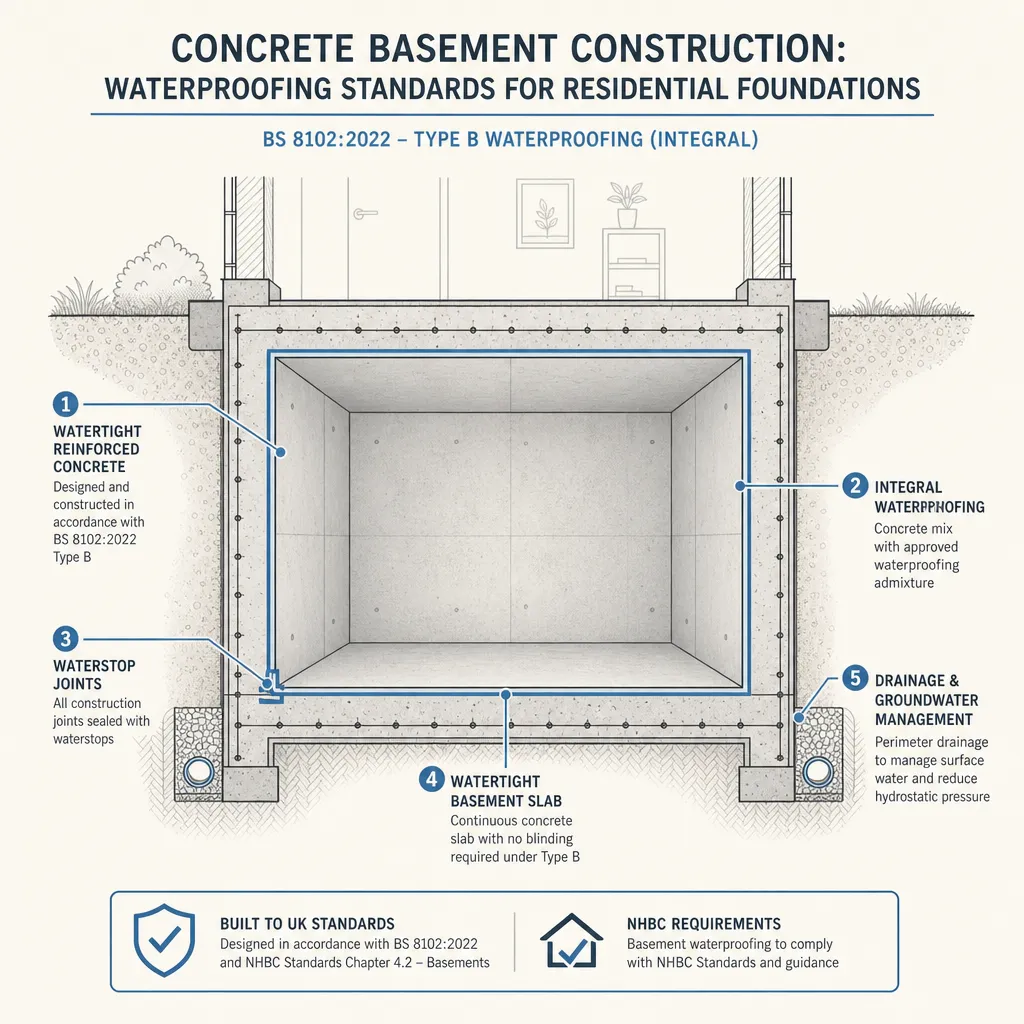
Concrete Basement Construction: Waterproofing Standards for Residential Foundations
Concrete basement waterproofing in the UK must comply with BS 8102:2022 and Building Regulations Part C.
 Surveys & Inspections
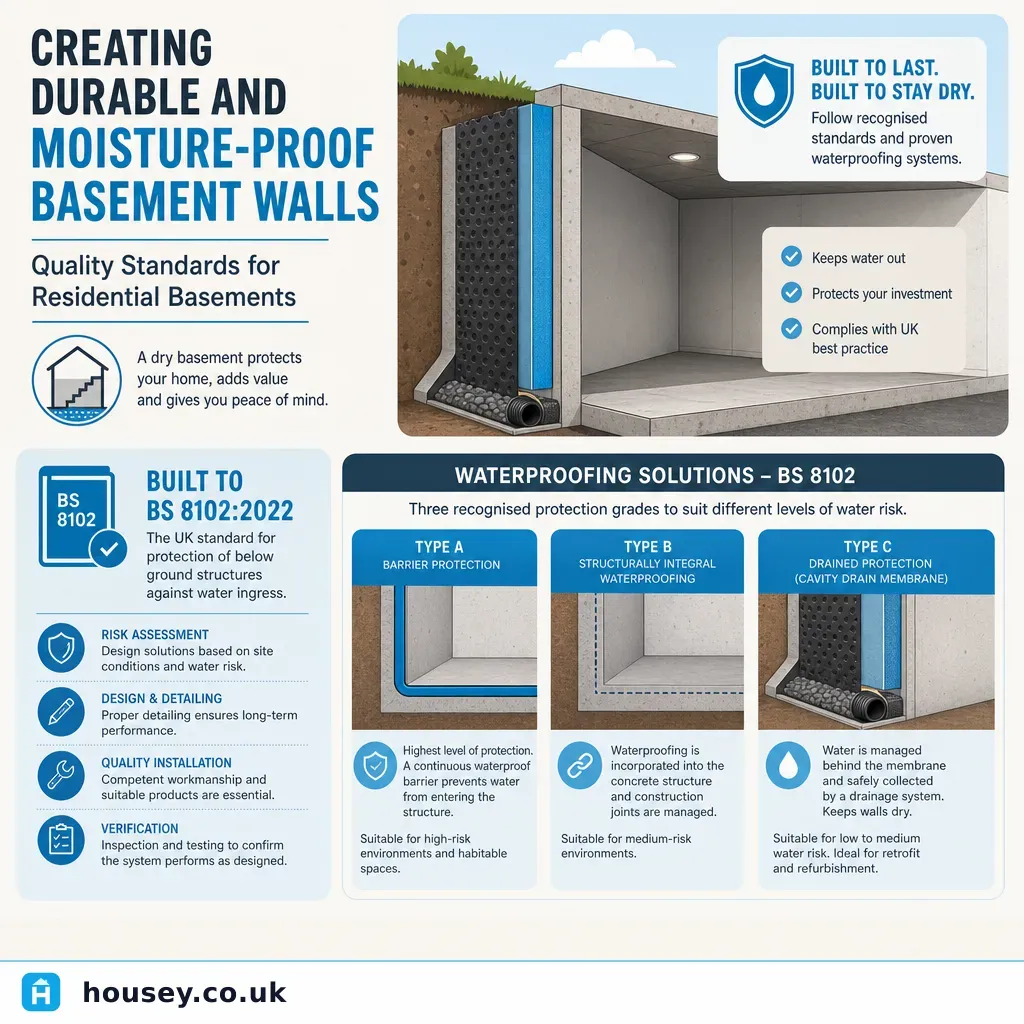
Creating Durable and Moisture-Proof Basement Walls: Quality Standards for Residential Basements
Basement waterproofing in UK homes must meet BS 8102:2022 requirements.
 Surveys & Inspections
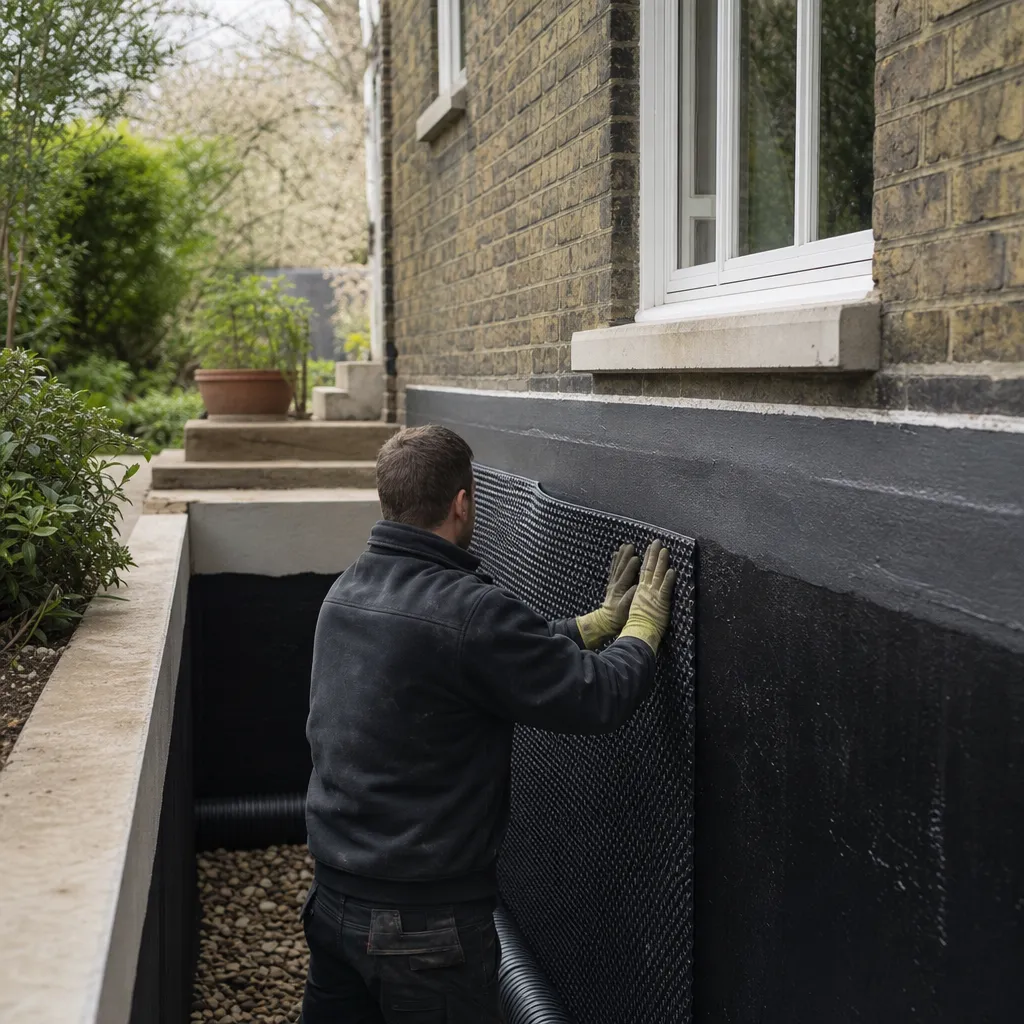
Basement Waterproofing Solutions for Damp Prevention
Basement waterproofing in the UK is governed by BS 8102:2022, which defines three system types: Type A (barrier coatings), Type B (structurally integral concrete), and Type C (cavity drain membrane with sump pump).
 Surveys & Inspections
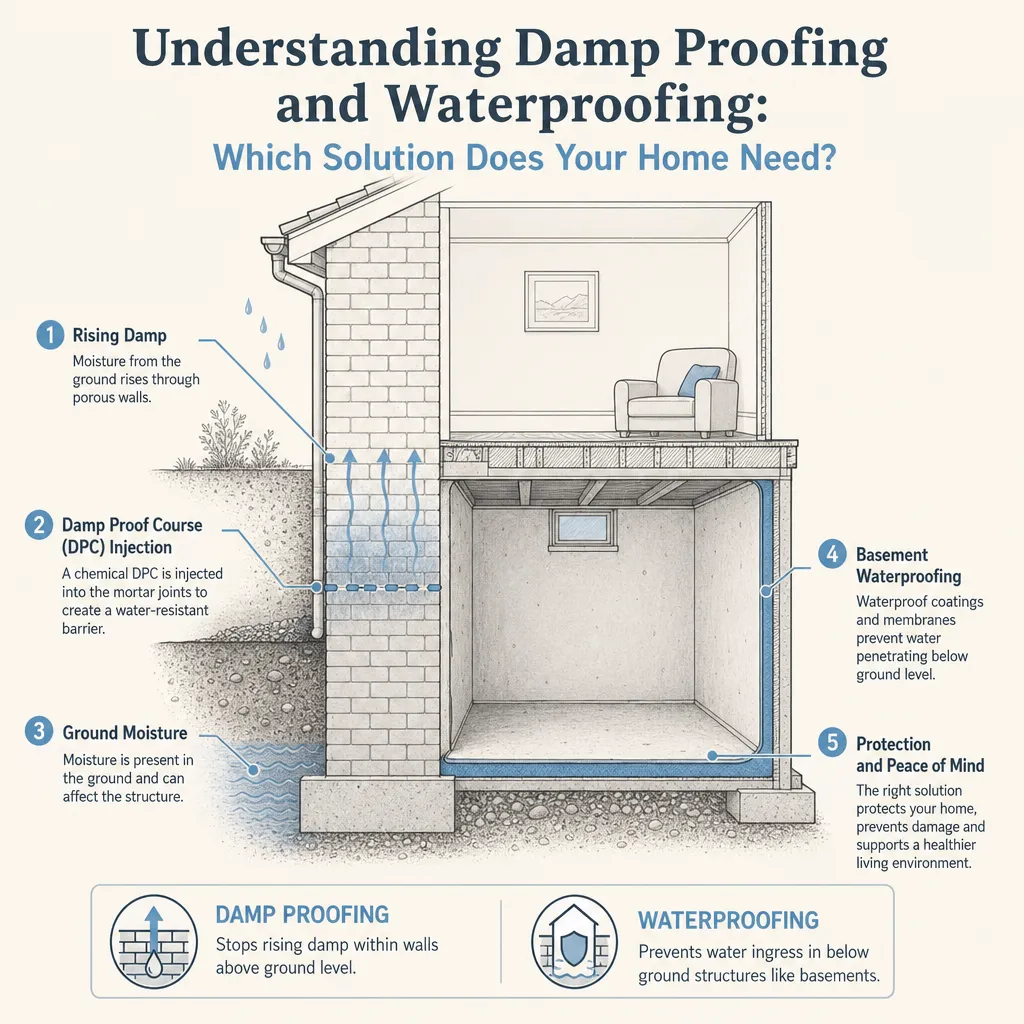
Understanding Damp Proofing and Waterproofing: Which Solution Does Your Home Need?
Damp proofing controls moisture movement through above-ground walls, while waterproofing excludes groundwater from below-ground structures.
 Surveys & Inspections
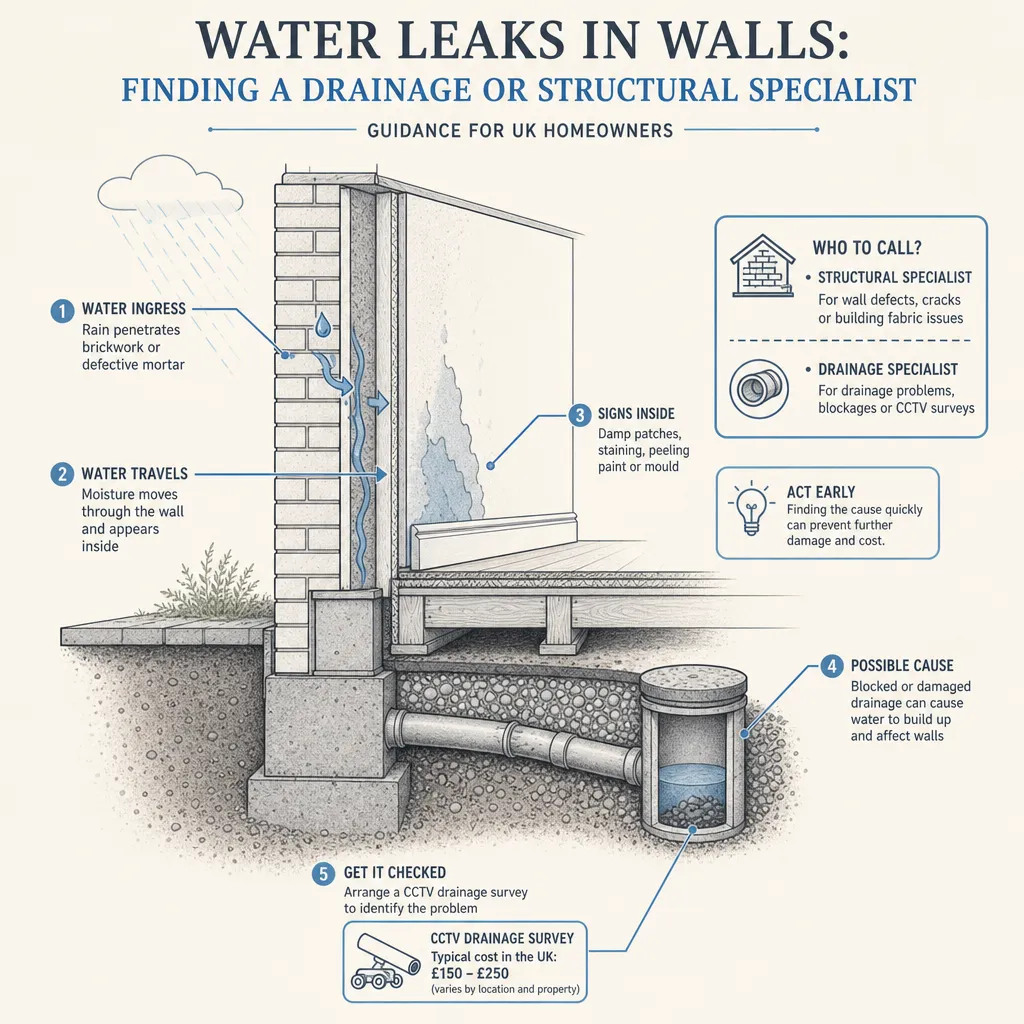
Water Leaks in Walls: Finding a Drainage or Structural Specialist
Water leaking through a wall can originate from a burst or leaking pipe, failed drainage, penetrating damp, a roof defect, or structural cracking.