Concrete Contractor Responsibilities: Services and Scope
By Housey · Last reviewed 31st of May 2026
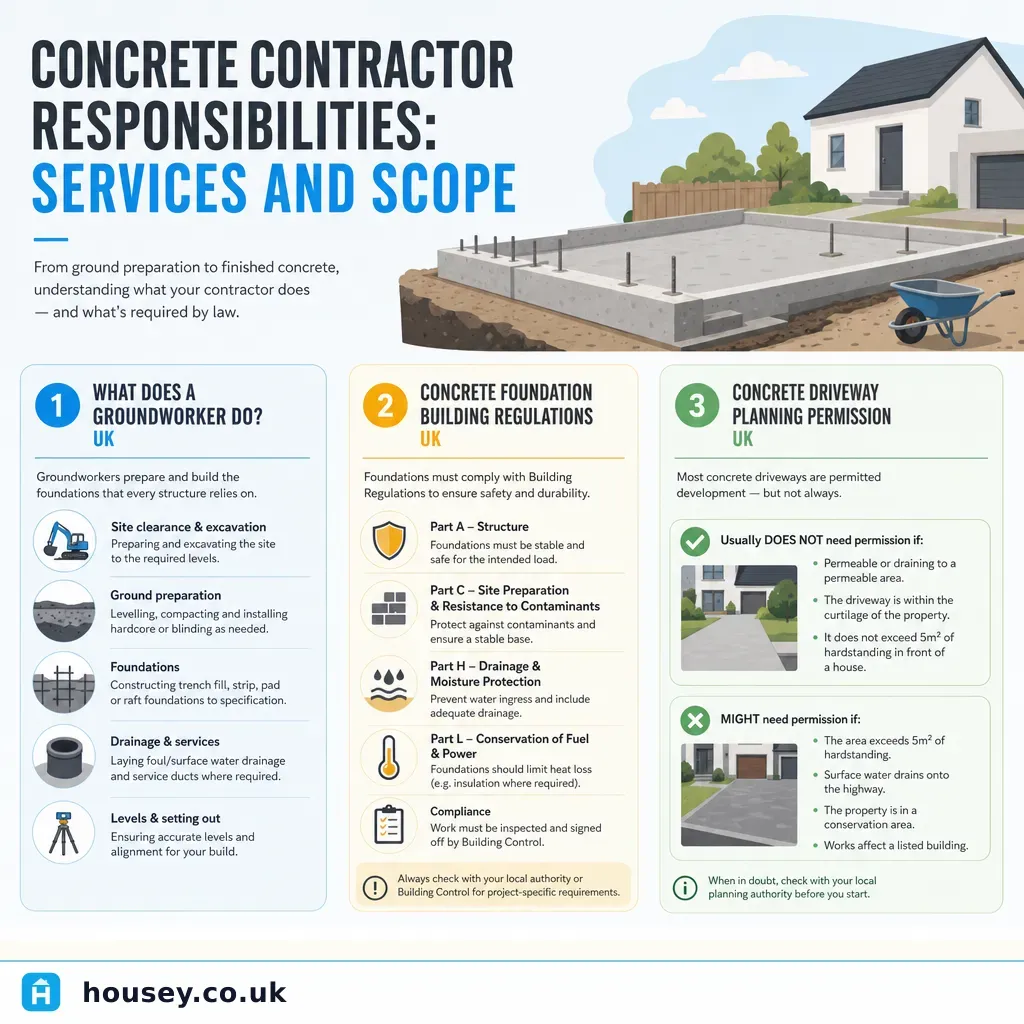
Concrete Contractor Responsibilities: Services and Scope
Whether you are extending a house, building a garage, or replacing a driveway, concrete work underpins many UK home improvement projects — often before any above-ground structure appears. Understanding what a concrete contractor or groundworker does, how their role interacts with building regulations, and which specialist you need for which task helps you plan work effectively, compare quotes accurately, and avoid costly delays. Scope and responsibilities vary significantly between a general groundworker and a specialist concrete contractor, and that distinction matters when building control sign-off is required.
Key points
- Concrete contractors and groundworkers typically handle foundations, floor slabs, drainage beds, driveways, paths, and external hardstanding — usually as the first trade on site before above-ground construction begins.
- Foundation work for extensions and new builds must comply with Building Regulations Part A (Structure) and requires building control inspection and sign-off before concrete is poured.
- Concrete strength is specified by grade: C20 is typical for blinding and garden paths; C25 for domestic floor slabs; C30 for driveways and lightly trafficked areas; C35 and above for reinforced structural elements.
- Ready-mixed concrete must generally be placed and compacted within 90 minutes of batching to maintain workability and achieve design strength.
- Impermeable driveways over 5 m² fronting a public highway typically require planning permission unless a permeable surface or compliant drainage is used.
What services does a concrete contractor provide?
Concrete contractors and groundworkers operate across a wide range of residential and light commercial projects. Their scope typically includes:
Foundations Strip, pad, raft, and trench fill foundations for extensions, new builds, garages, and garden structures. Foundation type and depth depend on soil conditions, structural loading, and proximity to trees; a structural engineer's specification is usually required for anything beyond a simple outbuilding.
Floor slabs Ground-bearing concrete floor slabs for extensions, garages, utility rooms, and annexes. These often incorporate damp-proof membranes, insulation boards, underfloor heating pipework, and steel reinforcement mesh before pouring.
Driveways and hardstanding Plain, exposed aggregate, or brushed concrete driveways and parking areas. Permeable concrete options address sustainable drainage (SuDS) requirements that apply in many local authorities.
Paths, patios, and steps External footpaths, garden steps, and patio bases in plain or decorative concrete finishes.
Drainage and kerbing Installation of drainage channels, soakaway beds, gully pots, and precast or in-situ concrete kerbs and edging.
Retaining walls Mass concrete or reinforced concrete retaining walls for level changes in gardens or on sloped sites. Walls above a certain height may require structural engineer input and building control notification.
Concrete contractor versus groundworker: what is the difference?
Role | Typical scope | Best for | When to use |
|---|---|---|---|
Groundworker | Excavation, drainage, foundations, slab formation | Complete sub-structure package | Extensions, garages, new builds — from dig to slab |
Specialist concrete contractor | Large reinforced pours, decorative finishes, commercial-grade slabs | Technically complex or high-specification work | When the spec exceeds standard residential groundwork |
Driveway installer | Surface preparation and laying in concrete, block paving, tarmac, or gravel | Surface replacement without deep structural groundwork | Straightforward driveway or hardstanding replacement |
Structural engineer | Specifies foundation type, reinforcement, and concrete grade for structural elements | Any load-bearing structure | Always required for extensions, retaining walls above 600 mm, or uncertain ground conditions |
In residential projects, a single groundworking firm often covers the full sub-structure package without requiring separate specialist concrete contractors.
Which professional do you need?
- Choose a groundworker if you need a complete sub-structure package: excavation, foundations, drainage, and slab for a house extension, new garage, or outbuilding.
- Choose a specialist concrete contractor if the project involves large reinforced pours, decorative polished concrete finishes, or technically demanding specification work beyond standard residential groundwork.
- Choose a driveway installer if your project is a surface replacement only — no deep excavation or structural foundations required.
- Engage a structural engineer first if you are building an extension, a retaining wall above approximately 600 mm, or any structure where foundation design is not straightforward.
- Check with your local planning authority before starting any driveway work fronting a public road — impermeable surfaces over 5 m² typically require planning permission.
Building Regulations and building control
Foundation and structural concrete work for extensions and new builds requires building control approval in England and Wales. You can use your local authority building control (LABC) or a registered building control approver. Key inspection checkpoints include:
- Foundation inspection: the building control inspector will usually need to inspect the excavation before concrete is poured — never pour without sign-off
- Slab inspection: reinforcement layout and membrane installation are typically checked before the concrete pour
- Drainage: below-ground drainage connections must be inspected and tested before backfilling
Driveways, garden paths, and freestanding outbuildings under 30 m² with no sleeping accommodation are usually exempt from building regulations, but always verify with your local authority before starting work.
Homeowner checklist: before concrete work begins
Before your contractor starts on site, confirm:
What to ask before accepting a quote
- What concrete grade and mix design will be used, and why is that appropriate for this application?
- Will the work be carried out by direct employees or subcontractors, and what are their qualifications?
- Is the quote based on a fixed depth and specification? What happens if ground conditions differ from expectations?
- Is VAT included in the price?
- What is your method for protecting the pour in cold, hot, or wet weather?
- How will the surface be finished, and what flatness tolerance or standard applies?
- What building control inspections are included in your programme?
- Do you carry public liability insurance, and can you provide a certificate of insurance?
When to get professional help
Always involve a structural engineer if the project includes foundations for any habitable structure or a vehicle-loaded slab on uncertain ground, if soil conditions are poor, made ground, contaminated, or near trees, or if a retaining wall exceeds approximately 600 mm in retained height. Existing slabs or foundations showing cracking, settlement, or heave should be assessed by a structural engineer before new concrete work proceeds. For straightforward driveways, paths, or garden bases, a reputable groundworker or driveway installer with verifiable references and current public liability insurance is usually sufficient.
How Housey can help
Housey can match you with vetted local professionals for concrete and groundwork projects across the UK. Find experienced groundworkers for foundations, slabs, and drainage, or compare quotes from specialist driveway installers for hardstanding and surface replacement — all through one straightforward quote-request process.
Frequently asked questions
Do I need planning permission for a concrete driveway?
If the driveway surface is impermeable — including standard concrete or tarmac — and the area exceeds 5 m², planning permission is typically required for a front-garden driveway that drains onto the highway. Using a permeable concrete or directing run-off to a lawn or soakaway may avoid this requirement. Always check with your local planning authority before work starts, as rules can vary by location.
How long does concrete take to cure fully?
Concrete achieves approximately 70% of its design strength within 7 days and reaches its full rated strength after about 28 days. Foot traffic is usually safe after 24–48 hours; vehicle loading should be avoided for at least 7–10 days. Cold weather significantly slows curing — below 5°C, hydration can effectively stop — so frost protection is critical for winter pours.
Can an existing concrete slab be broken out and replaced?
Yes. Groundworkers routinely break out existing slabs using breakers, mini-diggers, and grab lorries. The material is removed as construction waste and a new sub-base and slab are installed. Before work starts, check whether any services — water, gas, electricity, or drainage — run beneath the existing slab to avoid accidental damage during the break-out.
Sources and further reading
- Building Regulations Approved Document A: Structure — GOV.UK
- Planning Portal: Driveways and hardstanding — Planning Portal
- The Concrete Society: Good Concrete Guide — The Concrete Society
- HSE: Construction — groundwork and excavations — Health and Safety Executive
Useful next reads
 Improvement & Build
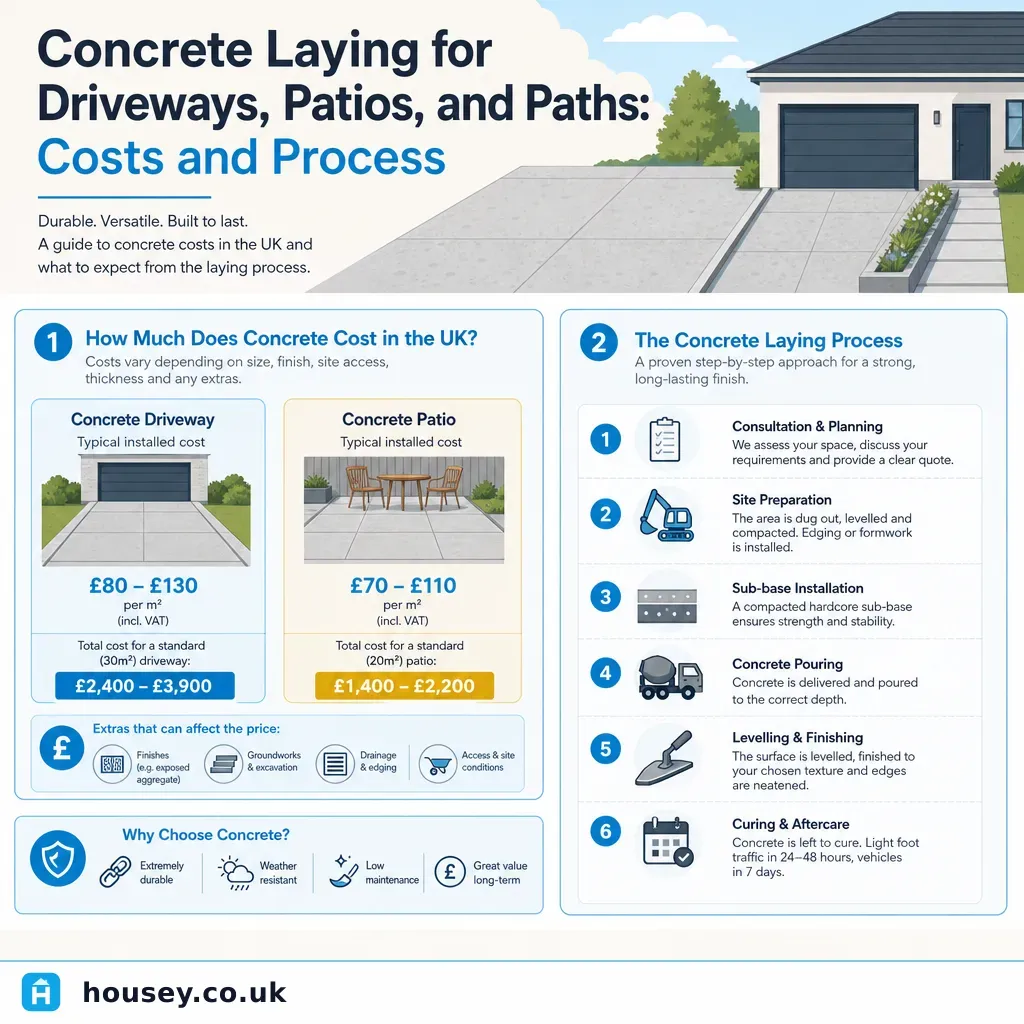
Concrete Laying for Driveways, Patios, and Paths: Costs and Process
Concrete laying for a UK driveway typically costs £65–£110 per square metre, including sub-base, reinforcement, formwork, and finishing.
 Improvement & Build
Selecting a Concrete Contractor: What to Ask Before You Hire
When choosing a concrete contractor, ask for proof of public liability insurance, a written specification stating the concrete mix to BS 8500, sub-base depth, and whether expansion joints are included.
 Improvement & Build
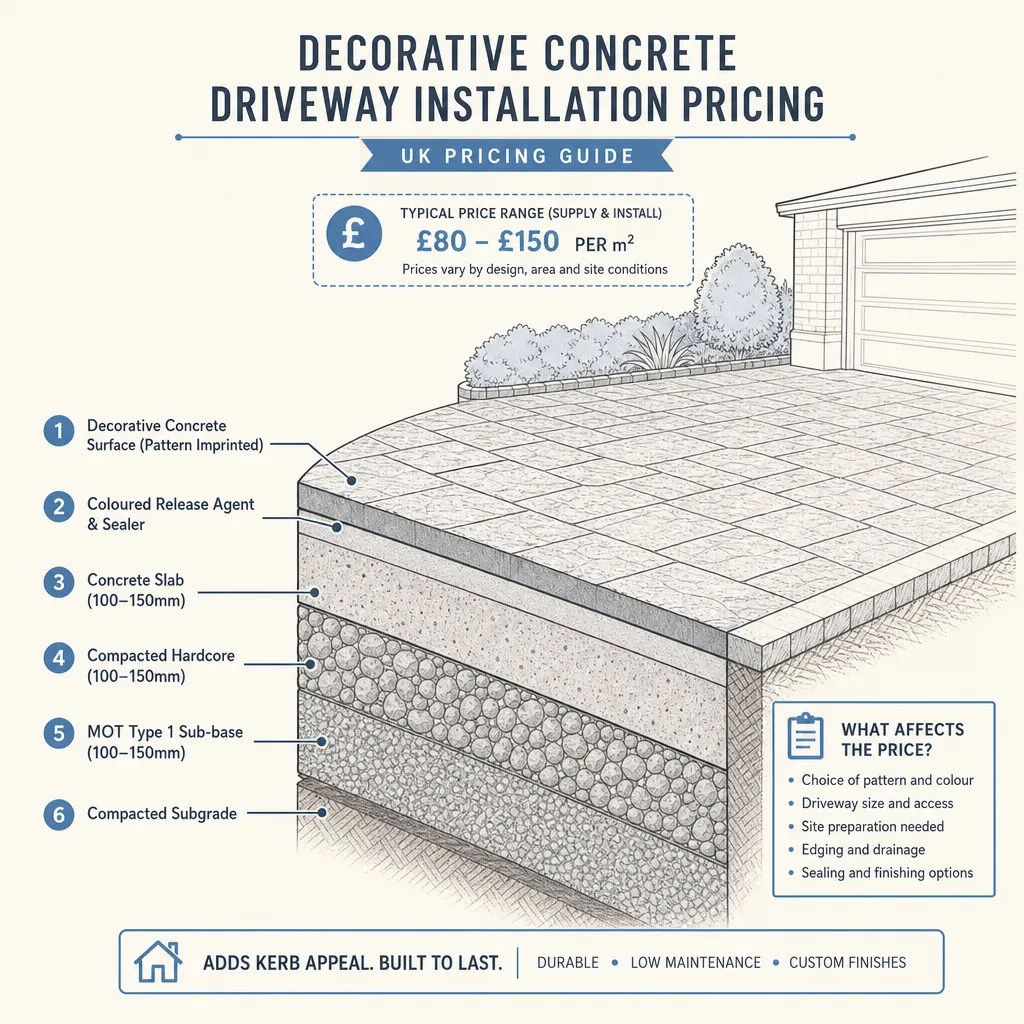
Decorative Concrete Driveway Installation Pricing
Pattern-imprinted concrete (PIC) is the most popular decorative driveway surface in the UK, offering cobble, slate, and tile effects at lower cost than natural stone.
 Improvement & Build
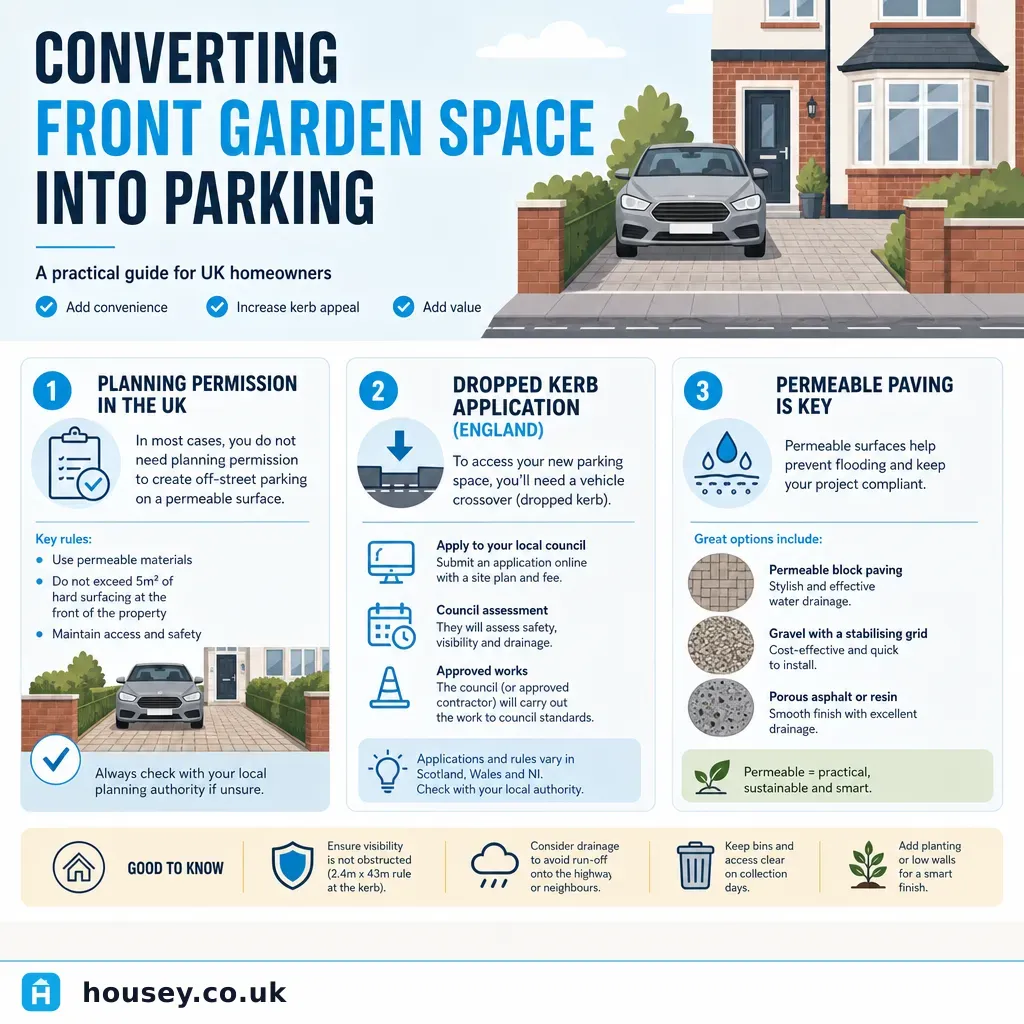
Converting Front Garden Space into Parking
Converting a front garden to parking in England requires permeable surfacing or planning permission if the area exceeds 5 m², plus a separate dropped kerb application to your local highway authority.
 Improvement & Build
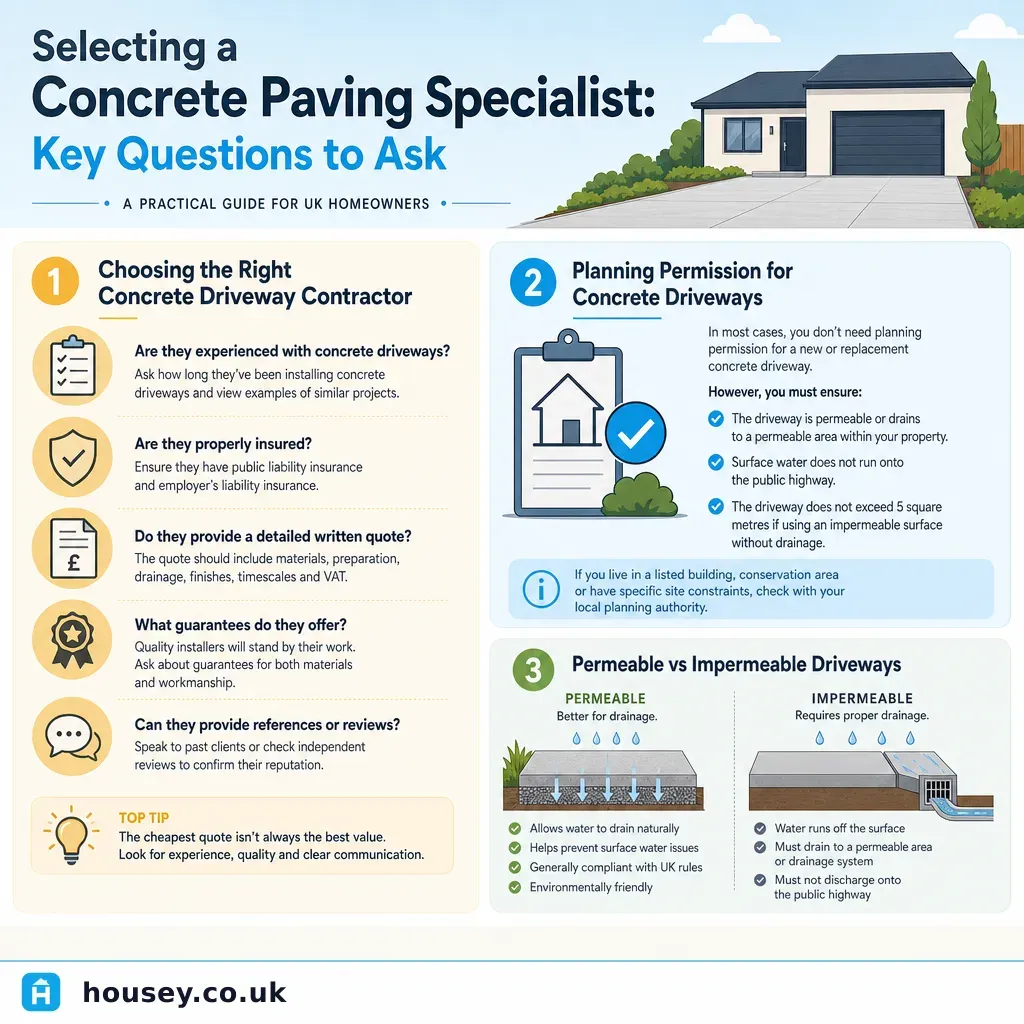
Selecting a Concrete Paving Specialist: Key Questions to Ask
When selecting a concrete paving specialist, check whether your planned surface requires planning permission — in England, impermeable driveways over 5 m² usually need consent unless drainage is properly managed.