Protecting Your Concrete Foundations: Waterproofing Methods and Best Practice
By Housey · Last reviewed 31st of May 2026
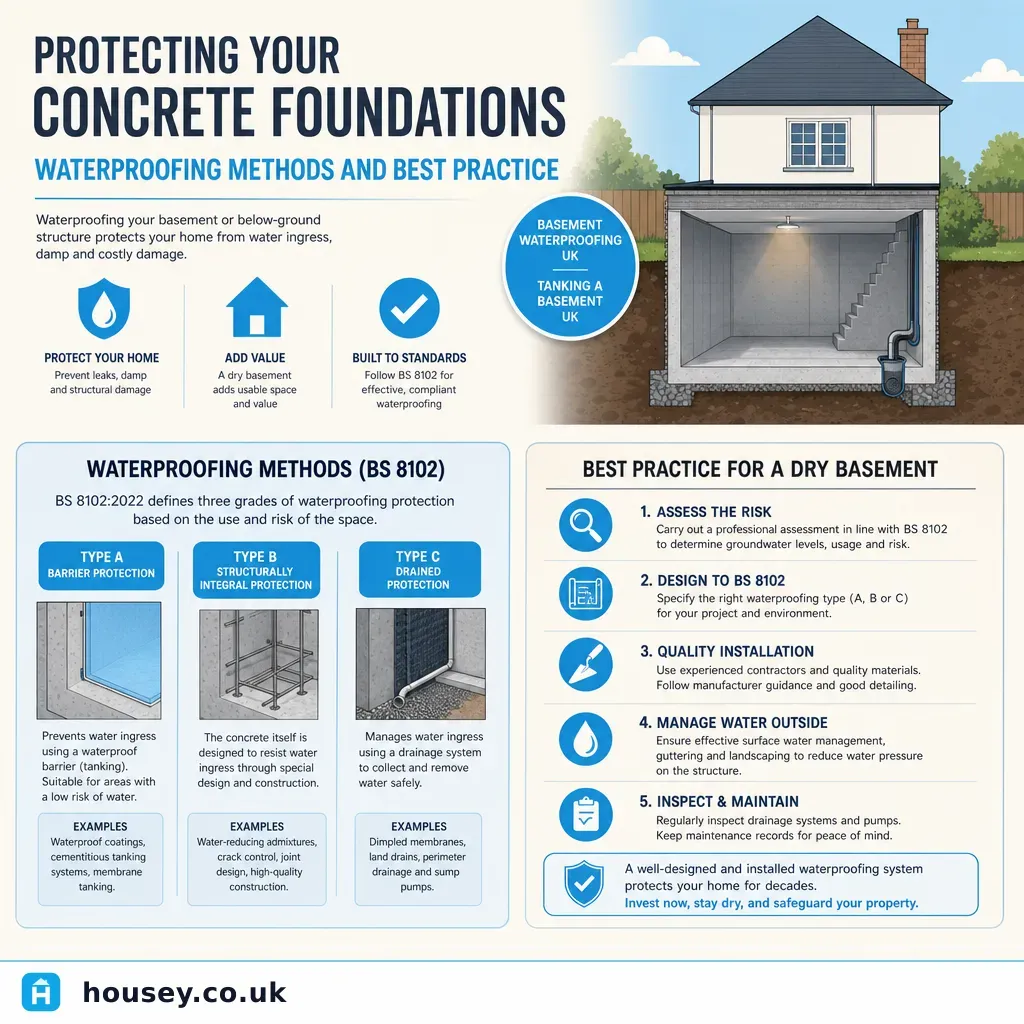
Protecting Your Concrete Foundations: Waterproofing Methods and Best Practice
For UK homeowners considering a basement conversion, or tackling persistent damp below ground level, the waterproofing strategy for concrete foundations determines whether the investment holds long-term. Pre-1970s properties often have minimal or no below-ground waterproofing, and even newer homes can develop moisture ingress as ground conditions shift, drainage connections age, or construction joints open under seasonal movement. Getting the approach wrong — or deferring it — can result in structural damage, mould growth, and significant remediation costs.
Key points
- BS 8102:2022 is the UK code of practice for below-ground waterproofing; it classifies protection into four usage grades (0–3) from basic damp-proofing to a fully habitable, dry environment.
- Three technical types exist under BS 8102: Type A (barrier/tanking), Type B (structurally integral waterproof concrete), and Type C (drained cavity system) — the correct type depends on ground conditions, hydrostatic pressure, and intended use.
- Building Regulations Approved Document C covers resistance to moisture from the ground; below-ground conversions to habitable use typically require building control approval.
- Cavity drain membrane systems (Type C) are the most common remedial approach in existing UK properties because they do not require excavation, but they manage water ingress rather than stopping it.
- Property Care Association (PCA)-registered contractors operate under a recognised code of practice for structural waterproofing and can offer insurance-backed guarantees; a RICS Level 3 Building Survey should precede any specification where structural condition is uncertain.
Why foundation waterproofing matters for UK homes
Concrete foundations and below-ground walls are permanently exposed to groundwater, surface run-off, and soil moisture. Hydrostatic pressure — the force water exerts against a below-ground structure — can push moisture through hairline cracks, construction joints, and porous aggregate even in apparently sound concrete. In the UK, clay-heavy soils across the Midlands, South East, and much of Greater London cause seasonal ground movement that repeatedly opens and closes stress cracks in foundations throughout the year.
Left unaddressed, sustained moisture ingress can corrode steel reinforcement (rebar), cause spalling and carbonation of concrete, create conditions for dry rot and wet rot in adjacent timber, and render below-ground spaces unusable for storage or habitable conversion. The timing of waterproofing is as important as the method — applying protection during construction is consistently less expensive and less disruptive than retrofitting an existing structure.
The three waterproofing types under BS 8102:2022
BS 8102:2022 (Protection of Below Ground Structures against Water from the Ground) is the principal UK standard. It defines three technical approaches:
Type | Approach | Best for | Key limitations |
|---|---|---|---|
Type A — Barrier | Tanking membranes (bituminous, crystalline, cementitious) applied to the inner or outer face of the structure | New-build with good access; remedial works where a cavity system is not feasible | External application requires excavation; internal tanking provides no drainage relief and can fail if bonding is poor or the structure moves |
Type B — Structurally Integral | Waterproof concrete (WPC) with designed mix, waterstops, and controlled joints throughout the structure itself | New-build basements where the structure is the barrier from the outset | Must be specified at design stage; practically impossible to retrofit; construction joints and service penetrations remain risk points |
Type C — Drained Cavity | Cavity drain membrane fixed to the inner wall face with a perimeter drain channel and sump pump to collect and expel water | Remedial work on existing UK properties; the most common retrofit approach | Manages water rather than excluding it; sump pump requires ongoing maintenance and a reliable power supply |
BS 8102 recommends a combined approach for inhabited spaces — typically Type A or B plus a Type C drainage layer — because single-system installations carry greater risk if compromised.
Which BS 8102 protection grade do you need?
The standard defines four usage grades that drive the specification:
- Grade 0: No moisture control required (e.g., open car park with natural drainage)
- Grade 1: Some seepage tolerable — plant rooms, utility storage, car parking
- Grade 2: No moisture, but some humidity tolerable — workshops, commercial stores
- Grade 3: Dry habitable environment — living rooms, bedrooms, offices, leisure spaces
A habitable basement in a residential conversion must meet Grade 3. In most UK ground conditions, this requires a combined Type A/B plus Type C system — a single tanking coat is rarely sufficient for continuous habitable use.
External versus internal waterproofing: which is more effective?
External waterproofing, applied to the outside face of the foundation before backfilling, is generally considered more effective because it intercepts water before it contacts the structure. In new-build projects, it can be incorporated as part of the construction sequence at relatively low additional cost. In existing properties, however, it requires full excavation around the foundation perimeter — expensive, disruptive, and often impractical on tight urban plots.
Internal waterproofing is therefore the default for most UK remedial projects. The trade-off is that internal systems manage ingress rather than eliminating it, and their performance depends heavily on surface preparation and workmanship quality.
Which approach should you choose? — decision tree
- Choose external waterproofing if the foundations are exposed during new construction or a major extension.
- Choose internal Type A tanking if moisture pressure is low, the structure is sound, and surface preparation is achievable.
- Choose internal Type C cavity drain if hydrostatic pressure is significant, previous tanking has failed, or a Grade 3 habitable finish is needed.
- Specify a combined Type A + Type C system if a structural engineer or specialist surveyor has recommended it, or where Grade 3 use is required in high-groundwater conditions.
- Consult a structural engineer or chartered surveyor before specifying any system if there are visible cracks in the foundation slab or walls, rust staining from rebar, or signs of structural movement.
Red flags: signs your existing foundation waterproofing is failing
Watch for these indicators that a professional assessment is needed:
- White powdery deposits (efflorescence) on concrete or masonry walls — minerals carried by water moving through the structure
- Persistent damp patches or tide marks at the floor-to-wall junction
- Peeling, bubbling, or debonding of a previously applied tanking membrane
- Rust streaks on internal wall surfaces — indicates rebar corrosion, a structural concern requiring urgent assessment
- Cracks at construction joints, corners, or through the slab — particularly if wider than 0.3 mm or visibly growing over time
- Sump pump cycling continuously or running on its own without obvious cause — suggests the drainage system is overwhelmed
- Musty or earthy odour in the basement or subfloor void
- Dry rot or wet rot in timber floor joists or studwork adjacent to the foundation
Rust streaks and widening cracks require a chartered surveyor or structural engineer, not just a waterproofing contractor.
Important limitations
This article provides general information about foundation waterproofing approaches used in UK residential construction. It is not a specification document, structural assessment, or engineering advice. The correct waterproofing system for your property depends on local ground conditions, the water table, the existing structure, hydrostatic pressure, the intended use grade, and local authority requirements. A qualified professional must assess your specific situation before any works are specified or commenced.
When this becomes urgent
Seek professional advice without delay if you notice any of the following:
- Rust staining or spalling on internal concrete surfaces
- Cracks wider than 0.3 mm, stepped cracks through brickwork, or cracks that are visibly widening over time
- Flooding or sustained standing water in the basement or subfloor
- Failure of a sump pump with no backup provision
- Signs of structural movement — sticking doors or windows, sloping floors, or cracking at window or door lintels
Do not commission remedial waterproofing works without first obtaining a structural assessment if any of the above are present.
What to ask a qualified professional
Before instructing a waterproofing specialist or damp contractor, ask:
- Which BS 8102 type and usage grade are you specifying for this property, and on what basis?
- Have you assessed the local water table and soil conditions?
- Does this work require building control approval, and will you manage the application?
- What surface preparation is required before the system is applied?
- Is the guarantee insurance-backed, and what does it cover?
- What ongoing maintenance does the system require — for example, sump pump servicing intervals?
- Are you a member of the Property Care Association (PCA) or another recognised body?
- What happens if conditions found during works differ from those assumed in your quote?
When to get professional help
Foundation waterproofing is not a DIY task for UK homeowners. Engage a specialist if you are planning a basement conversion to habitable use, buying or selling a property with known below-ground damp, dealing with a failed previous installation, or observing any of the red flags listed above. A damp and timber survey is usually the right starting point to diagnose the problem correctly and specify the appropriate remedy. Where structural concerns are present, a structural survey or structural engineer's report may also be required before waterproofing works are specified.
How Housey can help
Housey connects UK homeowners with vetted damp proofing specialists who can assess below-ground moisture problems, specify the appropriate BS 8102 system, and carry out compliant remedial works. Use our quote comparison tool to find qualified professionals in your area and compare written proposals side by side.
Frequently asked questions
Do I need building regulations approval for foundation waterproofing?
If you are converting a basement or below-ground space to habitable use, building regulations approval is almost always required — including compliance with Approved Document C (moisture resistance) and Part F (ventilation). Straightforward remedial waterproofing to a non-habitable space may not trigger a full application, but confirm with your local building control body before starting, as requirements can vary.
How long does foundation waterproofing last?
Cavity drain membrane systems typically carry warranties of 10–25 years, provided the sump pump is maintained. Cementitious tanking coatings may degrade if the structure moves or cracks. External waterproofing membranes, if protected from physical damage, can last 20–30+ years. Always check whether the guarantee is insurance-backed, what it covers, and whether it is transferable if you sell the property.
Can foundation waterproofing be done from the inside only?
Yes — and for most existing UK properties, internal waterproofing is the only practical option without costly excavation. Internal systems (Type A tanking or Type C cavity drain) manage moisture rather than fully excluding it. BS 8102:2022 recommends a combined approach for Grade 3 habitable use, as relying solely on a single internal tanking coat is rarely sufficient in high-groundwater UK conditions.
What is crystalline waterproofing?
Crystalline waterproofing products contain reactive chemicals that form insoluble crystals within concrete pores and fine cracks when exposed to water. Brands such as Xypex and Sika crystalline coatings are classified as Type A barrier systems under BS 8102. They perform best on sound, uncracked concrete and are used in both new-build and remedial applications, sometimes combined with a Type C drainage layer for added redundancy.
How much does foundation waterproofing cost in the UK?
Costs vary by system, property size, ground conditions, and access. As a rough order of magnitude only: internal cavity drain systems typically range from £80–£200+ per m²; cementitious tanking from £40–£100+ per m²; external waterproofing including excavation from £300–£600+ per linear metre of wall. Always obtain at least three written quotes. Indicative UK costs, last reviewed 2026-05-31.
Sources and further reading
- Building Regulations Approved Document C — Site Preparation and Resistance to Contaminants and Moisture — GOV.UK
- BS 8102:2022 Code of Practice for Protection of Below Ground Structures Against Water from the Ground — BSI Group
- Structural Waterproofing — Homeowner Guidance — Property Care Association
- RICS Home Surveys — consumer guidance — Royal Institution of Chartered Surveyors
- Basement Information Centre — Waterproofing Guidance — Basement Information Centre (BIC)
Useful next reads
 Surveys & Inspections
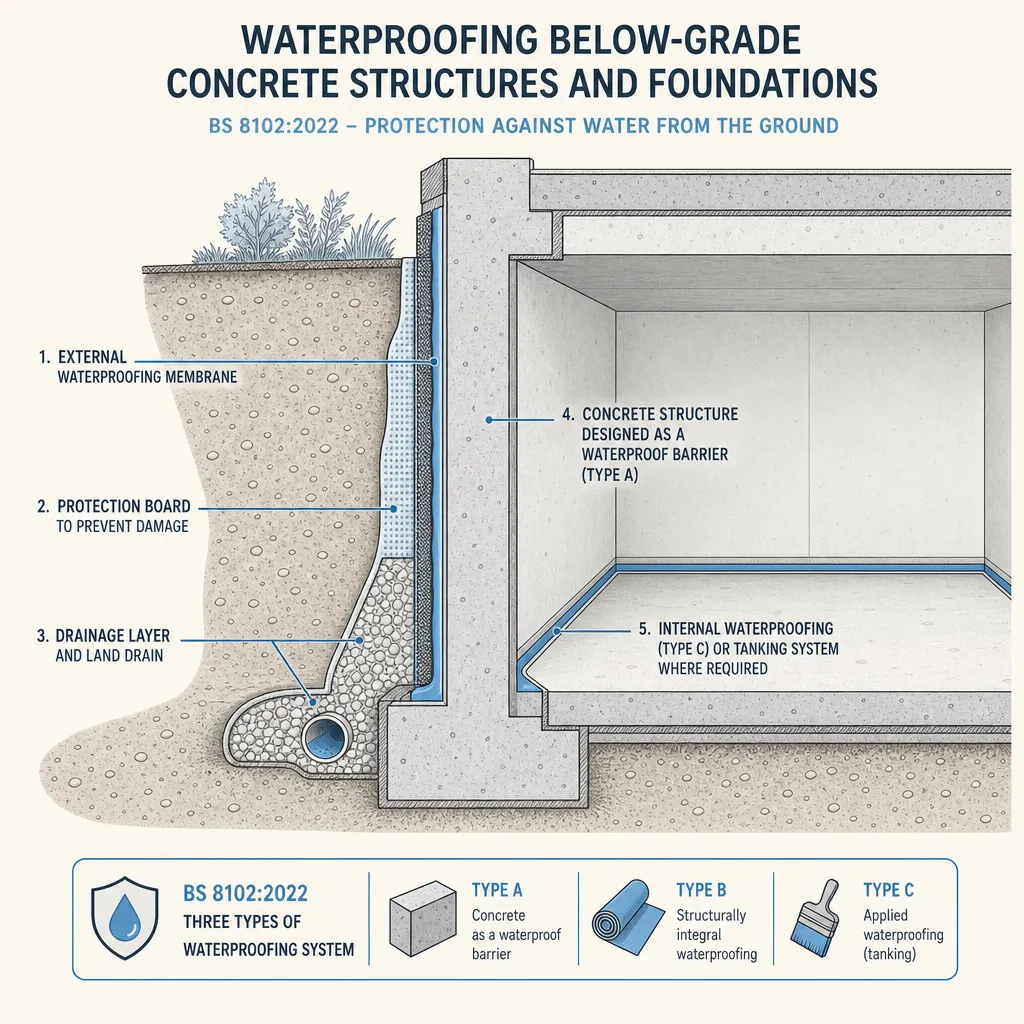
Waterproofing Below-Grade Concrete Structures and Foundations
Below-grade waterproofing in the UK should be designed to the grade of protection required under BS 8102:2022.
 Surveys & Inspections
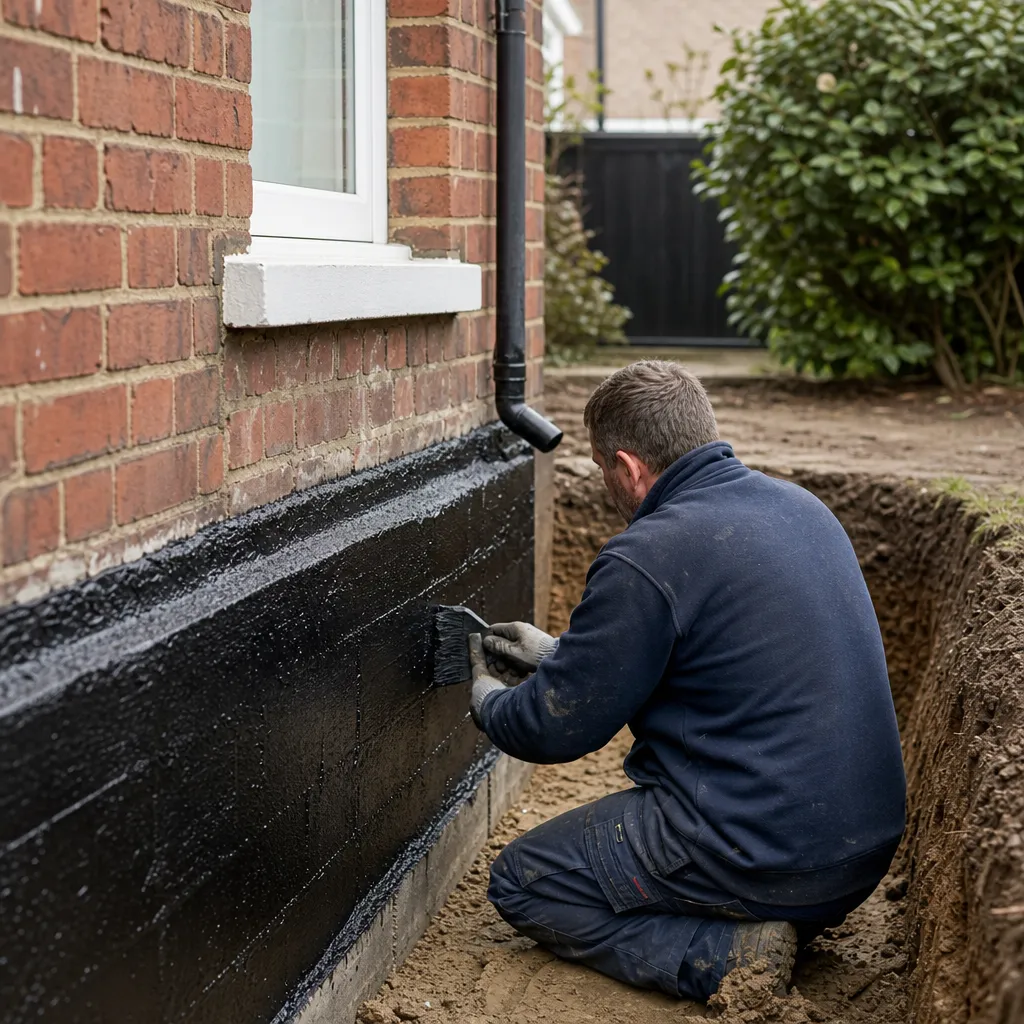
Foundation Waterproofing Fundamentals: Protecting Your Property
Foundation waterproofing prevents groundwater and soil moisture from penetrating below-ground structures.
 Surveys & Inspections
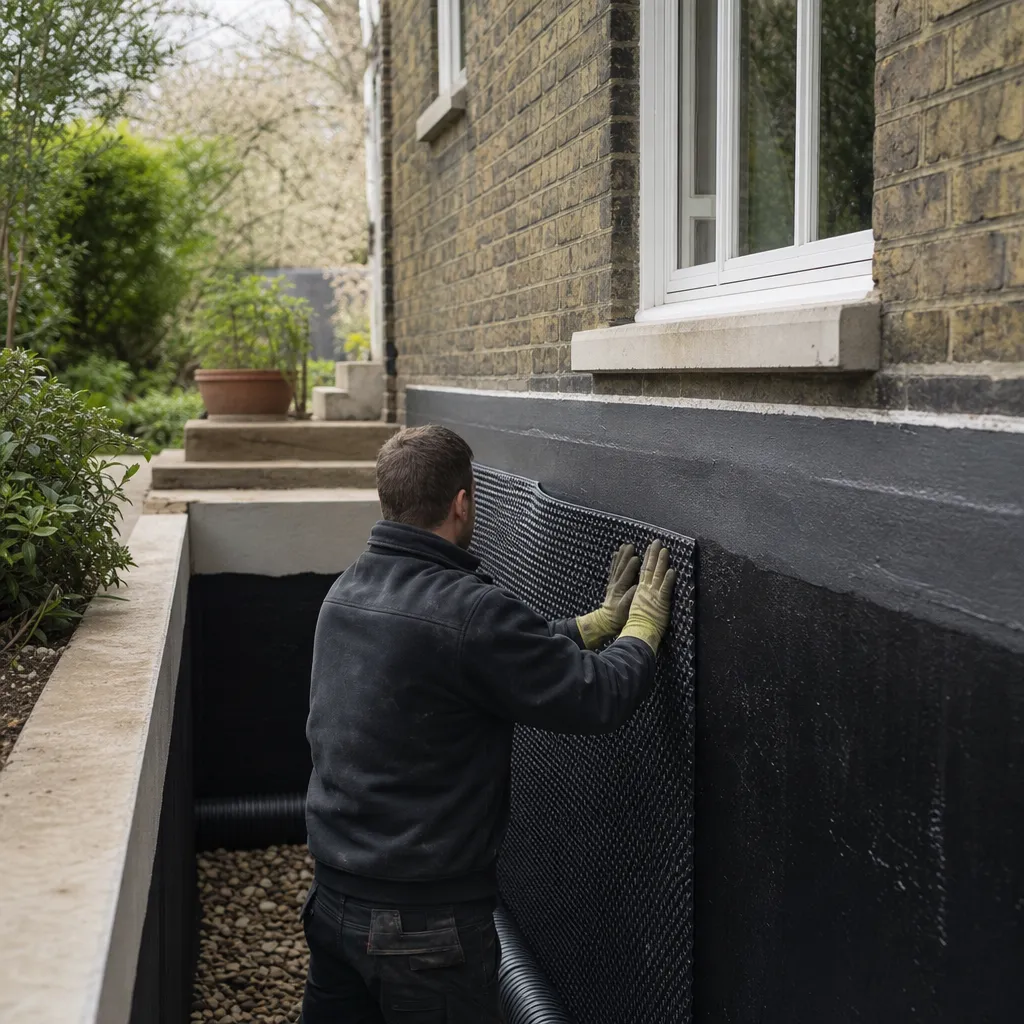
Basement Waterproofing Solutions for Damp Prevention
Basement waterproofing in the UK is governed by BS 8102:2022, which defines three system types: Type A (barrier coatings), Type B (structurally integral concrete), and Type C (cavity drain membrane with sump pump).
 Surveys & Inspections
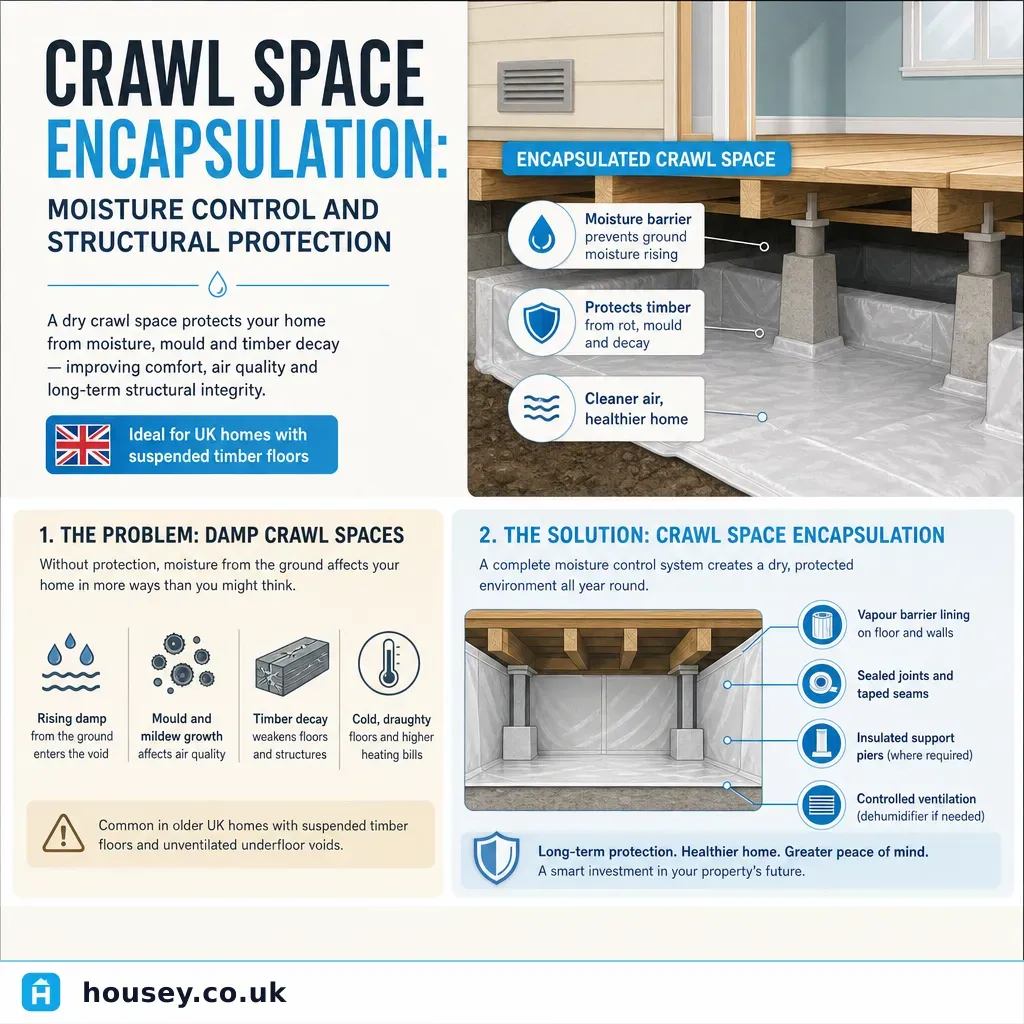
Crawl Space Encapsulation: Moisture Control and Structural Protection
Crawl space encapsulation seals the subfloor void beneath suspended timber floors with a vapour control layer and improved ventilation to prevent rising damp, condensation, timber rot and structural damage.
 Surveys & Inspections
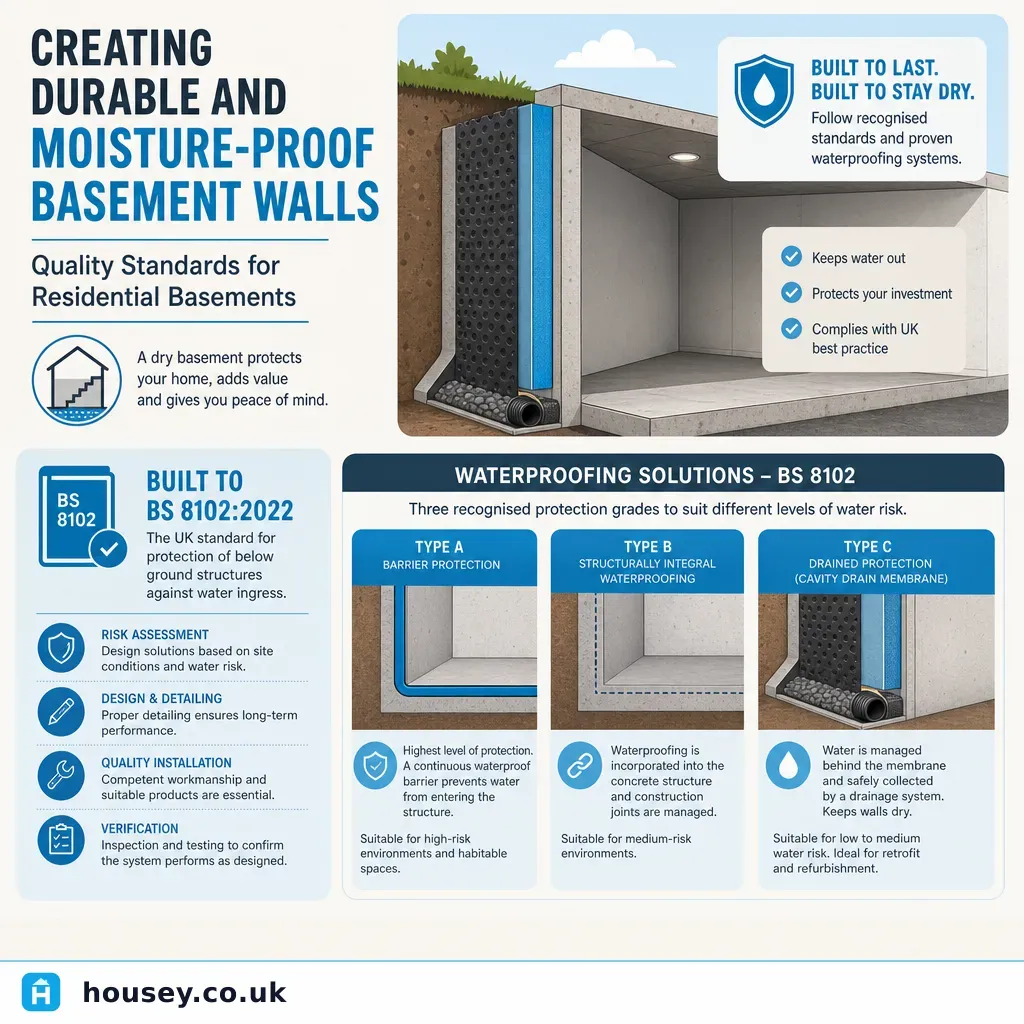
Creating Durable and Moisture-Proof Basement Walls: Quality Standards for Residential Basements
Basement waterproofing in UK homes must meet BS 8102:2022 requirements.