Waterproofing Below-Grade Concrete Structures and Foundations
By Housey · Last reviewed 25th of May 2026
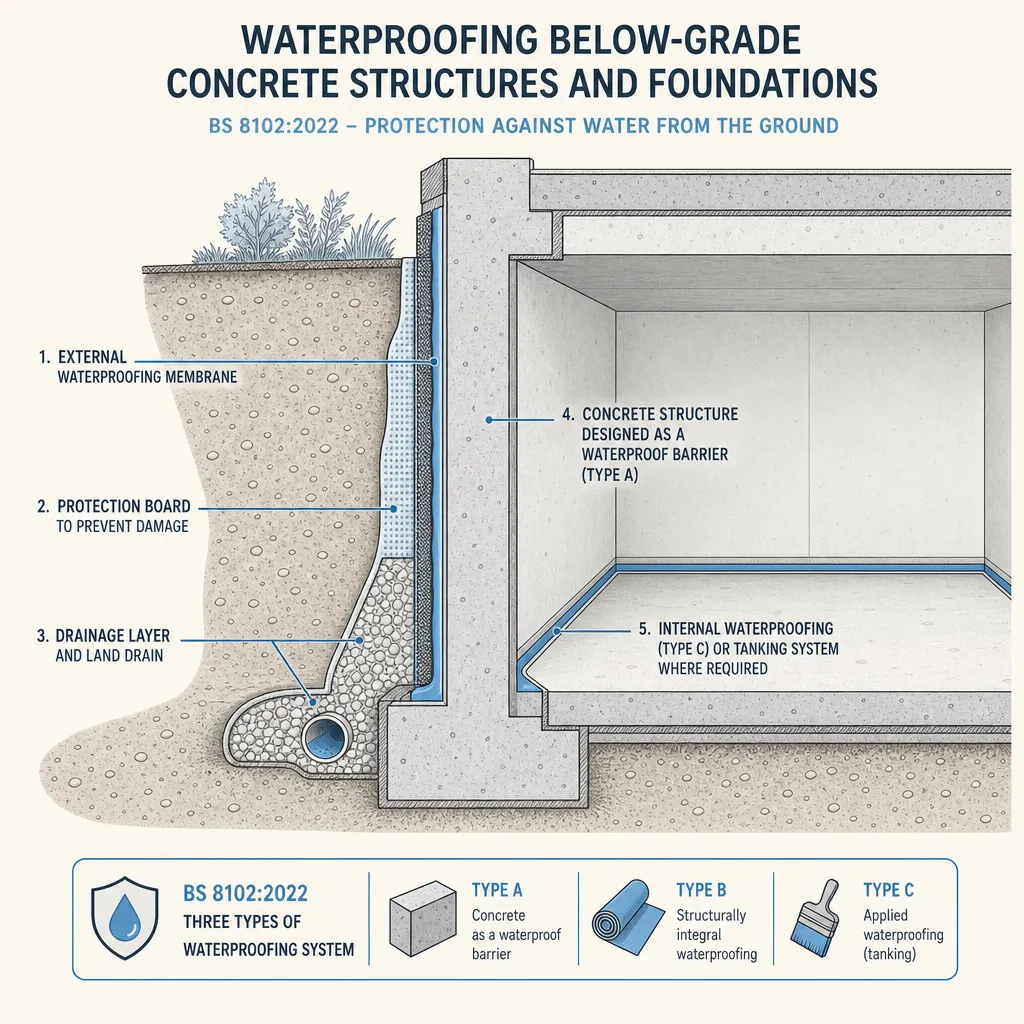
Waterproofing Below-Grade Concrete Structures and Foundations
Basement conversions, lower-ground-floor extensions, and underpinned areas are increasingly common in UK residential property as homeowners seek to add usable space without building upwards. Below-grade concrete structures face sustained pressure from groundwater, soil moisture, and seasonal water table variation — conditions that cause serious damp, structural damage, and health hazards when waterproofing is inadequate or absent. Understanding the options, standards, and professional requirements helps owners and buyers make better decisions before work begins or when problems emerge.
Key points
- BS 8102:2022 (Code of Practice for Protection of Below-Ground Structures against Water from the Ground) is the primary UK standard governing basement waterproofing design.
- BS 8102 defines grades of protection from Grade 1 (tolerable dampness, such as car parking) through to Grade 3 (fully dry and habitable) — each grade requires a different waterproofing approach.
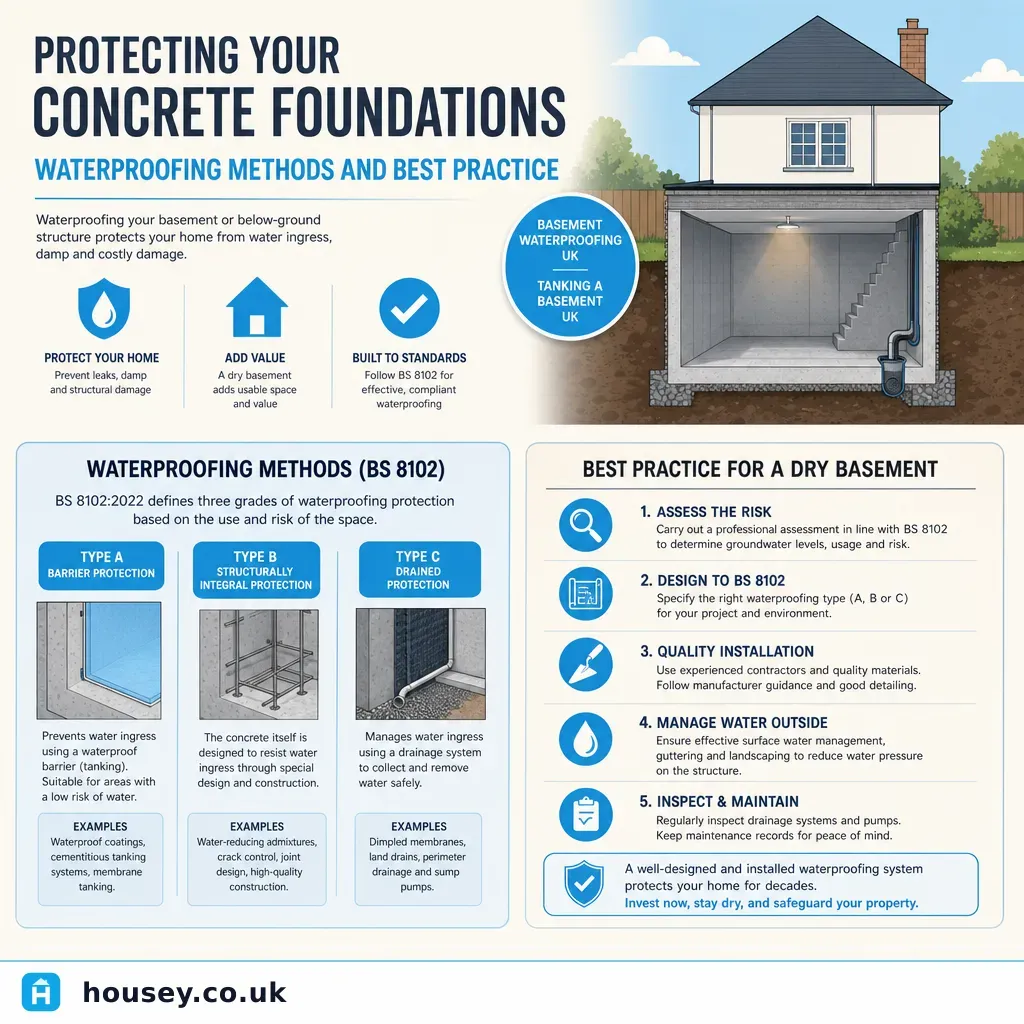
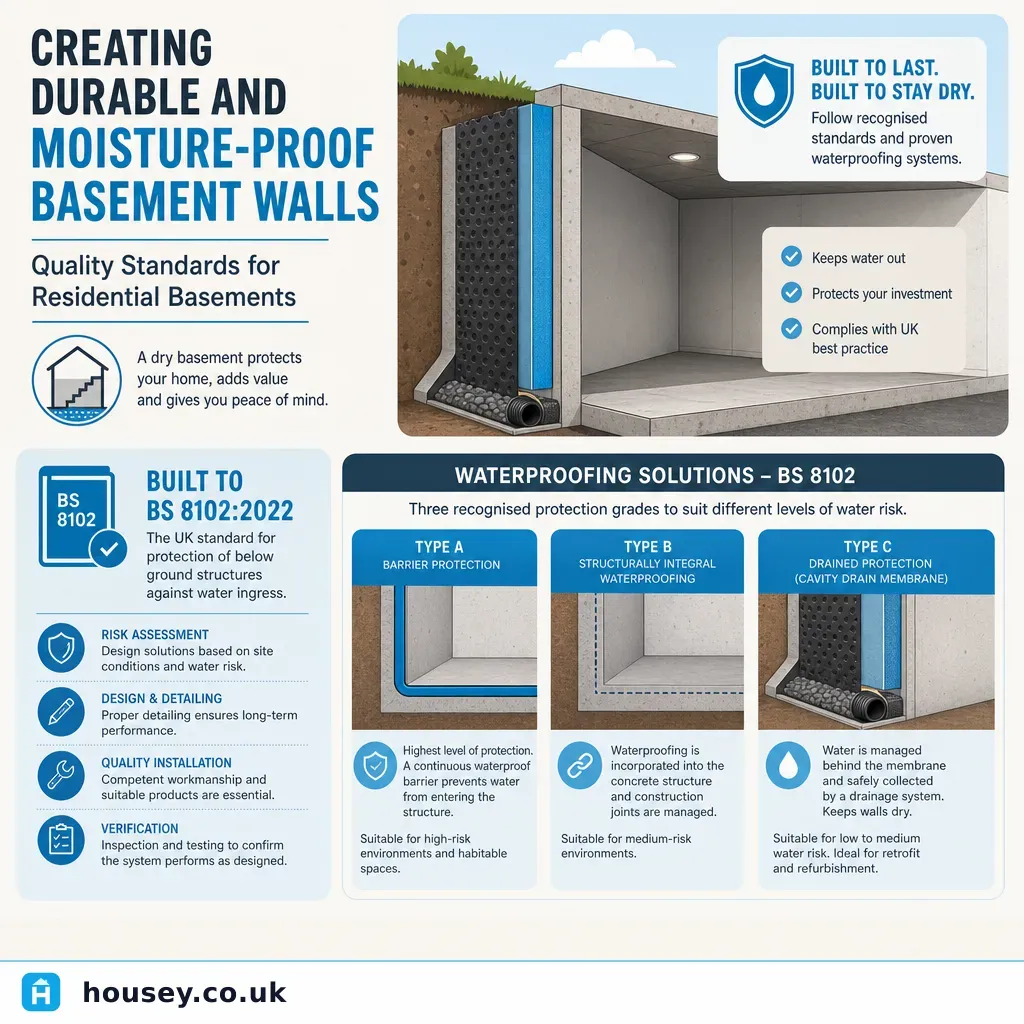
- The three main waterproofing system types are Type A (barrier or tanking), Type B (structurally integral concrete), and Type C (cavity drain and drainage) — combinations are commonly specified for habitable use.
- The Property Care Association (PCA) and the CSSW (Certificated Surveyor in Structural Waterproofing) credential are recognised quality markers for waterproofing design and installation in the UK.
- Building Regulations Approved Document C (Site preparation and resistance to contaminants and moisture) applies to below-ground moisture control alongside structural requirements under Part A.
What waterproofing grades mean in practice
BS 8102:2022 sets out grades of internal environment for below-ground structures. Most homeowners converting a cellar or basement to living accommodation are targeting Grade 3 — the standard for a fully habitable, dry space.
Grade | Typical environment | Acceptable conditions | Common system approach |
|---|---|---|---|
1 — Basic utility | Car parks, plant rooms | Some seepage tolerable | Type C drainage often sufficient |
2 — Better utility | Workshops, non-sensitive storage | No water ingress; some vapour | Type B or C, or combination |
3 — Habitable | Living rooms, bedrooms, kitchens | No ingress or dampness | Type A + C combination common |
Sensitive (Grade 3+) | Archives, data storage | Controlled humidity | Full combination + climate control |
The three waterproofing system types explained
Type A: barrier systems (tanking)
Type A systems apply an impermeable barrier to the structure. Applied externally during construction before backfilling, they keep water away from the structure — the most reliable approach. Applied internally on existing buildings, they are a practical retrofit option but rely entirely on membrane adhesion and integrity.
Common materials include:
- Cementitious crystalline systems (such as Sika-101 or Xypex)
- Sheet membranes (bonded bituminous or polymeric)
- Liquid-applied membranes (polyurethane or epoxy-based)
Type B: structurally integral waterproofing
Type B relies on the concrete structure itself being designed and constructed to be watertight — typically through a water/cement ratio of 0.45 or lower, admixtures, hydrophilic waterstops at construction joints, and strict quality control during pouring and curing. A structural engineer must design the mix and detailing. Type B alone rarely achieves Grade 3 reliability for habitable spaces and is usually combined with Type A or C elements.
Type C: cavity drain systems
Type C does not attempt to exclude water — it collects any ingress and drains it to a sump and pump for discharge. A studded HDPE membrane (cavity drain membrane) is fixed to walls and floor, creating a drainage cavity. Key considerations:
- A maintained sump and pump system is essential and must be regularly serviced
- Power failure risk requires a battery backup pump or overflow provision
- The system manages water rather than preventing it from entering — an important distinction for surveys and property sales
Red flags that waterproofing has failed or is inadequate
If you are buying a property with a below-ground space, or have an existing basement showing any of the following, arrange a professional assessment before proceeding:
- White crystalline deposits (efflorescence) on basement walls — mineral salts carried by water movement through the structure
- Tide marks or horizontal staining at skirting or wall-floor junctions
- Persistent musty smell in below-grade rooms, particularly after rainfall
- Blistering or delaminating internal plasterwork on below-ground walls
- Visible mould on walls, furniture, or stored items in a basement or cellar
- A sump pump running unusually frequently or triggering an alarm
- Cracks in walls coinciding with water seepage, especially stepped cracks through mortar joints
Any of these warrants a specific defect survey or a specialist waterproofing assessment before purchasing or before instructing remedial work.
What not to assume about basement waterproofing
"It has been dry for years, so it must be fine." Groundwater levels fluctuate seasonally and can be affected by nearby development. A basement that is dry during a dry period may experience seepage in a wet winter or after changes to local drainage patterns.
"Any builder or damp-proofer can do this." Structural waterproofing design requires specialist knowledge of BS 8102. Look for PCA-registered contractors and a CSSW-qualified designer — not all damp-proofing companies hold these credentials, and the distinction matters.
"Internal tanking is as good as external waterproofing." Internal tanking is a practical retrofit option but carries higher risk than external membranes applied during construction. It has no redundancy if the membrane loses adhesion or is damaged.
"A cavity drain system means the basement is waterproof." A Type C system manages water entry — it does not prevent it. Buyers, solicitors, and surveyors should understand this distinction when assessing any below-grade space.
Surveys and inspections for below-grade waterproofing
Before buying a property with a basement
A standard RICS Level 2 Home Survey may flag damp concerns but does not include specialist moisture investigation. If you are buying a property with any below-grade habitable or storage space, consider:
- A damp and timber survey from a PCA-registered specialist to assess moisture levels and the type and condition of any existing waterproofing system
- A structural survey (RICS Level 3) if there is any evidence of movement, cracking, or historic waterproofing failure in the structure
During design and construction
A CSSW-qualified specialist should design the waterproofing system before work starts, specifying the grade, system type, and interface details at every penetration and joint. Building control consultants can advise on compliance requirements and coordinate inspections at key construction stages.
Important limitations
This article provides general information about waterproofing approaches and UK standards. The appropriate strategy for any specific below-ground structure depends on groundwater conditions, structural type, intended use, and detailed site investigation. Nothing here replaces the assessment of a CSSW-qualified specialist, a RICS-accredited surveyor, or a chartered structural engineer. Waterproofing failures can be expensive to remediate and may carry health, insurance, and legal implications.
When to get professional help
Seek specialist professional advice immediately if:
- You are planning to convert a basement, cellar, or lower-ground floor to habitable use
- You are buying a property with any below-grade habitable or storage space
- Water is actively entering a below-ground area of your property
- A sump pump is running unusually frequently or has failed
- You notice any of the red flags listed in this article
What to ask a qualified professional
Before appointing a waterproofing specialist or surveyor for a below-grade project:
- Are you a member of the Property Care Association (PCA), and does the designer hold the CSSW qualification?
- Which grade of environment to BS 8102:2022 are you designing to, and is that appropriate for the intended use of this space?
- Which system type — A, B, C, or a combination — are you proposing, and why is it appropriate for this structure and ground condition?
- What site investigation or ground condition data are you relying on to inform the design?
- What are the long-term maintenance requirements, particularly for any sump and pump system?
- Will the completed system be inspected and certified, and what guarantee or warranty will be provided?
- If a cavity drain system is included, what provision is made for pump failure or power outage?
How Housey can help
Housey can match you with qualified professionals for every stage of a below-grade waterproofing project: a damp and timber survey to assess existing moisture conditions, a structural survey if wider building concerns are present, a specific defect survey to investigate a particular problem area in detail, and building control consultants to manage compliance requirements throughout construction.
Frequently asked questions
How much does basement waterproofing cost in the UK?
Indicative UK costs, last reviewed 2026-05-25. Cavity drain system installation for a typical residential basement ranges from around £50 to £100 per square metre or more, depending on specification, access, and existing conditions. External waterproofing of a new-build basement varies significantly by site and structural design. Obtain at least three quotes from PCA-registered contractors with scope, guarantee, and maintenance obligations clearly stated in writing.
Does basement waterproofing require Building Regulations approval?
Yes, in most cases. Converting a cellar or basement to habitable use requires Building Regulations approval covering structure, fire safety, ventilation, energy efficiency, and means of escape, in addition to waterproofing compliance. Check with your local building control body or appoint a building control consultant to advise on the full scope of required approvals for your specific project.
How long does a cavity drain waterproofing system last?
The HDPE membranes used in cavity drain systems are durable, with manufacturers typically claiming lifespans of 25 years or more. Sump and pump components require regular maintenance and periodic replacement, typically every five to ten years. A maintenance contract with the installing contractor is strongly recommended to keep the system functioning reliably over the long term.
Can I waterproof a basement myself?
Applying sealant products for minor surface dampness is within a competent DIYer's capability, but designing and installing a compliant waterproofing system for habitable use requires specialist knowledge and a Building Control submission. Errors in waterproofing are costly to remediate and may affect insurance cover and the property's value at resale.
Sources and further reading
- BS 8102:2022 — Protection of Below-Ground Structures against Water from the Ground — BSI (British Standards Institution)
- Approved Document C — Site preparation and resistance to contaminants and moisture — HM Government
- Property Care Association — Structural Waterproofing guidance — Property Care Association
- RICS — guidance on surveying below-ground structures — RICS
Useful next reads
 Surveys & Inspections
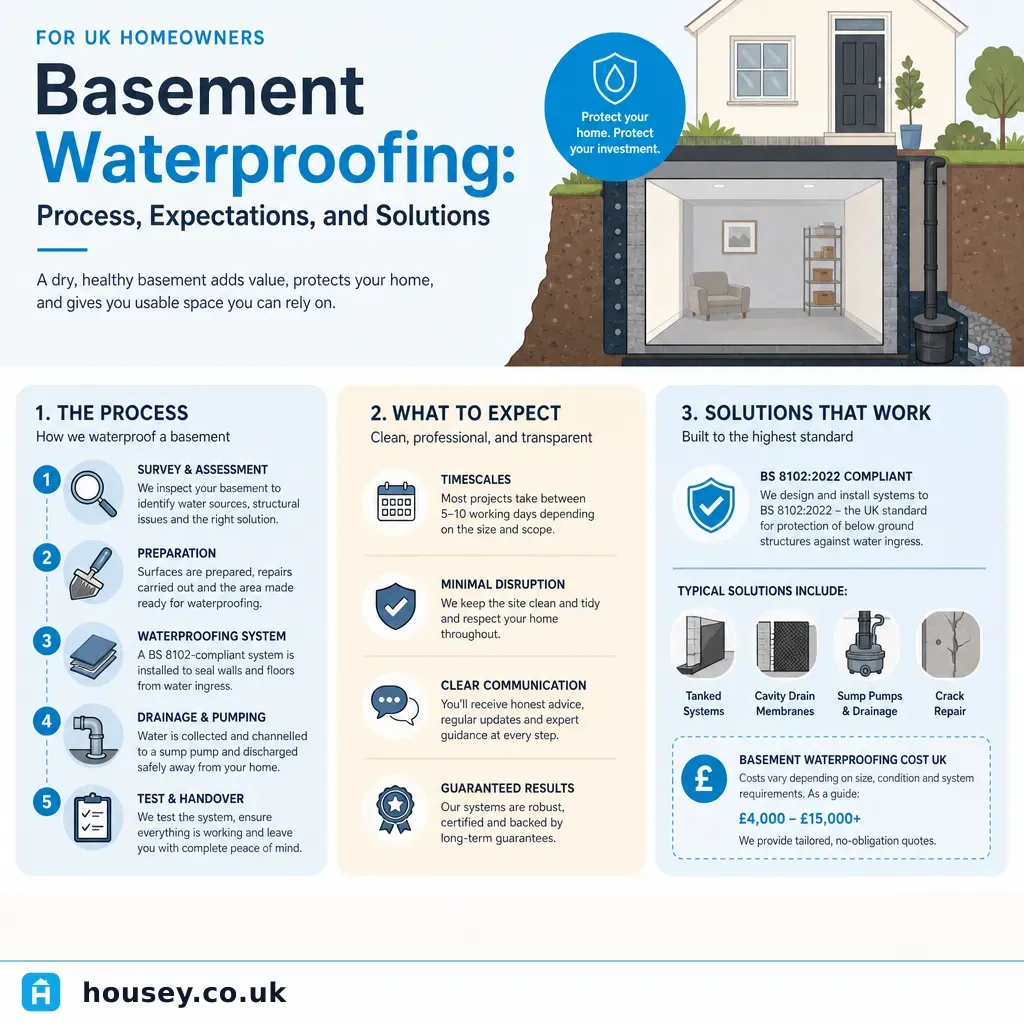
Basement Waterproofing: Process, Expectations, and Solutions
Basement waterproofing in the UK is governed by BS 8102:2022, which defines three protection grades and three system types: Type A barrier tanking, Type B structurally integral concrete, and Type C cavity drain membranes.
 Surveys & Inspections
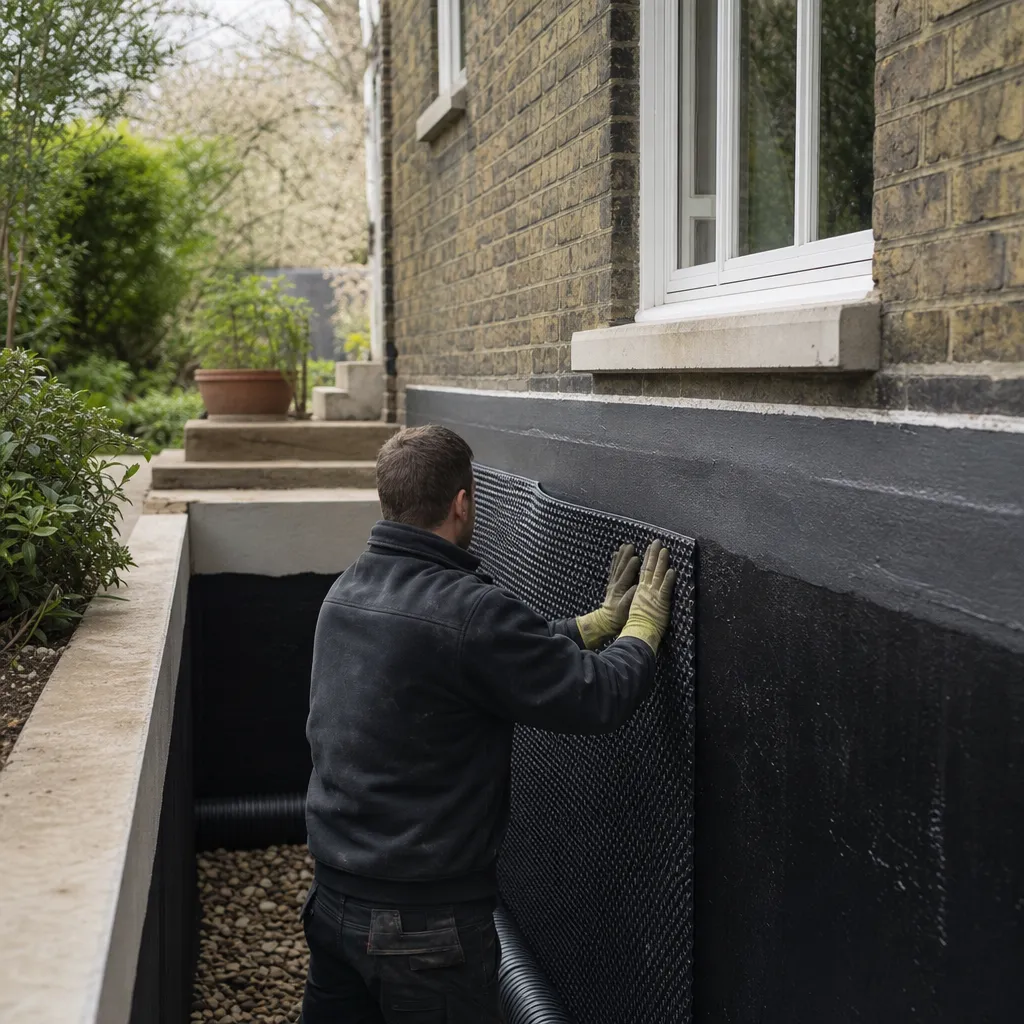
Basement Waterproofing Solutions for Damp Prevention
Basement waterproofing in the UK is governed by BS 8102:2022, which defines three system types: Type A (barrier coatings), Type B (structurally integral concrete), and Type C (cavity drain membrane with sump pump).
 Surveys & Inspections
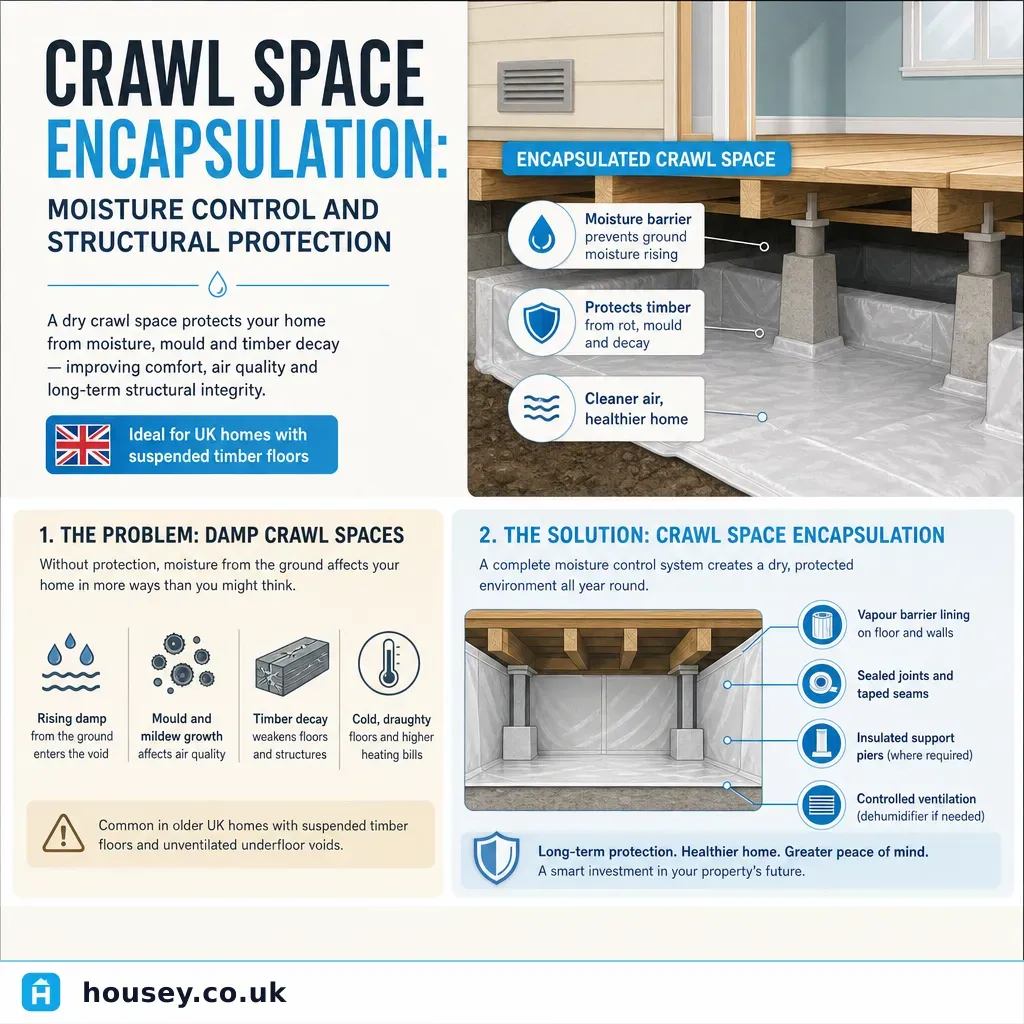
Crawl Space Encapsulation: Moisture Control and Structural Protection
Crawl space encapsulation seals the subfloor void beneath suspended timber floors with a vapour control layer and improved ventilation to prevent rising damp, condensation, timber rot and structural damage.
 Surveys & Inspections
Protecting Your Concrete Foundations: Waterproofing Methods and Best Practice
Foundation waterproofing protects below-ground concrete structures from hydrostatic pressure and soil moisture.
 Surveys & Inspections
Creating Durable and Moisture-Proof Basement Walls: Quality Standards for Residential Basements
Basement waterproofing in UK homes must meet BS 8102:2022 requirements.