Understanding Concrete Garage Floor Discolouration: Causes and Solutions
By Housey · Last reviewed 11th of May 2026
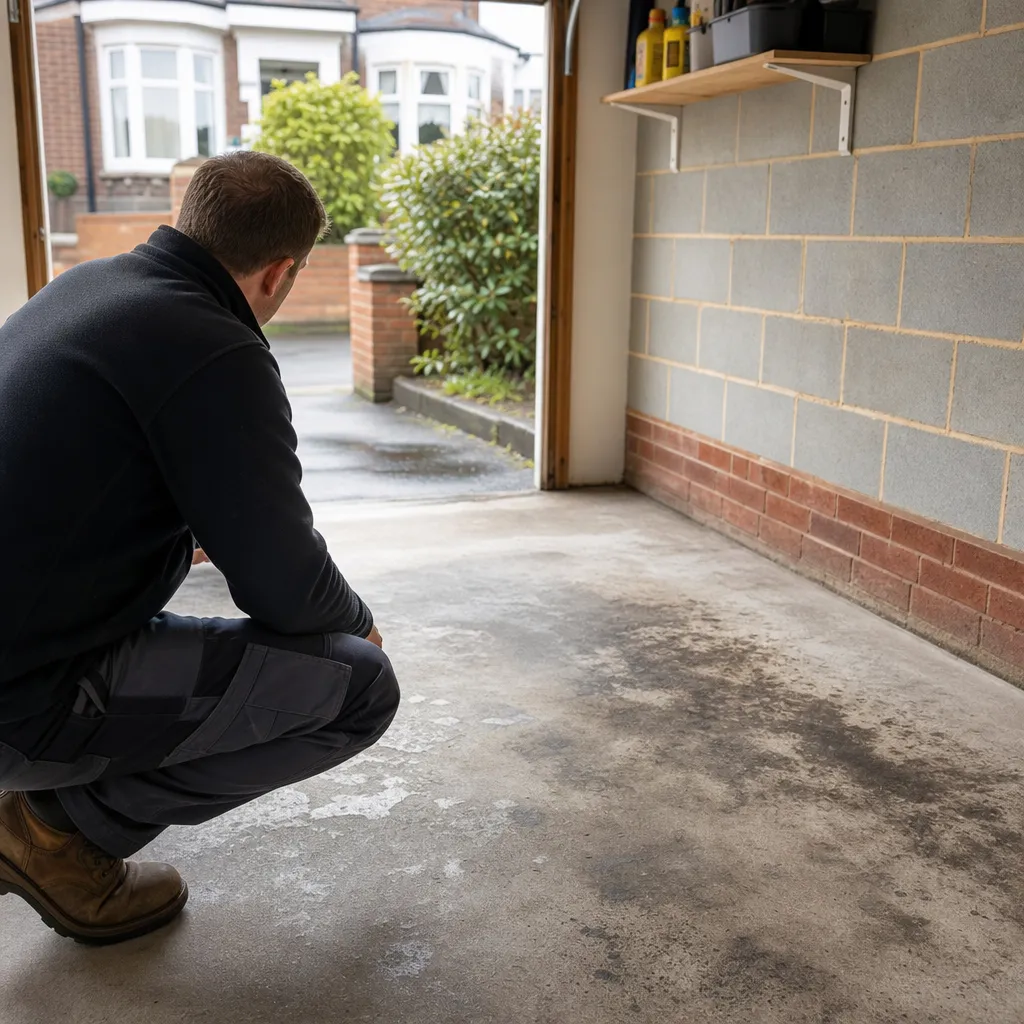
Understanding Concrete Garage Floor Discolouration: Causes and Solutions
A discoloured concrete garage floor is one of the more common — and often misunderstood — maintenance issues UK homeowners encounter. Patches of white powder, dark oil stains, orange rust marks, or grey-green algae each point to different underlying causes, and the right treatment depends entirely on identifying which you are dealing with. Applying the wrong product can mean wasted effort and cost, or treating a surface symptom while an underlying damp or drainage problem continues unchecked.
Key points
- Efflorescence — the white powdery or crystalline deposit most commonly seen on new or recently rewetted concrete — is caused by soluble salts migrating to the surface as moisture evaporates, not by surface contamination.
- Oil and fluid stains penetrate unsealed concrete quickly; fresh spills absorbed within minutes are far easier to remove than stains that have cured over several weeks.
- Tyre marks — particularly from performance or high-load vehicle tyres — are caused by plasticiser migration from the rubber compound and require specific solvent-based treatments rather than standard degreasers.
- Dark patches that reappear after cleaning often indicate moisture rising through the slab from below, which may point to a failed or absent damp-proof membrane (DPM).
- Bare concrete is porous and holds stains readily; a penetrating sealer or floor paint significantly reduces future staining once applied to a clean, dry slab.
What is causing the discolouration?
The table below maps the most common discolouration types seen on UK garage floors to their likely cause and recommended approach.
Discolouration type | Likely cause | Quick check | Recommended approach |
|---|---|---|---|
White powdery or crystalline patches | Efflorescence (salt migration) | Brushes off easily; reappears after rain or wetting | Dry-brush, apply dilute brick acid wash, seal once fully dry |
Dark spreading patches returning after drying | Rising damp or failed DPM | Tape polythene sheet to floor for 48 hrs — moisture on underside confirms rising damp | Investigate DPM; consider tanking or drainage improvement before re-sealing |
Brown or black greasy patches | Vehicle or machinery fluid leaks | Greasy to touch; solvent-cleanable | Specialist concrete degreaser; poultice treatment for deep stains |
Orange or reddish-brown patches | Rust from rebar, stored metal, or mineral-rich water | Hard surface; resists scrubbing | Rust-specific concrete cleaner (oxalic acid-based); seal afterwards |
Grey-green staining near walls or edges | Algae, lichen, or mould growth | Present in damp or poorly ventilated areas; responds to dilute bleach test | Anti-algae or biocide treatment; improve ventilation |
Patchy lighter and darker grey areas | Uneven curing during the original pour | Present from construction; consistent abstract pattern | Cosmetic only; floor paint or epoxy coating gives a uniform finish |
Raised, slightly glossy black marks | Plasticiser transfer from tyre rubber | Not greasy; resists standard degreasers | Solvent-based tyre-mark remover specifically formulated for concrete |
How to address the most common types
Efflorescence
Efflorescence is very common on garage floors — particularly in the first few years after construction or after a period of heavy rainfall. It is not structurally harmful but can recur if moisture ingress continues. Clean by dry-brushing first, then apply a diluted brick acid or proprietary efflorescence remover following the manufacturer's instructions. Rinse thoroughly and allow the slab to dry completely before applying any sealer. If efflorescence reappears regularly, investigate the source of moisture entering the slab.
Oil and fluid stains
Fresh spills should be absorbed immediately with cat litter, sand, or dry sawdust — do not hose them towards drains, as hydrocarbons are a drain contamination risk. For established stains, a specialist concrete degreaser is usually effective. Deep-set stains may benefit from a poultice treatment: a paste of degreaser and absorbent filler left on the stain for several hours before scrubbing off. Avoid high-pressure washing oil stains — this disperses contamination rather than removing it.
Rising damp
If dark patches consistently reappear after drying — especially against walls or in the centre of the slab — rising damp is the most likely cause. The polythene tape test can confirm this: seal a 50 × 50 cm sheet of polythene to the floor and check for condensation on the underside after 48 hours. If damp is confirmed, treatment options include applying a surface damp-proof membrane (paint-on waterproofing), installing drainage channels, or in severe cases, breaking out and re-laying the floor with a new DPM. Repainting or sealing over active rising damp will not produce lasting results.
Homeowner checklist: diagnosing your garage floor
Sealing and finishing options
Once the cause is identified and treated, sealing the floor significantly reduces future staining. The main options are:
- Penetrating concrete sealers: absorbed into the surface; provides an invisible finish; does not change the appearance of the floor; effective against water and light oil ingress. Suitable for most domestic garage floors.
- Epoxy floor paint: a two-part coating applied over the surface; produces a hard, glossy finish with good resistance to oil, fuel, and abrasion; requires thorough surface preparation including cleaning, acid-etching, and a moisture content check. Popular for garages used as workshops.
- Single-part floor paint: simpler to apply than epoxy but less durable; suitable for decorative purposes or light use. Not recommended as a long-term solution for working garages.
Whichever product is chosen, the slab must be clean, dry, and free of existing sealers before application. Most manufacturers specify a maximum acceptable moisture level — typically around 5% by weight — and some include a moisture indicator card in the kit.
When to get professional help
- Persistent rising damp that returns after surface sealing warrants a professional assessment of the slab's DPM and drainage.
- Cracking in the slab combined with discolouration may indicate settlement, subgrade movement, or reinforcement corrosion — a structural concern that requires a surveyor or structural engineer's opinion.
- If the garage is being converted to habitable space, Building Regulations require a new DPM, insulation, and appropriate floor finish in accordance with Approved Document C (resistance to moisture) and Approved Document L (energy efficiency). A building control officer or approved inspector should be consulted before work begins.
How Housey can help
If your garage floor discolouration points to a larger damp, drainage, or structural issue — or if you are planning a garage conversion that requires a full floor upgrade — Housey can help you find vetted local tradespeople and building professionals to assess and carry out the work. Use Housey to compare quotes and check credentials before committing to any significant floor repair.
Frequently asked questions
Is efflorescence on a garage floor harmful?
Efflorescence is not structurally harmful to concrete. It is a cosmetic issue caused by soluble salts depositing on the surface as water evaporates. However, if it recurs regularly, it indicates ongoing moisture movement through the slab, which is worth investigating — particularly if the garage is attached to the main dwelling.
Why do tyre marks appear even on a sealed floor?
Tyre marks from performance or high-load tyres result from plasticiser compounds in the rubber transferring to the floor surface — particularly in warm conditions or under heavy braking. A basic acrylic sealer provides limited resistance. Epoxy or polyurethane coatings offer better protection, but even these are not completely immune.
Can I seal over existing oil stains?
Not effectively. Oil-contaminated concrete does not bond reliably with sealers or paints, which will peel or blister over stained areas. The stain must be removed or substantially reduced first. For deep stains that cannot be fully removed, specialist stain-blocking primers are available from trade paint suppliers.
Does discolouration mean my concrete floor is failing?
Usually not. Most discolouration is cosmetic — the result of surface contamination, moisture movement, or the concrete's natural behaviour. Discolouration accompanied by cracking, crumbling, or surface delamination is more significant and warrants a professional inspection.
Sources and further reading
- GOV.UK: Approved Document C — Site preparation and resistance to moisture — GOV.UK / MHCLG
- The Concrete Society: concrete repair and maintenance guidance — The Concrete Society
- HSE: Working with concrete — control of substances hazardous to health — Health and Safety Executive
Useful next reads
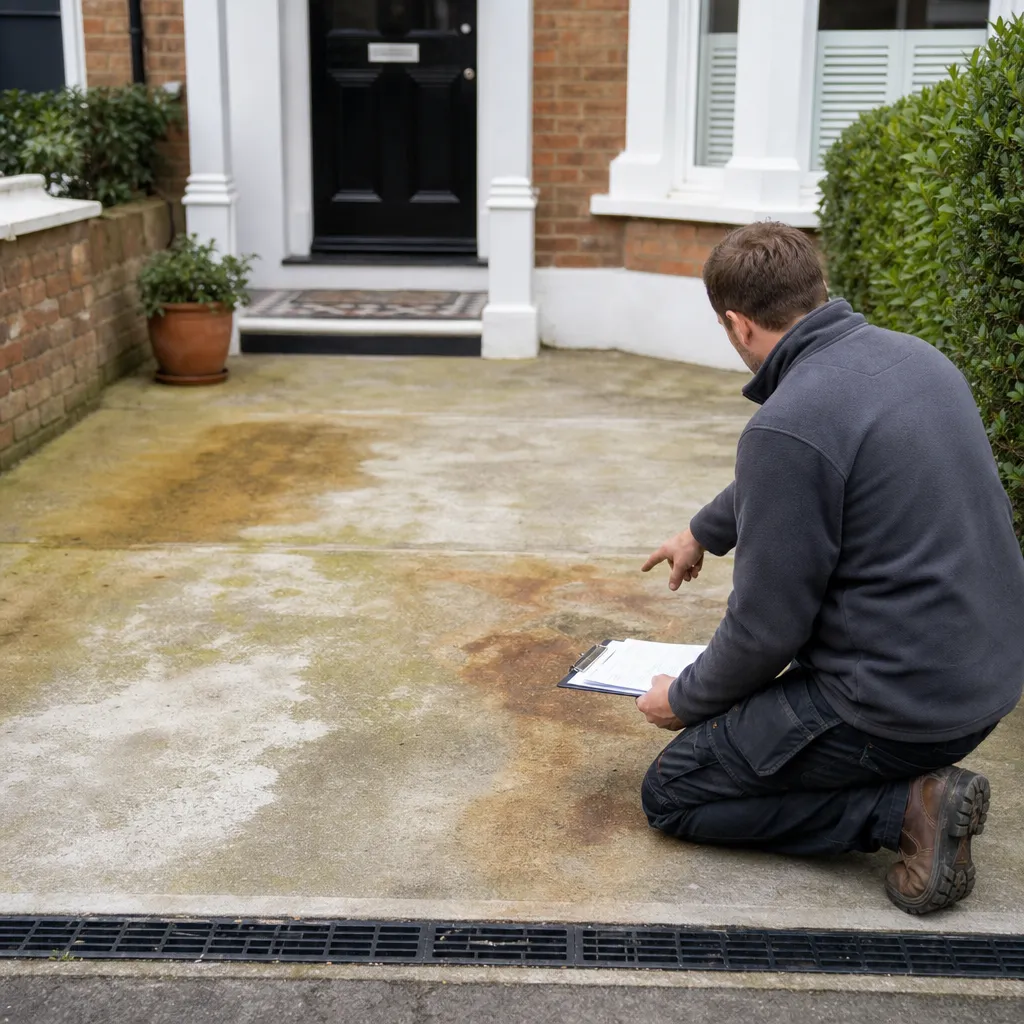 Improvement & Build
Surface Staining and Discolouration in Concrete Flatwork
Surface staining and discolouration in concrete flatwork has several distinct causes, each requiring a different remedy.
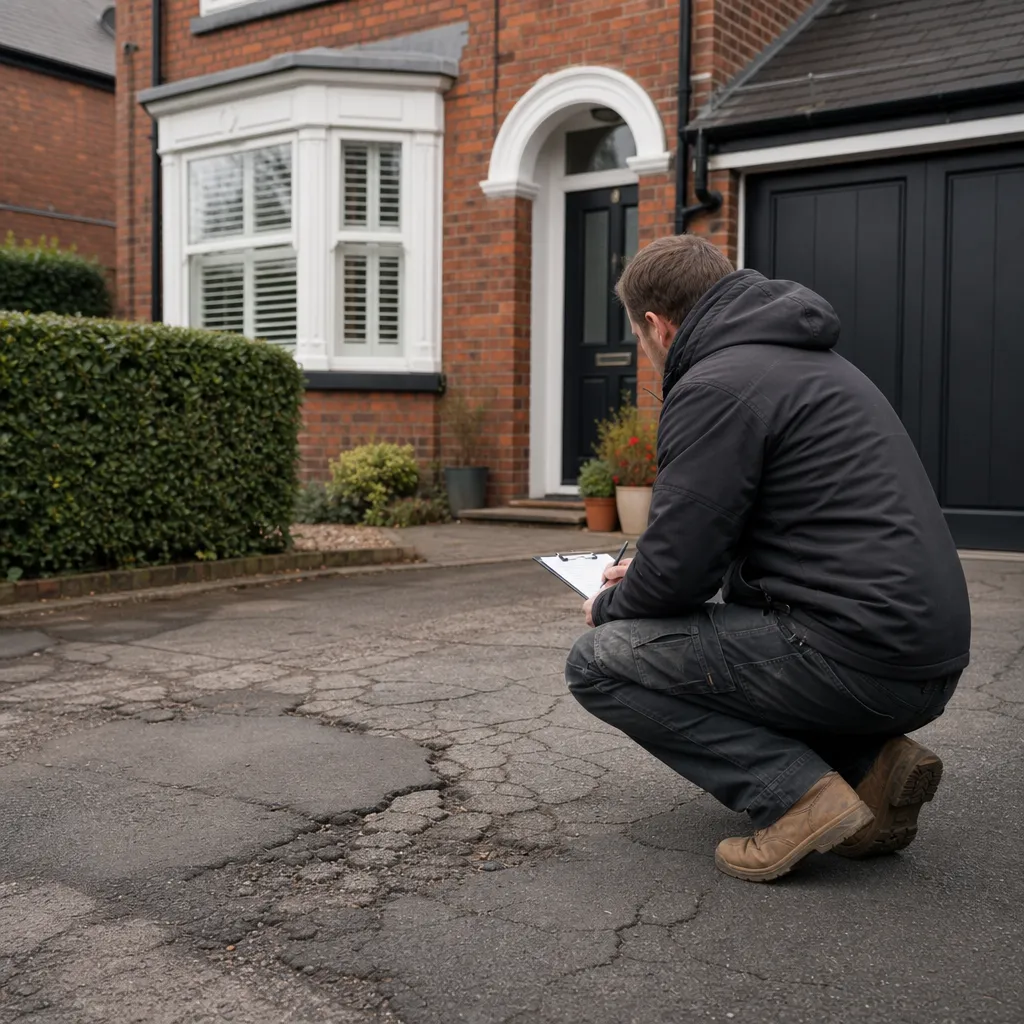 Improvement & Build
Winter Damage to Driveways: Repair and Prevention Strategies
Winter freeze-thaw cycles are the leading cause of UK driveway damage, cracking concrete, lifting block paving, and forming potholes in tarmac.
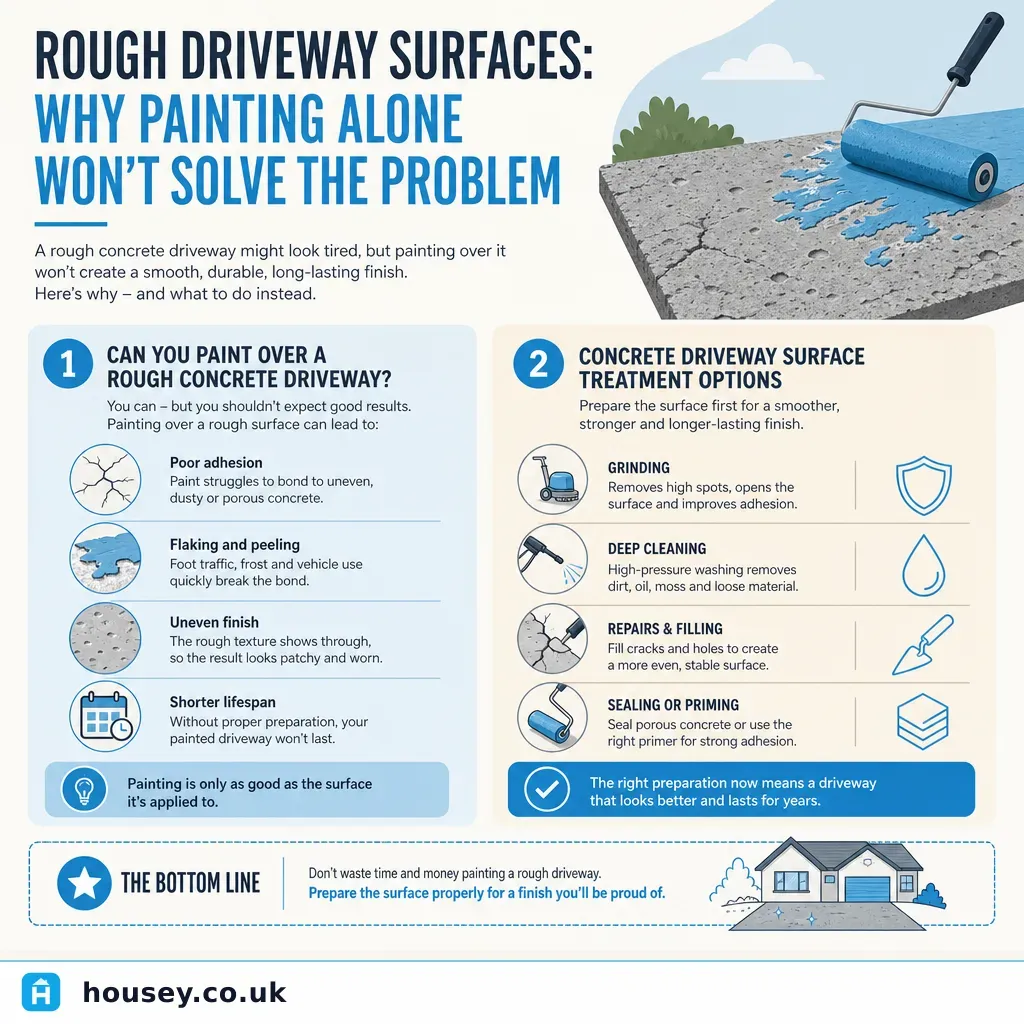 Improvement & Build
Rough Driveway Surfaces: Why Painting Alone Won't Solve the Problem
Rough driveway surfaces are caused by scaling, aggregate exposure, binder oxidation in tarmac, or sub-base failure — and painting over them won't last.
 Improvement & Build
Why Painting Your Driveway Isn't the Answer: Proper Driveway Maintenance
Driveway paint and sealants cannot fix structural cracks, sub-base failure, or freeze-thaw damage — they mask symptoms temporarily.
 Improvement & Build
Driveway Aesthetic Issues: Managing Colour Variation and Surface Consistency
Colour variation on a driveway is almost always caused by one of four things: efflorescence in new concrete, manufacturing batch differences in block paving, UV degradation in resin-bound surfaces, or sealer fade in imprinted concrete.