Rough Driveway Surfaces: Why Painting Alone Won't Solve the Problem
By Housey · Last reviewed 24th of May 2026
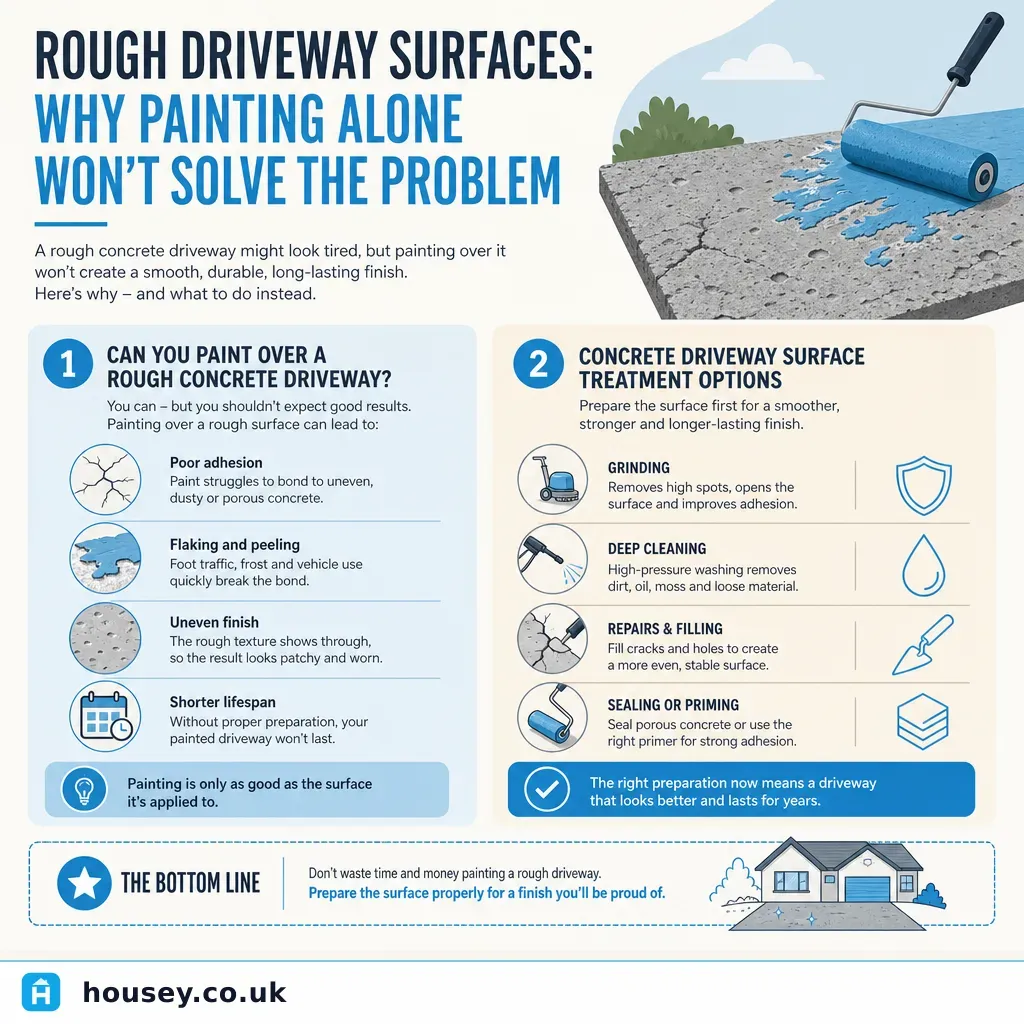
Rough Driveway Surfaces: Why Painting Alone Won't Solve the Problem
A rough or deteriorating driveway surface is a common problem in UK homes, particularly where older concrete or tarmac has been exposed to years of freeze-thaw cycles, vehicle loading, and weathering. The temptation to paint over the problem is understandable — it is quick, relatively cheap, and makes the surface look better immediately. But paint applied to a structurally compromised surface rarely lasts, and in many cases accelerates the underlying deterioration by trapping moisture.
Key points
- Driveway paint has a typical functional lifespan of 2–5 years on smooth, well-prepared concrete; on rough or damaged surfaces, adhesion is significantly reduced and failure occurs much sooner.
- Surface roughness in concrete driveways is most commonly caused by scaling (freeze-thaw spalling), aggregate exposure from surface layer loss, or delamination of the cement paste.
- Tarmac driveways develop surface ravelling — progressive loss of fine aggregate — when the bitumen binder oxidises and loses flexibility, typically after 15–20 years.
- Replacing more than 5 m² of impermeable surface at the front of a dwelling generally requires either a permeable alternative or planning permission under the Town and Country Planning (General Permitted Development) Order 2015.
- Before any surface treatment, the underlying cause — poor drainage, tree root disruption, base failure, or inadequate original construction — must be addressed, or the repair will fail.
What causes surface roughness — and why it matters
Driveway roughness is not a single problem. It is a symptom that can point to several different underlying conditions, each with a different remedy.
Scaling and pitting — small craters and flaking of the surface layer — usually indicate freeze-thaw damage or chemical attack, often from de-icing salts. The surface layer has physically separated from the substrate beneath.
Exposed aggregate — where the fine surface paste has worn away, leaving coarse stone visible — suggests the original concrete was under-strength, finished poorly, or has simply reached the end of its service life.
Ravelling in tarmac — loose grit and aggregate on the surface — indicates binder oxidation. The bitumen has hardened and lost adhesion, releasing the aggregate it once held.
Surface crazing — a fine network of cracks without significant depth — is usually cosmetic, arising from rapid drying during curing or thermal cycling, but can allow water ingress if left untreated.
Subsidence or undulation — areas that have dropped, rippled, or cracked along defined lines — indicates base failure or sub-base movement, not a surface problem at all.
Why paint fails on rough surfaces
Driveway paint — whether masonry paint, concrete floor paint, or a purpose-formulated driveway sealer — requires a clean, sound, and reasonably smooth substrate to bond properly. On a rough or degraded surface:
- Paint bridges loose aggregate. The paint film spans from peak to peak across pits and exposed stone, leaving air voids beneath. These collapse under vehicle weight, breaking the film.
- Moisture is trapped. Loose or scaled concrete retains water. Paint applied over damp or moisture-trapping material peels from beneath as water vapour pressure builds.
- The substrate continues to degrade. Paint does not arrest concrete carbonation, aggregate pop-out, or base movement. The surface beneath continues to deteriorate, eventually breaking through the paint film.
- Thorough preparation is impractical. Proper adhesion requires removing all unsound material. On heavily scaled or delaminating concrete, this can be so extensive that it fundamentally changes the surface profile.
Decision tree: choosing the right treatment for your rough driveway
Use this to identify the most appropriate response before instructing a contractor.
- Is the roughness confined to the top layer, with no cracking, sinking, or rocking?
- Yes → Likely surface layer failure. Consider repair mortar, overlay system, or full surface replacement depending on extent.
- No → Continue below.
- Are there cracks wider than 2 mm, or areas that rock or flex underfoot?
- Yes → Base or sub-base failure is likely. Surface-only treatment will not last. Get an assessment from an experienced driveway contractor before spending anything.
- Is the driveway tarmac showing loose grit across a wide area?
- Yes → Binder oxidation (ravelling). A rejuvenating sealer may extend life by 3–5 years if applied at an early stage. Beyond that, resurfacing is usually the more cost-effective route.
- Is the rough area limited to one or two isolated patches?
- Yes → Localised repair with a compatible repair compound may be appropriate. Match the material to the base (concrete-on-concrete, tarmac-on-tarmac).
- No → If widespread, full resurfacing is typically more economical than repeated patching.
- Has the driveway been repaired before and the patch failed within two years?
- Yes → Investigate why before repairing again. Common causes: base movement, incorrect repair material, or inadequate surface preparation.
Repair options compared
Treatment | Suitable for | Not suitable for | Durability | Cost driver |
|---|---|---|---|---|
Driveway paint or sealer | Sound surface with minor staining or texture issues | Rough, scaled, or loose surfaces | 2–5 years on sound substrate | Low material cost; short lifespan if misapplied |
Repair mortar or filler | Isolated cracks and pits in sound concrete | Large delaminated areas or base failure | 5–10 years with good preparation | Low to medium |
Tarmac rejuvenating sealer | Oxidised tarmac with early-stage ravelling | Advanced ravelling, cracking, base failure | 3–5 years additional life | Medium |
Overlay or micro-topping | Sound substrate needing a new surface profile | Any base movement or structural failure | 5–15 years | Medium to high |
Full resurfacing | Widespread surface failure on a sound base | Base failure | 15–25 years | High |
Full replacement | Base or sub-base failure | N/A | 20–30+ years | Highest |
Indicative UK costs, last reviewed 2026-05-24. Costs vary significantly by size, material, location, and contractor. Always obtain at least three quotes.
What to check before hiring a contractor
Before accepting any quote for driveway repair or treatment:
- Ask the contractor to explain the cause of the surface problem, not just the treatment they propose.
- Request confirmation that the sub-base will be inspected and is adequate for the proposed surface.
- Clarify what surface preparation is included — grinding, shot-blasting, cleaning, or removal of loose material.
- Ask for a written specification of materials, including product names and data sheets for sealers or resins.
- Confirm whether planning permission is needed if you are replacing more than 5 m² of impermeable surface at the front of the property.
- Ask for a written workmanship guarantee, separate from any material guarantee.
Permeable surfaces and planning rules
Since 2008, covering more than 5 m² of front garden with a new impermeable surface — concrete, standard tarmac, or conventional block paving without drainage gaps — generally requires either planning permission or use of a permeable alternative such as permeable block paving, resin-bound gravel, or open gravel. This is covered by GOV.UK guidance on paving your front garden. If you are replacing a like-for-like surface in the same footprint, the position can be less clear-cut; check with your local planning authority before starting work.
Red flags: when you should not proceed with surface-only treatment
- The driveway surface is sinking or has visible undulation across its width.
- Cracks run continuously across the full width of the driveway.
- There is evidence of tree root disruption — raised ridges following a root line beneath the surface.
- The driveway has been painted or coated before and the coating failed within two years.
- Standing water remains on the surface more than 30 minutes after rainfall, indicating drainage failure.
- The driveway is more than 25 years old and has had no previous resurfacing.
When to get professional help
Surface-only treatments are a false economy when the underlying structure is compromised. Engage an experienced driveway contractor or groundworker before spending on any repair where:
- Base or sub-base failure is suspected.
- Tree roots are present near or beneath the surface.
- There is evidence of drainage failure beneath the surface.
- The property is listed or in a conservation area, where additional consent may be required for changes to hard landscaping.
How Housey can help
Housey connects homeowners with experienced driveway installers who can assess the root cause of surface problems before recommending treatment — helping you avoid spending money on a solution that won't last.
Frequently asked questions
Can I use standard masonry paint on my concrete driveway?
Masonry paint is not formulated for vehicle traffic and typically fails within one to two seasons on a driveway. Purpose-formulated driveway paint or floor paint with appropriate abrasion resistance gives better results, but even these require a sound, clean, and correctly prepared substrate to adhere properly. Never apply paint over loose, scaled, or delaminating concrete.
How do I know if my driveway needs resurfacing or full replacement?
The key indicator is whether the base is sound. If the surface is failing but the underlying layers are stable — no sinking, rocking, or significant full-depth cracking — resurfacing is usually viable. If the base has moved, failed, or been disrupted by tree roots or drainage problems, full replacement is the more durable and economical long-term solution.
Do I need planning permission to replace my driveway?
If you are replacing more than 5 m² of front garden with a new impermeable surface, you generally need planning permission or must use a permeable alternative. This applies to concrete, standard tarmac, and conventional block paving. Replacing a like-for-like surface in the same footprint can be less clear-cut; check with your local planning authority before starting work.
Is tarmac or concrete better for a long-lasting driveway?
Both can last 20–30 years with proper installation and maintenance. Tarmac is more flexible and less prone to cracking where ground movement occurs but can soften in prolonged heat and benefits from periodic sealing. Concrete is harder and lower maintenance but more susceptible to cracking under frost or movement and more difficult to repair inconspicuously.
Can rough tarmac be repaired without full replacement?
Yes, in many cases. A rejuvenating sealer applied at an early stage of ravelling can restore surface cohesion and extend the driveway's life by several years. Localised potholes and cracks can be patched with compatible hot- or cold-lay tarmac products. If more than 30–40% of the surface is affected, full resurfacing is typically the more cost-effective option.
Sources and further reading
- Paving your front garden — GOV.UK planning guidance
- Do I need planning permission for a driveway? — Planning Portal
- The Concrete Society: Maintenance and repair guidance — The Concrete Society
- Find a TrustMark registered contractor — TrustMark (Government Endorsed Quality Scheme)
Useful next reads
 Improvement & Build
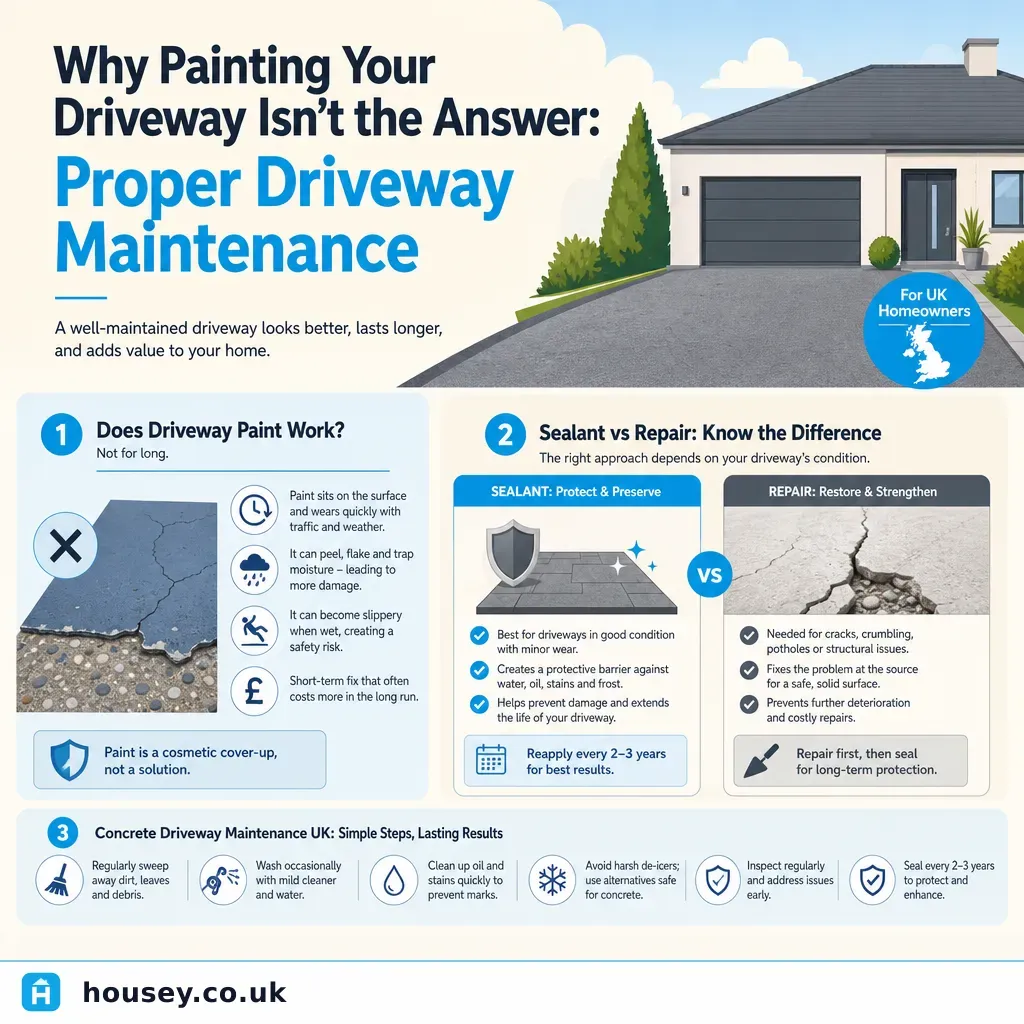
Why Painting Your Driveway Isn't the Answer: Proper Driveway Maintenance
Driveway paint and sealants cannot fix structural cracks, sub-base failure, or freeze-thaw damage — they mask symptoms temporarily.
 Improvement & Build
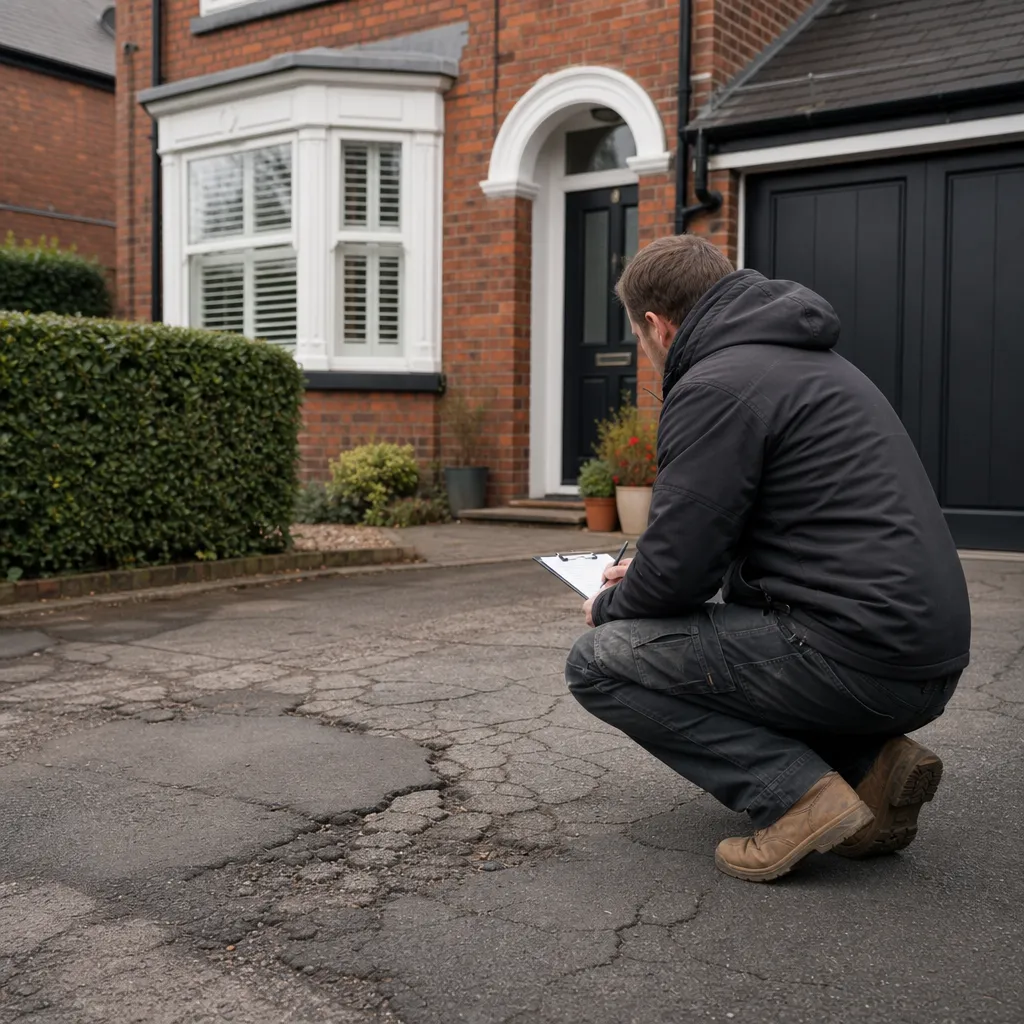
Winter Damage to Driveways: Repair and Prevention Strategies
Winter freeze-thaw cycles are the leading cause of UK driveway damage, cracking concrete, lifting block paving, and forming potholes in tarmac.
 Improvement & Build
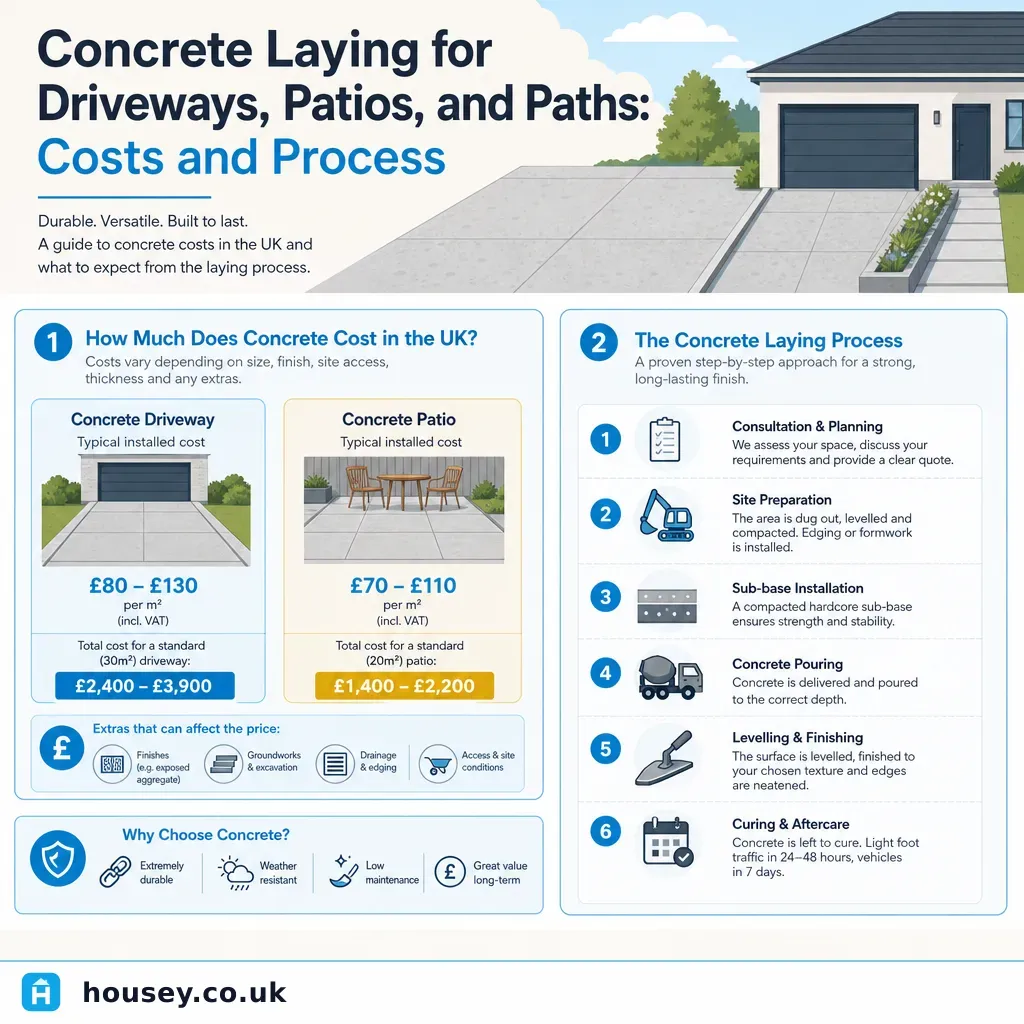
Concrete Laying for Driveways, Patios, and Paths: Costs and Process
Concrete laying for a UK driveway typically costs £65–£110 per square metre, including sub-base, reinforcement, formwork, and finishing.
 Improvement & Build
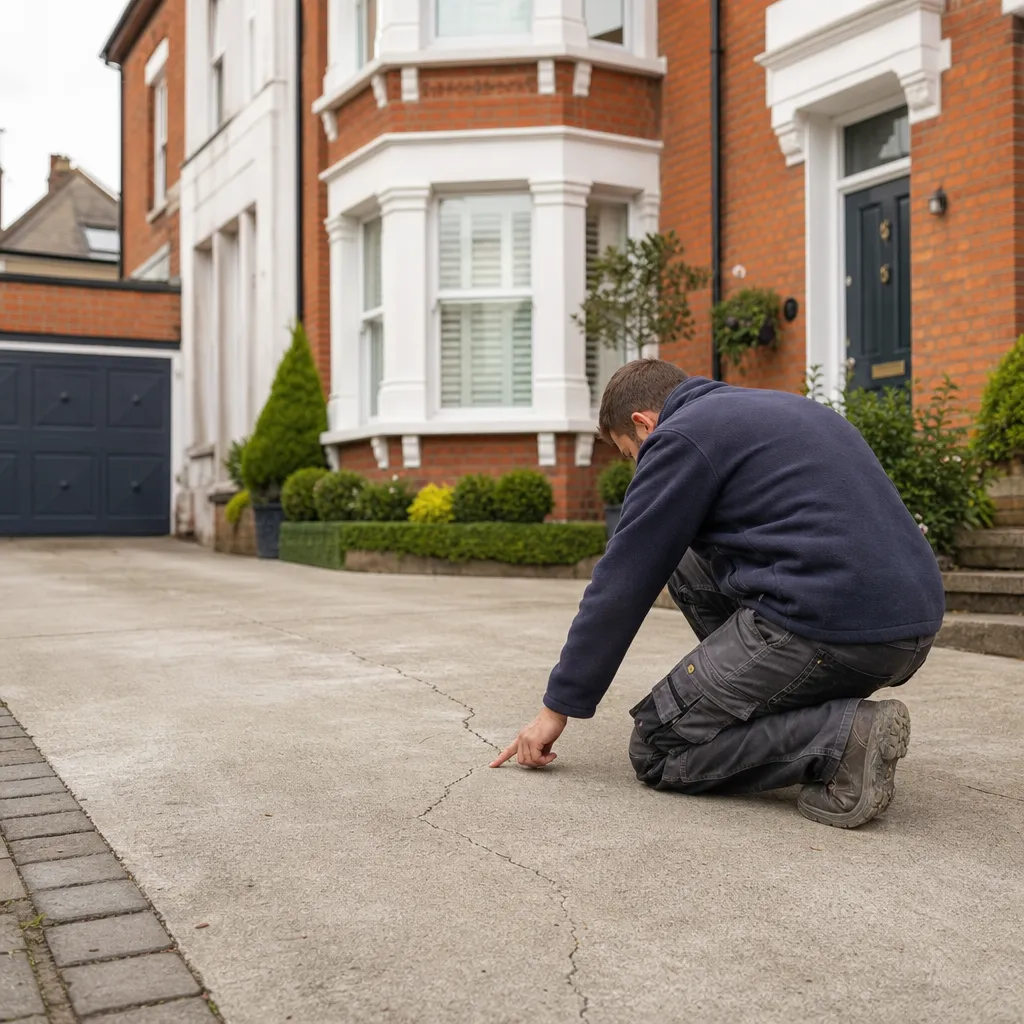
Preventing Deterioration and Cracking in Concrete Driveways and Flatwork
Concrete driveways deteriorate mainly through freeze-thaw cycling, shrinkage cracking, and sub-base failure.
 Improvement & Build
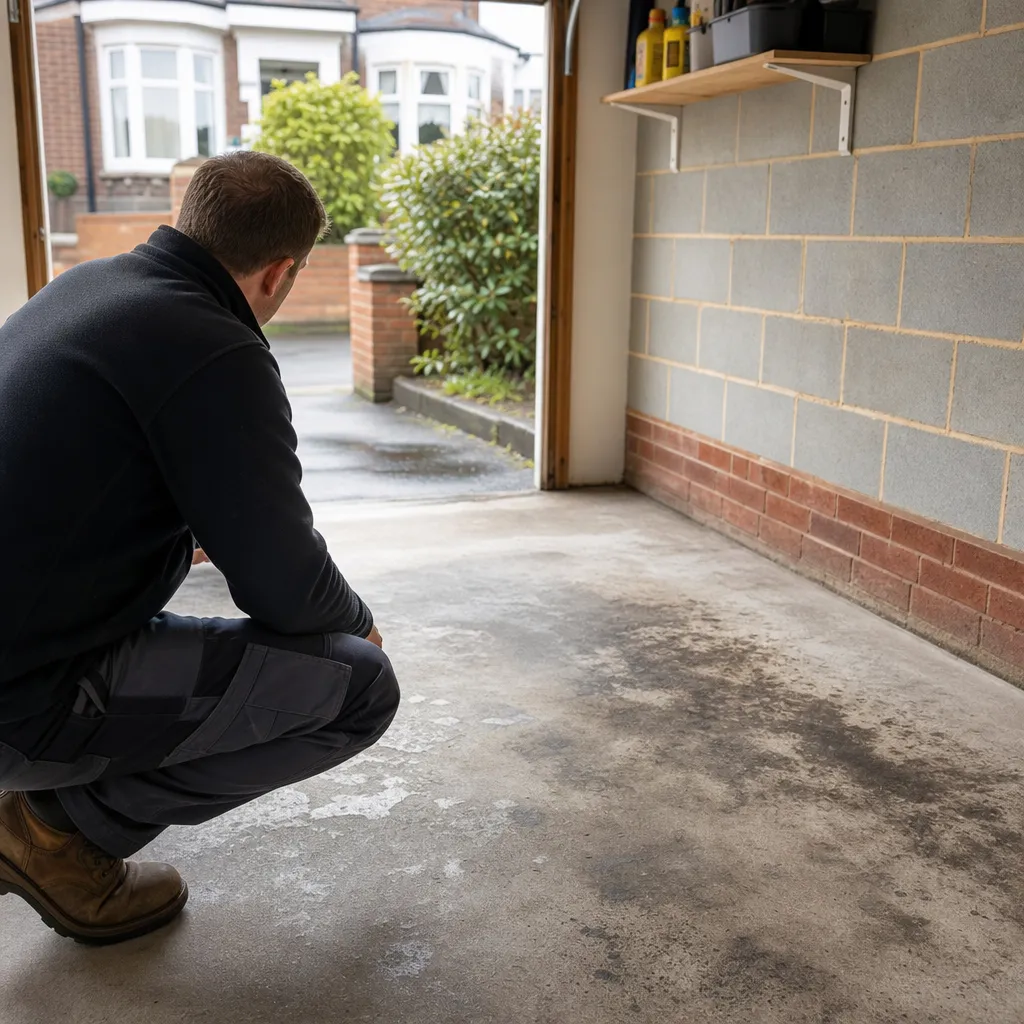
Understanding Concrete Garage Floor Discolouration: Causes and Solutions
Concrete garage floor discolouration in UK homes is most commonly caused by oil or fluid leaks, efflorescence (white mineral deposits from moisture), tyre rubber plasticiser transfer, algae or mould growth, or uneven curing during the original pour.