Why Painting Your Driveway Isn't the Answer: Proper Driveway Maintenance
By Housey · Last reviewed 24th of May 2026
Why Painting Your Driveway Isn't the Answer: Proper Driveway Maintenance
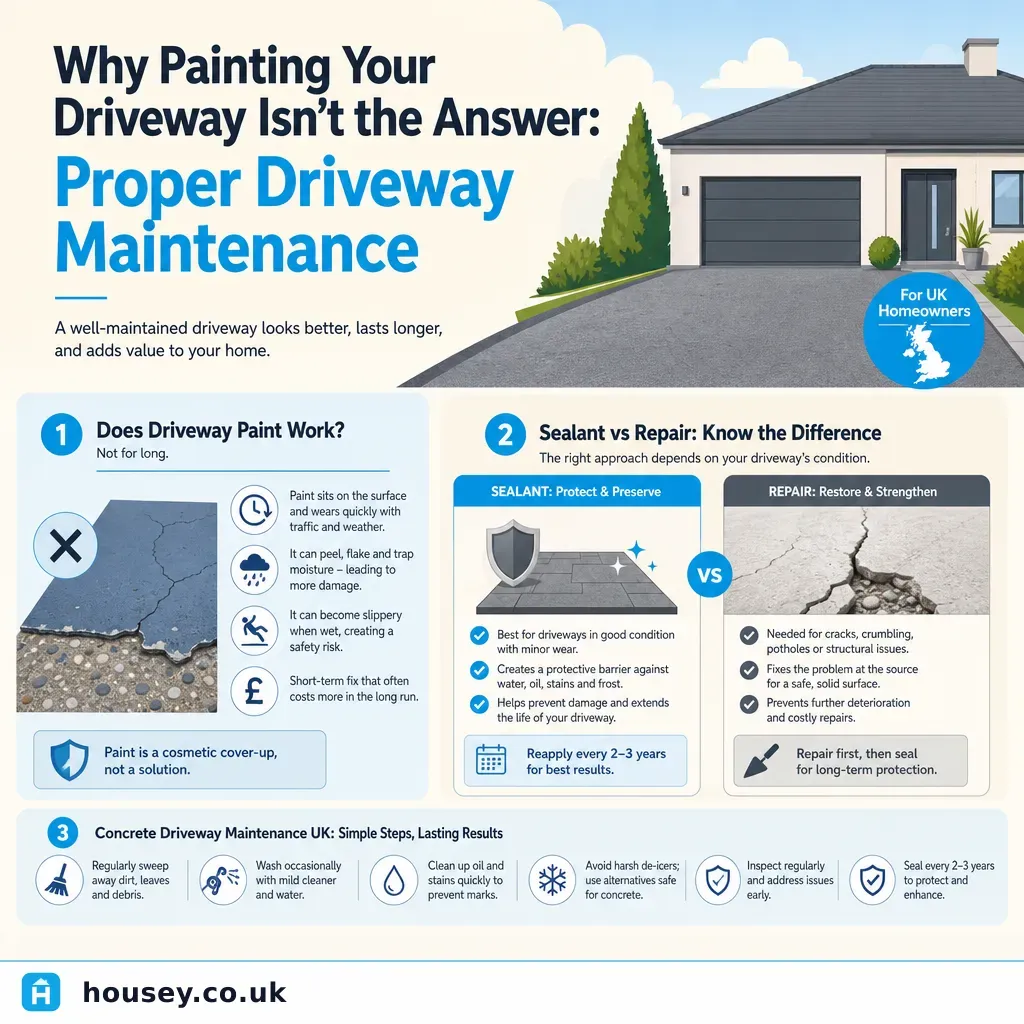
Driveway paint and sealant products are widely marketed to UK homeowners as a quick fix for tired, stained, or cracking surfaces. The reality is that most decorative coatings — however professionally applied — cannot address the underlying causes of driveway deterioration, and in some cases can accelerate damage by hiding problems that worsen undetected. Understanding when surface treatment genuinely helps, and when it simply buys time at the wrong stage, can save considerable expense.
Key points
- Driveway paint and sealants cannot bridge or fill active cracks; applied over movement, they will peel or re-crack within 12–24 months in UK freeze-thaw conditions.
- Concrete driveways deteriorate through freeze-thaw cycling, carbonation, de-icing salt ingress, and loading fatigue — surface coatings address none of these root causes.
- Planning permission is generally required for new or replacement driveways with an impermeable surface larger than 5 m² in England under the Town and Country Planning (General Permitted Development) (England) Order 2015.
- Block paving, resin-bound aggregate, and permeable concrete are compliant alternatives that avoid planning requirements by meeting Sustainable Drainage Systems (SuDS) principles.
- A freshly painted driveway shortly before a property sale may attract scrutiny from buyers' surveyors, who may interpret it as cosmetic concealment of underlying defects.
Why paint and sealant products underperform
Driveway coatings — whether bitumen emulsion paint, acrylic concrete paint, or polyurethane sealants — are surface treatments. They sit on top of the substrate and rely entirely on adhesion. The problem is that driveways are dynamic surfaces subject to significant, repeated stress:
- Thermal movement: Concrete expands and contracts with temperature. A dark-painted surface absorbs more heat, increasing thermal stress and the risk of surface cracking.
- Freeze-thaw cycling: Water infiltrates hairline cracks or surface porosity. When it freezes, it expands by roughly 9%, widening existing cracks and spalling the surface. A coating may hide this process, allowing it to worsen undetected beneath the paint film.
- Vehicle loading: The cumulative weight of vehicles crossing the same point creates fatigue in the substrate. Paint provides no structural reinforcement whatsoever.
- Substrate preparation failure: Many applications skip essential steps — degreasing, pressure washing, crack routing and filling, and priming. Without these, adhesion fails within a season.
What actually works: a maintenance comparison
Problem | Painting or sealing | Correct repair approach |
|---|---|---|
Surface staining (oil, rust, algae) | Temporary mask; may not adhere over contamination | Degrease, pressure wash, use targeted stain-removal products |
Hairline surface cracks (under 2 mm) | Covers temporarily; moisture still ingresses | Rout, clean, fill with flexible polyurethane sealant; apply treatment once cured |
Structural cracks (over 3 mm, or visibly widening) | Paint bridges nothing; will re-crack quickly | Investigate cause; may require partial or full slab replacement |
Spalling or scaling concrete | Coating hides damage; substrate continues to deteriorate | Surface rebonding with repair mortar, resin overlay, or full replacement if widespread |
General dullness and weathering on a sound surface | Legitimate use — set realistic expectations | Clean, prime, then sealant or paint where substrate is genuinely sound |
Settlement or heave | No surface coating addresses this | Excavate and relay with correct sub-base; investigate drainage |
What not to assume about driveway sealants
- So-called waterproofing sealants do not make concrete impermeable. Most penetrating sealants reduce surface absorption but do not prevent water ingress through cracks or joints — those require physical sealing.
- Tarmac restorer products are not the same as resurfacing. Restorer products darken and protect sound tarmac surfaces; they cannot replace lost aggregate or repair potholed areas.
- A freshly painted driveway may raise questions at sale. Buyers' solicitors and surveyors may query whether a newly coated concrete surface conceals recent crack repairs, particularly if the coating was applied shortly before the property came to market.
- Colour fading is normal and relatively fast. Most driveway paints fade within 2–5 years under UV exposure and traffic. Budget for reapplication or choose a more durable solution from the outset.
Planning and drainage rules: what you need to know
If you are considering replacing, rather than simply maintaining, your driveway, UK planning rules apply. Under the Town and Country Planning (General Permitted Development) (England) Order 2015, you do not need planning permission for front garden hardstanding if:
- The surface drains to a lawn, border, or soakaway — and does not discharge directly to the public sewer — or
- The surface material is permeable (resin-bound gravel, block paving with permeable jointing, or permeable concrete)
If the driveway surface is impermeable and covers more than 5 m², planning permission is required in England. Rules differ in Wales, Scotland, and Northern Ireland — always check with your local planning authority before beginning any replacement works.
Driveway maintenance checklist
Use this checklist annually to assess your driveway's condition before deciding on the right approach:
If you answer yes to the first two or three questions, surface treatment alone is unlikely to be sufficient.
When to get professional help
Surface coatings are a legitimate maintenance tool for a driveway that is structurally sound but showing cosmetic wear. If you see any of the following, get a professional assessment before spending money on paint or sealant:
- Cracks wider than 3 mm, especially diagonal or stepped cracks that suggest ground movement
- Visible settlement, or one area consistently sitting lower than another
- Water consistently pooling near the house or entering under a doorstep
- A soft or spongy feel underfoot in any section, indicating sub-base failure
- Frost heave causing sections to lift in winter and settle irregularly
How Housey can help
If your driveway needs more than a surface treatment, Housey can match you with experienced local driveway installers who can assess the condition of your existing surface and recommend the most appropriate solution — whether that is targeted repair, full resurfacing, or a replacement driveway in a permeable material.
Frequently asked questions
Can I paint a concrete driveway myself?
You can, but preparation is more demanding than most homeowners expect. The surface must be thoroughly degreased, pressure washed, and completely dry before any paint or sealant is applied. Any cracks must be routed and filled with a compatible flexible filler first. Applied to a well-prepared, structurally sound surface, a quality driveway paint can last 3–5 years before requiring reapplication.
Does driveway sealer stop weeds in block paving?
A sealant on block paving can reduce weed germination by limiting organic material and moisture in the joints, but it does not eliminate the problem entirely. For best results, joints should be brushed with kiln-dried sand and treated with a long-acting weed suppressant before sealing is applied. Reapplication of jointing sand is often needed after pressure washing.
How often should a tarmac driveway be resealed?
Sound tarmac generally benefits from a restorative sealant every 3–5 years to slow oxidation and surface weathering. Applying sealant too frequently risks product build-up, which can itself crack and peel. The surface must be clean, dry, and free of active potholes or crumbling areas before any sealant or restorer is applied.
Will a freshly painted driveway affect my home's kerb appeal when selling?
Freshly sealed block paving or tarmac can enhance kerb appeal when the surface is otherwise sound. However, buyers' surveyors may query whether a newly painted or coated concrete surface conceals recent crack repairs. It is better to repair defects properly and document the work than to apply a surface coating over them shortly before the property is marketed.
Sources and further reading
- Town and Country Planning (General Permitted Development) (England) Order 2015 — legislation.gov.uk
- Paving your front garden: when is planning permission required — GOV.UK
- Flood and Water Management Act 2010 — legislation.gov.uk
- CIRIA SuDS Manual — CIRIA
Useful next reads
 Improvement & Build
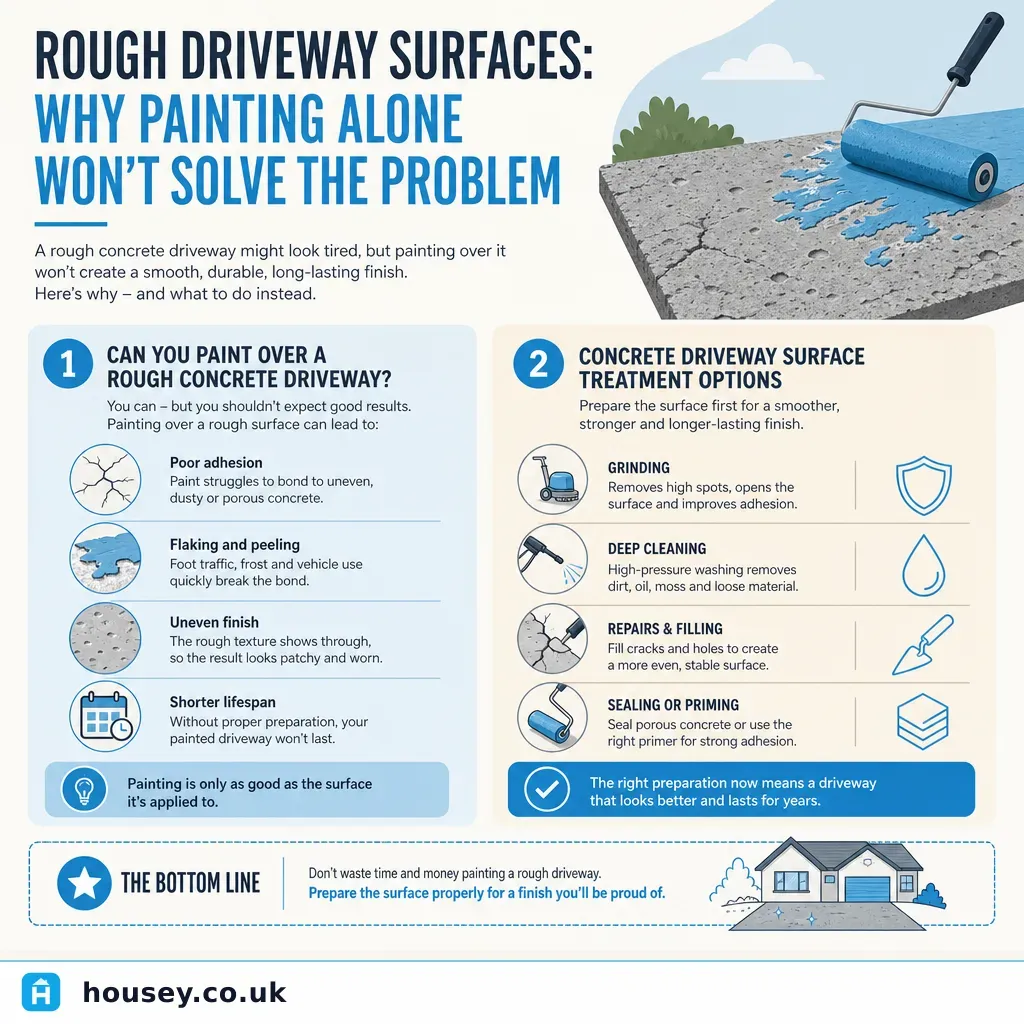
Rough Driveway Surfaces: Why Painting Alone Won't Solve the Problem
Rough driveway surfaces are caused by scaling, aggregate exposure, binder oxidation in tarmac, or sub-base failure — and painting over them won't last.
 Improvement & Build
Winter Damage to Driveways: Repair and Prevention Strategies
Winter freeze-thaw cycles are the leading cause of UK driveway damage, cracking concrete, lifting block paving, and forming potholes in tarmac.
 Improvement & Build
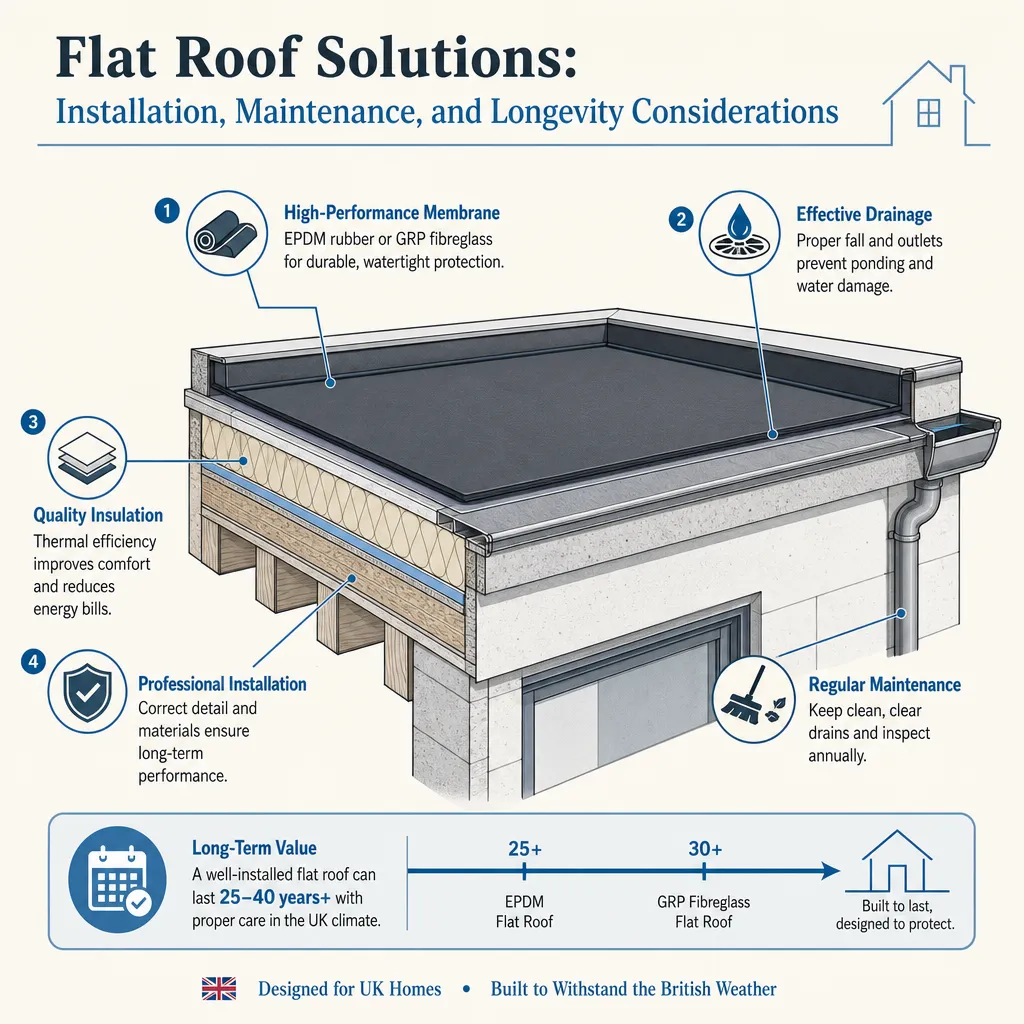
Flat Roof Solutions: Installation, Maintenance, and Longevity Considerations
Flat roofs use several waterproofing systems — EPDM rubber, GRP fibreglass, liquid-applied coatings, modified bitumen felt, lead, and zinc — each with different lifespans and installation requirements.
 Improvement & Build
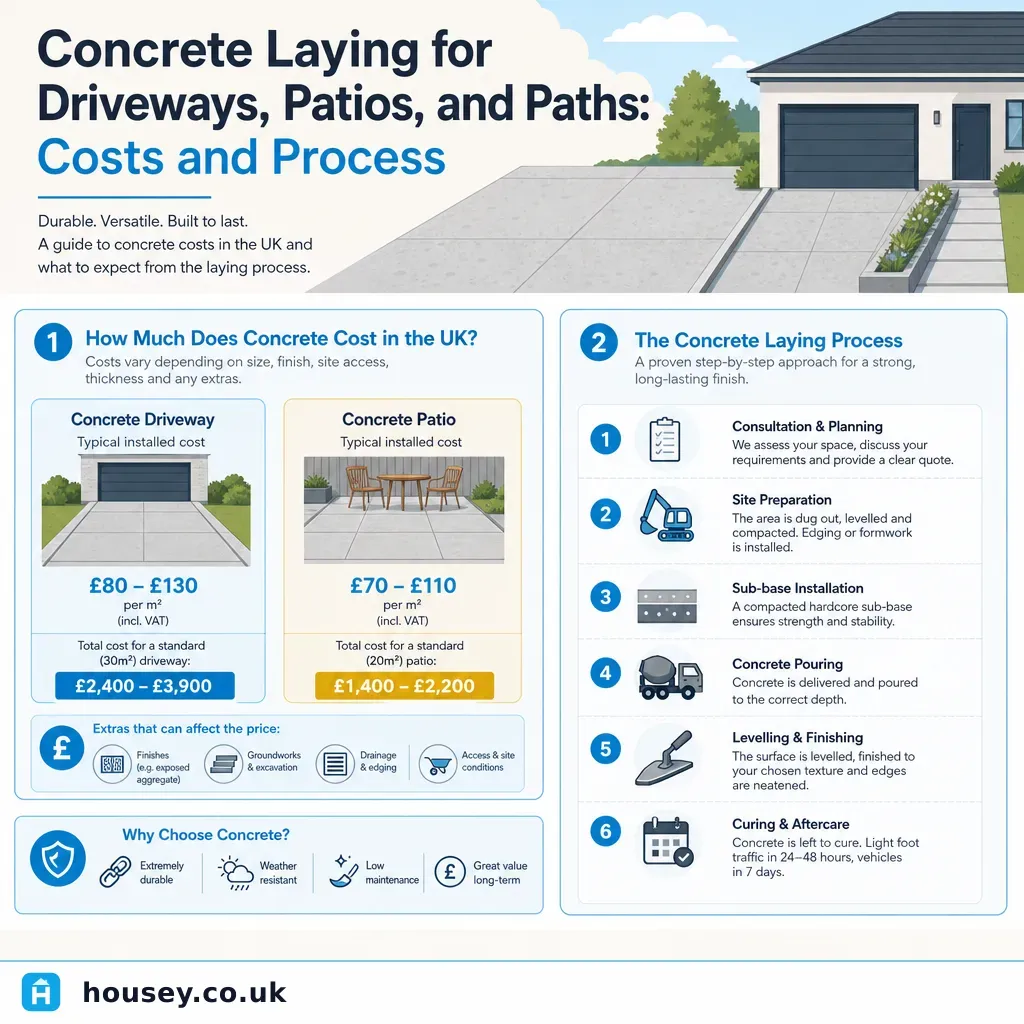
Concrete Laying for Driveways, Patios, and Paths: Costs and Process
Concrete laying for a UK driveway typically costs £65–£110 per square metre, including sub-base, reinforcement, formwork, and finishing.
 Improvement & Build
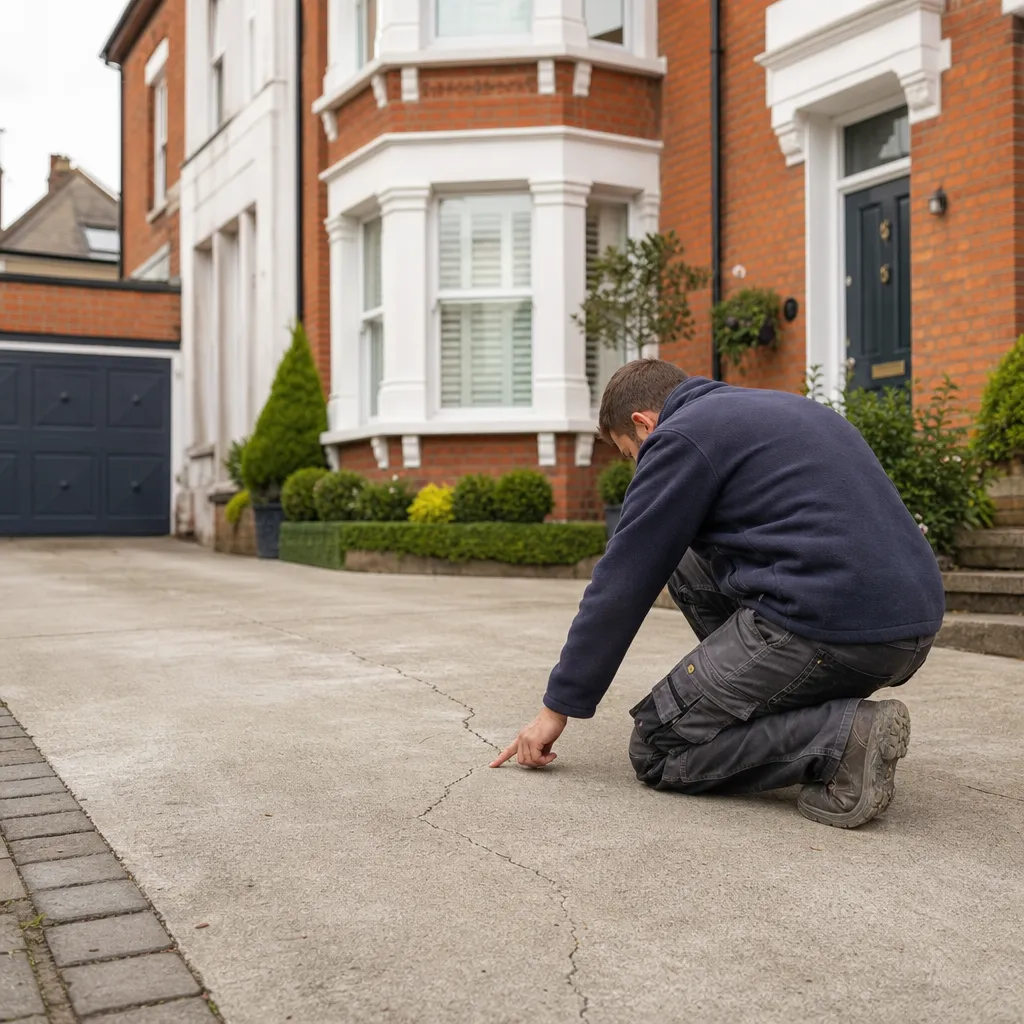
Preventing Deterioration and Cracking in Concrete Driveways and Flatwork
Concrete driveways deteriorate mainly through freeze-thaw cycling, shrinkage cracking, and sub-base failure.