Concrete Garden Features and Outdoor Landscape Design
By Housey · Last reviewed 25th of May 2026
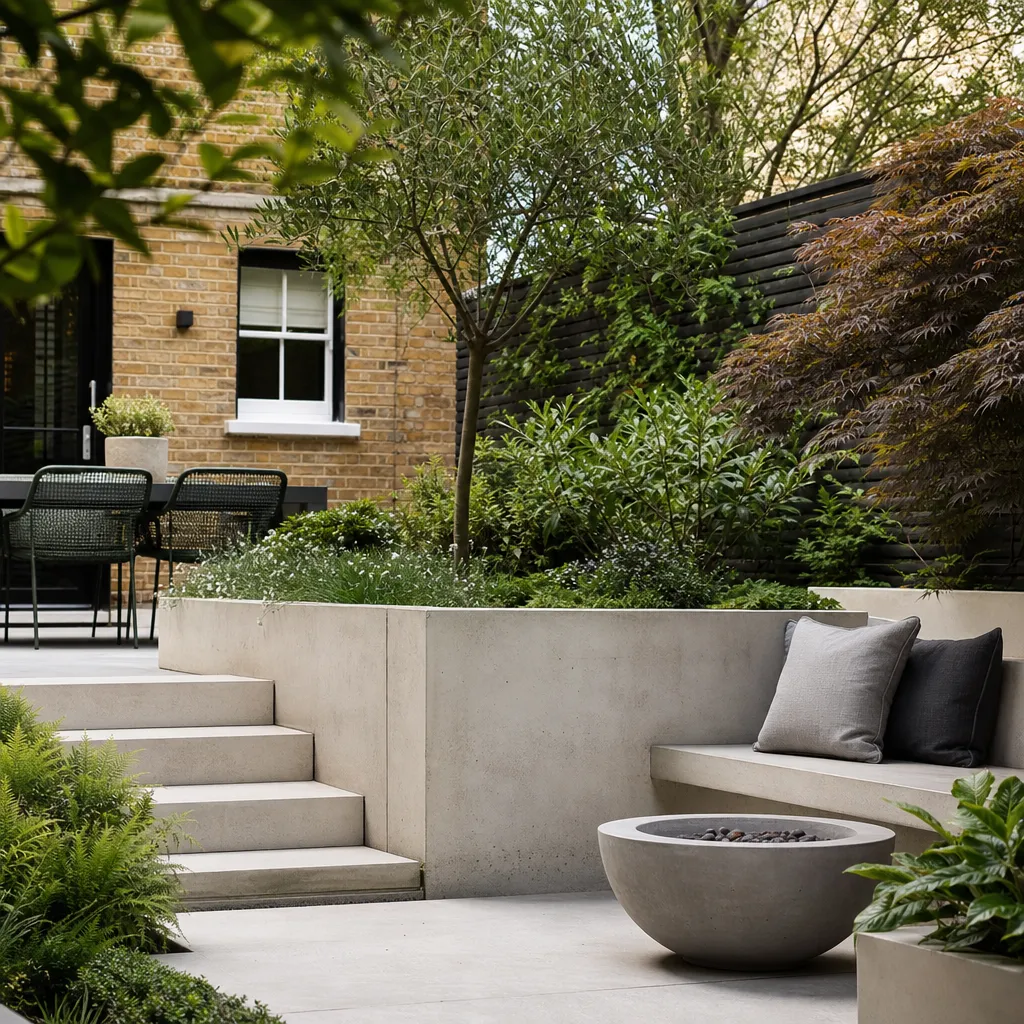
Concrete Garden Features and Outdoor Landscape Design
Concrete has moved well beyond the utilitarian grey slab in British gardens. Homeowners planning rear garden redesigns, contemporary courtyard schemes, or planting-focused outdoor spaces are increasingly specifying concrete in decorative forms — exposed aggregate paths, polished terrace slabs, cast-in-place raised beds, and precast water features. Whether you are briefing a garden designer or working directly with a landscaper, understanding the options, their practical requirements, and the planning rules that apply will help you get the result you want without unexpected cost or compliance problems.
Key points
- Front garden hard standing over 5m² must use permeable surfacing or drain to a lawn or planted border under England's permitted development rules; standard impermeable concrete at the front requires a planning application.
- Decorative finishes such as exposed aggregate, stamped concrete, and polished/ground concrete require a different mix specification and finishing sequence from plain broom-finished concrete — specifying the wrong mix can result in poor surface texture or premature deterioration.
- Concrete patios and paths need expansion joints at approximately 3–4 metre intervals to manage thermal movement and prevent uncontrolled cracking.
- Any concrete wall retaining more than 600mm of earth should be assessed by a structural engineer; walls over 1m retaining soil near a building or highway may require building control input under Building Regulations Part A.
- Precast concrete garden products (planters, edging, copings) vary widely in quality — check for UKCA/CE marking and confirm the manufacturer's frost-resistance rating for UK outdoor conditions.
Decorative concrete finishes compared
Choosing a finish affects cost, installation time, maintenance requirements, slip resistance, and how the garden ages over time.
Finish | Visual character | Slip resistance | Maintenance | Indicative UK installed cost | Best for |
|---|---|---|---|---|---|
Exposed aggregate | Textural, natural-stone appearance | Good | Low — occasional pressure washing | £60–£120/m² | Paths, driveways, contemporary patios |
Stamped / imprinted | Pattern-embossed, mimics stone or brick | Moderate — depends on sealant condition | Medium — reseal every 3–5 years | £70–£140/m² | Feature patios, pool surrounds, courtyard areas |
Polished / ground | Smooth, urban, high-gloss or satin | Low–moderate (sealant improves grip) | Medium — protect from moss and algae | £80–£160/m² | Contemporary terraces, covered outdoor areas |
Acid-etched / washed | Lightly textured, muted colour variation | Good | Low | £50–£100/m² | Utilitarian paths with a decorative edge |
Plain broom-finished | Functional, uniform | Good | Very low | £30–£70/m² | Driveways, service areas, utility paths |
Coloured (integral pigment) | Wide colour range, consistent throughout | As per underlying finish | Low–medium | Add £10–£30/m² to base cost | Feature patios, raised bed surrounds, garden art |
Indicative UK costs, last reviewed 2026-05-25. Prices vary by region, site access, ground conditions, and design complexity. Always obtain at least three itemised quotes.
Concrete features in UK gardens
Patios and terraces
A standard domestic patio is typically cast at 100–125mm thickness on a compacted hardcore sub-base. For a contemporary finish:
- Exposed aggregate weathers well in the British climate, resists algae better than smooth surfaces, and requires minimal ongoing maintenance.
- Polished or ground concrete suits a sleek, architectural aesthetic but benefits from a covered or semi-covered setting where moss and algae accumulation can be managed.
- Coloured or stamped concrete adds pattern and warmth without the cost of natural stone.
All patios adjacent to the house should incorporate drainage falls of at least 1:60 away from the wall and include expansion joints to prevent cracking from ground movement and seasonal temperature change.
Paths and stepping stones
Precast concrete slabs are the most cost-effective and quickest path solution, but in-situ poured paths with a brushed or exposed aggregate finish integrate more cohesively with planting schemes. Cast concrete stepping stones at 600×600mm or 600×900mm are a popular choice in contemporary planting-focused gardens, particularly when set into gravel or low ground cover.
Raised planters and garden beds
Concrete raised beds can be constructed in-situ using temporary formwork or from precast units. For permanent in-situ raised beds:
- Use a waterproof concrete mix or apply a crystalline waterproofing treatment to the inside face to limit excessive moisture transfer and staining.
- Allow for drainage at the base using weep holes or a gravel drainage layer beneath the growing medium.
- In-situ construction gives more design flexibility for bespoke shapes; precast units are faster to install and suit modular layouts.
Concrete garden walls and low retaining structures
Low concrete garden walls up to 600mm in rear gardens are generally within permitted development in England. Front garden walls above 1m adjacent to a highway or 2m elsewhere require planning permission. For walls retaining earth:
- Any wall retaining over 600mm of soil should be checked by a structural engineer.
- Reinforced concrete is standard for walls retaining over 600mm.
- Building Regulations Part A may apply where a retaining structure could affect the stability of an adjacent building.
Water features
Cast concrete water features — pools, rills, raised ponds — require a waterproof concrete mix using a hydrophobic admixture or proprietary waterproofing treatment applied to the finished surface. Ground-level features should have overflow drainage to prevent damage during heavy rain. Any electrical supply for pumps or lighting must be installed by a Part P-registered electrician with a dedicated outdoor circuit incorporating RCD protection.
Worked example: contemporary rear garden, 1930s semi-detached, Bristol
A homeowner in a 1930s semi-detached house in Bristol wants to replace a worn concrete path and patchy lawn with a contemporary hard-landscape scheme. The plan comprises a polished concrete terrace (35m²), exposed aggregate paths (20m²), three large precast concrete raised beds, and a cast concrete rectangular pond.
Key decisions the homeowner and their designer worked through:
- Terrace drainage — the polished slab must drain away from the rear wall; a linear channel drain connecting to a rear-garden soakaway is specified.
- Expansion joints — the designer specifies joints at 3.5m centres across the terrace slab to manage thermal movement.
- Pond waterproofing — a two-coat crystalline waterproofing product is applied to the pond walls and base before filling.
- Pond electrics — the pump circuit is installed by a NICEIC-registered electrician as a dedicated outdoor supply with a 30mA RCD.
- Planning position — the garden is at the rear of the property, so none of the proposed hard standing triggers a planning application under permitted development rules.
- Curing programme — the landscaper schedules the terrace pour in May to take advantage of above-5°C overnight temperatures, with a 7-day protection period before the raised beds are installed adjacent to the slab edge.
The scheme is completed without planning complications and achieves the polished, contemporary aesthetic the homeowner wanted within the agreed budget.
Homeowner checklist for concrete garden features
Before instructing a landscaper or garden designer, confirm:
Red flags when reviewing a quote
- No sub-base specification — a concrete slab without a properly compacted hardcore base will crack or settle unevenly.
- No expansion joints mentioned — any poured area longer than 3–4m in either direction needs them.
- Vague finish description — "decorative concrete" without a mix class, aggregate type, or finish method is not a workable specification.
- No drainage plan — patios adjacent to the house without confirmed drainage falls risk damp ingress.
- Electrical work not confirmed as Part P-registered — a legal requirement for new outdoor circuits in England and Wales.
- Very low unit cost for polished or stamped finishes — quality decorative finishes require specialist equipment and skilled operatives; unusually low prices often indicate substituted methods or finishes.
When to get professional help
Most decorative concrete garden projects can be delivered by a competent landscaper working to a clear specification. Engage additional professional input — a structural engineer or building control professional — if:
- The project includes a wall retaining over 1m of earth.
- The design includes a raised water feature or pond with significant structural loading.
- The property is in a Conservation Area or is listed, as external hard landscaping can require consent.
- The proposed front garden hard standing exceeds 5m² and you want to use an impermeable finish.
How Housey can help
Housey connects you with experienced garden designers who can translate your ideas into a coordinated scheme with detailed material specifications, drainage plans, and planning guidance, and with skilled landscapers who have the practical expertise to deliver high-quality decorative concrete finishes on site.
Frequently asked questions
Do I need planning permission for a concrete patio?
In England, concrete patios and hard standing in rear gardens are generally permitted development and do not require planning permission. Front garden hard standing over 5m² must use permeable surfacing or drain to a lawn or border — otherwise planning permission is required. Rules differ in Conservation Areas, National Parks, and for listed buildings, so always check with your local planning authority first.
How long does concrete take to cure outdoors in the UK?
Concrete achieves working strength sufficient for light foot traffic within 24 to 48 hours in normal UK summer conditions, but reaches full structural strength at 28 days. Cold weather below 5°C significantly slows curing; contractors may use insulating blankets or accelerating admixtures during winter pours. Avoid foot traffic and heavy loads until the contractor confirms the concrete has adequately cured.
Can I colour concrete to match my garden scheme?
Yes. Integral pigments added to the concrete mix at batching produce consistent, fade-resistant colour throughout the full depth of the slab. Surface-applied stains and acid etching are also used on existing concrete. Integral colour is the more durable approach for new work. Confirm the pigment manufacturer, UV stability, and expected colour consistency with your contractor before specifying.
How do I maintain decorative concrete outdoors?
Exposed aggregate and plain broom-finished concrete require periodic pressure washing and, in shaded areas, treatment with a moss and algae inhibitor. Stamped and polished surfaces should be resealed every three to five years using a breathable, UV-stable sealant. Avoid de-icing salts, which degrade the surface layer over time — use sharp sand as an alternative during icy conditions.
Sources and further reading
- When is permission required? — Planning Practice Guidance — GOV.UK
- Building Regulations Approved Document A — Structure — GOV.UK
- Find a registered electrician — NICEIC — NICEIC
- Concrete in landscape and garden design — technical guidance — The Concrete Centre (MPA)
Useful next reads
 Improvement & Build
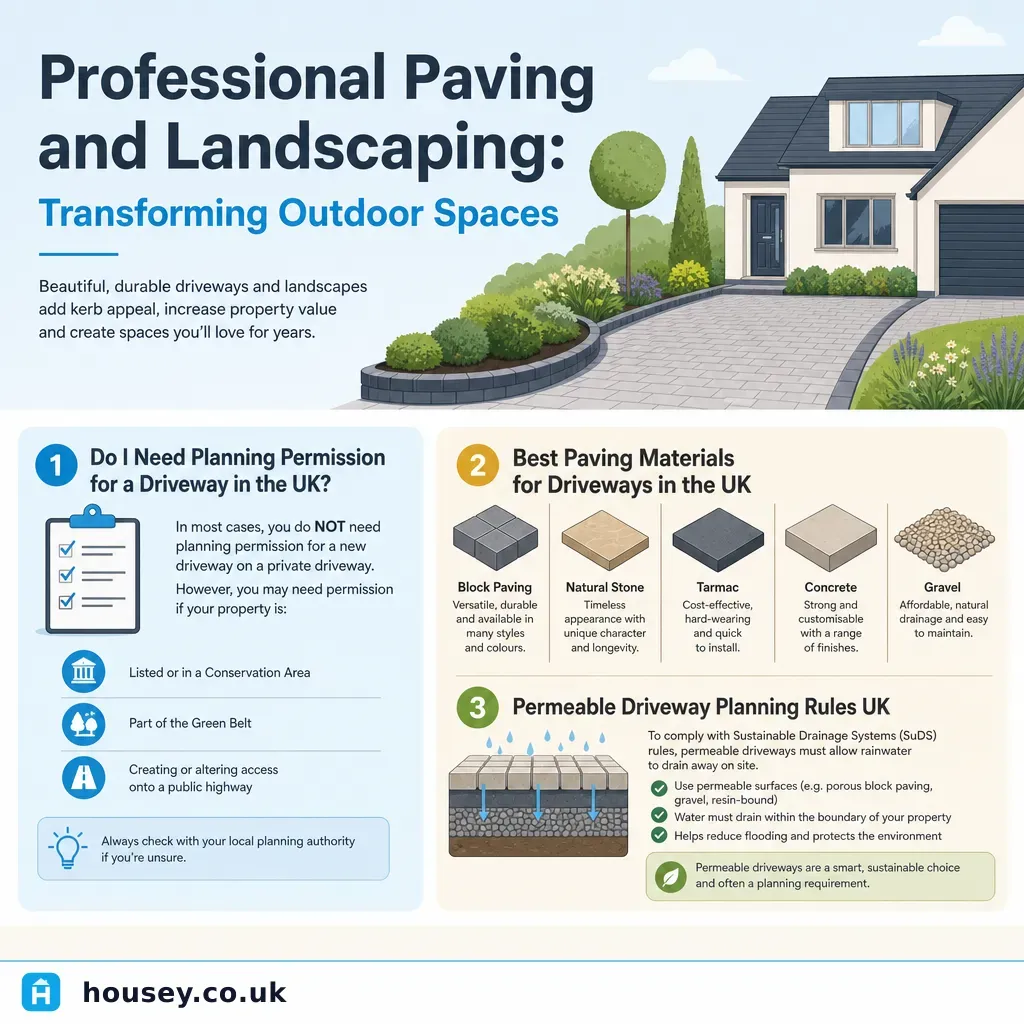
Professional Paving and Landscaping: Transforming Outdoor Spaces
Professional paving and landscaping can transform a garden or driveway, improving kerb appeal and adding usable outdoor space.
 Improvement & Build
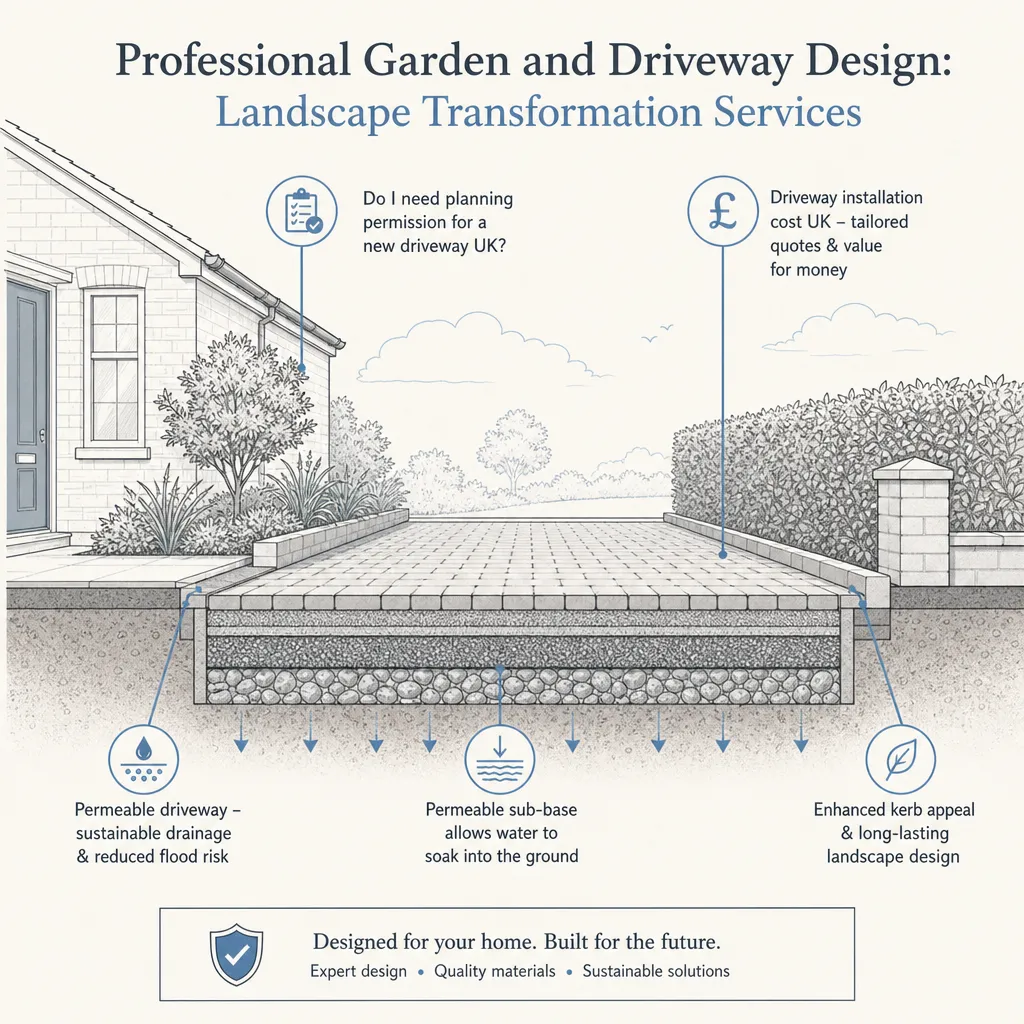
Professional Garden and Driveway Design: Landscape Transformation Services
Garden and driveway design combines hard landscaping — paving, block paving, gravel, resin — with planting and layout to improve kerb appeal and functionality.
 Improvement & Build
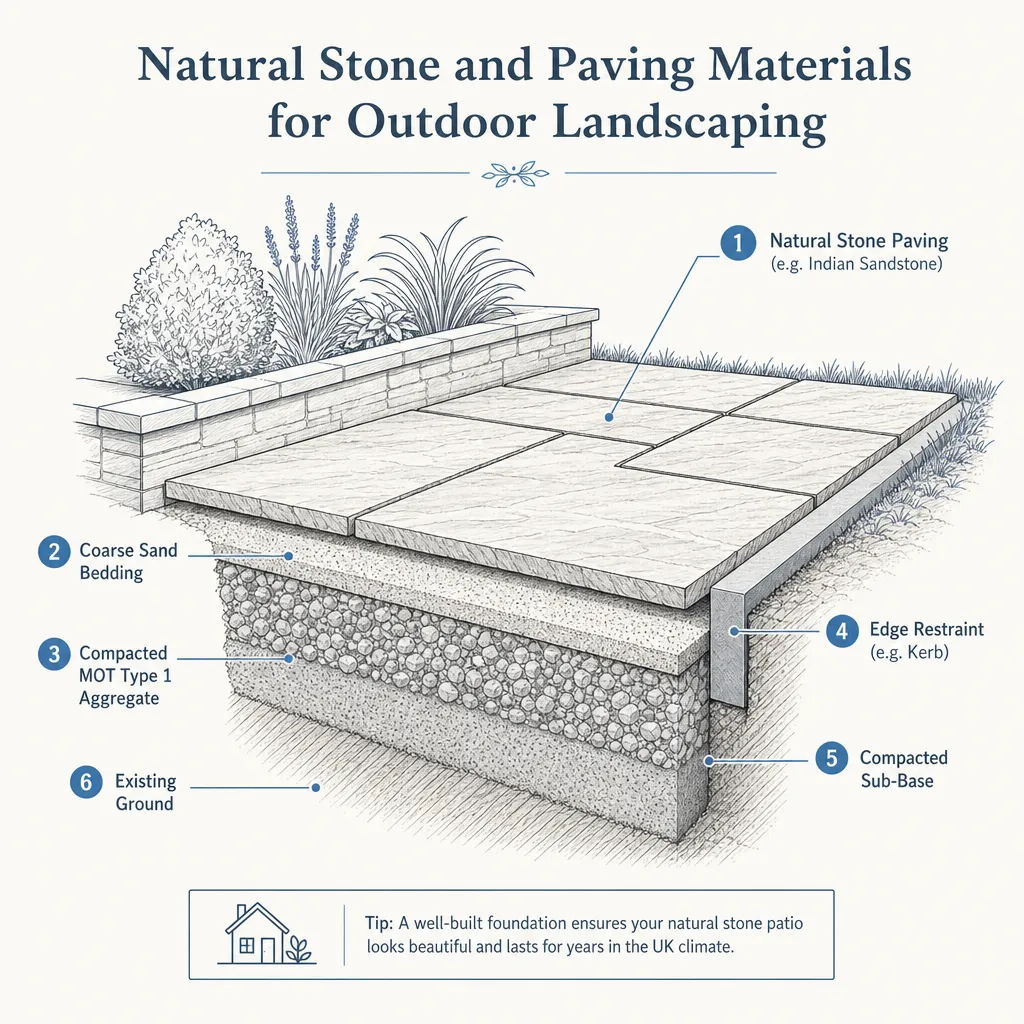
Natural Stone and Paving Materials for Outdoor Landscaping
Natural stone paving choices for UK gardens include Indian sandstone, limestone, granite, slate, basalt, and reclaimed York stone.
 Improvement & Build
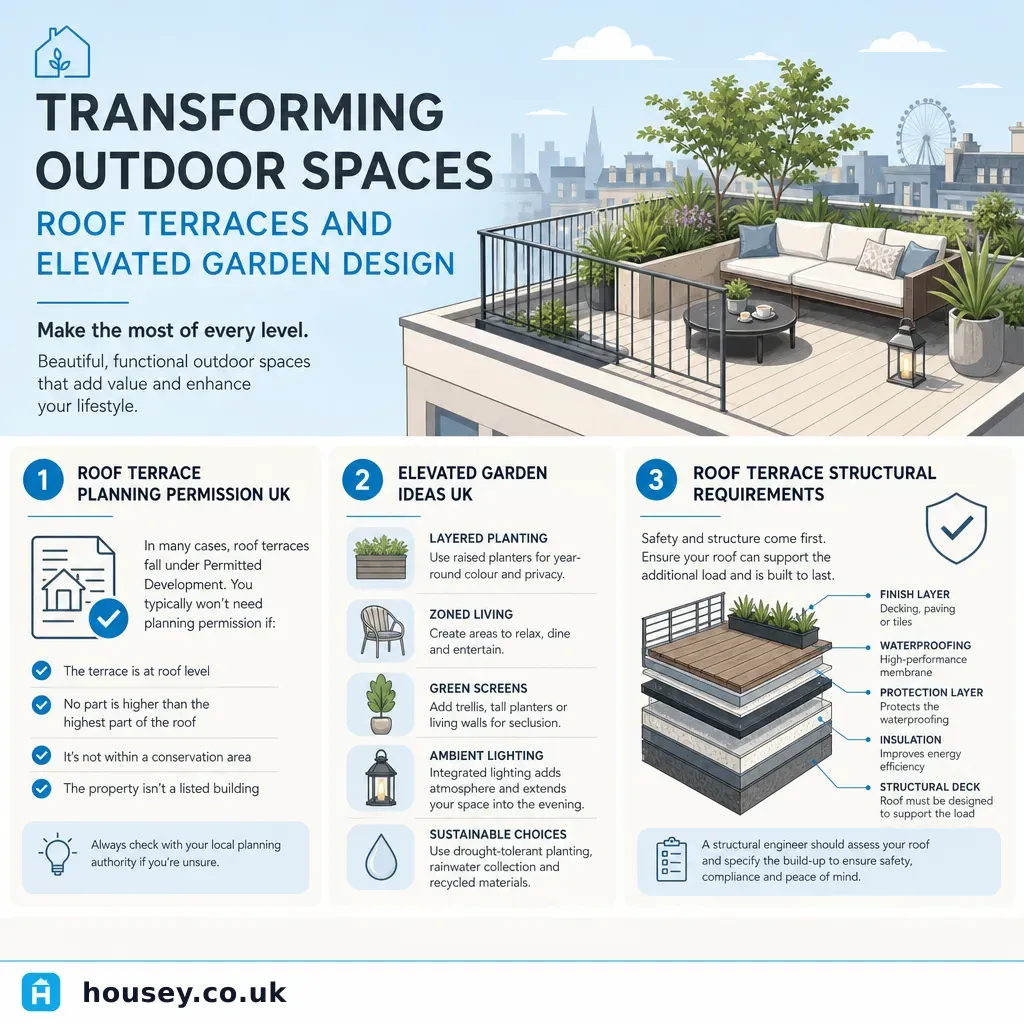
Transforming Outdoor Spaces: Roof Terraces and Elevated Garden Design
Roof terraces in the UK almost always need planning permission and a structural engineer's load capacity assessment before design work begins.
 Improvement & Build
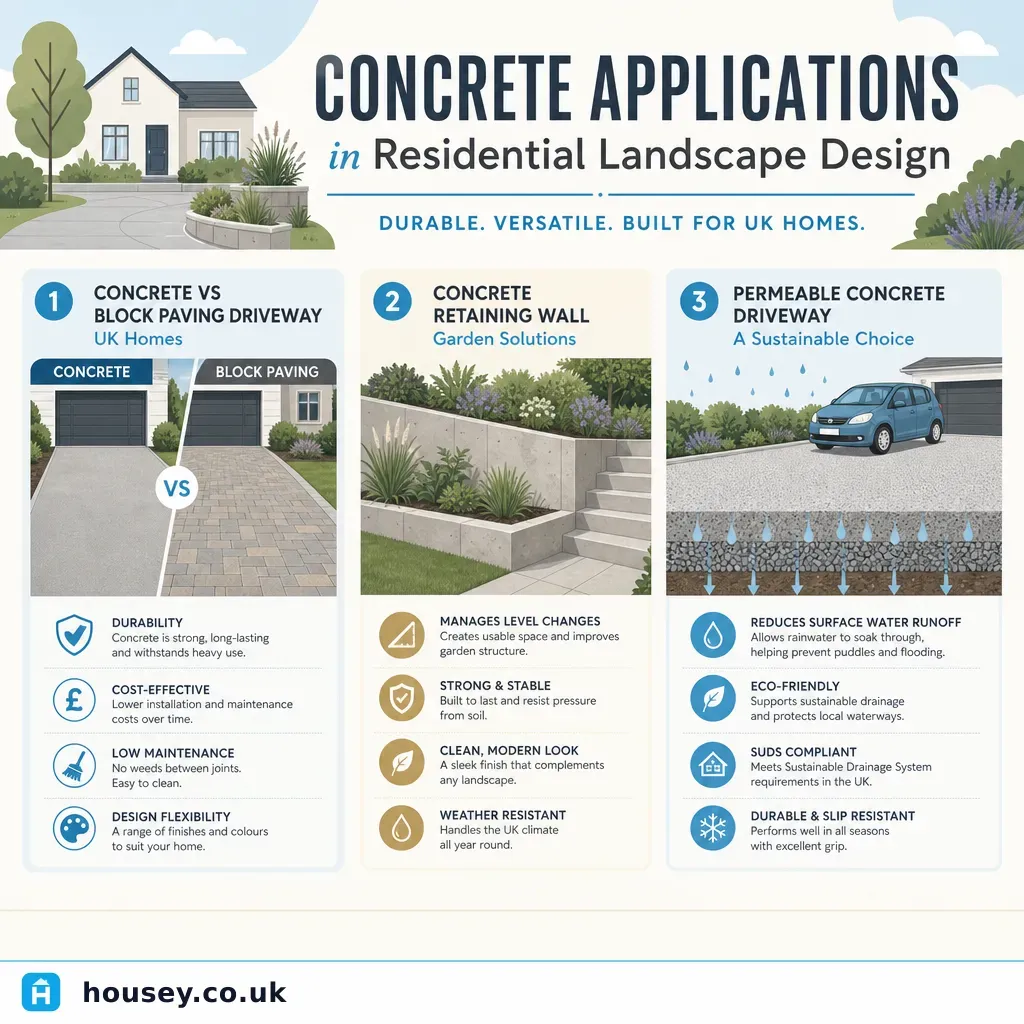
Concrete Applications in Residential Landscape Design
Concrete serves multiple roles in residential landscape design: as a surface material for driveways, patios, and paths; as a structural element in retaining walls and foundations; and as prefabricated components including slabs, edging, and copings.