Professional Paving and Landscaping: Transforming Outdoor Spaces
By Housey · Last reviewed 24th of May 2026
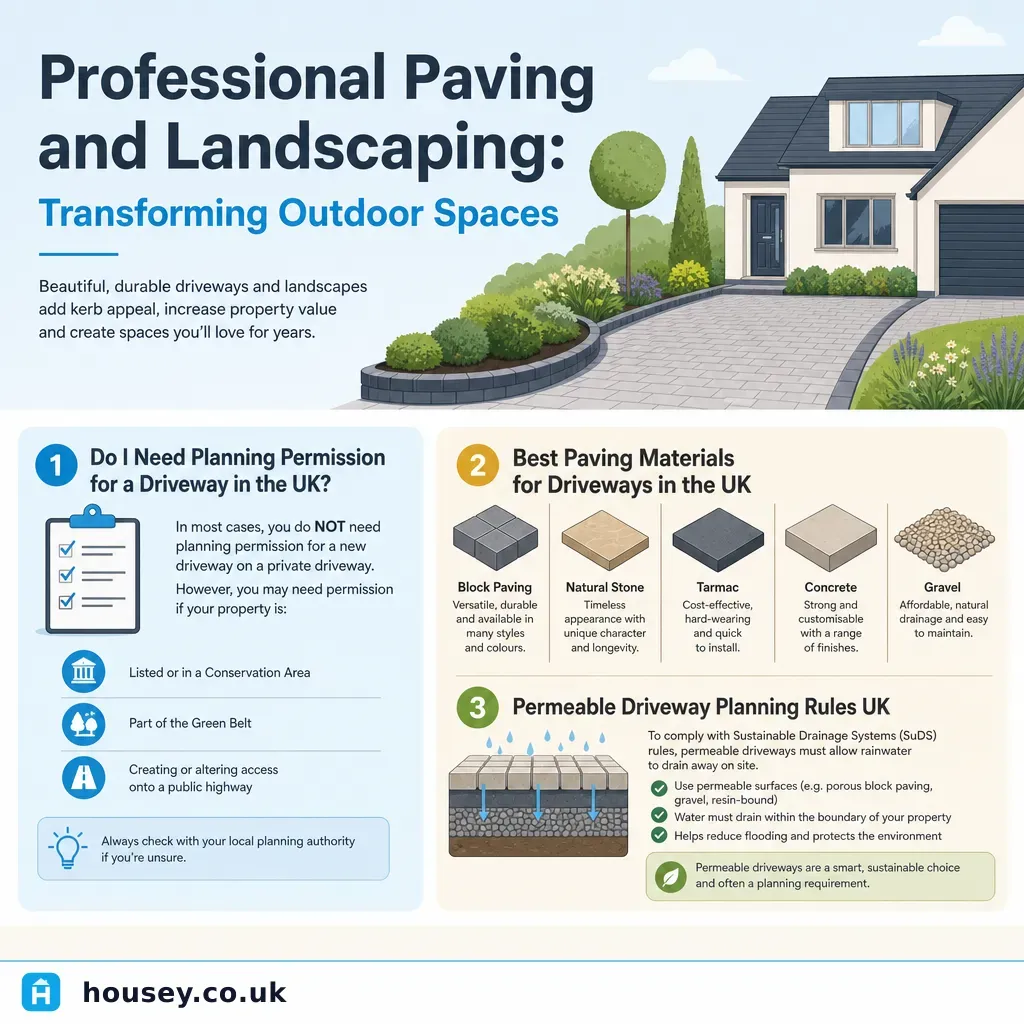
Professional Paving and Landscaping: Transforming Outdoor Spaces
UK homeowners typically consider professional paving and landscaping when tackling a new driveway, redesigning an overgrown garden, or preparing a property for sale. The investment ranges from a few hundred pounds for simple paving repairs to many thousands for a full hard and soft landscaping scheme, making professional specification and careful contractor selection genuinely worthwhile. Planning rules, drainage requirements, sub-base standards, and material choice all affect whether the finished result performs well and whether you need consent before work starts.
Key points
- Front garden driveways over 5 square metres of impermeable paving that drain to the road require planning permission under Schedule 2, Part 1, Class F of the Town and Country Planning (General Permitted Development) (England) Order 2015; permeable surfaces of any size are exempt.
- The Sustainable Drainage Systems (SuDS) requirement under Schedule 3 of the Flood and Water Management Act 2010 (in force in Wales; increasingly relevant in England) shapes drainage design decisions for new hard landscaping.
- Block paving typically carries an expected lifespan of 20–30 years; natural stone and granite setts can last considerably longer when laid on an adequate sub-base.
- A professional landscaper installing hard landscaping, retaining walls, or significant paved areas should hold public liability insurance of at least £1–2 million.
- Trees subject to a Tree Preservation Order (TPO) cannot be felled or significantly pruned without local planning authority consent, even within the curtilage of a private property.
Do you need planning permission for paving?
This is the most common source of confusion for homeowners planning a new driveway or front garden. Use this decision guide:
- No planning permission needed if the entire surface is permeable — gravel, loose stone, permeable block paving with open jointing, or resin bound aggregate on a permeable sub-base — regardless of area.
- No planning permission needed if run-off from an impermeable surface drains to a lawn, flowerbed, or soakaway (not directly to the public highway) and the impermeable area is under 5 square metres.
- Planning permission required if you are installing more than 5 square metres of impermeable paving in the front garden and the water will drain to the road or pavement.
- Check with your local planning authority if your property is listed, in a conservation area, or if permitted development rights have been removed by an Article 4 Direction.
- Consult an arborist and notify your local authority before removing or significantly pruning any tree — Tree Preservation Orders can apply without prior notice.
- For rear garden paving and patios: permitted development rights are more generous; planning permission is generally not required unless you are raising ground levels or working on a listed building.
Choosing the right paving material
Material choice affects appearance, durability, maintenance requirements, and drainage compliance. This comparison covers the main options for UK residential use.
Material | Typical lifespan | Best for | Not ideal for | Indicative installed cost per m² |
|---|---|---|---|---|
Concrete block paving | 20–30 years | Driveways, paths, utility areas | Period properties requiring premium aesthetics | £60–100 |
Natural sandstone | 20–40+ years | Patios, garden paths, decorative areas | Heavy vehicle traffic | £80–150 |
Granite setts | 40–80+ years | Driveways, entrance areas, period settings | Budget-constrained projects | £100–200 |
Resin bound aggregate | 15–25 years | Driveways, accessible paths, SuDS compliance | Areas with significant ground movement risk | £60–120 |
Gravel or loose stone | 10–20 years | Driveways, informal garden paths | Wheelchair, pushchair, or high-heel use | £20–50 |
Porcelain tiles | 25–40+ years | Contemporary patios, garden rooms | Frost-prone areas unless frost-rated grade specified | £80–160 |
Indicative UK costs per m² for supply and installation, last reviewed 2026-05-24. Costs vary by region, site conditions, sub-base depth required, access, and material specification. Always obtain itemised written quotes.
What to expect from a professional landscaper or driveway installer
A reputable contractor should always:
- Visit the site before providing a quote — accurate pricing requires assessment of existing sub-base conditions, drainage, levels, and access constraints.
- Provide a written specification detailing materials (brand, grade, thickness), sub-base depth, edging design, drainage provision, and jointing method.
- Include spoil removal in the quote or clearly itemise it — excavated material must be removed by a licensed waste carrier.
- Advise on drainage compliance for front driveways under the 2015 GPDO rules, particularly where the existing surface is impermeable.
- Confirm their waste carrier licence (required under the Environmental Protection Act 1990 for removal of excavated material and construction waste).
Homeowner checklist before paving or landscaping work begins
Work through this checklist before instructing any contractor:
Red flags when hiring a paving or landscaping contractor
Seek alternative quotes if a contractor:
- Gives a quote over the phone without visiting the site — accurate pricing for paving and landscaping requires a site assessment.
- Does not specify sub-base depth or drainage design in writing — inadequate sub-base is the most common cause of early failure.
- Offers to start immediately without a survey or detailed written specification.
- Cannot provide a business address, VAT registration number, or public liability insurance certificate.
- Proposes payment of a large cash sum before any materials are on site.
- Has no independently verifiable reviews or trade body affiliation.
When to get professional help
Most garden and paving projects are well managed by a competent landscaper or driveway installer. Seek additional professional input if:
- Your project involves retaining walls more than 600 mm high, which may require structural design by a qualified engineer.
- There are signs of poor drainage, waterlogging, or ground instability that could indicate a deeper soil or drainage problem.
- You are near a watercourse, in a flood zone, or in an area with a high water table — check Environment Agency flood maps before finalising your design.
- Significant ground levels are being altered in ways that could affect drainage to neighbouring properties.
- A Tree Preservation Order applies to any tree on or near the site.
How Housey can help
Housey connects homeowners with vetted landscapers and driveway installers who can visit your site, specify the right materials, and provide detailed written quotes. If your project extends to a full garden overhaul, you can also work with experienced garden designers through Housey to develop layout plans, planting schemes, and a coordinated hardscaping design.
Frequently asked questions
Do I need planning permission to pave my front garden?
If you use permeable materials — such as gravel, permeable block paving, or resin bound aggregate — no planning permission is required regardless of size. If you install more than 5 square metres of impermeable paving that drains to the road or pavement, you will need planning permission. Properties in conservation areas or covered by an Article 4 Direction may face additional restrictions; check with your local planning authority.
What is the most durable material for a UK driveway?
Granite setts and natural stone are among the most durable options, with lifespans exceeding 40–80 years when correctly laid on an adequate sub-base. Concrete block paving and resin bound aggregate are popular mid-range choices offering 15–30 years of good performance. Ultimately, durability depends as much on sub-base preparation and drainage design as on the surface material itself.
How much does a new driveway cost in the UK?
Costs vary considerably by material, size, and site conditions. As a rough guide, block paving typically costs £60–100 per square metre installed, while natural stone runs £80–150 per square metre and resin bound aggregate £60–120 per square metre. These are indicative UK figures, last reviewed 2026-05-24. Always obtain at least three itemised quotes, as sub-base conditions, spoil removal, and drainage design significantly affect the final price.
Can I remove a tree in my garden to make way for paving?
Not necessarily. Trees subject to a Tree Preservation Order (TPO) cannot be felled or significantly pruned without consent from your local planning authority. Trees in conservation areas are also protected and require notification before any work. Check with your local authority before removing or pruning any tree, even on private land — penalties for unauthorised removal of a protected tree can be substantial.
Sources and further reading
- Town and Country Planning (General Permitted Development) (England) Order 2015 — legislation.gov.uk
- Permeable surfacing of front gardens: good practice guide — GOV.UK
- Flood and Water Management Act 2010 — legislation.gov.uk
- Linesearch Before U Dig (LSBUD) — LSBUD
Useful next reads
 Improvement & Build
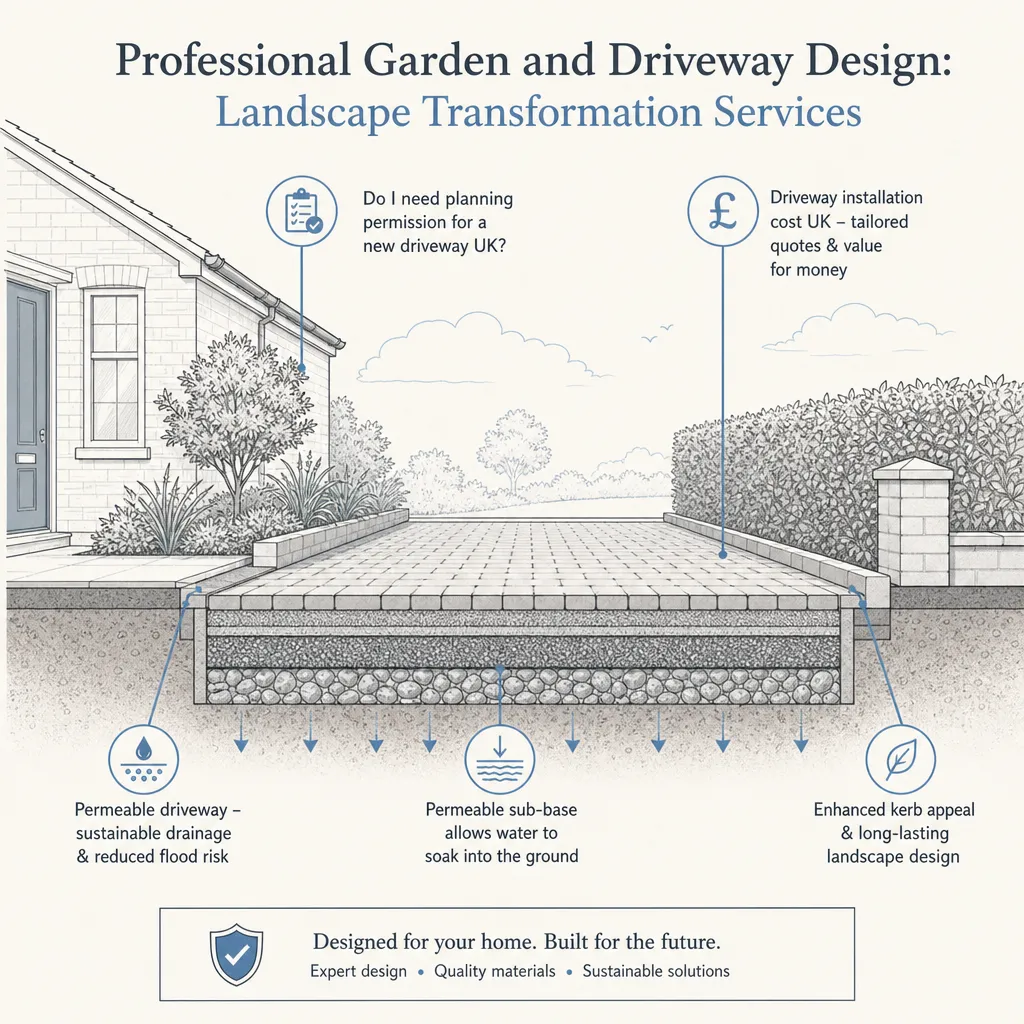
Professional Garden and Driveway Design: Landscape Transformation Services
Garden and driveway design combines hard landscaping — paving, block paving, gravel, resin — with planting and layout to improve kerb appeal and functionality.
 Improvement & Build
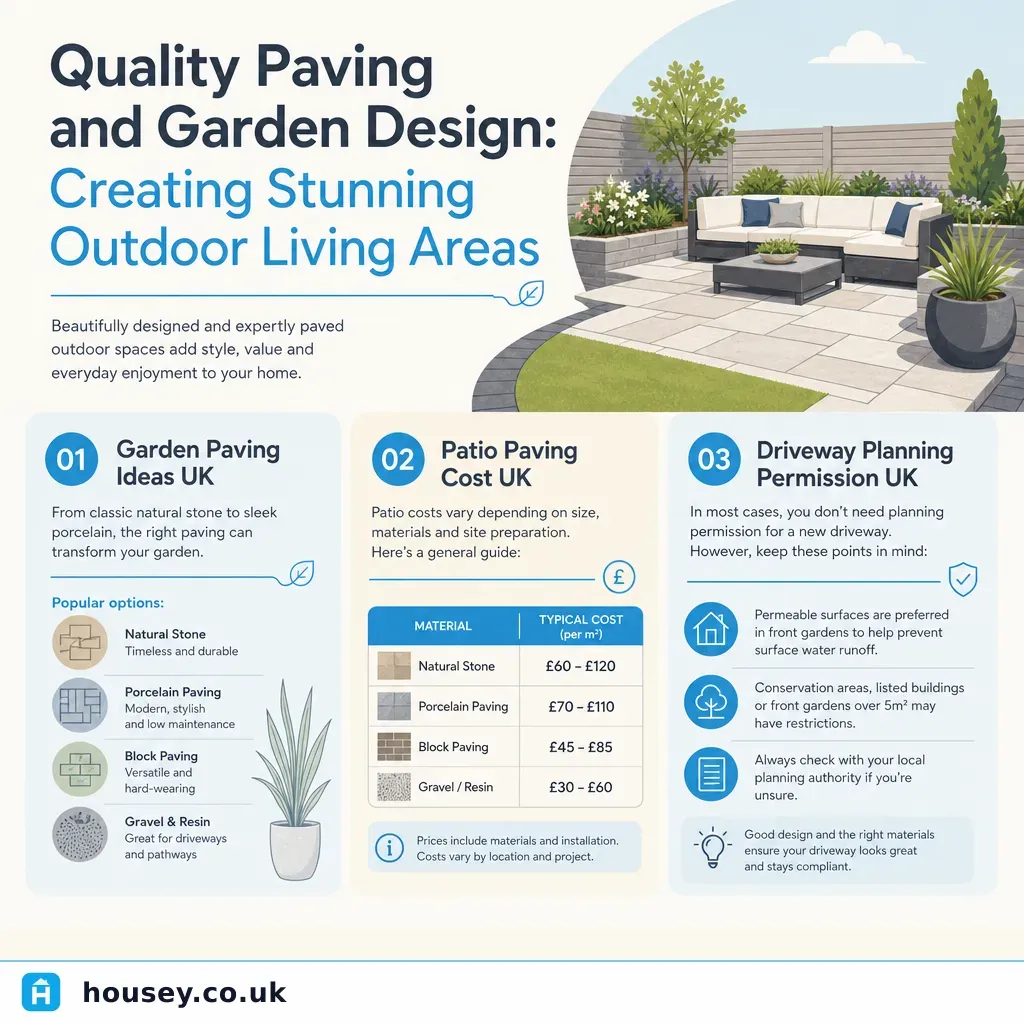
Quality Paving and Garden Design: Creating Stunning Outdoor Living Areas
Paving a front garden driveway over 5 square metres in England requires planning permission unless a permeable material is used and drainage is managed on site.
 Improvement & Build
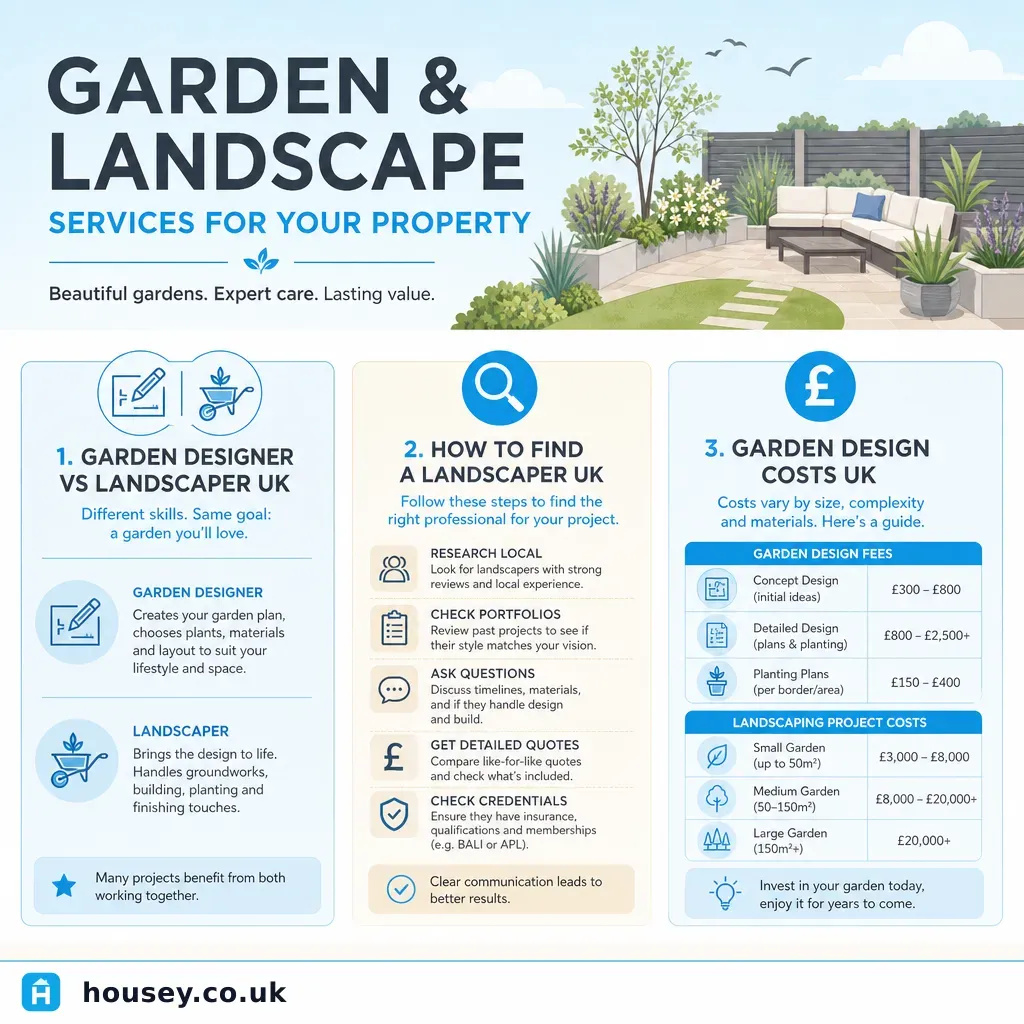
Garden and Landscape Services for Your Property
Garden designers and landscapers both improve outdoor spaces but offer different services.
 Improvement & Build
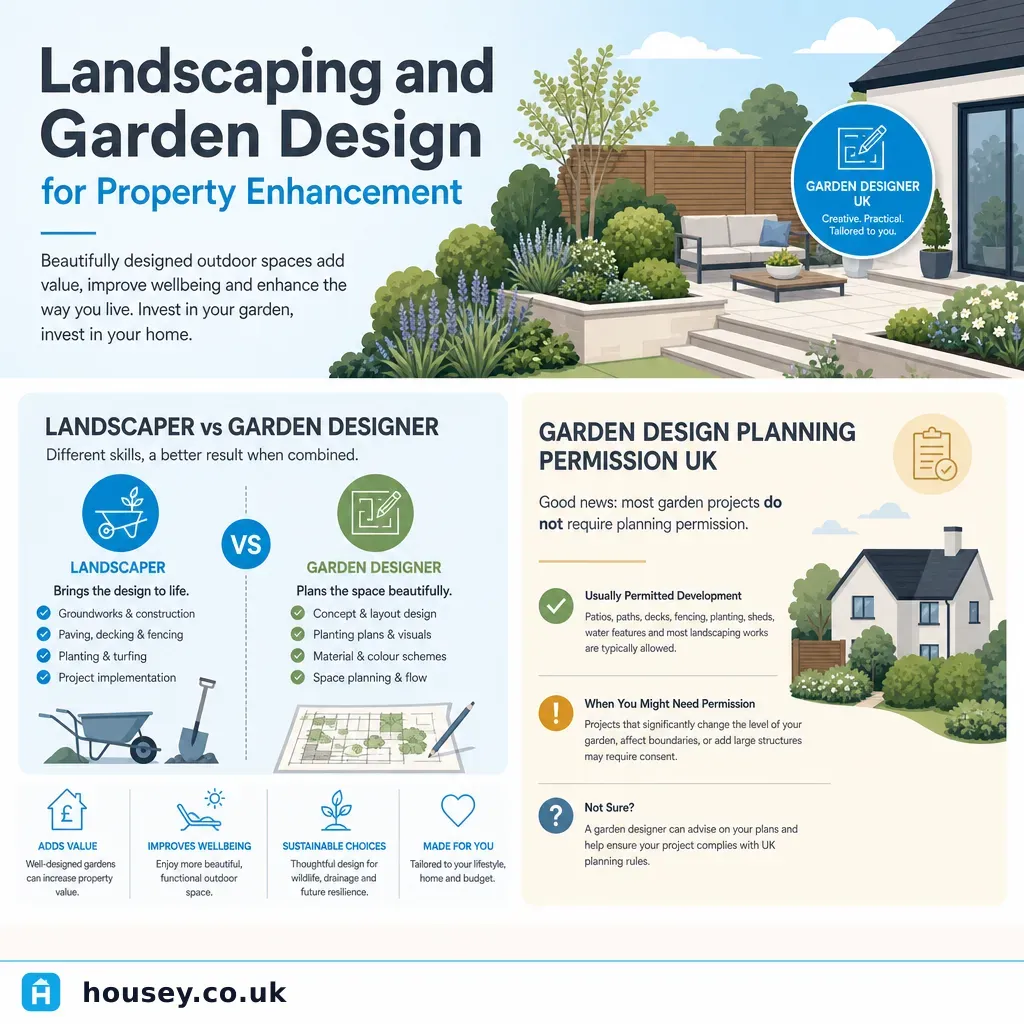
Landscaping and Garden Design for Property Enhancement
Landscaping and garden design involve planning and building outdoor spaces — from patios and raised beds to planting schemes and drainage.
 Improvement & Build
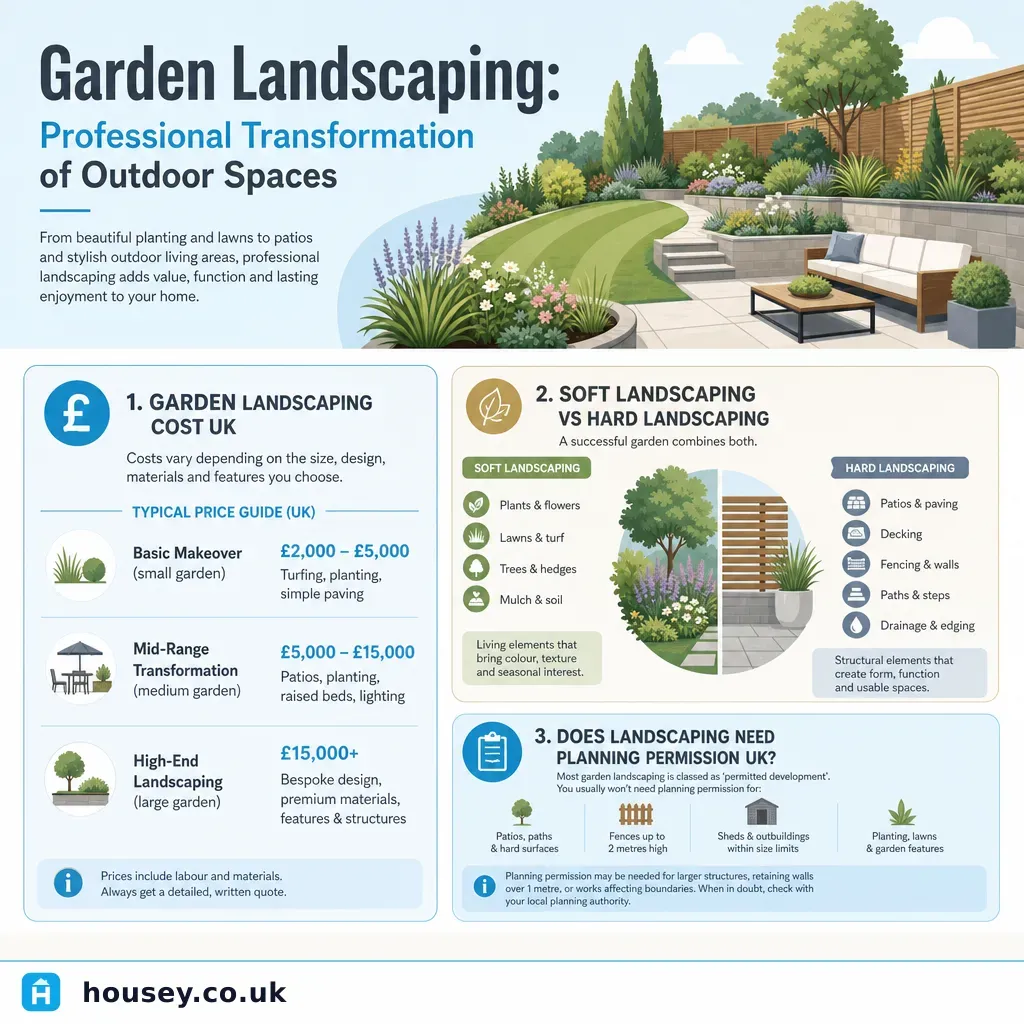
Garden Landscaping: Professional Transformation of Outdoor Spaces
Garden landscaping covers all physical works to reshape and improve an outdoor space, from earthworks and hard landscaping such as patios, paths, and walls, to planting, drainage, and lawn installation.