Natural Stone and Paving Materials for Outdoor Landscaping
By Housey · Last reviewed 26th of May 2026
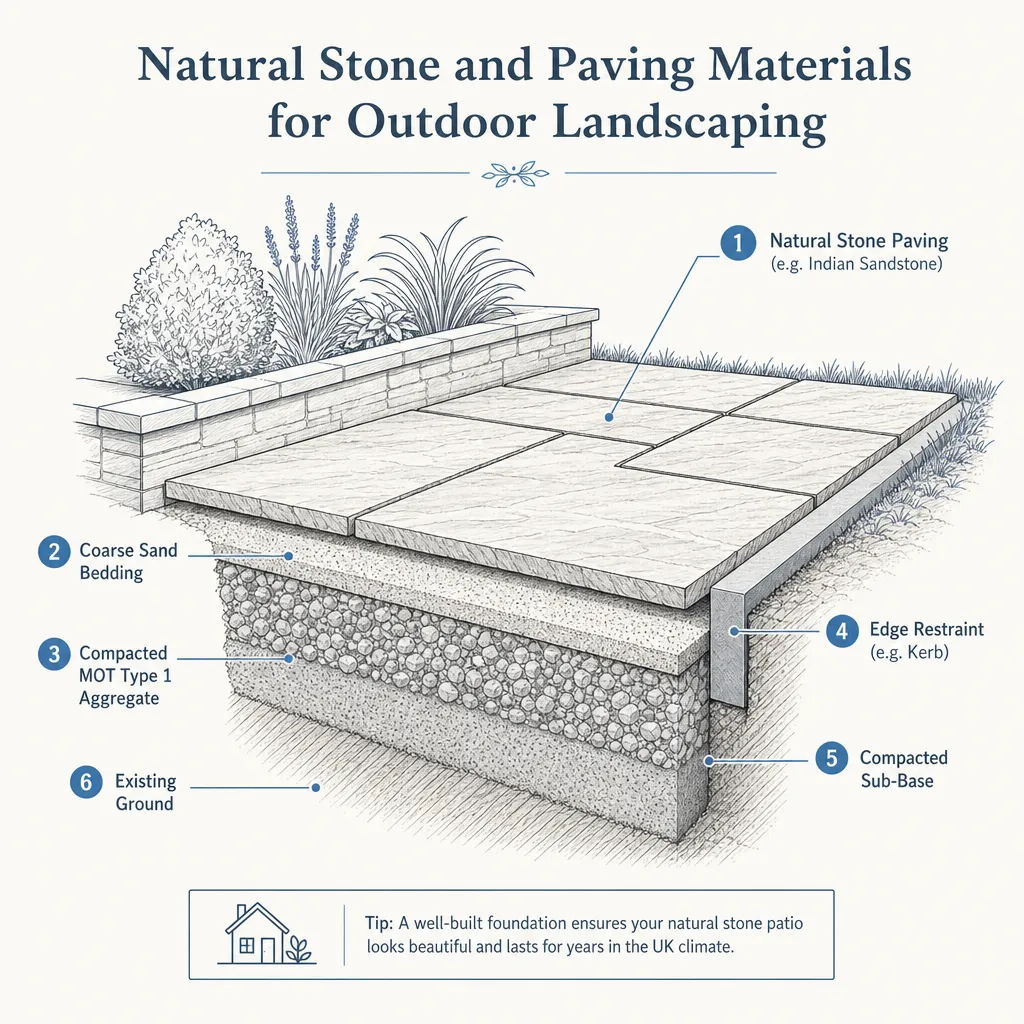
Natural Stone and Paving Materials for Outdoor Landscaping
Choosing a paving material for a garden, patio, or driveway is a long-term decision — poorly specified stone or inadequate sub-base preparation can result in cracking, sinking, staining, or drainage problems within a few years of installation. The market for outdoor paving in the UK has expanded considerably, with Indian sandstone, porcelain, and imported basalt now widely available alongside traditional York stone and locally quarried granite. Understanding the practical performance of different stone types in UK conditions, along with the regulatory requirements for driveways, helps homeowners specify and cost a project with confidence.
Key points
- Front garden driveways over 5 m² must use a permeable surface or include drainage to a soakaway or drainage system — this is a condition of permitted development rights under Schedule 2, Part 1, Class F of the Town and Country Planning (General Permitted Development) (England) Order 2015; impermeable paving without drainage requires a planning application.
- BS 7533 governs the structural design and construction of pavements using natural stone and segmental materials; it specifies a sub-base of 100–150 mm compacted MOT Type 1 aggregate for pedestrian use and 150–200 mm for vehicular loads.
- Indian sandstone — the UK's most widely used imported paving stone — should be sealed on installation to prevent staining and efflorescence, and re-sealed every two to three years.
- Limestone has a higher water absorption rate than granite, basalt, or slate, making it more susceptible to frost damage in northern UK locations; check EN 12371 freeze-thaw resistance ratings before specifying for exposed northern or upland sites.
- Porcelain outdoor tiles (20 mm, outdoor-rated) are non-porous and very low maintenance, but cracked individual tiles cannot be spot-repaired — the tile must be replaced in full, and colour matching can be difficult if the original batch is no longer available.
Comparing natural stone and paving materials
Material | Origin | Durability | Frost resistance | Maintenance | Best suited for | Indicative supply cost per m² |
|---|---|---|---|---|---|---|
Indian sandstone | India | Moderate | Moderate (varies by grade) | Seal on install; re-seal every 2–3 years | Patios, garden paths, informal gardens | £25–£55 |
Limestone | Portugal, France, UK | Moderate | Lower — check EN 12371 | Seal required; avoid acid cleaners | Formal gardens, sheltered southern locations | £35–£75 |
Granite | China, India, Scotland | High | Excellent | Low; occasional brushing | Driveways, high-traffic areas, steps | £40–£90 |
Slate | Wales, India, China | High | Good | Low; occasional sealing | Contemporary gardens, poolside, wet areas | £30–£65 |
Basalt | China, Vietnam | Very high | Excellent | Very low | Modern and urban gardens, driveways | £45–£85 |
Reclaimed York stone | Yorkshire, UK | High | Good | Low; optional sealing | Heritage and period properties, cottage gardens | £60–£150 |
Cobbles and setts | Various | Very high | Excellent | Low | Driveways, edging, feature areas | £35–£75 |
Porcelain (outdoor-rated) | Spain, Italy, China | Very high | Excellent | Very low | Modern gardens, low-maintenance designs | £25–£60 |
Indicative UK supply costs, last reviewed 2026-05-26. Laying costs typically add £50–£100 per m² depending on complexity, access, and groundworks required.
Sub-base and laying: what matters most
The long-term performance of any paving installation depends far more on what is underneath the stone than the stone itself. The key construction layers are:
- Excavation: typically 300–400 mm below finished level for pedestrian patios; 400–500 mm for driveways.
- Sub-base: compacted MOT Type 1 (crushed stone) to BS 7533 — 100 mm for pedestrian use, 150–200 mm for vehicle loads. This is the most critical layer.
- Bedding layer: traditionally a semi-dry sand-cement mortar at a 3:1 or 4:1 mix (40–50 mm depth) for natural stone; or open-graded grit sand for permeable installations.
- Jointing: natural stone patios are typically pointed with mortar, resin, or a brush-in jointing compound; joints should be 8–15 mm wide to accommodate thermal movement.
- Drainage falls: a minimum 1:80 fall (approximately 12 mm per metre) directed away from the building is standard practice for patios and paved areas.
Insufficient sub-base depth or inadequate compaction is the most common cause of premature paving failure in both DIY and budget professional installations.
Driveway drainage: regulations you must follow
For front garden driveways in England, permitted development rules restrict impermeable surfacing unless surface water is managed responsibly. Under Schedule 2, Part 1, Class F of the Town and Country Planning (General Permitted Development) (England) Order 2015, impermeable paving in a front garden is not permitted development if surface water drains directly to the highway or a public drainage system without adequate provision.
In practice, this means using one of the following approaches:
- A permeable surface material — permeable block paving, permeable porcelain, gravel, or resin-bound gravel with a porous sub-base.
- Connecting runoff to a dedicated drainage system such as a soakaway, infiltration trench, or watercourse.
Enforcement actions for non-compliant driveways do occur, particularly in areas with existing surface water flooding problems. Check with your local planning authority before laying new impermeable paving in a front garden if you are unsure whether your drainage arrangement is compliant.
Which professional do you need?
Scope of work | Professional | Why |
|---|---|---|
Scheme design, material selection, planting integration | Garden designer | Produces a layout drawing, specifies materials, and coordinates the project holistically |
Excavation, sub-base preparation, drainage installation | Groundworker | Specialist in earthworks and drainage; essential for driveways and large-scale paving projects |
Natural stone laying, cutting, pointing, and finishing | Landscaper (paving specialist) | Skilled in stone laying, setting falls, jointing, and finishing to a professional standard |
Planning queries or enforcement concerns | Local planning authority | Free pre-application planning advice is available from most LPAs for straightforward driveway queries |
For a simple garden patio without drainage implications or planning complications, an experienced landscaper can typically manage the project end to end. For a driveway, a large-area project, or one with significant level changes or drainage design, a groundworker is usually subcontracted to or works alongside a landscaper or garden designer.
Homeowner checklist before specifying paving
Before requesting quotes or ordering materials, work through the following:
- Confirm whether the area is a front garden driveway — if so, check the GPDO 2015 driveway drainage rules and your LPA's position on impermeable surfaces.
- Identify the load class: pedestrian only, occasional car, regular car, or regular HGV access — this determines sub-base depth and minimum slab thickness.
- Assess existing drainage: where does rainwater currently go, and is there a soakaway, lawn, or drain to accept runoff from the new surface?
- Check whether the property is listed or in a conservation area — materials visible from the public highway may require LPA approval.
- Request physical samples of stone before ordering: catalogue colours often differ from on-site appearance, particularly for Indian sandstone where colour can vary significantly between batches.
- Ask your supplier for the stone's EN 12371 freeze-thaw resistance rating if the site is in northern England, Scotland, or an exposed upland location.
- Ensure all quotes specify the same sub-base depth, bedding method, and jointing compound so you can compare like with like.
When to get professional help
Natural stone patio laying is achievable for an experienced and patient DIYer on a small, level area with good access. Professional help is important when:
- Excavation will go near underground services — always obtain a utility survey and contact the relevant utilities before breaking ground; striking a buried cable or pipe can be dangerous and costly.
- The project involves driveway drainage design that must comply with permitted development rules.
- The site has significant level changes, complex drainage falls across multiple directions, or steps that require precise setting-out.
- The property is listed, in a conservation area, or the paving is visible from the public highway and may be subject to approval requirements.
- Reclaimed or heritage stone is being used — cutting irregular sizes accurately requires specialist skill and appropriate tooling.
Red flags that the project is more complex than it first appears:
- Soft, boggy, or waterlogged ground suggesting drainage problems or poor bearing capacity.
- Existing cracking or movement in adjacent walls, steps, or retaining structures.
- Ground that slopes towards the house rather than away from it.
- Tree roots within 3 m of the planned paving area.
How Housey can help
For paving projects that require design input, groundworks, or professional stone laying, Housey can connect you with local landscapers, garden designers, and groundworkers who can survey your site, specify appropriate materials, and carry out the installation to a professional standard.
Frequently asked questions
Do I need planning permission to pave my front garden?
Not automatically. Permitted development rights allow front garden paving provided the material is permeable or surface water drains to a dedicated soakaway or drainage system. If you want an impermeable surface without suitable drainage provision, or if your property is in a conservation area, you will need planning permission. Check with your local planning authority before committing to materials and groundworks.
What paving material requires the least maintenance?
Porcelain (20 mm outdoor-rated) and granite require the least ongoing maintenance — both are hard, non-porous, and resistant to moss and staining. Indian sandstone and limestone need sealing on installation and re-sealing every two to three years, and are more prone to algae and lichen in shaded or wet conditions. For period or heritage properties, reclaimed York stone is often the more appropriate aesthetic choice despite higher maintenance needs.
How thick should natural stone paving slabs be?
For pedestrian patio use, 18–22 mm is standard for Indian sandstone and most imported stones. Areas with any vehicle access should use 30–50 mm slabs. Harder stones such as granite and basalt may perform adequately at 20 mm under light vehicle loads, but confirm the supplier's specification. Always match slab thickness to the intended loading and lay on a sub-base appropriate for the load class.
What causes paving slabs to crack or sink?
The most common causes are insufficient sub-base depth or compaction, hollow spots in the bedding mortar beneath slabs, poor drainage causing saturated ground, frost heave in water-retaining stones, and tree root growth lifting the sub-base. Correct sub-base construction to BS 7533 — typically 100–150 mm compacted MOT Type 1 for pedestrian use — significantly reduces these risks.
How close to the house wall can I lay paving?
Paving can be laid close to the house wall, but you must keep the finished surface at least 150 mm below the damp-proof course (DPC) level. The DPC is usually visible as a thin mortar course or plastic strip just above ground level. Paving above the DPC risks bridging it, allowing moisture to track into the wall and cause internal damp problems.
Sources and further reading
- Householder permitted development rights guidance — GOV.UK / Planning Portal
- BS 7533: Pavements constructed with clay, natural stone or concrete pavers — BSI
- Flood risk and surface water management guidance — GOV.UK / Environment Agency
- Natural stone specification and selection — Stone Federation Great Britain
Useful next reads
 Improvement & Build
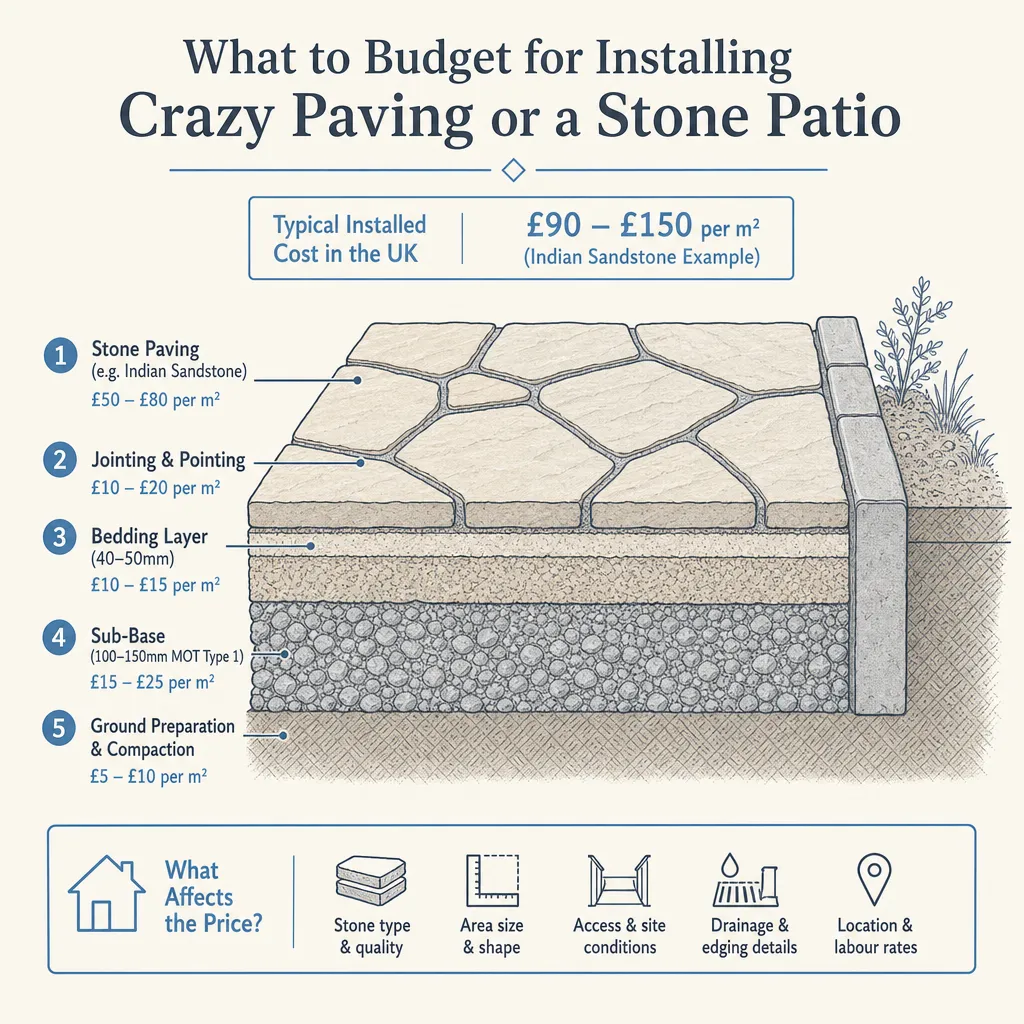
What to Budget for Installing Crazy Paving or a Stone Patio
Installing a stone patio in the UK typically costs £80–£200 per square metre fully installed, depending on stone type, sub-base depth, and site conditions.
 Improvement & Build
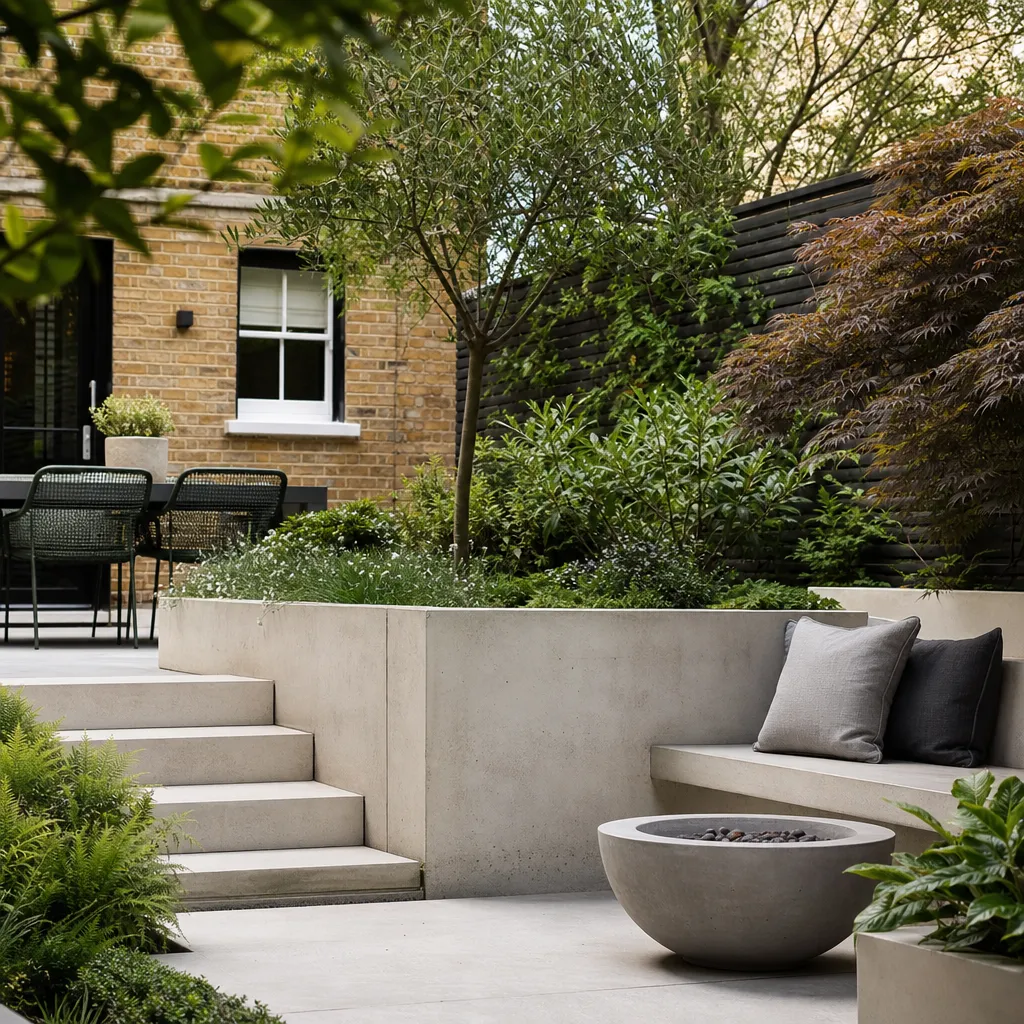
Concrete Garden Features and Outdoor Landscape Design
Concrete garden features range from exposed aggregate paths and stamped concrete patios to cast raised planters and precast water features.
 Improvement & Build
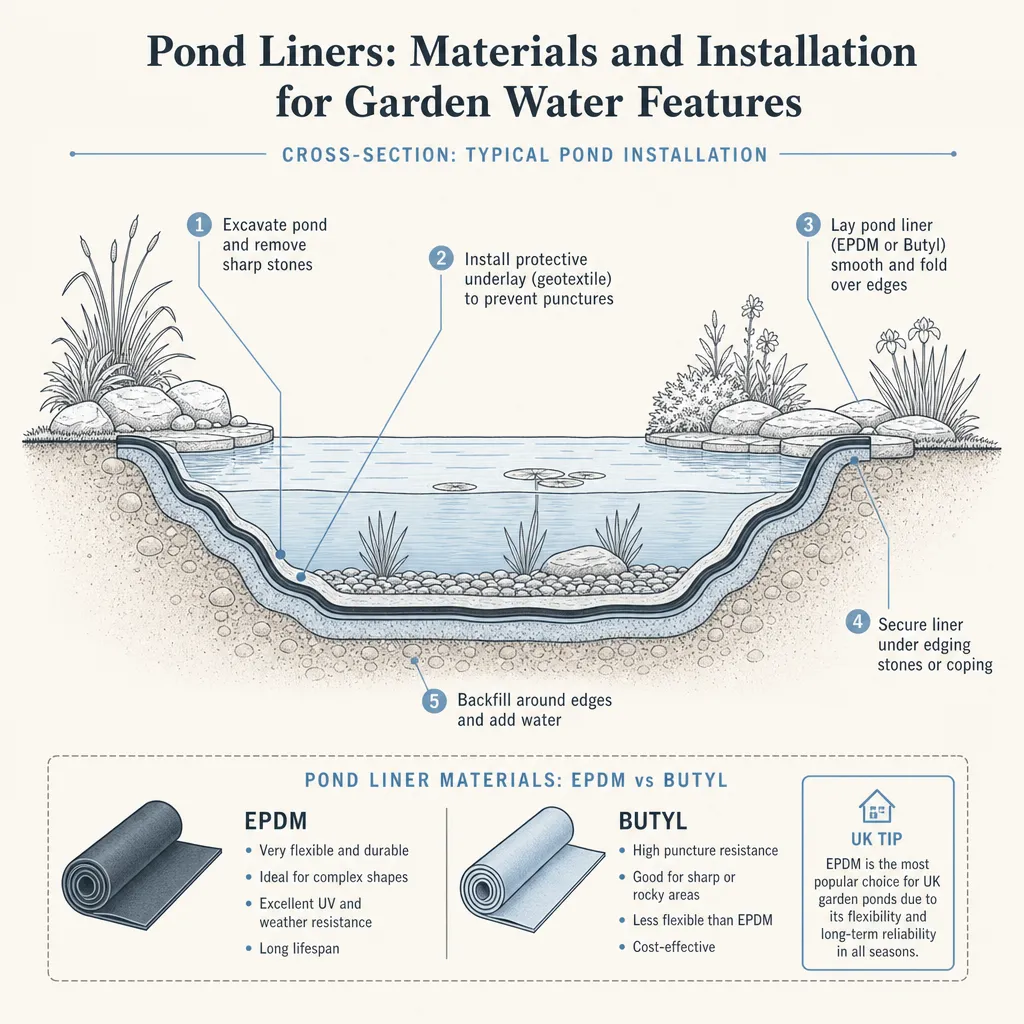
Pond Liners: Materials and Installation for Garden Water Features
Garden pond liners come in four main types: EPDM rubber, butyl rubber, PVC, and preformed fibreglass.
 Improvement & Build
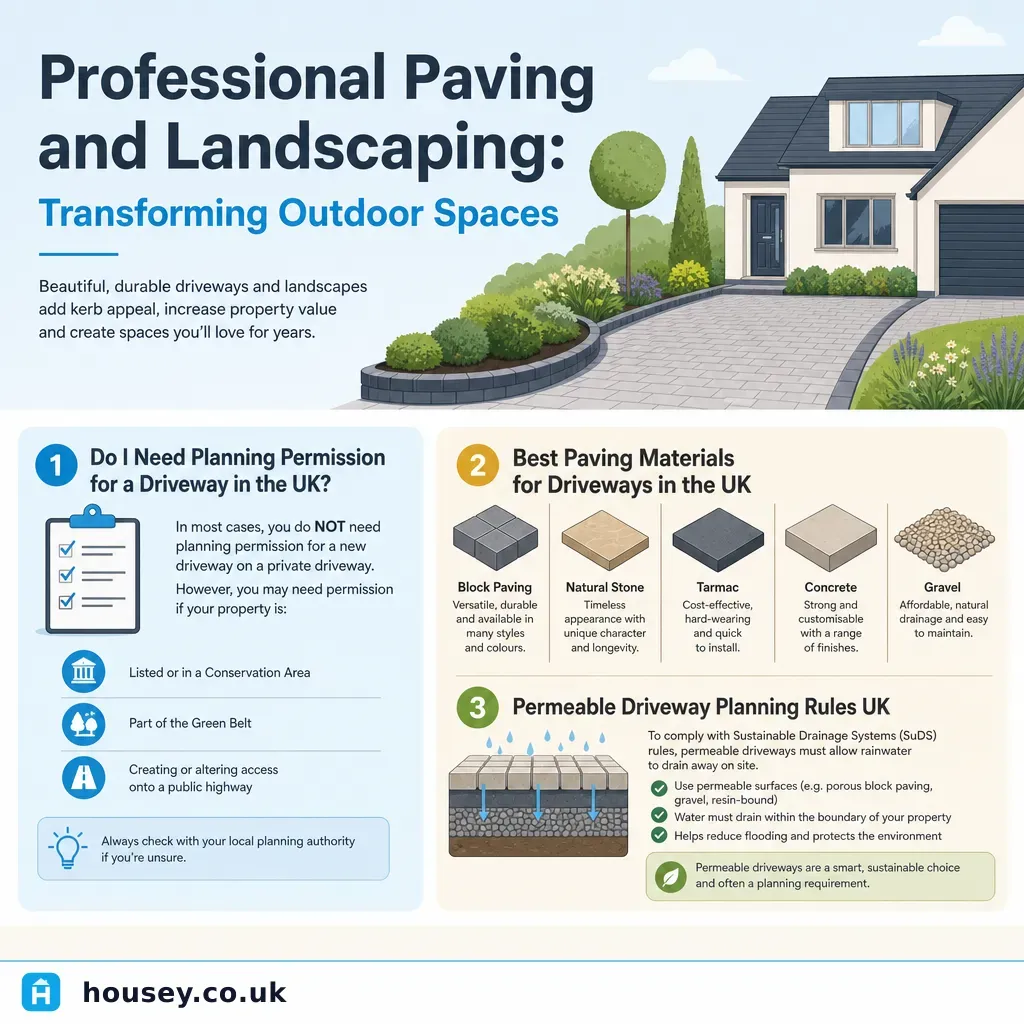
Professional Paving and Landscaping: Transforming Outdoor Spaces
Professional paving and landscaping can transform a garden or driveway, improving kerb appeal and adding usable outdoor space.
 Improvement & Build
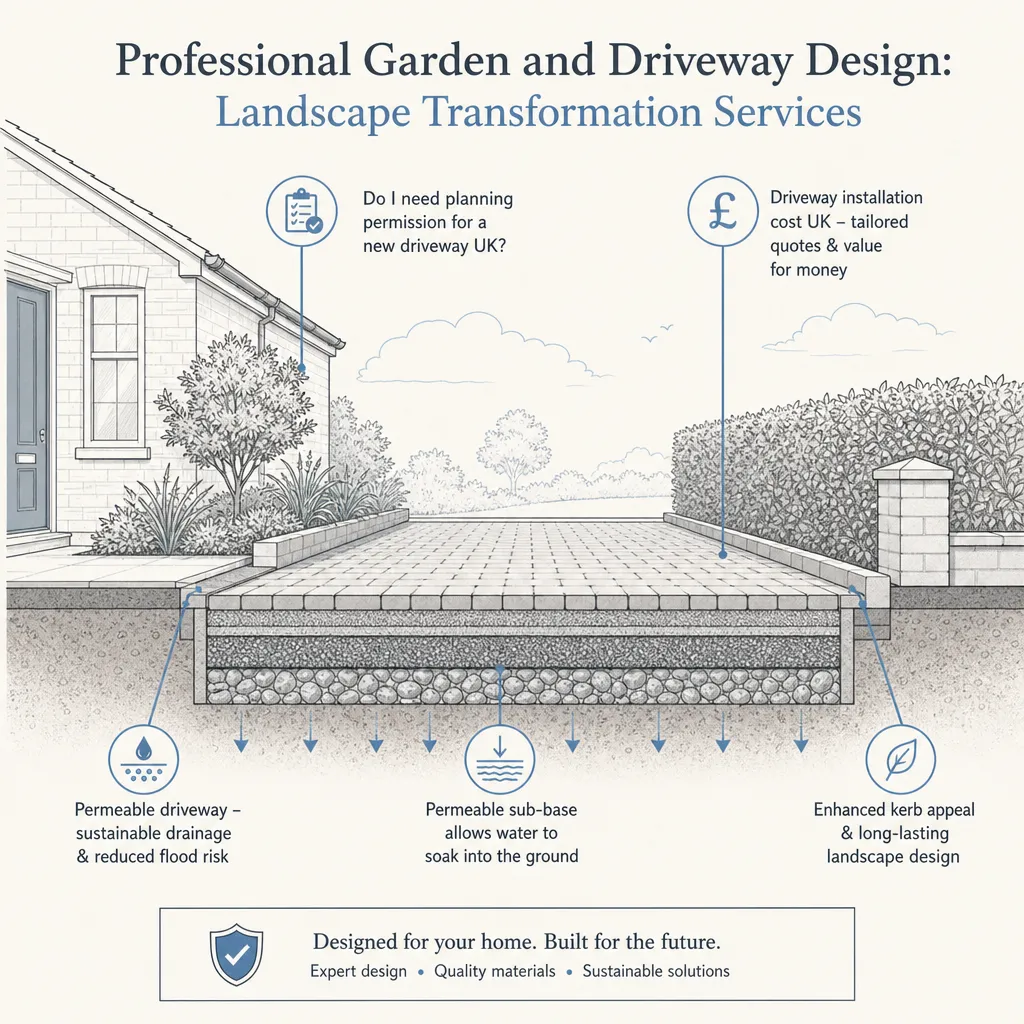
Professional Garden and Driveway Design: Landscape Transformation Services
Garden and driveway design combines hard landscaping — paving, block paving, gravel, resin — with planting and layout to improve kerb appeal and functionality.