Concrete Patio Repair and Renovation: Options and Costs
By Housey · Last reviewed 30th of May 2026
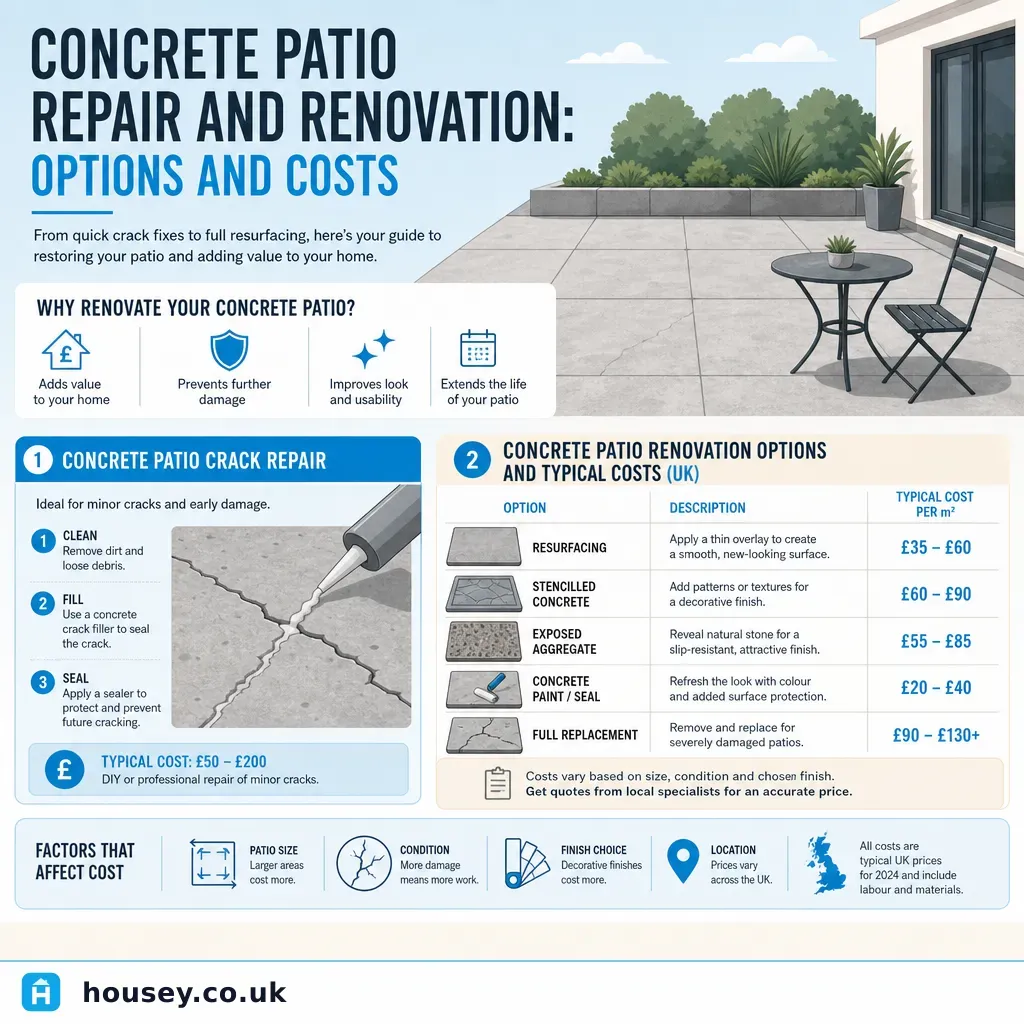
Concrete Patio Repair and Renovation: Options and Costs
A cracked, stained, or uneven concrete patio is the kind of problem that is easy to defer — partly because the range of fix options is not immediately obvious, and partly because the cost of getting it wrong is high. Choosing resurfacing when the sub-base has failed, or patching when drainage is the underlying problem, results in the same failure recurring within a few seasons. Getting the diagnosis right before committing to any surface treatment is the most cost-effective starting point for any UK homeowner.
Key points
- Surface cracks under 5 mm wide are generally cosmetic and suitable for flexible crack filler; cracks wider than 10 mm, or cracks that are stepping or spreading, may indicate a sub-base or drainage problem requiring investigation before any surface work begins.
- Concrete resurfacing (applying a new layer over existing concrete) is only viable if the existing slab is structurally sound, adequately bonded, clean, and free of active drainage problems — the overlay is only as good as the substrate beneath it.
- For front garden hardstanding, impermeable surfaces over 5 m² require planning permission unless drainage is directed to a lawn, border, or permeable surface; check with your local planning authority before replacing or extending a front patio.
- A failed sub-base is the most common cause of concrete patio failure; resurfacing or patching over a failed sub-base will fail again.
- Indicative UK costs range from £5–£20/m² for crack and surface repairs to £80–£150/m² for full concrete removal and replacement, depending on access, thickness, and disposal. Indicative UK costs, last reviewed 2026-05-30.
Diagnosing the problem before choosing a solution
Choosing the right repair starts with understanding what has gone wrong. The table below maps common patio problems to likely causes and indicative approaches.
Problem | Likely cause | Indicative approach |
|---|---|---|
Hairline surface cracks (under 2 mm) | Thermal movement, surface shrinkage | Flexible crack filler or penetrating surface sealer |
Wider stable cracks (5–10 mm) | Settlement, expansion joint failure | Flexible filler; consider re-cutting expansion joints |
Stepped or widening cracks | Sub-base failure, drainage problem, tree root intrusion | Investigate sub-base; section removal likely required |
Surface spalling (flaking layer) | Freeze-thaw damage, deicing salt, poor original mix | Resurfacing overlay if slab is sound; full replacement if widespread |
Pooling water or slow drainage | Incorrect fall, blocked or absent gully | Re-lay to corrected fall; unblock or install drainage |
Sunken or uneven section | Sub-base washout, compaction failure, root intrusion | Remove affected section, correct sub-base, relay |
Widespread staining or discolouration | Moss, algae, oil, mineral deposits | Pressure washing, specialist concrete cleaner, acid wash if needed |
Repair options compared
Crack and surface repair
Suitable for hairline and stable cracks up to approximately 10 mm wide, localised surface spalling, and isolated staining.
How it works: the crack is cleaned and widened slightly to allow proper filler penetration, flexible polyurethane or epoxy filler is applied in layers, and a penetrating surface sealer can be applied across the whole area to unify appearance and protect the surface.
Limitations: colour-matching is difficult; repaired cracks often remain visible. Does not address underlying drainage or sub-base problems — if these exist, the repair will re-open.
Indicative cost: £5–£20/m² for labour and materials (cost per m² reduces on larger areas). Indicative UK costs, last reviewed 2026-05-30.
Concrete resurfacing overlay
A modified concrete, microcement, or polymer-modified screed is bonded over the existing slab to create a fresh surface. Can be finished plain, textured, or coloured.
When suitable: the existing slab is structurally sound, well-bonded, clean, adequately draining, and shows no active sub-base movement. Overlay thickness is typically 10–20 mm.
Limitations: depends entirely on the bond to the existing slab — contamination, residual moisture, or loose material causes delamination. Life expectancy is lower than full replacement; preparation is the most critical phase of the project.
Indicative cost: £30–£60/m² depending on finish, preparation required, and contractor. Indicative UK costs, last reviewed 2026-05-30.
Surface treatment and decoration
Sound existing concrete can be acid-etched and sealed, treated with specialist concrete paint or stain, or overlaid with a pattern-imprinted coating to mimic stone or block paving.
When suitable: the concrete is structurally sound and cosmetic improvement is the primary objective.
Limitations: paint and sealers require periodic reapplication; pattern-imprinted overlays depend on skilled installation for a convincing, long-lasting result.
Indicative cost: £15–£40/m² for sealing or painting; £40–£70/m² for pattern overlay. Indicative UK costs, last reviewed 2026-05-30.
Full removal and replacement
The existing slab is broken out, removed (by skip or on-site crusher), and a new slab laid on a correctly prepared sub-base. Replacement also provides the opportunity to change the surface material — natural stone, porcelain, or block paving instead of plain concrete.
When suitable: widespread cracking, failed sub-base, active drainage failure, significant unevenness, or where resurfacing would be a false economy given the scale of problems.
Indicative cost: £80–£150/m² for a concrete replacement slab including removal and disposal; higher for natural stone or porcelain finishes. Sub-base remediation adds cost if required. Indicative UK costs, last reviewed 2026-05-30.
Planning and drainage considerations
For rear garden patios, planning permission is not generally required for repair or replacement. For front garden hardstanding, Permitted Development rules apply: any new impermeable surface over 5 m² requires planning permission unless runoff drains to a lawn, border, or permeable surface. This applies to replacement as well as new installation.
Building Regulations do not apply to patio works, but drainage connections to a public sewer or sustainable drainage system (SuDS) may require approval depending on the local authority. Check with your local planning authority if the project involves new drainage connections to the public sewer.
What to ask before accepting a quote
Before accepting any quote for patio repair or replacement, ask the following:
- Has the existing slab been assessed before recommending an approach, or is replacement being proposed as a default?
- What preparation is included in the resurfacing price — grinding, cleaning, priming?
- What is the expected lifespan of the proposed repair or resurfacing, and what ongoing maintenance will be required?
- Who will carry out the work, and what trade memberships or accreditations do they hold?
- Is removal and disposal of broken concrete included in the replacement cost?
- What sub-base specification will be used, and how will the correct fall to drainage be ensured?
- What happens if additional sub-base problems are uncovered once work begins?
- Is VAT included in the quoted price?
Homeowner checklist: preparing for patio repair works
When to get professional help
Most patio repair and resurfacing is well within the scope of experienced landscapers and groundworkers. Some situations warrant additional specialist input:
- Stepping, widening, or recurring cracks, or sections that have sunken, may indicate sub-base or drainage problems that need diagnosis before any surface work begins.
- Suspected tree root intrusion — a tree surgeon can advise on whether root management is needed alongside patio works.
- New drainage connections to a public sewer or SuDS — consult your local authority or a drainage engineer before proceeding.
- Patios adjacent to retaining structures or boundary walls — confirm that excavation will not affect structural stability before work begins.
How Housey can help
Housey connects you with experienced groundworkers and landscapers for patio repair, resurfacing, and full replacement across the UK. For projects involving new hard standing, driveway extensions, or drainage integration, driveway installers can advise on the most durable and compliant solutions for your property. Describe your project to receive quotes from local, vetted professionals.
Frequently asked questions
Can I repair a cracked concrete patio myself?
Small, stable surface cracks under 5 mm wide can be filled using flexible concrete crack filler available from builders' merchants. Larger, stepped, or actively widening cracks suggest underlying sub-base or drainage problems that require professional diagnosis before any surface treatment. Incorrect repair can trap moisture, worsen freeze-thaw damage, and lead to more extensive failure relatively quickly.
How long does a concrete patio resurfacing last?
A well-prepared resurfacing overlay on a sound existing slab can last 10–20 years with normal use. Life expectancy depends heavily on surface preparation, the quality of the bonding agent, and whether underlying drainage and sub-base issues were addressed beforehand. A poorly prepared overlay may delaminate within 2–5 years, making thorough preparation the most critical phase of the project.
Does replacing a patio require planning permission?
Rear garden patio replacement generally does not require planning permission. Front garden hardstanding is subject to permeability rules: impermeable surfaces over 5 m² typically require planning permission unless runoff drains to a permeable surface, lawn, or border. Check with your local planning authority if the work is at the front of the property or involves new drainage connections.
Is concrete or porcelain better for a UK patio?
Both are durable when correctly installed. Concrete is lower cost and can be repaired or resurfaced; porcelain is increasingly popular — highly durable, frost-resistant, low maintenance, and available in a wide range of finishes — though more expensive to supply and lay. Natural stone (sandstone, slate, granite) offers a long lifespan but requires appropriate sealing to perform well in UK climate conditions.
Sources and further reading
- When is permission required? — GOV.UK
- Hard landscaping and drainage — Royal Horticultural Society
- Concrete repair and maintenance guidance — The Concrete Society
- SuDS guidance — CIRIA
Useful next reads
 Improvement & Build
Designing an outdoor kitchen for entertaining and garden living
An outdoor kitchen in a UK garden needs a stable, level base — typically a concrete slab or quality paving — with weather-rated materials such as stainless steel grade 316 or frost-rated porcelain.
 Improvement & Build
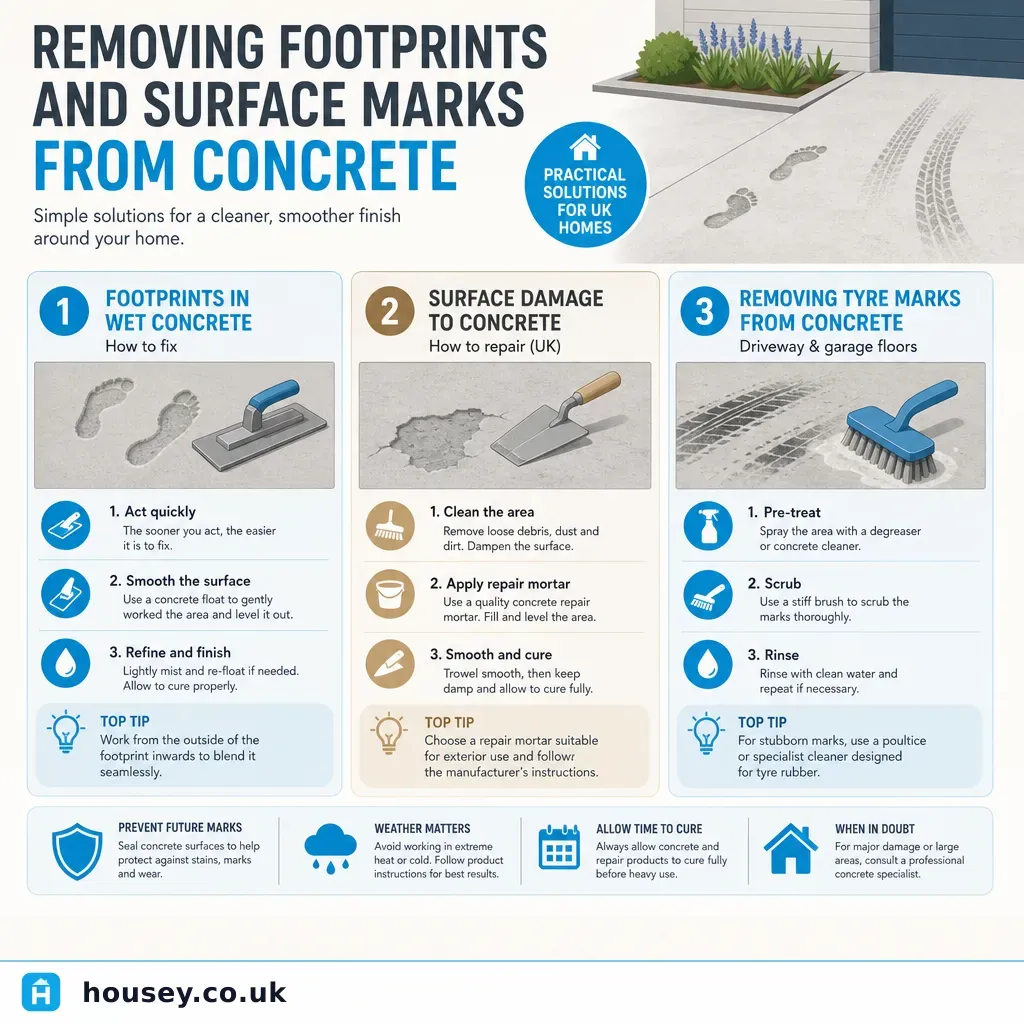
Removing Footprints and Surface Marks from Concrete
Footprints and marks in fresh concrete under 4–6 hours old can often be re-floated or trowelled smooth by a skilled finisher before initial set occurs.
 Improvement & Build
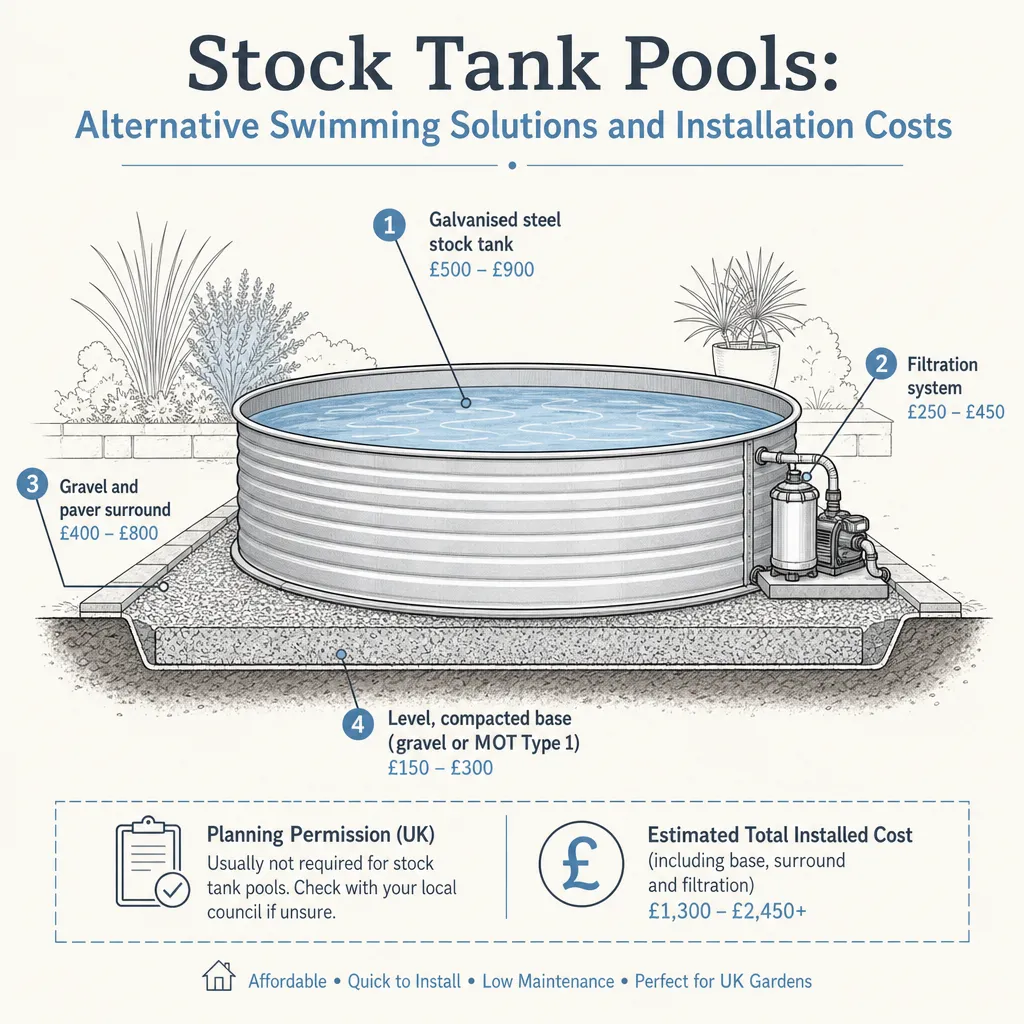
Stock Tank Pools: Alternative Swimming Solutions and Installation Costs
A stock tank pool is a galvanised steel agricultural trough repurposed as a garden plunge or swimming pool.
 Improvement & Build
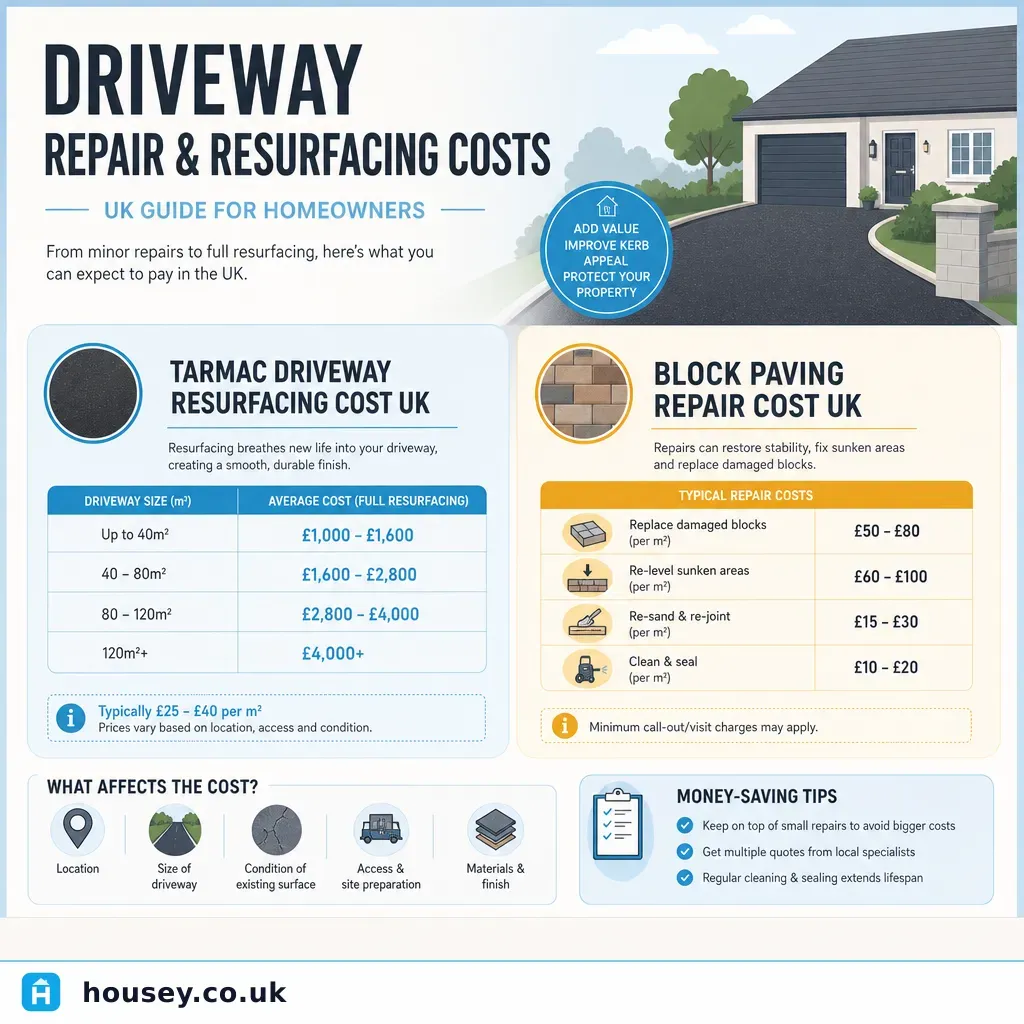
Driveway Repair and Resurfacing Costs
Driveway repair costs in the UK range from around £150 for a single pothole patch to £5,000–£12,000 or more for a full dig-out and replacement on a double driveway.
 Improvement & Build
Solar-powered outdoor lighting: designing efficient garden illumination
Solar-powered outdoor lighting suits most UK gardens and requires no mains wiring, making it a practical, low-disruption option for paths, borders, and security.