Removing Footprints and Surface Marks from Concrete
By Housey · Last reviewed 11th of May 2026
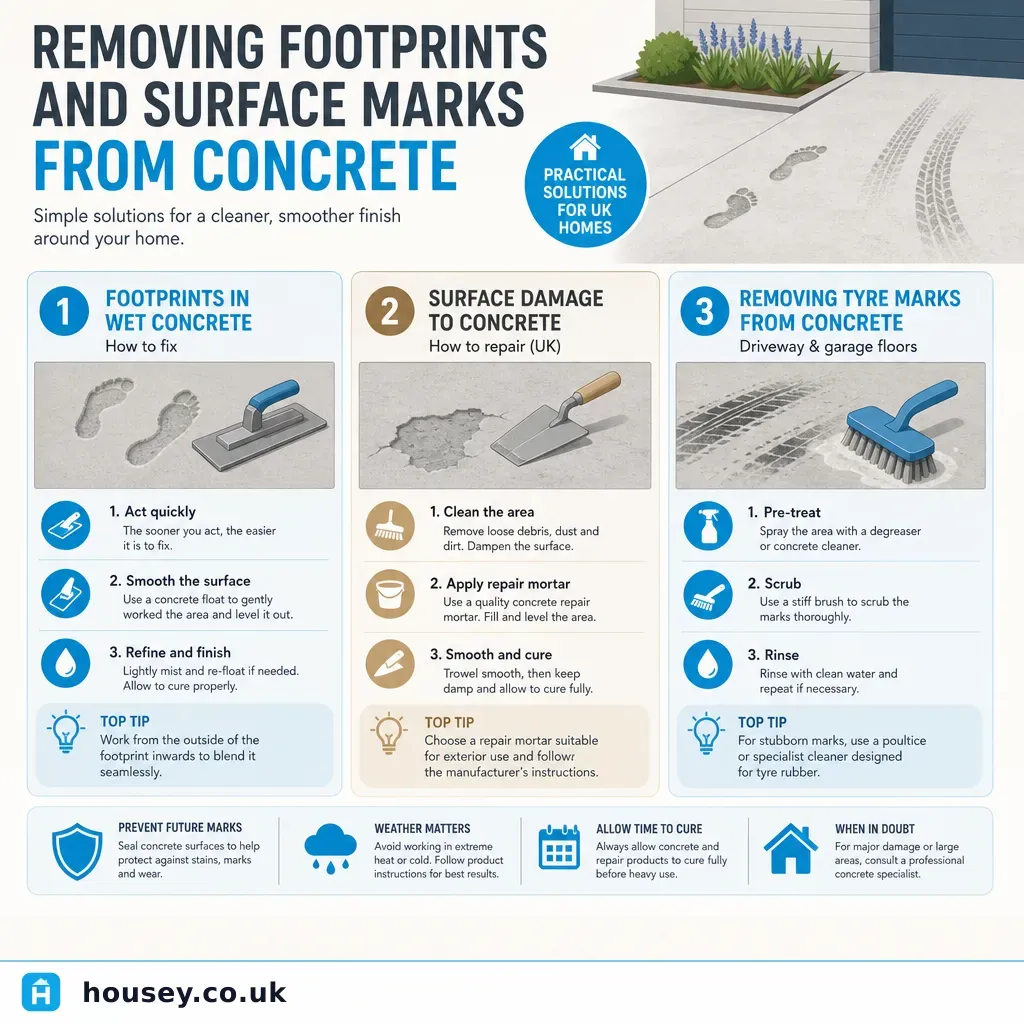
Removing Footprints and Surface Marks from Concrete
Whether a dog ran across a freshly laid path, a wheelbarrow left tyre tracks, or a delivery driver walked over a new driveway before the surface had set, surface marks in concrete are a frustrating and surprisingly common problem. The options available depend almost entirely on how long ago the concrete was poured — acting early gives far more choices than waiting until the slab has fully cured.
Key points
- Fresh concrete can be re-worked by a skilled finisher if you act within the first 4–6 hours, before initial set; after this window, re-working fractures the paste-aggregate bond and weakens the surface layer.
- Concrete achieves approximately 75% of its design strength at 7 days and reaches full cure at around 28 days — surface repairs carried out before full cure risk further damage to the slab.
- Mechanical grinding and shot blasting of cured concrete generate respirable crystalline silica (RCS) dust governed by the Control of Substances Hazardous to Health (COSHH) Regulations 2002; dust suppression and appropriate respiratory protective equipment (RPE) are required by law.
- Thin-overlay resurfacing (typically 5–20 mm deep) can conceal widespread surface marks on driveways and paths without the need to break out and relay the existing slab.
- Resurfacing an existing driveway does not usually require planning permission under permitted development rights, but conservation areas, Article 4 directions, and drainage requirements for new impermeable surfaces over 5 m² can affect this.
Why footprints and marks form in fresh concrete
Concrete remains workable in its plastic state from the time of placing until initial set — typically 4–10 hours depending on mix design, ambient temperature, and the water-to-cement ratio. During this window, any pressure on the surface leaves an impression because the paste has not yet locked around the aggregate particles.
After initial set the surface becomes rigid but is still chemically active. Hydration — the reaction that progressively develops strength — is still underway, and foot traffic at 24–48 hours can cause surface delamination (separation of the surface layer from the body of the slab), particularly where the mix carried excess bleed water or the finisher worked the surface too early.
Repairing marks in fresh concrete: the first 4–6 hours
If the concrete was placed recently and the marks are still fresh, a skilled concrete finisher may be able to re-float or power-trowel the surface to blend the impression before the paste locks. This is entirely timing-critical.
What is possible:
- Hand or mechanical re-floating to level out shallow impressions.
- Dry cement dusting and re-trowelling to bring up fresh surface paste over slightly deeper marks.
What is not possible:
- Re-working once initial set has occurred — this breaks the bond between aggregate and paste and weakens the surface.
- Blending marks that have dried or crusted around their edges.
If the laying contractor is responsible for the damage, contact them immediately. Most reputable concreters carry public liability insurance and should rectify damage caused during or immediately after their works.
Repairing marks in cured concrete: mechanical options
Once concrete has passed initial set, mechanical methods are required. The three most common in UK residential settings are:
Diamond grinding A floor grinder fitted with diamond-segment pads removes a thin layer of surface paste, levelling raised marks — such as a heeled boot impression that left a raised rim — and producing a lightly textured, uniform surface. Diamond grinding generates RCS dust. Under HSE COSHH guidance on silica, wet suppression or on-tool extraction with an H- or M-class vacuum and appropriate RPE are required. This is not a safe task for a homeowner without proper equipment.
Shot blasting Shot blasting propels steel shot at high velocity across the surface, removing the surface layer uniformly and leaving a consistent texture that acts as a strong mechanical key for thin overlays. It is particularly effective for larger areas such as driveways. Shot-blasting equipment is specialist and is typically operated by or hired from a contractor.
Scarifying or planing For deeper marks or significant high spots, a scarifier (milling cutter) can remove more material. This is generally reserved for industrial floors or severe residential defects.
Comparison of concrete surface repair methods
Method | Best for | Not ideal for | Typical result | Key consideration |
|---|---|---|---|---|
Re-floating / power trowelling | Fresh concrete under 4–6 hours old | Any cured surface | Near-seamless blend | Timing-critical; requires skilled finisher |
Diamond grinding | Isolated raised marks on a cured slab | Large areas or deep recesses | Smooth, aggregate-exposed surface | RCS dust — suppression and RPE required by law |
Shot blasting | Large areas; preparation before overlay | Single small marks | Uniform textured profile | Specialist equipment; usually contractor-only |
Thin overlay / micro-topping | Widespread marks on an otherwise sound slab | Structural cracks or delaminated surfaces | Even, uniform new finish | Bond primer essential; substrate must be clean and sound |
Full break-out and relay | Severely cracked, heaved, or sunken slab | Budget-constrained projects | Brand-new surface | Highest cost; concrete waste disposal required |
Which approach is right for you?
Use this decision tree to narrow down the options:
- Act within 4–6 hours if the concrete was poured very recently — contact the laying contractor or a concrete finisher to re-float the surface before initial set.
- Choose diamond grinding if the marks are on a fully cured slab (ideally at 28 days), confined to a small area, and are raised surface impressions rather than deep recesses.
- Choose shot blasting and thin overlay if marks are widespread across a driveway or path and a uniform finish is needed — typically the most cost-effective route for areas over approximately 10 m².
- Consult a specialist if the marks are accompanied by cracks, crumbling, or delamination, which suggest a deeper defect in the original mix, placement, or finishing that a surface-only repair may not address.
- Consider full relay if the slab shows structural cracking, heave, or settlement, as surface repairs will not address the underlying cause.
Driveway and path resurfacing: UK context
For residential driveways in England and Wales, resurfacing an existing driveway does not usually require planning permission under permitted development rights. Exceptions include:
- Laying new impermeable hard standing over 5 m² at the front of a house — this may require the use of a permeable material or the provision of drainage to a lawn or border. See Planning Portal guidance on driveways.
- Properties in conservation areas or subject to Article 4 directions may have restricted permitted development rights — check with your local planning authority before starting work.
- Listed buildings require listed building consent for external works that alter the character of the building.
Indicative UK costs for driveway resurfacing with a thin overlay applied to an existing sound slab: £25–£60 per m² depending on material, area, preparation required, and region. Full break-out and relay typically costs £50–£120 per m². Indicative UK costs, last reviewed 2026-05-11. Always obtain at least three written quotes.
When to get professional help
Surface repairs to concrete are achievable at small scale by a competent tradesperson, but professional assessment is the right step when:
- Marks are accompanied by cracks wider than a hairline (approximately 0.3 mm or more).
- The surface is spalling, delaminating, or crumbling — suggesting carbonation, frost damage, or a poor-quality original mix.
- The slab has heaved, settled, or become noticeably uneven, indicating a subbase or drainage problem that surface repair will not fix.
- The affected area is large (over 10 m²) or grinding is involved — RCS dust management requires proper equipment and respiratory protection.
- The driveway or path is a shared boundary or party structure.
How Housey can help
If your driveway or path needs more than a small cosmetic fix — or if you want a professional assessment before committing to a repair method — Housey's vetted driveway installers can provide quotes for resurfacing, pre-overlay grinding, and full-relay work across the UK.
Frequently asked questions
Can footprints in dried concrete be removed completely?
It depends on depth and when you act. Impressions in fresh concrete within 4–6 hours can often be re-floated almost invisibly. Once cured, diamond grinding can level raised edges and improve appearance significantly, but deep impressions may remain faintly visible without a thin overlay. A full overlay or relay gives the most uniform result on a driveway or path.
How long after pouring can you walk on concrete?
Pedestrian foot traffic is usually safe after 24–48 hours for most standard mixes, though this varies with temperature, mix design, and loading conditions. Avoid heavy loads for at least 7 days. Vehicle access is not usually recommended until 7–14 days. Always check with your concrete supplier for guidance based on the specific mix used.
Does repairing concrete surface marks need planning permission?
Resurfacing an existing driveway or path does not generally require planning permission under permitted development. However, laying new impermeable hard standing over 5 m² at the front of a dwelling may engage drainage requirements under Building Regulations. Conservation areas and Article 4 directions can restrict permitted development — check with your local planning authority if in doubt.
Can I fix concrete footprints myself?
Minor cosmetic improvement is possible with a patching mortar on small areas, but achieving a seamless finish without specialist equipment is difficult. Grinding and shot blasting generate respirable crystalline silica dust, requiring proper suppression and appropriate respiratory protective equipment under COSHH Regulations 2002. For anything beyond a very small patch, a professional with the right equipment is advisable.
Sources and further reading
- Respirable crystalline silica from construction dust — Health and Safety Executive (HSE)
- Hard standings for cars: driveways and permitted development — Planning Portal
- BS 8500: Concrete — Complementary British Standard to BS EN 206 — BSI British Standards
- Repair and maintenance of concrete structures — The Concrete Society
Useful next reads
 Improvement & Build
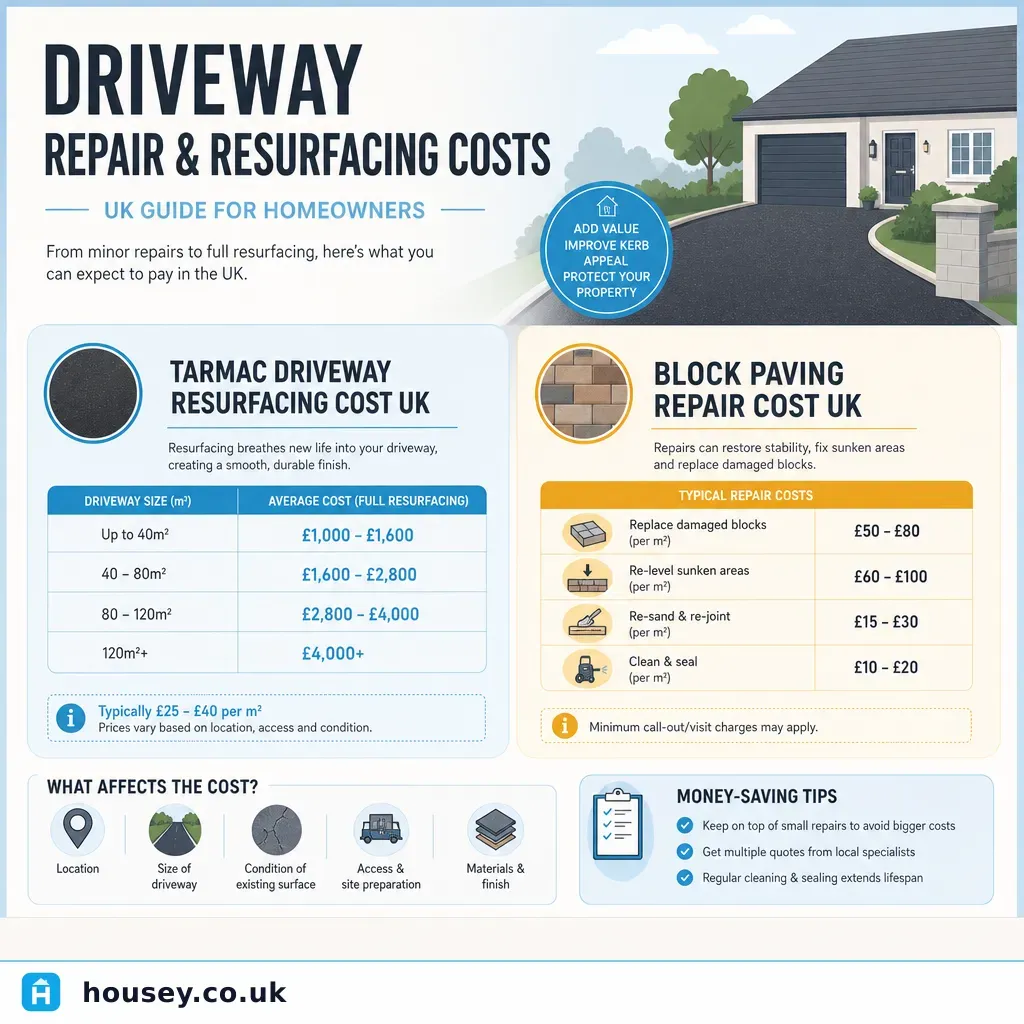
Driveway Repair and Resurfacing Costs
Driveway repair costs in the UK range from around £150 for a single pothole patch to £5,000–£12,000 or more for a full dig-out and replacement on a double driveway.
 Improvement & Build
Window installation checklist for homeowners
Before installation, confirm your installer is registered with FENSA or CERTASS and can self-certify Building Regulations compliance.
 Improvement & Build
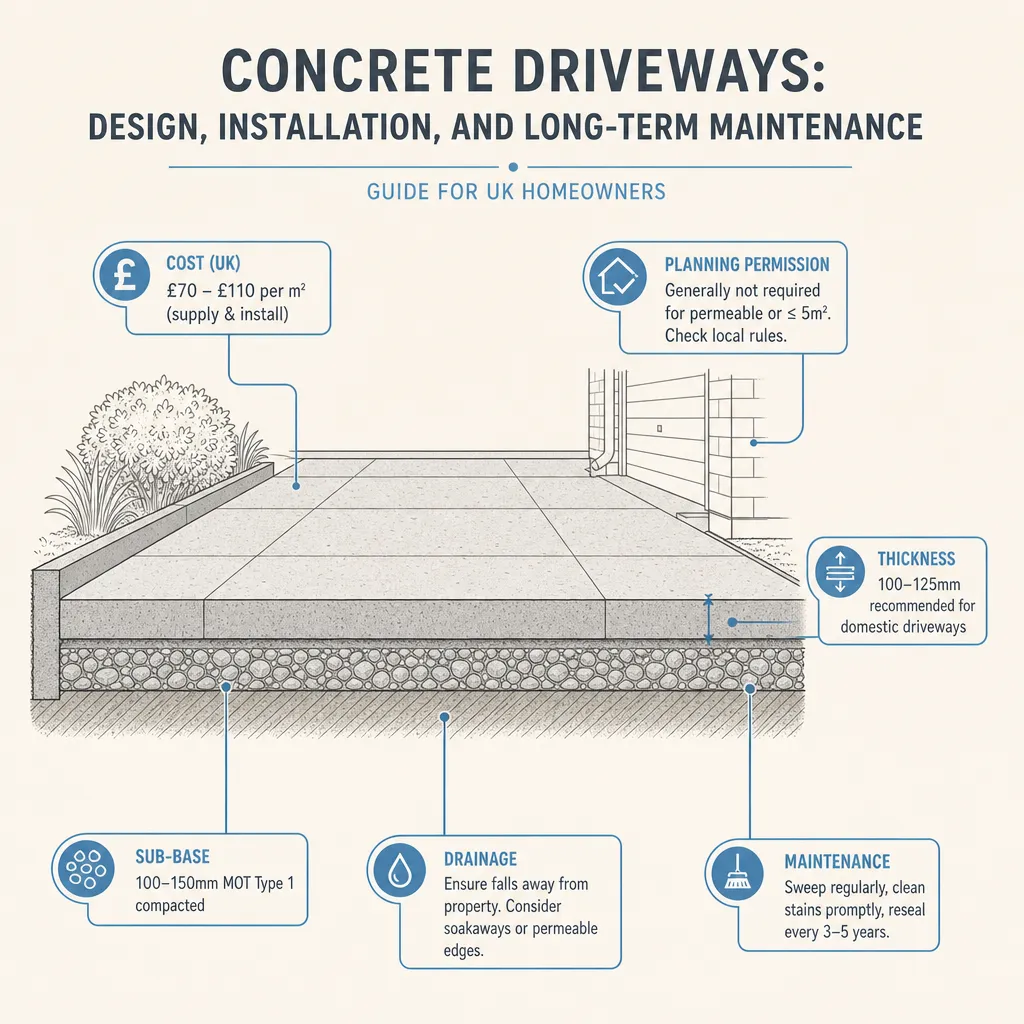
Concrete Driveways: Design, Installation, and Long-Term Maintenance
A concrete driveway requires a compacted sub-base of at least 150mm and a concrete slab of at least 100mm for domestic use.
 Improvement & Build
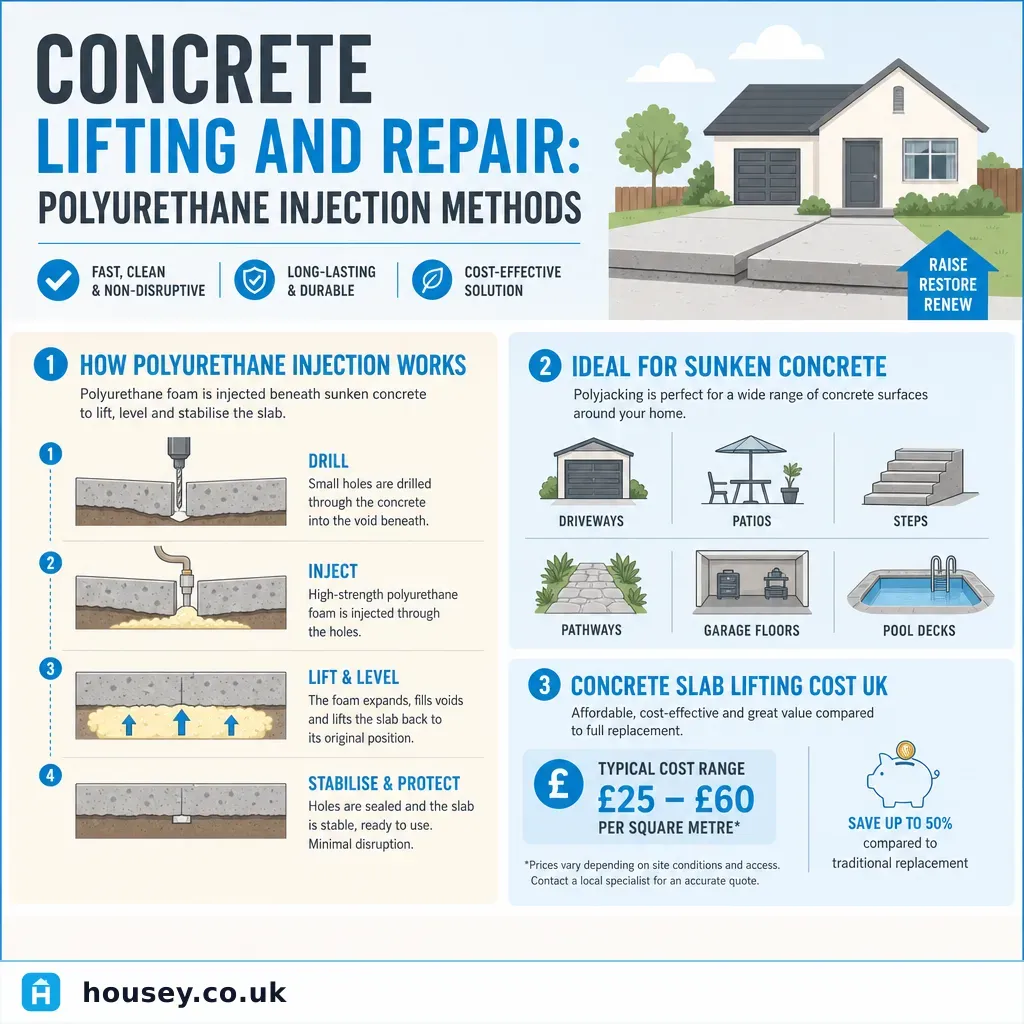
Concrete Lifting and Repair: Polyurethane Injection Methods
Polyurethane injection (polyjacking) lifts sunken concrete slabs by injecting expanding foam beneath them through small drilled holes.
 Improvement & Build
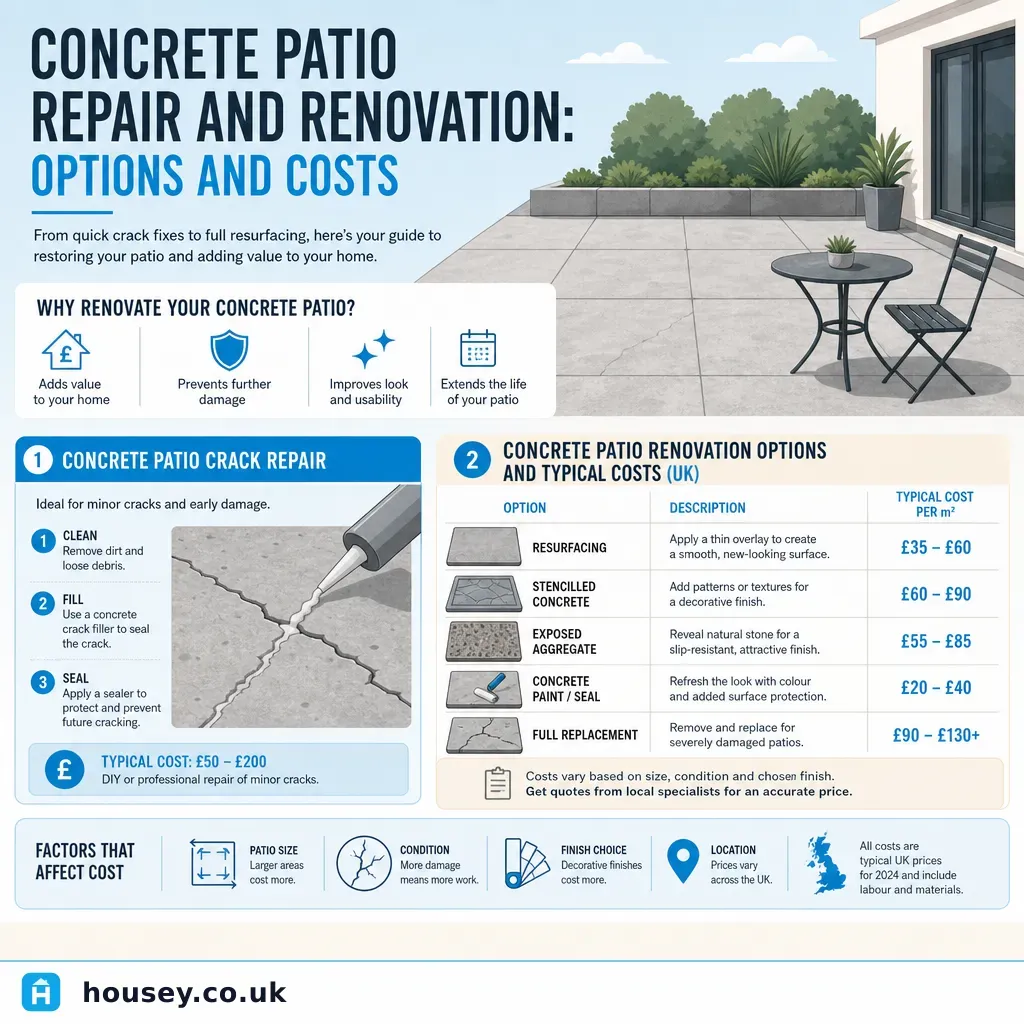
Concrete Patio Repair and Renovation: Options and Costs
Concrete patio repair options range from crack filling (for hairline cracks under 5 mm) through resurfacing overlays (viable only on structurally sound, well-draining slabs) to full removal and replacement.