Concrete Removal and Demolition: When and How Much It Costs
By Housey · Last reviewed 5th of May 2026
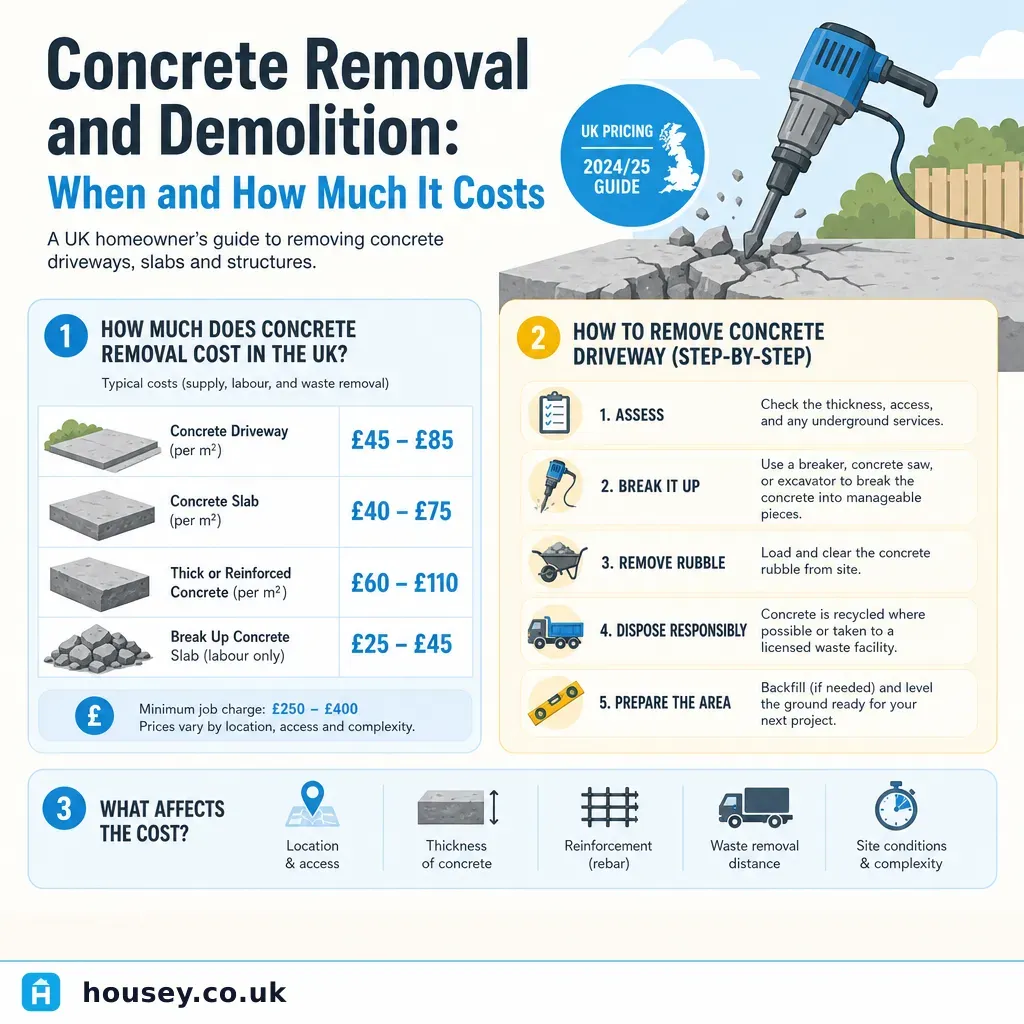
Concrete Removal and Demolition: When and How Much It Costs
Breaking out and removing concrete is often the first task on site before new landscaping, driveway installation, or groundwork for an extension. Whether you are dealing with a deteriorating patio slab, an old garage base, or unwanted garden paths, the cost and complexity of removal depends on factors that are easy to overlook when comparing contractor quotes — particularly slab thickness, reinforcement, and site access.
Key points
- Reinforced concrete — containing steel rebar — costs significantly more to remove than unreinforced slabs because rebar must be cut and separated before broken material can be loaded.
- Broken concrete is classified as inert waste under UK regulations and can legally be crushed and recycled as recycled aggregate or hardcore sub-base material.
- If concrete was laid in or near buildings constructed before 2000, check whether asbestos-containing materials are present before any breaking work begins.
- Skips placed on a public road require a permit from the local council, typically costing £25–£60 and taking several days to arrange.
- Crystalline silica dust released during concrete breaking is a respiratory hazard under COSHH regulations; contractors must use water suppression or respiratory protective equipment.
When is concrete removal needed?
Concrete removal typically arises in these residential situations:
- Driveway replacement — old or cracked concrete is broken out before a new surface is installed.
- Garden redesign — a redundant patio, path, or hardstanding is cleared to make way for planting or soft landscaping.
- Extension or outbuilding work — existing slabs or old foundation remains must be removed before new footings are excavated.
- Drainage access — drains beneath a concrete slab require breaking through for repair, relining, or replacement.
- Pre-sale preparation — removing deteriorated hardstanding to improve a property's appearance or to comply with permitted development drainage rules.
In most cases this work is carried out by a demolition contractor or groundworker, either as a standalone task or as part of a wider groundwork package.
Methods of concrete removal
The right method depends on slab thickness, reinforcement, access, and proximity to sensitive structures.
Method | Best for | Key limitations | Typical equipment |
|---|---|---|---|
Electric or hydraulic breaker | Unreinforced slabs up to 150mm thick | Noise and vibration; not suited to very thick slabs | Breaker hammer, compressor |
Concrete or diamond saw | Clean cuts; isolating sections; small areas | Silica dust; water suppression required | Diamond disc or chain saw |
Mini-excavator with breaker | Large areas, thick or reinforced slabs | Requires access gap of at least 850mm | 1–3 tonne excavator |
Manual breaking | Very small areas or restricted access | Slow and physically demanding | Lump hammer, cold chisel |
Expansive demolition grout | Near sensitive structures or confined spaces | Slow reaction (24–48 hours); splitting only | Drilled holes plus grout compound |
For most residential driveways and garden slabs, an electric or hydraulic breaker — or a mini-excavator with a breaker attachment for larger areas — is the most practical and cost-effective choice.
Indicative costs for concrete removal in the UK
Indicative UK costs, last reviewed 2026-05-05. Actual quotes vary by slab thickness, reinforcement, access, volume, and distance to disposal facility.
Project type | Indicative range | Notes |
|---|---|---|
Break out unreinforced path or patio | £25–£55/m² | Reasonable access assumed; includes loading to skip or lorry |
Break out unreinforced driveway slab | £30–£65/m² | Includes breaking and loading |
Break out reinforced concrete | £55–£110/m² | Rebar cutting significantly increases cost |
Standard 6-yard skip hire | £200–£400 | Excludes road permit; regional variation |
Grab lorry collection (inert waste) | £150–£280 per load | Faster than skip for large volumes |
On-site crushing and recycling | £80–£180 per tonne | Reduces disposal cost; recycled material usable as sub-base |
Concrete weighs approximately 2.4 tonnes per cubic metre. A 25m² unreinforced slab at 100mm thick produces around 6 tonnes of broken material, so disposal is a significant part of the overall budget. Always request itemised quotes separating breaking, loading, and disposal.
What affects the cost most
Slab thickness — a garden path is typically 75–100mm; a residential driveway 100–150mm; structural slabs or foundations may be 200–500mm or more. Thicker slabs take longer to break and produce more waste.
Reinforcement — unreinforced concrete breaks relatively quickly. Reinforced concrete requires cutting rebar with an angle grinder or saw before sections can be separated and loaded, adding considerable time and cost.
Access — a mini-excavator needs a gate or gap of at least 850mm to reach a rear garden. Poor access means more manual labour and longer handling time, which is directly reflected in quotes.
Disposal route — skip hire suits phased loading but requires a road permit for on-street placement. A grab lorry is more efficient for large single volumes. On-site crushing reduces cost where recycled material can be reused as sub-base on the same project.
A note on asbestos
Asbestos-containing materials were used in UK construction until a full ban took effect in 1999. In older garages, outbuildings, and industrial buildings, asbestos cement sheets — used for roofing, soffits, and cladding — may be present alongside or above concrete slabs.
If you suspect asbestos-containing materials are present, do not break, drill, or disturb them. Arrange a survey by a UKAS-accredited asbestos surveyor before any breaking work begins. Certain asbestos removal tasks require a notifiable non-licensed (NNLW) contractor; others require a HSE-licensed contractor. A concrete removal contractor is not automatically qualified to assess or handle asbestos — make the building's history clear before instructing any work.
Red flags when getting concrete removal quotes
- A contractor who quotes without visiting the site or asking about slab thickness and reinforcement — these are the primary cost drivers.
- No mention of waste disposal, or a quote that excludes it without clear explanation.
- No discussion of disposal route or whether road permits for on-street skips are included.
- No reference to silica dust control or personal protective equipment.
- No mention of checking for underground services before breaking begins.
- Cash-only payment requested, or no written specification provided before work starts.
What to ask before accepting a quote
- Has the contractor viewed the slab, and what is their assessment of thickness and reinforcement?
- What equipment will be used, and does a mini-excavator have sufficient access?
- Is disposal included, and what is the disposal route?
- Are road permits for skip hire included if the skip will be on a public road?
- Has a utility check been carried out or arranged before breaking begins?
- How will silica dust be controlled during breaking and cutting?
- Is VAT included in the quoted price?
- What is the expected duration and how many operatives will be on site?
- What clean-up is included after breaking and loading?
When to get professional help
Concrete removal generates hazardous silica dust, produces heavy inert waste requiring organised disposal, and is not suited to DIY for anything beyond very small areas. Engage a professional contractor when:
- The slab is reinforced or thicker than approximately 100mm
- Work is near drains, manholes, utility pipes, or structural elements
- The volume of waste is significant — broadly any project over about 5m²
- There is any possibility of asbestos-containing materials nearby
- The concrete forms part of a structural foundation, retaining wall, or load-bearing element
For structural demolition, a structural engineer should advise on sequence and any temporary works before breaking begins.
How Housey can help
Housey connects you with vetted demolition contractors and groundworkers for concrete removal projects of all sizes. Request itemised written quotes and compare them side by side before committing to any work.
Frequently asked questions
Do I need planning permission to remove a concrete driveway or patio?
In most cases, no planning permission is needed to remove existing concrete hardstanding. If you live in a conservation area or the property is listed, check with your local planning authority first. If you plan to replace the concrete with a new impermeable surface over 5m² in England, the replacement surface may itself require drainage compliance or a planning application.
How long does concrete removal take for a typical driveway?
A standard residential driveway of 25–50m² with unreinforced concrete typically takes one to two days with appropriate equipment and a two-person crew. Reinforced concrete, poor access, or a thick slab will extend the programme. Your contractor should give a realistic timeframe after viewing the site — quotes given without a site visit may underestimate the job significantly.
Can old concrete be recycled?
Yes. Broken concrete is classified as inert waste and can be crushed and recycled as recycled aggregate or hardcore sub-base material. Many demolition contractors, waste transfer stations, and recycling facilities accept clean concrete for processing. Reusing crushed concrete on the same site — where the specification allows — can reduce both disposal costs and the number of lorry movements required.
Is silica dust a risk during concrete breaking?
Yes. Crystalline silica dust is released when concrete is cut, drilled, or broken, and prolonged exposure causes serious respiratory disease. Under COSHH regulations, contractors must control silica dust exposure through water suppression, on-tool extraction, or respiratory protective equipment. If a contractor breaks concrete without any dust control measures in place, this is a significant health and safety concern.
What is the difference between a demolition contractor and a groundworker for concrete removal?
Both can carry out concrete breaking and removal. Demolition contractors typically handle larger-scale, complex, or structurally sensitive projects including reinforced concrete and building demolition. Groundworkers most commonly undertake residential and garden-scale work — driveway removal, patio breaking, site clearance — as part of wider groundwork. For straightforward residential jobs either is usually suitable; for structural or complex work choose a demolition specialist.
Sources and further reading
- Construction, demolition and excavation waste: manage and dispose — GOV.UK / Environment Agency
- Asbestos: the licensed contractor guide — Health and Safety Executive (HSE)
- Construction dust: silica and COSHH — Health and Safety Executive (HSE)
- Waste exemptions: using waste for a specified purpose — GOV.UK / Environment Agency
Useful next reads
 Improvement & Build
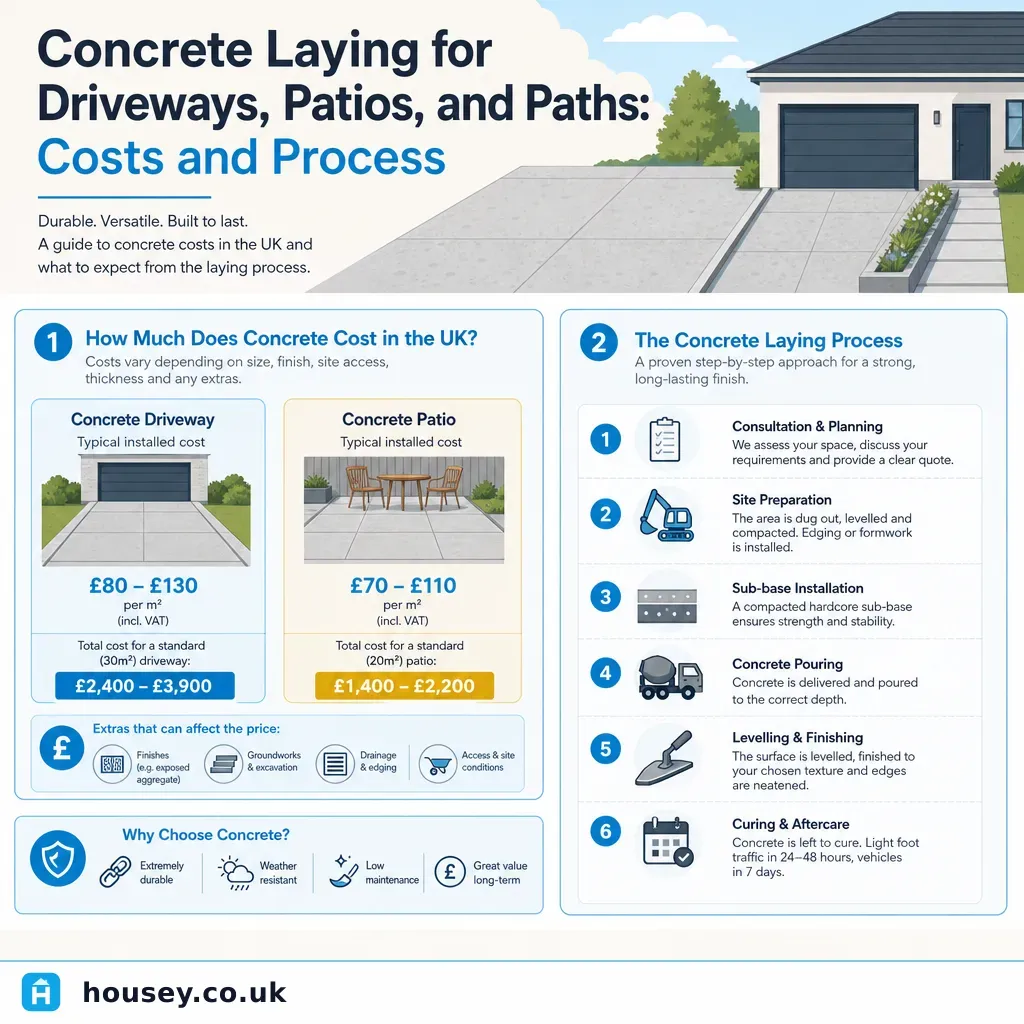
Concrete Laying for Driveways, Patios, and Paths: Costs and Process
Concrete laying for a UK driveway typically costs £65–£110 per square metre, including sub-base, reinforcement, formwork, and finishing.
 Improvement & Build
Vinyl Flooring Removal Costs
Vinyl flooring removal in the UK costs around £3–£12 per m² depending on floor type and whether adhesive removal is required.
 Improvement & Build
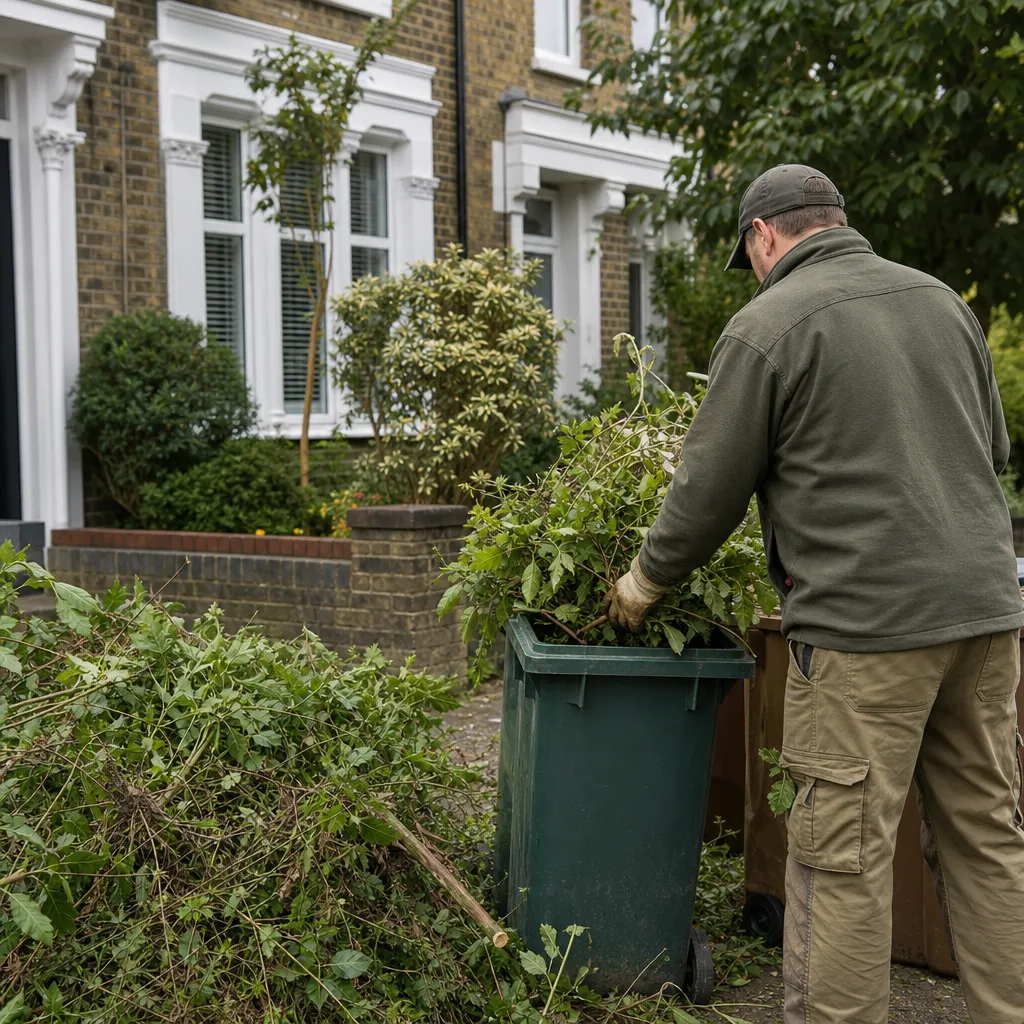
Yard waste removal: recycling, donating and reusing options
UK councils collect garden waste kerbside — often by annual subscription — or you can drop it free at a Household Waste Recycling Centre.
 Improvement & Build
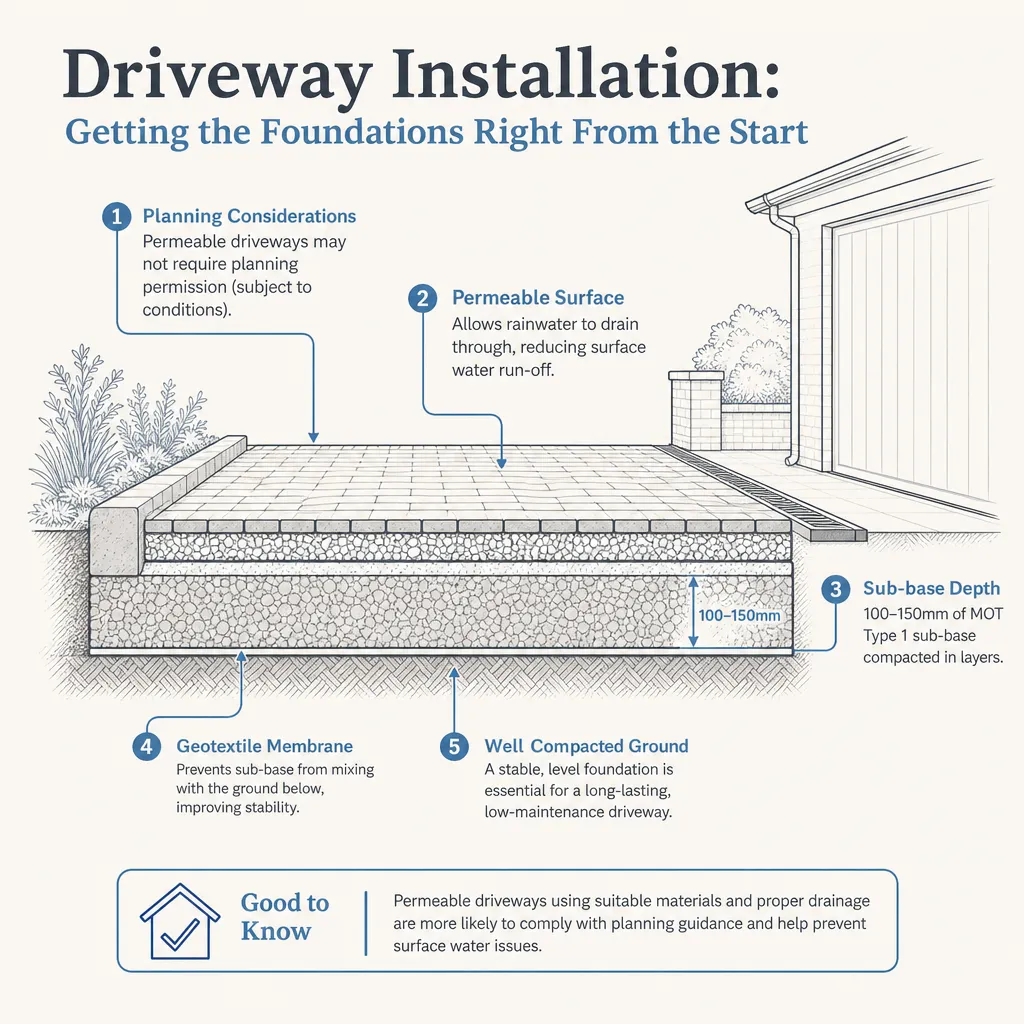
Driveway Installation: Getting the Foundations Right From the Start
A long-lasting driveway depends more on sub-base depth and drainage design than on the surface material chosen.
 Improvement & Build
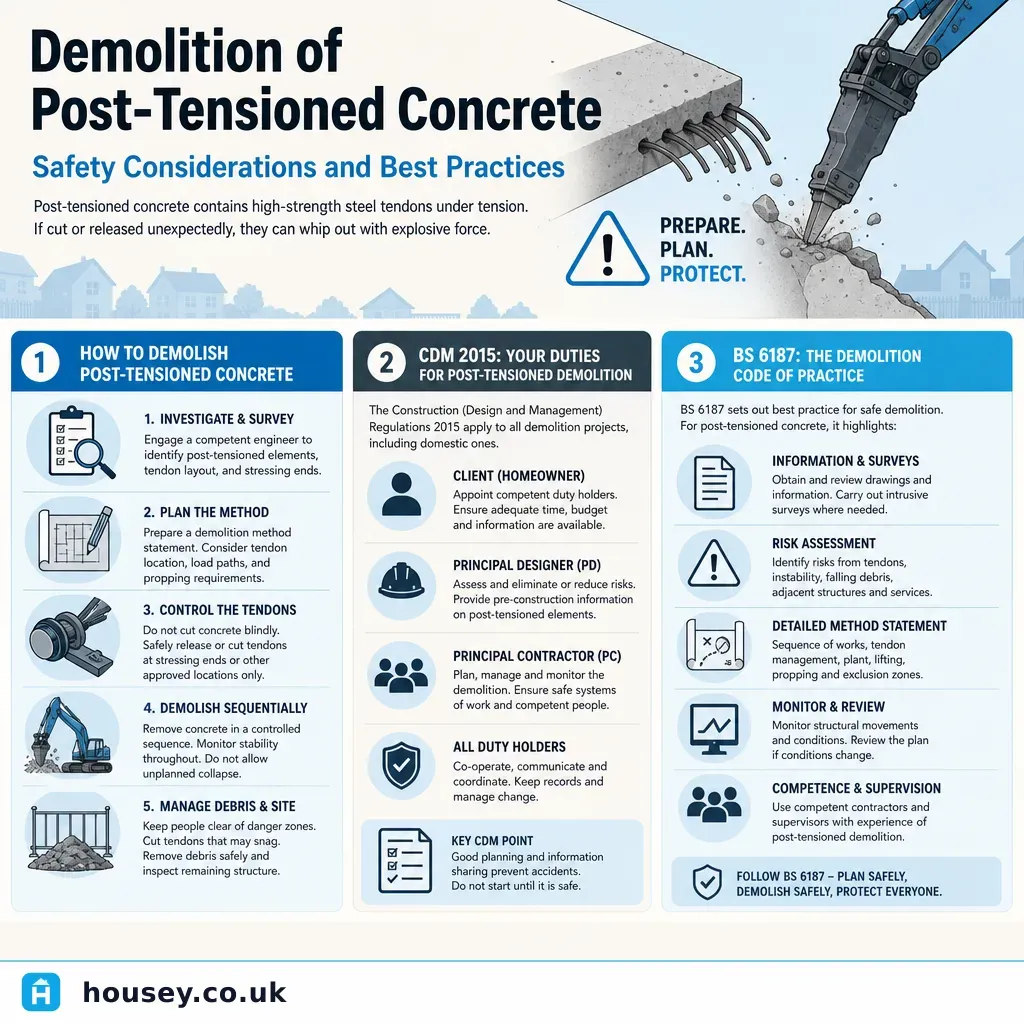
Demolition of Post-Tensioned Concrete: Safety Considerations and Best Practices
Post-tensioned concrete contains steel tendons under loads of up to 1,860 MPa.