Driveway Installation: Getting the Foundations Right From the Start
By Housey · Last reviewed 31st of May 2026
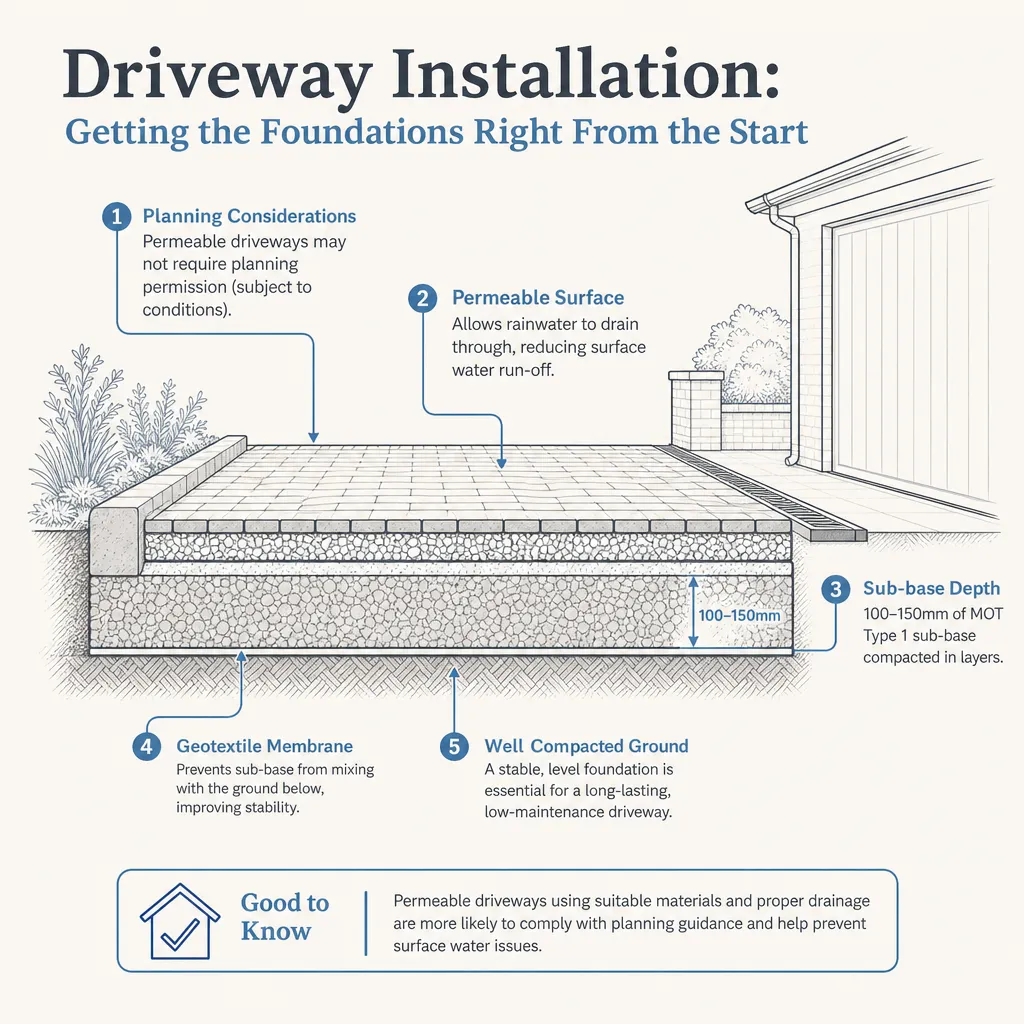
Driveway Installation: Getting the Foundations Right From the Start
The decision to install or replace a driveway is one of the most common improvement projects for UK homeowners, often prompted by a crumbling tarmac surface, an expanding household with additional vehicles, or a desire to improve kerb appeal ahead of a sale. The finished surface gets most of the attention in quotes and showroom visits, but the sub-base depth and drainage design determine whether a new driveway lasts five years or twenty-five. A handful of planning and drainage requirements introduced since 2008 also catch homeowners off guard before work has even begun.
Key points
- Driveways over 5 m² using an impermeable surface require planning permission in England unless surface water drains to a lawn, flower bed, or permeable soakaway within the property — a rule introduced by the Town and Country Planning (General Permitted Development) Order 2008.
- A correctly specified domestic driveway sub-base typically requires 100–150 mm of compacted Type 1 MOT granular material on a geotextile membrane, increasing to 150 mm or more on clay soils.
- Block paving, resin-bound aggregate, and gravel are all classified as permeable surfaces when correctly specified, generally avoiding the planning permission requirement.
- Surface water from a driveway must not discharge onto the public highway — a requirement under the Highways Act 1980 that applies regardless of surface material or driveway size.
- VAT on residential driveway installation is charged at the standard rate of 20%; zero-rating may apply for new-builds or installations for a disabled person's principal home — always confirm the applicable rate with your contractor before signing a contract.
Do I need planning permission for a new driveway?
Since October 2008, the Town and Country Planning (General Permitted Development) Order has removed Permitted Development rights for front garden driveways larger than 5 m² using a non-permeable surface, unless surface water drains to a lawn, flower bed, or suitable soakaway within the property.
In practice:
- Permeable surfaces (resin-bound aggregate, permeable block paving with open jointing, gravel laid on free-draining sub-base): generally do not require planning permission.
- Impermeable surfaces (standard tarmac, solid concrete, traditionally mortared block paving) where run-off drains to a lawn or soakaway within the property: generally do not require planning permission.
- Impermeable surfaces where run-off discharges to highway drainage: planning permission required.
Rules differ in Wales, Scotland, and Northern Ireland — check with your local planning authority. Conservation areas and listed buildings may face additional constraints regardless of surface type.
Do you need planning permission? — decision tree
- Is the driveway at the rear of the house? → Planning permission unlikely required for most surfacing works.
- Is the surface permeable (resin-bound, gravel, permeable block paving)? → Planning permission generally not required in England.
- Does surface water drain to a lawn or flower bed within the property boundary? → Planning permission generally not required.
- Is the property in a conservation area, or is it listed? → Check with your local planning authority before starting any work.
- None of the above apply? → Contact your local planning authority; a Householder Application may be needed.
Always verify with your local planning authority, as property history and local conditions can affect the outcome.
Sub-base preparation: why what lies beneath matters most
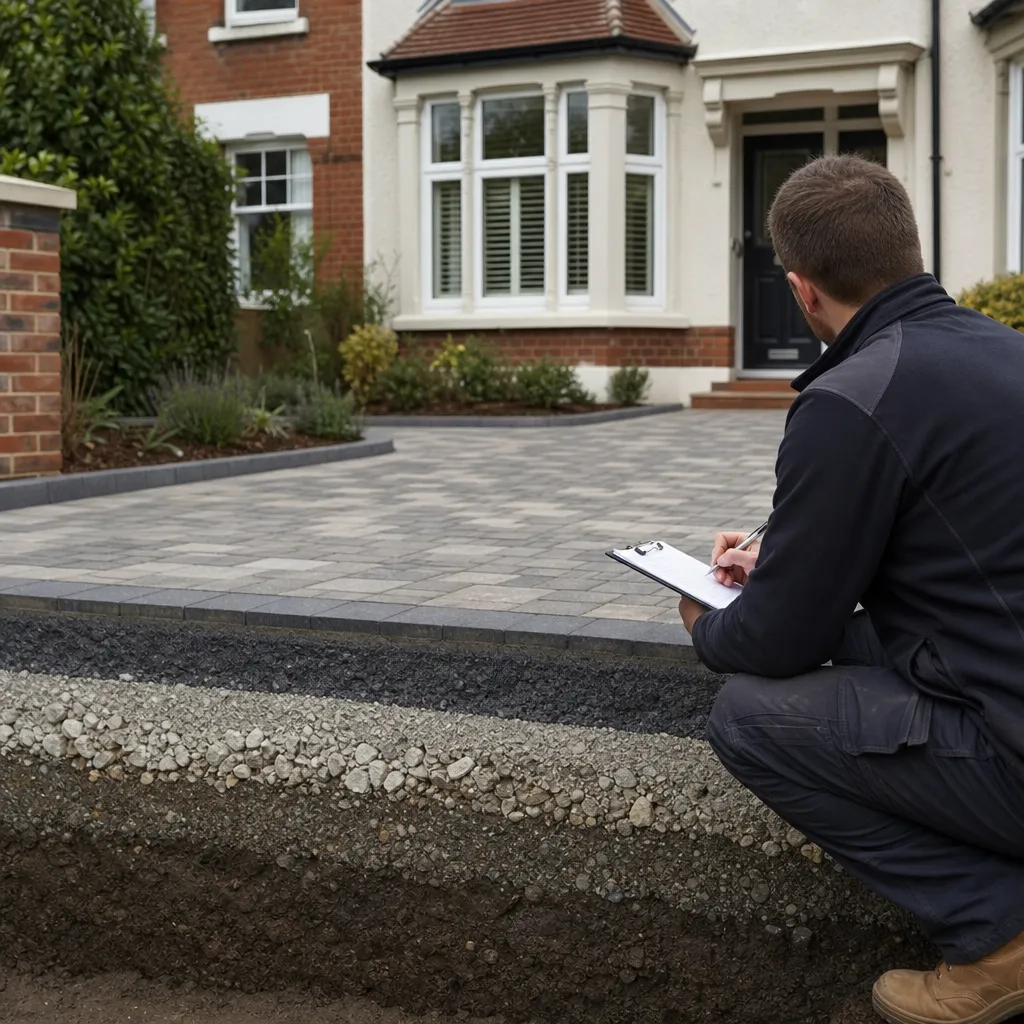
The sub-base is the structural foundation that distributes vehicle loads across the ground beneath. Most driveway failures — cracking, rutting, settlement, and edging movement — originate from inadequate sub-base depth or poor preparation, not from the quality of the surface material itself.
A standard sub-base sequence for a residential driveway:
- Excavate to the required total depth — typically 200–300 mm depending on surface type and ground conditions
- Lay a geotextile membrane over the prepared formation to prevent sub-base and subgrade intermixing over time
- Place and compact Type 1 MOT granular sub-base to a minimum of 100 mm on firm ground, or 150 mm or more on clay or soft ground
- Install edge restraints — concrete haunching or proprietary plastic edging — before laying the surface to prevent lateral spread
On clay soils, present across large parts of England, seasonal shrink-swell movement can cause differential settlement beneath a driveway. Experienced contractors working in these areas often increase sub-base depth or add a lean-mix concrete layer as a precaution. A poorly prepared sub-base on clay is by far the most common cause of premature surface failure within three to five years of installation.
Comparing driveway surface materials
Material | Typical lifespan | Permeable? | Relative cost | Best for | Not ideal for |
|---|---|---|---|---|---|
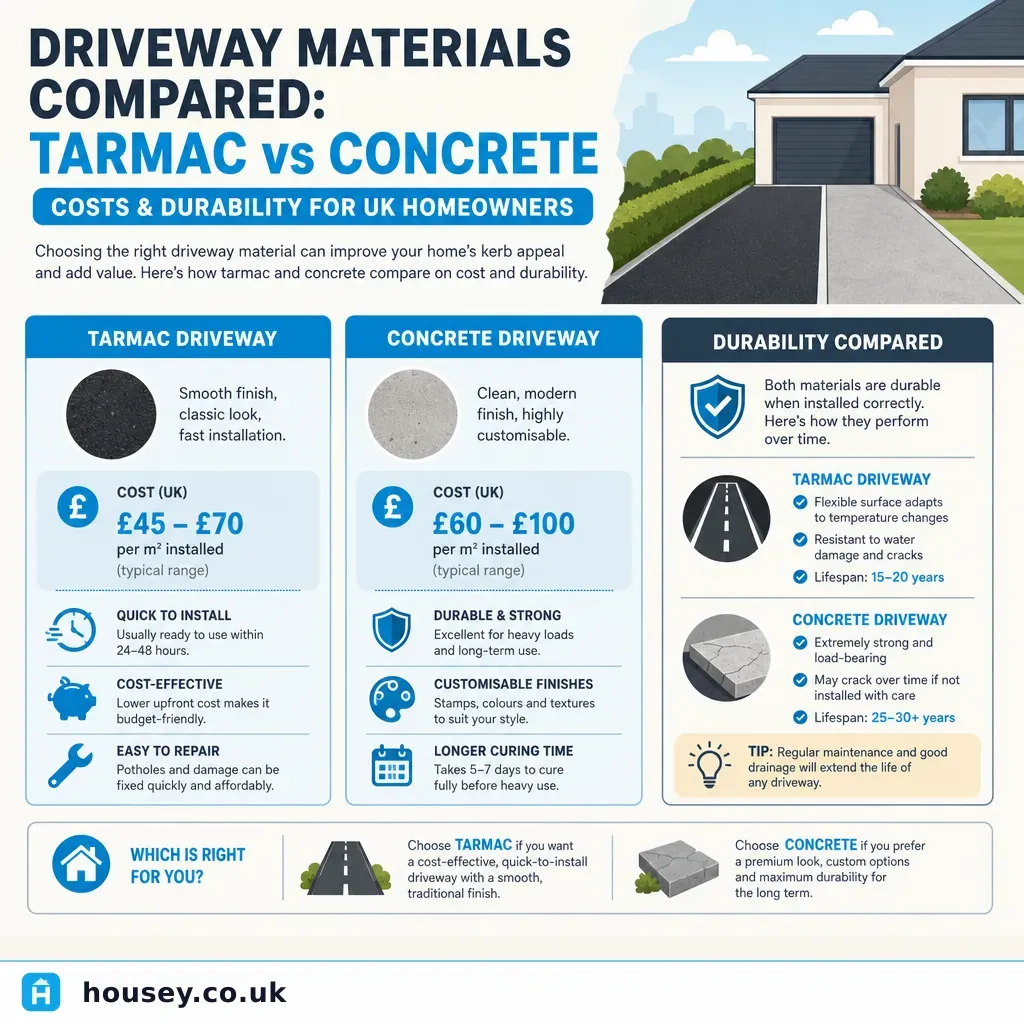
Tarmac (asphalt) | 15–25 years | No (standard) | £ | Large areas; fast installation; robust in cold weather | Front gardens over 5 m² (planning permission may apply); surface can soften in extreme heat |
Block paving | 20–30+ years | Yes, if open-jointed | ££ | Appearance; long-term durability; individual blocks replaceable | Higher installation cost; needs correct sub-base depth on clay soils |
Resin-bound aggregate | 15–25 years | Yes (fully permeable) | ££–£££ | Smooth decorative finish; weed-resistant; no planning permission needed | Requires skilled installation; surface can crack if sub-base fails |
Concrete | 25–40 years | No (standard) | ££ | Durability; heavy vehicle use; low long-term maintenance | Planning permission often required; difficult to repair if cracked; expansion joints essential |
Gravel (loose) | 5–15 years | Yes | £ | Low cost; quick installation; fully permeable | Displacement under tyres; weed growth; maintenance-intensive; unsuitable for steep slopes |
Porcelain / natural stone | 25+ years | Depends on jointing | £££ | Premium appearance; durable surface | High material and installation cost; must be jointed permeably for Permitted Development compliance |
Indicative UK costs, last reviewed 2026-05-31. Prices vary by region, driveway size, ground conditions, and contractor. Always obtain written quotes.
Drainage: the rule that catches homeowners out
Drainage design is where planning compliance, practical installation, and legal obligation converge. The key principles for UK homeowners:
- Surface water must not run onto the public highway — a requirement under the Highways Act 1980 that applies regardless of driveway material or size.
- Water should be directed to a soakaway, permeable area, or drain within the property boundary.
- If connecting to an existing surface water drain, check whether your local authority or water company requires approval — requirements vary across authorities and water companies.
- In Wales, Schedule 3 of the Flood and Water Management Act 2010 (in force since January 2019) requires Sustainable Drainage Systems (SuDS) approval from the local SuDS Approving Body (SAB) for new drainage above a certain area — check early in the design process.
- In England, Schedule 3 SuDS provisions are planned but not yet in force nationally — monitor GOV.UK guidance for updates before commencing works.
Checklist: what to confirm before your driveway installation starts
Use this checklist when reviewing contractor proposals and preparing your property:
What to ask before accepting a quote
- What excavation depth and sub-base specification are you proposing, and why?
- Is disposal of excavated material (spoil) included in the quoted price?
- What drainage solution are you proposing, and how does it comply with Permitted Development requirements?
- Are edge restraints included, and what type?
- What surface product are you specifying — supplier, grade, and specification?
- What guarantee does the completed installation carry, and is it in writing?
- Is VAT included, and at what rate?
- Are you registered with TrustMark or a member of a recognised trade body such as the British Association of Landscape Industries?
- What is your programme, and how long will the driveway be out of use?
When to get professional help
Most driveway installations are straightforward home improvement projects, but seek specialist advice before proceeding if:
- The property is in a conservation area or is a listed building
- Trees are present within or adjacent to the work area — roots can be damaged by excavation, and Tree Preservation Orders (TPOs) may restrict certain works
- Ground conditions are poor — boggy ground, soft clay, or suspected made-ground or fill material
- You need to create or alter a dropped kerb to the public highway — this requires consent from the local highway authority and work on the highway must be carried out by an approved contractor
- The proposed driveway drains towards a neighbouring boundary or a watercourse
How Housey can help
Housey connects homeowners with vetted driveway installers across the UK. Whether you are replacing a tired tarmac surface or laying a new resin-bound driveway from scratch, you can request and compare written quotes from local specialists who understand your area's ground conditions, drainage requirements, and planning rules.
Frequently asked questions
Do I need planning permission for a new driveway?
In England, planning permission is generally not required if the surface is permeable (gravel, resin-bound, permeable block paving) or if an impermeable surface drains to a lawn or soakaway within the property boundary. Driveways over 5 m² with impermeable surfaces discharging to highway drains do require a Householder Application. Rules differ in Wales, Scotland, and Northern Ireland — always check with your local planning authority before starting work.
How long does a new driveway last?
A well-constructed concrete driveway can last 25–40 years; block paving 20–30+ years; tarmac and resin-bound typically 15–25 years; gravel requires regular topping up over a 5–15 year lifespan. Longevity depends heavily on sub-base quality, drainage design, ground conditions, and the weight and frequency of vehicles using the surface. A poor sub-base on clay soil is the most common cause of early failure.
How thick should the driveway sub-base be?
For a typical domestic driveway on firm ground, a compacted Type 1 MOT sub-base of 100 mm minimum is standard. On clay soils or where heavier vehicles such as vans or motorhomes are parked regularly, 150 mm or more is commonly specified. Total excavation depth also includes the bedding layer (around 30–50 mm for block paving) and the surface material itself. Ask your contractor to specify all depths in writing before work begins.
Do I need a dropped kerb for a new driveway?
If no vehicle crossing currently exists at the boundary with the public highway, you need consent from your local highway authority before creating one. Work on the public highway must normally be carried out by an approved contractor. Driving over an unmodified kerb can cause damage and create legal liability. Contact your local authority's highways department early in the planning process, as lead times can extend to several months.
Is driveway installation subject to VAT?
Standard VAT at 20% applies to most residential driveway installations. Zero-rating may apply for new-build properties or for installations carried out for a disabled person's principal home under the VAT Act 1994. Always ask your contractor to confirm the applicable VAT rate and show it clearly on the written quote, as errors can be costly to correct once works have started.
Sources and further reading
- When is permission required — Planning Practice Guidance — GOV.UK
- Town and Country Planning (General Permitted Development) (England) Order 2008 — legislation.gov.uk
- Highways Act 1980 — legislation.gov.uk
- Flood and Water Management Act 2010 — Schedule 3 SuDS — legislation.gov.uk
- Sustainable Drainage (SuDS) — guidance for developers — Welsh Government
Useful next reads
 Improvement & Build
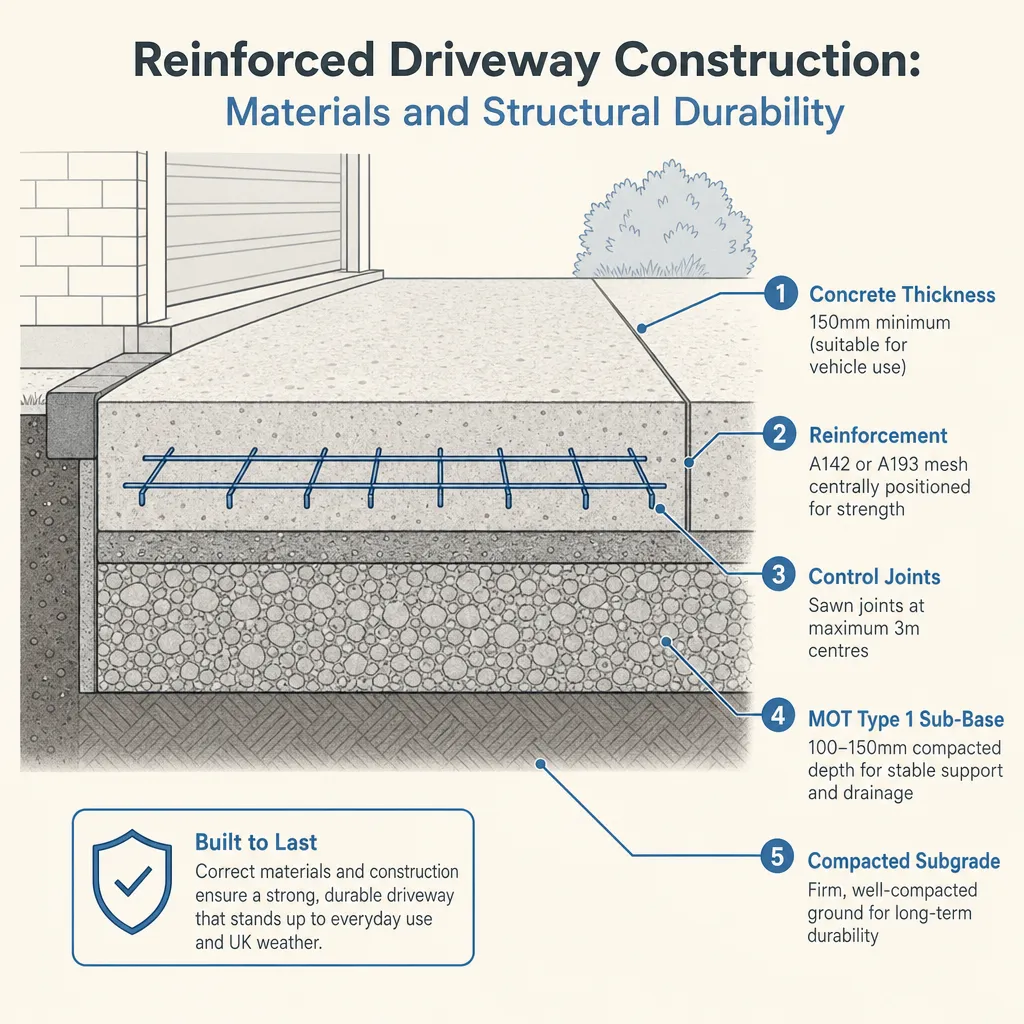
Reinforced Driveway Construction: Materials and Structural Durability
A domestic concrete driveway should be at least 100 mm thick — 150 mm where vans or heavier vehicles use it — on a compacted 100–150 mm MOT Type 1 sub-base, with A142 or A193 steel fabric mesh placed at mid-depth and expansion joints every 3–4 m.
 Improvement & Build
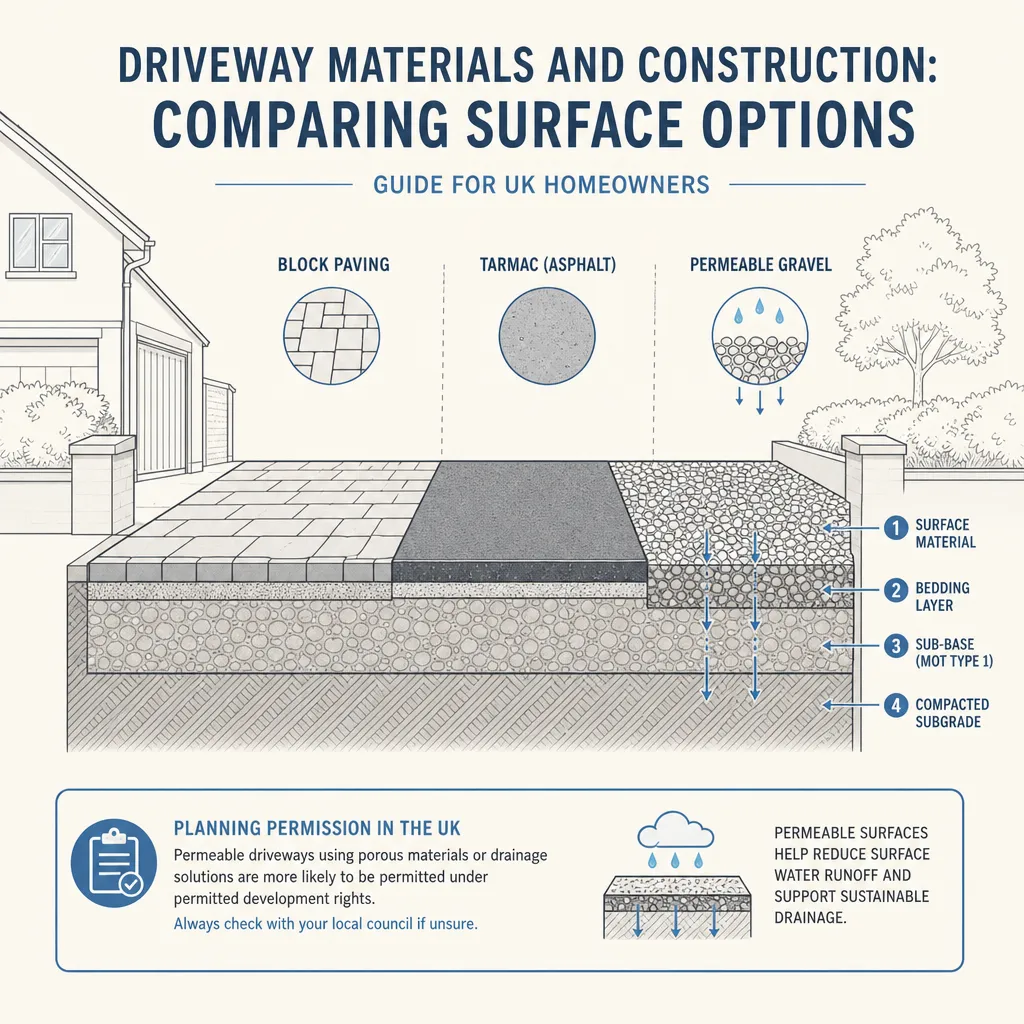
Driveway Materials and Construction: Comparing Surface Options
Common driveway surfaces in the UK include block paving, tarmac, concrete, gravel, and resin-bound aggregate.
 Improvement & Build
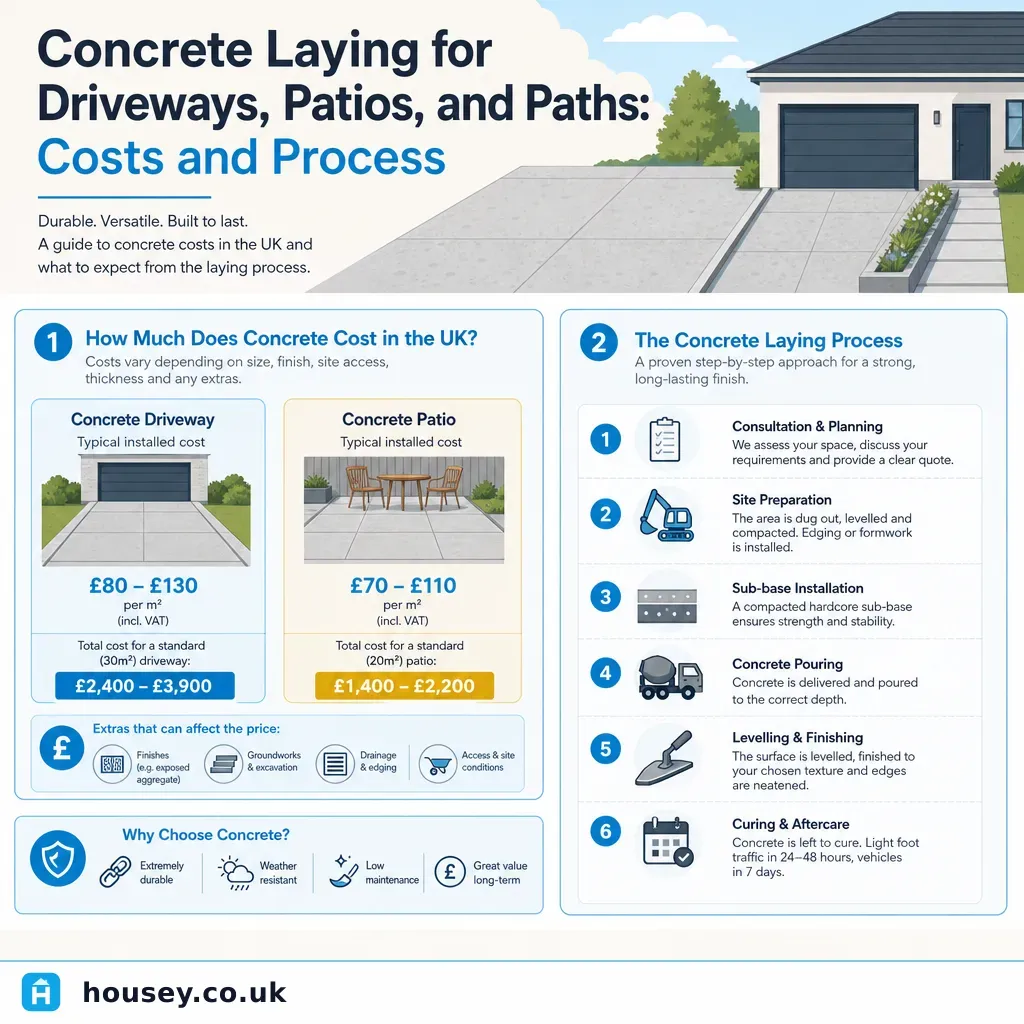
Concrete Laying for Driveways, Patios, and Paths: Costs and Process
Concrete laying for a UK driveway typically costs £65–£110 per square metre, including sub-base, reinforcement, formwork, and finishing.
 Improvement & Build
Driveway Thickness: Achieving the Right Specification for Residential Properties
The correct thickness for a residential driveway depends on the surface material and the traffic it will carry.
 Improvement & Build
Driveway Materials Compared: Tarmac vs Concrete Costs and Durability
Tarmac driveways typically cost £50–£80 per square metre installed and can be used within 24 hours, while concrete costs £80–£130 per square metre but lasts longer and offers more finish options.