Vinyl Flooring Removal Costs
By Housey · Last reviewed 11th of May 2026

Vinyl Flooring Removal Costs
Removing vinyl flooring is a common early step in a renovation project — clearing old sheet vinyl, vinyl tiles, or luxury vinyl tile (LVT) before laying new flooring or exposing original boards. The cost and complexity depend on floor area, adhesive type, subfloor condition, and — critically — whether the property dates from before approximately 2000, when some vinyl products contained asbestos-based materials that require specialist handling before any work begins.
Key points
- Vinyl flooring installed before approximately 2000 — particularly floor tiles and some cushion-floor sheet vinyl — may contain asbestos-containing materials (ACMs); do not attempt removal without a professional assessment first.
- Indicative costs for professional vinyl flooring removal range from approximately £3–£12 per m² depending on floor type, adhesive condition, and whether disposal is included — Indicative UK costs, last reviewed 2026-05-11.
- Black bitumen mastic adhesive used under many older vinyl floor tiles may also contain asbestos; it can be more hazardous and more labour-intensive to remove than the tiles themselves.
- Asbestos-containing vinyl flooring waste is classified as hazardous waste under the Hazardous Waste (England and Wales) Regulations 2005 and cannot be taken to a standard household waste recycling centre.
- Asbestos work in domestic properties is regulated under the Control of Asbestos Regulations 2012; higher-risk removal must be carried out by an HSE-licensed contractor.
What does vinyl flooring removal cost in the UK?
Costs vary depending on the floor type, how firmly the vinyl is bonded to the subfloor, and whether any asbestos-containing material is present.
Scenario | Indicative cost per m² | Notes |
|---|---|---|
Modern sheet vinyl, no adhesive bond | £2–£5 | Straightforward lift and dispose |
Modern vinyl tiles, minimal adhesive | £3–£7 | More labour due to individual tile removal |
Sheet vinyl adhered to concrete subfloor | £5–£10 | Adhesive residue requires scraping or grinding |
Vinyl tiles with mastic adhesive on concrete | £6–£12 | Old mastic adhesive is the most labour-intensive scenario |
Pre-2000 vinyl with suspected asbestos | Obtain specialist quotes | HSE-regulated; hazardous waste disposal costs apply separately |
Indicative UK costs, last reviewed 2026-05-11. Disposal for a typical room may add £150–£400 depending on volume and waste classification — Indicative UK costs, last reviewed 2026-05-11. Always obtain at least three quotes before proceeding.
The asbestos risk in older vinyl floors
This is the most important factor to consider before any vinyl flooring removal in a property built or refurbished before approximately 2000.
Asbestos-containing vinyl floor tiles (AFTs) and the black bitumen-based adhesive (commonly called black mastic) used to fix them were widely installed in UK domestic and commercial properties from the 1950s through to the late 1990s. Common forms include:
- 9-inch (225 mm) and 12-inch (300 mm) square floor tiles, often found in kitchens, utility rooms, and hallways
- Cushion-floor sheet vinyl with asbestos-reinforced backing layers
- Black bitumen mastic adhesive used beneath many floor tiles of this era
Disturbing these materials — by lifting, scraping, grinding, or sanding — can release asbestos fibres. Asbestos fibres are a known cause of mesothelioma, asbestosis, and lung cancer. The Health and Safety Executive (HSE) regulates asbestos work in the UK under the Control of Asbestos Regulations 2012.
If your property dates from before approximately 2000:
- Commission a Type 2 asbestos survey from a UKAS-accredited surveyor before any removal work begins
- Do not assume tiles are safe simply because they appear intact — the act of lifting and breaking tiles can release fibres
- HSE-licensed contractors are required for higher-risk asbestos removal; notifiable non-licensed (NNLC) contractors can carry out lower-risk work under HSE notification rules
Important limitations
This article provides general guidance on vinyl flooring removal costs and the typical process in the UK. It does not constitute asbestos safety advice for your specific property. Whether asbestos is present, which removal method is appropriate, and which contractor category is required all depend on the type, condition, quantity, and location of any asbestos-containing material found. Always consult a UKAS-accredited asbestos surveyor before starting removal work in any pre-2000 property, and instruct an appropriately qualified contractor where ACMs are confirmed.
What to ask a qualified professional
Before instructing anyone to remove vinyl flooring in a pre-2000 property, ask:
- Has an asbestos survey been carried out for this specific floor, and can you provide the survey report before starting work?
- If asbestos-containing materials are confirmed, are you an HSE-licensed or NNLC contractor, and can you provide your licence or HSE notification details?
- How will asbestos waste be packaged, labelled, and disposed of — and will I receive a hazardous waste consignment note?
- Is adhesive or mastic removal included in your quote, or is it priced separately?
- Will subfloor levelling or patching after removal be carried out, or is that an additional cost?
- What preparation do I need to complete before work starts — clearing furniture, disconnecting appliances?
Should you remove vinyl flooring yourself?
- Remove yourself if the property was built after 2000, the floor is a modern LVT or sheet vinyl with no adhesive complications, and you are comfortable with manual removal and correct disposal at a licensed household waste recycling centre.
- Hire a professional if the property predates 2000, thick adhesive is present on the subfloor, the floor's history is unclear, or the removal is part of a larger renovation requiring a properly prepared substrate.
- Always use an HSE-licensed or NNLC specialist if a survey confirms asbestos-containing materials are present in the floor or adhesive. Do not attempt DIY removal of confirmed asbestos-containing flooring under any circumstances.
When to get professional help
Seek specialist advice or professional help before proceeding if:
- The property was built or significantly refurbished before approximately 2000 and the floor has not been surveyed for asbestos
- Black bitumen adhesive is visible on the subfloor surface or at the edges of lifted tiles
- The floor covering is cracked, damaged, or friable — suggesting fibres may already be releasing
- You are working above a fragile or historically significant subfloor such as original Victorian quarry tiles or stone flags, where removal must be carried out with particular care to avoid damage
How Housey can help
Housey can help you find local tradespeople for floor clearance and preparation as part of a wider renovation project. For any property where asbestos may be present, always arrange a survey from a UKAS-accredited asbestos assessor before instructing a removal contractor. Use Housey to find verified professionals for your project once the scope of work is clear.
Frequently asked questions
How do I know if my vinyl floor contains asbestos?
Visual inspection cannot confirm whether vinyl flooring contains asbestos. The only reliable method is laboratory analysis of a sample taken by a trained surveyor. If your property was built or significantly refurbished before approximately 2000, commission a Type 2 asbestos survey before any removal work begins, particularly where floor tiles or black mastic adhesive are present.
Can I take old vinyl flooring to a household waste recycling centre?
Non-asbestos vinyl flooring can generally be taken to a licensed household waste recycling centre, though policies vary by local authority — call ahead to confirm. Vinyl flooring confirmed to contain asbestos is classified as hazardous waste under the Hazardous Waste (England and Wales) Regulations 2005 and must be correctly packaged and disposed of at a licensed hazardous waste facility, not a standard HWRC.
How long does vinyl flooring removal take?
A standard 20–30 m² room with sheet vinyl and no adhesive complications can typically be cleared in a few hours. Vinyl tile removal with mastic adhesive residue on concrete can take a full day or more for the same area. Always budget additional time for subfloor levelling and making good before any new flooring is installed.
What might I find under old vinyl flooring?
Lifting vinyl can reveal original timber floorboards, Victorian quarry tiles, or a good concrete screed in usable condition. It can equally uncover rotten boards, cracked or uneven screeds, damp, or thick adhesive requiring treatment before new flooring can go down. Allow a contingency of 10–20% on subfloor preparation costs for unexpected findings.
Sources and further reading
- HSE — Asbestos: working with it safely — Health and Safety Executive
- Control of Asbestos Regulations 2012 — legislation.gov.uk
- GOV.UK — Dispose of hazardous waste — GOV.UK
- UKAS — Find an accredited asbestos surveyor — UKAS
Useful next reads
 Improvement & Build
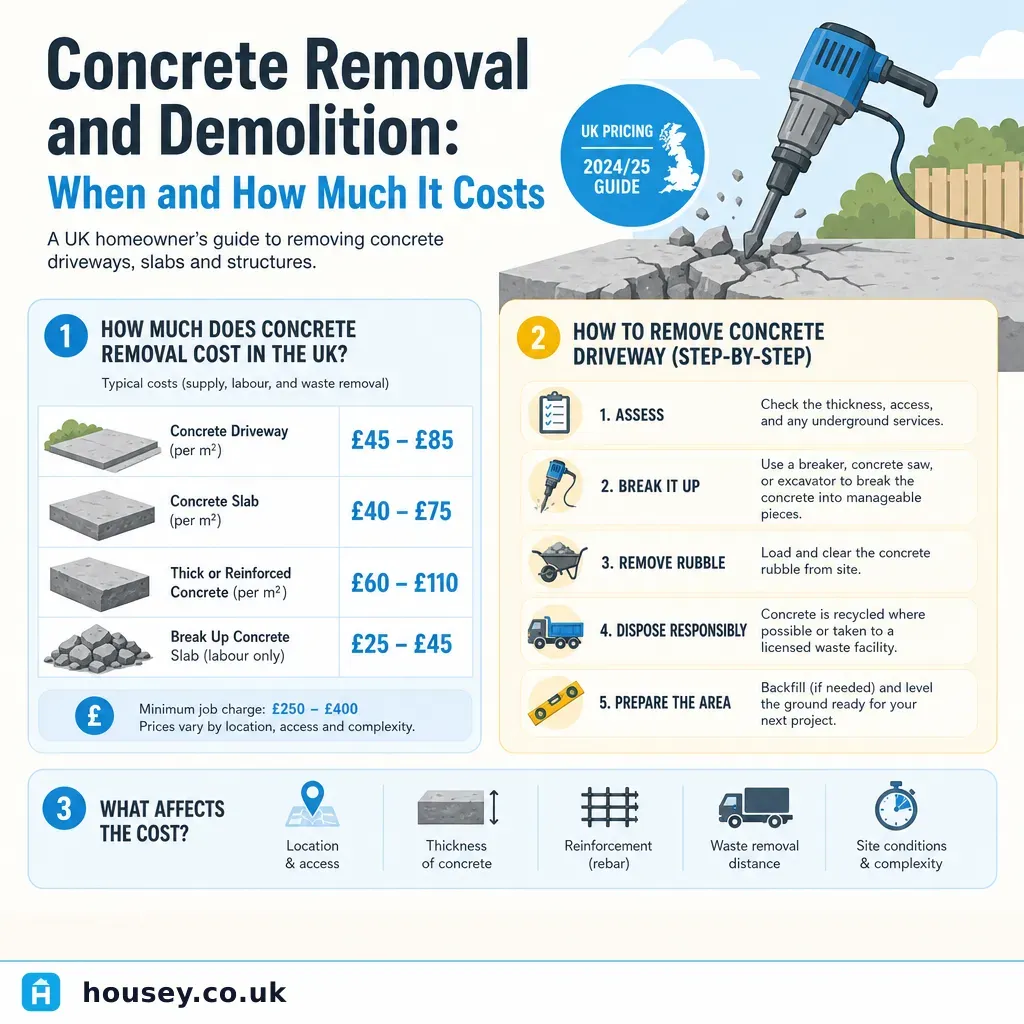
Concrete Removal and Demolition: When and How Much It Costs
Concrete removal in the UK typically costs £25–£65 per square metre for unreinforced slabs, rising to £55–£110 per square metre for reinforced concrete containing rebar.
 Improvement & Build
Who Provides House Demolition Services
House demolition in the UK is carried out by specialist demolition contractors, often members of the National Federation of Demolition Contractors (NFDC).
 Improvement & Build
Open Plan Living Space Conversion Costs
Opening up a living space in the UK typically costs £3,000–£15,000+ depending on whether walls are load-bearing, the beam specification required, and the extent of remodelling.
 Improvement & Build
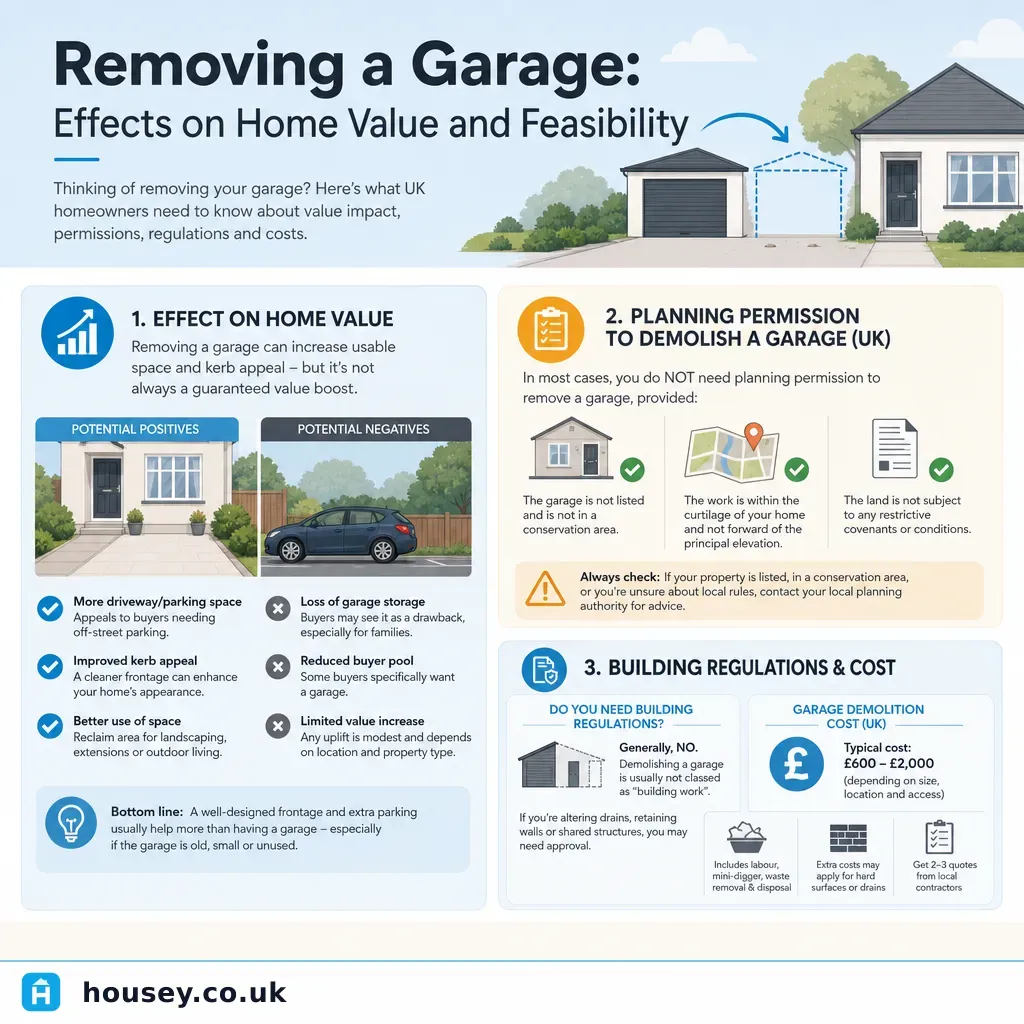
Removing a Garage: Effects on Home Value and Feasibility
Demolishing a garage in England may require prior notification to the local planning authority, and structural or building regulations assessments are often needed if the garage is attached to or integral with the house.
 Improvement & Build
Removing a Conservatory: Value and Feasibility Considerations
Removing a conservatory in England usually does not need planning permission if the original structure was permitted development, but reinstating the original wall almost always requires a building regulations application covering structural, thermal, and moisture elements.