Concrete Structure Demolition Methods and Safety Procedures
By Housey · Last reviewed 25th of May 2026
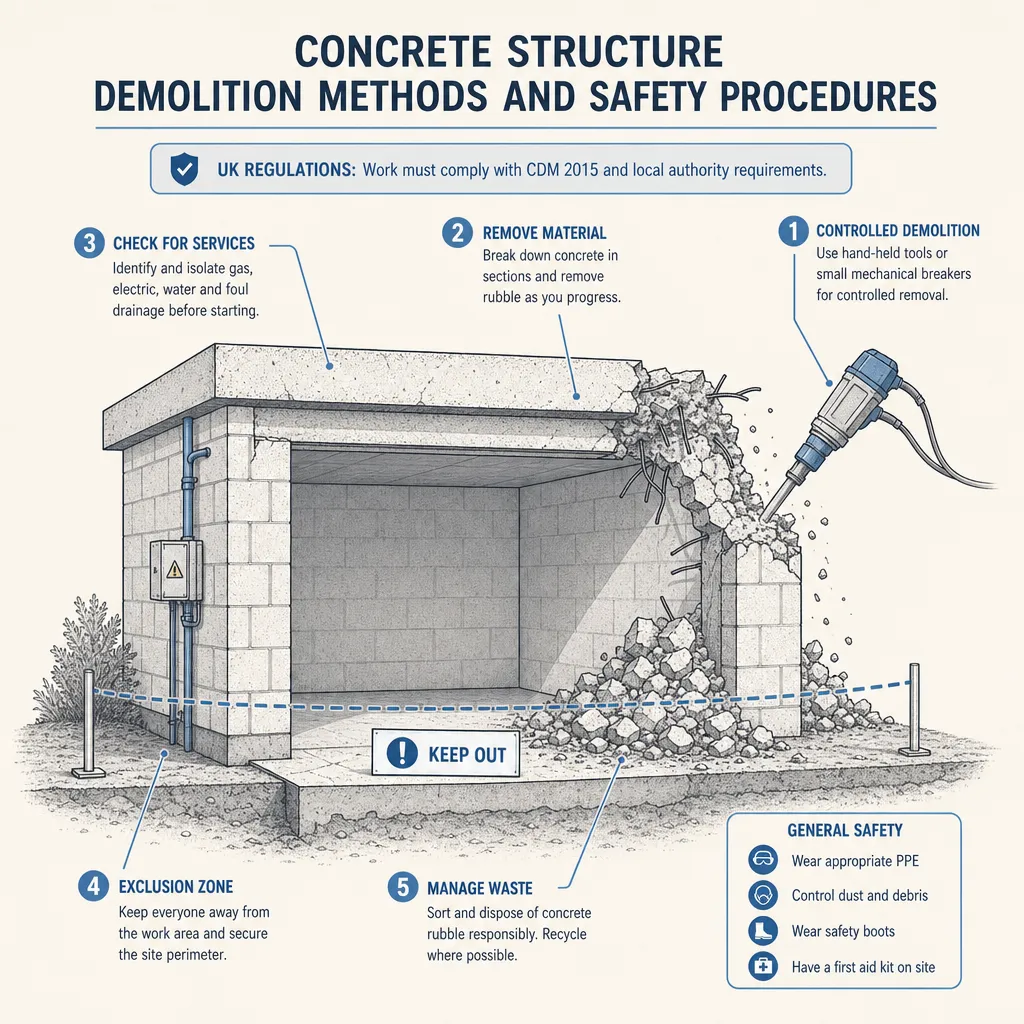
Concrete Structure Demolition Methods and Safety Procedures
Demolishing a concrete structure — whether a garage slab, a reinforced outbuilding, or a load-bearing wall — is one of the more technically demanding tasks in domestic renovation. The decision to demolish typically arises when a homeowner is planning an extension, clearing a plot, or removing a deteriorating structure that can no longer be economically repaired. Getting the method wrong, or failing to notify the right authorities, can lead to serious injury, neighbour disputes, or costly enforcement action.
Key points
- The Construction (Design and Management) Regulations 2015 (CDM 2015) apply to virtually all demolition work on a UK residential site and place legal duties on the homeowner as client.
- An asbestos refurbishment/demolition survey is legally required before any demolition under the Control of Asbestos Regulations 2012 where asbestos-containing materials (ACMs) may be present — this includes most structures built before 2000.
- Demolition of a load-bearing element or a structure attached to the main dwelling typically requires a building control demolition notice under the Building Act 1984 (section 80); in England, at least six weeks' notice must be given to the local authority.
- If the structure to be demolished shares a wall with a neighbour or is within 3 metres of an adjacent foundation, the Party Wall etc. Act 1996 requires formal notice to affected neighbours before work starts.
- Mechanical excavator demolition with a hydraulic breaker is the standard domestic approach; specialist methods such as diamond wire sawing are reserved for precision work in confined or sensitive locations.
Demolition methods for concrete structures
The right method depends on the structure's scale, reinforcement, proximity to retained buildings, and site access constraints.
Method | Best for | Not ideal for | Typical professional | Main risk if wrong |
|---|---|---|---|---|
Mechanical excavator (hydraulic hammer) | Freestanding garages, slabs, outbuildings on open sites | Confined spaces, vibration-sensitive neighbours, proximity to services | Demolition contractor | Damage to adjacent foundations or underground services |
Wire sawing / diamond sawing | Precision cuts in reinforced walls or floors, basement and underpinning contexts | Large-volume bulk removal, remote sites | Specialist concrete cutting contractor | Silica dust exposure; structural destabilisation if cutting sequence is wrong |
Hydraulic breaking (handheld) | Smaller sections, restricted access, close to retained finishes | Large thick reinforced slabs — very slow | General builder or demolition contractor | Vibration damage to adjacent structural elements |
Controlled explosive demolition | Large industrial or commercial concrete structures | Almost all domestic residential contexts | Licensed explosives demolition specialist | Entirely unsuitable for residential — requires extensive exclusion zones and licensing |
Soft-strip and manual deconstruction | Mixed-material structures where salvage is planned | Plain concrete with no salvage value | Demolition contractor | Slow and not cost-effective for solid concrete |
For most domestic projects — a garage, rear outbuilding, or detached garden building — mechanical demolition is the standard approach. Concrete is broken into manageable sections, reinforcement steel stripped out and recycled separately, and rubble removed as inert waste.
Legal and regulatory requirements before demolition
CDM Regulations 2015
The Construction (Design and Management) Regulations 2015 apply to virtually all construction and demolition work in the UK. For notifiable projects — those lasting more than 30 working days with more than 20 workers simultaneously, or exceeding 500 person-days — you must notify the Health and Safety Executive (HSE) using the F10 notification form. Below these thresholds, CDM 2015 still requires domestic clients to ensure a principal contractor is appointed and that pre-construction health and safety arrangements are in place.
Asbestos survey
Under the Control of Asbestos Regulations 2012, an asbestos refurbishment and demolition survey must be commissioned before any demolition of structures that may contain ACMs. Concrete buildings constructed before 2000 — particularly those with composite roofing panels, fibre cement cladding, or internal insulation boards — may contain asbestos. A UKAS-accredited asbestos surveyor must carry out this survey. Do not disturb any suspect materials until the survey has been completed and any ACMs have been safely managed or removed by a licensed contractor.
Building control notification
If the demolition involves a load-bearing wall, a foundation, or a structure attached to the main dwelling, a demolition notice under the Building Act 1984 (section 80) is likely to be required. In England, local authorities must receive at least six weeks' notice before demolition begins. Your local authority's building control team or an Approved Inspector can clarify specific requirements for your project.
Party Wall etc. Act 1996
If the structure shares a wall with a neighbour, is built on or near the boundary, or is within 3 metres of an adjacent foundation, a party wall notice must be served before work begins. Failure to serve notice can result in an injunction halting the works and potential liability for any damage caused to neighbouring property.
Demolition sequence and site safety
A safe demolition sequence for a reinforced concrete structure on a domestic site typically follows this order:
- Pre-demolition survey — structural assessment, services identification and formal disconnection, asbestos survey, drainage survey.
- Notify authorities — building control demolition notice, CDM F10 notification if applicable, party wall notice where required.
- Site preparation — erect exclusion zones (hoarding or security fencing), arrange welfare facilities, protect existing drainage.
- Soft strip — remove internal fixtures, insulation, and any materials requiring separate disposal streams.
- Structural demolition — work top-down or from the outer face inward to prevent premature collapse; cut rebar before moving large sections of reinforced concrete.
- Waste segregation — separate inert concrete rubble, reinforcement steel, and any hazardous materials including asbestos; each requires appropriate waste transfer documentation.
- Site clearance and reinstatement — grading, capping, and drainage restoration.
Which demolition method should you choose?
- Choose mechanical excavator demolition if you have open site access, a freestanding concrete structure, and a standard domestic scale of work.
- Choose diamond or wire sawing if the structure is load-bearing, closely attached to a retained building, or requires a precision cut at a defined location.
- Choose handheld hydraulic breaking if the area is confined, access is limited to pedestrian routes, or you are working close to retained finishes or live services.
- Ask a structural engineer first if you are demolishing anything that may be load-bearing or if adjacent structures could be affected by the sequence of removal.
- Check with building control before starting if the structure is attached to your home, on or near the boundary, or subject to a planning condition or restrictive covenant.
Homeowner demolition checklist
Before work begins, confirm:
Important limitations
This article provides general information about demolition methods and the regulatory framework in England. Building regulations, local authority requirements, CDM notification thresholds, and asbestos management obligations vary by project scale, property type, and location. A qualified structural engineer, CDM coordinator, or accredited demolition contractor must assess your specific situation before any work begins. Nothing in this article constitutes structural, legal, or health and safety advice.
What to ask a qualified professional
Before instructing a demolition contractor or structural engineer:
- What demolition method do you recommend for this structure, and what is your reasoning?
- Have you reviewed the asbestos survey, and how will any ACMs be managed, removed, and documented?
- What CDM documentation will you produce, and will you act as principal contractor for the project?
- How will you manage vibration, dust, and noise to protect neighbouring properties and structures?
- Is building control notification required, and will you handle submissions on my behalf?
- What waste carrier licence and waste transfer notes will you provide on completion?
- What is your contingency if unexpected reinforcement, underground services, or hazardous materials are found during works?
When to get professional help
Engage a qualified professional before any concrete structure demolition. Do not proceed without professional input if:
- The structure is attached to your main dwelling or forms part of a party wall.
- You suspect asbestos-containing materials may be present anywhere in or on the structure.
- You are unsure whether the structure is load-bearing or connected to foundation elements.
- The structure is within 3 metres of a neighbour's foundations or boundary structures.
- The structure is subject to a planning condition, listed building consent, or restrictive covenant.
- Any undeclared underground services or drainage are discovered during investigation.
How Housey can help
Housey connects you with vetted demolition contractors who manage the full process — from pre-demolition surveys and regulatory notifications to safe structural removal and waste disposal. For complex projects or structures attached to your home, our building control consultants can advise on notification requirements and regulatory compliance before a single tool is lifted.
Frequently asked questions
Do I need planning permission to demolish a concrete structure?
In England, demolition of most buildings requires a prior approval application to the local planning authority under the Town and Country Planning (Demolition — Description of Buildings) Direction 2021, unless the structure is under 50 cubic metres or meets other exemptions. Always confirm with your local planning authority before starting work, as rules vary by location and structure type.
Can I demolish a concrete structure myself?
Small concrete garden features such as paths and modest slabs can be removed by a competent homeowner using a hired electric breaker. However, any load-bearing structure, anything larger than a small garden pad, or anything that may contain asbestos requires a qualified contractor. CDM 2015 obligations and waste handling regulations apply regardless of who carries out the work.
How is demolished concrete disposed of in the UK?
Concrete rubble is classified as inert waste and can be taken to a licensed waste transfer station or recycled as aggregate. Your contractor must hold a registered waste carrier licence from the Environment Agency and provide a waste transfer note for all waste removed from site. Concrete may sometimes be crushed and reused on site as hardcore, subject to contamination testing requirements.
How long does domestic concrete demolition typically take?
A single-car concrete garage slab typically takes one to two days for an experienced team with an excavator. A larger reinforced structure may take three to five days. Timescales extend significantly when asbestos remediation, structural engineering input, or extensive waste processing is required. Indicative UK costs, last reviewed 2026-05-25 — always obtain multiple itemised quotes as prices vary by structure size, access, and region.
Sources and further reading
- Construction (Design and Management) Regulations 2015 — guidance for clients — Health and Safety Executive
- Control of Asbestos Regulations 2012 — Health and Safety Executive
- Building Act 1984 — demolition notice provisions (section 80) — legislation.gov.uk
- Party Wall etc. Act 1996 — legislation.gov.uk
- Register as a waste carrier — GOV.UK — GOV.UK
Useful next reads
 Improvement & Build
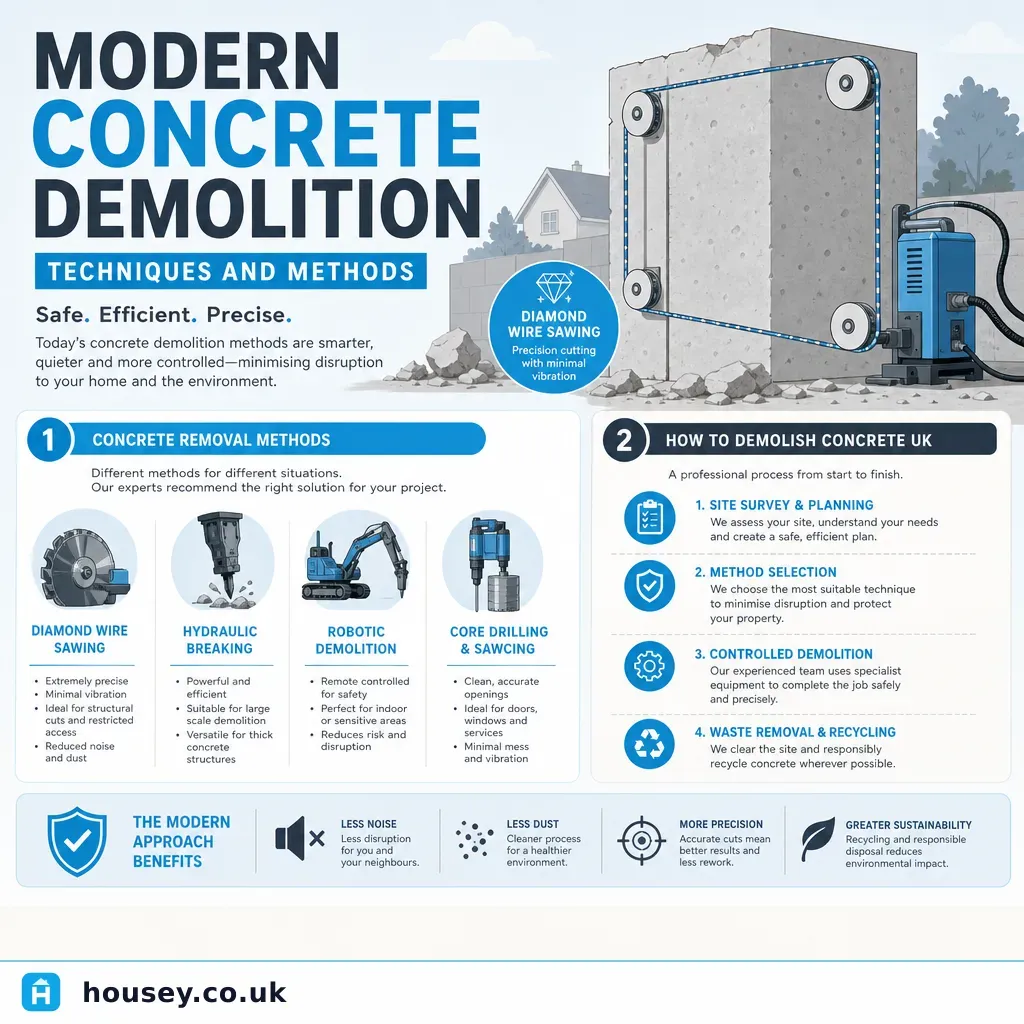
Modern Concrete Demolition Techniques and Methods
Concrete demolition in the UK uses methods including hydraulic breaking, diamond wire sawing, hydrodemolition, and hydraulic bursting.
 Improvement & Build
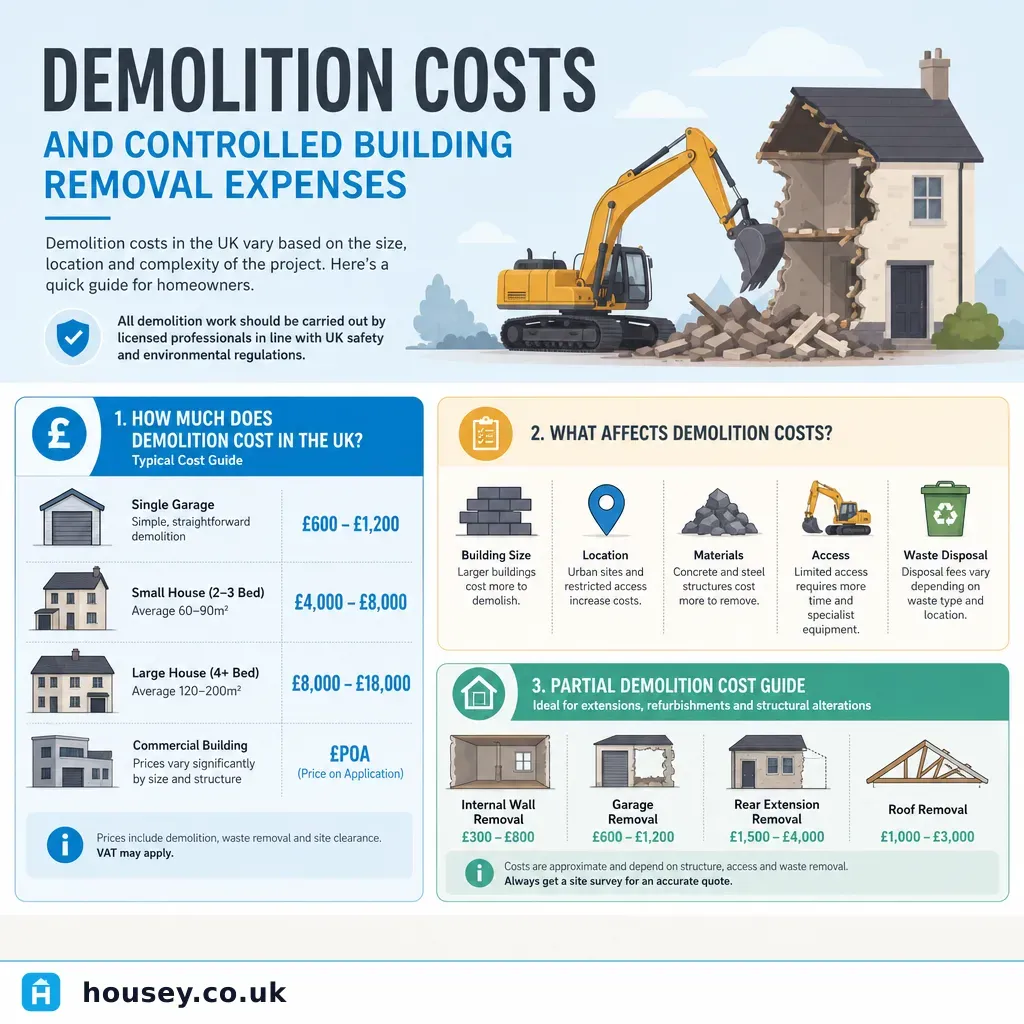
Demolition Costs and Controlled Building Removal Expenses
Full building demolition in the UK typically costs £5,000–£50,000+ depending on structure size, materials, and site access.
 Improvement & Build
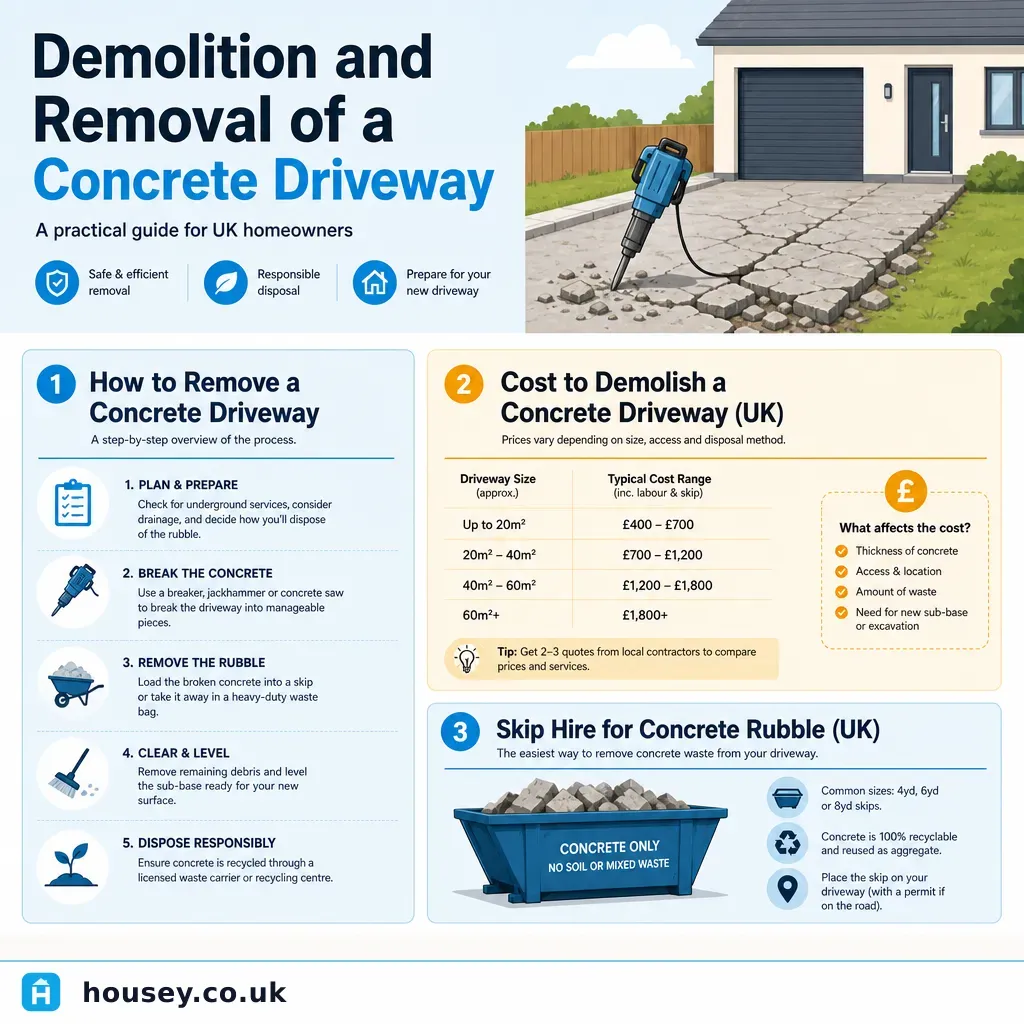
Demolition and Removal of a Concrete Driveway
Removing a concrete driveway typically costs £500–£1,500 for a standard single-car drive in the UK, including breaking, loading, and skip disposal.
 Improvement & Build
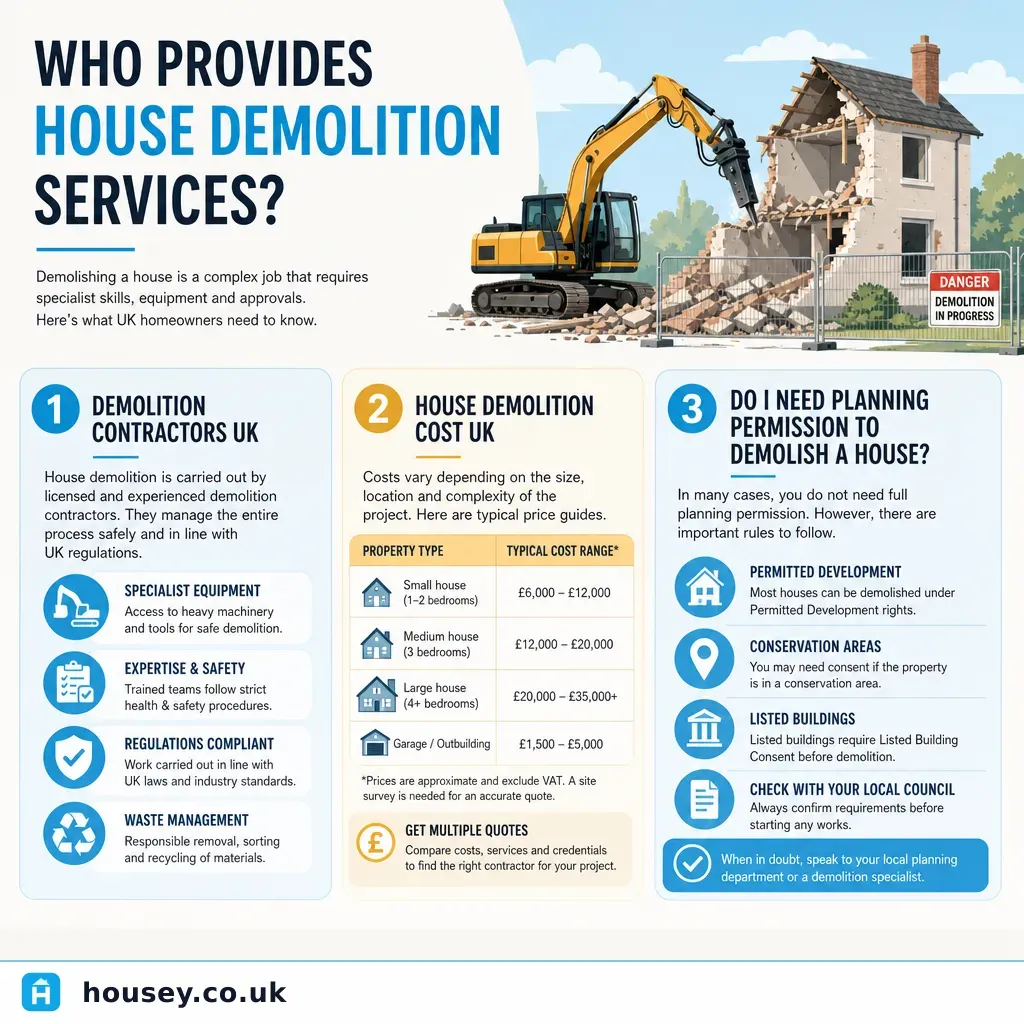
Who Provides House Demolition Services
House demolition in the UK is carried out by specialist demolition contractors, often members of the National Federation of Demolition Contractors (NFDC).
 Improvement & Build
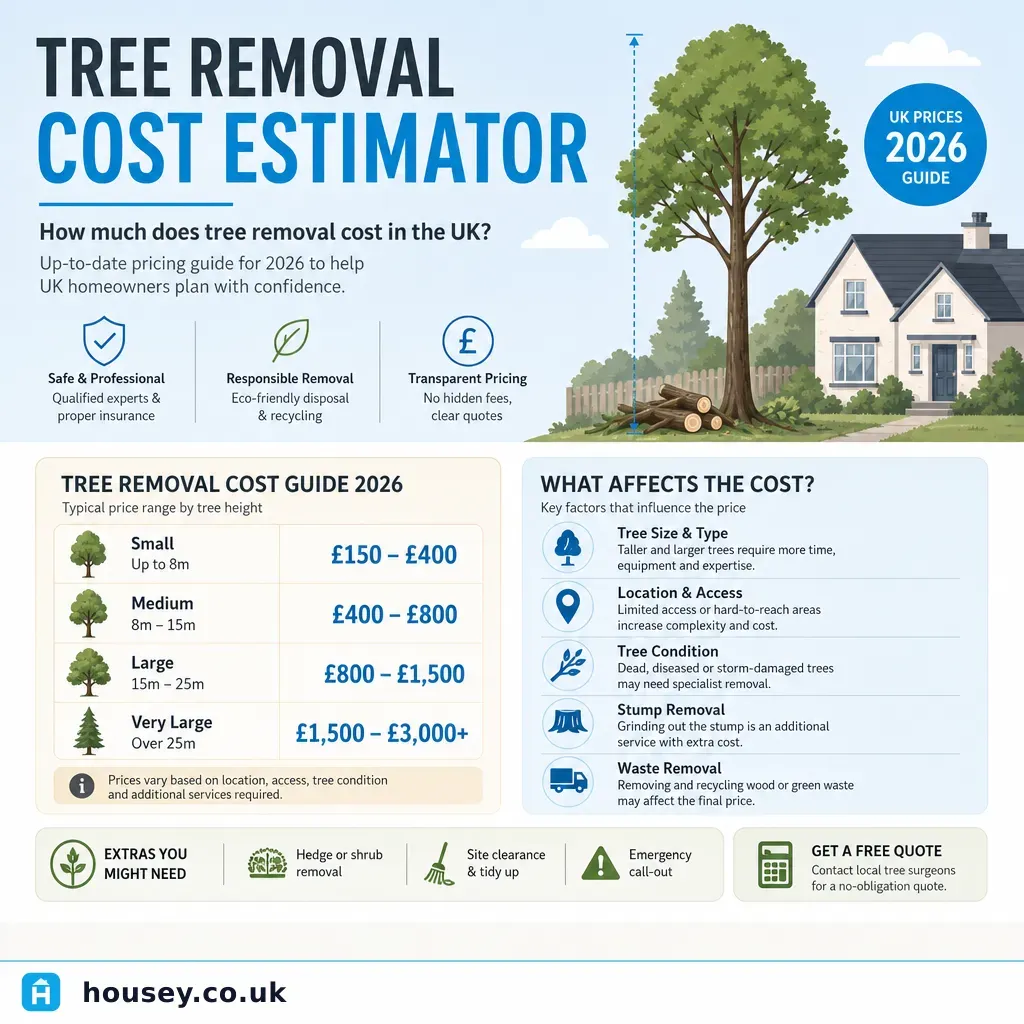
Tree Removal Cost Estimator
Tree removal in the UK costs roughly £150 to £5,000 or more, depending on the tree's height, species, access conditions, and whether stump removal is needed.