Demolition Costs and Controlled Building Removal Expenses
By Housey · Last reviewed 6th of May 2026
Demolition Costs and Controlled Building Removal Expenses
Demolition projects range from taking down a crumbling garden wall to clearing an entire structure to make way for a new build, and the cost difference between those extremes is vast. Whether you're removing a dilapidated outbuilding, taking out a load-bearing wall as part of a renovation, or preparing a site for an extension, understanding what drives demolition costs helps you budget accurately and compare quotes on a like-for-like basis. In the UK, demolition sits at the intersection of planning law, asbestos regulation, and waste-management duties — all of which affect both the timeline and the total bill.
Key points
- Full building demolition in the UK commonly costs between £5,000 and £50,000+, depending on structure size, construction materials, location, and site access conditions.
- Any building constructed or refurbished before 2000 must be assessed for asbestos-containing materials (ACMs) before demolition begins, under the Control of Asbestos Regulations 2012.
- Demolition of a structure with a volume greater than 50 m³ requires a prior approval application to the local planning authority under Part 11 of the Town and Country Planning (General Permitted Development) (England) Order 2015.
- All demolition waste must be handled by a licensed waste carrier; the property owner retains a duty of care under the Environmental Protection Act 1990, and penalties for unlawful disposal can reach £50,000 in criminal proceedings.
- Contractors carrying out licensed asbestos removal must hold a current Health and Safety Executive (HSE) licence, verifiable on the HSE licensed asbestos contractors register.
What affects demolition costs in the UK?
Demolition is rarely priced by the square metre alone. Contractors assess a combination of factors before issuing a quote, and understanding these helps you identify whether a price is reasonable and what might change it.
Structure size and type
A small brick outbuilding of around 20 m² costs far less to demolish than a two-storey detached garage or a rendered-block extension. Reinforced concrete, stone construction, and complex roof steelwork all take longer and require different equipment, increasing both labour and plant hire costs significantly.
Materials and asbestos risk
Older properties — particularly those built or refurbished between the 1950s and 1980s — commonly contain asbestos in roof sheets, soffit boards, floor tiles, pipe lagging, or insulated ceiling tiles. A pre-demolition asbestos survey (type 3, also called a refurbishment and demolition survey) is a legal requirement before work begins on any building that may contain ACMs. If licensed asbestos removal is required, expect to add £500–£5,000 or more to the overall cost depending on the quantity and type of material.
Site access and location
A structure close to a public highway with good vehicular access is cheaper to demolish than one in a rear garden reachable only through a narrow passageway. Scaffolding, shoring for neighbouring walls, temporary hoarding, and any traffic management for road closures all add to the total.
Waste disposal
Demolition generates significant volumes of rubble, timber, metal, and hazardous materials. Licensed waste disposal is typically priced per tonne or per skip load. Crushed concrete and brick can sometimes be recycled on site or sold, which may partially offset disposal costs.
Structural complexity and internal removal
Removing a load-bearing wall inside a house is a separate category of work from full structural demolition. It requires a structural engineer's calculations, temporary support (acrow props and needling), and building regulations approval. The physical removal of the wall may take half a day, but the engineering design and building control sign-off process adds both time and professional fees.
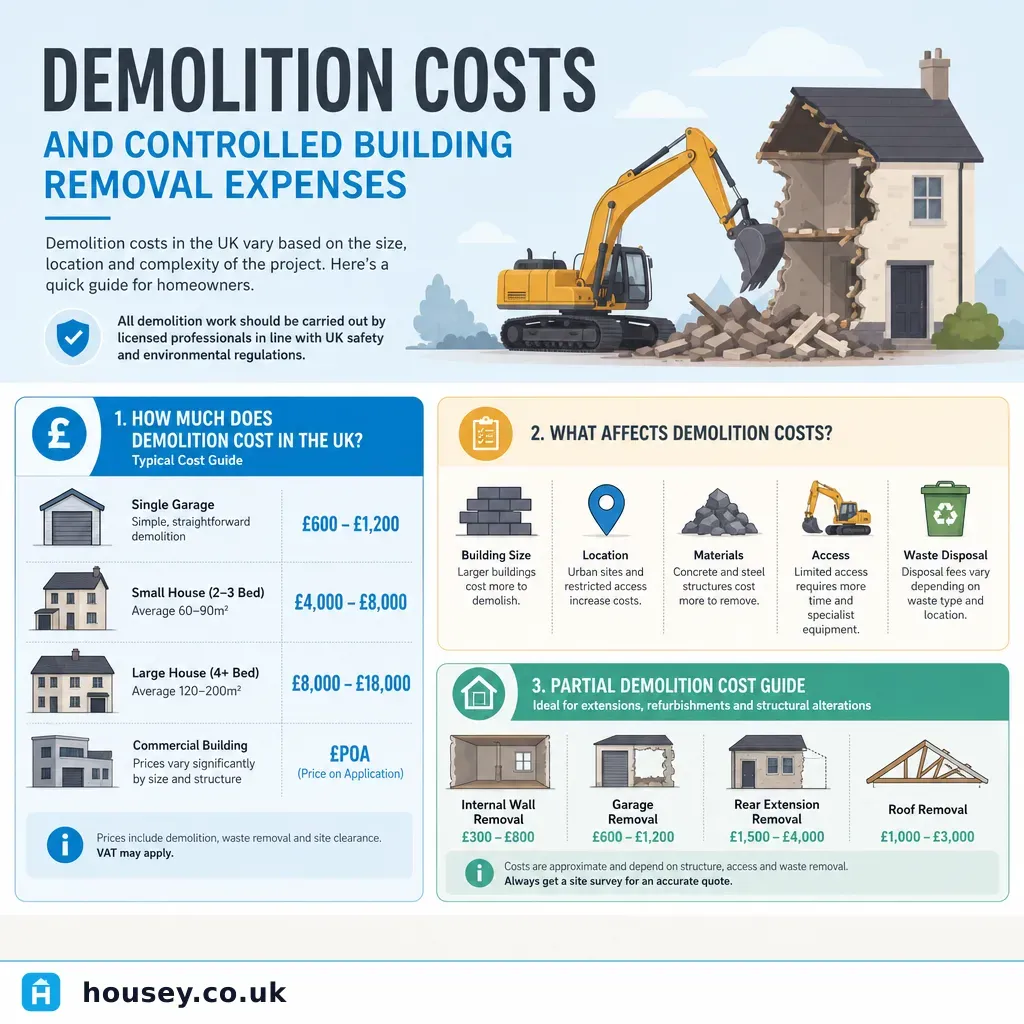
Indicative UK demolition costs by project type
Indicative UK costs, last reviewed 2026-05-06. Prices vary significantly by region, contractor, and site conditions. Always obtain at least three written quotes before committing.
Project type | Indicative cost range | Key cost factors |
|---|---|---|
Garden or boundary wall removal | £200–£1,500 | Length, material (brick vs stone), proximity to boundary |
Small outbuilding or shed demolition | £500–£2,500 | Foundation depth, materials, site access |
Single garage demolition | £1,500–£5,000 | Construction type, flat vs pitched roof, asbestos risk |
Internal structural wall removal | £1,000–£3,500 | Span, load-bearing beam specification, building control |
Full house demolition | £15,000–£50,000+ | Size, materials, asbestos, prior approval, location |
Site clearance after demolition | £500–£5,000+ | Volume of debris, site access, distance to licensed tip |
Planning and prior approval for demolition
Many homeowners are unaware that demolishing a building over a certain size is not automatically permitted development. In England, under Part 11 of Schedule 2 to the Town and Country Planning (General Permitted Development) (England) Order 2015 (as amended), demolition of a structure with a volume greater than 50 m³ requires a prior approval application to the local planning authority. The LPA considers the proposed demolition method and the restoration of the site.
Rules vary across the UK:
- Scotland: Demolition may require a building warrant under the Building (Scotland) Act 2003; check with your local council.
- Wales: Broadly similar prior-approval requirements apply under Welsh planning legislation.
- Northern Ireland: Contact Planning Service NI for current requirements.
Listed buildings and those in conservation areas have stricter controls. Listed Building Consent may be required even for partial demolition. Always check with your LPA before starting any demolition work.
Decision tree: do you need a specialist contractor or can you DIY?
- Choose a licensed demolition contractor if the structure is load-bearing, contains asbestos, is over 3 metres tall, or requires plant machinery to remove safely.
- Choose a structural engineer first if you are removing an internal wall, to confirm whether it is load-bearing and to design the beam and temporary support arrangement before any contractor is instructed.
- Use an HSE-licensed asbestos contractor if a pre-demolition survey reveals licensed asbestos-containing materials — do not attempt removal yourself under any circumstances.
- Check with your LPA if the structure has a volume greater than 50 m³, is listed, or is in a conservation area before any work begins.
- Consider DIY only for very small, simple, non-load-bearing garden structures with no hazardous materials, no planning implications, and where you can work safely without risk to yourself, neighbours, or the public.
Red flags when hiring a demolition contractor
Before instructing a contractor, watch for these warning signs:
- No written quote or scope of works: reputable contractors provide a written, itemised quote and payment schedule before starting.
- No waste carrier licence: all businesses transporting controlled waste must be registered with the Environment Agency in England; ask for the licence number and verify it on the public register.
- No pre-demolition asbestos survey on a pre-2000 building: insist on a survey before work starts — its absence is a legal non-compliance, not just a procedural gap.
- No evidence of public liability and employers' liability insurance: request current certificates before instructing anyone.
- Unusually low quotes: prices significantly below other quotes often indicate unlicensed waste disposal, which can expose you to liability under the Environmental Protection Act 1990.
- Cash-only with no paperwork: leaves you with little recourse if work is substandard and creates legal and tax complications.
Important limitations
This article provides general cost guidance and process information for UK homeowners. Demolition costs, planning requirements, and asbestos regulations vary significantly by property type, size, location, construction, and individual site conditions. Nothing in this article constitutes structural, legal, or safety advice. A qualified professional — including a licensed demolition contractor, structural engineer, or accredited asbestos surveyor — should assess your specific situation before any work begins. Requirements differ between England, Scotland, Wales, and Northern Ireland.
What to ask a qualified professional
Before accepting any quote from a demolition contractor, ask:
- Is a pre-demolition asbestos survey included, and which UKAS-accredited analyst will carry it out?
- Are you a licensed waste carrier? (Request the licence number for verification via the Environment Agency public register.)
- Do you hold an HSE licence for asbestos removal if ACMs are found during the survey?
- Does the quote include temporary shoring or hoarding for adjacent structures?
- Who submits any required prior approval application to the local planning authority?
- What is your current public liability insurance limit, and can I see the certificate?
- Will building regulations sign-off be obtained for any structural elements?
- What is excluded from the quote — for example, below-ground foundations, hazardous soil, or surface reinstatement?
When to get professional help
Always instruct a qualified professional if:
- The structure or wall is load-bearing, or you are unsure whether it is.
- The building was constructed or substantially refurbished before 2000 (asbestos risk must be professionally assessed).
- Demolition is adjacent to a public highway, neighbouring property, or shared party wall.
- The structure is listed or located in a conservation area.
- The work requires plant machinery such as excavators or demolition rigs.
- You intend to extend, rebuild, or change the use of the cleared site, as this may trigger additional planning and building control requirements.
How Housey can help
If you are planning a demolition project, Housey can help you connect with vetted demolition contractors who can assess your site, carry out the necessary pre-demolition checks, and provide written, itemised quotes. Getting multiple quotes through a single platform makes it straightforward to compare scope, price, insurance credentials, and waste-management arrangements side by side.
Frequently asked questions
Do I need planning permission to demolish a building?
Buildings under 50 m³ may fall under permitted development in England, but you must give prior notification to your local planning authority. Structures over 50 m³ require a prior approval application under Part 11 of the GPDO 2015. Listed buildings and those in conservation areas require consent regardless of size. Rules differ in Scotland, Wales, and Northern Ireland — always check with your local authority before starting any demolition work.
How do I check for asbestos before demolition?
Commission a refurbishment and demolition (type 3) asbestos survey from a UKAS-accredited analyst before any work begins. This is a legal requirement under the Control of Asbestos Regulations 2012 for any pre-2000 building. The analyst takes samples and issues a written report identifying asbestos-containing materials. If ACMs are present, an HSE-licensed contractor must remove them before demolition can proceed.
How long does a full house demolition take?
Most residential demolitions take between two days and two weeks depending on building size, construction type, asbestos removal requirements, site access, and waste disposal logistics. Prior approval waiting periods and asbestos remediation are the most common sources of delay. Ask your contractor for a realistic programme, including any regulatory lead times, before committing to a start date.
Who is responsible for demolition waste?
The property owner holds a duty of care for waste produced on their site under the Environmental Protection Act 1990. Your contractor assumes practical responsibility for waste they transport — but only if they hold a valid Environment Agency waste carrier licence. Always obtain a written waste transfer note and keep it for at least two years as evidence of lawful disposal.
Can I remove a structural wall myself?
Removing a structural wall without a structural engineer's calculations and building regulations approval is unsafe and creates serious problems when selling. Unpermitted structural alterations are routinely identified during buyers' surveys and conveyancing searches. Temporary propping must also be correctly specified by an engineer. Instruct a structural engineer and notify your local building control body before starting any internal structural removal work.
Sources and further reading
- Control of Asbestos Regulations 2012 — legislation.gov.uk
- HSE: Asbestos — the survey guide (HSG264) — Health and Safety Executive
- HSE: Licensed asbestos contractors register — Health and Safety Executive
- Planning Portal: Demolition — Planning Portal
- GOV.UK: Register as a waste carrier — GOV.UK
- Environmental Protection Act 1990 — section 34 duty of care — legislation.gov.uk
Useful next reads
 Improvement & Build
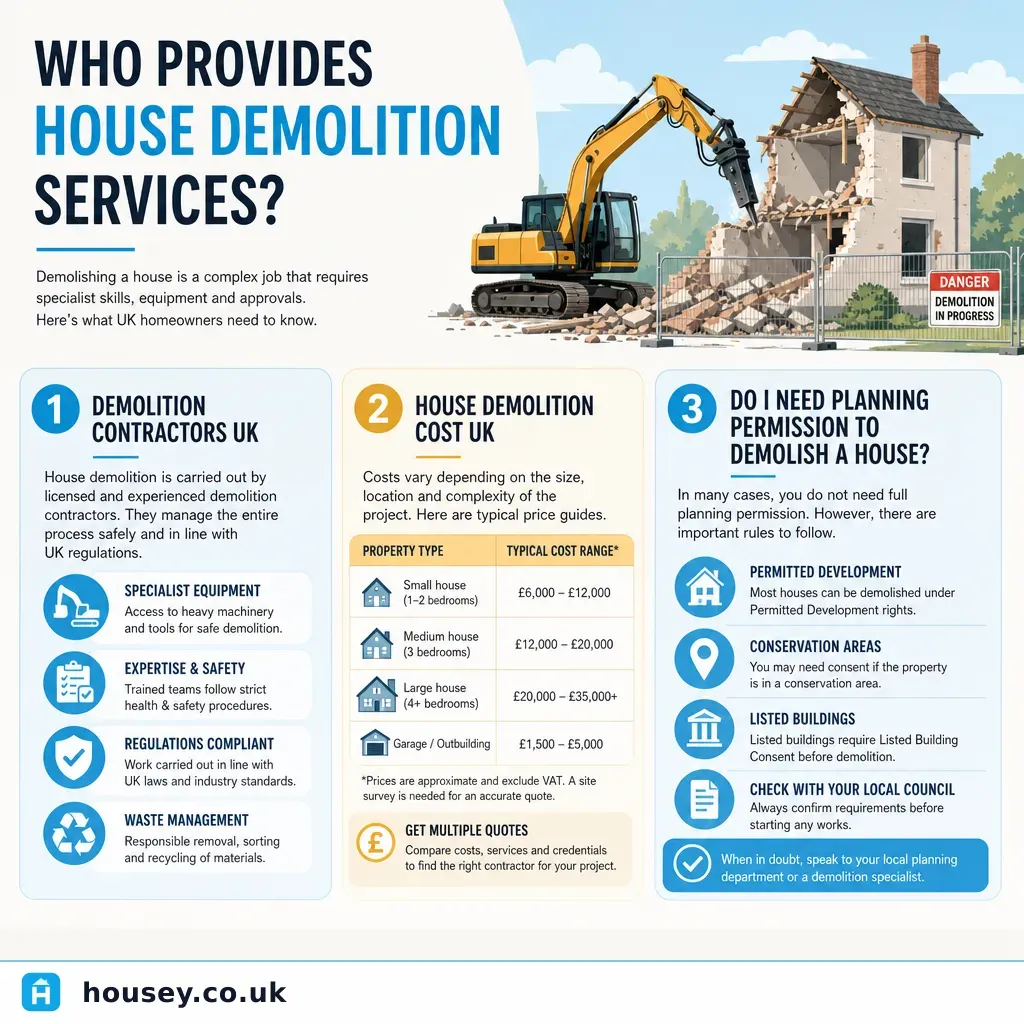
Who Provides House Demolition Services
House demolition in the UK is carried out by specialist demolition contractors, often members of the National Federation of Demolition Contractors (NFDC).
 Improvement & Build
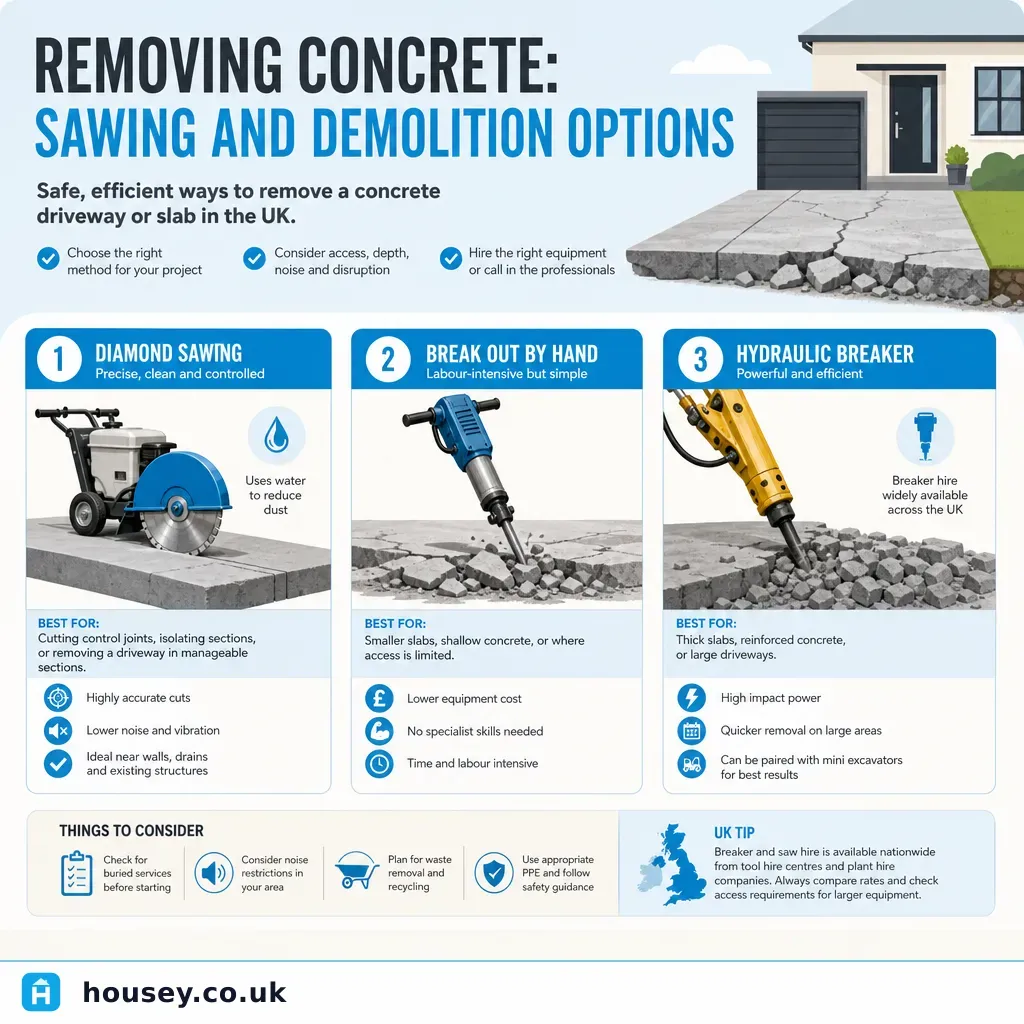
Removing Concrete: Sawing and Demolition Options
Concrete removal methods include hydraulic or electric breakers for bulk demolition, diamond disc or wire sawing for precision cuts, and hand tools for small areas.
 Improvement & Build
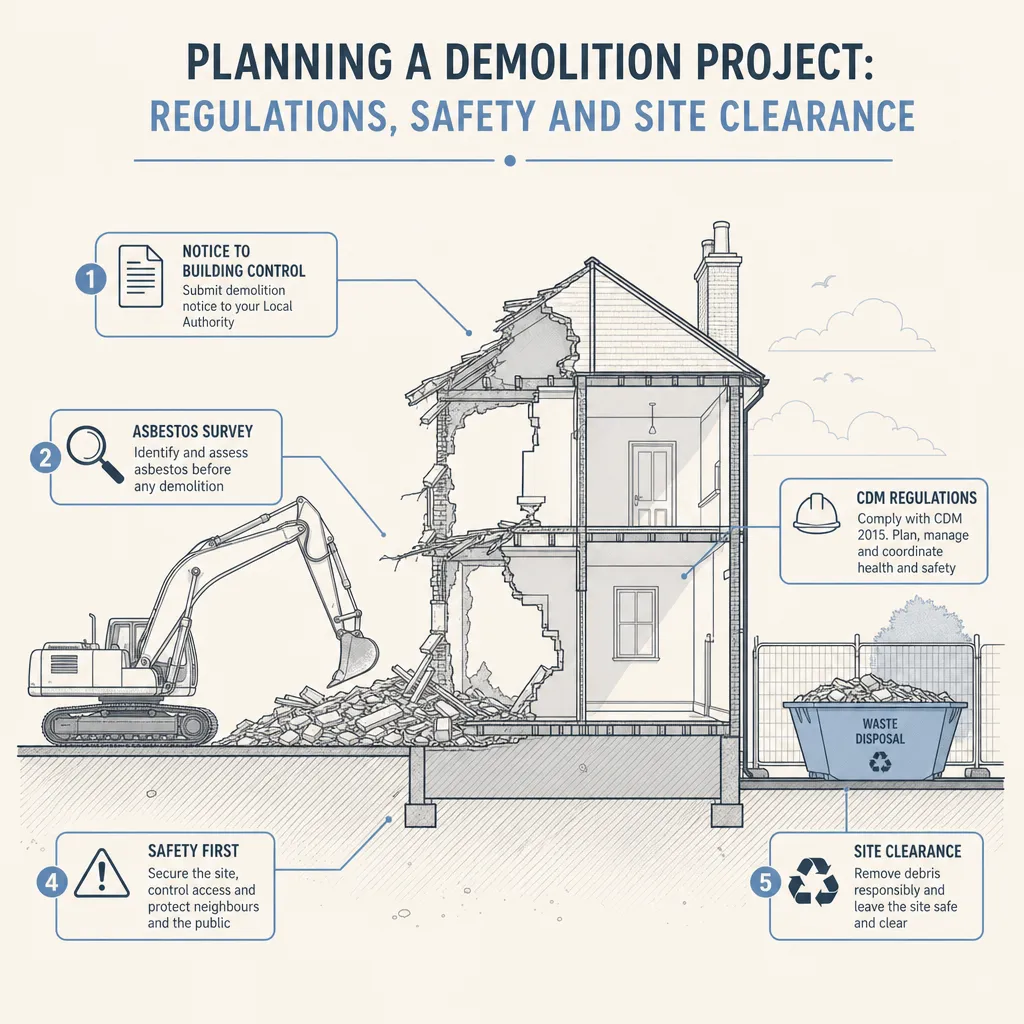
Planning a Demolition Project: Regulations, Safety and Site Clearance
Demolishing a building in England requires a Section 80 building control notice served at least six weeks before work starts, a Refurbishment and Demolition asbestos survey before any demolition begins, and compliance with CDM 2015.
 Improvement & Build
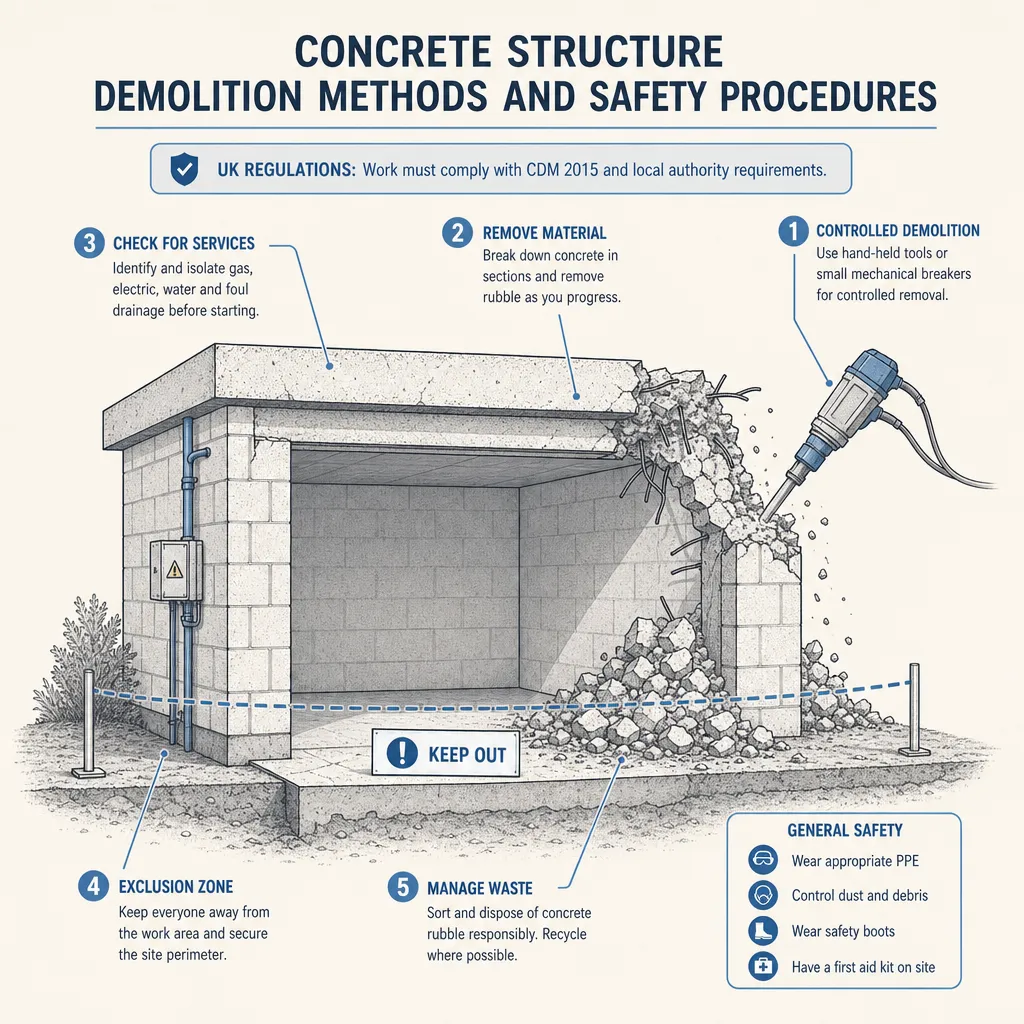
Concrete Structure Demolition Methods and Safety Procedures
Concrete structures on UK residential sites are most commonly demolished using mechanical excavators with hydraulic breaker attachments.
 Improvement & Build
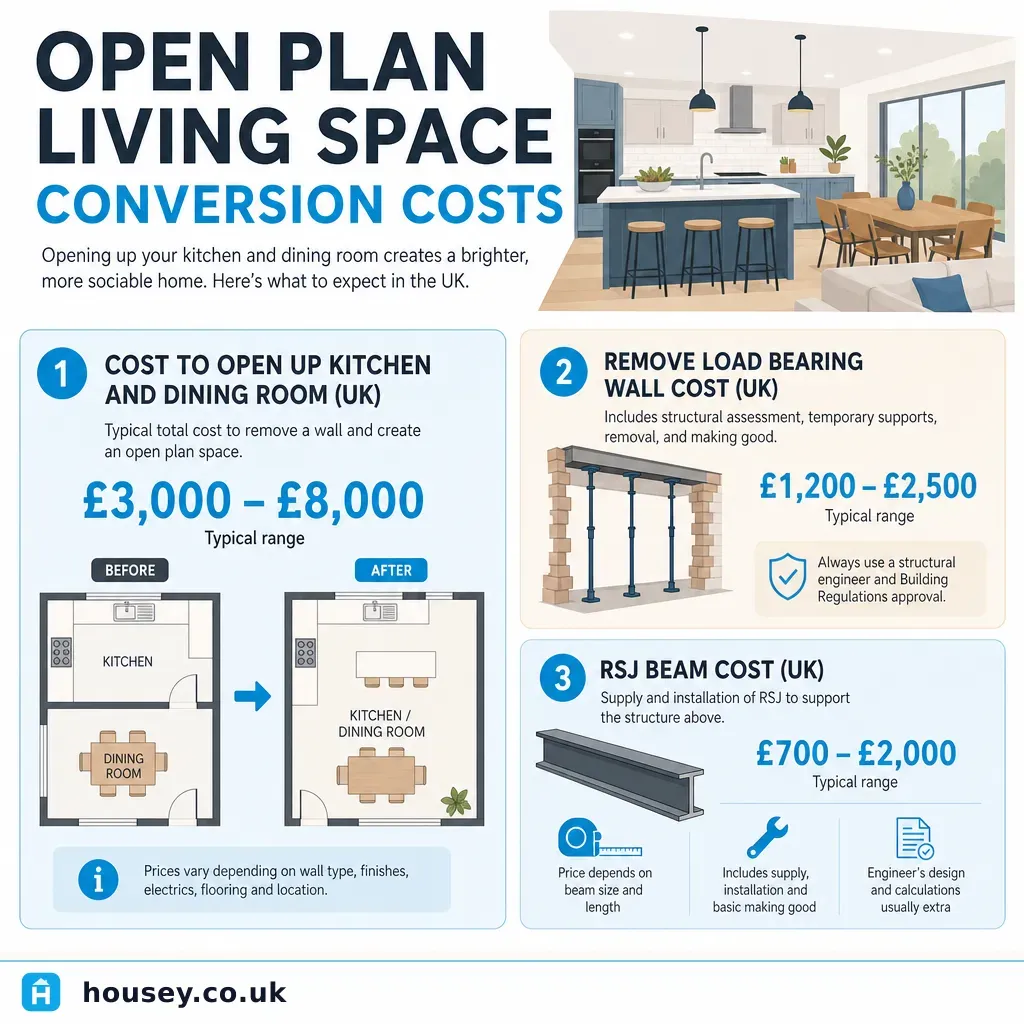
Open Plan Living Space Conversion Costs
Opening up a living space in the UK typically costs £3,000–£15,000+ depending on whether walls are load-bearing, the beam specification required, and the extent of remodelling.