Modern Concrete Demolition Techniques and Methods
By Housey · Last reviewed 24th of May 2026
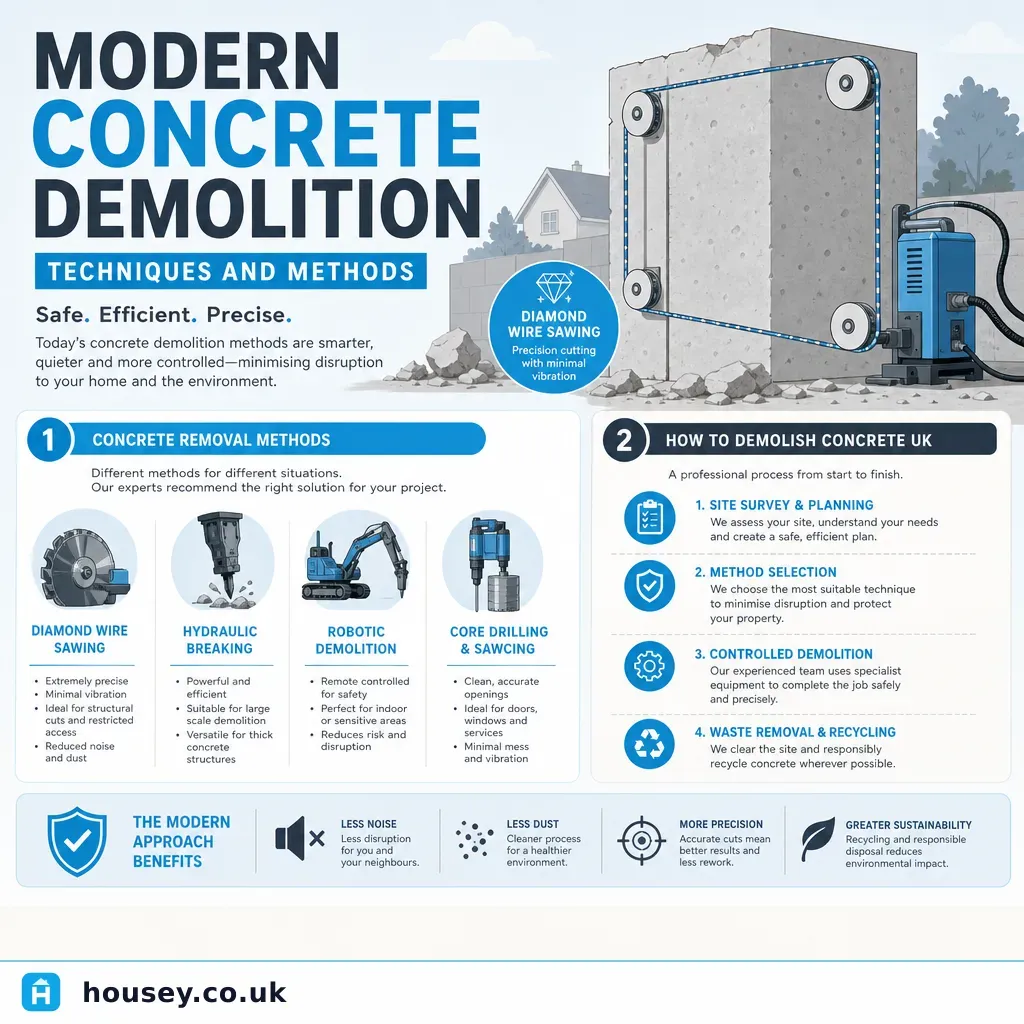
Modern Concrete Demolition Techniques and Methods
Concrete demolition is a routine requirement across the spectrum of UK construction projects — from a homeowner removing a garage slab or old outbuilding to a developer clearing a reinforced concrete frame ahead of redevelopment. The method chosen has direct consequences for safety, programme duration, vibration impact on neighbouring properties, dust generation, and options for recycling the demolished material. UK demolition work is governed by a robust legal framework, and incorrect method selection or inadequate contractor procurement can have serious consequences for health, neighbouring buildings, and regulatory compliance.
Key points
- Demolition work is subject to the Construction (Design and Management) Regulations 2015 (CDM 2015), which place legal duties on clients — including homeowners commissioning work on their own property.
- A refurbishment and demolition (R&D) asbestos survey is legally required under the Control of Asbestos Regulations 2012 before demolition of any structure where asbestos is reasonably likely — this applies to most buildings constructed before 2000.
- Planning prior approval may be required before demolishing structures above certain volumes; listed building consent or conservation area consent is required for demolition affecting a listed or conservation area structure.
- Respirable crystalline silica (RCS) dust from cutting or breaking concrete is a serious occupational health hazard under the Control of Substances Hazardous to Health (COSHH) Regulations 2002, causing silicosis — an irreversible lung disease.
- All demolished concrete must be transferred via a licensed waste carrier with a waste transfer note, as required by the Environmental Protection Act 1990; inert concrete aggregate is commonly crushed and recycled as sub-base material.
Why method selection matters
Concrete is among the most durable materials in the built environment, and its removal requires careful planning. The wrong method can damage load-bearing elements in adjacent structures, generate vibration that cracks neighbouring walls or plaster finishes, produce uncontrolled debris, or expose workers and bystanders to silica dust or disturbed asbestos-containing materials (ACMs).
UK demolition contractors must comply with the Work at Height Regulations 2005, Control of Noise at Work Regulations 2005, Control of Vibration at Work Regulations 2005, and the CDM 2015 framework. Method selection is therefore not purely a technical question — it is a legal and risk management decision that requires professional input on any project beyond the most minor residential works.
Comparing concrete demolition methods
Method | Best for | Vibration / noise | Typical UK residential use | Recyclability of output |
|---|---|---|---|---|
Hydraulic excavator breaker | Large slabs, foundations, retaining walls with machine access | High vibration, high noise | Very common for driveways, garage bases, foundation clearance | Good — aggregate can be crushed |
Hand-held pneumatic or electric breaker | Smaller slabs, restricted access, internal works | Moderate vibration | Most common method for homeowner projects | Good |
Diamond wire sawing | Precision cuts through reinforced sections; occupied building works | Very low vibration | Specialist; growing for refurbishment and heritage works | Excellent — clean sections |
Diamond blade floor or wall sawing | Openings, service penetrations, core drilling | Low vibration | Doorway openings, utility penetrations | Good |
Hydraulic bursting and splitting | Confined indoor spaces where noise and vibration must be minimised | Near-silent | Growing use in sensitive urban locations | Good |
Hydrodemolition (high-pressure water jetting) | Selective removal of degraded concrete; bridge deck repair | Low vibration, high noise | Specialist infrastructure and repair use | Excellent — aggregate largely undamaged |
Controlled explosive demolition | Large reinforced structures, industrial chimneys, multi-storey frames | Single high-energy event | Rare in residential; used for large commercial and industrial | Moderate — rubble requires sorting |
Suitability is site-specific. A qualified contractor should always assess the structure before any method is selected.
Pre-demolition requirements in the UK
Before instructing a demolition contractor, homeowners and developers should expect the following to be required:
Asbestos R&D survey: Under the Control of Asbestos Regulations 2012, a refurbishment and demolition asbestos survey must be carried out before demolition of any structure where asbestos is reasonably likely. This applies to the vast majority of buildings constructed before 2000. The survey must be carried out by a competent, independent surveyor — not the company proposing the remedial works.
Structural assessment: Where any load-bearing element is to be removed or destabilised, a structural engineer's assessment is needed before work begins. Removing a concrete slab that supports internal walls, or demolishing a wall carrying a beam or lintel, requires structural input.
HSE notification (Form F10): Under CDM 2015, if the project exceeds the notifiable threshold — more than 30 working days with more than 20 workers simultaneously, or more than 500 person-days of construction work — it must be notified to the Health and Safety Executive using the F10 online service.
Planning and heritage consents: Prior approval may be required to demolish buildings above certain volumes under the Town and Country Planning Act 1990. Listed building consent is required for demolition affecting a listed structure. Conservation area consent applies to the demolition of unlisted buildings within a conservation area.
Party Wall Act notification: Under the Party Wall etc. Act 1996, works within 3 to 6 metres of a neighbouring building, or affecting a shared wall, may trigger obligations to serve notice and allow the adjoining owner to appoint a surveyor.
Red flags when hiring a demolition contractor
- No evidence of public liability insurance — reputable contractors hold at least £2 million cover; £5 million or more is advisable for work near occupied buildings.
- No request to see an asbestos survey before quoting or commencing — any competent contractor will insist on reviewing survey results before mobilising.
- Inability or unwillingness to produce a method statement and risk assessment — both are required under CDM 2015.
- No Environment Agency waste carrier registration, or inability to provide waste transfer notes for demolished material.
- Providing a price without visiting the site.
- Proposing vibro-impact methods adjacent to a listed building, historic masonry, or a neighbour with documented structural concerns, without specialist written justification.
- Operatives without CCDO (Certificate of Competence of Demolition Operatives) cards — the recognised UK competency standard for demolition workers.
Important limitations
This article provides general information about concrete demolition methods available in the UK. Demolition is inherently hazardous work governed by complex legal, structural, and environmental requirements. The appropriate method, consents, and precautions vary significantly depending on the structure's age, construction, location, proximity to other buildings, planning status, and ground conditions. A qualified demolition contractor and, where load-bearing elements are involved, a chartered structural engineer should always assess the specific situation before any demolition commences. Nothing in this article constitutes structural or legal advice.
When this becomes urgent
Seek professional advice immediately if:
- You suspect asbestos-containing materials are present in the structure — do not disturb any material before a proper R&D asbestos survey has been completed by a competent, independent surveyor.
- Demolition work could affect a load-bearing element or a shared structure without prior structural engineering input.
- Cracks, movement, or visible distress appear in an adjacent building during or immediately after demolition work.
- Your local planning authority has issued an enforcement notice relating to demolition works, or you are uncertain whether listed building consent or conservation area consent is required before proceeding.
What to ask a qualified professional
- Have you reviewed the R&D asbestos survey results for this structure, and are all ACMs accounted for in your method statement?
- What method statement and risk assessment will you produce, and at what point before work starts will these be available?
- Are your operatives CCDO-carded, and is your company a member of the National Federation of Demolition Contractors (NFDC)?
- Who acts as principal contractor under CDM 2015 for this project, and has the client role been formally defined?
- How will demolished concrete and other waste be disposed of, and can you provide waste transfer notes at each removal?
- Does this project meet the HSE F10 notification threshold, and who is responsible for submitting the notification?
- Will any adjacent structure require temporary propping or structural monitoring during the works?
- Does the scope of demolition trigger any obligations under the Party Wall etc. Act 1996?
When to get professional help
Concrete demolition beyond removing small, isolated, unreinforced slabs in the open air should always involve a qualified demolition contractor. Professional input is essential if:
- The concrete is reinforced with rebar or contains post-tensioned cables.
- The element is load-bearing or supports other building elements above.
- The building is listed or within a conservation area.
- There is any possibility of asbestos-containing materials — do not disturb the structure before a proper survey is complete.
- Works are within 6 metres of a neighbouring building or boundary structure.
- The project is a commercial site or meets the CDM 2015 notifiable threshold.
For minor residential works such as breaking out a concrete path or garden slab, always wear a P3-rated dust mask and use water suppression when cutting or breaking concrete, to minimise silica dust exposure.
How Housey can help
Housey connects you with professional demolition contractors who can carry out site assessments, arrange asbestos surveys, produce CDM-compliant method statements, and complete concrete demolition safely and in accordance with UK law. Compare credentials and quotes before appointing any contractor.
Frequently asked questions
Do I need planning permission to demolish a concrete outbuilding?
For small residential outbuildings, demolition may not require planning permission, but this depends on the structure's size, planning history, and location. Structures above certain volumes may require prior approval from your local planning authority under the Town and Country Planning Act 1990. Any structure within a conservation area or listed building curtilage requires specific consents. Always check with your local planning authority before starting work.
Is silica dust from concrete breaking dangerous?
Yes. Concrete dust contains respirable crystalline silica (RCS), which causes silicosis — an irreversible and potentially fatal lung disease — with prolonged or repeated exposure. HSE guidance requires dust suppression using water, adequate respiratory protective equipment (a P3-rated mask at minimum), and health surveillance for workers regularly exposed. Anyone breaking concrete should take these precautions and keep bystanders clear of the work area.
How is demolished concrete disposed of in the UK?
Concrete classified as inert waste can be crushed and recycled as Type 1 or Type 3 sub-base aggregate. All waste must be transported by a licensed waste carrier and received at a licensed facility. A waste transfer note is required under the Environmental Protection Act 1990 for every removal. Fly-tipping of demolition waste carries civil and criminal penalties including significant fines and site restoration orders.
What is a CCDO card and why does it matter?
A Certificate of Competence of Demolition Operatives (CCDO) is the recognised UK qualification for demolition workers, demonstrating that an operative has been assessed against National Occupational Standards for demolition work. Insisting on CCDO-carded operatives is one of the clearest ways to verify competency when instructing a demolition contractor for concrete breaking, structural removal, or any high-risk demolition activity.
Sources and further reading
- CDM 2015 guidance for the construction industry — HSE
- Control of Asbestos Regulations 2012 — legislation.gov.uk
- COSHH: Silica dust in construction — HSE
- Environmental permits and waste carrier licences — GOV.UK / Environment Agency
- Party Wall etc. Act 1996: Explanatory booklet — GOV.UK
- National Federation of Demolition Contractors — NFDC
Useful next reads
 Improvement & Build
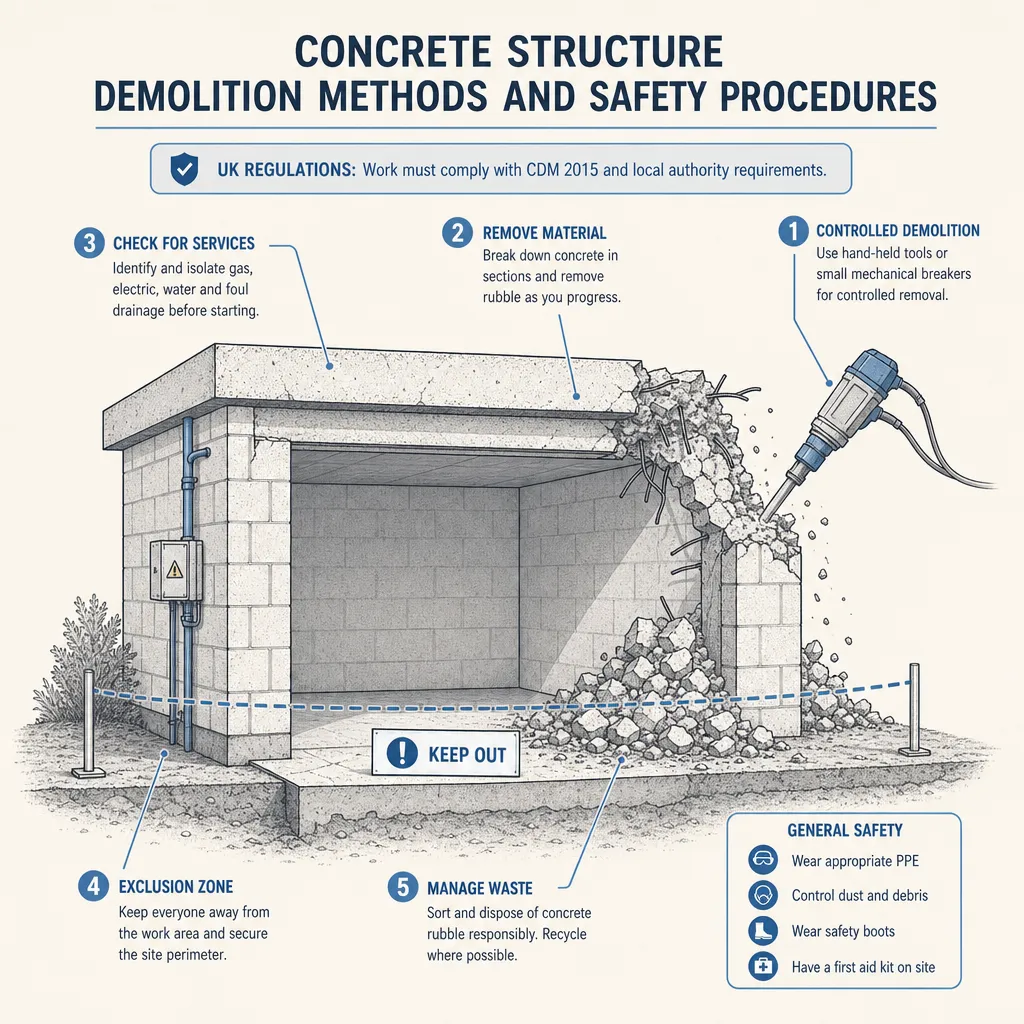
Concrete Structure Demolition Methods and Safety Procedures
Concrete structures on UK residential sites are most commonly demolished using mechanical excavators with hydraulic breaker attachments.
 Improvement & Build
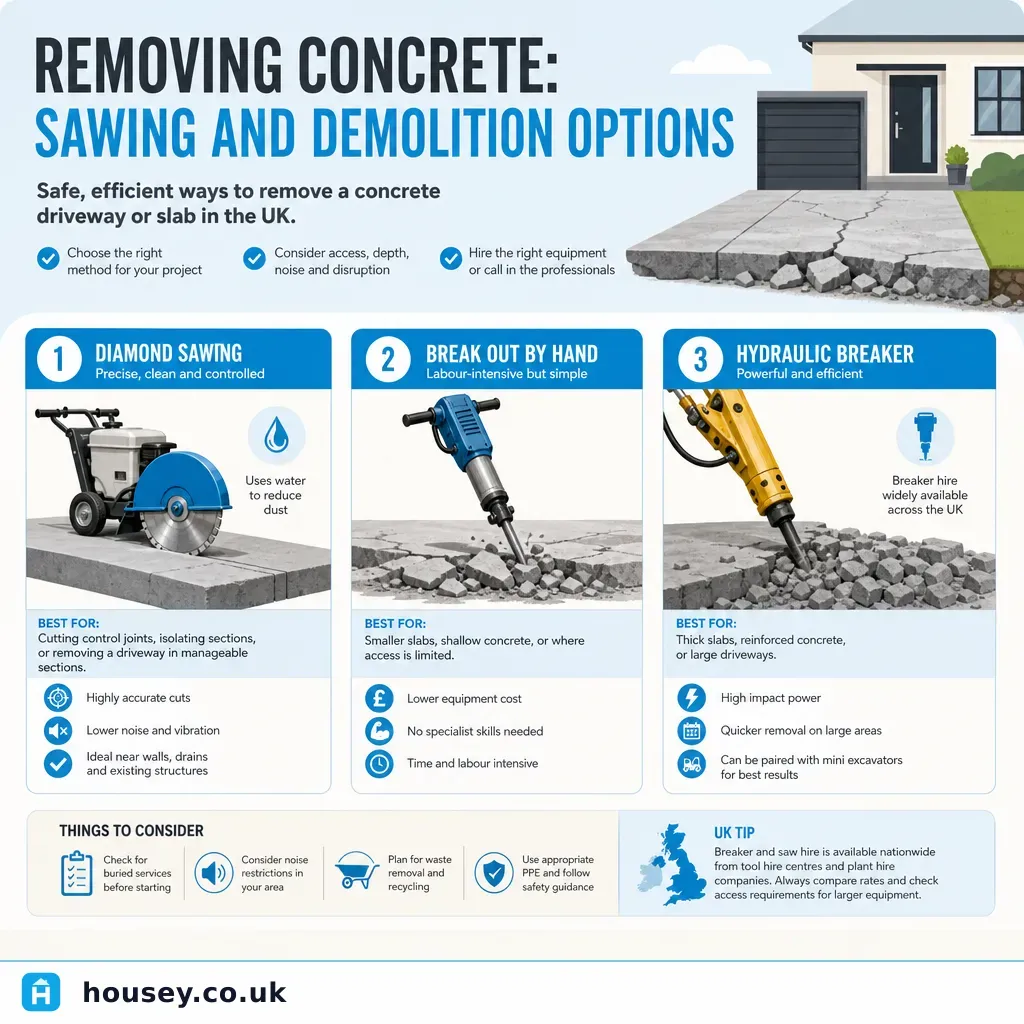
Removing Concrete: Sawing and Demolition Options
Concrete removal methods include hydraulic or electric breakers for bulk demolition, diamond disc or wire sawing for precision cuts, and hand tools for small areas.
 Improvement & Build
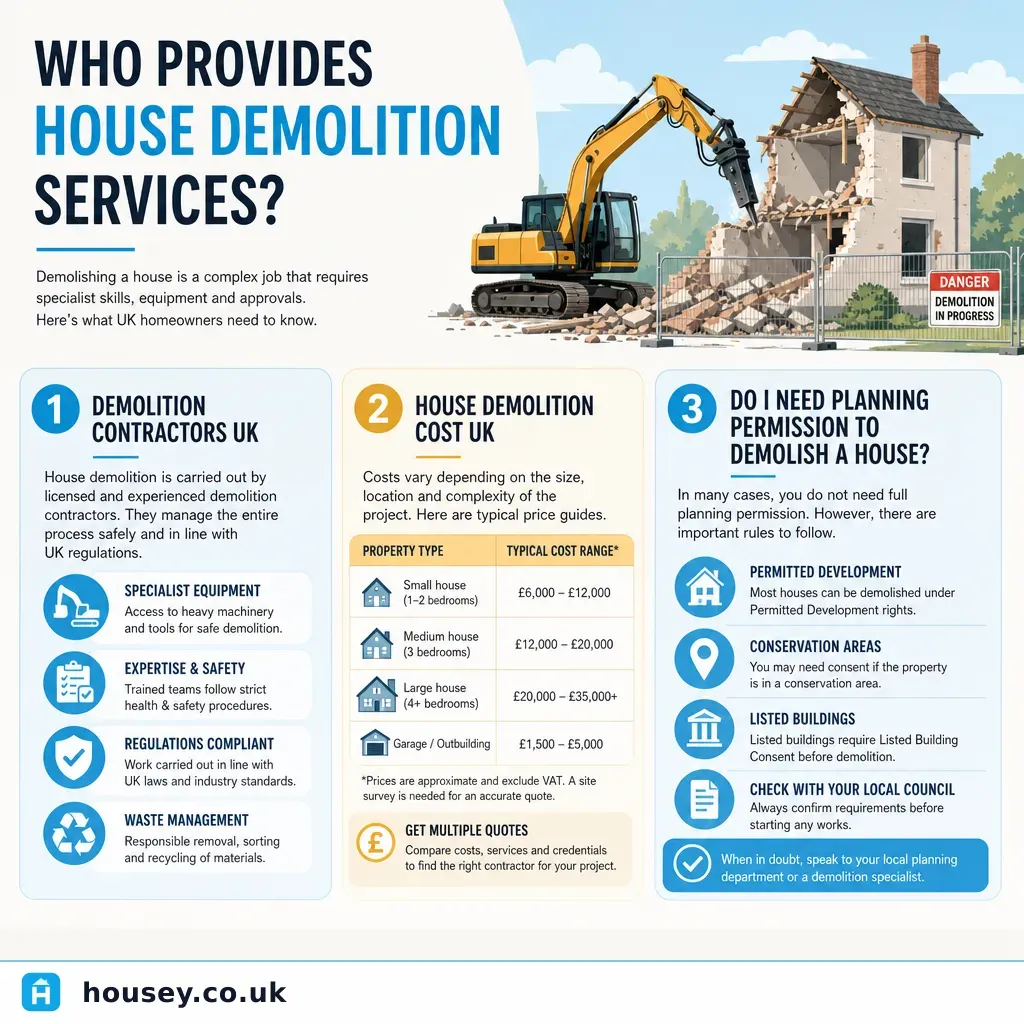
Who Provides House Demolition Services
House demolition in the UK is carried out by specialist demolition contractors, often members of the National Federation of Demolition Contractors (NFDC).
 Improvement & Build
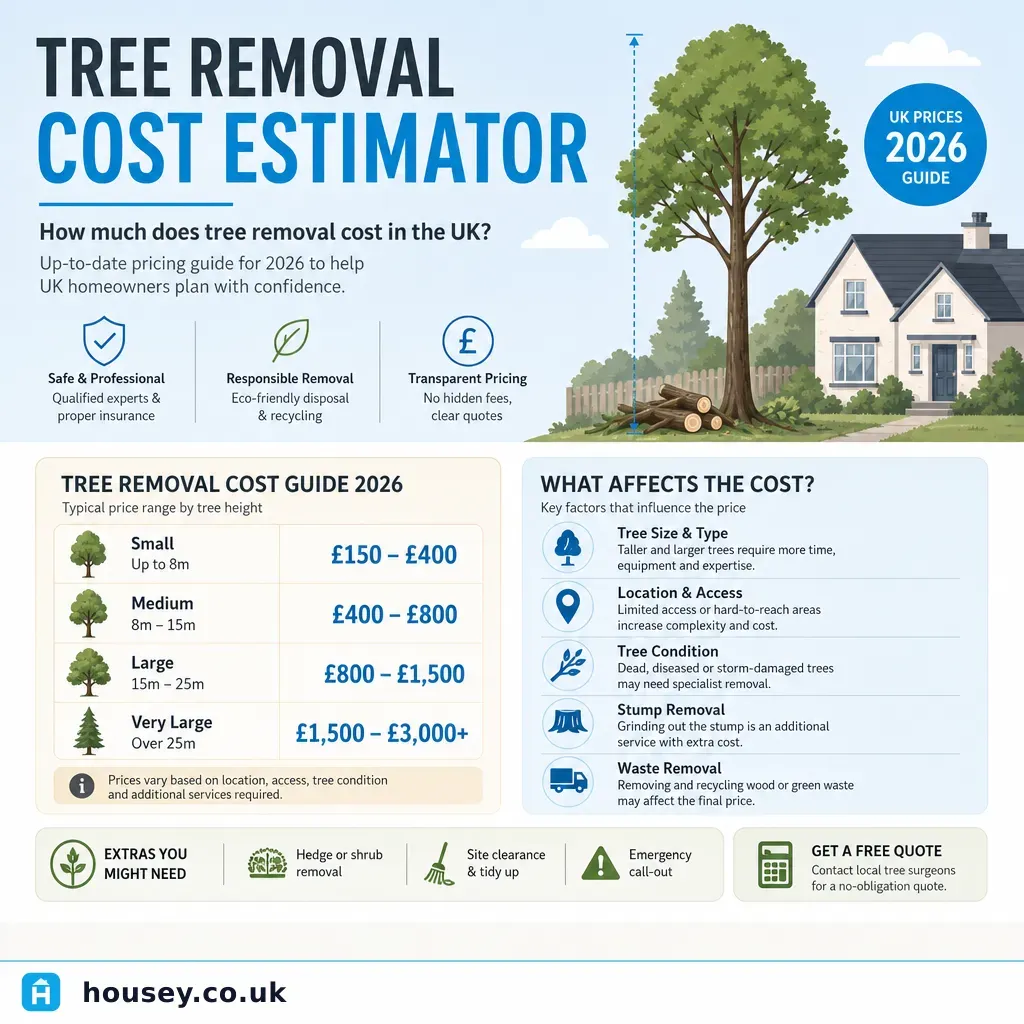
Tree Removal Cost Estimator
Tree removal in the UK costs roughly £150 to £5,000 or more, depending on the tree's height, species, access conditions, and whether stump removal is needed.
 Improvement & Build
Shrub and Vegetation Removal: Costs and Process
Shrub and vegetation removal costs £50–£2,500 or more depending on area size, species involved, and whether stumps need grinding.