What Homeowners Should Expect from Concrete Work: Quality Standards Without Premium Costs
By Housey · Last reviewed 24th of May 2026
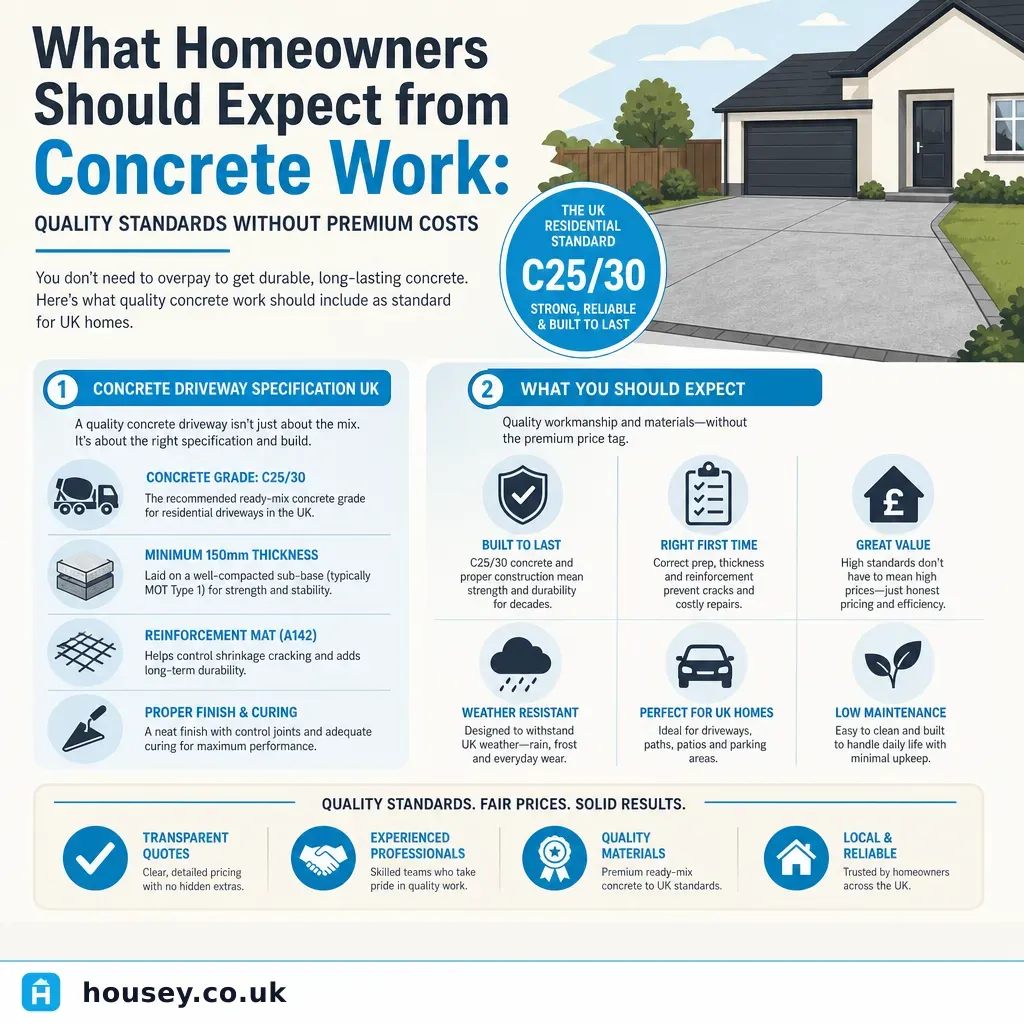
What Homeowners Should Expect from Concrete Work: Quality Standards Without Premium Costs
Concrete is one of the most widely used materials in UK residential construction — from driveways and garden paths to extension foundations and retaining walls. Yet at the domestic level it is also one of the most poorly specified. Homeowners who do not know what to look for often accept vague quotes and end up with concrete that cracks, settles, or deteriorates prematurely because the mix strength, depth, or sub-base preparation was inadequate for the loads placed on it.
Key points
- Ready-mix concrete in the UK is produced to BS EN 206 and specified using standardised designations; a domestic driveway should use a minimum C25/30 mix, broadly equivalent to the older ST3 designation.
- Slab depth matters as much as mix strength: a driveway subject to car traffic typically requires a minimum 100 mm of concrete over at least 100–150 mm of compacted Type 1 MOT crushed-stone sub-base.
- Sub-base compaction is where cost is most often quietly cut — inadequate compaction causes settlement and cracking that becomes visible only months after the work is complete.
- In cold weather (below 5°C), concrete placement requires precautions to prevent early freezing; concrete that freezes before it achieves adequate strength will fail permanently and cannot be recovered by subsequent curing.
- Reinforced concrete elements — foundations, retaining walls, and structural beams — should be specified by a structural engineer, not sized by contractor rule of thumb.
What quality concrete work actually means
Quality in concrete work is largely invisible when it matters most — at the time of placement. By the time cracking, settlement, or surface deterioration appears, the decisions that caused it were typically made weeks earlier during preparation, mix selection, and the pour itself. Knowing what to ask before work starts is more valuable than trying to identify failure after the concrete has set.
Concrete grade and depth: what to specify for common residential applications
Application | Minimum concrete grade | Minimum slab depth | Sub-base specification | Notes |
|---|---|---|---|---|
Pedestrian path or patio | C20/25 (ST2) | 75–100 mm | 75–100 mm compacted hardcore | Avoid in frost-prone areas without adequate drainage |
Domestic driveway (cars only) | C25/30 (ST3) | 100 mm | 100–150 mm compacted Type 1 MOT | Reinforcement mesh (A142) is advisable |
Driveway with occasional light van traffic | C28/35 | 125–150 mm | 150 mm compacted Type 1 MOT | Steel mesh reinforcement recommended |
Strip foundation for a domestic extension | C25/30 minimum | 300–450 mm depending on soil | Not applicable | Depth confirmed by building control or structural engineer |
Ground-bearing floor slab | C25/30 | 100 mm minimum | 150 mm hardcore plus damp-proof membrane | DPM is a Building Regulations requirement under Approved Document C |
Retaining wall | Structural design required | Structural design required | Structural design required | Must be specified by a structural engineer regardless of height |
Indicative UK specifications — actual requirements depend on ground conditions, soil type, load, and local factors. Always confirm with a competent contractor or structural engineer. Indicative information, last reviewed 2026-05-24.
Surface preparation: where quality is most often cut
Experienced contractors and homeowners who have investigated concrete failures will often say the same thing: the concrete itself is rarely the problem — the preparation underneath it is.
For a domestic driveway, correct preparation includes:
- Excavation to the correct depth — allowing for the full sub-base depth, the concrete thickness, any blinding layer, and the required fall for drainage. Cutting this short by even 50 mm significantly reduces the slab's load capacity.
- Sub-base compaction in layers — Type 1 MOT crushed stone should be mechanically compacted in layers no deeper than 100 mm, not simply tipped to full depth and levelled.
- Edge restraints at all free edges — concrete without restraints at boundaries with soil or lawn will crack and crumble at the margins within a few seasons.
- Falls for drainage — a minimum 1:80 gradient should be maintained away from buildings and towards drains or permeable surfaces to prevent surface water ponding.
- DPC clearance — where concrete abuts a wall, the finished surface should be at least 150 mm below the damp-proof course to avoid bridging it and introducing moisture into the building fabric.
Asking to see the sub-base depth and compaction before concrete is poured is entirely reasonable and should be welcomed by any competent contractor.
Homeowner quality checklist
Before the pour
During the pour
After the pour
What to ask before accepting a quote
- What concrete grade (to BS EN 206) are you specifying for this application, and why is it appropriate?
- What is the sub-base material, depth, and compaction method — and how many compaction passes will be made?
- What edge restraints are included in the quoted price?
- Will the concrete be supplied as ready-mix? Can I see the delivery ticket on the day of the pour?
- How will the surface be finished and cured after the pour?
- Is VAT included in the quoted price?
- What is your process if visible cracking appears within the first 12 months?
- Do you carry public liability insurance? Can you provide a certificate before work starts?
Red flags in a concrete quote or on site
These signs during a quote process or during the works suggest the contractor may be cutting corners:
- No mention of sub-base depth, material, or compaction method in the written quote.
- A price significantly below other quotes with no explanation of what has been omitted.
- Proposing to add water to the concrete on site to improve workability.
- Unable or unwilling to confirm the concrete grade or mix designation in writing.
- Planning to pour in sub-5°C conditions without mentioning cold-weather precautions.
- No edge restraints or shuttering included in the quoted scope for open-edged slabs.
- Wanting to complete a large pour in a single day when the project scale makes this implausible.
When to get professional help
Straightforward domestic paths, patios, and driveways do not typically require a structural engineer. However, involve a qualified professional if:
- The work includes foundations for a new extension or outbuilding — a structural engineer or architect should specify the foundation design, and building regulations approval will be required.
- The work includes a retaining wall of any significant height — even low retaining walls can fail without a proper structural design.
- Ground conditions are uncertain: clay soils with nearby mature trees, made-ground, or previously developed land all carry a higher risk of differential settlement.
- The driveway may require planning permission — in England, a front garden driveway draining to an impermeable surface larger than 5 m² that discharges to the public highway requires planning permission. Check your local planning authority's requirements before work starts.
How Housey can help
Housey connects you with experienced extension builders who can advise on concrete specifications for foundations and floor slabs as part of a wider build, and design-and-build firms who can manage both design and construction for more complex residential projects. Request multiple quotes and compare what each includes before committing.
Frequently asked questions
What is the difference between C25/30 and ST3 concrete?
C25/30 is the current designation under BS EN 206, indicating a characteristic compressive strength of 25 MPa and a target mean strength of 30 MPa at 28 days. ST3 was the older standardised prescribed mix designation used in the UK before the European standard replaced it. The two are broadly equivalent for domestic driveways and floor slabs — specify C25/30 when ordering to ensure compliance with current standards.
How long before I can drive on new concrete?
Foot traffic is typically safe after 24–48 hours under normal UK conditions. Vehicle traffic should be avoided for a minimum of seven days. Concrete achieves its full design strength at 28 days — avoid heavy or repeated loading during this period, and do not allow delivery vehicles onto the slab for at least two weeks after the pour.
Why is my new concrete driveway cracking?
Cracking in new concrete most commonly results from inadequate sub-base compaction, insufficient slab depth, the absence of control joints to guide cracking, rapid drying in hot or windy conditions, or freezing before curing was complete. Fine surface crazing is often cosmetic and affects only the surface layer; cracks through the full depth of the slab indicate a more significant problem and warrant investigation.
Do I need planning permission for a concrete driveway in England?
In England, a front garden driveway can normally be installed under permitted development rights without planning permission, provided it drains to a permeable surface or towards a lawn or border. If the surface is impermeable and larger than 5 m² and drains to the public highway, planning permission is required. Rules differ in Wales, Scotland, and Northern Ireland — check with your local planning authority before starting work.
Sources and further reading
- BS EN 206 — Concrete: Specification, performance, production and conformity — BSI
- Approved Document C — Site preparation and resistance to contaminants and moisture — HM Government
- Planning permission: driveways and dropped kerbs — GOV.UK
- Concrete Centre — Concrete specification for domestic use — Concrete Centre
Useful next reads
 Improvement & Build
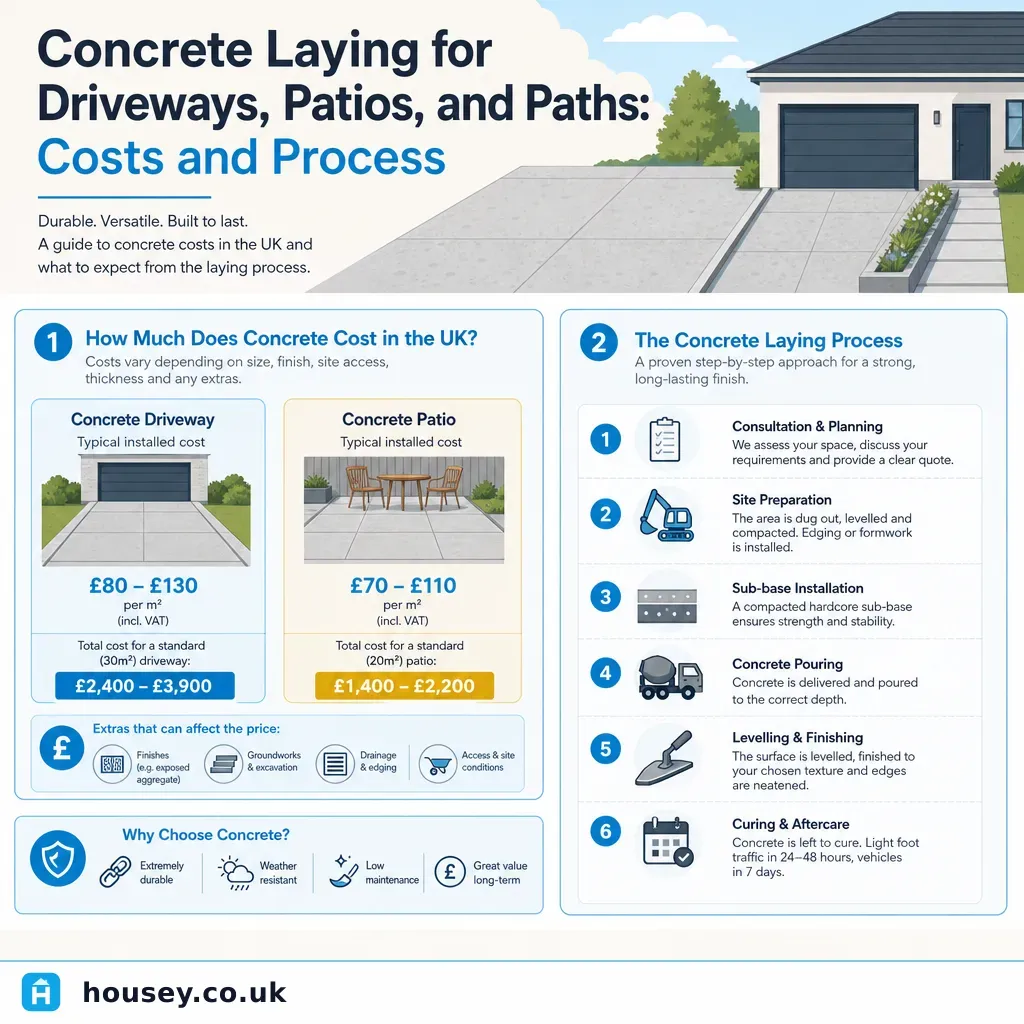
Concrete Laying for Driveways, Patios, and Paths: Costs and Process
Concrete laying for a UK driveway typically costs £65–£110 per square metre, including sub-base, reinforcement, formwork, and finishing.
 Improvement & Build
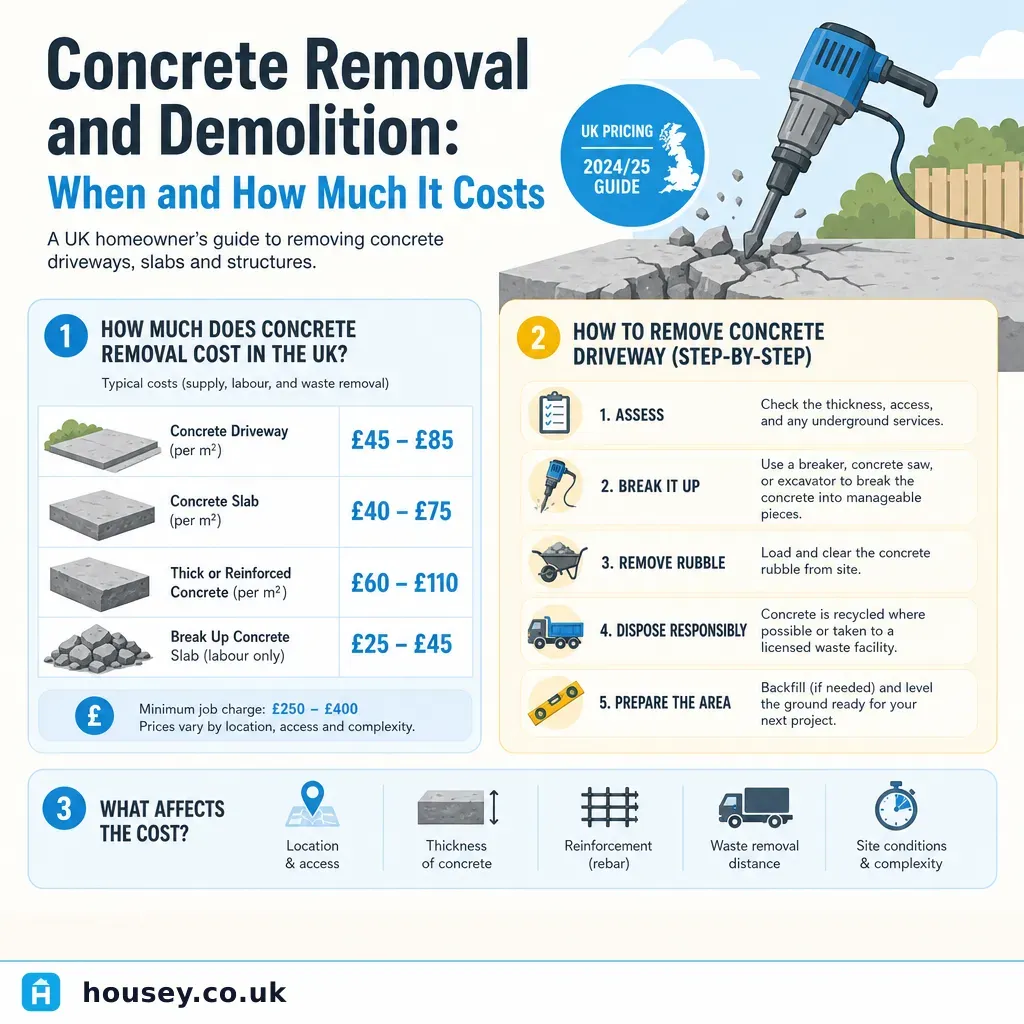
Concrete Removal and Demolition: When and How Much It Costs
Concrete removal in the UK typically costs £25–£65 per square metre for unreinforced slabs, rising to £55–£110 per square metre for reinforced concrete containing rebar.
 Improvement & Build
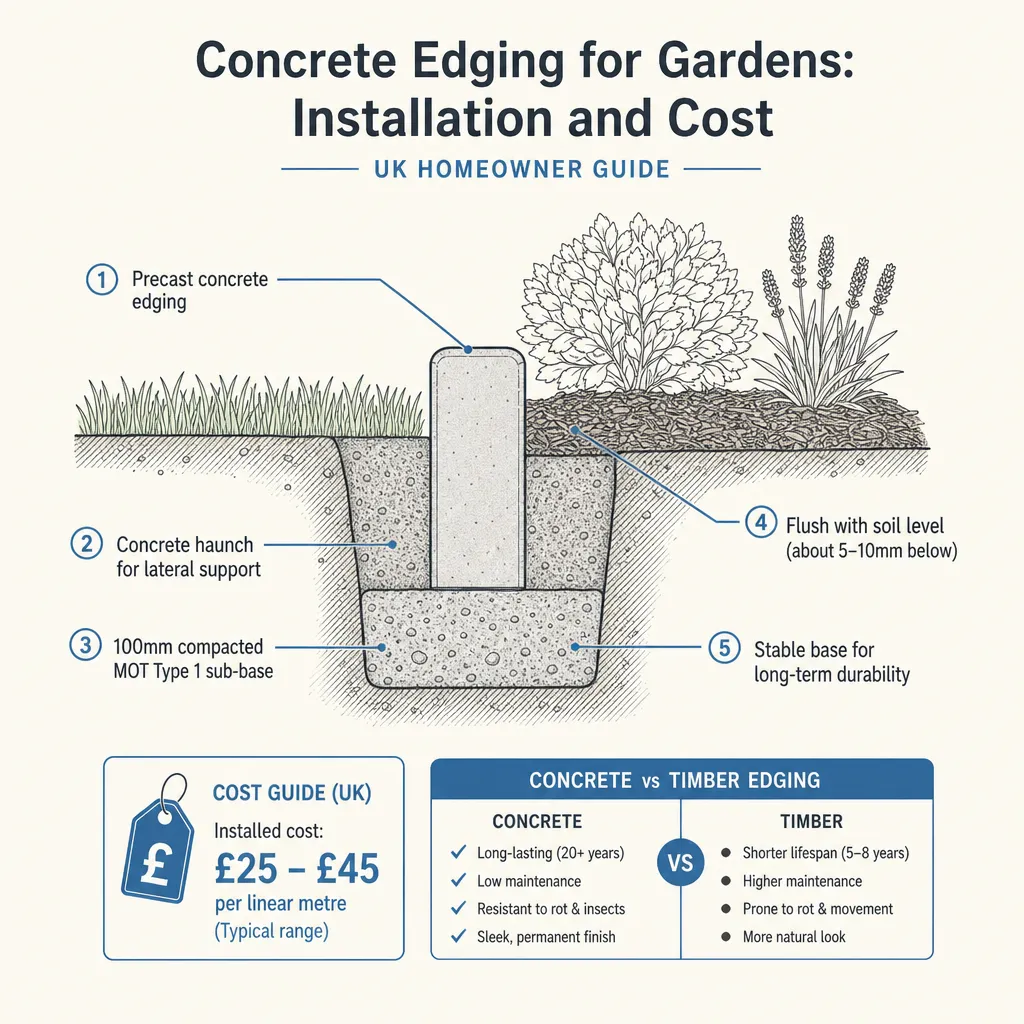
Concrete Edging for Gardens: Installation and Cost
Concrete garden edging — whether precast sections or poured in situ — gives lawns and planting beds a durable, low-maintenance boundary.
 Improvement & Build
Aluminium Windows: Benefits, Specifications, and Installation Costs
Aluminium windows typically cost £600–£1,800 per window installed in the UK, depending on size and specification.
 Improvement & Build
Building an Outdoor Kitchen: Design, Materials, and Investment
Building an outdoor kitchen in the UK costs roughly £3,000–£25,000 depending on size and materials.