Conservatories and Extensions: Planning Permission and Building Regulations
By Housey · Last reviewed 12th of May 2026
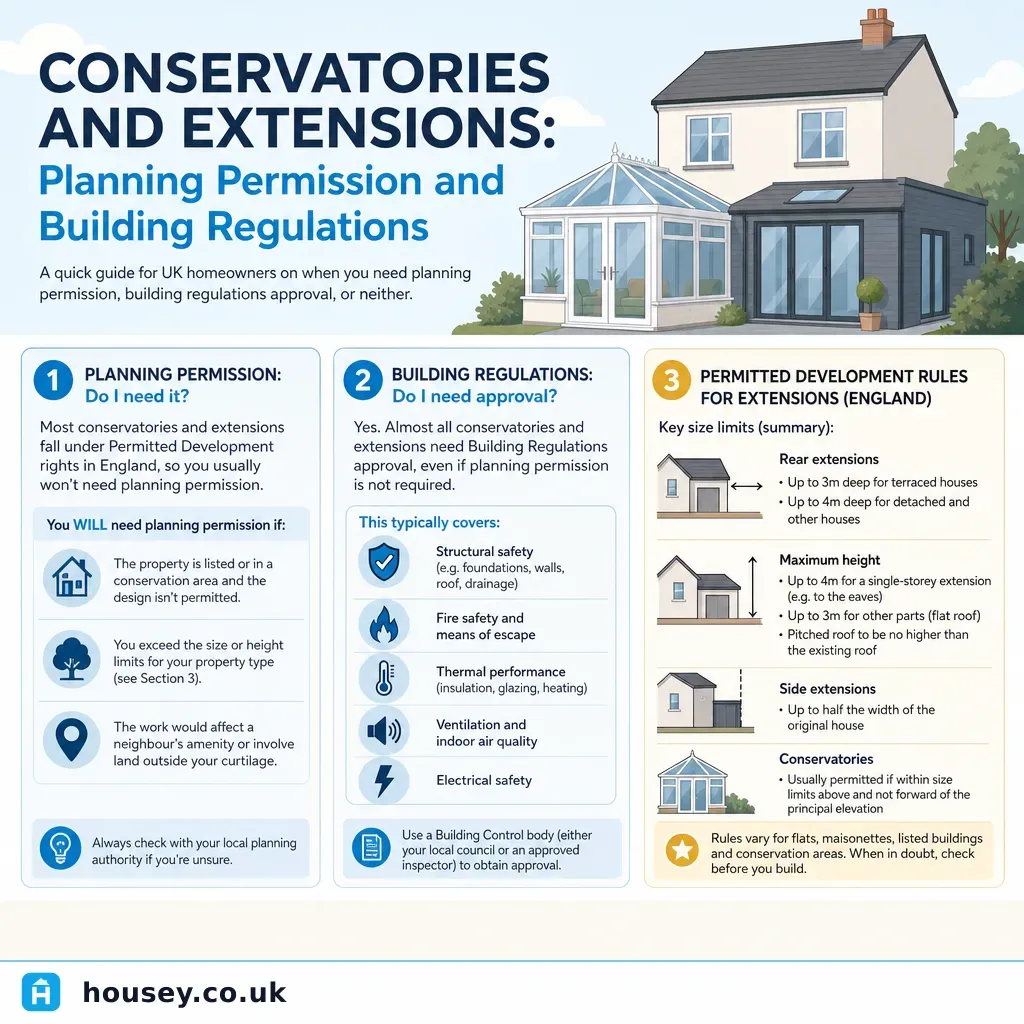
Conservatories and Extensions: Planning Permission and Building Regulations
Whether you are planning to add a glazed garden room to a Victorian terrace or extend the back of a 1970s semi, understanding how planning permission and building regulations apply — differently — to conservatories and extensions can save you significant time, money, and legal risk. Common assumptions about "not needing permission" frequently turn out to be incomplete, and undocumented or non-compliant work can complicate a future sale or trigger enforcement action.
Important limitations
This article provides general information about planning and building regulation rules in England. Rules in Wales, Scotland, and Northern Ireland differ in material respects. Planning requirements also depend on your specific property's planning history, location, prior extensions, and any local restrictions. Always verify with your local planning authority (LPA) and a qualified professional before starting work. This article does not constitute planning, legal, or building control advice.
Key points
- Most single-storey rear extensions qualify as permitted development under Schedule 2, Part 1, Class A of the Town and Country Planning (General Permitted Development) (England) Order 2015 (as amended), subject to size and position limits.
- Conservatories may be exempt from Building Regulations 2010 if they meet all criteria: ground floor, at least 75% translucent roof, at least 50% glazed walls, thermally separated from the main dwelling, and independent or no fixed heating.
- Extensions almost always require building control approval regardless of planning status — the key Approved Documents engaged include Part A (structure), Part B (fire safety), Part L (thermal performance), and Part P (electrical safety).
- Properties in conservation areas, Areas of Outstanding Natural Beauty (AONBs), National Parks, or subject to an Article 4 Direction have significantly reduced or removed permitted development rights.
- Listed buildings require listed building consent for any external or internal alterations — this is separate from, and in addition to, any planning permission or building regulations requirement.
Conservatory or extension: what is the legal distinction?
The difference between a conservatory and an extension matters primarily for building regulations. A conservatory-style structure may be exempt from building regulations if it satisfies the cumulative conditions in Schedule 2, Part 1, Class B of the Building Regulations 2010 (as amended). All of the following must be met:
- Built at ground floor level.
- The roof is at least 75% translucent or transparent material.
- The walls are at least 50% glazed.
- The structure is thermally separated from the main dwelling by fixed, external-quality doors.
- It has an independent heating system with separate controls, or no fixed heating at all.
- The floor area does not exceed 30 m².
If any single criterion is not met — for example, if the glazed roof is replaced with a solid insulated tiled roof — the structure ceases to qualify as a conservatory for building regulations purposes. It is treated as an extension and building control approval becomes necessary.
Decision tree: which rules apply to your project?
- Conservatory — building regulations exempt if: ground floor, translucent or transparent roof covering ≥75% of the roof area, glazed walls ≥50%, thermally separated by fixed external doors, ≤30 m², and independent or no fixed heating.
- Extension requiring building regulations if: solid or tiled roof, predominantly masonry or rendered walls, thermally integrated with the main house (no separating door), or floor area >30 m².
- Check with your LPA before starting if the property is in a conservation area, AONB, National Park, or on a listed building — additional restrictions apply regardless of the building regulations classification.
- Instruct an architect or planning consultant if the proposal is within 2m of a boundary, over 4m in height, involves two storeys, or the property is listed or sits in an Article 4 Direction area.
- Serve Party Wall Act notices if any works are within 3m of a neighbouring property's foundation or affect a shared party wall.
Planning permission: when do you need it for an extension?
Permitted development limits for houses in England
Most single-storey rear extensions to houses qualify as permitted development under Class A, Schedule 2, Part 1 of the Town and Country Planning (General Permitted Development) (England) Order 2015. The table below summarises the key limits. These apply to houses only — flats and maisonettes are not covered.
Condition | Detached house | Semi-detached or terraced house |
|---|---|---|
Maximum depth — standard permitted development | 4 m from the original rear wall | 3 m from the original rear wall |
Maximum depth — larger home extension scheme (prior approval) | Up to 8 m | Up to 6 m |
Maximum eaves height of single-storey extension | 3 m (within 2m of boundary) | 3 m (within 2m of boundary) |
Maximum overall height of single-storey extension | 4 m | 4 m |
Side extensions | Generally not permitted development if width exceeds half the original house width | Generally not permitted development |
Two-storey extensions | Not permitted development within 7m of the rear boundary | Not permitted development within 7m of the rear boundary |
The larger home extension scheme — sometimes called the prior approval process for larger extensions — allows single-storey rear extensions beyond standard limits with prior approval from the LPA. This is a lighter process than a full planning application, but neighbours have 21 days to raise objections and the LPA assesses the siting, design, and external appearance.
When a full planning application is required
You will need to apply for full planning permission if:
- The extension exceeds standard or prior approval size limits.
- The property is in a conservation area, AONB, National Park, or World Heritage Site.
- The property is listed (listed building consent is also required separately).
- An Article 4 Direction has removed permitted development rights in your area.
- Previous extensions have already used up the permitted development allowance.
- The extension creates a separate dwelling or materially changes the use of the property.
Conservatories and planning permission
Conservatories are subject to the same planning permission tests as extensions. If the structure meets the permitted development size and position criteria, no planning application is needed. The building regulations exemption question is entirely separate and does not affect the planning position.
Building regulations: what they cover and why extensions must comply
Building regulations set minimum standards for the design and construction of buildings in England. For extensions, the key Approved Documents typically engaged are:
- Part A (Structure) — foundations, structural loading, lintels.
- Part B (Fire safety) — fire spread, escape routes, separation.
- Part C (Moisture) — damp-proofing and ground conditions.
- Part F (Ventilation) — adequate fresh air in habitable spaces.
- Part L (Conservation of fuel and power) — thermal performance of new walls, roof, and floors; windows; doors.
- Part P (Electrical safety) — any new or altered electrical installation.
Building control approval is required before work begins. You can either notify your local authority building control (LABC) or appoint a privately approved building inspector. On satisfactory completion, you receive a completion certificate — an important document for any future sale. Conservatories meeting all exemption criteria are not required to have building regulations approval, but your contractor should confirm exemption status in writing and you should retain the specification.
When this becomes urgent
If works that may have required planning permission have already started, stop and take advice promptly. Local planning authorities can issue enforcement notices within four years of a breach for building operations, or ten years for change of use. If you have received an enforcement notice or a planning contravention notice, do not continue works and seek planning advice immediately. When buying a property, undocumented or potentially non-compliant extensions can delay or prevent a sale — your conveyancer should flag these.
What to ask a qualified professional
Before instructing an architect, planning consultant, or builder, ask:
- Does my property have any Article 4 Direction, conservation area designation, or listing that affects permitted development?
- Has the property been previously extended, and what remains of the permitted development allowance?
- Will this structure qualify as a conservatory for building regulations purposes — and can you confirm that in writing?
- If building regulations are required, who will manage the building control application and act as the responsible person?
- Will I receive a completion certificate on satisfactory completion?
- Does the work require a Party Wall Act notice to be served on any adjoining owner?
- Are there any planning conditions on the existing property that restrict further development?
When to get professional help
Most extensions beyond a straightforward single-storey rear addition benefit from professional input. Seek help from an architect or planning consultant if:
- The extension is within 2m of a boundary, above 4m, or involves two storeys.
- The property is listed, in a conservation area, or subject to any planning condition.
- The structure involves removing or altering a load-bearing wall.
- You are unsure whether permitted development rights apply or have been used up.
- The extension will affect drainage, significantly change land levels, or involve excavation near a shared boundary.
How Housey can help
Housey connects homeowners with experienced professionals across the UK. If you need guidance on planning rules before committing to a design, our planning consultancy service can assess your proposal. For building control sign-off and compliance, our building control consultants can manage the process from start to completion certificate. An architect can help you design a scheme that works within permitted development or prepare drawings for a full planning application.
Frequently asked questions
Does replacing a conservatory's glass roof with a solid tiled roof require building regulations?
Yes. Once a conservatory's roof is no longer at least 75% translucent or transparent, the structure no longer meets the building regulations exemption criteria. It is reclassified as an extension and building regulations approval is required, including compliance with Part L (thermal performance) and other applicable Approved Documents.
What is prior approval under the larger home extension scheme?
The larger home extension scheme allows single-storey rear extensions up to 8m (detached) or 6m (other houses) without a full planning application. You must notify the local planning authority and neighbouring properties, who have 21 days to raise objections. The LPA then determines whether prior approval is needed for siting, design, and external appearance.
Does the Party Wall etc. Act 1996 apply to extensions?
It may. If your extension is within 3m of a neighbouring property's foundation, or involves work on or adjacent to a shared party wall, you are likely required to serve notices on adjoining owners under the Party Wall etc. Act 1996 before starting work. Your architect or planning consultant can advise on whether this applies.
Do permitted development rights apply to flats and maisonettes?
No. Permitted development rights for householder extensions apply to houses only. Flats, maisonettes, and properties converted into flats do not benefit from the same Class A rights. Any extension to a flat will generally require a full planning application.
Sources and further reading
- Town and Country Planning (General Permitted Development) (England) Order 2015 — legislation.gov.uk
- Building Regulations 2010 — legislation.gov.uk
- Planning permission: when you need it — GOV.UK
- Householder permitted development rights: guidance — GOV.UK
- Approved Document L: Conservation of fuel and power — GOV.UK
Useful next reads
 Planning & Pre-Build
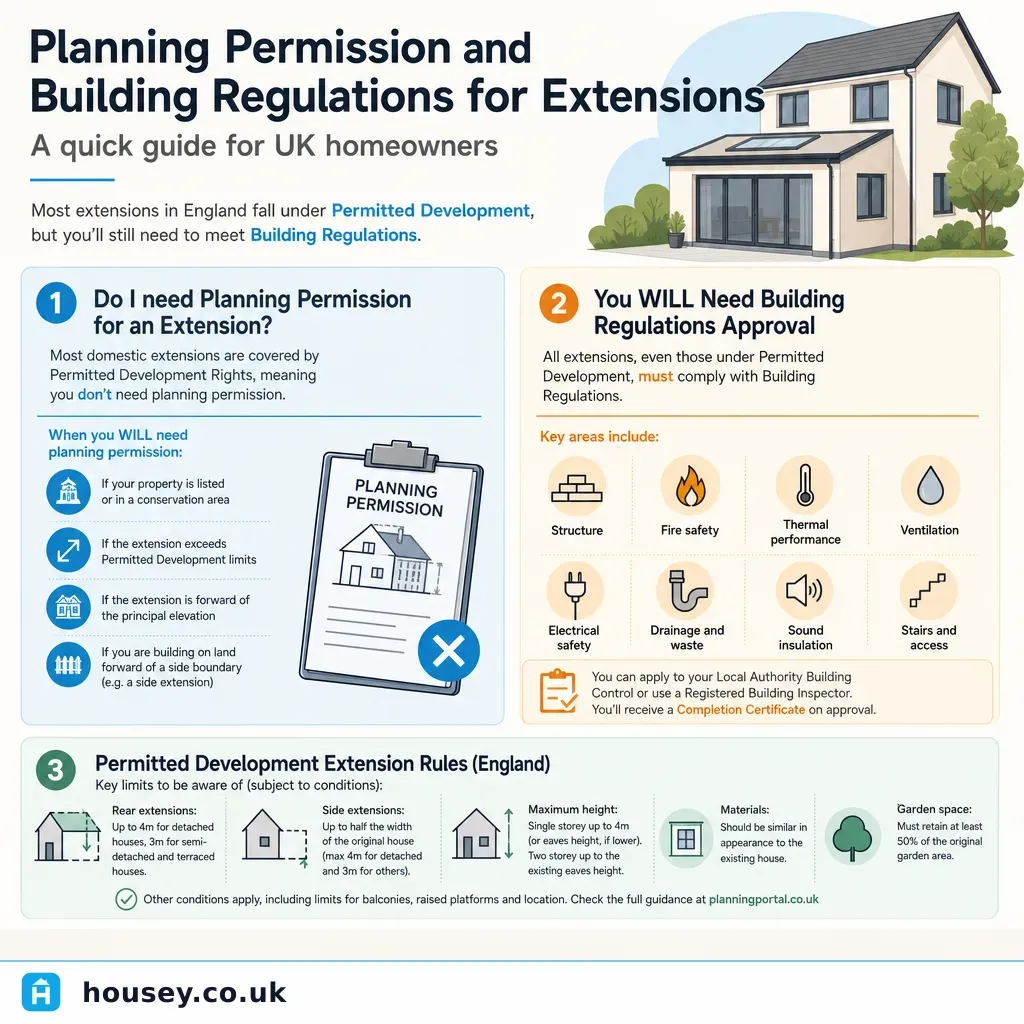
Planning Permission and Building Regulations for Extensions
UK home extensions usually require both planning permission and Building Regulations approval, though most smaller rear extensions qualify as Permitted Development under the GPDO 2015 and need no planning application.
 Planning & Pre-Build
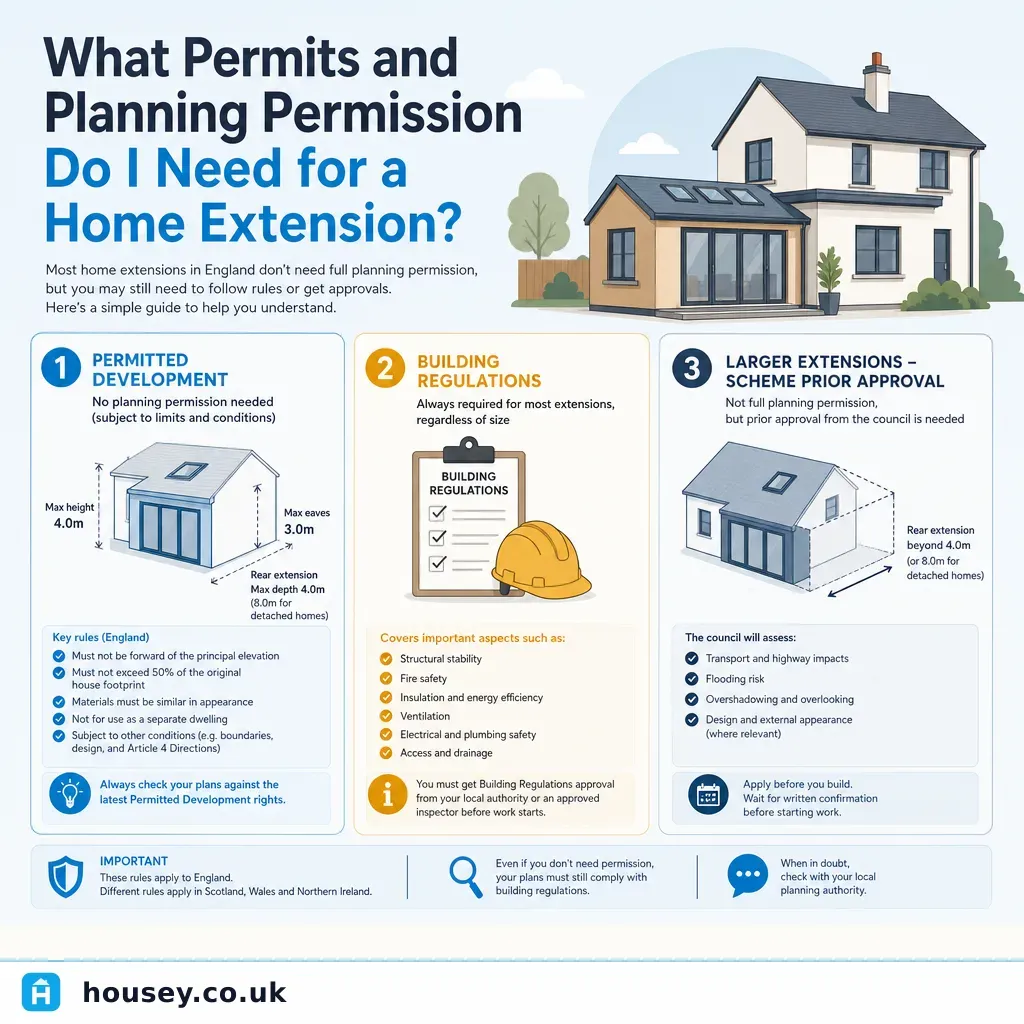
What Permits and Planning Permission Do I Need for a Home Extension?
Most single-storey rear extensions fall under permitted development and do not need a formal planning application, provided they stay within size limits set out in the Town and Country Planning (General Permitted Development) (England) Order 2015.
 Planning & Pre-Build
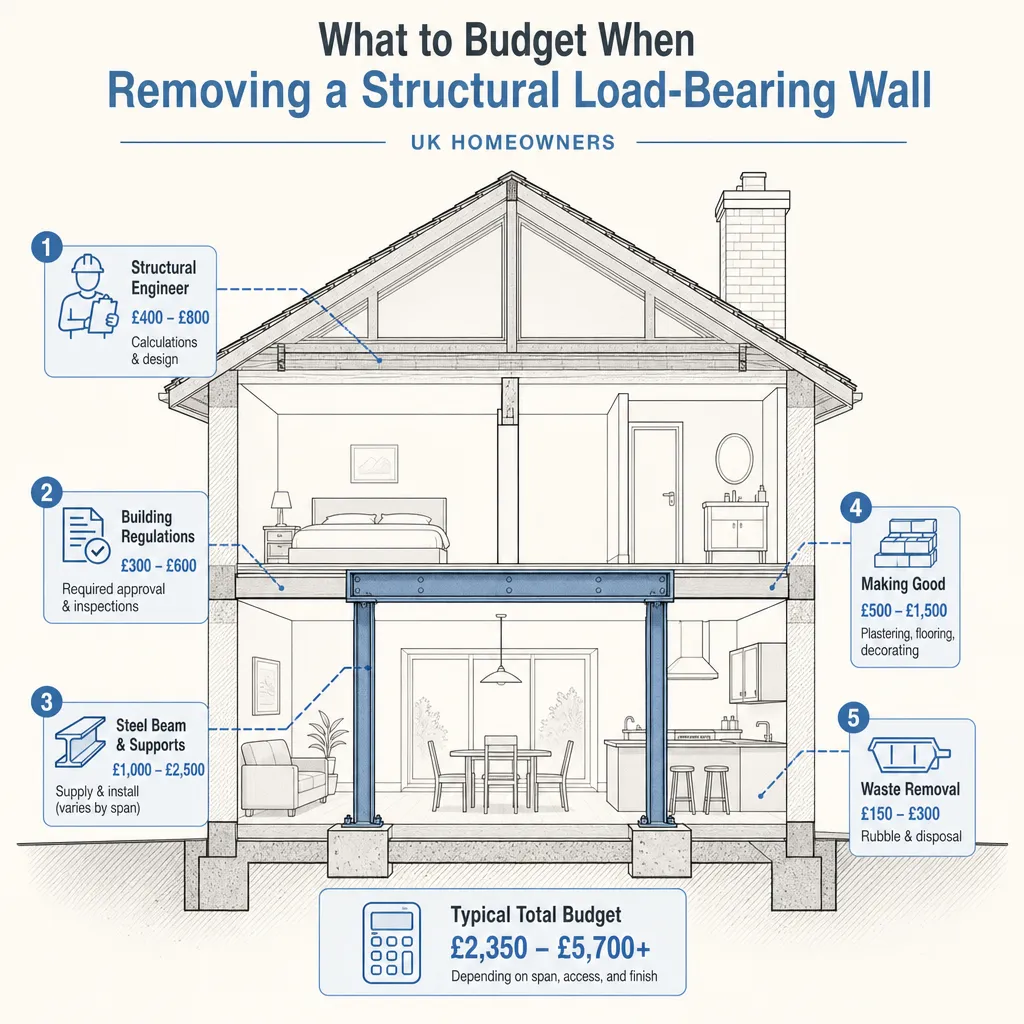
What to Budget When Removing a Structural Load-Bearing Wall
Removing a load-bearing wall in a typical UK home costs £2,500–£8,000 or more in total, covering a structural engineer's calculations, Building Regulations approval, the steel beam, builder's labour, and replastering.
 Planning & Pre-Build
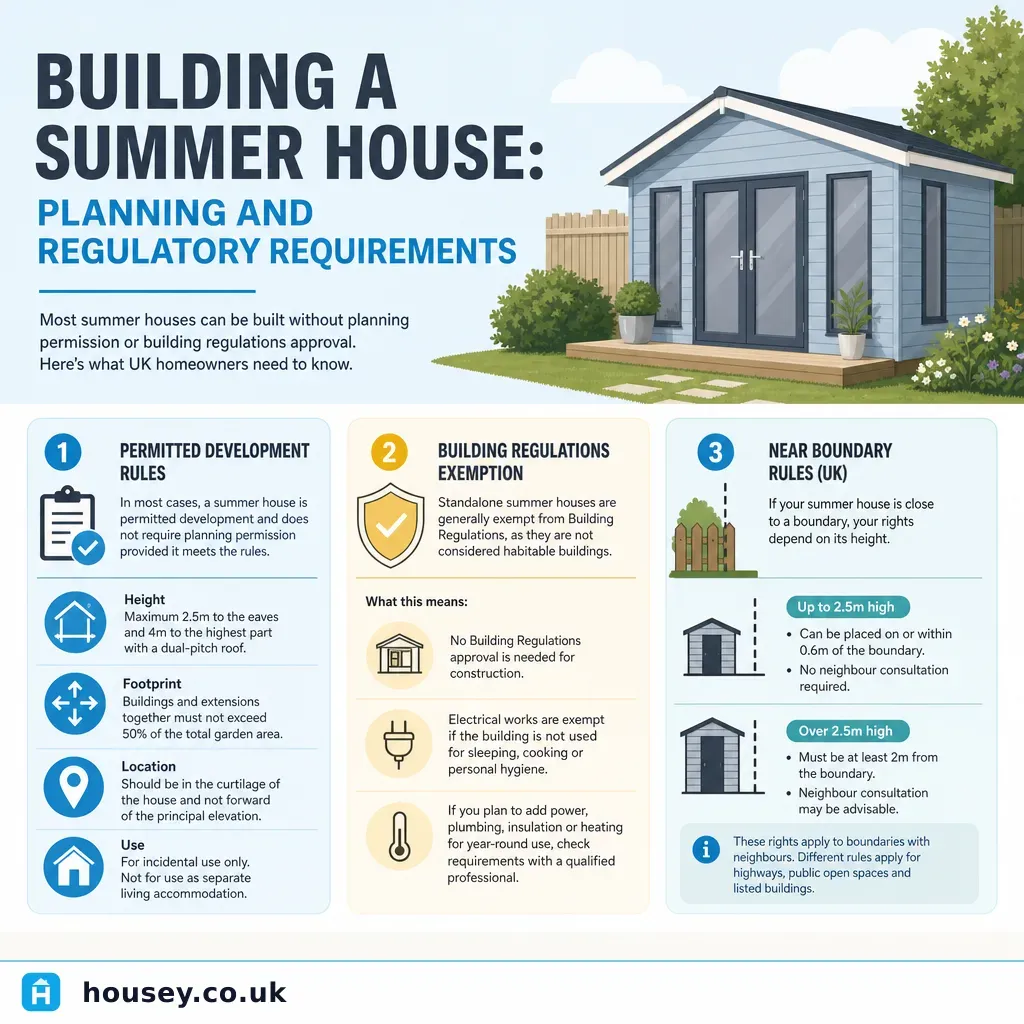
Building a Summer House: Planning and Regulatory Requirements
Most garden summer houses in England fall under Class E permitted development and need no planning permission, provided they are single-storey, within height limits, and not used for sleeping.
 Planning & Pre-Build
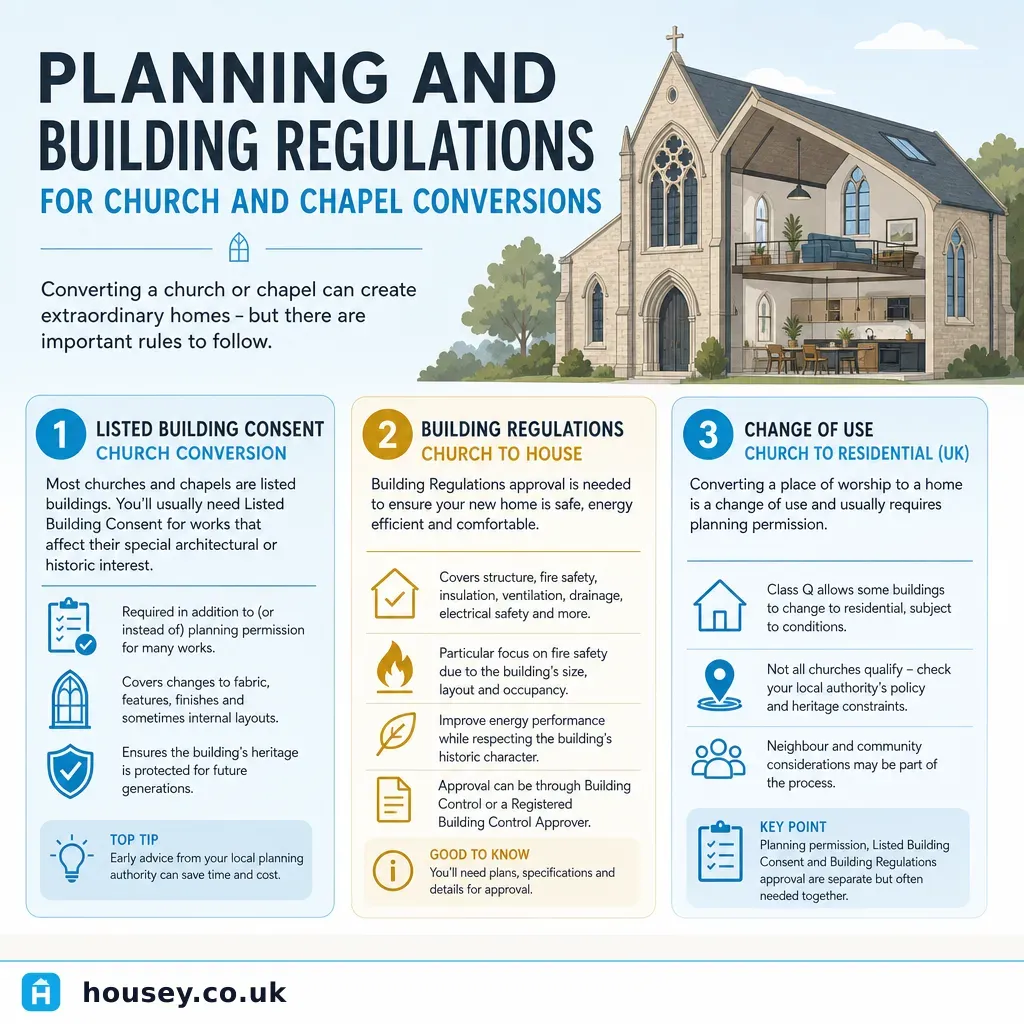
Planning and Building Regulations for Church and Chapel Conversions
Converting a church or chapel to residential use requires planning permission for change of use from Class F1 to Class C3, and listed building consent if the building is listed.