Construction and Building Services: Managing Your Property Development Project
By Housey · Last reviewed 19th of May 2026
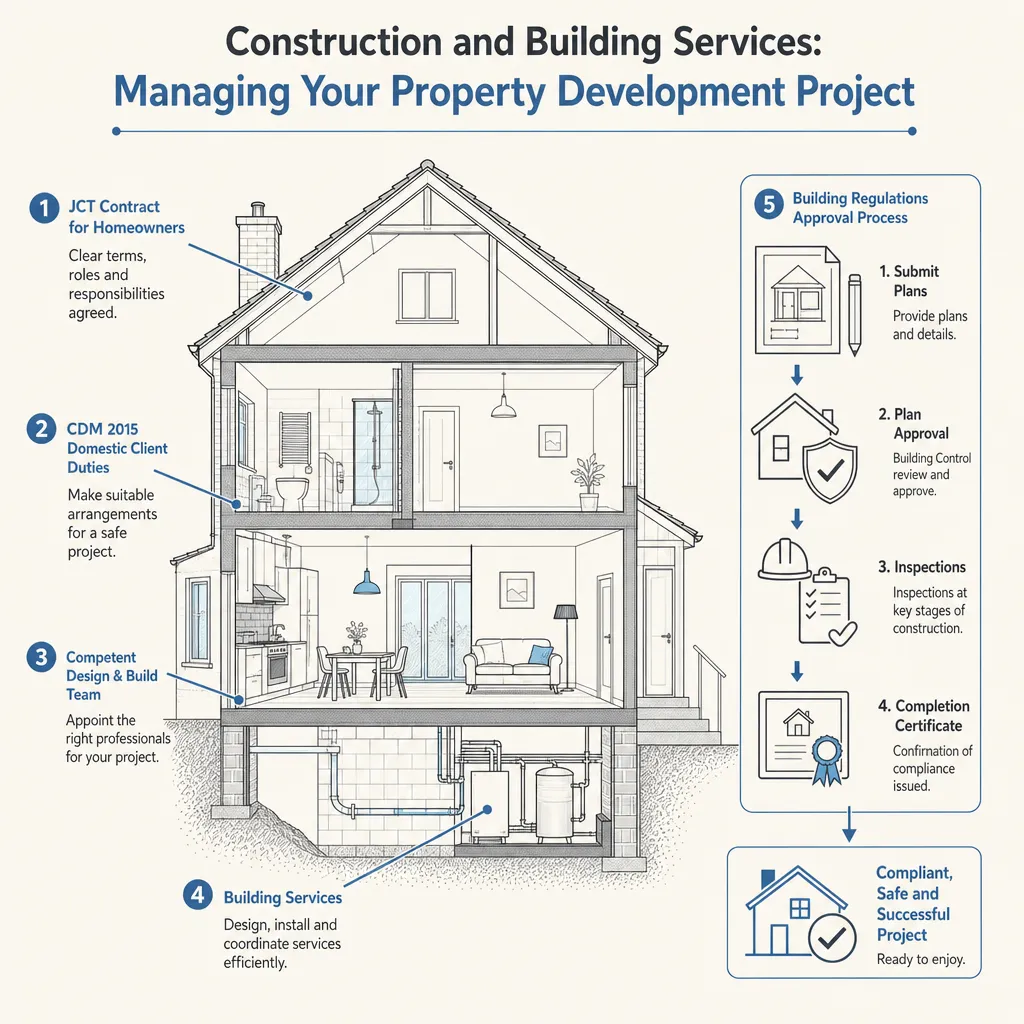
Construction and Building Services: Managing Your Property Development Project
Once planning permission is secured, the harder work often begins: selecting the right professionals, choosing the right contract, meeting regulatory obligations, and keeping the project on time and on budget. Whether you are commissioning a rear extension, a loft conversion, or a more ambitious self-build, understanding the roles, contracts, and statutory requirements involved will protect you from the most common — and costly — mistakes.
Key points
- Building Regulations approval under the Building Act 1984 is required for most structural works, extensions, and loft conversions; it is separate from planning permission and cannot be obtained retrospectively without potential enforcement consequences.
- Where two or more contractors work on a domestic project, the Construction (Design and Management) Regulations 2015 (CDM 2015) require the client to formally appoint a Principal Designer and a Principal Contractor in writing before work begins.
- The Building Safety Act 2022 introduced mandatory registration and a Gateway approval process for Higher-Risk Buildings (HRBs) — residential buildings of 18m or over, or 7 or more storeys.
- JCT (Joint Contracts Tribunal) contracts — including the Homeowner Contract and the Minor Works Building Contract — are the most widely used standard forms for UK residential construction.
- A defects retention of 2.5–5% of the contract value is standard practice, withheld until the end of the defects liability period (typically 12 months after practical completion).
Which professional do you need?
Role | What they do | Qualification to look for | Typically needed when |
|---|---|---|---|
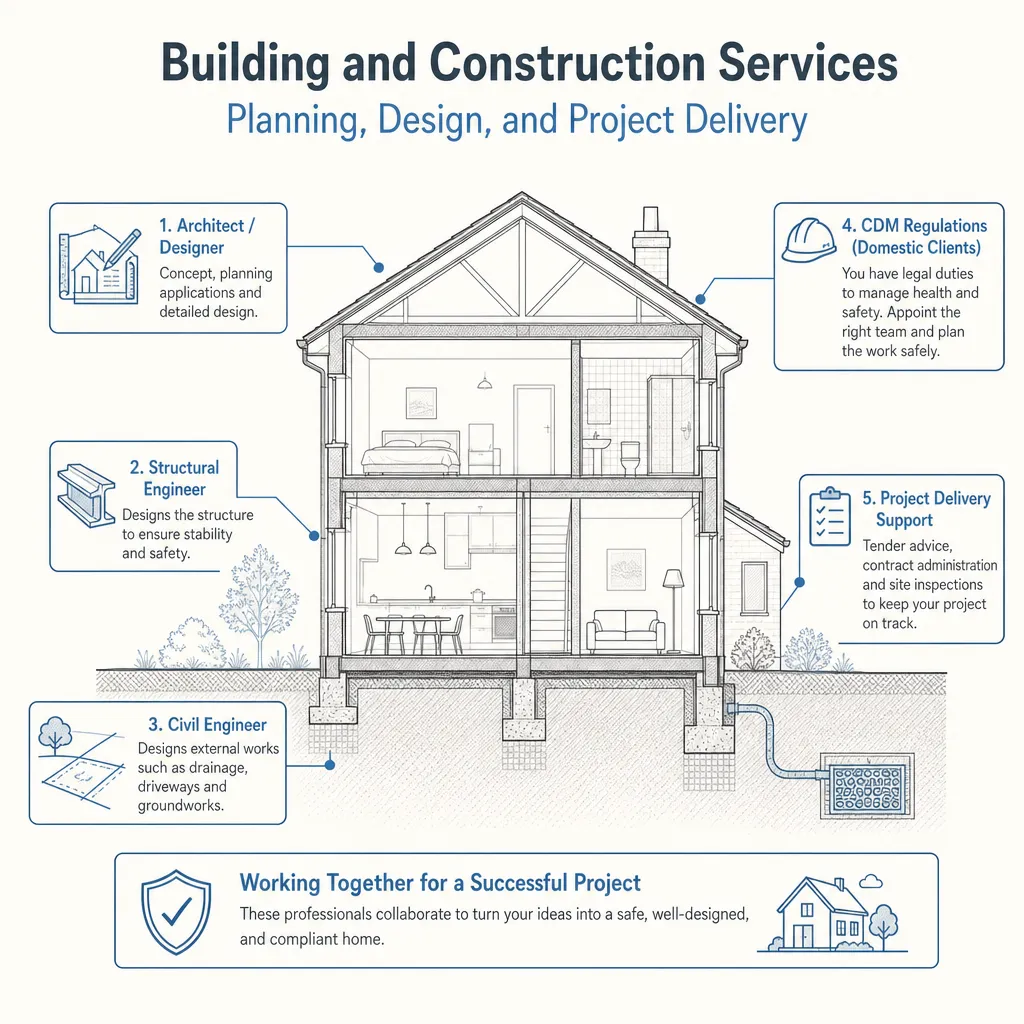
Architect / architectural designer | Design, planning drawings, Building Regulations submissions, contract administration | ARB-registered, RIBA chartered | From concept; essential on complex or larger projects |
Structural engineer | Structural calculations, beam and foundation design | MIStructE, MICE, CEng | Extensions, loft conversions, openings in load-bearing walls |
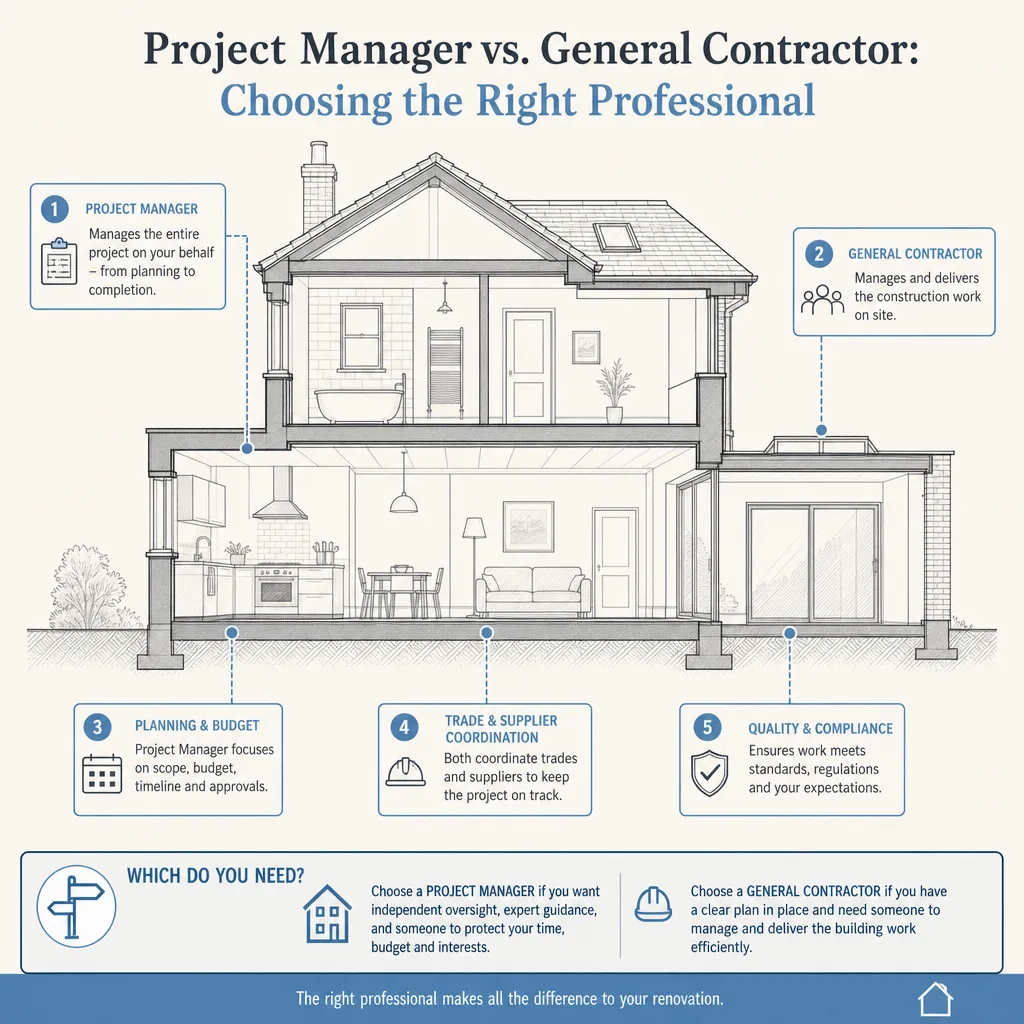
Project manager | Programme, cost control, contractor coordination | MRICS, MCIOB, or strong demonstrable track record | Medium–large projects; where client cannot oversee works directly |
Main contractor | Delivery of all works; management of sub-contractors | FMB or Master Builder membership; trade references | Any project involving multiple trades |
Civil engineer | Groundworks, drainage, retaining walls, external infrastructure | MICE, CEng | Projects with significant drainage or civil engineering works |
Building control surveyor (LABC or RBI) | Building Regulations compliance sign-off | CABE, RICS, or local authority BCB | All projects requiring Building Regulations approval |
Party wall surveyor | Serving notices and agreeing party wall awards | RICS or FPWS | Works within 3–6m of or on a shared or party wall |
Procurement routes: how to organise your project
Route | Best for | Main risk | Typical contract |
|---|---|---|---|
Traditional (separate design then build) | High design quality; competitive tendering | Programme risk if design incomplete at tender | JCT Minor Works, Intermediate, or Standard Building Contract |
Design and Build | Single-point responsibility; faster delivery | Reduced design control; quality can be squeezed | JCT Design and Build Contract |
Construction Management | Complex or phased projects; client wants direct control | Client carries programme and cost risk | Separate trade contracts; CM fee agreement |
Direct labour / self-build | Maximum cost control; experienced client | High management burden; no single liability point | Individual trade contracts or JCT Homeowner Contract |
Decision tree: managing your project
- Use an architect throughout if the project involves complex design, listed building or conservation area constraints, or you want a professional to administer the contract and certify payment stages.
- Appoint a project manager if you cannot monitor works regularly, the project involves multiple contractors or phases, or the contract value exceeds approximately £100,000.
- Use a JCT contract for any project involving multiple trades — it provides clear payment provisions, a defects liability mechanism, and a formal dispute resolution pathway.
- Appoint a CDM Principal Designer if there are two or more contractors working on the project — this is a legal duty under CDM 2015, not an optional extra.
- Seek legal advice if the contract value exceeds £250,000, terms deviate significantly from a standard JCT form, or there are unusual arrangements around design responsibility or risk allocation.
Building Regulations and Building Control
Building Regulations under the Building Act 1984 (and the current suite of Approved Documents A–S) apply to almost all structural and significant building works. Two approval routes exist:
- Local Authority Building Control (LABC): apply to your council's Building Control Body.
- Registered Building Inspector (RBI): a private-sector alternative through a CABE or RICS-registered inspector.
From April 2024, the Building Safety Regulator (BSR) — established under the Building Safety Act 2022 — oversees the mandatory Gateway process for Higher-Risk Buildings of 7 or more storeys or 18m or more in height. Any project involving an HRB must follow the Gateway regime; seek specialist advice before proceeding.
Protecting yourself: contracts, payments, and retention
Contracts: A verbal agreement is not adequate for any substantial project. The JCT Homeowner Contract sets out rights on payments, defects, and disputes in plain language and is suitable for most domestic residential works.
Payment: Structure payments by milestone (foundations complete, roof sealed, first fix, second fix, practical completion) rather than by calendar date. The Housing Grants, Construction and Regeneration Act 1996 provides a payment notice and suspension regime applicable to most construction contracts.
Retention: Withhold 2.5–5% of the contract sum at practical completion; release half at the end of the defects liability period (typically 12 months) after outstanding defects are remedied.
Insurance: Obtain copies of the contractor's employer's liability insurance (minimum £5m) and public liability insurance (minimum £2m) before work begins. Consider a performance bond or latent defects insurance on larger schemes.
Homeowner checklist: before construction starts
Important limitations
This article provides general information about managing a UK property construction project. Rules, duties, and risks vary significantly depending on project type, scale, and location. Nothing here replaces professional legal, structural, or regulatory advice for your specific circumstances.
- CDM 2015 duties and their application to your project should be confirmed with the Principal Designer or a qualified health and safety adviser.
- Building Regulations requirements vary by project type; always confirm the scope of approval needed with your LABC or registered building inspector before starting work.
- Building contract terms on any project of significant value or complexity should be reviewed by a solicitor.
When this becomes urgent
Seek immediate professional advice if:
- A contractor stops work mid-project and is not responding.
- A building control officer issues a contravention notice or stop notice.
- Excavation reveals unexpected contamination, buried services, or unstable ground conditions.
- A structural element has been removed or altered without engineering sign-off.
- A party wall dispute has arisen and no surveyor has been appointed.
What to ask a qualified professional
Before appointing a main contractor, architect, or project manager, ask:
- Are you registered with a recognised professional body (RIBA, ARB, RICS, CIOB, FMB) and do you hold current professional indemnity insurance?
- Who will hold the CDM Principal Designer role for this project, and how will it be documented?
- Which form of contract do you recommend, and what are the payment and retention provisions?
- How will scope changes and variations be managed and priced during construction?
- Have you confirmed what Building Regulations approval is required, and which route — LABC or RBI — is most appropriate?
- How will disputes be escalated and resolved if they arise during the project?
When to get professional help
Never proceed without a written contract on any project of substance. Seek immediate professional advice if:
- A contractor requests more than 30% payment before starting work.
- Your building control officer raises a stop-notice or non-compliance notice.
- Disputes arise over defective work — instruct a chartered building surveyor or solicitor promptly.
- Ground conditions during excavation reveal contamination, unmarked services, or structural instability.
How Housey can help
Housey connects homeowners with vetted project managers who can oversee your build from pre-contract through to practical completion, and civil engineers for projects involving drainage, groundworks, or external civil infrastructure. Use Housey's quote-comparison tools to get structured proposals from qualified professionals before committing to a procurement route.
Frequently asked questions
Do I need a project manager for a home renovation?
For simple single-trade projects — a kitchen refit, bathroom installation, or replastering — a project manager is rarely necessary. Once the project involves multiple trades in sequence, a programme spanning several months, or a contract value above roughly £50,000–£75,000, a project manager's fee (typically 5–15% of construction cost) often pays for itself through avoided delays, defect disputes, and coordination failures.
What is a JCT contract and do I need one?
JCT (Joint Contracts Tribunal) contracts are the standard-form building agreements used across UK residential and commercial construction. The JCT Homeowner Contract is designed for agreements between homeowners and contractors, covering payments, defects, and disputes in accessible language. For any project above approximately £5,000–£10,000 in value, a written contract — ideally JCT-based — is strongly advisable.
What do CDM 2015 regulations mean for me as a homeowner?
Where your domestic project involves more than one contractor, CDM 2015 requires you, as the client, to appoint a Principal Designer and Principal Contractor in writing before work begins. Failing to do so means those duties fall to you by default. Your architect can often fulfil the Principal Designer role; your main contractor typically acts as Principal Contractor. The HSE provides specific guidance for domestic clients at GOV.UK.
How do I protect myself if a contractor becomes insolvent mid-project?
Key protections include a retention clause in the contract, project-specific insurance or a performance bond on larger schemes, confirming sub-contractors are paid before releasing stage payments, and keeping full copies of all drawings and specifications. If insolvency occurs, seek legal advice promptly — you may have rights over materials on site under the contract terms.
Sources and further reading
- Building Regulations Approved Documents — GOV.UK — GOV.UK
- CDM 2015 guidance for domestic clients — HSE — Health and Safety Executive
- Building Safety Act 2022 — legislation.gov.uk — legislation.gov.uk
- JCT contracts for homeowners — Joint Contracts Tribunal — Joint Contracts Tribunal
- Housing Grants, Construction and Regeneration Act 1996 — legislation.gov.uk — legislation.gov.uk
- Building Safety Regulator — HSE — Health and Safety Executive
Useful next reads
 Planning & Pre-Build
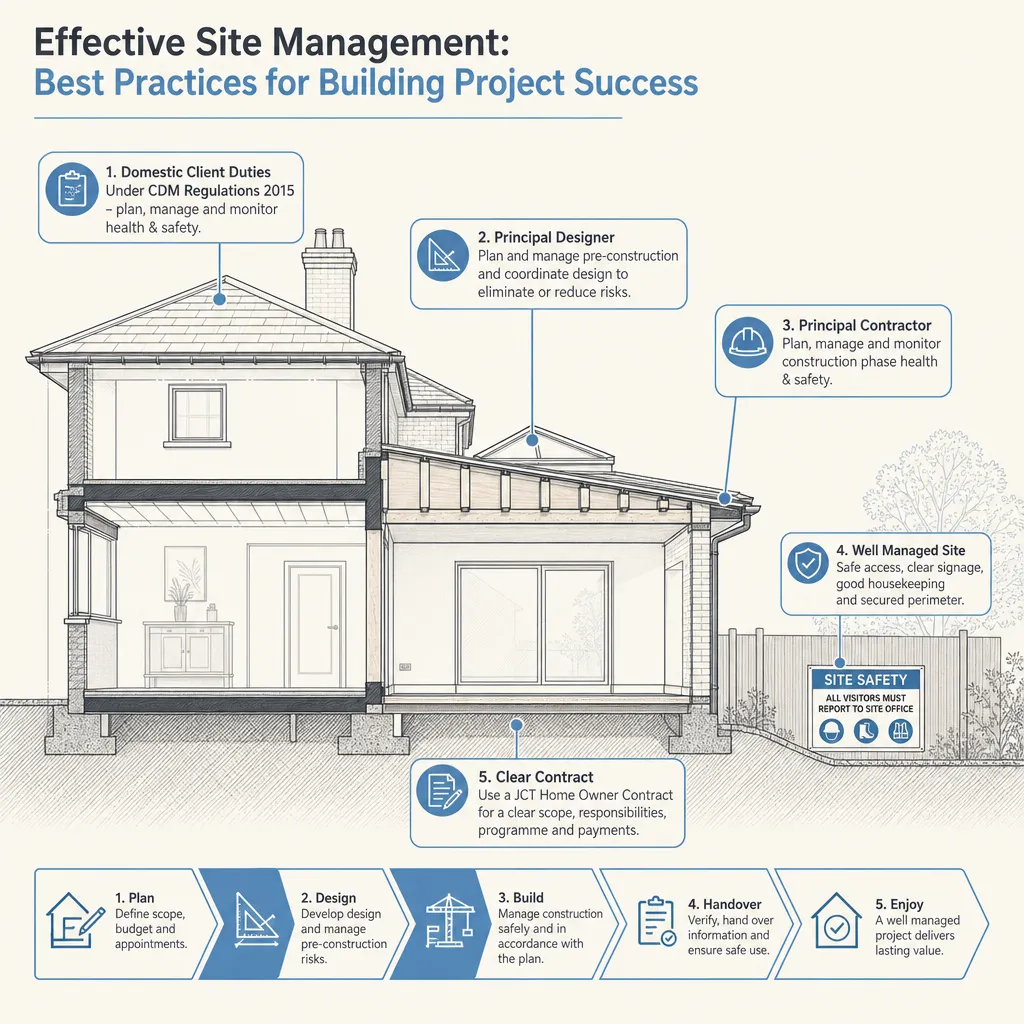
Effective Site Management: Best Practices for Building Project Success
Effective site management on a UK building project requires a clear programme, written contracts, CDM Regulations compliance, and proactive coordination between the principal contractor and all trades.
 Planning & Pre-Build
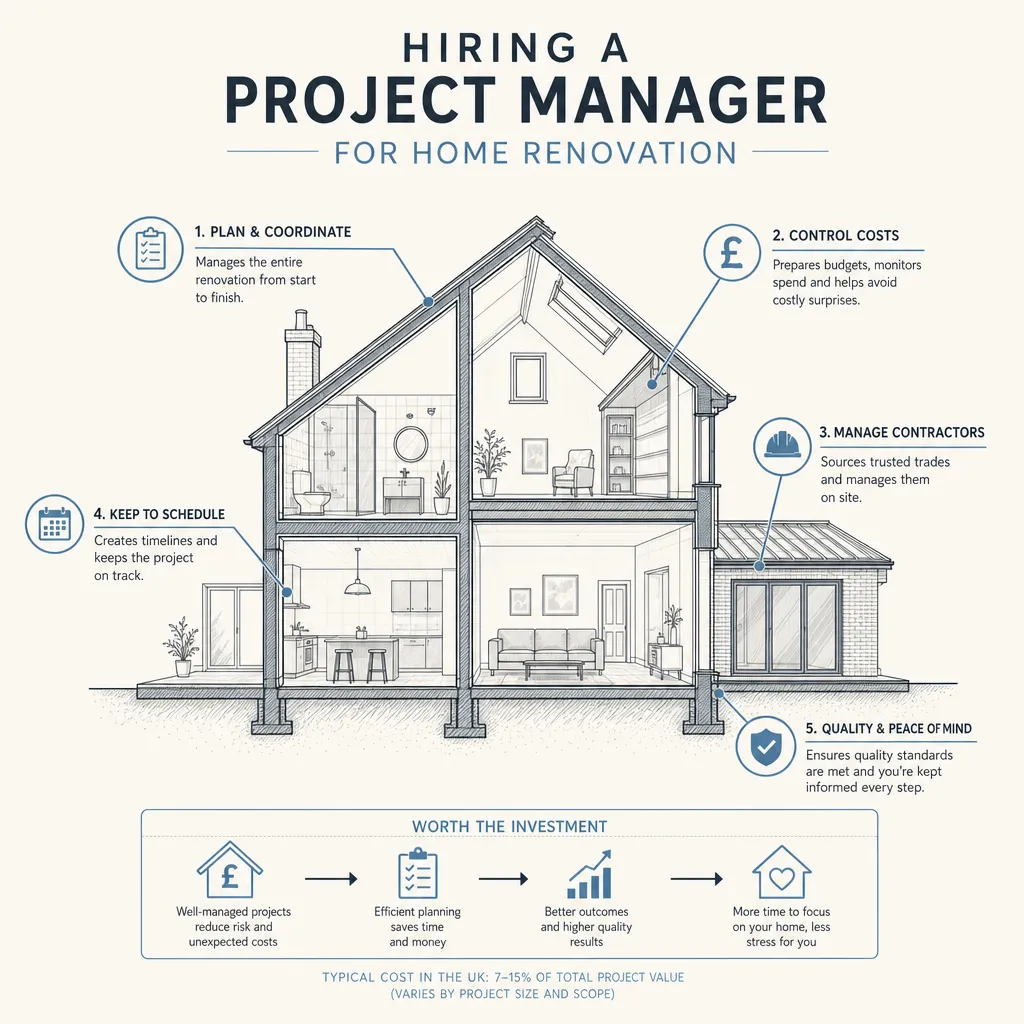
Hiring a Project Manager for Home Renovation
A project manager for home renovation coordinates contractors, manages programme and budget, and oversees quality and building control liaison on your behalf.
 Planning & Pre-Build
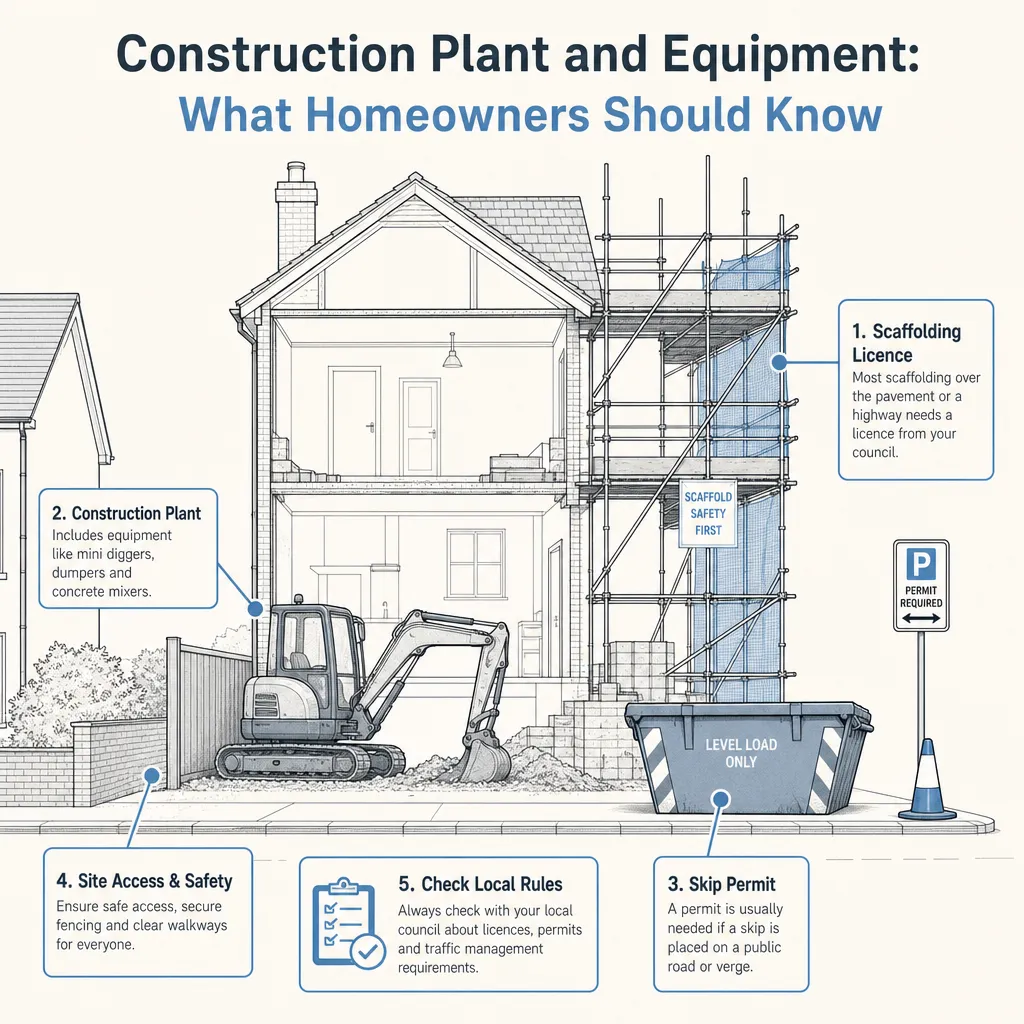
Construction Plant and Equipment: What Homeowners Should Know
Construction plant covers scaffolding, skips, excavators, cranes, and other site machinery.
 Planning & Pre-Build
Project Manager vs. General Contractor: Choosing the Right Professional
A project manager works on your behalf to oversee programme, costs, and contractor performance — they do not carry out building work themselves.
 Planning & Pre-Build
Building and Construction Services: Planning, Design, and Project Delivery
Construction projects in the UK typically involve architects, structural engineers, civil engineers, project managers, and quantity surveyors — each with a distinct role at different stages.