Project Manager vs. General Contractor: Choosing the Right Professional
By Housey · Last reviewed 1st of June 2026
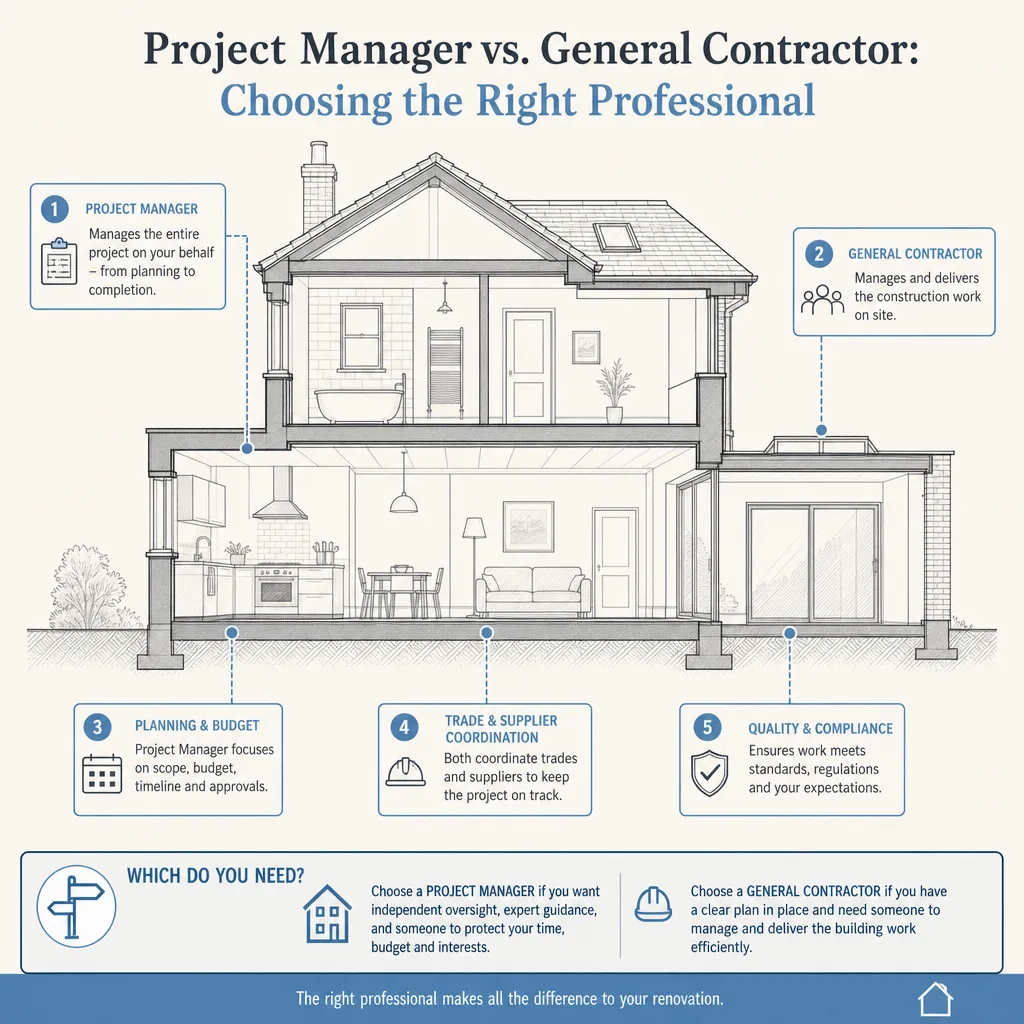
Project Manager vs. General Contractor: Choosing the Right Professional
When you commission a significant building project — a rear extension, loft conversion, or multi-phase renovation — the question of who coordinates the work is as consequential as who carries it out. In the UK, two roles frequently cause confusion: the construction project manager (PM) and the main contractor (the UK equivalent of a general contractor, and the Principal Contractor under the Construction (Design and Management) Regulations 2015). They have different responsibilities, different commercial relationships with you as the client, and suit different types of project. Choosing the wrong model can affect your costs, programme, and legal exposure in ways that are difficult to rectify once work is underway.
Key points
- A construction project manager works on your behalf to oversee programme, budget, design coordination, and contractor performance — they typically do not carry out building work and are paid a management fee, usually 5–15% of project value.
- A main contractor holds a building contract with you, assumes responsibility for delivering the specified works, manages subcontractors directly, and carries the principal contractual risk for delivery.
- Under the Construction (Design and Management) Regulations 2015 (CDM 2015), any project involving more than one contractor requires a formally appointed Principal Contractor — this duty almost always rests with the main contractor, not the PM.
- Joint Contracts Tribunal (JCT) contract forms are the standard for UK domestic and commercial building work; the JCT Minor Works Building Contract suits most domestic extensions up to approximately £200,000.
- Professional project managers may hold RICS, CIOB (Chartered Institute of Building), APM (Association for Project Management), or RIBA credentials — always verify the specific qualification and its scope of practice before instructing.
What does a construction project manager do?
A PM on a UK residential project works for you — the client — as an independent representative. Their role is to manage those who design and build, not to build themselves. Typical responsibilities include:
- Advising on procurement strategy: which contract structure and contractor type best suits your project.
- Coordinating the design team — architect, structural engineer, mechanical and electrical consultants — and managing the flow of information between them.
- Preparing and managing the programme from design development through to practical completion.
- Controlling the budget, including contingency management and evaluation of change orders.
- Issuing instructions to the contractor on your behalf within the agreed terms of the building contract.
- Conducting site inspections to monitor progress and quality against the specification and drawings.
- Certifying interim and final payments to the contractor.
- Coordinating building control, party wall, and other statutory approvals.
A PM does not carry the direct risk of delays or defective work in the way a contractor does — that risk sits within the building contract. However, a PM owes you a professional duty of care: negligent oversight or incorrect payment certifications can give rise to professional liability claims.
What does a main contractor do?
A main contractor holds a priced building contract with you and undertakes to deliver the agreed works by the agreed date. In practice this means:
- Employing and managing all subcontractors: groundworks, structure, carpentry, plumbing, electrical, and finishing trades.
- Sourcing materials and managing deliveries to site.
- Running the site day-to-day: health and safety, logistics, and programme sequencing.
- Reporting progress to you — or to your PM or architect, if one is appointed.
- Managing on-site risks including adverse ground conditions, weather delays, and supply chain issues.
- Coordinating building control inspections at each required stage.
- Fulfilling Principal Contractor duties under CDM 2015 where the project involves more than one contractor.
The contractor's commercial interest is to complete the job profitably within the contracted price. A clearly written contract with a well-defined specification — and independent oversight from a PM or supervising architect — protects you from scope creep, specification dilution, and inflated variation claims.
Comparison: project manager, main contractor, and design-and-build
| Construction project manager | Main contractor | Design-and-build firm |
|---|---|---|---|
Works for | You (the client) | Themselves (under build contract) | Themselves (design + build contract) |
Primary role | Management and independent oversight | Deliver the specified works | Design and deliver the works under one contract |
Design responsibility | None — coordinates the design team | None under traditional procurement | Yes — holds design liability |
Contractual risk | Low — advisory and management role | High — holds the build contract | High — holds combined design and build contract |
Independence from build profit | High | None | None |
Best suited to | Complex projects, multiple contractors, clients with limited time | Clearly specified, single-phase domestic builds | Fast-track projects; clients wanting one point of contact |
Typical cost structure | Management fee: 5–15% of project value | Lump sum or measured contract | Fixed or target-cost contract |
CDM 2015 role | May be appointed Principal Designer separately | Principal Contractor | Principal Contractor; often Principal Designer if design-led |
Which professional do I need? — decision guide
- Appoint a main contractor if you have a complete, specified design from an architect and want a single party to hold the build contract and manage all subcontractors. This is the most common route for UK domestic extensions and loft conversions.
- Appoint a project manager if your project involves multiple contractors or consultants working in sequence, if you have limited time to manage the build yourself, if independent payment certification and quality oversight matter to you, or if the project value exceeds £200,000 where complexity justifies dedicated management.
- Choose a design-and-build firm if programme speed is a priority, if you want one point of contact for both design and construction, and if you are comfortable with reduced design control. Consider appointing an independent consultant to review designs on your behalf.
- Appoint both a PM and a main contractor on larger projects — typically £500,000 or above — complex phased renovations, or works in occupied premises where full-time independent oversight and contract administration are genuinely warranted.
- Check CDM 2015 duties regardless of procurement route: if your project involves more than one contractor, you must appoint a Principal Designer and a Principal Contractor in writing before construction begins. As a domestic client, these duties transfer to the Principal Contractor by default if appointments are not made — but explicit written appointments protect you.
What to ask before accepting a quote
Use these questions when interviewing project managers and main contractors:
- What professional qualifications and accreditations do you hold? (For PMs: MRICS, MCIOB, MAPM, or RIBA-chartered. For contractors: Considerate Constructors Scheme, CHAS, Constructionline, or Federation of Master Builders (FMB) membership.)
- Can you provide references from projects of comparable value and type?
- What contract form do you propose to use, and why? (For most domestic work: JCT Minor Works or JCT Intermediate Building Contract.)
- How are variations — changes to agreed scope — valued and authorised? Is there a formal variation order process?
- Who will be the named site manager, and how many days per week will they be present on site?
- How is the programme structured, and what notification is required if delays arise?
- What insurance do you carry — employers' liability, public liability, and professional indemnity?
- What defects liability period applies after practical completion, and what is the process for rectifying snagging items?
- How do you manage the building control process, and how is the completion certificate obtained and handed over?
CDM 2015: what every homeowner should know
The Construction (Design and Management) Regulations 2015 place duties on clients — including domestic homeowners — as well as on designers and contractors. Key client duties include:
- Appointing a Principal Designer (usually the lead architect or designer) to coordinate health and safety during the pre-construction phase.
- Appointing a Principal Contractor before construction starts on any project involving more than one contractor.
- Allowing sufficient pre-construction time for design, planning, and coordination.
- Maintaining a health and safety file for the completed project, to be passed on at any future sale.
As a domestic client, if you do not make these appointments in writing, the Principal Contractor assumes those duties by default. If you have also appointed a PM, agree in writing which party holds each CDM role before works commence to avoid ambiguity.
When to get professional help
Always seek independent advice before signing a contractor's own standard terms — particularly provisions governing variation pricing, programme liability, and damages caps. A construction solicitor or Chartered Surveyor (RICS) can review proposed contract terms and flag unusual or unfair clauses.
Consider appointing a PM or supervising architect if:
- Your project value exceeds £100,000, where errors in contract administration can prove costly to resolve.
- The project involves listed building works, Conservation Area restrictions, party wall agreements, or multiple statutory consents requiring coordination.
- The works involve structural modifications, basement excavation, or other technically complex operations requiring independent scrutiny of the contractor's proposals.
- You have concerns about a contractor's financial stability — check Companies House filing history and consider a formal credit check on the contracting entity.
How Housey can help
Housey connects homeowners with vetted project managers and design-and-build firms across the UK. Whether you need independent oversight of a complex renovation or a single point of contact for design and construction, you can compare qualified professionals and request detailed quotes through the platform.
Frequently asked questions
Is a project manager the same as an architect in the UK?
Not necessarily. Some architects offer full project management services (RIBA Plan of Work Stage 5 — Construction), but not all provide intensive oversight of cost, programme, and contractor performance. A dedicated construction PM — whether RICS-qualified, CIOB-chartered, or APM-credentialed — typically focuses more explicitly on contract administration, cost control, and programme management than on design.
What building contract should I use for a UK home extension?
The JCT Minor Works Building Contract is widely used for straightforward domestic projects up to approximately £200,000. The JCT Intermediate Building Contract suits more complex or phased works. Both are available from the Joint Contracts Tribunal. An architect or PM can advise on the most appropriate form for your project and complete the contract particulars correctly.
Can a main contractor also act as the project manager?
A main contractor can offer project management services, but their commercial interest in the build outcome creates a conflict of interest. If the contractor manages the project, you lose independent oversight of costs, quality, and programme. For straightforward, well-specified projects this may be acceptable; for complex or high-value builds, independent oversight is usually worthwhile.
How do I verify that a contractor is legitimate?
Ask for their company registration number and verify it against Companies House. Confirm current public liability insurance — minimum £2m for domestic work. Check membership of recognised schemes such as the Federation of Master Builders (FMB), Constructionline, or CHAS. For works involving gas, electrical, or structural elements, confirm subcontractor competency certifications such as Gas Safe or NICEIC.
Sources and further reading
- Construction (Design and Management) Regulations 2015 — legislation.gov.uk
- CDM 2015 — guidance for clients — Health and Safety Executive
- JCT — Joint Contracts Tribunal — JCT
- RICS — project management in construction — Royal Institution of Chartered Surveyors
- CIOB — Chartered Institute of Building — CIOB
- Federation of Master Builders — find a builder — FMB
Useful next reads
 Planning & Pre-Build
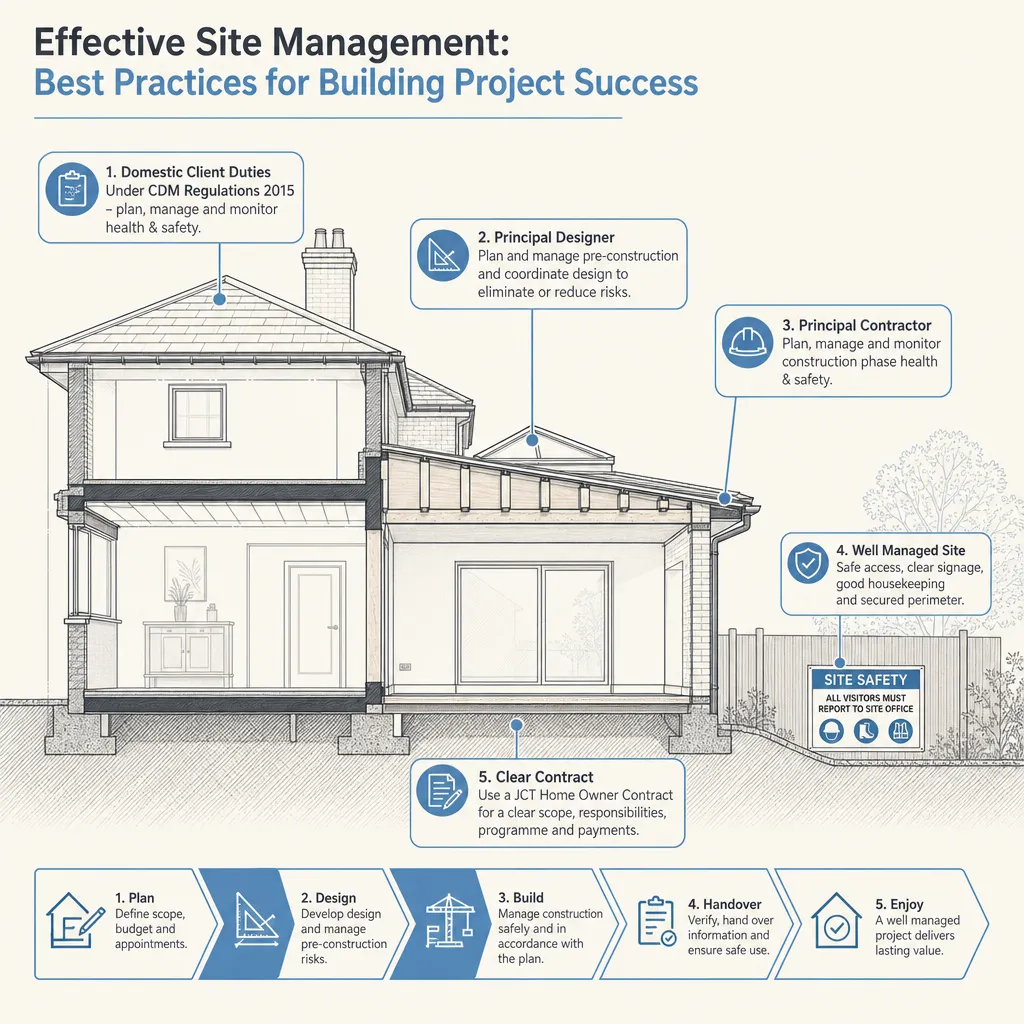
Effective Site Management: Best Practices for Building Project Success
Effective site management on a UK building project requires a clear programme, written contracts, CDM Regulations compliance, and proactive coordination between the principal contractor and all trades.
 Planning & Pre-Build
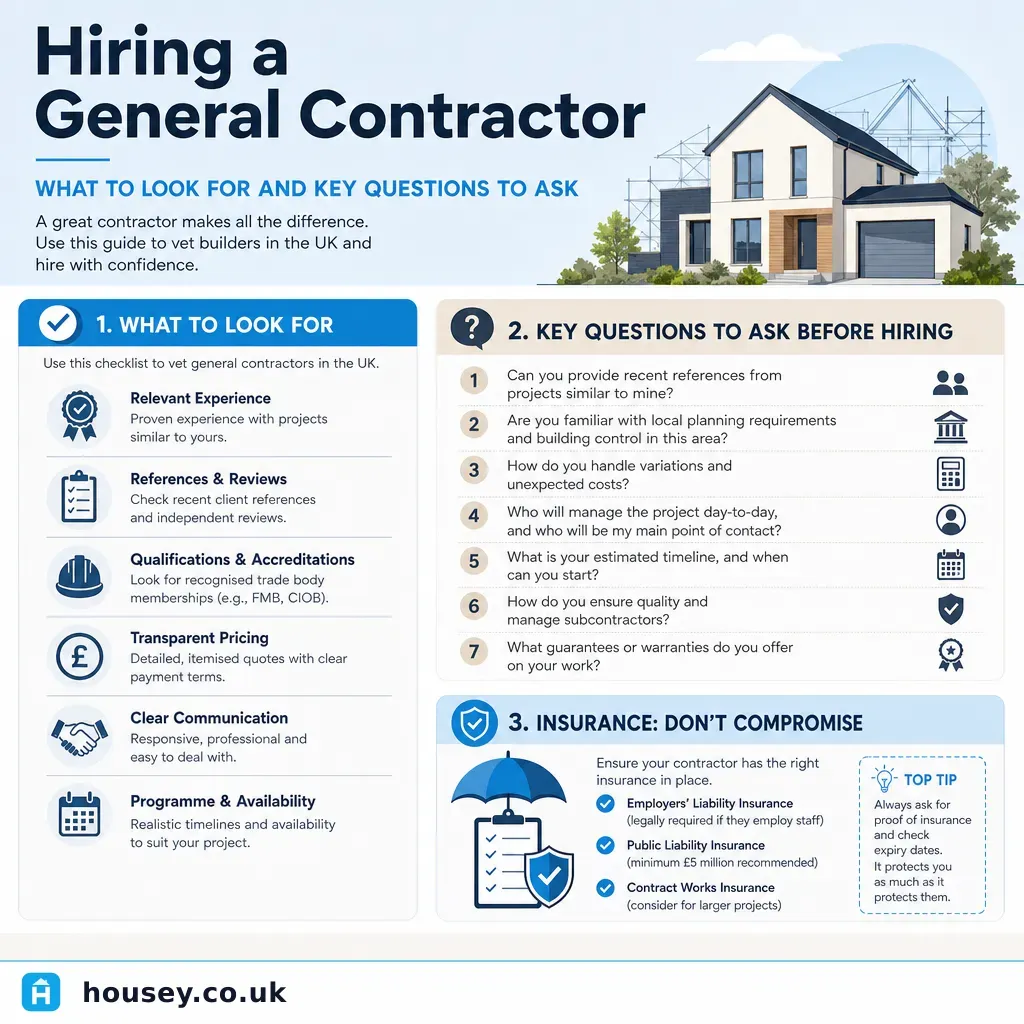
Hiring a General Contractor: What to Look For and Key Questions to Ask
Hiring a general contractor in the UK requires verifying FMB or TrustMark membership, checking that public liability and employers' liability insurance certificates are current, obtaining at least three written quotes against the same specification, and signing a written contract — ideally a JCT form — with stage payments tied to verified milestones rather than calendar dates.
 Planning & Pre-Build
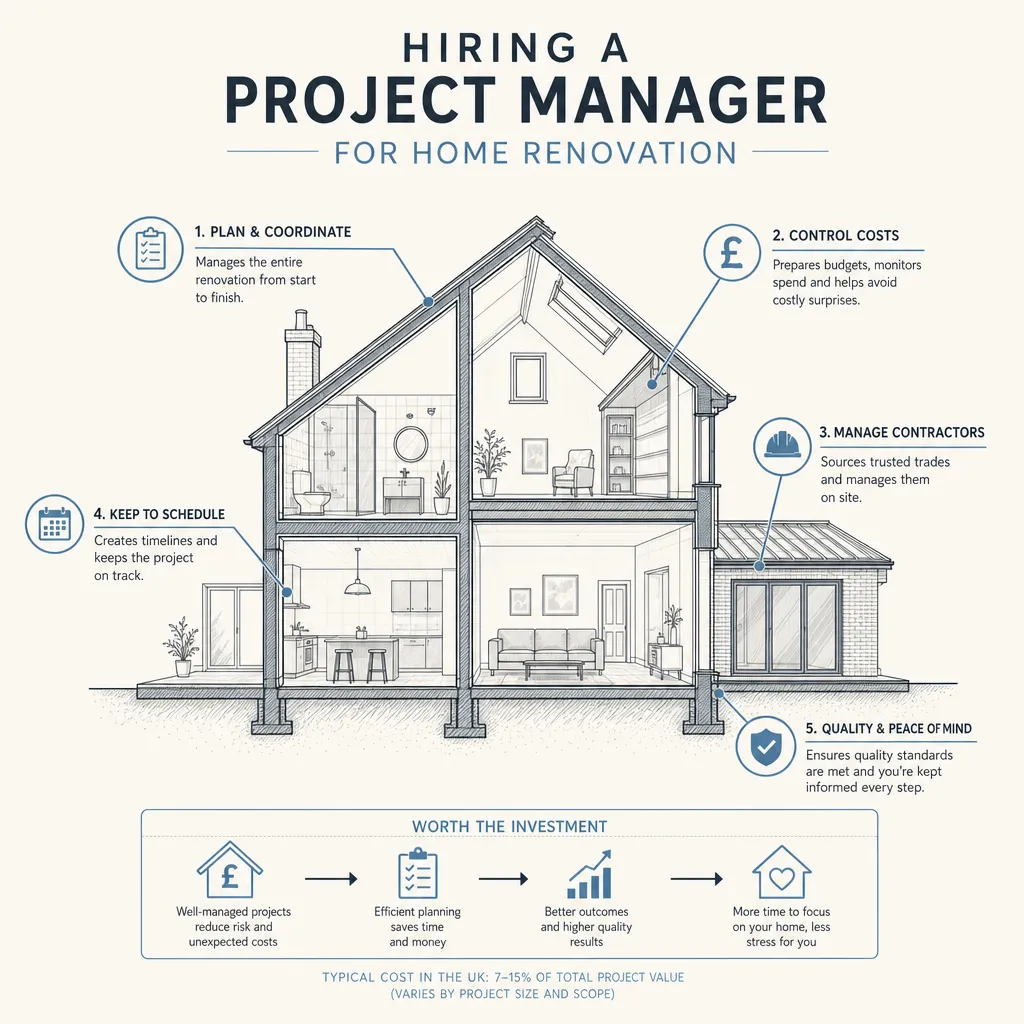
Hiring a Project Manager for Home Renovation
A project manager for home renovation coordinates contractors, manages programme and budget, and oversees quality and building control liaison on your behalf.
 Planning & Pre-Build
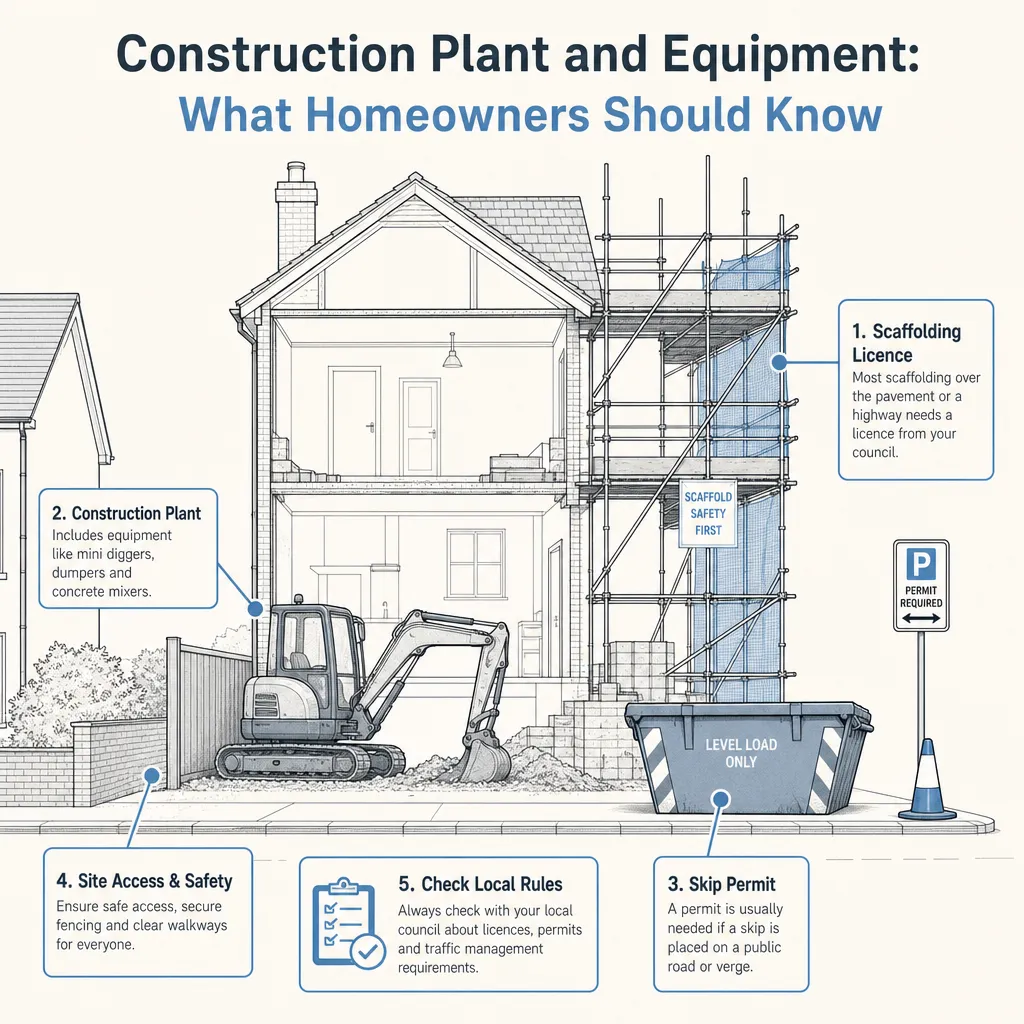
Construction Plant and Equipment: What Homeowners Should Know
Construction plant covers scaffolding, skips, excavators, cranes, and other site machinery.
 Planning & Pre-Build
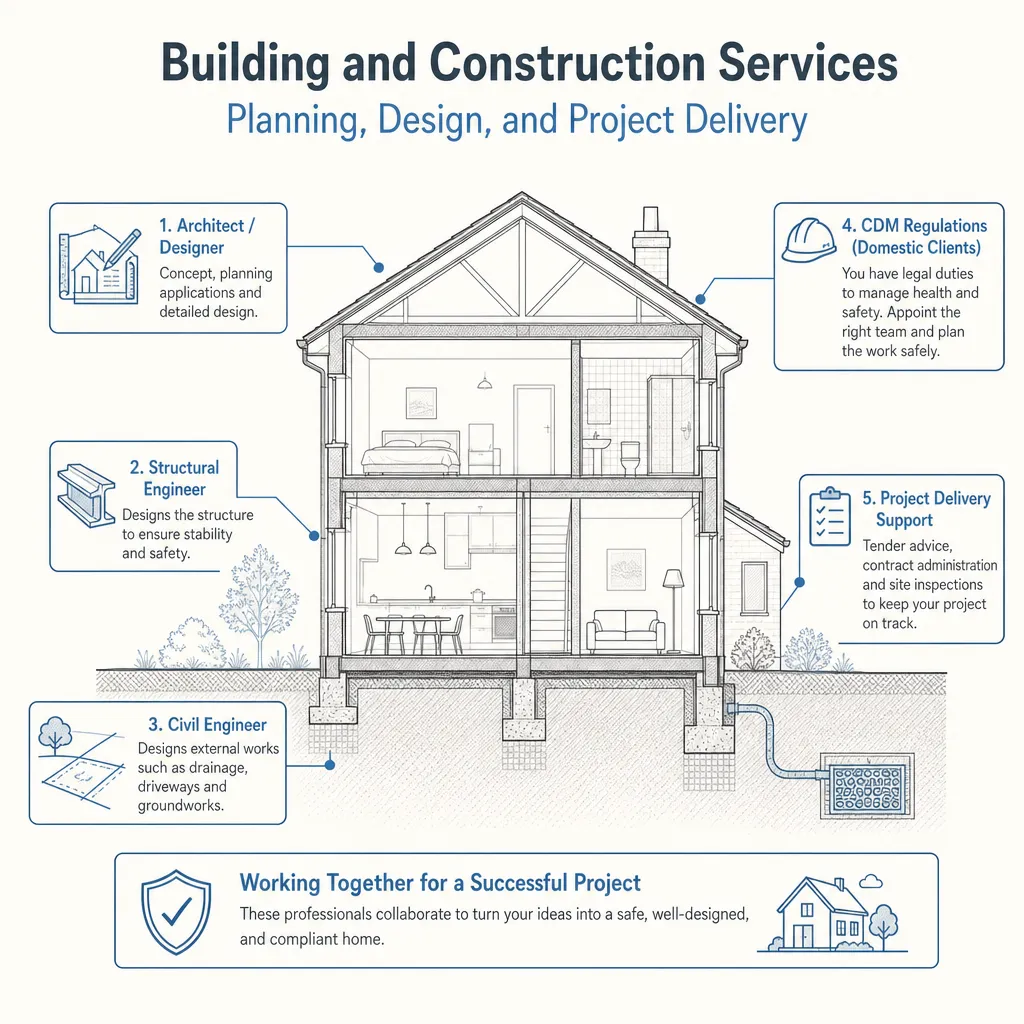
Building and Construction Services: Planning, Design, and Project Delivery
Construction projects in the UK typically involve architects, structural engineers, civil engineers, project managers, and quantity surveyors — each with a distinct role at different stages.