Removing a Garage: Effects on Home Value and Feasibility
By Housey · Last reviewed 11th of May 2026
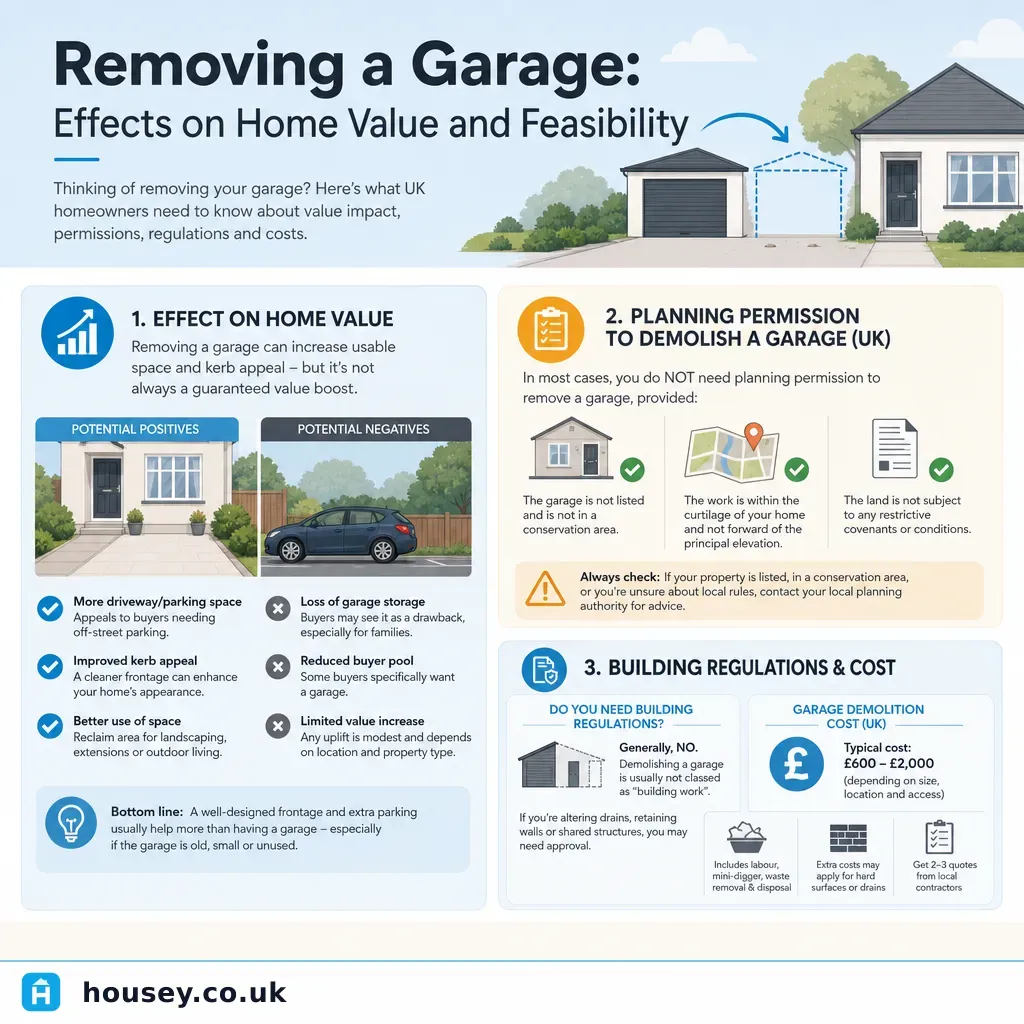
Removing a Garage: Effects on Home Value and Feasibility
Garages are removed from UK residential properties for many reasons — to release land for an extension, to gain additional garden space, or because a deteriorating structure has become a liability rather than an asset. The decision is rarely as simple as instructing a demolition crew: it carries planning, structural, building regulations, and valuation implications that vary significantly depending on whether the garage is detached, attached, or integral to the main house. Getting the preliminary assessment right avoids costly surprises once work is under way.
Key points
- Demolishing a detached outbuilding exceeding 50 m³ in England requires prior notification to the local planning authority under the Town and Country Planning (Demolition — Description of Buildings) Direction 2021, even where no planning application is needed.
- Where a garage shares a wall, roof, or structural element with the main house, a structural engineer's assessment is required before demolition begins — removing the garage affects the loadings and weather envelope of the main building.
- Building Regulations approval is likely to apply when the garage is attached to or integral with the dwelling, when services need diverting, or when new construction follows on the cleared footprint.
- Removing off-street parking can reduce property value in areas where parking is scarce — RICS valuers note the presence and condition of outbuildings and parking as part of their assessment.
- Structures built before 2000 may contain asbestos-containing materials in roofing sheets, soffits, or flue pipes — a survey by a competent asbestos professional is required before any demolition begins.
How garage removal affects property value
The effect on value is not uniform and depends on the local market, the type of garage, its condition, and what replaces it.
Scenario | Likely value effect | Key consideration |
|---|---|---|
Detached garage in good condition removed; garden space gained | Neutral to slight positive or slight negative depending on area | In parking-scarce areas, loss of off-street parking reduces value; where parking is ample, garden gain may offset this |
Integral garage removed and opening infilled | Can be negative | Alters the front elevation; loss of parking is visible to buyers and noted by lenders' valuers |
Garage removed to enable a quality side or rear extension | Neutral to positive | Value uplift from a well-executed extension often outweighs the loss of the garage |
Dilapidated garage removed and site cleared | Neutral to slight positive | Removes a liability and survey risk; buyers are no longer discounting for the structure's condition |
Garage in dense urban area (e.g., inner London, Bristol city centre) removed | Potentially significantly negative | Off-street parking in dense urban areas commands a material premium; buyers and lenders factor this into offers |
RICS mortgage valuers record the presence, type, and condition of parking and outbuildings. Removal of off-street parking can affect the assessed security value and, in some cases, the lender's loan-to-value offer.
Planning and permitted development: what applies?
Decision tree — garage demolition in England
- Detached outbuilding within the residential curtilage, volume under 50 m³, no conservation area designation, not listed: Demolition is typically permitted development — no planning application required. Confirm with your LPA if in any doubt.
- Detached outbuilding exceeding 50 m³: Prior notification to the LPA is required under the Town and Country Planning (Demolition — Description of Buildings) Direction 2021 before works begin.
- Garage attached to or forming part of the main house: Altering the external envelope of a dwelling may require planning permission. Confirm with your LPA before instructing works.
- Conservation area: Demolition of a building within a conservation area requires Conservation Area Consent — check with your LPA regardless of the garage type.
- Listed building: Listed building consent is required for any demolition or alteration of a listed building or its curtilage structures. Consult your LPA's conservation officer.
- Converted garage used as habitable space: If the conversion was approved under a change-of-use planning permission or building regulations consent, removal or reinstatement requires consideration of those approvals.
- New development on the cleared footprint: Any new structure will require its own building regulations application and, if it exceeds permitted development limits, a planning application.
When building regulations apply
Building regulations are likely to apply if the garage shares a wall with the main house (removing it exposes the main building's structure and weather envelope), if the garage is integral with living accommodation above or alongside, if services including electricity, gas, or drainage run through the structure and require diversion, or if new construction is to follow on the footprint.
Homeowner checklist before garage demolition
Red flags before you proceed
- The garage roof abuts or is integrated with the main house roof — removal may expose or damage the dwelling's weatherproofing and require structural intervention.
- A chimney breast or flue runs through the garage — removal requires structural engineering input and building control notification before work begins.
- The garage has recently been converted to habitable space and forms part of the property's assessed room count — removing it may require planning permission for change of use and will affect the RICS valuation.
- The property is within a Controlled Parking Zone (CPZ) or an area of high parking pressure — removing off-street parking in such locations can significantly reduce value and affect a mortgage offer.
- Pre-2000 corrugated or flat roofing is present — suspect asbestos-containing materials must be surveyed and, if confirmed, removed by a licensed contractor before any demolition begins. Do not break up, drill, or disturb suspect materials.
- A shared access or right of way runs along the garage boundary — neighbour rights or easements may be affected by demolition or subsequent development, and your solicitor should advise before work begins.
Important limitations
This article provides general information about garage demolition in England. Planning rules, building regulations requirements, and structural considerations vary significantly by property type, construction method, local planning authority, and any conditions or covenants attached to the title. Rules differ in Wales, Scotland, and Northern Ireland. Nothing in this article constitutes structural, planning, legal, or asbestos-related advice. Engage qualified professionals to assess your specific property before instructing any works.
What to ask a qualified professional
Before instructing demolition, consider asking:
- Is the garage structurally independent of the main house, or does it share load-bearing walls, a roof structure, or a party wall?
- Are there asbestos-containing materials — particularly in the roof, soffits, or flue — that require a survey and licensed removal contractor before demolition?
- Does the demolition require prior notification to the LPA, or is a full planning application needed given the property's location or history?
- Are there planning conditions on the title that restrict removal of outbuildings or require retention of parking provision?
- Will building regulations approval be required, and what is the scope of the application?
- What is the impact on the main building's structural integrity and thermal envelope if a shared wall is exposed or removed?
- Are there any party wall or shared boundary issues that need to be resolved under the Party Wall etc. Act 1996 before works begin?
When to get professional help
Always seek professional input before proceeding if:
- The garage shares a wall, roof, or any structural element with the main dwelling.
- The roof or wall materials predate 2000 and asbestos-containing materials may be present.
- The property is listed, in a conservation area, or subject to planning conditions or restrictive covenants.
- Services need diverting and the full scope is unclear.
- The property is leasehold and the lease may restrict external structural changes or require landlord consent.
How Housey can help
Housey can connect you with experienced demolition contractors for domestic garage removals, a structural engineer to assess shared walls and loading implications before work begins, and professionals who can produce building regulations drawings to support your application and ensure the works comply with current requirements.
Frequently asked questions
Do I need planning permission to demolish a garage in England?
In England, demolishing a detached outbuilding within the residential curtilage does not usually require a planning application under permitted development rights. However, if the structure exceeds 50 m³ in volume, prior notification to the local planning authority is required before demolition. Conservation areas and listed buildings have stricter requirements. Attached or integral garages may need permission if their removal alters the main dwelling's external envelope — confirm with your LPA before proceeding.
Will removing a garage reduce my property value?
It depends on the local market and garage type. In dense urban areas where off-street parking is scarce, removing a garage can reduce value materially. In suburban areas with ample roadside parking, the effect may be neutral or offset by additional garden space or development potential. A RICS valuer or local estate agent familiar with your specific street can give a more reliable opinion based on comparable properties nearby.
How much does garage demolition cost in the UK?
Indicative UK costs, last reviewed 2026-05-11. A straightforward single detached garage demolition typically costs between £1,000 and £3,500 depending on size, construction type, and disposal requirements. Additional costs arise for asbestos surveys and removal, service diversions, and hard-landscaping or reinstatement of the cleared area. Obtain at least three quotes from competent contractors and confirm how waste and rubble disposal is priced.
Does removing an integral garage require building regulations?
Almost certainly yes. An integral garage that shares a wall, floor, or roof with the main house is part of the dwelling's structural and thermal envelope. Removing it exposes structural elements, affects thermal performance, and often requires drainage or service diversions — all of which trigger a Building Regulations application. Notify your local building control body or an approved inspector before any works begin, and obtain a completion certificate on sign-off.
Sources and further reading
- When is permission required? (demolition guidance) — GOV.UK Planning Practice Guidance
- Town and Country Planning (General Permitted Development) (England) Order 2015 — legislation.gov.uk
- Building Regulations Approved Document A: Structure — GOV.UK
- Control of Asbestos Regulations 2012 — HSE
- Conservation areas: permitted development rights — Historic England
- RICS Home Survey Standard — RICS
Useful next reads
 Improvement & Build
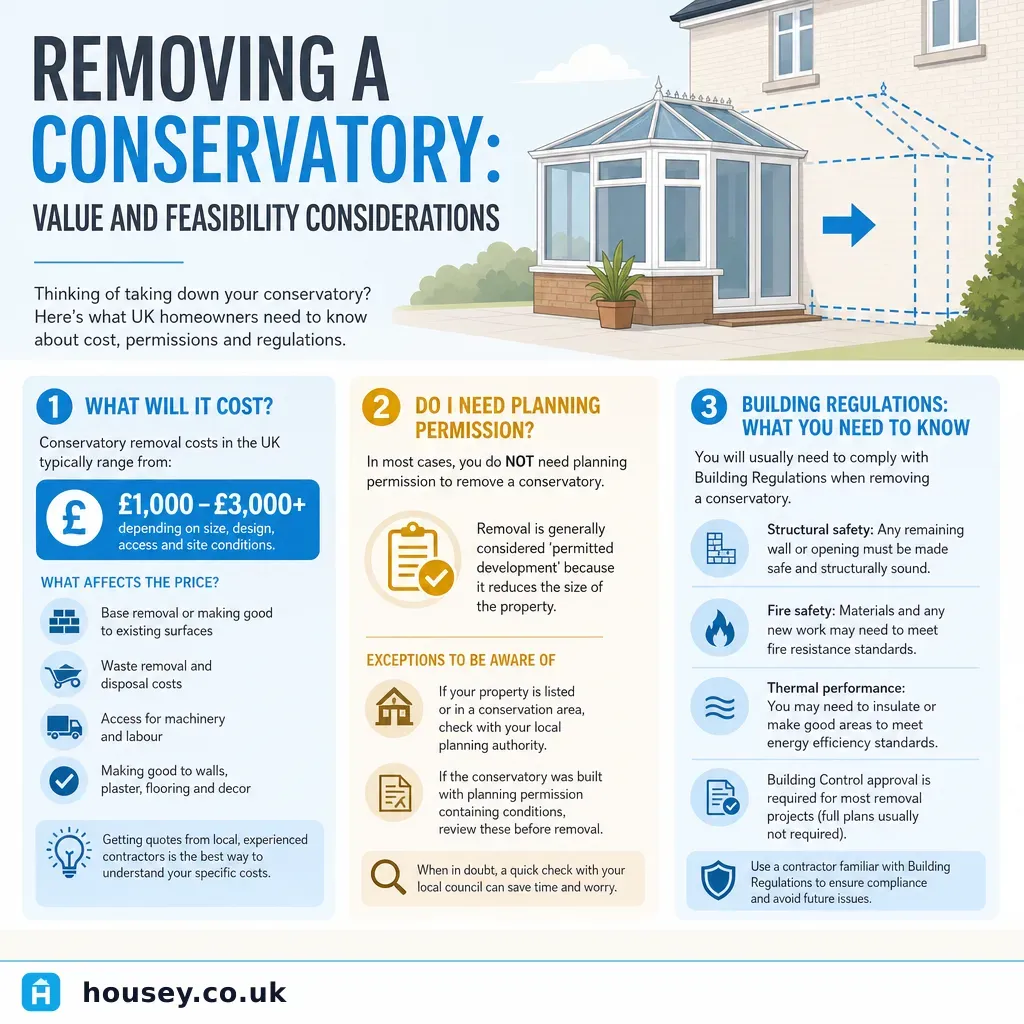
Removing a Conservatory: Value and Feasibility Considerations
Removing a conservatory in England usually does not need planning permission if the original structure was permitted development, but reinstating the original wall almost always requires a building regulations application covering structural, thermal, and moisture elements.
 Improvement & Build
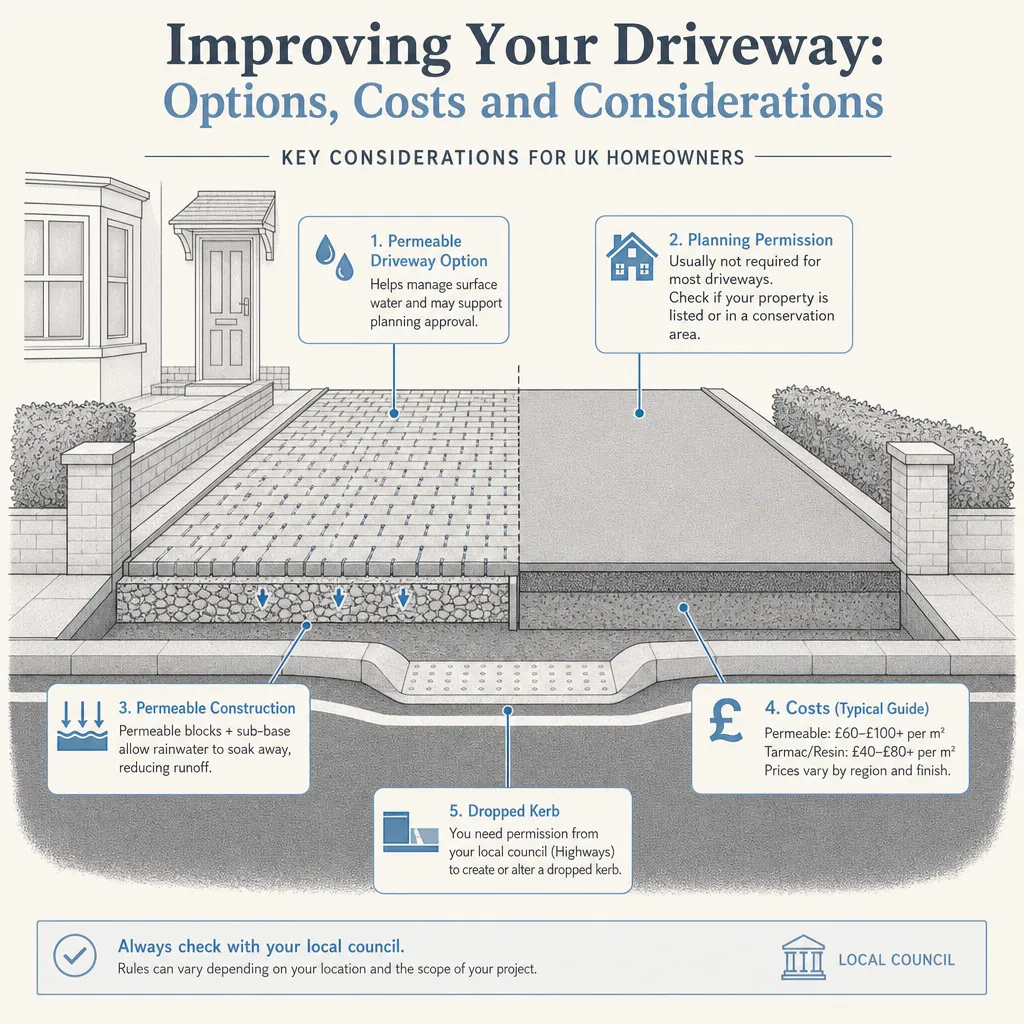
Improving Your Driveway: Options, Costs and Considerations
Installing a new driveway with a non-permeable surface larger than 5m² over a front garden in England requires planning permission unless water drains to a permeable area.
 Improvement & Build
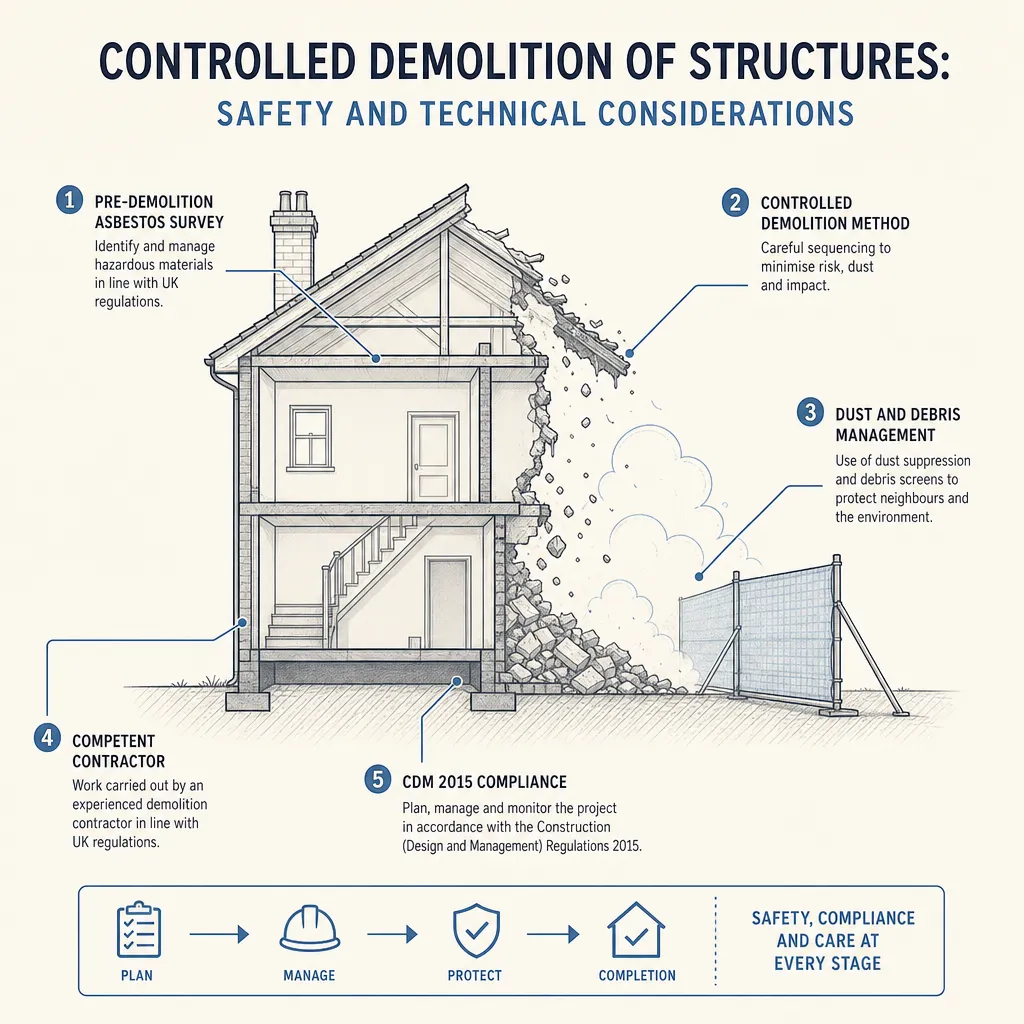
Controlled Demolition of Structures: Safety and Technical Considerations
Controlled demolition in the UK covers any planned, engineered removal of a structure, governed by CDM 2015 and HSE requirements.
 Improvement & Build
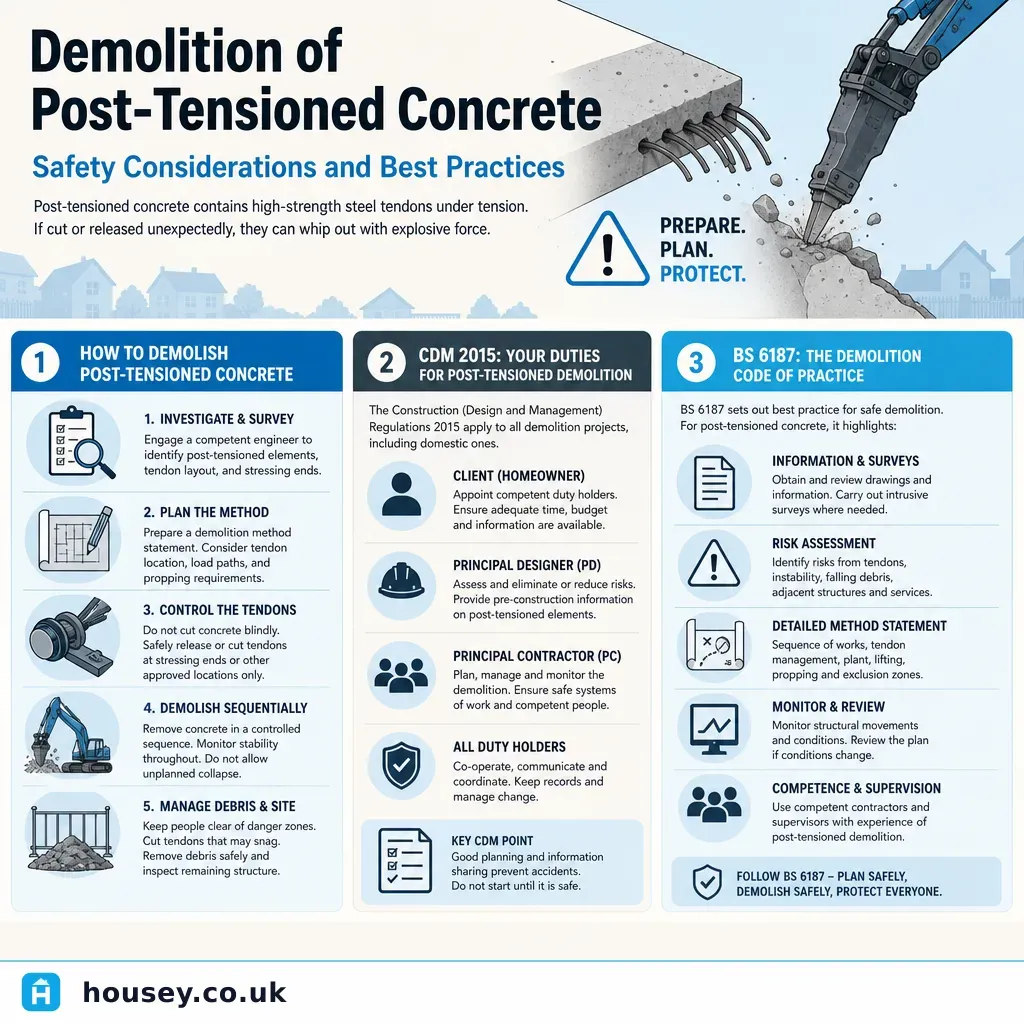
Demolition of Post-Tensioned Concrete: Safety Considerations and Best Practices
Post-tensioned concrete contains steel tendons under loads of up to 1,860 MPa.
 Improvement & Build
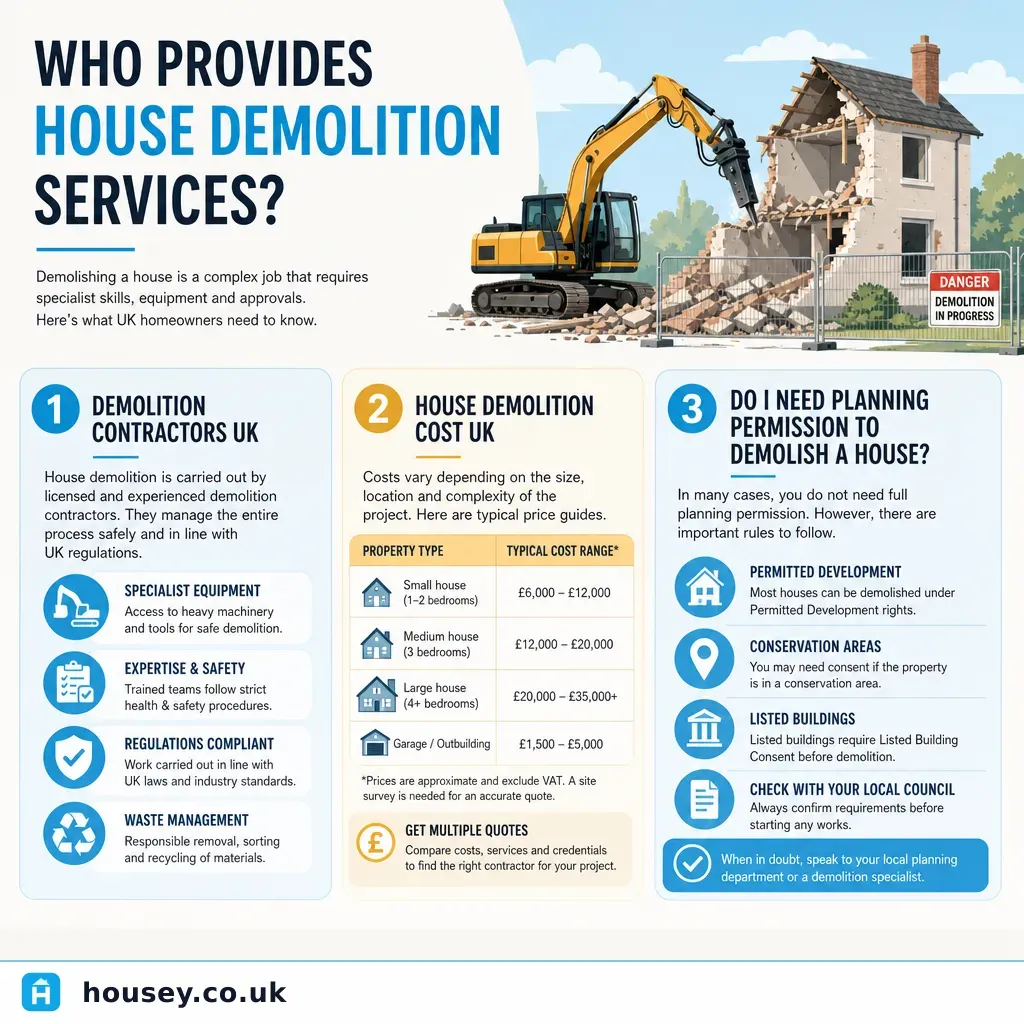
Who Provides House Demolition Services
House demolition in the UK is carried out by specialist demolition contractors, often members of the National Federation of Demolition Contractors (NFDC).