Garage Conversion for Added Living Space and Value
By Housey · Last reviewed 11th of May 2026
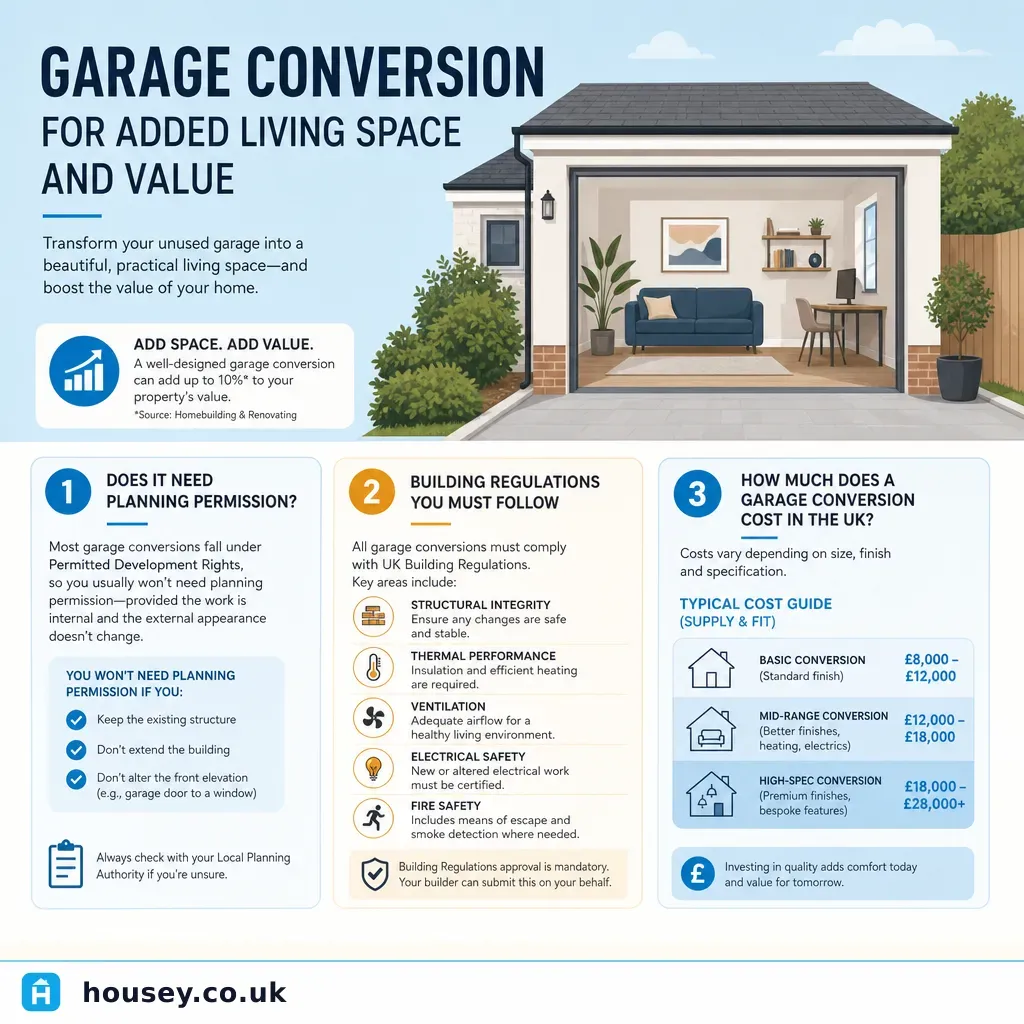
Garage Conversion for Added Living Space and Value
Garage conversions are one of the most straightforward ways to add habitable floor area to an existing UK home without extending the footprint, pouring new foundations, or going through a lengthy planning process. For homeowners with an integral or attached garage that rarely sees a car, the question is usually not whether to convert, but whether permitted development applies, what building regulations require, and whether the investment makes financial sense for their particular property and market. Getting the regulatory and structural elements right from the outset avoids enforcement notices, failed building control sign-off, and complications at resale.
Key points
- Most integral and attached garage conversions in England fall within Class G permitted development and do not require a planning application, but this does not cover detached garages being converted into separate dwellings.
- All garage conversions — regardless of planning status — require Building Regulations approval under Parts A, B, C, F, L, and often P.
- Building Regulations Part L requires new habitable rooms to meet minimum U-values; typical targets for a retrofitted garage wall are around 0.18 W/m²K.
- A building regulations completion certificate is essential for a future property sale — mortgage lenders and conveyancing solicitors routinely request it.
- Properties in conservation areas, listed buildings, and those subject to Article 4 directions may require a full planning application even for work that would otherwise be permitted development.
Does a garage conversion need planning permission?
In England, converting an integral or attached garage to habitable use is generally permitted development under Class G of the Town and Country Planning (General Permitted Development) (England) Order 2015, provided:
- The work does not involve an extension to the building beyond the original footprint.
- The property is a dwellinghouse — not a flat, maisonette, or property that has been split into multiple units.
- The property is not in a conservation area, subject to an Article 4 direction, or listed — all of which remove or restrict permitted development rights.
- The original planning consent for the house did not include a condition requiring the garage to be retained for parking, which is common on 1980s and 1990s estate developments.
Planning permission decision guide:
- Choose the permitted development route if the garage is integral or attached, the property is a standard dwellinghouse, and no Article 4 or conservation area restrictions apply.
- Apply for planning permission if the property is listed, in a conservation area, or has a prior planning condition requiring garage retention.
- Check the original planning consent before committing to any works — your local planning authority can advise, and a planning consultant can assist if conditions are unclear.
- Note that Scotland, Wales, and Northern Ireland have separate planning frameworks with different permitted development thresholds and requirements.
What building regulations apply?
Building regulations approval is mandatory for all garage conversions, regardless of whether planning permission was needed. A building control officer will inspect the works at agreed stages and issue a completion certificate when satisfied. The main applicable parts in England and Wales are:
Regulation Part | What it covers | Typical application to garage conversions |
|---|---|---|
Part A — Structure | Floors, walls, roof adequacy | Existing slab assessed; new openings require lintel or RSJ specification |
Part B — Fire safety | Means of escape and fire spread | Fire doors, smoke alarms, and escape windows may be required |
Part C — Resistance to moisture | Damp-proof membrane and insulation | Concrete garage floors usually need a DPM and insulated floating floor or screed |
Part F — Ventilation | Background and purge ventilation | Trickle vents or mechanical extract ventilation required in habitable rooms |
Part L — Energy efficiency | Thermal performance of envelope | Minimum U-values for walls, roof, floor, doors, and windows must be met |
Part P — Electrical safety | Notifiable electrical work | New circuits require an NICEIC- or NAPIT-registered electrician to certify |
Building control can be carried out by the local authority building control (LABC) service or a Registered Building Inspector under the Building Safety Act 2022. Completing works without a completion certificate can make the property harder to sell and mortgage.
Comparing garage conversion types
Garage type | Typical planning status | Key structural considerations | Relative cost (indicative) |
|---|---|---|---|
Integral garage (within main house footprint) | Usually permitted development | Floor and thermal envelope upgrade; door opening may need lintel | Lower — structure already exists |
Attached garage (linked to house, own roof) | Usually permitted development | Roof junction detail; potential cold-bridging at junction with main house | Moderate — may need new roof detail |
Detached garage (separate structure in garden) | Usually permitted development | Full thermal envelope; new services connection to main building | Higher — standalone structure |
Detached garage converted to separate dwelling | Planning permission required | Full compliance as new dwelling including Part M accessibility provisions | Highest — full planning and regulatory process |
Indicative UK costs for a straightforward integral garage conversion range from approximately £10,000 to £25,000 depending on specification, finishes, and region. These are indicative figures, last reviewed 2026-05-11, and quotes will vary significantly by location and scope. Obtain at least three detailed written quotes before proceeding.
What affects value — and what doesn't
Adding habitable floor space generally adds value, but the return depends on several factors:
- Local parking supply: in areas where off-street parking is scarce or controlled, removing a garage may reduce the property's appeal to buyers and partially offset any gain from the added room.
- Quality and compliance: a conversion with a building regulations completion certificate, appropriate insulation, and finishes that match the rest of the house adds more value than one that is visually inconsistent or lacks documentation.
- Use of the new space: a bedroom with an en-suite or a home office with natural light tends to attract more buyer interest than a utility room or secondary storage space.
- Documentation trail: missing completion certificates can prompt indemnity insurance requirements or remediation demands from a buyer's solicitor, which reduces the net financial benefit.
Homeowner checklist before starting work:
Important limitations
This article provides general information about garage conversions in England. Planning rules differ in Scotland, Wales, and Northern Ireland. Permitted development rights can be removed or restricted by Article 4 directions, conservation area designations, or existing planning conditions, none of which are visible from an external inspection of the property. Building regulations requirements and the registered building inspector regime are subject to ongoing change following the Building Safety Act 2022. Always verify requirements with your local planning authority and a building control body before work begins. Nothing in this article constitutes planning, legal, structural, or financial advice.
When this becomes urgent
Seek professional advice before starting work if:
- You are unsure whether your property has planning conditions relating to garage retention — these are not visible without checking the original consent.
- The garage has a shared wall with a neighbour, as the Party Wall etc. Act 1996 may apply and formal notices may be required.
- The garage roof or walls show signs of movement, cracking, or water ingress — structural assessment should precede conversion works.
- You are purchasing a property with an existing garage conversion — always check that building regulations approval and a completion certificate are in place before exchange.
- You plan to install new electrical circuits, gas connections, or structural alterations.
What to ask a qualified professional
Before instructing a garage conversion specialist or submitting a building control application:
- Will you manage the building regulations application, and will I receive a formal completion certificate on completion?
- How will you achieve the required U-values for the walls, floor, and roof without excessive loss of internal floor area?
- How will you address dampness and cold bridging in the existing concrete floor slab?
- Is a structural engineer required to specify a lintel or RSJ for any new openings through walls?
- Does the Party Wall etc. Act 1996 apply to any shared walls, and will you advise on notices?
- What trade body or accreditation scheme are you registered with, and what warranties do you provide?
When to get professional help
Garage conversions involve structural, thermal, fire safety, and regulatory elements that interact closely — particularly around moisture, ventilation, and means of escape. A garage conversion specialist can manage the full project from feasibility through building control sign-off. If you need technically compliant drawings for a planning application or building regulations submission, a professional building regulations drawings service will produce documents that meet the requirements of your local authority or Registered Building Inspector.
How Housey can help
Housey connects homeowners with experienced garage conversion specialists and professionals who produce building regulations drawings. Describe your garage type and intended new use, and receive competitive quotes from vetted local specialists.
Frequently asked questions
Do I need planning permission to convert my garage in England?
Most integral and attached garage conversions in England are permitted development and do not require a planning application. However, this does not apply to listed buildings, properties in conservation areas, or those with prior planning conditions requiring the garage to be retained for parking. Always check with your local planning authority if you are uncertain.
Can I carry out a garage conversion without building regulations approval?
No. All garage conversions require building regulations approval in England and Wales, regardless of planning status. Working without approval — or failing to obtain a completion certificate — can cause significant difficulties when you come to sell the property, as mortgage lenders and conveyancing solicitors routinely request it.
Will a garage conversion add value to my home?
A well-executed conversion with a building regulations completion certificate typically adds value, particularly if it creates a bedroom, home office, or living room. In areas where off-street parking is scarce, losing a garage may partially offset the gain. A local RICS-registered valuer can give an assessment specific to your location.
How long does a garage conversion take?
Most standard integral garage conversions take between four and eight weeks from start to completion. Projects involving structural alterations such as new lintels, RSJs, or openings through party walls may take longer. Your building control officer will agree inspection stages at the outset, and these affect the programme.
Sources and further reading
- Garage conversions: do I need permission? — Planning Portal
- Building regulations approval — GOV.UK
- Town and Country Planning (General Permitted Development) (England) Order 2015 — legislation.gov.uk
- Party Wall etc. Act 1996 — guidance — GOV.UK
- Building Safety Act 2022 — legislation.gov.uk
Useful next reads
 Improvement & Build
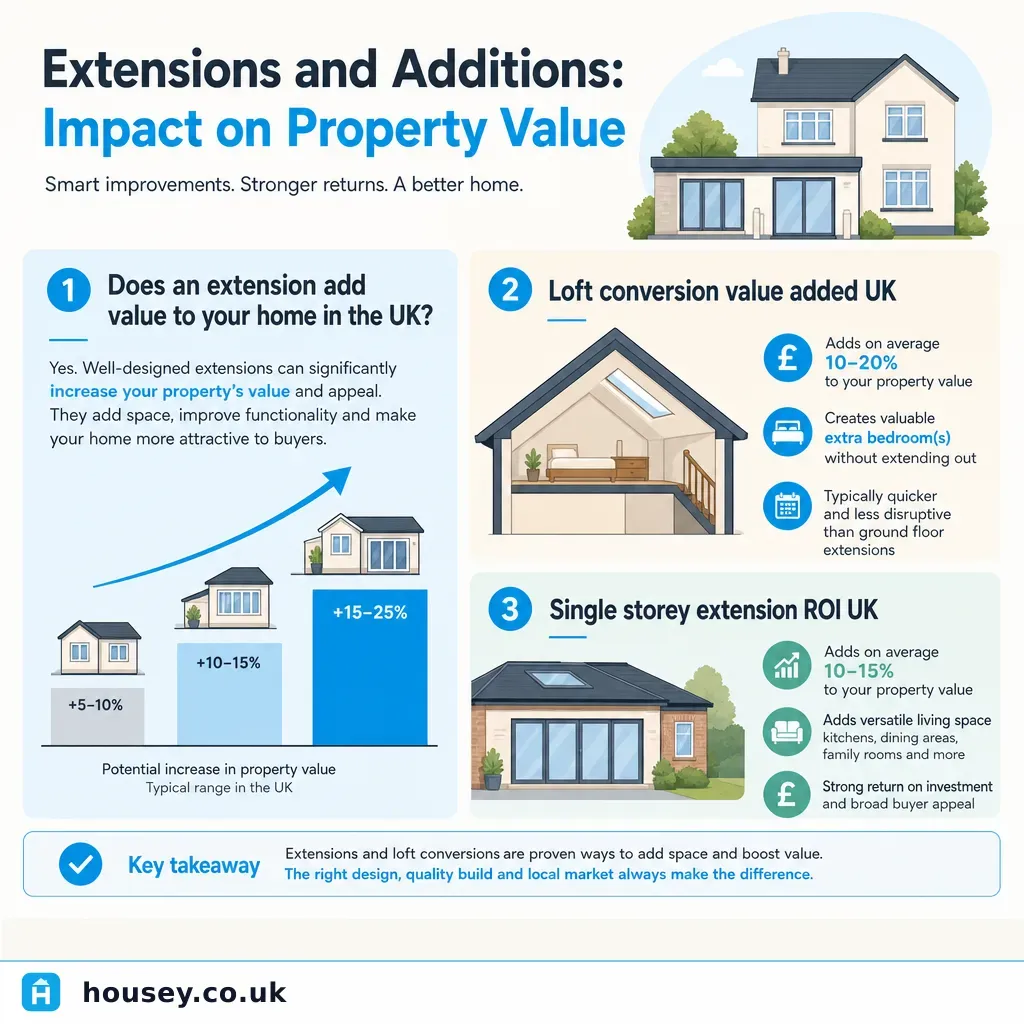
Extensions and Additions: Impact on Property Value
Extensions typically add 5–20% to UK property values depending on type, quality, and local market conditions.
 Improvement & Build
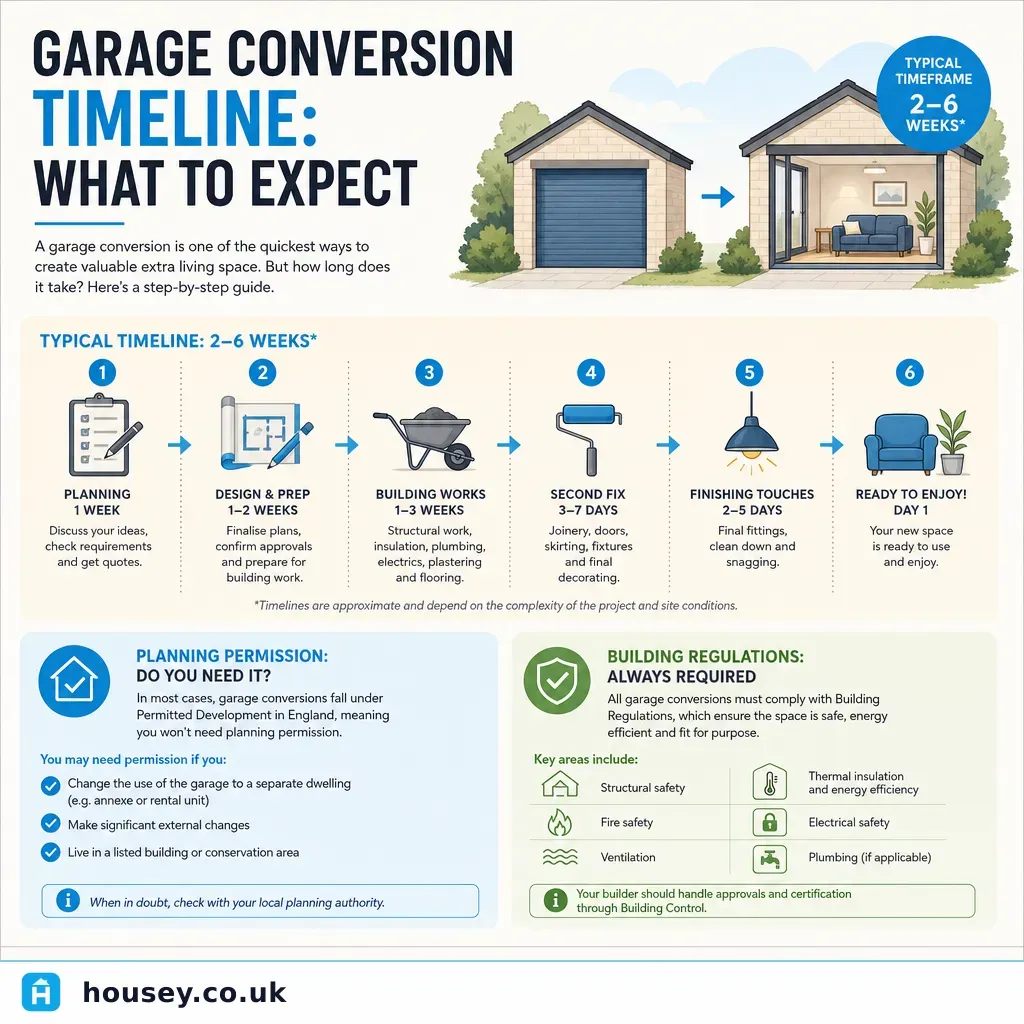
Garage Conversion Timeline: What to Expect
A straightforward attached garage conversion in England usually takes 4–8 weeks of construction, plus pre-start time for building control approval (5 working days for Full Plans).
 Improvement & Build
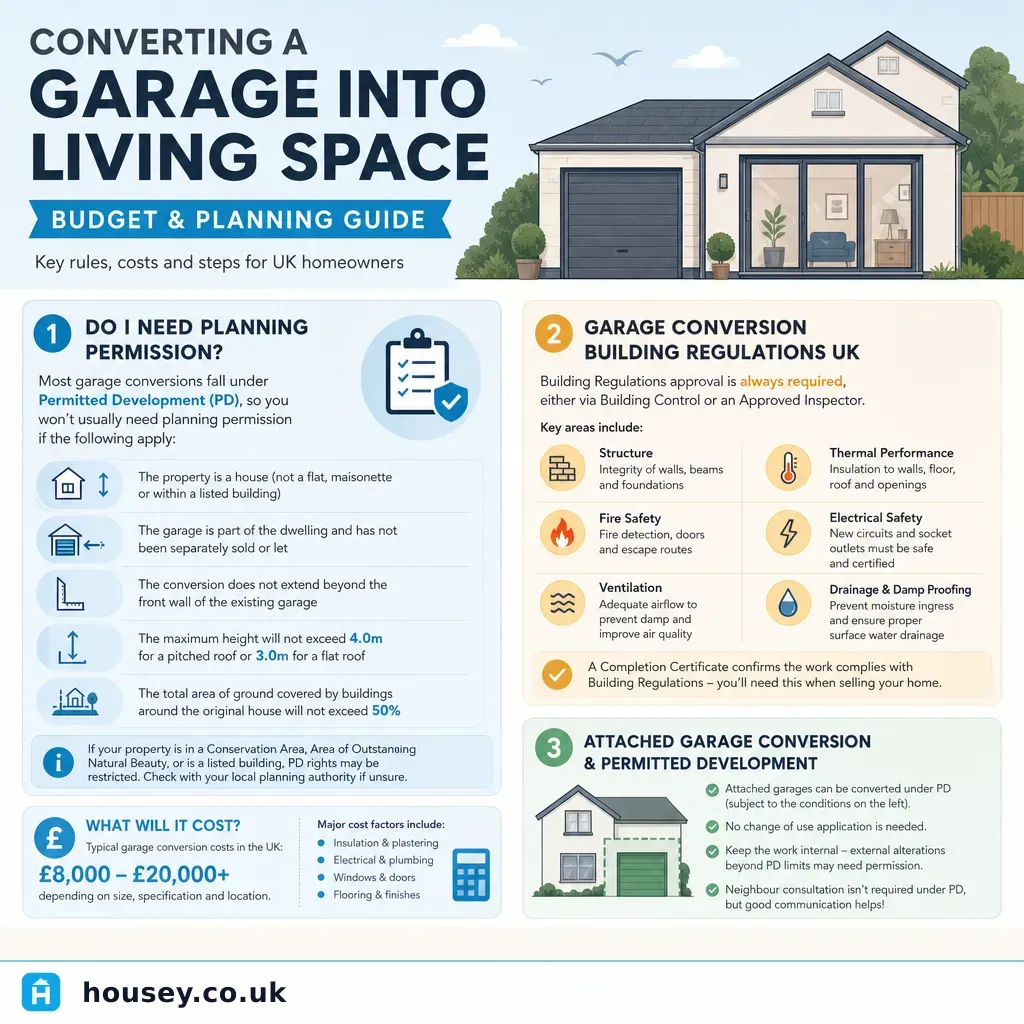
Converting a Garage into Living Space: Budget and Planning Guide
A single-garage conversion typically costs £8,000–£20,000 in the UK.
 Improvement & Build
Removing a Conservatory: Value and Feasibility Considerations
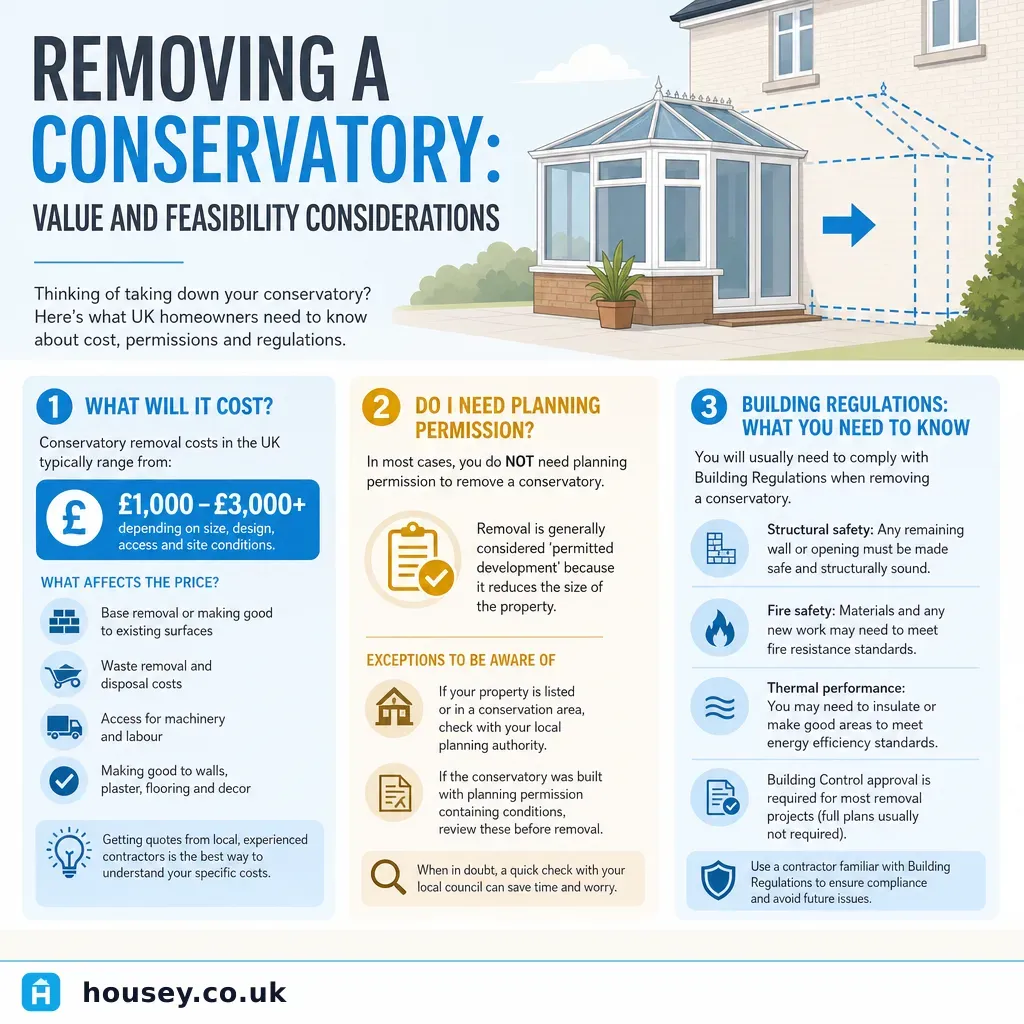
Removing a conservatory in England usually does not need planning permission if the original structure was permitted development, but reinstating the original wall almost always requires a building regulations application covering structural, thermal, and moisture elements.
 Improvement & Build
Converting a Garage: Planning, Design and Building Requirements
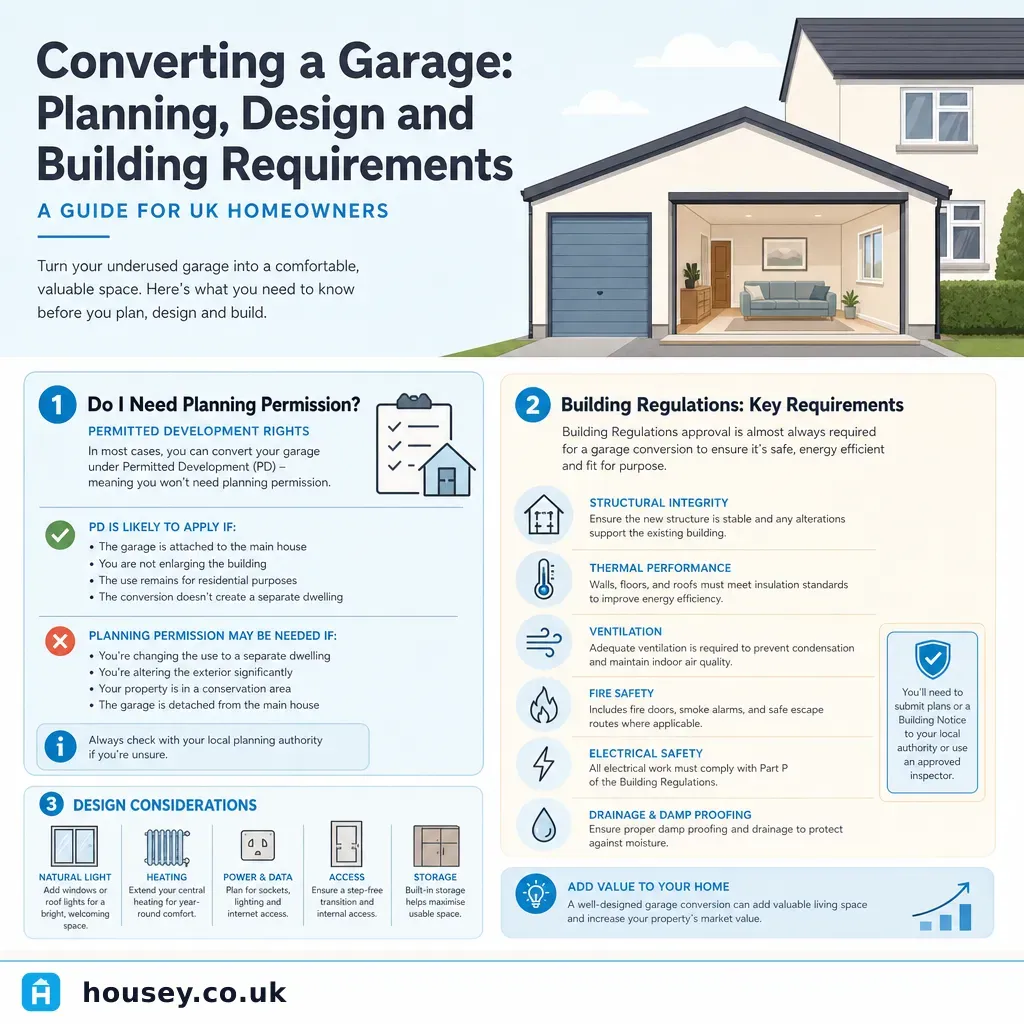
Most garage conversions in England do not need planning permission under permitted development rights, but all conversions require Building Regulations approval covering structure, thermal insulation, fire safety, and ventilation.