Converting a Garden Shed Into Habitable Space
By Housey · Last reviewed 10th of May 2026
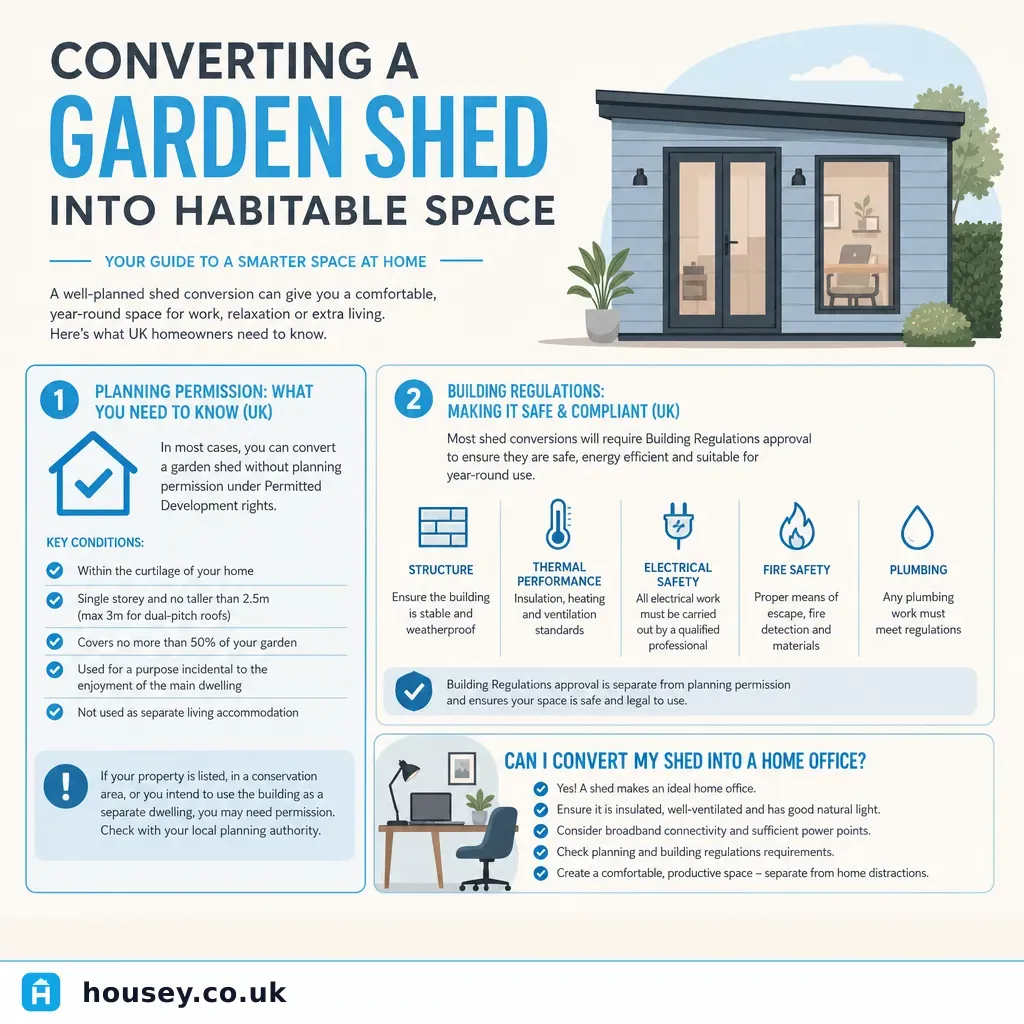
Converting a Garden Shed Into Habitable Space
Many homeowners look at an existing garden shed and wonder whether it could become something more useful — a home office, hobby room, teenager's retreat, or occasional sleeping space. The appeal is obvious, but converting a shed into habitable space in England involves navigating planning permission, Building Regulations, and practical construction challenges that go well beyond fitting out a timber box. Getting the regulatory position clear before any work begins protects both your investment and your ability to sell the property later.
Key points
- A shed converted into habitable space almost always requires Building Regulations approval under the Building Regulations 2010, regardless of whether planning permission is also needed.
- Most domestic garden sheds fall under Class E permitted development (Schedule 2, Part 1, Town and Country Planning (General Permitted Development) (England) Order 2015) for storage use, but switching use to habitable space changes the regulatory position.
- Building Regulations Part L (energy efficiency), Part F (ventilation), Part B (fire safety), and Part P (electrical safety) all apply to habitable rooms.
- In conservation areas, National Parks, Areas of Outstanding Natural Beauty, and World Heritage Sites, permitted development rights are more restricted — check with your Local Planning Authority (LPA) before starting.
- A shed converted to habitable use without building regulations approval can complicate a future property sale — conveyancers routinely ask about outbuildings in pre-contract enquiries.
Does a shed conversion need planning permission?
For most residential properties in England, converting a garden shed into a home office or occasional-use room does not require a planning application under Class E permitted development. However, this depends on conditions being met.
When permitted development may apply
- The outbuilding is within the curtilage of the house (your enclosed garden).
- It is not forward of the principal elevation of the house.
- Its height does not exceed 2.5 m within 2 m of a boundary, or 4 m (dual-pitched roof) or 3 m (any other roof type) further away.
- The total footprint of all outbuildings does not exceed 50% of the curtilage, excluding the footprint of the original house.
When planning permission is required
- The property is a listed building — any alteration or change of use requires listed building consent from the LPA.
- The property is in a conservation area or designated land — Class E restrictions are tighter; check with your LPA before assuming permitted development applies.
- The outbuilding is intended as self-contained accommodation — a separate annexe with independent cooking, sleeping, and sanitary facilities constitutes a material change of use and requires a full planning application.
- Permitted development rights have been removed by an Article 4 Direction — your LPA can confirm whether this applies.
Does a shed conversion need building regulations approval?
Yes, in almost all cases where the shed will be used as habitable space. The Building Regulations 2010 draw a clear distinction between a structure used for storage (non-habitable) and one used for living, sleeping, or regular working (habitable). Once a space is habitable, the following Approved Documents apply:
- Part L (Conservation of Fuel and Power) — insulation standards for walls, floor, roof, and windows must be met.
- Part F (Ventilation) — adequate fresh-air supply and moisture management are required.
- Part B (Fire Safety) — particularly relevant if the building is used for sleeping.
- Part P (Electrical Safety) — applies if any electrical installation work is carried out.
- Part A (Structure) — the existing structure must be assessed as structurally sound for the intended use.
You will need to submit either a Full Plans application (recommended — confirms compliance before work begins) or a Building Notice (faster but riskier, with inspection during and after construction) to your local authority building control department or an approved inspector.
Decision tree: planning permission, building regs, or both?
- Proceed under permitted development (no planning application) if: the shed is within the permitted development limits above, the intended use is not self-contained accommodation, and the property is not listed or in a conservation area.
- Submit a planning application if: the shed will be self-contained accommodation, the property is listed or in a conservation area, or the structure exceeds permitted development volume or height limits.
- Always apply for building regulations approval if: the shed will be used as habitable space — home office, bedroom, living room, or any room used regularly.
- Consult your LPA if: your property has an Article 4 Direction, you are unsure whether the use is self-contained, or the outbuilding was erected without permission.
- Instruct a building control consultant or architect if: the conversion involves structural alterations, new electrical circuits, or the building is listed.
What building work is typically involved?
Converting a standard timber shed to a Building Regulations-compliant habitable room usually involves a significant programme of work. Most existing sheds fall short of habitable standards in several areas:
Element | Typical requirement | Common issue with existing sheds |
|---|---|---|
Foundations | Adequate concrete strip or slab | Most sheds sit on timber bearers or paving slabs |
Structure | Timber frame adequate for habitable loads | Shed frames are rarely designed for insulated walls |
Insulation | Part L standards — 100 mm walls, 150 mm floor, 200 mm roof | Typically uninsulated |
Windows and doors | Double-glazed, thermally broken frames | Single-glazed shed windows fail Part L |
Electrical installation | Part P compliant, notifiable if new circuit | Usually absent or non-compliant |
Ventilation | Trickle vents, extract if wet room included | Absent or inadequate |
Fire safety | Escape window or door, smoke detection if sleeping use | Rarely provided |
Shed conversion vs purpose-built garden room: a comparison
Option | Planning risk | Building regs required? | Indicative cost | Build quality | Typical timeline |
|---|---|---|---|---|---|
Convert existing shed | Low–medium (condition dependent) | Yes, for habitable use | £8,000–£20,000+ | Variable — depends on existing structure | 2–5 months |
Purpose-built timber garden room | Low–medium (same PD rules apply) | Yes, for habitable use | £15,000–£40,000+ | Higher — built to spec | 3–6 months |
New permanent garden building (masonry or SIP) | May need planning | Yes | £20,000–£60,000+ | Highest | 4–8 months |
Indicative UK costs, last reviewed 2026-05-10. Actual costs depend on specification, location, and contractor.
Important limitations
This article provides general information about the planning and Building Regulations framework in England. Rules vary by property type, tenure, local authority, planning history, and the specific outbuilding involved. Nothing in this guide constitutes planning advice or legal advice. A qualified building control consultant, planning consultant, or architect should assess your specific property and intended use before any work begins or any application is submitted.
When this becomes urgent
Stop relying on general guidance and seek professional advice without delay if:
- You have already started conversion work without building regulations approval — a regularisation application may be possible, but unpermitted habitable works can affect saleability and insurance.
- The shed shows signs of structural instability — racking, rot at the base, or movement in walls or roof — as habitable conversion without structural assessment is unsafe.
- You intend to use the converted space for sleeping — fire escape and smoke detection requirements under Part B require careful professional assessment.
- The property is listed, in a conservation area, or subject to restrictive covenants — permitted development rights may not apply and enforcement action is possible.
What to ask a qualified professional
When speaking to a building control consultant, architect, or planning consultant about a shed conversion:
- Does this conversion require a planning application, or does it fall within permitted development for this specific property?
- Which Building Regulations Approved Documents will apply to the intended use?
- Is the existing structure adequate for habitable conversion, or does it need to be rebuilt?
- Should I use a Full Plans application or a Building Notice, and what are the practical implications of each?
- What insulation specification will meet Part L for a structure of this size?
- Will I need a separate electrical circuit, and does it need to be installed by a Part P-registered electrician?
- What will the completion certificate process look like, and how long does building control sign-off typically take?
- Are there any restrictions on this property that could affect permitted development rights?
When to get professional help
For any shed conversion intended as habitable space, professional involvement is required by law for building control purposes. In practice:
- Engage a building control consultant or approved inspector early to agree the compliance route before work starts.
- Use an architect or architectural technician if structural drawings or a Full Plans submission is needed.
- Instruct a planning consultant if the property is listed, in a conservation area, or if self-contained accommodation is proposed.
- Ensure all electrical work is carried out by a Part P-registered electrician (NICEIC or NAPIT registered).
How Housey can help
Housey connects homeowners with vetted professionals for outbuilding and conversion projects. Whether you need building regulations drawings prepared before your application, guidance from experienced building control consultants, or quotes from extension builders familiar with outbuilding conversion, you can submit a brief and compare responses from local professionals.
Frequently asked questions
Can I use a converted shed as a permanent home office?
A shed used regularly as a workplace is classed as habitable space and requires Building Regulations approval. You do not typically need a planning application under Class E permitted development in England, provided the property meets the relevant conditions — but confirm with your Local Planning Authority. Building Regulations approval is required regardless of whether planning permission is needed.
Do I need planning permission to sleep in a converted shed?
If the shed will be used for occasional sleeping as part of the household, Building Regulations apply but planning permission may not be required under permitted development. If the space will be a self-contained annexe with independent cooking and sanitary facilities, a change of use planning application is likely needed. Always check with your local planning authority before starting work.
How long does building regulations approval take for a shed conversion?
A Full Plans application typically takes 5–8 weeks to approve before work begins, with inspections at agreed stages and a completion certificate issued on satisfactory sign-off. A Building Notice can be started on submission but carries more risk, as compliance is assessed during and after construction rather than agreed upfront.
What happens if I convert a shed without building regulations approval?
The local authority can issue an enforcement notice requiring remediation or removal. Unpermitted habitable works also appear in conveyancing searches and may need to be regularised before a property sale can proceed. A retrospective regularisation application is possible but may require opening up walls or floors to allow the inspector to assess insulation and structure.
Sources and further reading
- Outbuildings — permitted development rules — Planning Portal
- Building Regulations Approved Documents — GOV.UK
- Town and Country Planning (General Permitted Development) (England) Order 2015 — legislation.gov.uk
- Building regulations guidance for homeowners — Local Authority Building Control (LABC)
- Listed buildings and planning consent — Historic England
Useful next reads
 Planning & Pre-Build
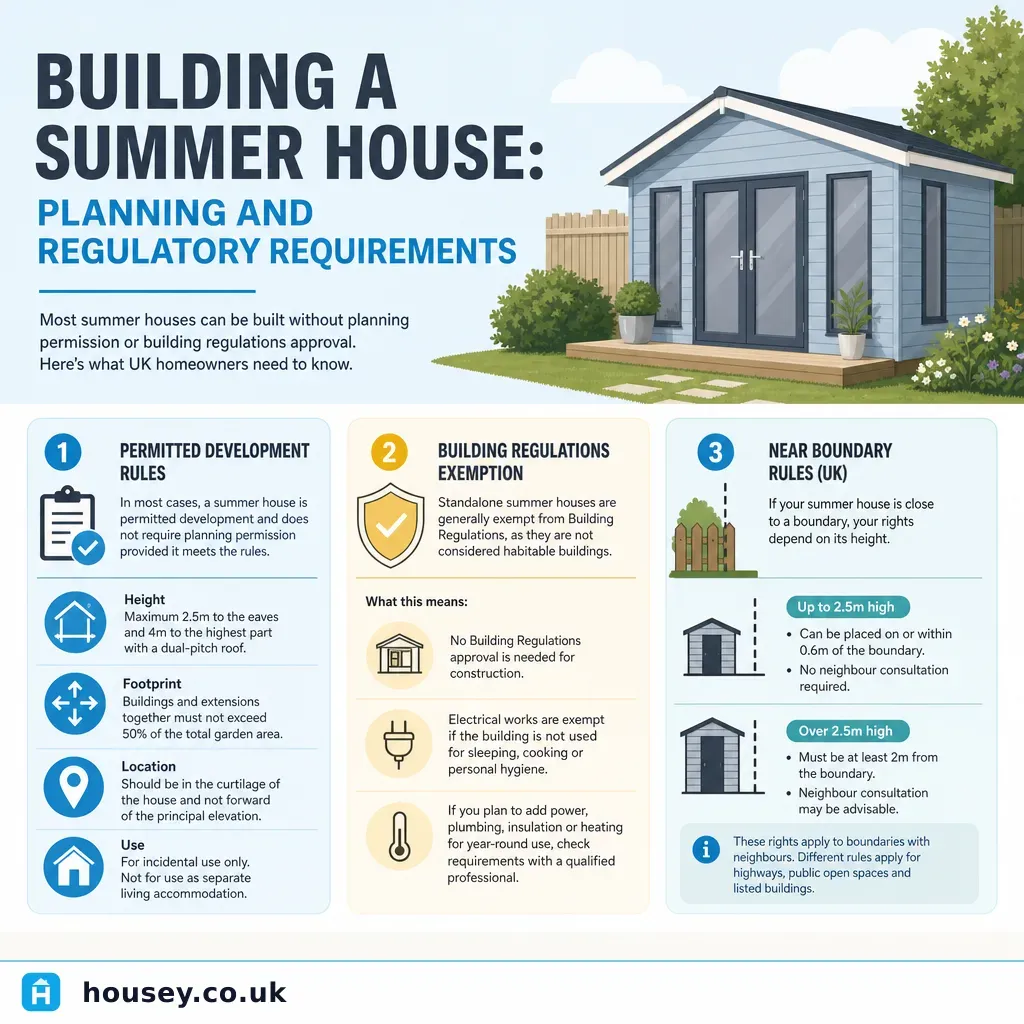
Building a Summer House: Planning and Regulatory Requirements
Most garden summer houses in England fall under Class E permitted development and need no planning permission, provided they are single-storey, within height limits, and not used for sleeping.
 Planning & Pre-Build
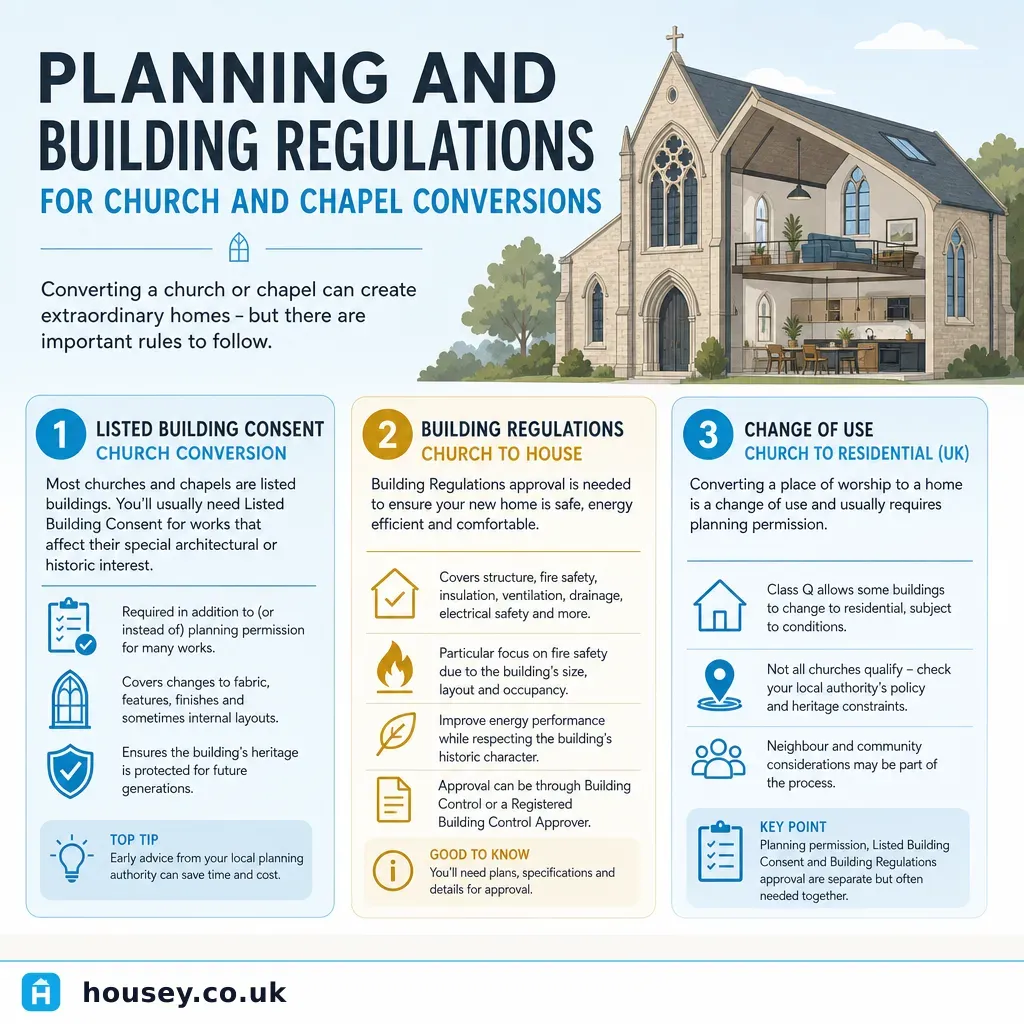
Planning and Building Regulations for Church and Chapel Conversions
Converting a church or chapel to residential use requires planning permission for change of use from Class F1 to Class C3, and listed building consent if the building is listed.
 Planning & Pre-Build
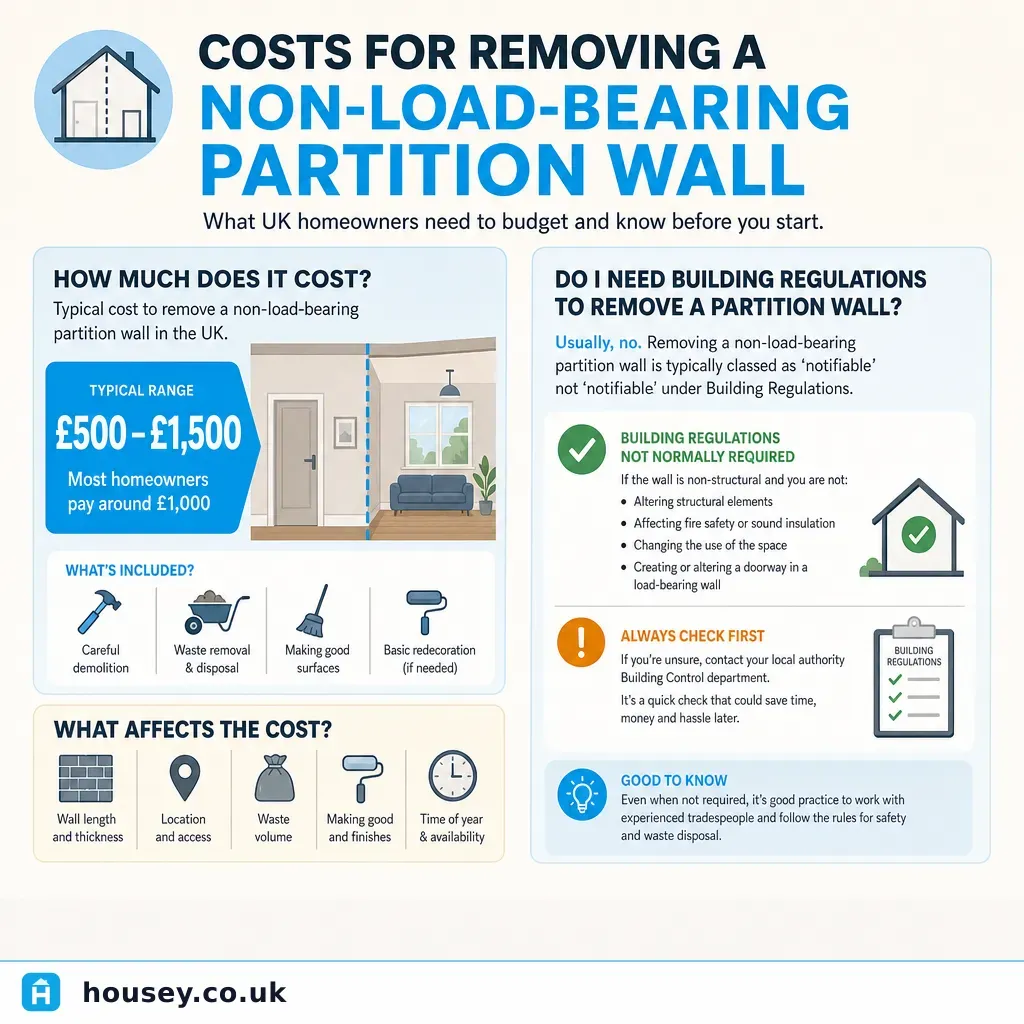
Costs for removing a non-load-bearing partition wall
Removing a non-load-bearing partition wall in a UK home typically costs £300–£1,500 in labour, plus £200–£600 or more for replastering and making good.
 Planning & Pre-Build
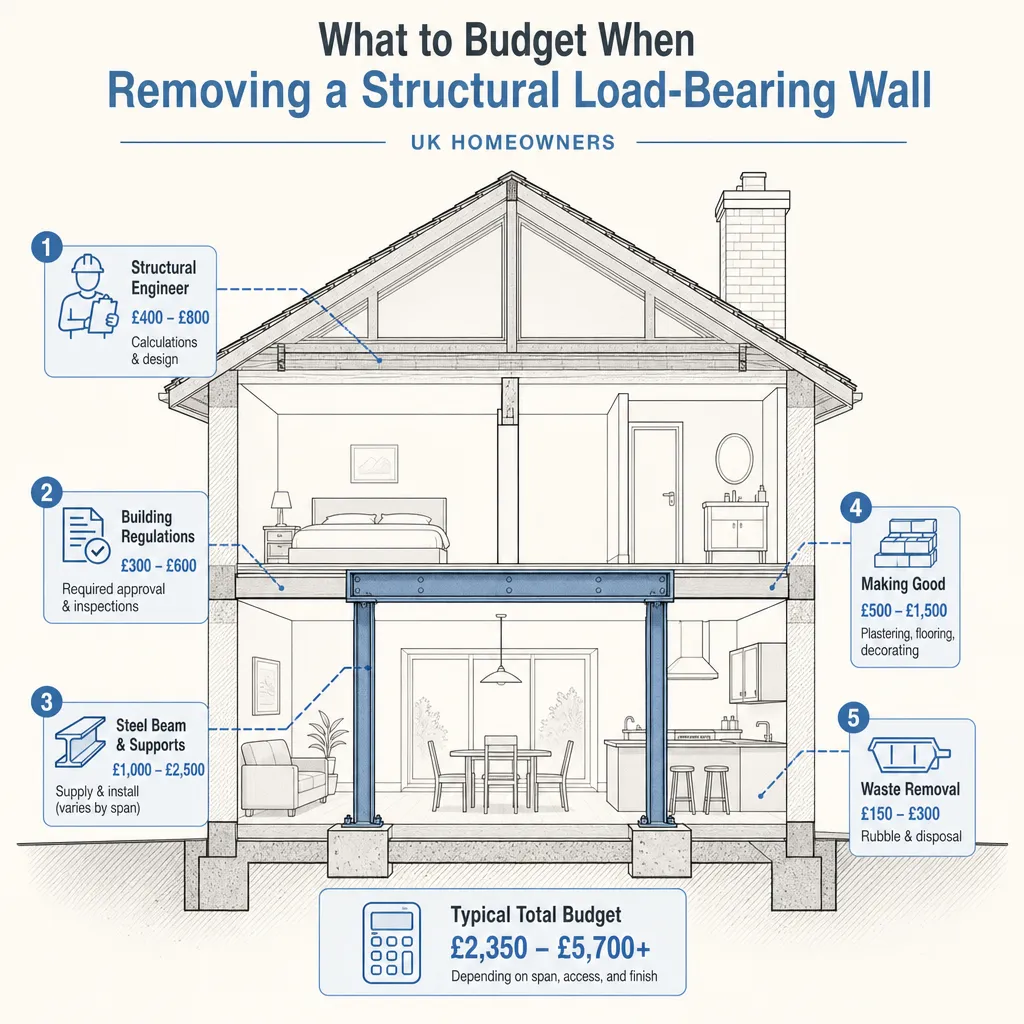
What to Budget When Removing a Structural Load-Bearing Wall
Removing a load-bearing wall in a typical UK home costs £2,500–£8,000 or more in total, covering a structural engineer's calculations, Building Regulations approval, the steel beam, builder's labour, and replastering.
 Planning & Pre-Build
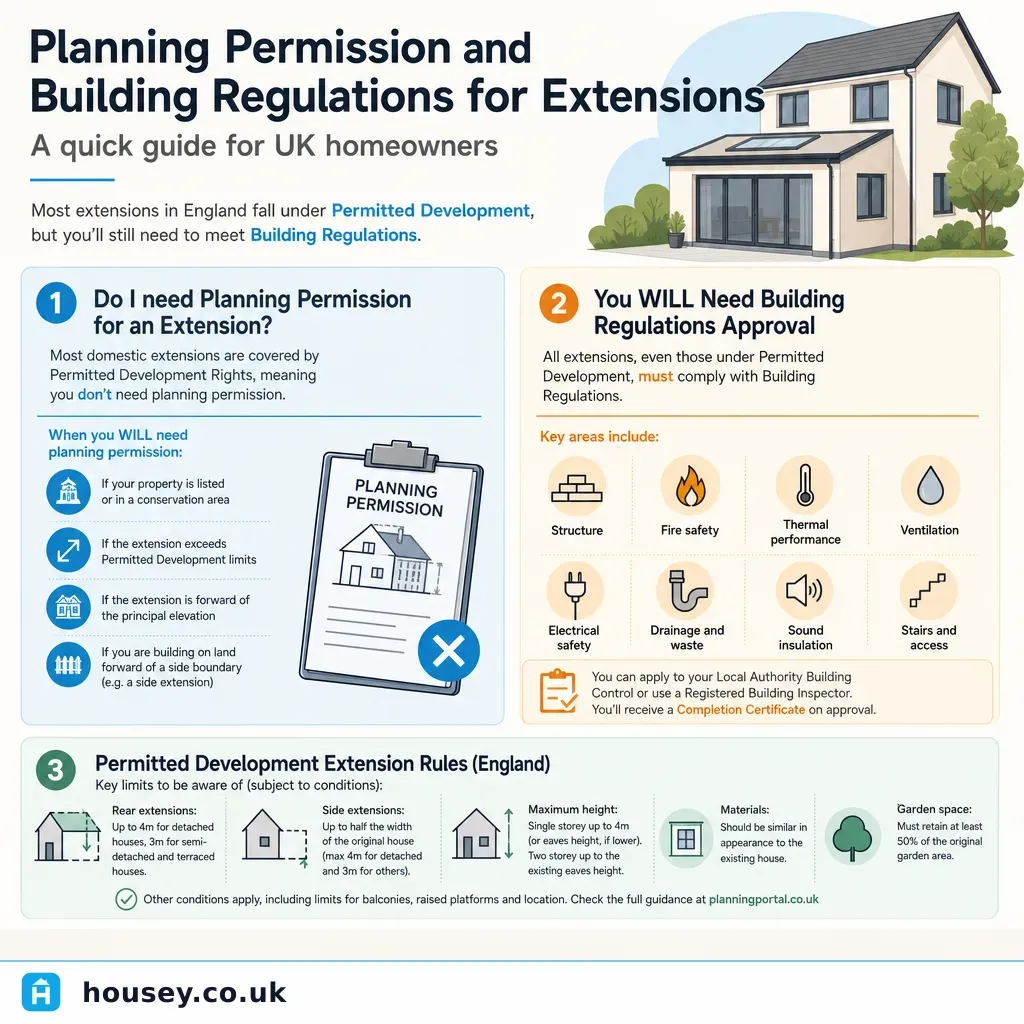
Planning Permission and Building Regulations for Extensions
UK home extensions usually require both planning permission and Building Regulations approval, though most smaller rear extensions qualify as Permitted Development under the GPDO 2015 and need no planning application.