Converting a Barn Into a Residential Property: Planning and Costs
By Housey · Last reviewed 5th of May 2026
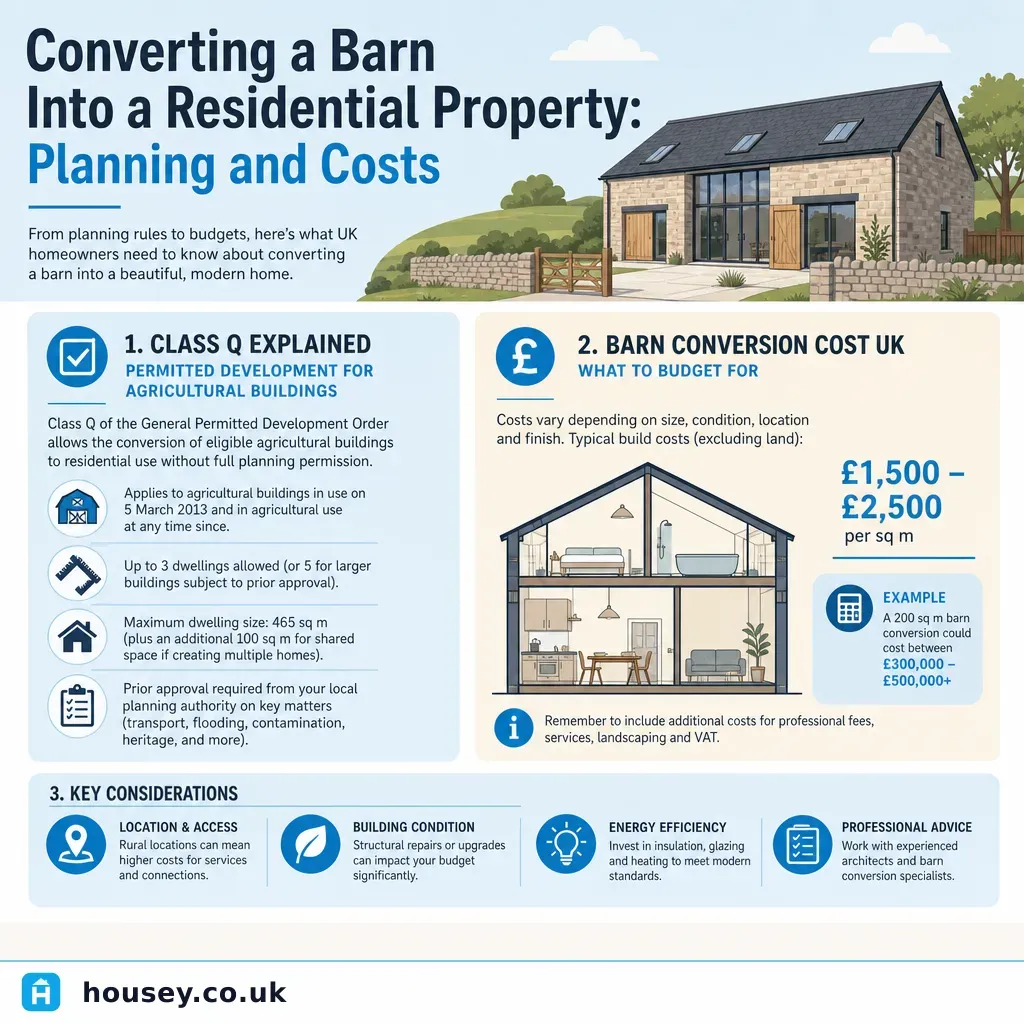
Converting a Barn Into a Residential Property: Planning and Costs
Barn conversions attract buyers and self-builders drawn to generous volumes, rural settings, and the opportunity to create something architecturally distinctive. The planning and regulatory journey, however, is more complex than a standard extension — involving permitted development rules with strict qualifying criteria, structural challenges specific to agricultural buildings, potential heritage constraints, and a cost profile that can surprise even experienced renovators. Whether you have inherited a redundant farm building or are considering purchasing one, understanding the planning framework before committing is essential.
Key points
- Class Q of the Town and Country Planning (General Permitted Development) (England) Order 2015 allows certain agricultural buildings to change use to residential without full planning permission, but prior approval from the local planning authority (LPA) is always required.
- Class Q limits cumulative development to a maximum of five dwellings per agricultural unit, with a combined residential floorspace cap of 865 square metres.
- Class Q does not apply in Wales or Scotland, where full planning permission is required under their respective national planning frameworks.
- VAT on the first conversion of a non-residential building to a dwelling is charged at the reduced rate of 5% rather than 20%, as confirmed in HMRC VAT Notice 708.
- Building regulations approval is always required regardless of which planning route is used; structural engineering input is typically necessary given the non-domestic construction of most agricultural buildings.
Class Q permitted development: does your barn qualify?
Class Q allows agricultural buildings to change to residential use (use class C3) without a full planning application, but prior approval is still needed and all of the following conditions must be met:
- The building must have been used solely for agricultural purposes as part of an established agricultural unit on 20 March 2013 and must have remained in agricultural use (or been unused) since that date.
- The building must not be a listed building or scheduled monument.
- Cumulative development under Class Q on the same agricultural unit must not exceed five dwellings or 865 square metres of combined residential floorspace.
Where prior approval is required, the LPA will assess: transport and highways impact, noise, contamination risks, flooding risk, whether the location makes residential use impractical or undesirable, and the design and external appearance of the conversion.
Note: location restrictions relating to National Parks, Areas of Outstanding Natural Beauty (AONBs), and similar designations were updated by amendments in 2024. Always check the current text of the legislation on legislation.gov.uk or take advice from a planning consultant before assuming eligibility.
Class Q prior approval vs full planning permission
| Class Q prior approval | Full planning permission |
|---|---|---|
Where it applies | England only, qualifying agricultural buildings | England, Wales, Scotland |
Application type | Prior approval notification | Full planning application |
Typical determination period | 56 days | 8–13 weeks (minor development) |
Key constraints | All qualifying conditions must be met; structural works limited to what is necessary for conversion | Local plan policies on design, landscape, ecology, highways, and heritage |
New extensions | Not permitted under Class Q alone | Can be applied for separately |
Listed buildings | Not eligible for Class Q | Requires full planning permission plus listed building consent |
Typical professionals needed | Planning consultant, architectural technologist | Architect or planning consultant |
Which planning route applies to your barn?
Use this decision guide before engaging professionals or committing to a purchase:
- Is the barn in Wales or Scotland? → Full planning permission required; engage a planning consultant familiar with the relevant national planning policy.
- Is the barn a listed building or scheduled monument? → Class Q does not apply; full planning permission and listed building consent are required. Involve a heritage consultant or conservation architect.
- Was the barn in lawful agricultural use on 20 March 2013? → If not, or if you are uncertain, Class Q is unlikely to apply. Seek planning advice before proceeding.
- Does the barn exceed 865 sqm or would conversion create more than five dwellings? → The excess falls outside Class Q and would need a full planning application.
- Has the LPA removed Class Q rights via an Article 4 direction? → Check the LPA's website; full planning permission may be required regardless of the building's qualifying status.
- None of the above apply? → Class Q prior approval may be available. Engage a planning consultant to confirm eligibility and prepare the notification.
Structural considerations: what most barns need before they can become homes
Agricultural buildings are not designed for residential loads or continuous occupation. A structural engineer should assess the building before any planning application is lodged, examining:
- The condition and adequacy of the existing frame — whether timber, steel portal, or masonry — which may have seen decades of agricultural use with minimal maintenance
- Foundation adequacy: barns were often built on minimal strip or pad foundations that may not suit the changed loading, drainage requirements, or thermal performance of a residential conversion
- Roof structure condition: many agricultural roofs are single-skin corrugated sheeting or lightweight purlins that will need significant upgrading or replacement
- How the existing fabric can accommodate the insulation and airtightness improvements required by Building Regulations Part L (Conservation of Fuel and Power)
Part L applies to conversions and sets energy efficiency targets for the building fabric. For solid masonry barns, achieving compliance often requires internal insulation, which reduces usable floor area and must be managed carefully to avoid interstitial condensation — particularly in traditional stone or brick construction where breathability is important.
Indicative costs for a barn conversion in England
Costs depend heavily on the barn's size, condition, structural complexity, location, and finish specification. The figures below are indicative only.
Cost element | Indicative range |
|---|---|
Planning/prior approval professional fees | £3,000 – £15,000+ |
Structural engineering survey and design | £2,000 – £8,000 |
Architectural drawings and specification | £8,000 – £25,000+ |
Building regulations application | £800 – £2,000 |
Construction — standard conversion | £1,500 – £2,500 per sqm |
Construction — high specification or complex | £2,500 – £4,000+ per sqm |
VAT on qualifying construction services | 5% (reduced rate) |
Indicative UK costs, last reviewed 2026-05-05. Figures exclude land purchase, site clearance, utility connections, and any Section 106 planning obligations. Obtain itemised quotes from contractors and professional advisers before committing to purchase or design.
A worked example: a 200 sqm steel-framed agricultural building converted to a four-bedroom dwelling to a good residential standard in the East Midlands might reasonably cost £350,000–£500,000 in construction costs alone, before professional fees, planning, and VAT. Properties in the South East and around major cities tend to fall toward the upper end of this range or beyond.
Important limitations
This article provides general information about barn conversion planning and costs in England. Planning decisions depend on the specific property, its history, its location, the adopted local development plan, and the LPA's interpretation of policies and permitted development rules. Cost estimates depend on site conditions, structural condition, specification, contractor availability, and market conditions at the time of tender.
Nothing in this article constitutes planning, legal, structural, or financial advice. Barn conversions involve regulated decisions — prior approval or full planning permission, building regulations, VAT treatment, and potentially listed building consent — that require input from qualified professionals. Legislation and policy can change; always check current legislation on legislation.gov.uk and consult a qualified professional before acting.
What to ask a qualified professional
Before submitting any application or commissioning design work, ask the relevant professionals:
Planning consultant:
- Does this building genuinely meet the Class Q qualifying conditions, including the 20 March 2013 agricultural use requirement?
- Has this LPA approved Class Q applications for similar buildings locally, and what prior approval risks does this site carry?
- Are there any Article 4 directions or local plan policies that restrict Class Q in this area?
Structural engineer:
- Can the existing frame support the intended residential conversion, or is partial or full rebuilding likely?
- What foundation work is anticipated and how will this affect the budget?
- Are there any immediate structural safety concerns that affect access or survey?
Architect or architectural technologist:
- How do I achieve Part L compliance without losing an unacceptable amount of internal floor area?
- Are there heritage or local character considerations that will influence the design?
- What ventilation strategy do you recommend given the construction type?
Contractor:
- Have you completed barn conversions before, and can you provide references and examples?
- How do you handle unforeseen structural or ground conditions in your pricing?
VAT adviser or accountant:
- Does this project qualify for the 5% reduced VAT rate throughout, and what conditions must be met to preserve eligibility?
When to get professional help
Engage a planning consultant before purchasing a barn if conversion is the intention — checking planning history, Class Q eligibility, and listed building status before exchange of contracts is far less expensive than discovering a disqualifying problem after completion.
Seek professional advice promptly if:
- The barn is listed or within a conservation area and you are unsure of the consent requirements
- The LPA has previously refused a Class Q application for this or a neighbouring building
- The structure shows signs of significant movement, partial collapse, or serious material deterioration
- You are uncertain about the agricultural use history required to qualify for Class Q
- A contractor has flagged unexpected ground conditions or major structural issues during early site visits
How Housey can help
Housey connects buyers and self-builders with experienced professionals across the barn conversion journey. Request quotes from planning consultants to assess Class Q eligibility and manage your prior approval or planning application, from architectural technologists to develop your conversion drawings and energy efficiency strategy, and from structural engineers to assess the existing frame and foundations before design is finalised.
Frequently asked questions
Can I extend a barn as part of a Class Q conversion?
Class Q development must constitute conversion rather than rebuild. Structural works are only permitted to the extent necessary for the building to function as a dwelling — new extensions adding volume are generally not allowed under Class Q alone. If an extension is required, a separate planning application for that element would need to be made alongside the Class Q prior approval.
Do I need building regulations approval for a barn conversion?
Yes. Building regulations approval is always required for a change of use to residential, regardless of the planning route. The regulations cover structure, fire safety, insulation, ventilation, drainage, accessibility, and energy efficiency. A building control body — either the local authority building control team or an approved inspector — must be notified before work begins.
Is a barn conversion eligible for the reduced 5% VAT rate?
The first conversion of a non-residential building to a single household dwelling typically qualifies for the 5% reduced rate of VAT under HMRC VAT Notice 708. This applies to qualifying construction services, not to materials purchased separately by a self-builder. Eligibility conditions apply; obtain advice from a tax professional or VAT specialist to confirm the position for your specific project.
Does Class Q permitted development apply in Wales or Scotland?
No. Class Q rights apply in England only. In Wales, barn conversions require full planning permission under Welsh planning policy, including Future Wales and adopted local development plans. In Scotland, different permitted development rules apply and barn conversions generally require a planning application. Seek advice from a planning professional experienced in the relevant national planning system.
Sources and further reading
- Town and Country Planning (General Permitted Development) (England) Order 2015 — Class Q — legislation.gov.uk
- Planning Portal: Agricultural buildings and prior approval — Planning Portal
- Approved Document L: Conservation of fuel and power — GOV.UK
- VAT Notice 708: Buildings and construction — HM Revenue & Customs
- Adapting traditional farm buildings — Historic England
Useful next reads
 Planning & Pre-Build
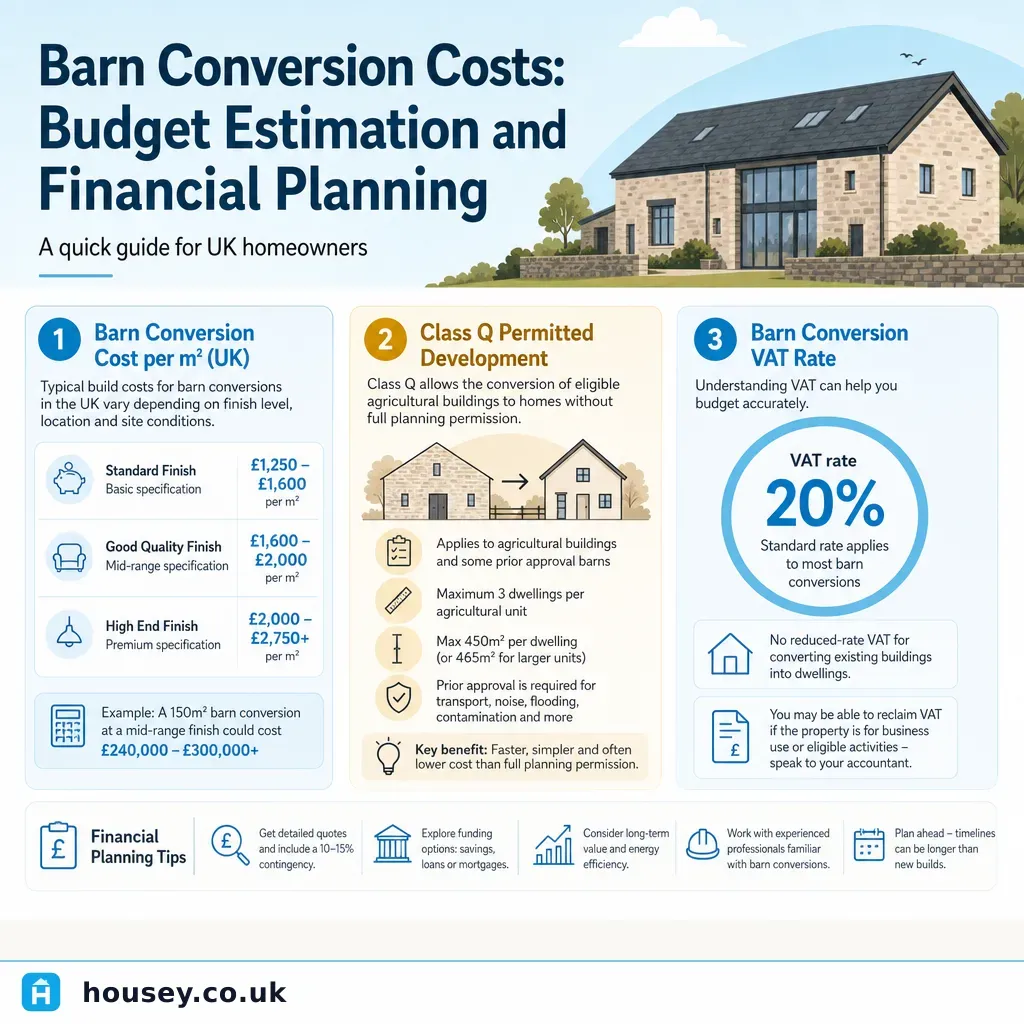
Barn Conversion Costs: Budget Estimation and Financial Planning
Barn conversions in the UK typically cost £1,500–£3,000 or more per square metre depending on structural condition, specification, and location.
 Planning & Pre-Build
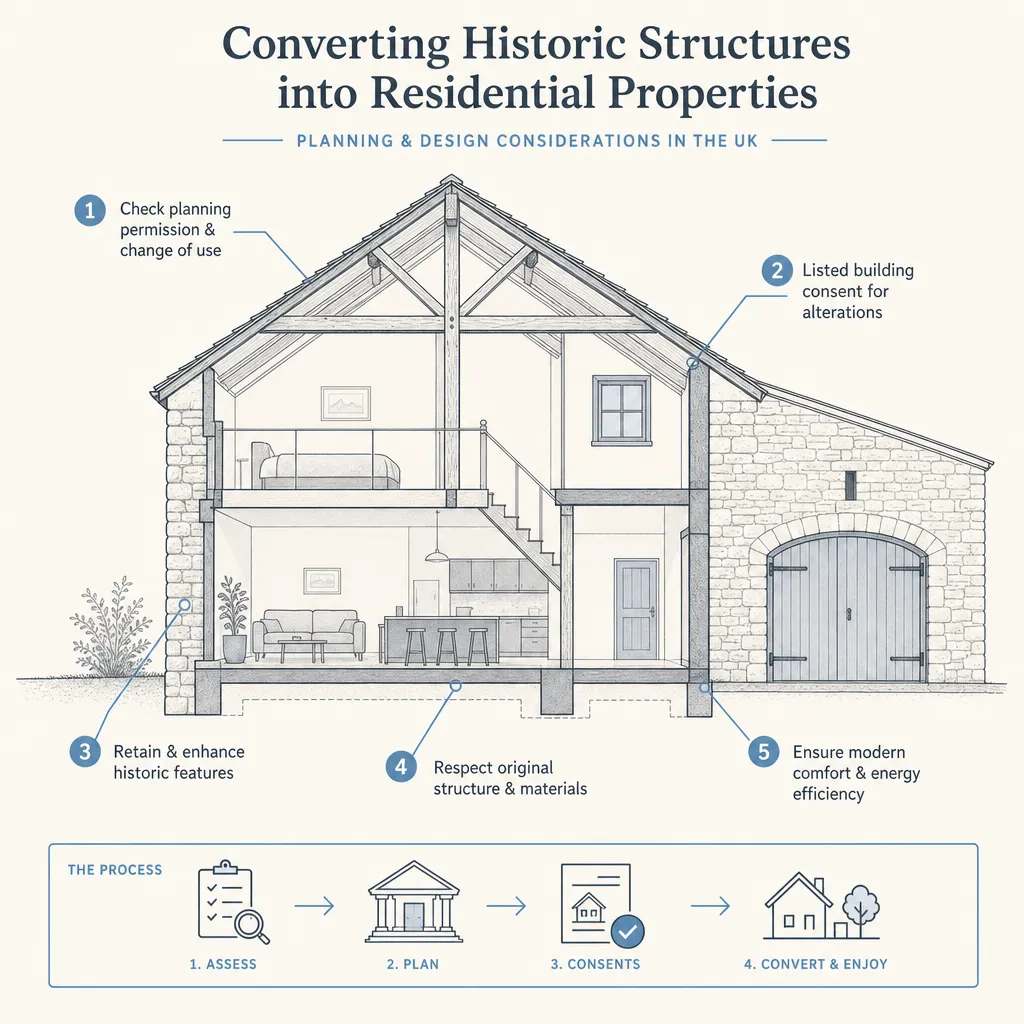
Converting Historic Structures into Residential Properties
Converting a historic barn, chapel, or industrial building into a home in the UK requires planning permission and, where the building is listed, Listed Building Consent as a separate application.
 Planning & Pre-Build
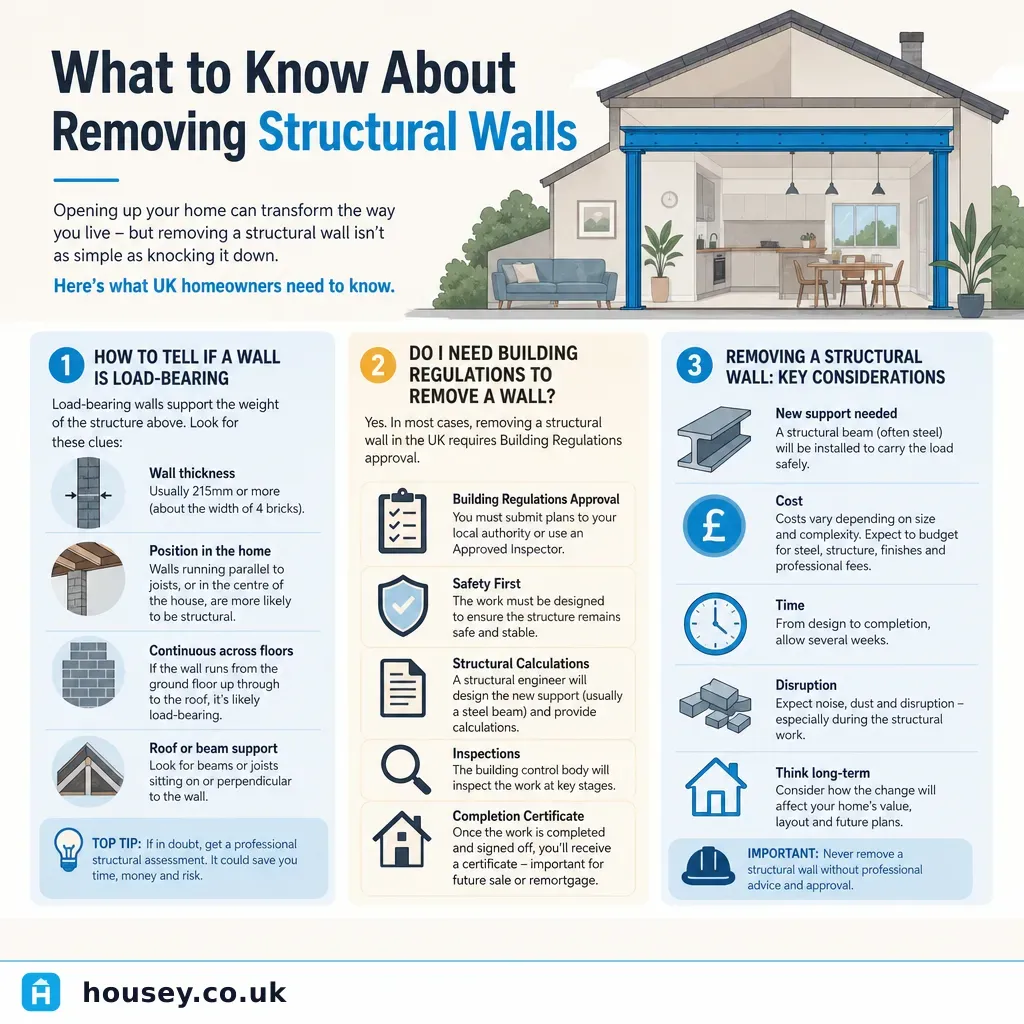
What to Know About Removing Structural Walls
Removing a structural or load-bearing wall in a UK home requires a structural engineer's assessment, a correctly specified steel beam (RSJ), and Building Regulations approval.
 Planning & Pre-Build
Home Improvements Not Requiring Planning Permission
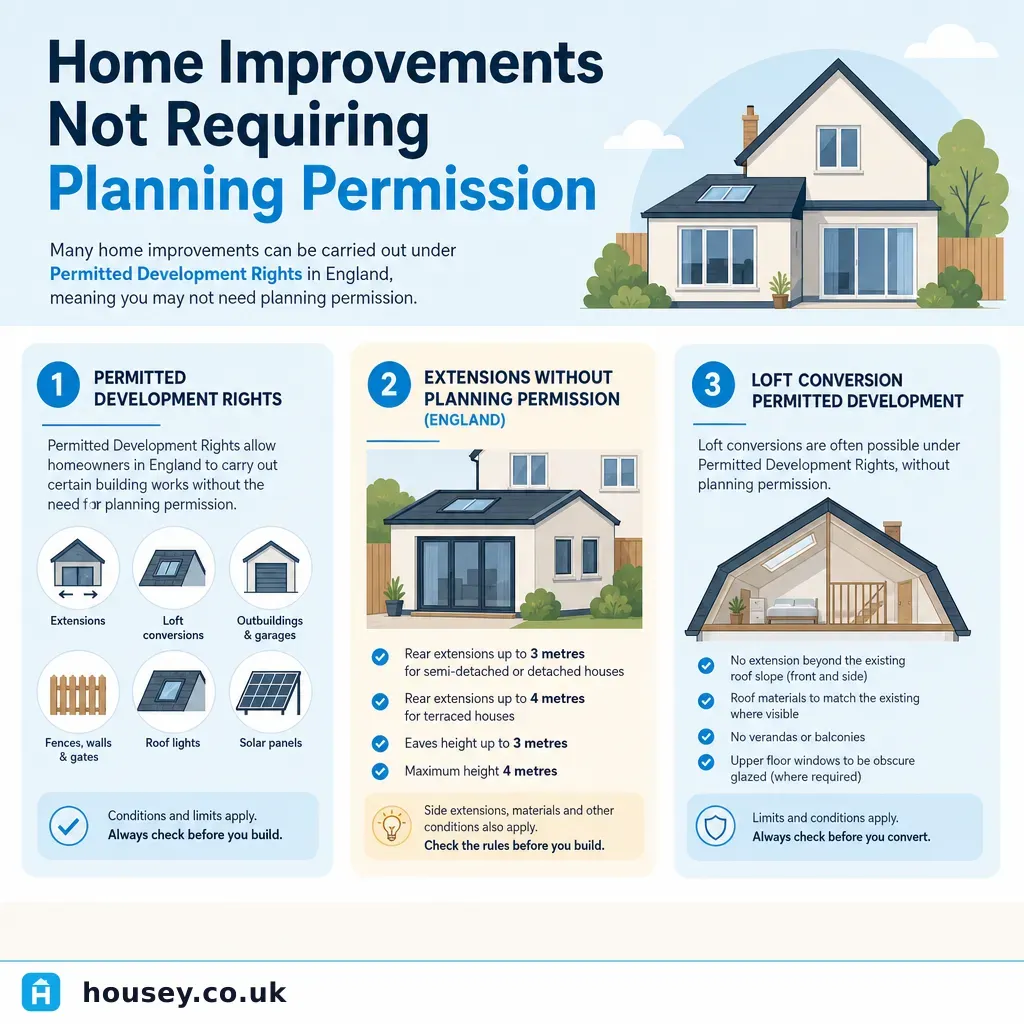
Many common home improvements in England fall under Permitted Development Rights and do not require a planning application.
 Planning & Pre-Build
Costs for removing a non-load-bearing partition wall
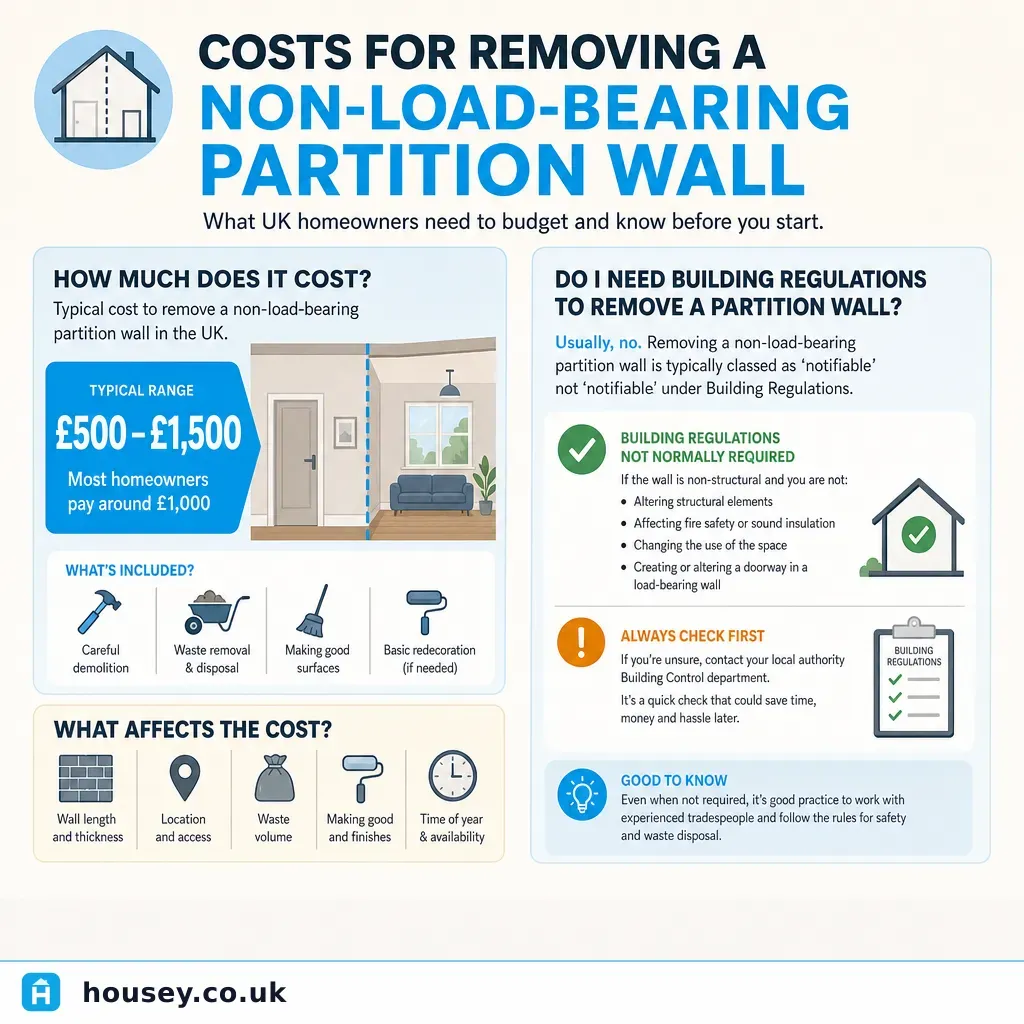
Removing a non-load-bearing partition wall in a UK home typically costs £300–£1,500 in labour, plus £200–£600 or more for replastering and making good.