Converting Historic Structures into Residential Properties
By Housey · Last reviewed 31st of May 2026
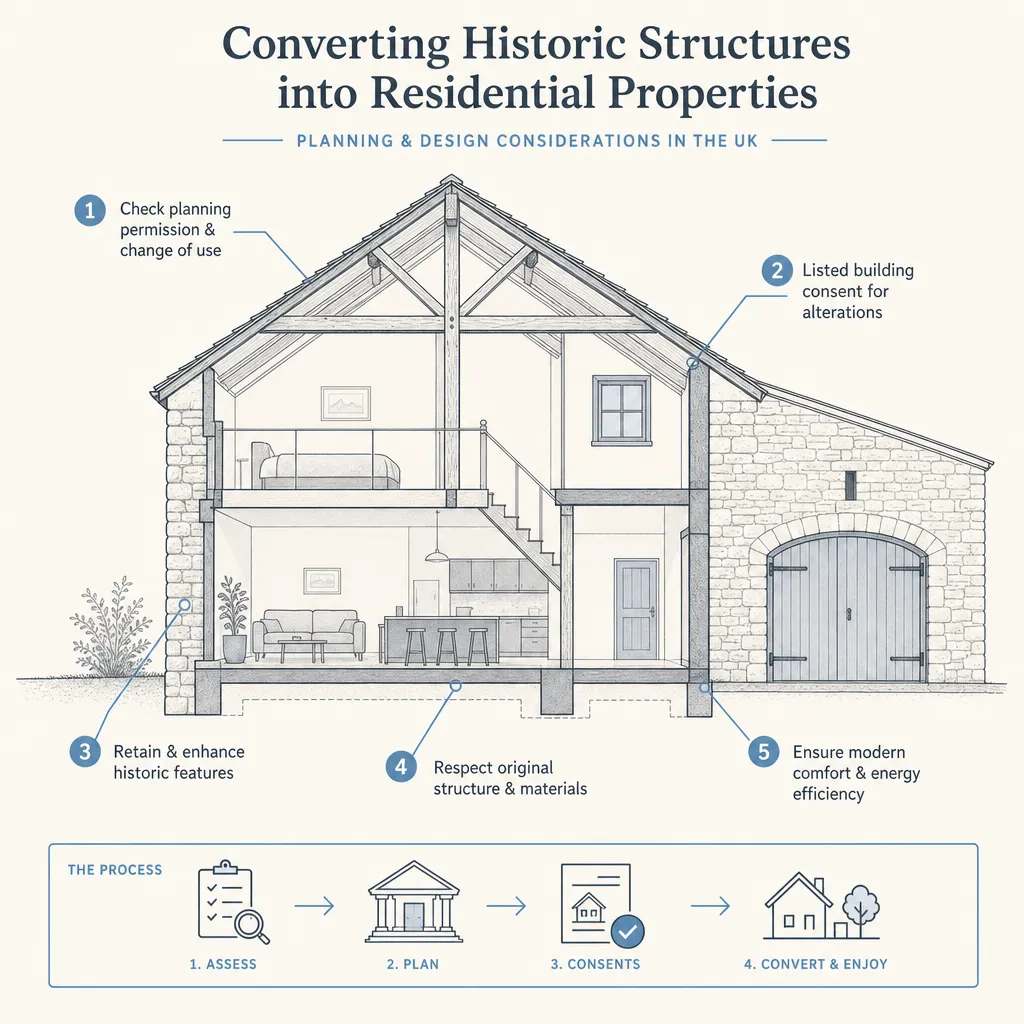
Converting Historic Structures into Residential Properties
The conversion of a barn, chapel, mill, waterworks, or other historic structure into a home is one of the most complex — and potentially rewarding — residential projects a UK homeowner can undertake. Unlike a straightforward extension or new build, a historic conversion sits at the intersection of planning policy, heritage legislation, structural engineering, and Building Regulations, each of which can shape what is achievable, at what cost, and over what timescale.
Key points
- Change of use from an agricultural, commercial, or community building to a residential dwelling requires planning permission; Class Q permitted development may be available for certain agricultural buildings in England, but does not apply to listed buildings.
- Listed buildings require Listed Building Consent (LBC) from the local planning authority for any works affecting their character — this is separate from planning permission and carries criminal penalties if works proceed without it under the Planning (Listed Buildings and Conservation Areas) Act 1990.
- Building Regulations apply to conversion works regardless of listed status; this creates a tension between conserving historic fabric and modern energy-efficiency requirements (Part L) that must be resolved with the local Building Control body.
- A structural engineer's assessment is essential before any conversion begins — historic structures frequently have inadequate foundations, corroded ties, or structural forms that differ significantly from what is visible.
- VAT on the conversion of a non-residential building to a residential dwelling is reduced to 5% on eligible works, as set out in HMRC Notice 708.
Planning consent: what you will need and when
The route to consent depends on the building's status and current use.
Building type | Planning route | Additional consent needed |
|---|---|---|
Agricultural barn (unlisted) | Class Q permitted development (prior approval) or full planning permission | Building Regulations; may need drainage and highways assessment |
Listed barn or agricultural building | Full planning permission required (Class Q does not apply) | Listed Building Consent; possibly Conservation Area consent |
Former church or chapel | Full planning permission (change of use) | Listed Building Consent if listed; may involve diocesan approvals |
Former industrial building (mill, waterworks) | Full planning permission | Listed Building Consent if listed; contamination assessment likely |
Building in a Conservation Area (unlisted) | Full planning permission | Conservation Area regulations apply to demolition and some alterations |
Class Q permitted development (under the Town and Country Planning (General Permitted Development) (England) Order 2015, as amended) allows certain agricultural buildings to convert to dwellings without full planning permission, subject to prior approval on design, transport, noise, contamination, and flooding. It has size limits and cannot be used for listed buildings. Class Q rules have been amended several times; always check the current position with the local planning authority (LPA) or a planning consultant before proceeding.
Scotland, Wales, and Northern Ireland have different planning frameworks from England; the above refers to England only.
Heritage designations and their implications
Understanding which designations apply to the building is the essential first step before commissioning any design work.
Listed buildings in England are graded by Historic England by level of significance:
- Grade I: buildings of exceptional interest (approximately 2% of listed buildings).
- Grade II*: particularly important buildings of more than special interest (approximately 6%).
- Grade II: nationally important buildings (approximately 92%).
All grades require Listed Building Consent for alterations affecting character. The Historic England National Heritage List for England allows you to check whether a building is listed and at what grade.
Conservation Areas are designated by local planning authorities. Being within a Conservation Area (but not listed) still restricts certain works and requires specific permission for demolition. Check the LPA's conservation area maps and Article 4 Directions, which may withdraw further permitted development rights.
Structural assessment: why it cannot be skipped
Historic structures were built to different standards, with different materials, and for entirely different purposes. Structural issues commonly encountered during conversion feasibility include:
- Inadequate foundations — many pre-20th-century buildings have shallow, unreinforced footings that cannot safely carry new residential loads.
- Corroded or missing tie rods in agricultural or industrial buildings that rely on them for lateral stability.
- Structural form dependent on stored materials — some agricultural buildings relied on grain or hay for lateral restraint; once empty, they may be less stable.
- Timber decay in roof structures and floor joists from long-term moisture ingress.
- Poorly executed previous repairs using incompatible materials such as hard cement mortars or impermeable renders.
A structural engineer should inspect the building before design work begins and produce a structural appraisal report. This informs the architect's design and identifies any enabling works needed before conversion can proceed. Do not assume that a building in apparently good visible condition is structurally sound.
Building Regulations and the heritage tension
Building Regulations apply to conversion works in England regardless of listed status. Key areas where heritage conservation and compliance come into tension:
- Part L (Conservation of Fuel and Power): the Regulations require improvements to thermal performance. For listed buildings, and often for unlisted buildings of traditional construction, meeting standard U-values may not be possible without damaging the building fabric. Approved Document L and MHCLG guidance include provisions for historic and traditionally constructed buildings, allowing a performance-based approach. Engage early with Building Control.
- Part B (Fire Safety): compliant escape routes, fire compartmentation, and detection systems are required. Complex historic floor plans with original features require careful fire strategy design.
- Part F (Ventilation): traditional buildings breathe naturally through their fabric. Sealing them without adequate mechanical ventilation can cause condensation and mould. A PAS 2035-informed approach to moisture risk is advisable for any thermal upgrade.
Design considerations for historic conversions
A specialist architect — ideally RIBA Conservation Architect accredited — is strongly advisable. Key design principles:
- Minimum intervention: use the least damaging method to achieve the desired outcome; reversible interventions are preferred by conservation officers and are more straightforward to gain consent for.
- Compatible materials: lime mortars, breathable insulation systems such as wood fibre or hemp, and vapour-open membranes are usually more appropriate than cement-based or impermeable systems in traditionally constructed buildings.
- Retaining character-defining features: Listed Building Consent applications must demonstrate that historic character is preserved or enhanced. Identify and document significant features early so they inform the design from the outset.
Important limitations
This article provides general information only. Planning and heritage regulations are complex, frequently amended, and applied differently by different local planning authorities and Historic England. The structural condition of any historic building cannot be assessed remotely or on the basis of photographs. Always obtain professional advice from a qualified architect, structural engineer, and planning consultant before committing to a conversion project. Listed Building Consent applications require specialist knowledge; carrying out works without consent is a criminal offence under the Planning (Listed Buildings and Conservation Areas) Act 1990.
When this becomes urgent
Seek immediate professional advice if:
- You discover structural movement, wall bulging, or roof deflection in a building you have purchased or are under contract to convert.
- You have been served a planning enforcement notice or a listed building enforcement notice.
- Works have already started on a listed building without Listed Building Consent.
- You discover potential contamination — fuel tanks, asbestos, industrial chemicals — during initial investigation works.
What to ask a qualified professional
Questions for your architect (ideally RIBA Conservation Architect accredited)
- Is the building listed, and at what grade? Is it in a Conservation Area or near a Scheduled Monument?
- What planning route applies — full planning permission, Class Q prior approval, or another route?
- What precedents or conditions has this LPA applied to similar Listed Building Consent applications?
- Can you provide a heritage statement and design and access statement as part of the planning submission?
- What are the likely Building Regulations challenges, particularly around Part L thermal performance and Part F ventilation?
Questions for your structural engineer
- Can you carry out a structural appraisal before design work commences?
- Are there signs of foundation movement, inadequate structural ties, or serious decay that would affect viability?
- What enabling works are needed before the main conversion can proceed?
- Will the conversion significantly alter load paths, and if so, what structural interventions are needed?
- Are there any elements that should be investigated by opening up before the design is finalised?
When to get professional help
A historic conversion is not a project to undertake without professional support at every stage. Appoint:
- A RIBA Conservation Architect or architect experienced in historic conversions, from the outset.
- A structural engineer before design work begins.
- A planning consultant with heritage experience if the building is listed or in a Conservation Area.
- A specialist project manager for complex conversions with multiple contractors and phased programmes.
Red flags that suggest the project needs more professional input:
- A contractor proposing to start work without a structural investigation having been completed.
- A designer with no visible track record of listed buildings or historic structures.
- A planning application submitted without a heritage statement.
- No consideration of moisture risk and vapour management in the fabric specification.
- Consent granted but Building Control not yet engaged on the approach to Part L compliance.
How Housey can help
Housey connects UK homeowners with specialists suited to historic conversion projects. You can compare quotes for architectural design services, structural engineering assessment, building regulations drawings, and specialist project managers — all from professionals with relevant UK experience.
Frequently asked questions
Do I always need planning permission to convert a barn into a home?
Not always in England — Class Q permitted development may allow certain agricultural buildings to convert to dwellings through prior approval rather than full planning permission. However, Class Q has strict conditions, does not apply to listed buildings, and requires prior approval from the LPA. In Scotland, Wales, and Northern Ireland, different rules apply. Always check with a planning consultant or your LPA before relying on Class Q.
What is Listed Building Consent, and do I need it for a conversion?
Listed Building Consent (LBC) is a separate consent from planning permission, required for any works to a listed building that would affect its character as a building of special architectural or historic interest — including internal works. LBC is required regardless of whether works would otherwise be permitted development. Carrying out works without consent is a criminal offence under the Planning (Listed Buildings and Conservation Areas) Act 1990.
How long does a historic conversion take from purchase to completion?
Timescales vary enormously. A straightforward barn conversion under Class Q with no listing might take 12–18 months from purchase to completion. A listed chapel requiring Listed Building Consent, full planning permission, and significant structural enabling works might take 3–5 years. Allow additional time for pre-application discussions, heritage consultee responses, and a longer design period than for a standard new-build project.
Is VAT reduced on barn and historic building conversions?
The conversion of a non-residential building to a residential dwelling qualifies for the 5% reduced VAT rate under HMRC Notice 708, provided the building has not been used as a dwelling in the preceding ten years. Zero-rating does not apply, unlike new-build construction. Confirm the VAT position with your contractor and accountant at the outset, as the rules are specific and the position must be established before work begins.
Sources and further reading
- Historic England: Listed Buildings — Historic England
- Planning (Listed Buildings and Conservation Areas) Act 1990 — legislation.gov.uk
- GOV.UK: Permitted development rights — technical guidance — MHCLG / GOV.UK
- HMRC Notice 708: Buildings and Construction — HMRC
- Historic England: Energy Efficiency and Historic Buildings — Historic England
- National Heritage List for England — Historic England
Useful next reads
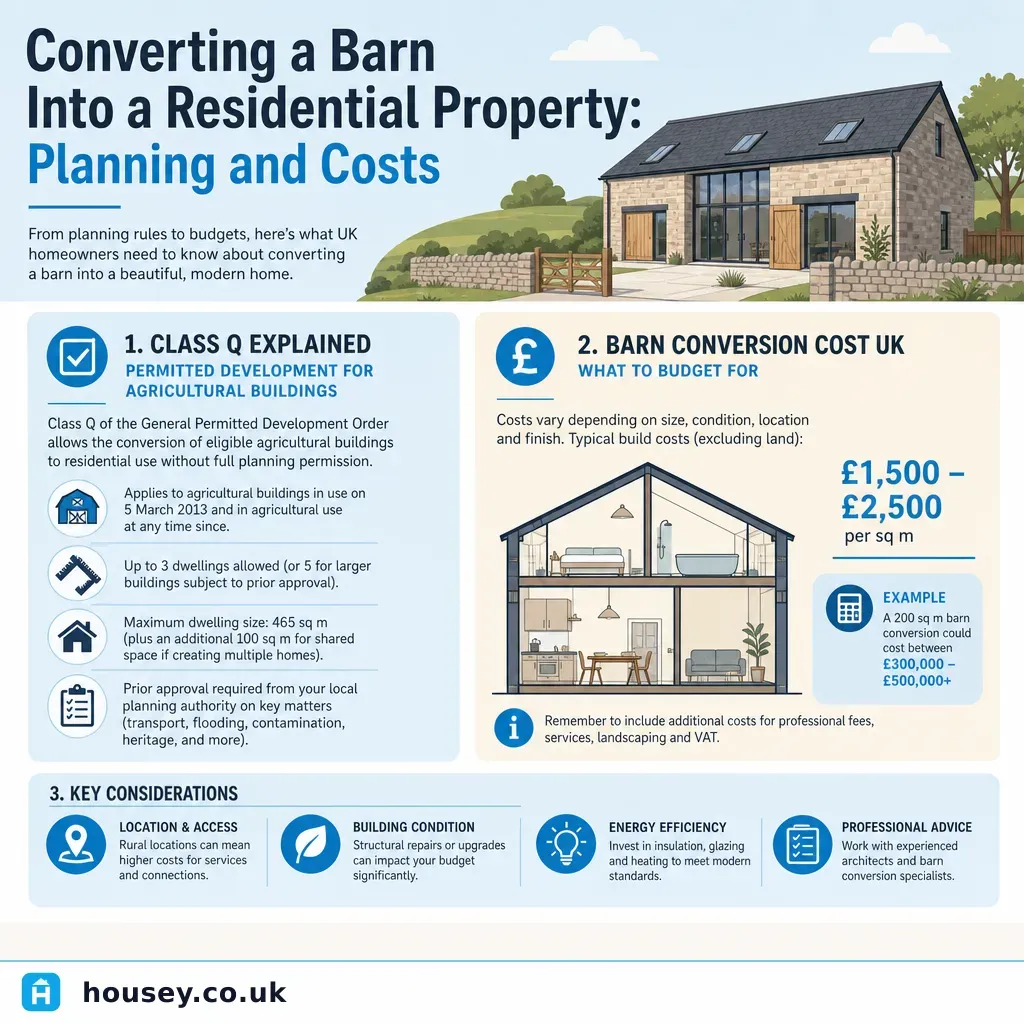 Planning & Pre-Build
Converting a Barn Into a Residential Property: Planning and Costs
Barn conversions in England may qualify for Class Q permitted development, which allows a change of use to residential without full planning permission — though prior approval from the local planning authority is always required.
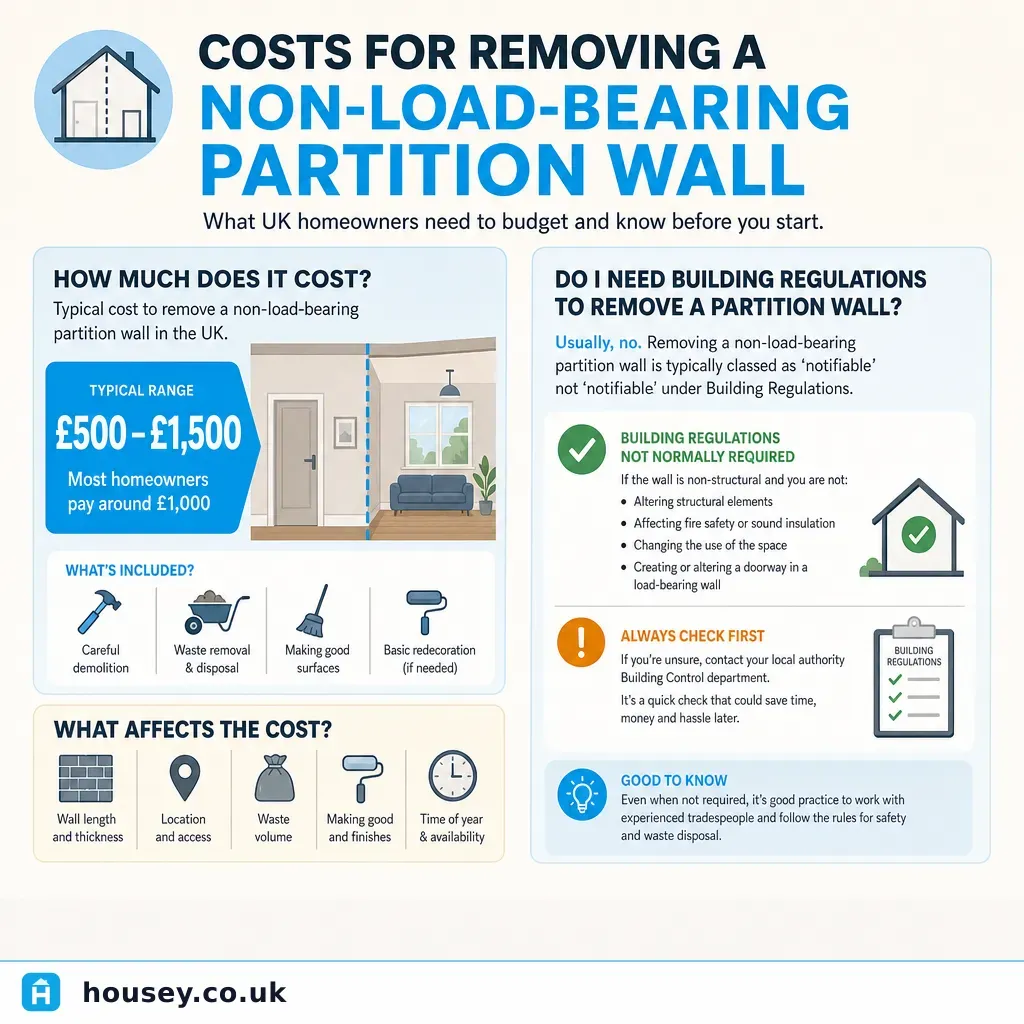 Planning & Pre-Build
Costs for removing a non-load-bearing partition wall
Removing a non-load-bearing partition wall in a UK home typically costs £300–£1,500 in labour, plus £200–£600 or more for replastering and making good.
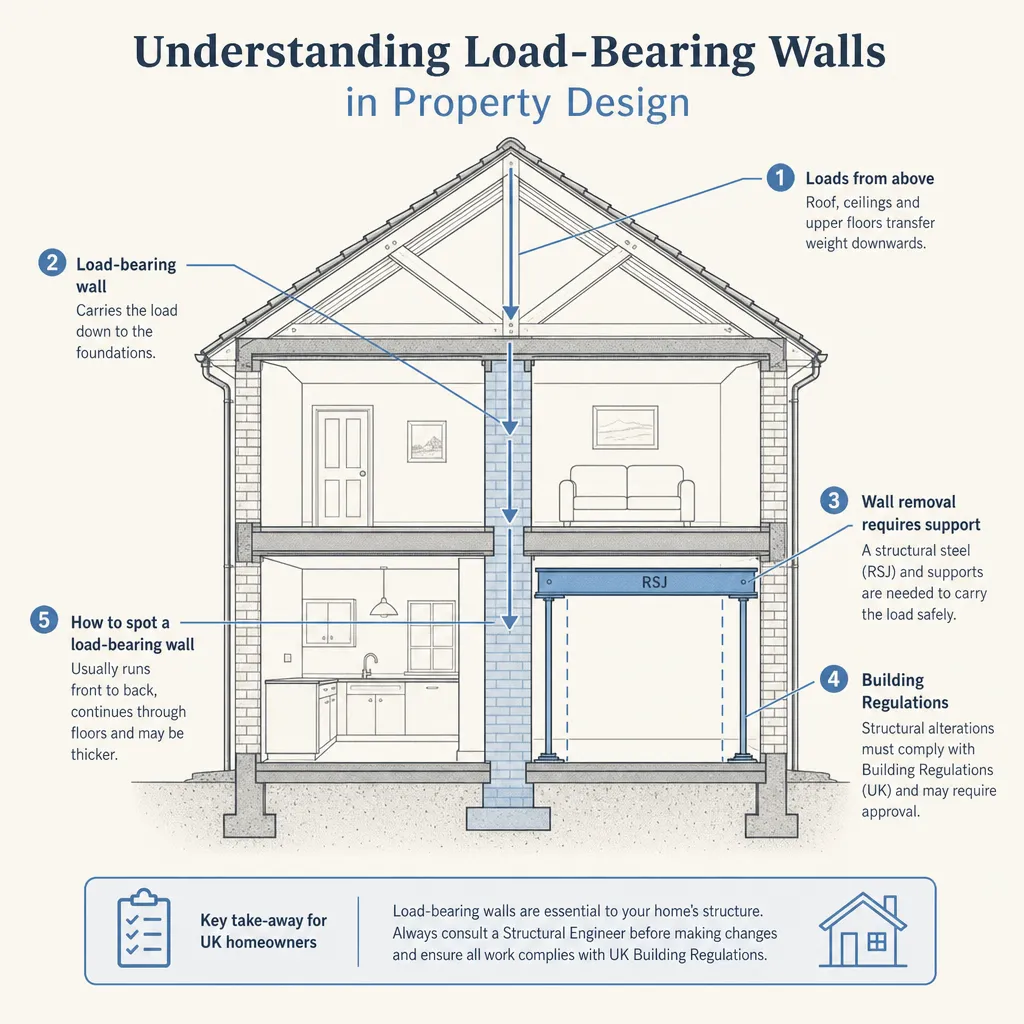 Planning & Pre-Build
Understanding Load-Bearing Walls in Property Design
A load-bearing wall carries the weight of floors, roofs, or other walls above it down to the foundations.
 Planning & Pre-Build
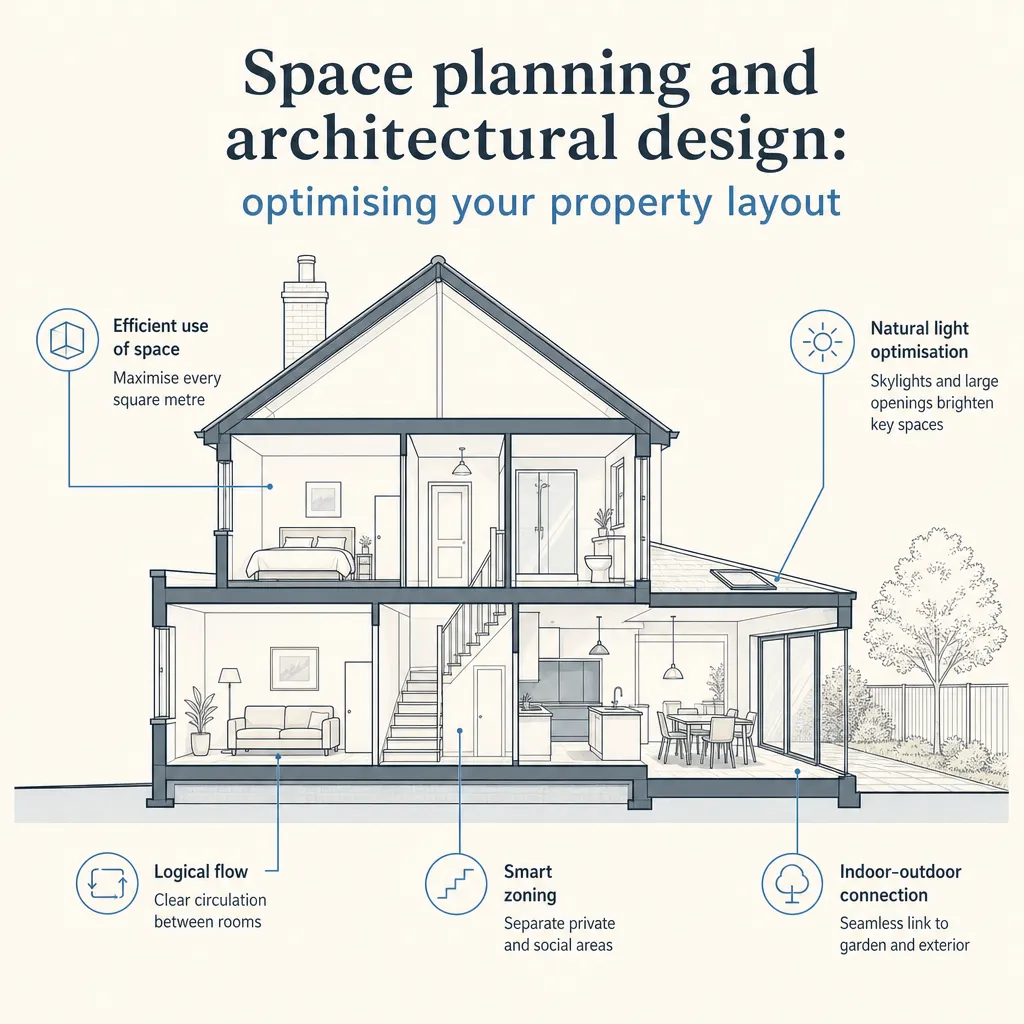
Space planning and architectural design: optimising your property layout
Space planning defines how rooms, circulation routes, and services are arranged within a property to make the best use of available area.
 Planning & Pre-Build
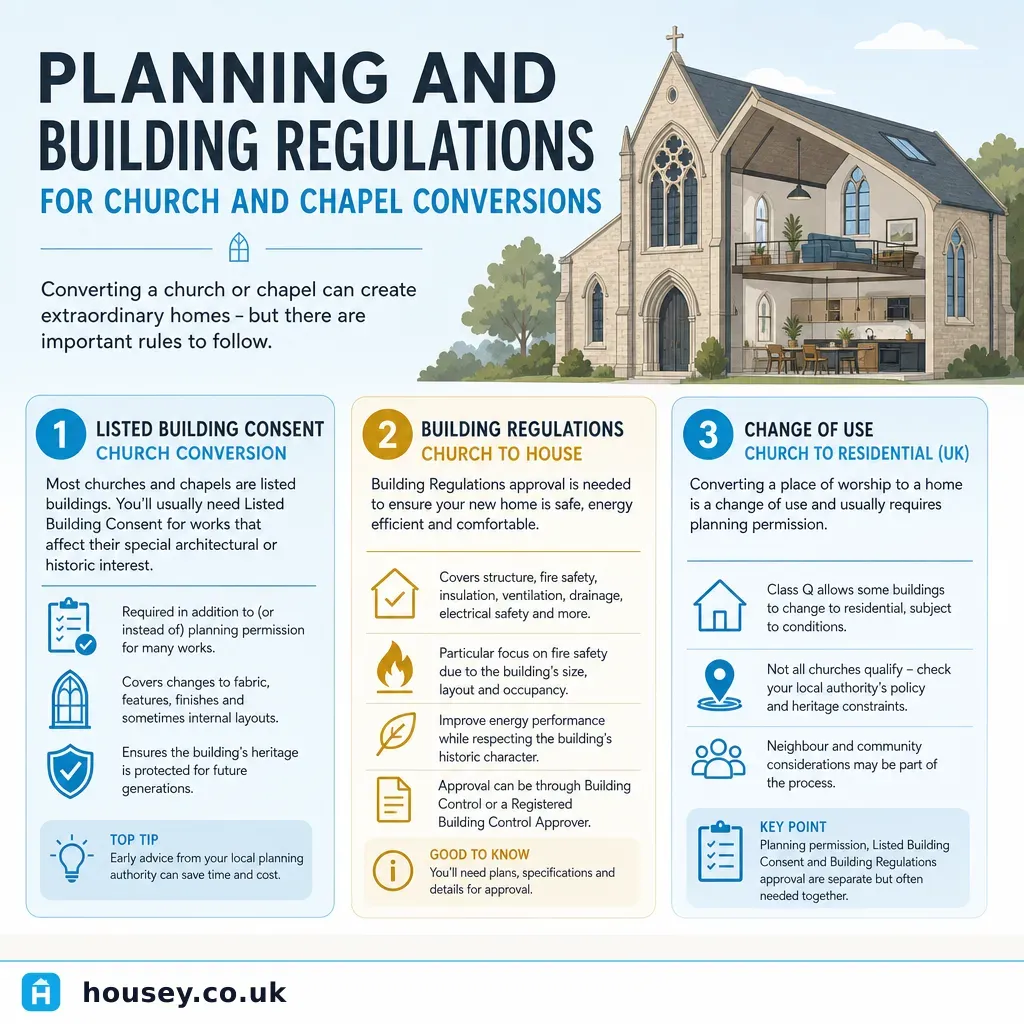
Planning and Building Regulations for Church and Chapel Conversions
Converting a church or chapel to residential use requires planning permission for change of use from Class F1 to Class C3, and listed building consent if the building is listed.