Costs Involved in Relocating a Bathroom to an Upper Floor
By Housey · Last reviewed 6th of May 2026
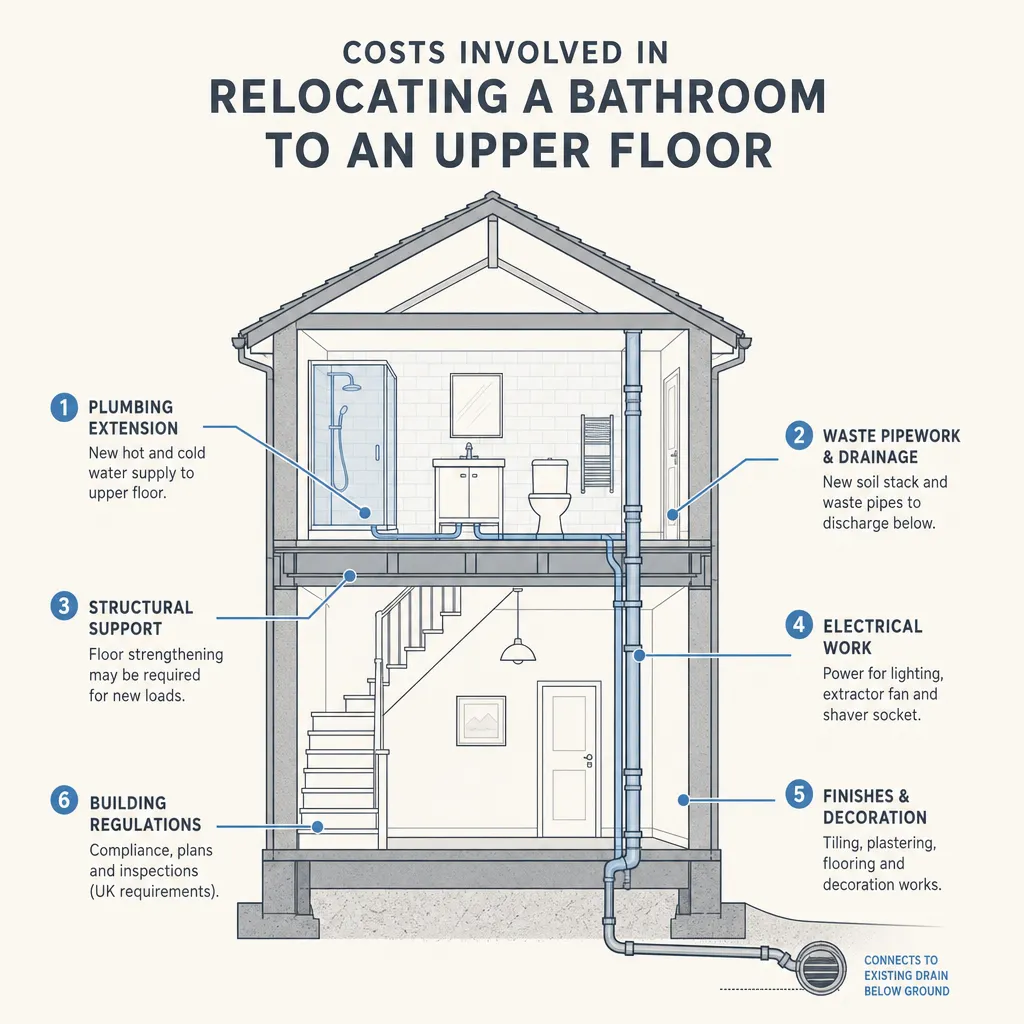
Costs Involved in Relocating a Bathroom to an Upper Floor
Moving a bathroom from one floor to another — whether to free up ground-floor space for open-plan living or to create an en-suite on a bedroom floor — is among the more disruptive renovation projects in a UK home. The costs go well beyond a plumber's day rate: drainage routing, structural floor assessment, ventilation requirements, and electrical sign-off each involve a separately regulated trade. Understanding the full scope before committing helps you budget accurately and choose the right professional team.
Key points
- Building Regulations Approved Document H (drainage and waste disposal) and Approved Document P (electrical safety in dwellings) both apply to bathroom relocation projects in England and Wales.
- All electrical work in a bathroom is notifiable under Part P and must be carried out by an electrician registered with NICEIC, NAPIT, or an equivalent competent person scheme — or separately notified to Building Control.
- Floor joists may need to be notched or drilled to route new 110mm waste pipes — limits on notching depth and position are set out in Approved Document A, Table A1, and structural advice should be sought before any cuts are made.
- Approved Document F requires mechanical extract ventilation ducted to the outside in any bathroom that lacks an openable window.
- Indicative total costs range from approximately £7,000 to £20,000 or more depending on drainage method, structural complexity, and finishes chosen (indicative UK costs, last reviewed 2026-05-06).
Why is moving a bathroom to an upper floor so involved?
The core challenge is drainage. A bathroom on an upper floor must discharge waste water down through the floor structure to connect with the existing soil stack or drain run at a lower level. This typically requires notching or drilling through floor joists — work that must stay within the dimensional limits of Approved Document A, Table A1, or be to a structural engineer's specification. In pre-war properties with shallower joists there may be little tolerance for a standard 110mm soil pipe without structural intervention.
Hot and cold water supply routes also need planning: pipes inside external walls can freeze in winter, so internal routes are preferred. The existing boiler or hot water cylinder should be checked for adequate pressure at the new upper-floor location, particularly in properties with gravity-fed hot water systems rather than a combination boiler.
Gravity drainage versus macerators: a comparison
Option | Best for | Not ideal for | Building Control position | Indicative extra cost |
|---|---|---|---|---|
Gravity drainage | Properties where floor structure can accommodate 110mm waste pipes with adequate fall | Shallow joist depths or very long horizontal runs | Preferred approach; straightforward sign-off under Approved Document H | £500–£2,500 for structural work and drainage run |
Macerator (pumped drainage) | Cases where gravity drainage is not feasible without major structural work | Use as sole WC where gravity drainage is reasonably practicable | Permitted under Approved Document H with specific conditions — confirm with Building Control | £600–£1,500 for unit and installation |
Approved Document H advises that pumped drainage should only be used where gravity drainage is not reasonably practicable. Confirm your approach with Building Control before instructing any trade.
Indicative cost breakdown
The following ranges vary by region, property, and specification. Obtain at least three itemised quotes covering the same scope.
- Plumber (supply, waste, and bathroom fitting): £2,000–£5,000
- Structural engineer (floor joist assessment): £400–£1,000
- Structural work (notching, trimming, or remedial strengthening): £500–£2,500
- Drainage and soil stack modifications: £500–£2,000
- Electrician (Part P — lighting, shaver socket, extractor fan): £500–£1,500
- Mechanical ventilation (extractor fan and ducting to outside): £200–£600
- Tiling and bathroom fitting (mid-range specification): £2,000–£5,000
- Building Control application and inspections: £350–£900
- Making good (flooring, walls, ceiling in affected areas): £500–£2,000
Indicative total: £7,000–£20,000+ (indicative UK costs, last reviewed 2026-05-06). High-specification sanitaryware, bespoke tiling, or significant structural remediation will push costs considerably higher.
Source: Indicative ranges compiled from RICS refurbishment guidance and published trade price guides; individual quotes will vary.
What not to assume
Do not assume a macerator avoids building regulations. Macerators are regulated under Approved Document H and Building Control sign-off is still required. An inspector will check the unit is appropriate for the intended use and correctly installed.
Do not assume the floor structure can accommodate standard pipe runs. Even minor notching of floor joists must stay within the limits in Approved Document A, Table A1. Exceeding these limits without a structural engineer's specification can weaken the floor and create a structural safety risk.
Do not assume boiler or cylinder pressure is adequate at upper-floor level. Gravity-fed hot water systems may deliver noticeably lower pressure at upper-floor outlets. A plumber or heating engineer should check the system before the layout is finalised.
Do not assume any electrician can carry out bathroom electrical work. Electrical installations in a bathroom are subject to the special location requirements of BS 7671 and are notifiable under Part P. Only a NICEIC-, NAPIT-, or equivalent-registered electrician can self-certify this work; otherwise it must be notified separately to Building Control.
Homeowner checklist before work starts
Red flags to watch for
- A quote that does not include Building Control fees — sign-off is mandatory and must be budgeted for.
- A plumber proposing to route 110mm soil pipes with insufficient fall — waste pipes require a minimum gradient of 1:40 for a 110mm diameter pipe to drain correctly; inadequate fall causes persistent blockages.
- Any contractor suggesting bathroom electrical work does not need notifying to Building Control — it does, under Part P.
- Springy, sagging, or visibly damaged floor joists discovered during opening-up works — stop all trades immediately and instruct a structural engineer before any work resumes.
- A suspiciously low headline quote that does not itemise trades separately — bathroom relocation is a multi-trade project and low prices often exclude significant scope.
Important limitations
This article provides general guidance on costs and regulations for bathroom relocation projects in England. Building regulations differ in Scotland (Building Standards) and Northern Ireland (Building Regulations NI). Individual project costs depend on property age, existing drainage layout, joist dimensions, and specification chosen. The cost ranges given are indicative only and are not a substitute for site-specific professional advice. Always verify current requirements with your local Building Control body and the relevant registered professionals.
What to ask a qualified professional
- Which Building Regulations applications are needed, and who will prepare and submit them?
- Will drainage be gravity or macerator — and what are the specific reasons for your recommendation at this property?
- What are the structural implications of routing waste pipes through the floor, and will you produce a structural note or calculation?
- Is the existing boiler or cylinder capable of supplying the new bathroom at adequate pressure?
- How will ventilation be provided, and where will the ducting terminate externally?
- Who will carry out the electrical work, and which competent person scheme are they registered with?
- What is included in your quote if structural complications are discovered once the floor is opened up?
When to get professional help
A structural engineer should assess the floor structure before any pipes are routed or joists are cut — not after the floor is opened. If a contractor discovers rotted joists, unexpectedly shallow timbers, or signs of past structural movement during opening-up works, pause all trades immediately and instruct an engineer before work resumes. For listed buildings, speak to your local authority listed buildings officer before any works are planned.
How Housey can help
Housey can connect you with the specialists a bathroom relocation project requires. Find a structural engineering consultant to assess your floor structure and drainage routing options, a building control consultant to manage your Building Regulations application and inspections, or a drainage contractor to advise on your soil stack connection and the most suitable waste pipe design for your property.
Frequently asked questions
Do I need building regulations approval to move a bathroom?
Yes. Moving a bathroom to another floor involves work notifiable under several Approved Documents: Part H (drainage), Part P (electrical safety), and potentially Part A (structure) and Part F (ventilation). You must apply to your local authority Building Control or an approved inspector before work starts. Carrying out notifiable work without approval can cause serious complications when you come to sell the property.
How long does a bathroom relocation project take?
Most projects take four to ten weeks from instructing trades to completion, depending on trades availability and whether structural complications arise. The Building Control inspection process adds time — typically a final inspection once all work is complete before the completion certificate is issued. Allow additional time if a structural engineer assessment is required at design stage.
Can I move my only bathroom to an upper floor?
Yes, subject to Building Regulations approval. If the sole bathroom will be on an upper floor with no ground-floor WC, consider accessibility implications — particularly if any occupant has limited mobility. The Building Regulations do not prohibit this arrangement in existing dwellings, but it is worth discussing with Building Control at the planning stage.
Will a macerator affect my property's resale value?
A properly installed and Building Control-certified macerator in a secondary bathroom is unlikely to significantly affect resale value. However, some buyers and mortgage lenders are cautious about macerators as the sole drainage solution for a property's only bathroom. Where gravity drainage is feasible, it is generally considered more desirable from a resale and lending perspective.
What water regulations apply to a new bathroom installation?
The Water Supply (Water Fittings) Regulations 1999 apply to all new water supply installations in England and Wales. Your plumber must ensure the installation complies, and you may need to notify your water supplier if adding a new WC or making significant changes to supply pipework. Your plumber should be familiar with these requirements.
Sources and further reading
- Approved Document H: Drainage and waste disposal — MHCLG / GOV.UK
- Approved Document P: Electrical safety — dwellings — MHCLG / GOV.UK
- Approved Document F: Ventilation — MHCLG / GOV.UK
- Approved Document A: Structure — MHCLG / GOV.UK
- Water Supply (Water Fittings) Regulations 1999 — legislation.gov.uk
- NICEIC: Find a registered electrician — NICEIC
Useful next reads
 Improvement & Build
Estimate for Merging Two Properties into a Single Residence
Merging two properties into one typically costs £30,000–£120,000 or more, depending on property type, structural complexity, and professional fees.
 Improvement & Build
Expanding Doorways: Planning, Costs, and Building Requirements
Expanding a doorway in a load-bearing wall requires Building Regulations Part A approval and a structural engineer's lintel design.
 Improvement & Build
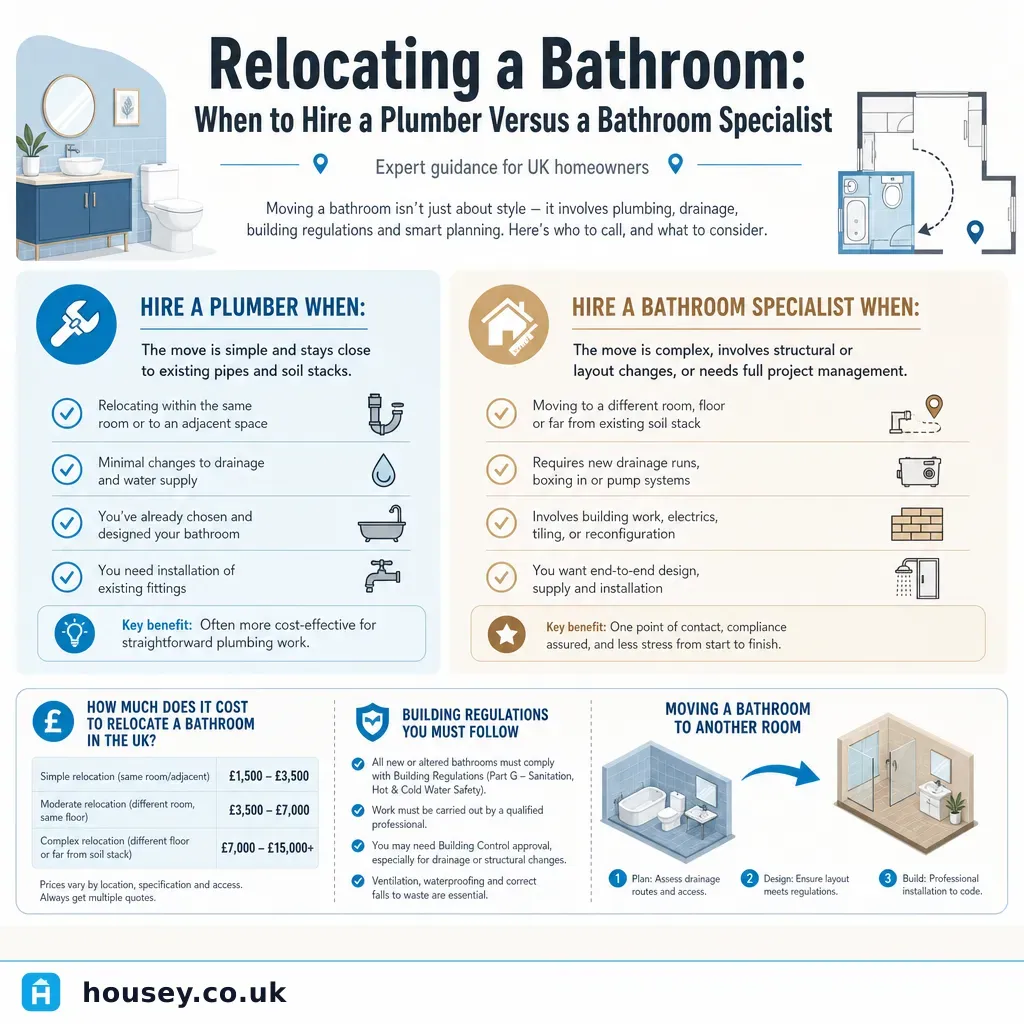
Relocating a Bathroom: When to Hire a Plumber Versus a Bathroom Specialist
Relocating a bathroom usually requires both a qualified plumber for pipework and drainage and other specialist trades for electrics, tiling, and finishes.
 Improvement & Build
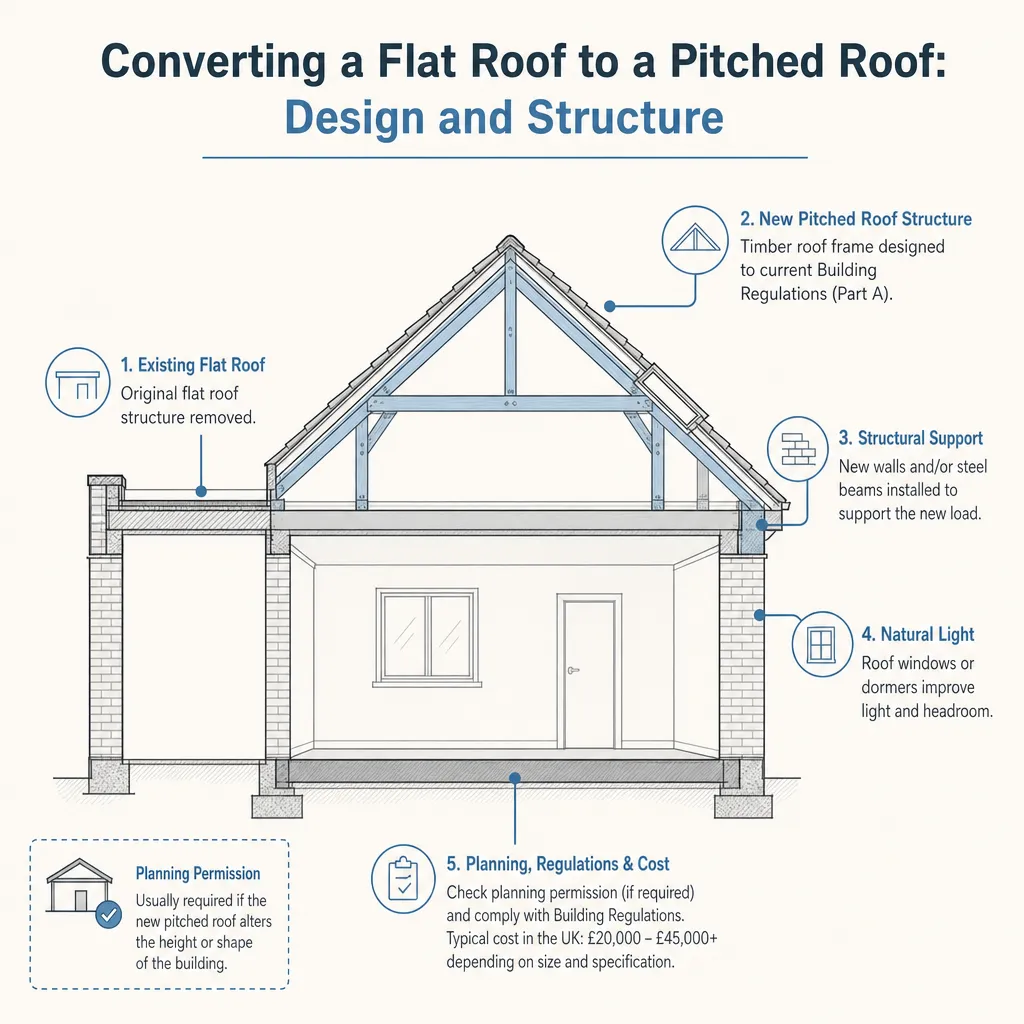
Converting a Flat Roof to a Pitched Roof: Design and Structure
Converting a flat roof to a pitched roof almost always requires Building Regulations approval and a structural engineer's design.
 Improvement & Build
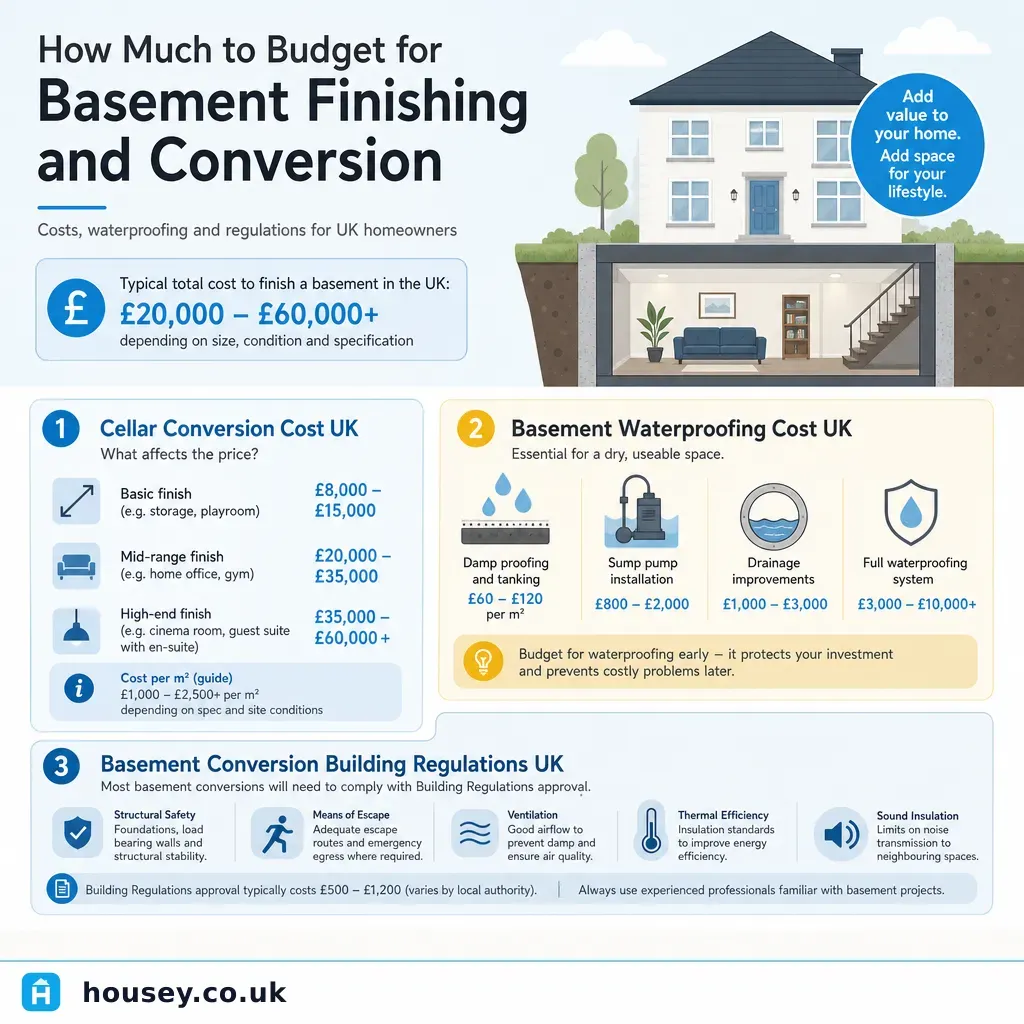
How Much to Budget for Basement Finishing and Conversion
Basement conversions in the UK typically cost £700–£1,500 per square metre for a simple cellar finish with existing headroom, rising to £1,500–£3,500 per square metre for a full conversion with underpinning.