Converting Listed Educational Buildings Into Modern Residential Homes
By Housey · Last reviewed 9th of May 2026
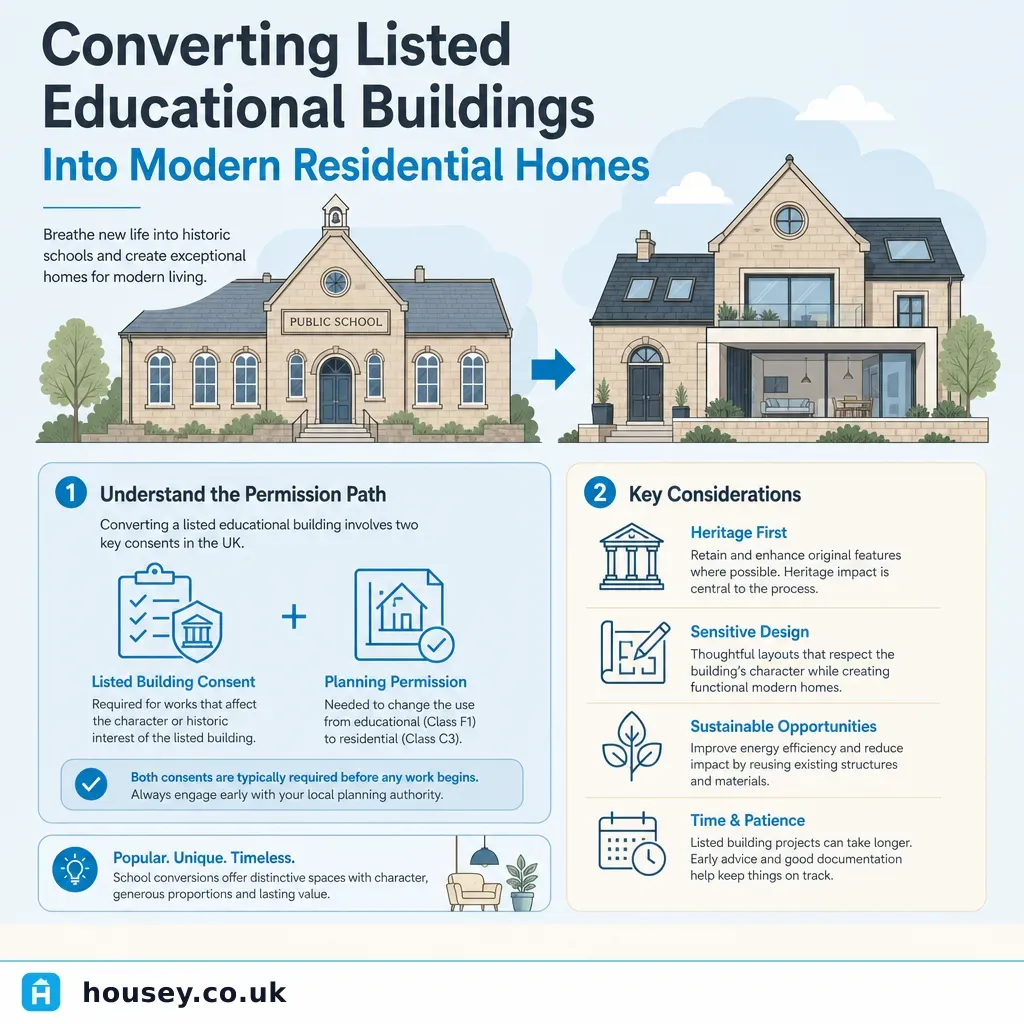
Converting Listed Educational Buildings Into Modern Residential Homes
Converting a listed school, chapel, or college into a private home sits at the intersection of planning law, heritage protection, and structural engineering. These buildings typically carry a Grade I, Grade II*, or Grade II listing, meaning works — internal or external — require formal listed building consent alongside planning permission for change of use. The Planning (Listed Buildings and Conservation Areas) Act 1990 creates serious criminal liability for works carried out without the required consents, making professional guidance essential before any decisions are committed to.
Key points
- Listed building consent (LBC) is legally separate from planning permission and must be obtained before any works affecting a building's character, appearance, or fabric — including internal alterations such as removing partition walls or altering original joinery.
- Change of use from Use Class F.1 (educational) to Use Class C3 (residential) requires full planning permission; permitted development does not apply to this change of use.
- Historic England is a statutory consultee for Grade I and Grade II* applications, typically extending the decision period beyond the standard 8-week target.
- Structural interventions must not harm the building's special architectural or historic interest; appoint a structural engineer with demonstrable listed building experience.
- Unauthorised works are a criminal offence under Section 9 of the Planning (Listed Buildings and Conservation Areas) Act 1990, with no time limit on prosecution.
What consents do you need?
Most listed educational conversions require three separate approvals. Listed building consent and planning permission are applied for separately but can be submitted simultaneously.
Consent type | Who decides | Statutory period | Key consideration |
|---|---|---|---|
Planning permission (change of use) | Local planning authority | 8 weeks (13 weeks for major applications) | Some Local Plans require evidence the educational use is no longer viable |
Listed building consent | Local planning authority | 8 weeks (longer where Historic England consulted) | All works — including internal — must preserve the building's special interest |
Building regulations approval | Building control body or approved inspector | No fixed statutory period | Fire, energy performance, structural adequacy, and accessibility all apply |
Conservation area consent | Local planning authority | 8 weeks | Required if unlisted structures on the site are to be demolished |
Which professionals do you need and when?
Appointing the right specialists in the right order avoids costly delays. A poorly coordinated team is one of the most common causes of programme and budget overrun on heritage conversion projects.
Stage | Professional | Why |
|---|---|---|
Feasibility and heritage assessment | Establishes what the LPA will accept; identifies significance of the historic fabric | |
Design and consent drawings | Architectural technologist or conservation architect | Measured survey, consent drawings, design and access statement, heritage impact assessment |
Structural assessment | Structural engineer with listed building experience | Assesses existing fabric; designs reversible interventions |
Planning and LBC applications | Manages submissions; negotiates with LPA and Historic England | |
Building regulations | Advises on Part L flexibility, fire strategy, and accessibility within heritage constraints | |
Construction phase | Coordinates contractors; monitors compliance with consent conditions |
Pre-application consultation with the LPA is strongly recommended before design work begins. For Grade I and Grade II* buildings, allow additional time for Historic England's review.
Common structural and design challenges
Floor heights: Victorian school halls often have 4–6m floor-to-ceiling heights. Inserting mezzanines or new floors is structurally achievable but must not harm the spatial quality or historic fabric.
Glazing: Original multi-pane windows, leaded lights, and clerestory glazing are usually central to a building's special interest. Secondary glazing is generally the only energy-efficiency measure conservation officers will accept as an alternative to replacement.
Roof structures: Large-span roofs on halls and gymnasiums often require repair rather than replacement; consent conditions typically specify like-for-like materials such as Welsh slate or clay tiles.
Energy performance: Part L flexibility for listed buildings is recognised in Approved Document L and Historic England's guidance on energy efficiency in historic buildings. A fabric-first approach, secondary glazing, and breathable draught-proofing are the most commonly accepted measures.
Decision framework: assessing viability before you commit
- Grade I or Grade II* listing? Historic England will be a statutory consultee — allow longer timescales and a higher design standard from the outset.
- LPA policy restricting educational-use loss? Check the Local Plan — some authorities require viability evidence before granting change of use.
- Conservation area? External appearance constraints apply to all structures on the site, listed or not.
- Building structurally stable? A structural engineer's preliminary assessment is needed before meaningful design work can proceed.
- Building been vacant? Seek accountancy advice on VAT reliefs for empty residential conversions — refer to HMRC VAT Notice 708.
Red flags to watch for
- An architect or planner with no demonstrable listed building experience — this is a specialist field and inexperience regularly leads to refusals or costly redesigns.
- Any contractor offering to begin clearance or demolition before consents are secured — affecting listed fabric without LBC is a criminal offence.
- A design proposing replacement of original windows, doors, or joinery with modern equivalents — conservation officers rarely accept this without compelling justification.
- No pre-application consultation with the LPA planned — for a conversion of this scale, pre-app advice is strongly recommended and sometimes required.
- Absence of a formal heritage impact assessment — the NPPF requires LPAs to assess heritage significance and impact; applications submitted without one routinely fail.
Important limitations
This article is general information only. Listed building law, planning policy, and conservation requirements vary significantly by property, listing description, location, and local authority. Nothing here constitutes legal, structural, or planning advice. A qualified heritage consultant and planning consultant should assess your specific building before you commit expenditure or make irreversible decisions.
What to ask a qualified professional
- How many listed educational-to-residential conversions have you managed, and can you share references?
- Which local planning authorities have you worked with in this area, and are you familiar with the conservation officer?
- How will the heritage impact assessment address this building's specific significance as described in the listing?
- How do you approach Approved Document L compliance in listed buildings, and what measures do you typically propose?
- What are realistic timescales for pre-application, submission, and decision — and what are the main risks to that programme?
- Have you previously managed the Historic England consultation process, and can you do so here if required?
When to get professional help
Seek professional heritage and planning advice before you do anything else — including buying the building if you have not already done so. It is especially important if the building is Grade I or Grade II* listed, the LPA has an educational-use retention policy, structural surveys reveal deterioration or previous unauthorised works, or you are uncertain what the listing description covers internally.
How Housey can help
Housey connects you with UK professionals experienced in heritage and listed building projects. Start with a heritage and conservation consultant to assess feasibility and significance, then find a planning consultant to manage your applications and a structural engineer experienced in historic structures — all through Housey's quote request platform.
Frequently asked questions
Do I need listed building consent even for internal works?
Yes. Listed building consent is required for any works that would affect the character of a listed building as a building of special architectural or historic interest — and this explicitly includes internal alterations. Removing partition walls, altering historic staircases, inserting new floors, or changing original joinery all typically require LBC. The listing covers the entire building, including the interior, unless the consent document specifically excludes certain elements.
Can I add a contemporary extension to a listed educational building?
Many local planning authorities and Historic England accept well-designed contemporary additions where they are clearly subservient in scale, set back from the principal elevation, and use sympathetic materials without being imitative. Every case is assessed individually. A heritage consultant and conservation-experienced architect should advise on what your specific LPA is likely to accept before you invest in detailed design work.
How long does the process take from purchase to occupation?
For a straightforward Grade II listed educational conversion, allow 18–36 months from purchase to occupation: 3–6 months for feasibility and pre-application; 4–8 months for design and application preparation; 2–4 months for the LPA decision; and 6–18 months for construction. Grade I and Grade II* buildings typically take longer, particularly where Historic England is a statutory consultee.
What VAT applies to listed building conversions?
Approved alterations to listed buildings were zero-rated for VAT for many years, but this relief was removed in 2012. Works on listed buildings are generally now standard-rated at 20%. Where you are converting a dwelling that has been empty for at least two years, a reduced 5% rate may apply to certain works. The rules are complex — take advice from an accountant familiar with property and refer to HMRC VAT Notice 708.
What happens if works are carried out without listed building consent?
Carrying out works without listed building consent is a criminal offence under Section 9 of the Planning (Listed Buildings and Conservation Areas) Act 1990, with no time limit on prosecution. The local planning authority can serve an enforcement notice requiring restoration at the owner's cost. Courts may impose unlimited fines and, in serious cases, a custodial sentence. Unauthorised works also make a property difficult to sell or remortgage.
Sources and further reading
- Listed buildings and listed building consent — GOV.UK
- Planning (Listed Buildings and Conservation Areas) Act 1990 — legislation.gov.uk
- Energy efficiency and historic buildings — Historic England
- National Planning Policy Framework — GOV.UK / DLUHC
- Conservation of fuel and power: Approved Document L — GOV.UK
- VAT Notice 708: buildings and construction — HMRC
Useful next reads
 Planning & Pre-Build
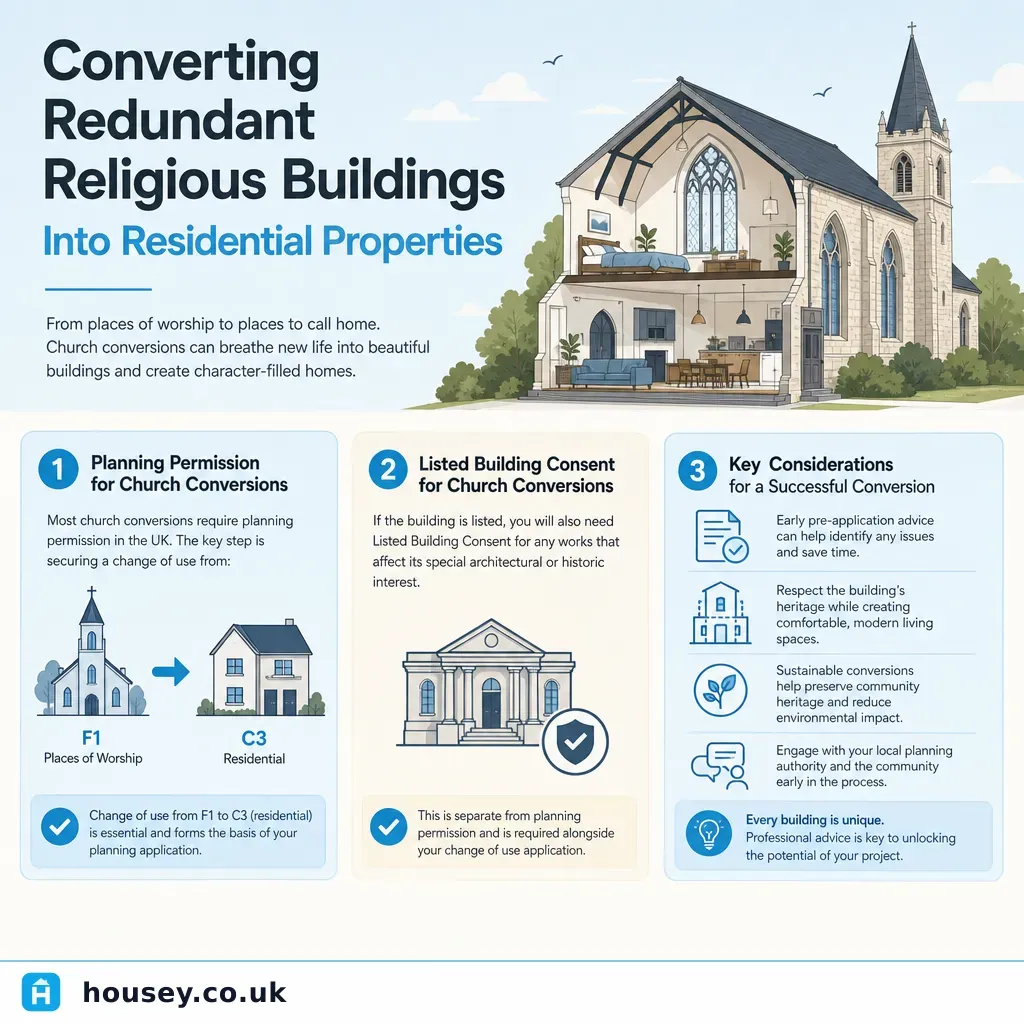
Converting Redundant Religious Buildings Into Residential Properties
Converting a redundant religious building to residential use in the UK requires planning permission for change of use from Use Class F.
 Planning & Pre-Build
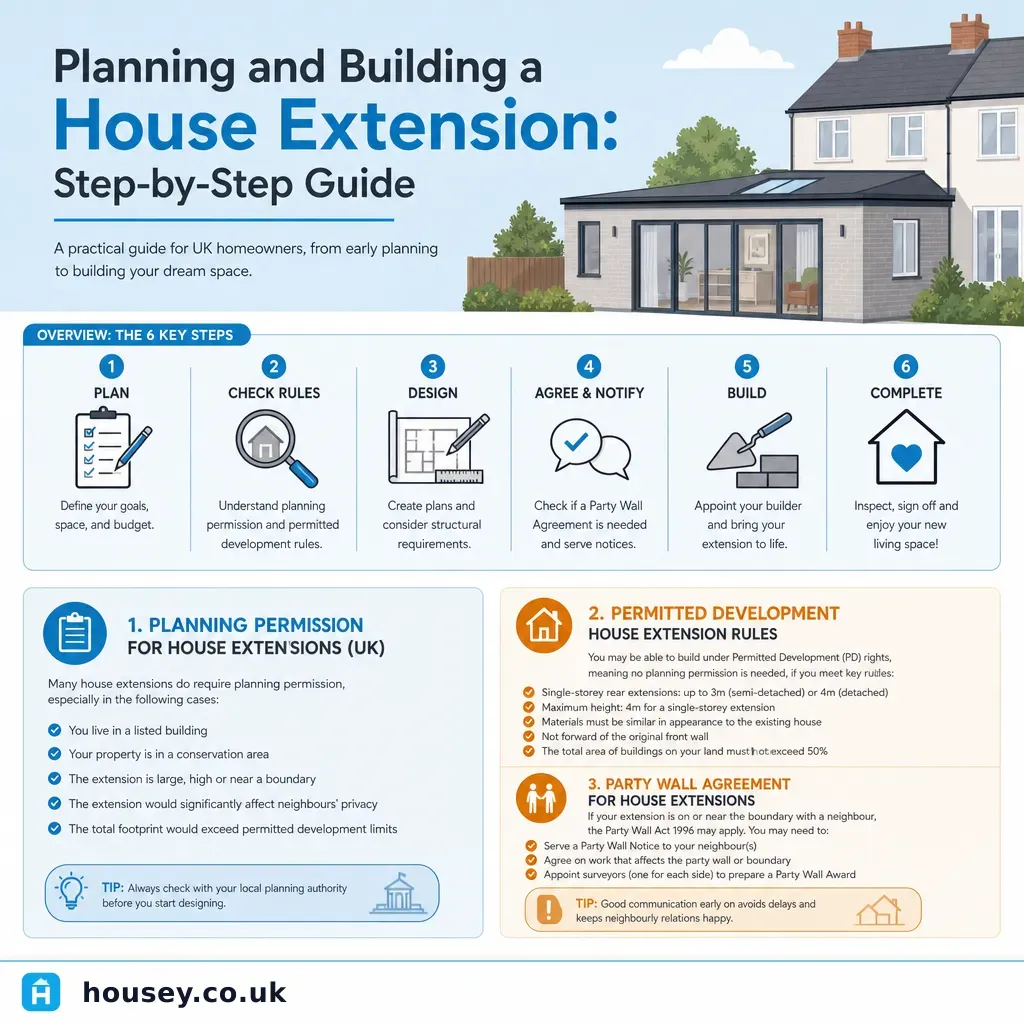
Planning and Building a House Extension: Step-by-Step Guide
A house extension in the UK usually requires either planning permission or confirmation of permitted development rights, Building Regulations approval, and — where work affects a shared wall or boundary — compliance with the Party Wall etc.
 Planning & Pre-Build
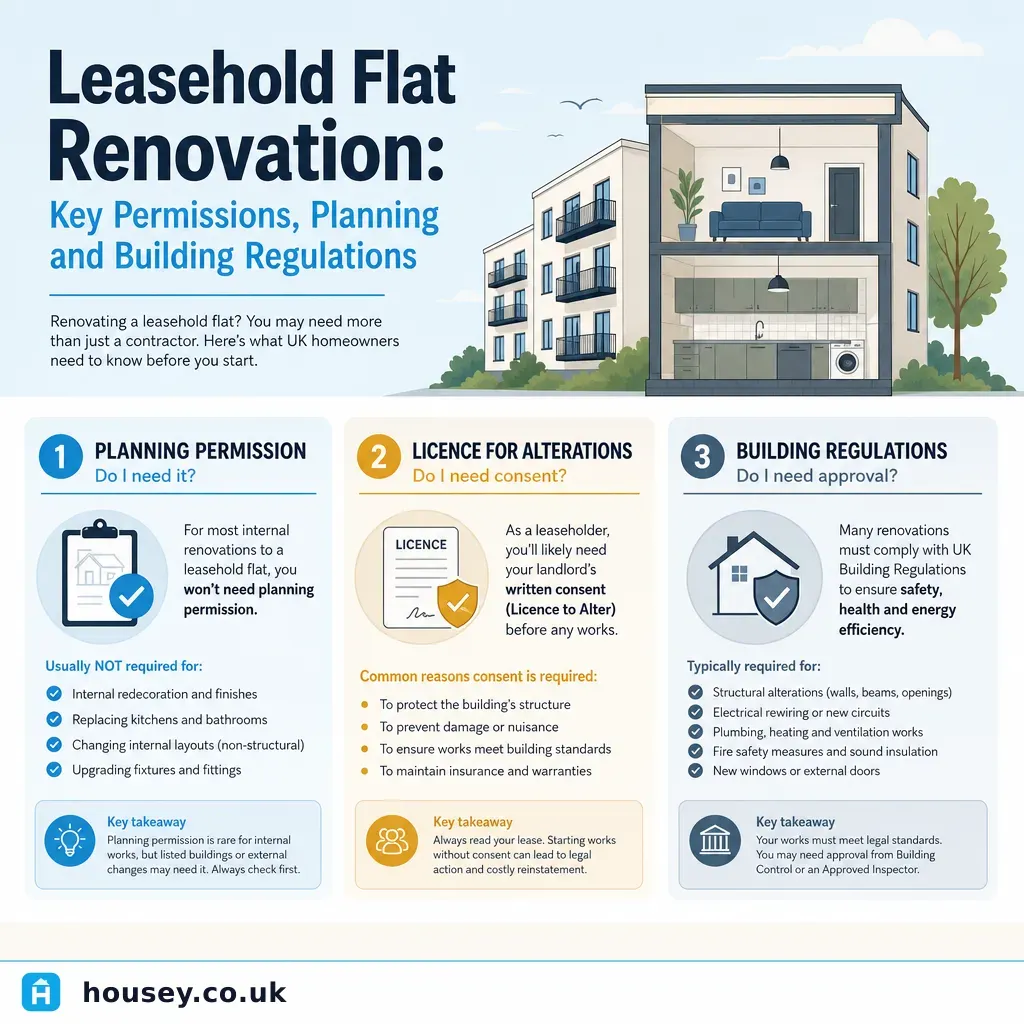
Leasehold Flat Renovation: Key Permissions, Planning and Building Regulations
Most leasehold flat renovations require written consent from your freeholder or managing agent before work begins — this is usually called a licence for alterations.
 Planning & Pre-Build
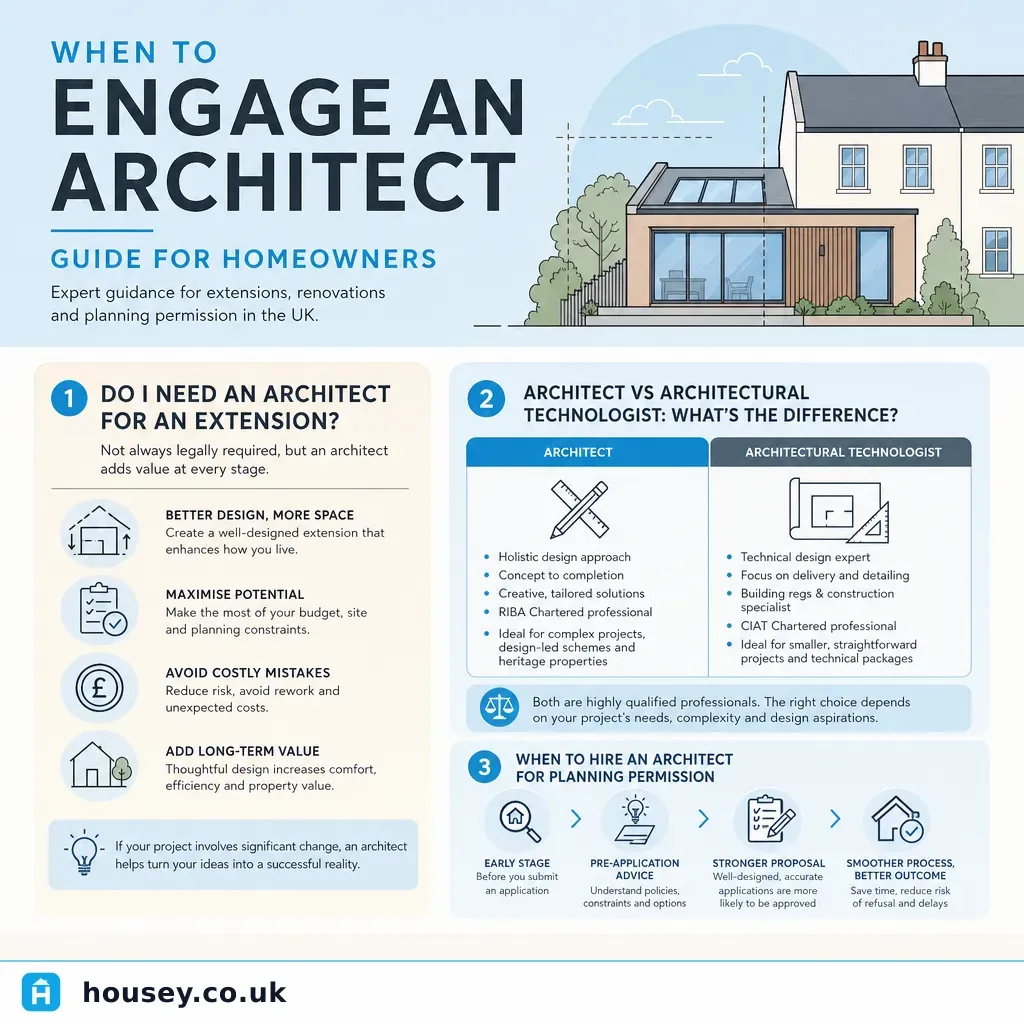
When to Engage an Architect: Guide for Homeowners
You usually need an architect for complex extensions, new builds, listed building works, conservation area projects, or contentious planning applications requiring detailed design drawings.
 Planning & Pre-Build
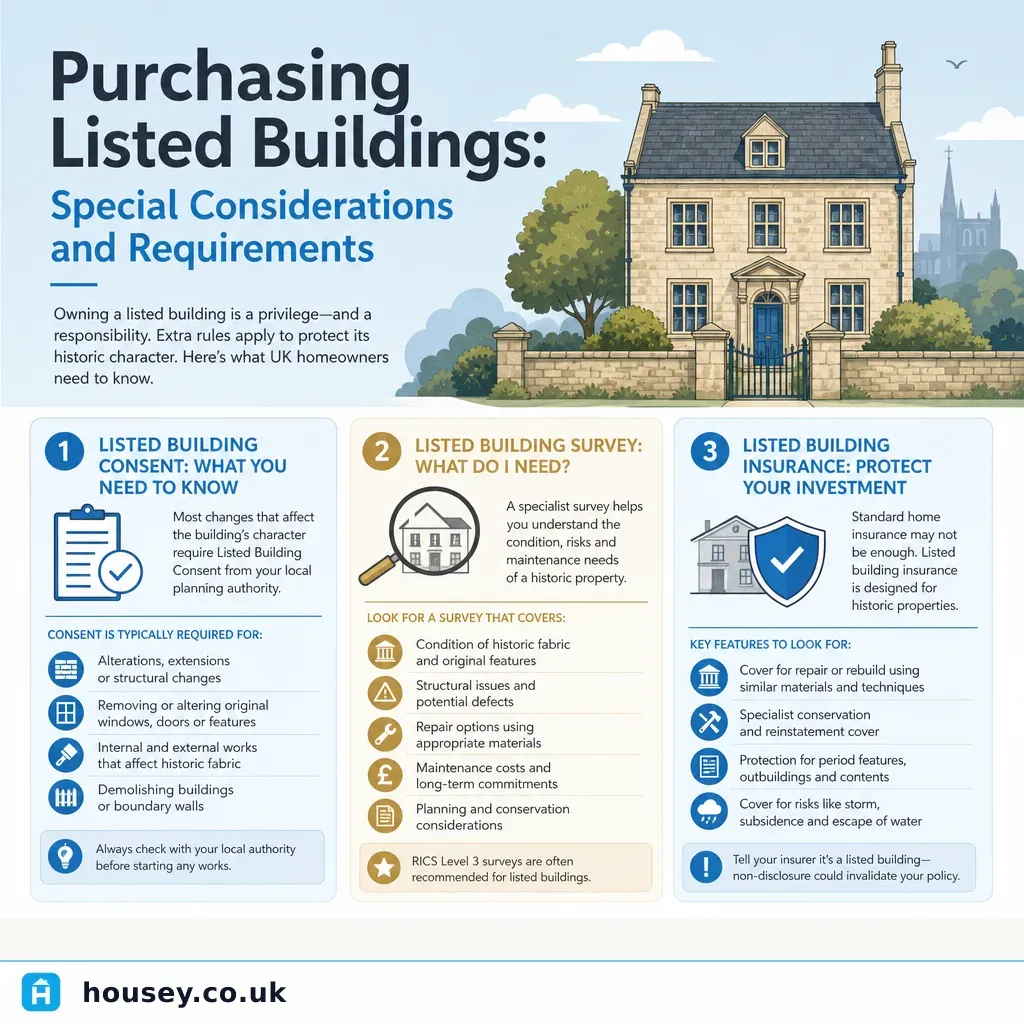
Purchasing Listed Buildings: Special Considerations and Requirements
Buying a listed building means any works affecting its character require Listed Building Consent — separate from planning permission.