Converting Redundant Religious Buildings Into Residential Properties
By Housey · Last reviewed 30th of May 2026
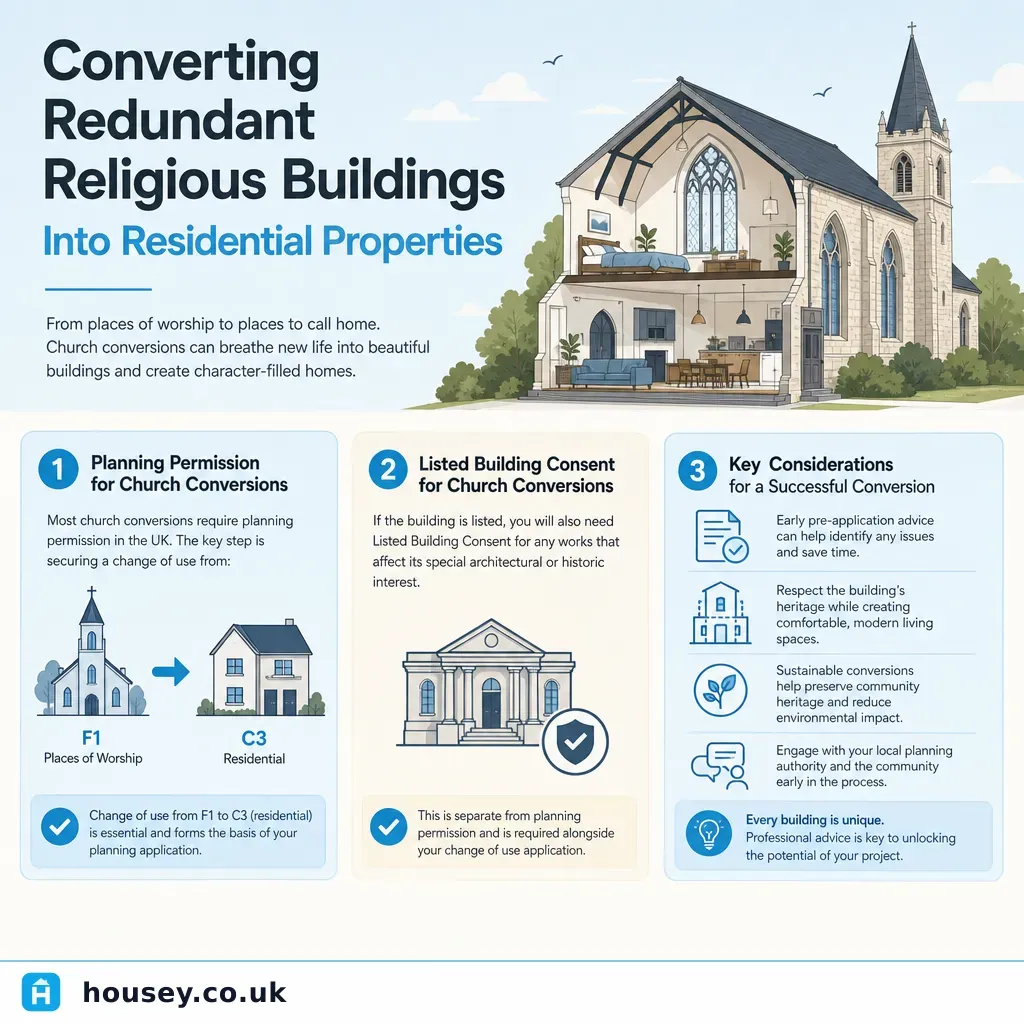
Converting Redundant Religious Buildings Into Residential Properties
Churches, chapels, Quaker meeting houses, and former synagogues represent some of the UK's most architecturally distinctive and structurally complex conversion opportunities. Many are no longer required for worship and have been declared redundant by their denominations, creating a pipeline of unusual buildings that development-minded purchasers find compelling. However, the planning, heritage, structural, and regulatory hurdles are substantial — particularly where a building is listed or sits within a conservation area — and the costs of a conversion that stalls mid-process, or faces enforcement action, are considerable.
Key points
- A change of use from Place of Worship (Use Class F.1) to residential (Use Class C3) requires full planning permission in England; there is no permitted development right for this change of use.
- Most historic religious buildings of architectural merit are listed (Grade I, Grade II* or Grade II); listed building consent is required in addition to planning permission for any works affecting the character or fabric of a listed building.
- The Church of England's redundant church process is governed by the Pastoral Measure 2011 and involves the Diocese, Historic England, and potentially the Churches Conservation Trust — the disposal route differs substantially from buying a redundant Nonconformist chapel on the open market.
- Building Regulations apply in full to the conversion, including Part A (structural), Part B (fire safety), Part E (sound insulation between dwellings), Part F (ventilation), Part L (energy efficiency), and Part M (access).
- Zero-rate VAT may apply to eligible construction services in the conversion of a non-residential building to dwellings under Schedule 8, Group 5 of the VAT Act 1994 — always confirm eligibility with a specialist VAT adviser, as conditions are specific.
Planning permission and change of use
Change of use from F.1 (learning and non-residential institutions, which includes places of worship) to C3 (dwellinghouses) is not permitted development in England. A full planning application to the Local Planning Authority (LPA) is required.
The LPA will consider:
- Loss of a community facility: most Local Plans contain policies protecting existing community uses. Applicants may need to demonstrate the facility is genuinely redundant and has been marketed for alternative community or cultural uses before residential conversion is considered.
- Heritage impact: whether the conversion would preserve, enhance, or harm the significance of the building and its setting — a key consideration under the National Planning Policy Framework.
- Design quality: the LPA may require that the external character of the building is respected, limiting fenestration changes, extensions, and roofline alterations.
- Residential amenity: outlook, overlooking, noise, parking, and access.
- Housing mix: in some areas, the LPA may seek affordable housing contributions or particular unit types as part of the consent.
Where the building is listed, listed building consent from the LPA is required separately from planning permission. For Grade I and Grade II* listed buildings, Historic England is a statutory consultee. In Wales, Cadw performs an equivalent role; in Scotland, Historic Environment Scotland.
Which professional do you need?
Stage | Professional | Why |
|---|---|---|
Initial feasibility and planning strategy | Planning consultant or architect with heritage experience | Assesses LPA policy, listing status, and likely conditions before purchase |
Pre-application discussions with LPA | Architect or planning consultant | Establishes scheme acceptability before full application costs are incurred |
Listed building consent and planning application | Architect with conservation experience | Heritage impact assessment, design and access statement, planning drawings |
Structural assessment | Structural engineer | Religious buildings often have large open spans, specialist roof structures, and uncertain foundations |
Building Regulations drawings and submission | Architectural technologist or architect | Required before and during construction |
VAT and tax planning | VAT specialist or tax adviser | Non-residential to residential conversions may qualify for zero-rate VAT on eligible services |
Asbestos survey | Qualified asbestos surveyor | Pre-2000 buildings should be surveyed before any intrusive works |
Worked example: a redundant Welsh Nonconformist chapel
A purchaser acquires a mid-Victorian stone Nonconformist chapel in a Welsh market town for conversion to four residential units. The building is Grade II listed and within a conservation area.
- Pre-application meeting with the Local Planning Authority and Cadw to discuss the principle of conversion and acceptable design parameters — particularly the treatment of the original arched windows and interior gallery.
- Structural engineer's report identifying the condition of the roof trusses, wall-plate connections, and foundations; the chapel has a shallow-pitch slate roof spanning a large open nave with no intermediate support, requiring a bespoke steel insertion strategy.
- Planning application for change of use (F.1 to C3) and listed building consent; the supporting heritage statement demonstrates that inserting residential floors and mezzanines can be achieved without removing original pews, the gallery structure, or significant historic fabric.
- Building Regulations approval covering fire escape routes (particularly for upper-level gallery units), acoustic separation between dwellings under Approved Document E, and thermal performance targets under Approved Document L.
- Asbestos refurbishment survey prior to commencement — ceiling boards and pipe lagging in the vestry test positive; remediation by a licensed asbestos contractor is required before construction begins. Do not disturb suspected asbestos-containing materials.
- VAT position confirmed — conversion from non-residential to dwellings qualifies for zero-rate VAT on eligible construction services under Schedule 8, Group 5 of the VAT Act 1994, materially reducing build costs.
Red flags that should prompt professional advice before purchase
- No pre-application response from the LPA: do not purchase a redundant religious building on the assumption that residential planning will be granted. Community facility protection policies and heritage constraints can block or significantly limit consent.
- Grade I or Grade II* listing: the most constrained categories. Schemes affecting the interior fabric of a Grade I church face the highest level of scrutiny and mandatory Historic England involvement.
- Church of England disposal complications: the process under the Pastoral Measure 2011 is distinct from a standard open-market sale. Freehold may vest in the Churches Conservation Trust rather than transfer to a developer. Understand the disposal route fully before valuing the opportunity.
- Large open spans and unusual roof structures: hammer-beam roofs, thin-shell concrete roofs (common in mid-20th-century chapels), and queen-post trusses require specialist structural engineering assessment before any insertion works are designed.
- Asbestos-containing materials: pre-2000 religious buildings frequently contain asbestos in floor tiles, ceiling boards, pipe lagging, and roofing materials. A full refurbishment and demolition asbestos survey (as described in HSE guidance HSG264) must be completed before any intrusive works. Do not disturb suspected materials.
- Proximity to burial sites: many redundant churches sit on or immediately adjacent to consecrated ground. Check for statutory constraints on ground disturbance near graves before any foundation or drainage works are planned.
Energy performance and Building Regulations Part L
The thermal performance of a stone, brick, or concrete religious building is typically very poor — solid walls with no cavity, single-glazed lancet windows, uninsulated floors, and large volumes of unheated air. Meeting the fabric targets in Approved Document L for a conversion requires balancing minimum energy efficiency requirements against the need to preserve historic character.
For listed buildings, there is some flexibility where achieving the notional standard would unacceptably alter the character or appearance of the building — but this position must be agreed with the LPA and the building control body at design stage, not assumed retrospectively. A whole-building energy model is usually required for larger conversion schemes, and a specialist heritage energy consultant can help identify acceptable interventions such as secondary glazing, reversible internal insulation, and low-carbon heating.
Important limitations
Planning and listed building consent decisions are made by individual Local Planning Authorities and are subject to local plan policies, heritage designations, and material considerations that vary by location, building, and proposal. Rules for Wales (Cadw), Scotland (Historic Environment Scotland), and Northern Ireland (Historic Environment Division) differ from those in England. This article provides general orientation only. Always instruct a planning consultant and heritage architect with direct experience of religious building conversions before purchase or planning submission. Nothing in this article constitutes planning, structural, or legal advice.
When this becomes urgent
- You have exchanged on a redundant religious building without obtaining pre-application advice from the LPA.
- Works have commenced on a listed building without listed building consent — this is a criminal offence under the Planning (Listed Buildings and Conservation Areas) Act 1990.
- Asbestos-containing materials have been disturbed during initial investigations or clearance works.
- A structural engineer has identified significant deterioration in the roof structure or evidence of subsidence.
What to ask a qualified professional
Before purchasing a redundant religious building:
- What is the LPA's policy on change of use from community or worship use in this location?
- What listing grade is the building, and are there any Article 4 directions in force in the area?
- What is the likely scope and cost of a heritage impact assessment?
- Has the LPA received any recent pre-applications for this site, and what was the response?
When instructing a structural engineer:
- Are there any signs of structural movement, subsidence, or roof failure that would affect the viability of conversion?
- What are the structural implications of inserting intermediate floors into the main open span?
- Are there any unusual structural elements — such as thin-shell concrete or historic ironwork — that require specialist assessment?
When assessing the VAT position:
- Does this conversion qualify for zero-rate VAT on construction services under Group 5, Schedule 8 of the VAT Act 1994?
- Are there any conditions on VAT relief that affect how the completed units must be sold or used?
When to get professional help
A redundant religious building conversion is not a project for first-time developers without access to specialist planning, heritage, and structural advice. The combination of planning risk, listed building consent requirements, structural complexity, asbestos, and unusual Building Regulations challenges means that professional advice from the outset — ideally before exchange of contracts — is essential.
Do not begin any intrusive works, survey investigations, or temporary repairs to a listed building without first confirming whether listed building consent is required. Unauthorised works to a listed building are a criminal offence under the Planning (Listed Buildings and Conservation Areas) Act 1990, regardless of whether the works are reversible.
How Housey can help
Housey connects developers and homeowners with the specialists who navigate complex conversion projects. If you need a planning consultant with experience of change of use and heritage consents, an architectural technologist to prepare construction and compliance drawings, or building regulations drawings to obtain approval before works start on site, you can find and compare qualified professionals through our platform.
Frequently asked questions
Does a redundant church automatically get planning permission for residential use?
No. Change of use from F.1 (Place of Worship) to C3 (residential) is not permitted development in England. A full planning application is required. The Local Planning Authority will consider heritage impact, community facility protection policies, and design quality. There is no guarantee of consent, and applications can be refused or granted subject to onerous conditions.
Do I need listed building consent as well as planning permission?
Yes, if the building is listed. Listed building consent is a separate consent from planning permission and is required for any works that would affect the character or fabric of a listed building, including internal alterations such as inserting floors or partitions. Carrying out works without listed building consent is a criminal offence under the Planning (Listed Buildings and Conservation Areas) Act 1990.
What VAT rate applies to converting a church to residential?
Conversion of a non-residential building to dwellings may qualify for zero-rate VAT on eligible construction services under Schedule 8, Group 5 of the VAT Act 1994. The conditions are specific and VAT treatment can be complex — particularly where some units are sold and others retained for rent. Always obtain specialist VAT advice from a qualified tax adviser before construction begins.
What is the Churches Conservation Trust?
The Churches Conservation Trust (CCT) is a national charity that cares for historic churches at risk of falling into disrepair. When a Church of England church is made redundant under the Pastoral Measure 2011, it may be vested in the CCT rather than sold on the open market. The CCT sometimes facilitates conversions but requires that historic character is preserved. Verify the disposal route before assuming a CCT-vested building can be freely purchased and converted.
Sources and further reading
- Planning Portal: change of use — Planning Portal
- Planning (Listed Buildings and Conservation Areas) Act 1990 — legislation.gov.uk
- Approved Document L (2021): Conservation of fuel and power — GOV.UK
- Historic England: energy efficiency and historic buildings — Historic England
- Asbestos: the survey guide (HSG264) — Health and Safety Executive
- VAT Notice 708: buildings and construction — HMRC
- Churches Conservation Trust — Churches Conservation Trust
Useful next reads
 Planning & Pre-Build
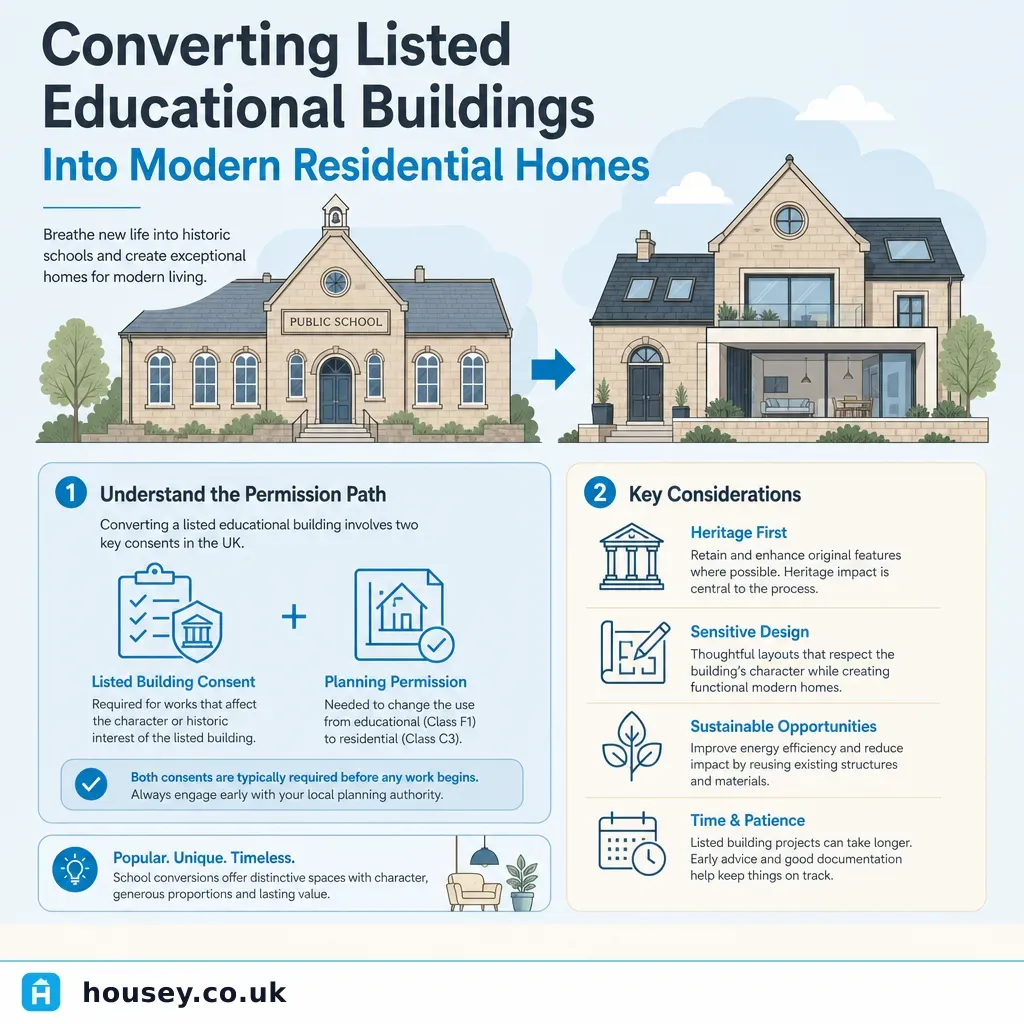
Converting Listed Educational Buildings Into Modern Residential Homes
Converting a listed educational building to residential use requires listed building consent and planning permission for change of use from your local planning authority.
 Planning & Pre-Build
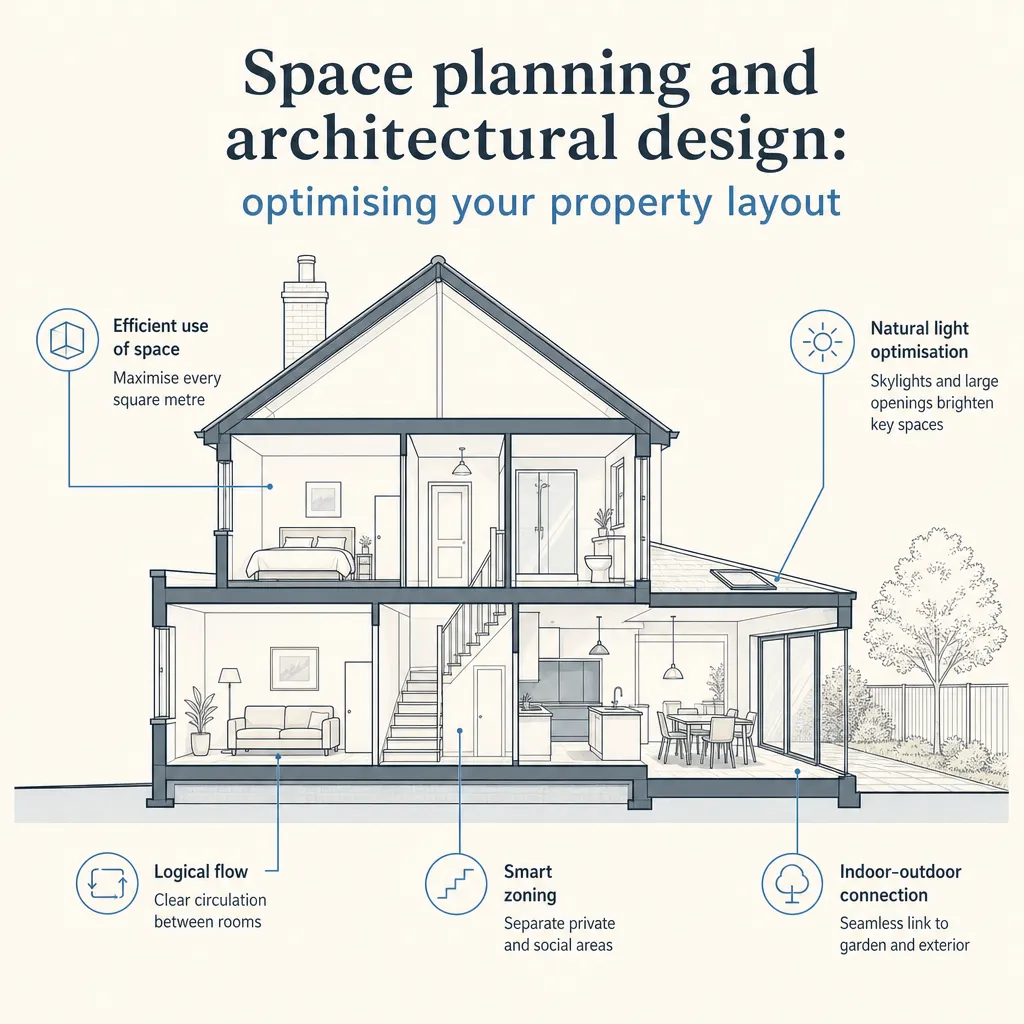
Space planning and architectural design: optimising your property layout
Space planning defines how rooms, circulation routes, and services are arranged within a property to make the best use of available area.
 Planning & Pre-Build
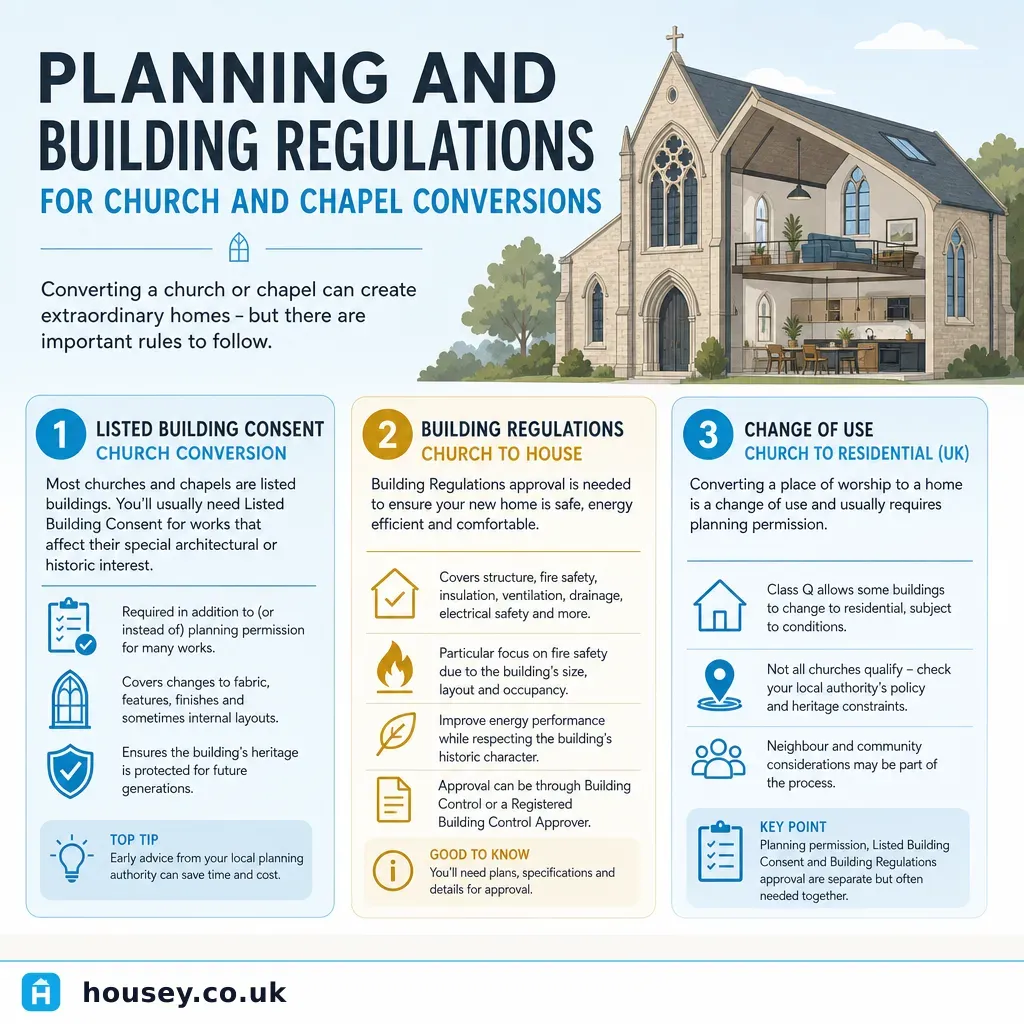
Planning and Building Regulations for Church and Chapel Conversions
Converting a church or chapel to residential use requires planning permission for change of use from Class F1 to Class C3, and listed building consent if the building is listed.
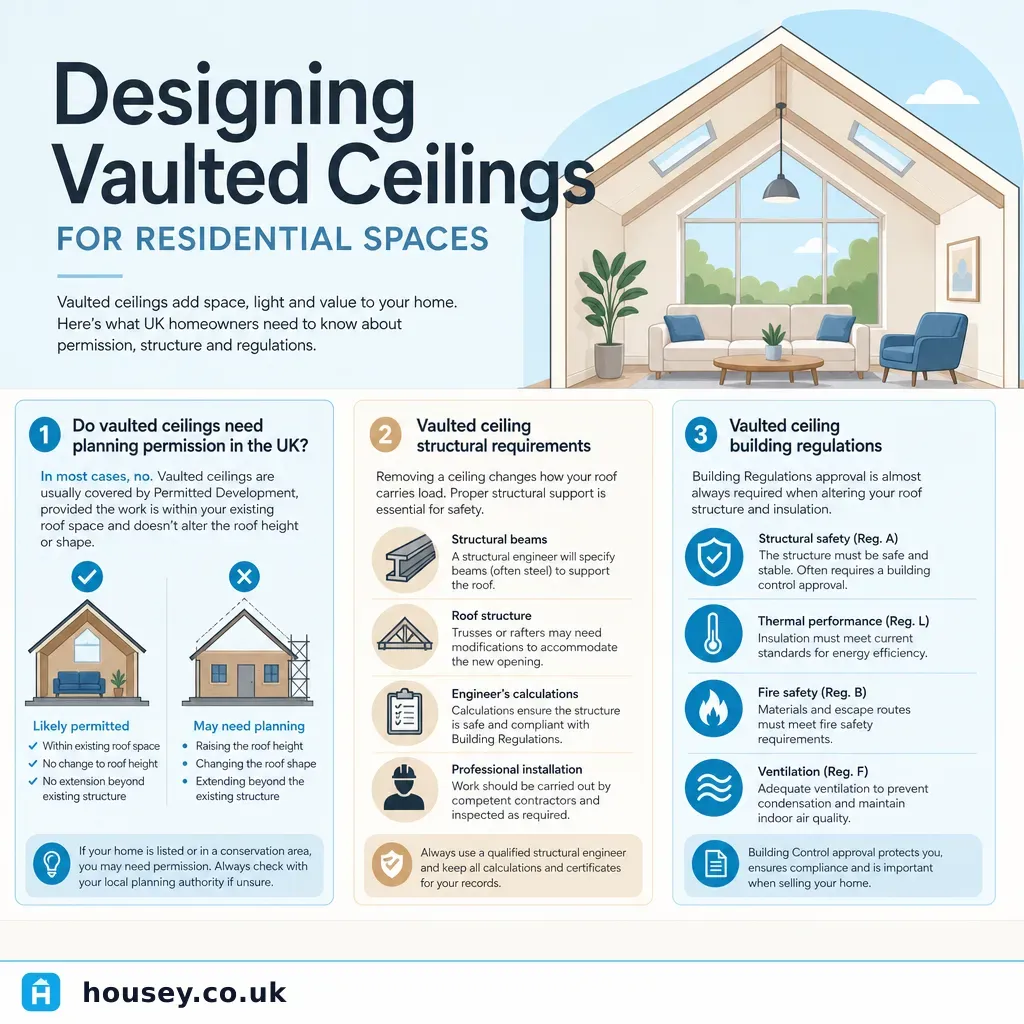 Planning & Pre-Build
Designing vaulted ceilings for residential spaces
Creating a vaulted ceiling in an existing home involves restructuring the roof timbers that form the structural triangle, which always requires a structural engineer's calculations and Building Regulations approval under Approved Document A.
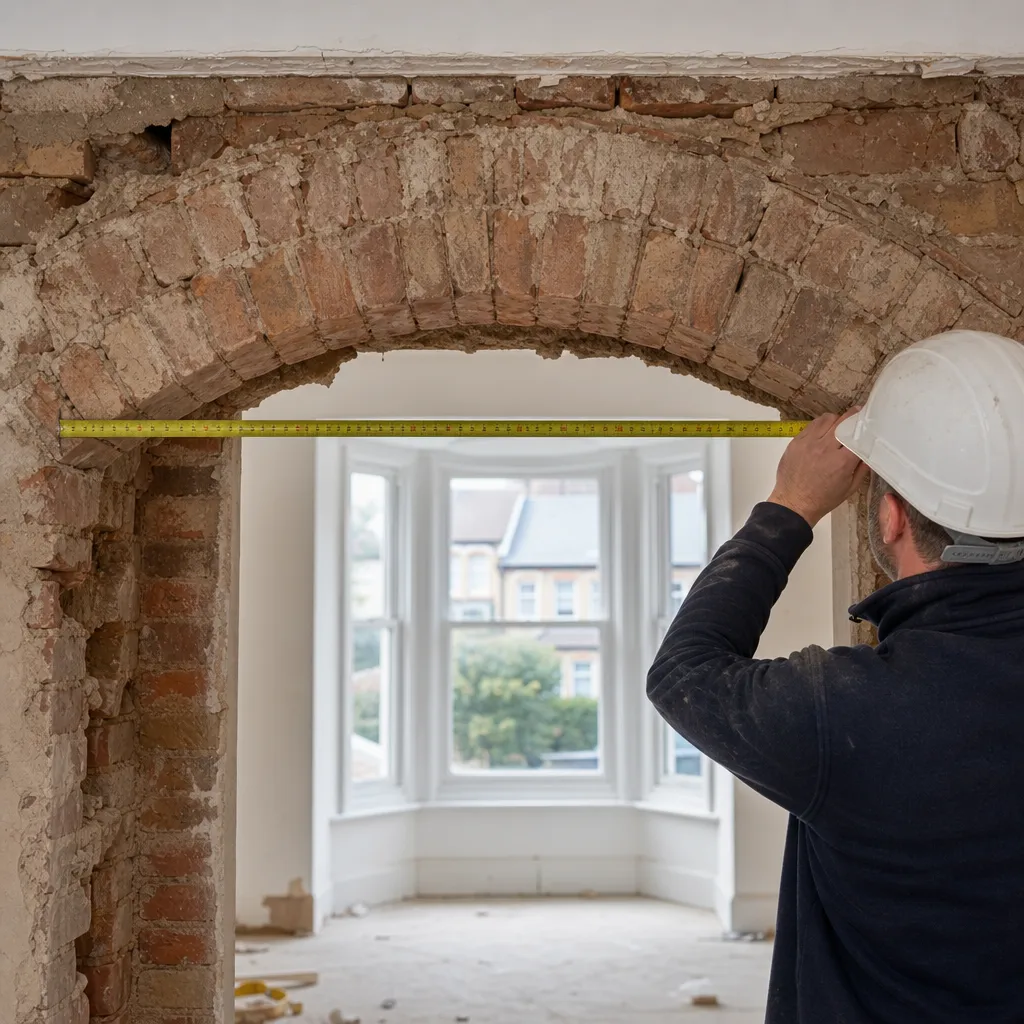 Planning & Pre-Build
Structural Arching in Walls: Load Distribution and Design
Structural arching occurs when masonry redistributes compressive loads in a triangular or parabolic path around an opening, reducing the load on the lintel below.