Leasehold Flat Renovation: Key Permissions, Planning and Building Regulations
By Housey · Last reviewed 19th of May 2026
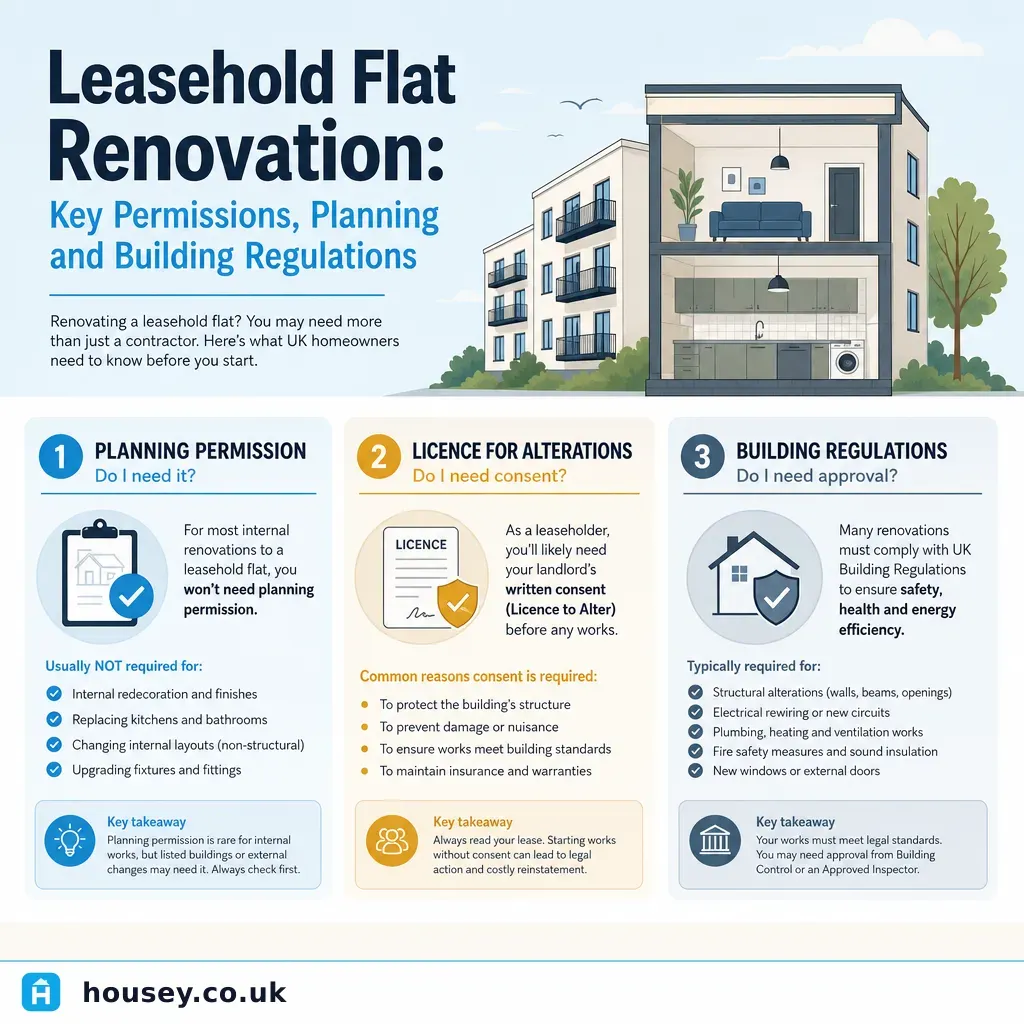
Leasehold Flat Renovation: Key Permissions, Planning and Building Regulations
Renovating a leasehold flat in the UK involves a layer of legal and regulatory checks that freehold homeowners never encounter. Whether you are planning a kitchen refit in a Victorian conversion, rewiring a purpose-built 1970s block, or opening up an internal wall in a city-centre apartment, your starting point is the lease — not a builder's quote. Getting the sequence wrong can stall a future sale, void building warranties, or in serious cases trigger a forfeiture clause.
Key points
- Most leases require written landlord or freeholder consent — usually called a licence for alterations — before structural, service, or significant cosmetic works begin.
- Building Regulations approval is required for structural alterations, electrical rewiring, new bathrooms, and changes to drainage even inside a leasehold flat; the lease does not remove this statutory duty.
- Planning permission is rarely needed for internal flat renovations, but external changes — new windows, external insulation, satellite dishes in certain locations — may require it.
- Under the Landlord and Tenant Act 1985, leaseholders have rights to challenge service charges over £250 per contractor and to inspect major-works accounts.
- A licence for alterations is a legal document: completing works without one can create problems on resale, remortgaging, or at lease renewal, and may constitute a breach of covenant.
What does your lease actually say?
The lease is the first document to read. Most leases contain an absolute covenant against alterations (no changes without landlord consent, full stop) or a qualified covenant (no changes without consent, which must not be unreasonably withheld). A small number of leases — typically older or poorly drafted ones — are silent on alterations altogether, which does not mean works are automatically permitted.
Look specifically for:
- Clauses referencing "alterations", "improvements", "additions", or "structural works"
- Any obligation to reinstate the flat to its original condition at the end of the lease
- Clauses about flooring (many leases restrict hard flooring to protect lower flats from noise)
- References to shared services: soil stacks, communal heating, gas risers, structural walls and columns
If you cannot locate or interpret the relevant lease clauses, a solicitor experienced in leasehold conveyancing should review it before you proceed.
Do you need a licence for alterations?
A licence for alterations is a formal written consent from the freeholder (or their managing agent) allowing specified works to proceed. It is a legal document, not simply an email approval.
When a licence is usually required
- Removing or altering internal walls (especially if they may be load-bearing)
- Any work affecting shared services: soil stacks, risers, communal pipes
- Installing a new bathroom or en suite involving drainage changes
- Full electrical rewiring
- New openings in floors or ceilings between flats
- Significant hard flooring installation over existing joists
When you may not need a formal licence
- Like-for-like kitchen unit replacements with no changes to drainage or electrics
- Redecorating, replastering, or replacing carpets
- Installing a new boiler in the same position using existing pipework
Even for lower-risk works, it is prudent to notify the managing agent in writing and keep a copy of any acknowledgement. A solicitor will usually prepare the licence for alterations on behalf of the freeholder; expect to pay their legal fees (typically £500–£1,500 plus VAT depending on complexity — indicative UK costs, last reviewed 2026-05-19; quotes vary).
Planning permission and leasehold flats
Internal alterations to a flat almost never require planning permission. The Town and Country Planning Act 1990 and the General Permitted Development Order 2015 (as amended) mean that most internal works are not "development" in planning terms.
However, planning permission may be required for:
Work type | Planning needed? | Notes |
|---|---|---|
Internal wall removal | No (usually) | Check lease and Building Regs |
New or enlarged windows | Possibly | Especially in conservation areas or listed buildings |
External insulation / cladding | Yes (often) | Requires freeholder consent too |
Roof terrace / new external door | Usually yes | Check with local planning authority |
Satellite dish visible from highway | Possibly | Permitted development rules apply |
Listed building — any alteration | Listed Building Consent required | Even internal works |
If the building is in a conservation area or is a listed building, the rules are significantly stricter. Check with your local planning authority before assuming permitted development applies.
Building Regulations and leasehold flats
Building Regulations approval is a legal requirement regardless of tenure. The fact that you are a leaseholder does not remove the duty to comply with England's Building Regulations 2010 (and subsequent amendments including Part L 2021 and the Building Safety Act 2022 regime).
Works in a flat that typically require Building Regulations approval include:
- Structural alterations: removing load-bearing walls, installing new beams, forming new openings
- Electrical work: full or partial rewiring, new consumer units, adding circuits
- Drainage changes: new bathrooms, relocation of WCs or waste pipes
- Heating changes: new boiler installations, replacement of a boiler with a different fuel type
- Insulation upgrades: in some cases, particularly where thermal performance thresholds under Part L are affected
- Sound insulation: new separating floors or walls between dwellings (Part E)
You will need either a full plans application or a building notice submitted to your local authority building control (LABC), or an application to a Registered Building Inspector under the Building Safety Act 2022 regime. For larger or more complex works, full plans give greater certainty before work begins.
Decision tree: which consents do you need?
- Check your lease first. If there is a covenant against alterations, obtain a licence for alterations from the freeholder before instructing contractors.
- Check if the building is listed or in a conservation area. If yes, contact the local planning authority before any external or significant internal works.
- Determine whether works are structural, electrical, involve drainage, or affect shared services. If yes, Building Regulations approval is required — engage a structural engineer or architectural technologist to prepare compliant drawings.
- Confirm whether external changes are planned. If yes, check whether permitted development rights apply or whether a planning application is needed.
- Notify the managing agent in writing even for minor works. This creates a paper trail and can prevent disputes on resale.
- Ask a solicitor if you are unsure about your lease obligations, especially before completing on a flat where works have already been carried out by a previous leaseholder without consent.
Important limitations
This article provides general information about the leasehold renovation process in England. Lease terms vary significantly between properties and freeholders; nothing here constitutes legal advice. Rules on permitted development, listed building consent, and building control vary by local authority and property type. Always review your specific lease, consult a qualified solicitor for leasehold matters, and engage registered professionals for building regulations and planning applications.
What to ask a qualified professional
Questions for your solicitor
- Does my lease contain an absolute or qualified covenant against alterations?
- Is freeholder consent likely to be given, and what conditions might they impose?
- What fees and timescales should I expect for a licence for alterations?
- Are there any previous unlicensed works I should be aware of before proceeding?
Questions for your architect or architectural technologist
- Which elements of my proposed works require Building Regulations approval?
- Do I need structural calculations, and should I instruct a structural engineer?
- Should I apply via full plans or a building notice?
- Will my works affect fire safety, sound insulation, or energy performance compliance under Part E or Part L?
Questions for the managing agent
- What is the process for applying for a licence for alterations, and what information is required?
- Are there any restrictions in the building rules around noise, working hours, or contractor access?
- Are there any shared services or structural elements I should be aware of before planning my works?
When to get professional help
Seek professional advice before starting any works if:
- Your lease contains an absolute covenant against alterations
- The flat is in a listed building or conservation area
- You are removing or altering any wall that might be load-bearing
- Works involve shared drainage, soil stacks, or communal services
- A previous owner has already carried out works without obtaining consent
- You are planning to remortgage or sell within the next few years — undocumented alterations can hold up transactions and may require costly retrospective remediation
How Housey can help
Housey connects UK leaseholders with the professionals needed to navigate flat renovations compliantly. If your works require building regulations drawings — including structural calculations, fire safety layouts, or energy performance compliance — our service connects you with vetted professionals. For structural work involving walls, beams, or floor openings, our structural engineering service provides calculations and design input. Housey also lists architectural technologists who can manage the full consents process from licence application through to building control sign-off, and a planning consultancy service for external changes that require planning permission or conservation area assessment.
Frequently asked questions
Do I always need freeholder consent to renovate a leasehold flat?
In most cases, yes — leases typically contain a covenant requiring written consent for alterations beyond routine decoration. The formality of that consent varies: some leases allow email approval for minor works, while structural or service-affecting works usually require a formal licence for alterations prepared by a solicitor. Always read your lease first and seek legal advice if uncertain.
What happens if I carry out works without a licence for alterations?
Completing works in breach of your lease terms is a breach of covenant. Consequences may include difficulty selling or remortgaging the flat, the freeholder requiring reinstatement of original conditions, demands to pay retrospective fees, and in serious cases the freeholder may apply to court. Solicitors acting on a sale will typically require retrospective consent or an indemnity insurance policy.
Who pays for building regulations approval in a leasehold flat?
The leaseholder carrying out the works pays for building regulations approval, including any application fees and the cost of building control inspections. These are separate from and in addition to any legal fees for a licence for alterations. Local authority building control fees vary; an approved inspector may offer a fixed-fee alternative.
Can my freeholder charge me for giving consent for alterations?
Yes. Freeholders can charge reasonable legal and administrative fees for reviewing and granting a licence for alterations. Under general leasehold law those charges must be reasonable, though what counts as reasonable is not always clear-cut. Ask for a fee estimate before you commit, and if you believe fees are excessive the Leasehold Advisory Service (LEASE) can provide independent guidance.
Sources and further reading
- Leasehold property guidance — GOV.UK
- Building Regulations Approved Documents — GOV.UK
- Landlord and Tenant Act 1985 — legislation.gov.uk
- Town and Country Planning (General Permitted Development) (England) Order 2015 — legislation.gov.uk
- Leasehold Advisory Service (LEASE) — LEASE
Useful next reads
 Planning & Pre-Build
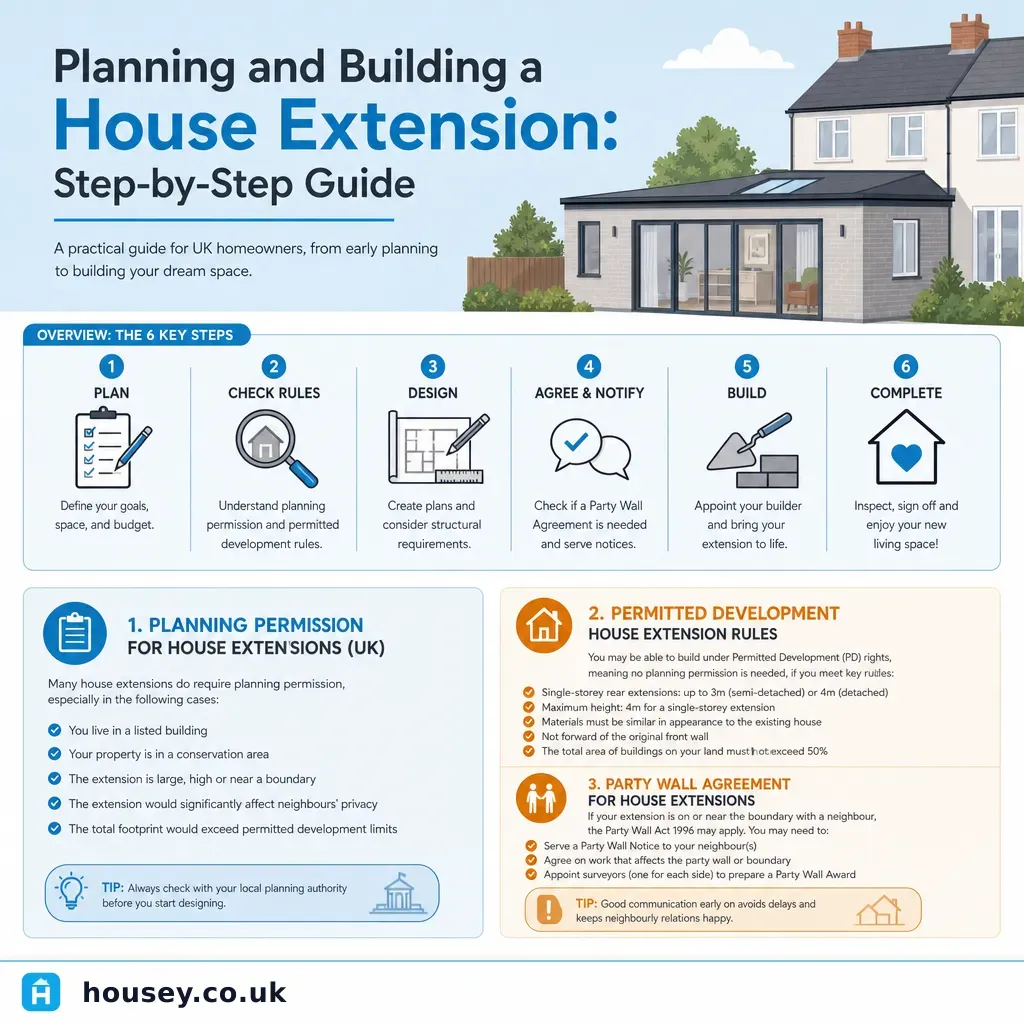
Planning and Building a House Extension: Step-by-Step Guide
A house extension in the UK usually requires either planning permission or confirmation of permitted development rights, Building Regulations approval, and — where work affects a shared wall or boundary — compliance with the Party Wall etc.
 Planning & Pre-Build
When to Engage an Architect: Guide for Homeowners
You usually need an architect for complex extensions, new builds, listed building works, conservation area projects, or contentious planning applications requiring detailed design drawings.
 Planning & Pre-Build
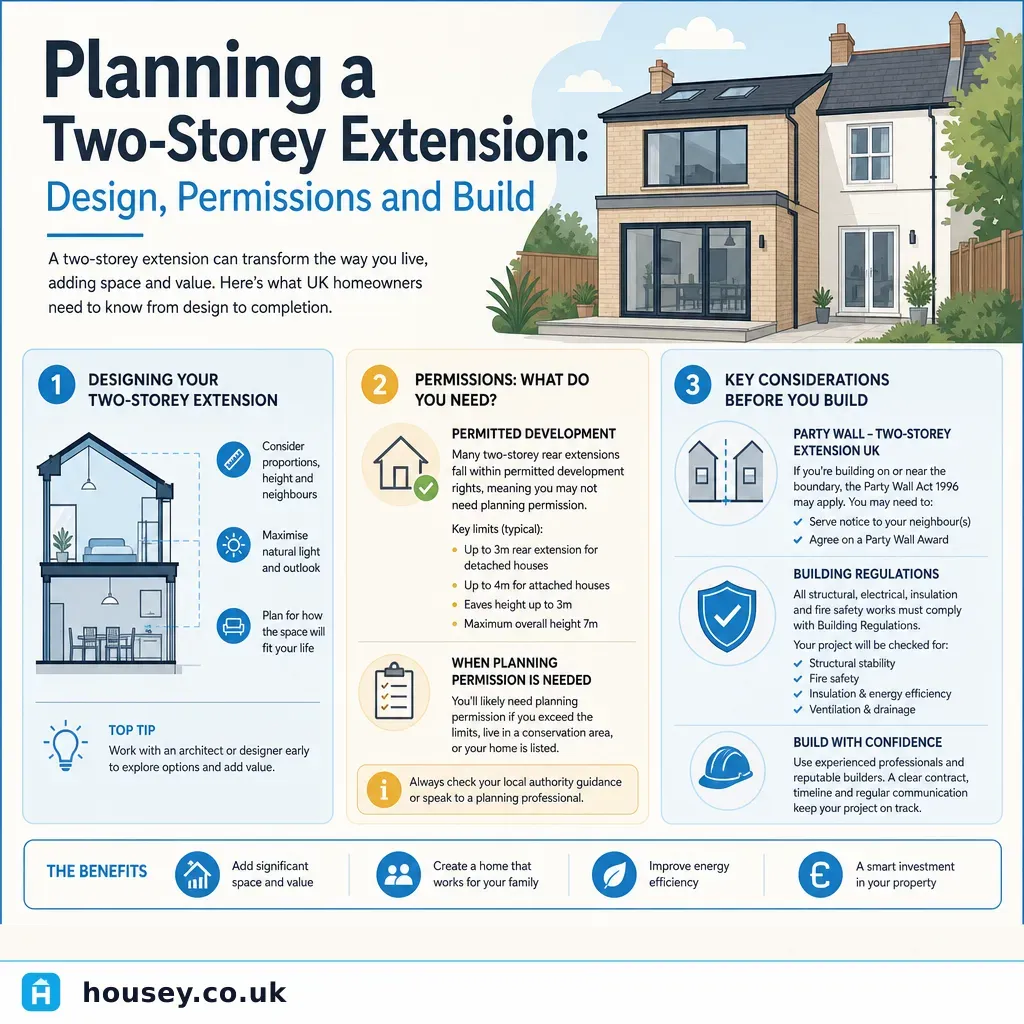
Planning a Two-Storey Extension: Design, Permissions and Build
A two-storey extension usually requires full planning permission, though a rear extension may fall within Permitted Development if it projects no more than 3 metres.
 Planning & Pre-Build
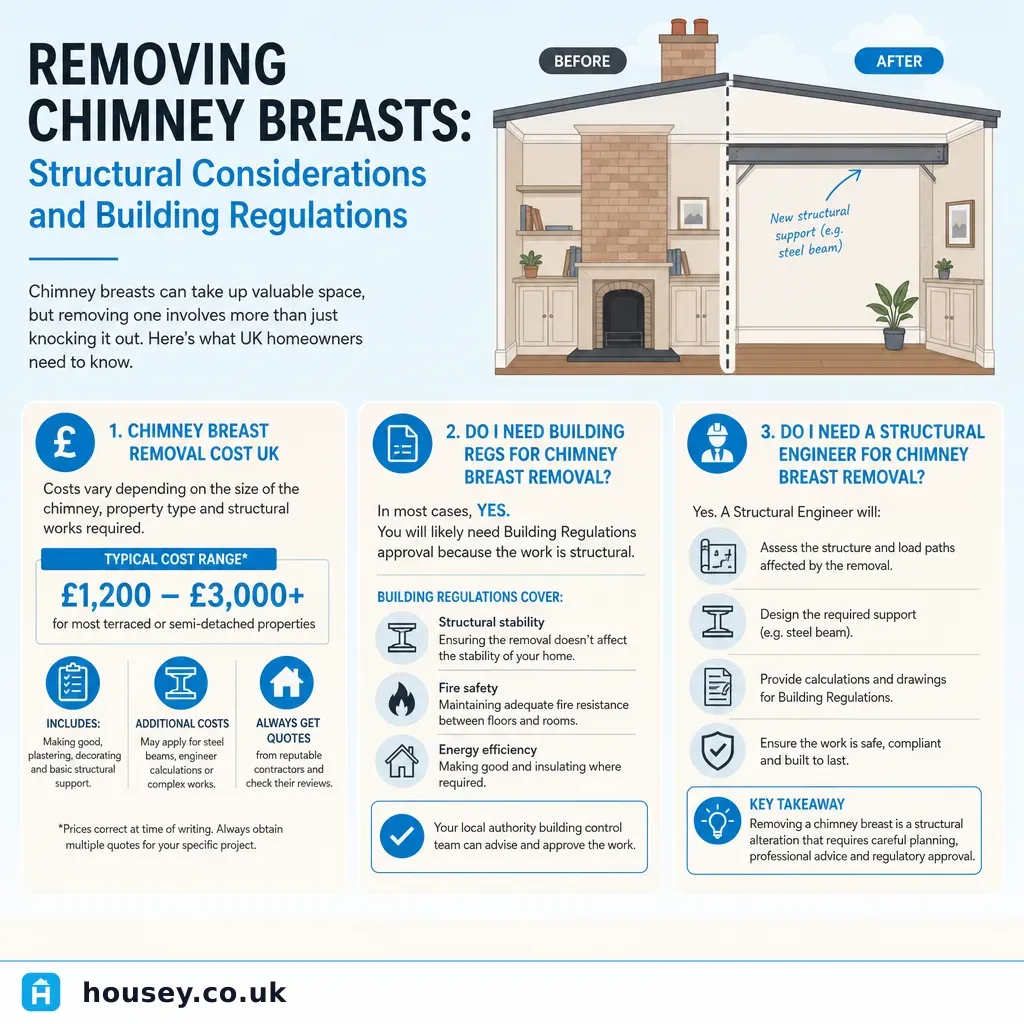
Removing Chimney Breasts: Structural Considerations and Building Regulations
Removing a chimney breast in England and Wales almost always requires building regulations approval because it is structural work.
 Planning & Pre-Build
Designing and Building a House: Architectural and Engineering Guidance
Building a new house in the UK requires separate planning permission and Building Regulations approval, a professional team typically including an ARB-registered architect, a structural engineer, and often a civil or geotechnical engineer.