Planning and Building a House Extension: Step-by-Step Guide
By Housey · Last reviewed 19th of May 2026
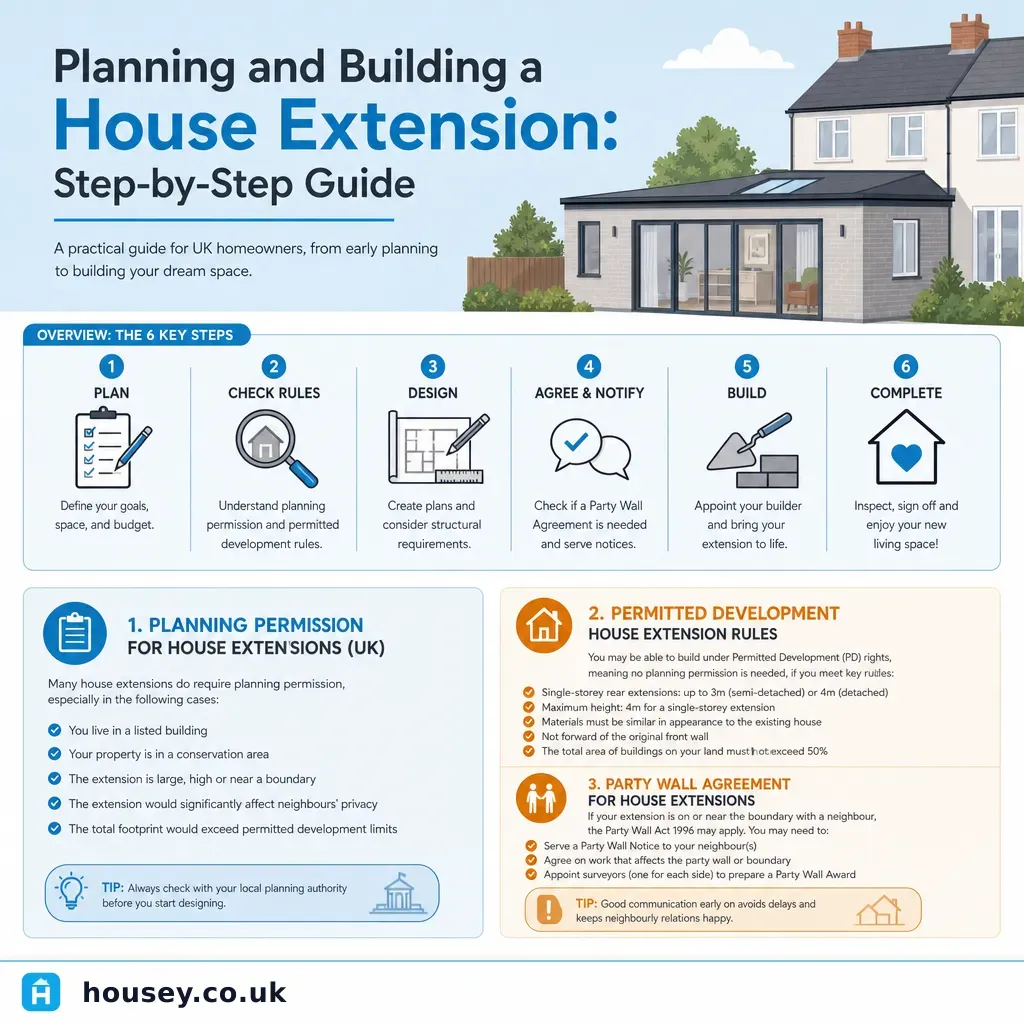
Planning and Building a House Extension: Step-by-Step Guide
A house extension is one of the most significant building projects a UK homeowner can undertake, bringing together planning law, structural engineering, building control, and construction management in a single project. Whether you are adding a ground-floor kitchen-diner to a 1930s semi or a two-storey rear extension to a Victorian terrace, the decisions made in the pre-build phase largely determine whether the project completes on time, within budget, and without legal or structural complications.
Key points
- Extensions exceeding the permitted development limits — for detached houses, a single-storey rear extension of more than 4m, or any side extension — require full planning permission from the local planning authority.
- The Party Wall etc. Act 1996 requires formal written notice to adjoining owners at least 2 months before work on a party wall, or 1 month before excavation within 3m of a neighbour's foundations.
- Building Regulations approval is required for all structural extensions, covering Parts A (structure), B (fire safety), C (moisture resistance), F (ventilation), L (thermal performance), and P (electrics) as applicable.
- A structural engineer is required to design foundations, steel beams, and any load-bearing modifications — no extension should proceed without structural calculations.
- Extensions that create a new habitable room must meet current thermal performance standards under Part L, including minimum U-values of 0.18 W/m²K for walls, 0.15 W/m²K for roofs, and 1.4 W/m²K for glazing.
Do I need planning permission for a house extension?
Whether your extension requires planning permission depends on its size, position, height, and the nature of your property.
Which route applies to your extension?
- Choose permitted development if you are on standard residential land (not a listed building, AONB, conservation area, or National Park), your proposed single-storey rear extension is within 4m of the original rear wall (detached) or 3m (semi-detached or terraced), the ridge height does not exceed 4m, and you have not already exhausted your permitted development allowance.
- Apply for prior approval under the Neighbour Consultation Scheme if you want a single-storey rear extension of up to 8m (detached) or 6m (semi/terraced) — the larger home extension route introduced under the Town and Country Planning (General Permitted Development) (England) Order 2015.
- Apply for full planning permission if the extension involves a second storey, side return, or wraparound element; if the property is listed; if it is in a conservation area or subject to an Article 4 direction; or if permitted development allowances have already been used.
- Check with your local planning authority before assuming permitted development applies — many LPAs offer pre-application advice for a modest fee, and your property's planning history may reveal conditions or restrictions that affect your rights.
Consider applying for a Lawful Development Certificate even where the extension appears to be permitted development. This provides written confirmation from your LPA that the works are lawful, which conveyancers and mortgage lenders may request at the point of sale.
Party wall: what you must do before work begins
The Party Wall etc. Act 1996 applies if your extension involves any of the following:
- Work on or to a shared (party) wall
- Building a new wall on or at the boundary line
- Excavating within 3m of a neighbour's building where the excavation goes below their foundation level
- Excavating within 6m of a neighbour's building where the excavation falls within a 45-degree line from the base of their foundations
You must serve written party wall notice at least 2 months before work begins on a party wall, or 1 month before excavation work. Neighbours can consent in writing, dissent (triggering the appointment of a party wall surveyor), or fail to respond within 14 days — which is treated as a dissent. A party wall surveyor will produce a Party Wall Award setting out how work is to be carried out and who is responsible for any damage. The building owner typically bears the cost of the award.
The step-by-step process
Stage 1: Design and feasibility (weeks 1–8)
Engage an architectural technologist or RIBA-chartered architect to produce design drawings, assess permitted development eligibility, and advise on planning and building control requirements. Early feasibility work can prevent costly redesigns later.
Stage 2: Planning (weeks 4–20 or more)
Submit a planning application if required — the statutory determination period for householder applications is 8 weeks, though complex or contentious cases often take longer. For permitted development, submit a Neighbour Consultation Scheme notification where applicable. Consider applying for a Lawful Development Certificate to confirm permitted development status.
Stage 3: Structural design and building control (weeks 6–16)
Appoint a specialist in structural engineering to design foundations, steel beams, and load-bearing alterations. Structural calculations are required for the building control submission. Submit a Full Plans application to your local authority building control or an approved inspector — this gives you an approved set of drawings before work starts, reducing the risk of costly alterations during construction.
Stage 4: Procurement and contractor selection
Obtain at least three written, itemised quotes from vetted extension builders. Ensure quotes specify foundation type and depth, structural steel sizes, insulation standards, and all finishing works. Verify that each contractor holds current public liability insurance and is registered with NHBC, the Federation of Master Builders, or a comparable scheme.
Stage 5: Party wall process (running in parallel with stages 2–4)
Serve party wall notices and resolve any dissent before construction begins. Do not start work until the party wall process is complete or consented notices are in place.
Stage 6: Construction
A single-storey rear extension construction programme is typically 10–16 weeks. The sequence is: site preparation, foundations, superstructure walls, roof, windows and doors, first-fix services, internal finishes, and second-fix. Building control inspections are required at foundation level, damp-proof course, structural frame, insulation, and on completion.
Stage 7: Completion certificate
Building control will issue a completion certificate confirming the work complies with the Building Regulations. This document is required when you sell the property and may be requested by mortgage lenders.
Cost guide
Indicative UK costs, last reviewed 2026-05-19. Costs vary significantly by region, specification, and contractor.
Extension type | Indicative cost range | Notes |
|---|---|---|
Single-storey rear (20–30m²) | £35,000–£70,000 | Standard specification |
Single-storey rear (30–50m²) | £55,000–£110,000 | Larger footprint; kitchen-diner typical |
Two-storey rear | £70,000–£150,000+ | Increased structural complexity |
Side return (terraced or London) | £40,000–£90,000 | Often combined with a rear extension |
Wraparound (L-shape) | £80,000–£160,000+ | Full planning permission usually required |
Professional fees — architect or technologist, structural engineer, party wall surveyor, planning consultant — typically add 12–18% to construction costs. Always request itemised quotes and clarify what is and is not included.
Important limitations
This guide provides general information about the house extension process in England. Planning policy, permitted development rights, party wall obligations, and Building Regulations requirements vary by property type, location, tenure, and prior works history. Nothing here constitutes legal, planning, or structural engineering advice for your specific circumstances. Permitted development rules in Scotland, Wales, and Northern Ireland differ from those in England — consult the relevant government or local authority if your property is outside England.
What to ask a qualified professional
Before appointing an architectural technologist or architect:
- What is your experience with similar extensions in this area and property type?
- Will you manage the planning application and building control submission?
- What happens to fees if planning permission is refused?
Before commissioning structural engineering work:
- Will you provide stamped structural calculations for the building control submission?
- What foundation type are you recommending and why?
- Will you visit the site before producing your calculations?
Before appointing extension builders:
- Do you hold current public liability insurance and a recognised trade membership such as FMB or NHBC?
- What does your quote include — specifically foundations, structural steel, insulation, and waste removal?
- How do you manage building control stage inspections?
- What is your payment schedule?
When to get professional help
Consult a planning consultancy before submitting any application if the extension is near a boundary, involves a listed building, or if the local planning authority has a history of refusing similar proposals. Engage a structural engineer before breaking any ground — no extension should proceed without structural calculations. If there is any doubt about party wall obligations, consult a party wall surveyor before serving notice.
Red flags that require immediate professional advice:
- Cracks in existing walls found during strip-out work
- Evidence of underground drainage running through the proposed extension footprint
- A neighbour formally dissenting to a party wall notice close to the planned start date
- A builder suggesting that building control is optional or that informal neighbour agreement is sufficient
How Housey can help
Housey can match you with local professionals at every stage of your extension project. Find a qualified architectural technologist to handle design and planning submissions, commission building regulations drawings for your building control application, engage a specialist in structural engineering for foundations and beam calculations, and use planning consultancy to navigate complex or sensitive applications. When you are ready to build, Housey's network of vetted extension builders can provide competitive, itemised quotes.
Frequently asked questions
How long does a house extension take from start to finish in the UK?
From initial design through to receiving a completion certificate, most single-storey rear extensions take 9–18 months. This includes 2–4 months for design and planning, 2–4 months for structural design and building control, 2–4 months for contractor procurement, and 3–4 months for construction. Projects requiring full planning permission, complex party wall negotiations, or unusual ground conditions take longer.
Can I live in my house during an extension build?
In most cases, yes — though ground-floor kitchen extensions often require you to vacate part of the house during construction. Dust, noise, and loss of access to the rear of the property are the main disruptions. Discuss site hoarding, temporary kitchen arrangements, agreed working hours, and dust management with your builder before work begins.
Do I need a party wall agreement for every house extension?
Not always. The Party Wall etc. Act 1996 applies only where work involves a shared wall, excavation within 3m of a neighbour's foundations, or building on the boundary. A straightforward rear extension staying entirely within your own plot and not affecting shared structures may not engage the Act. A party wall surveyor can confirm whether your specific proposals trigger obligations under the Act.
What is a Lawful Development Certificate and do I need one for my extension?
A Lawful Development Certificate is written confirmation from your local planning authority that proposed or completed works are lawful under permitted development. It is not legally required but is strongly recommended — without one, the permitted development status of your extension may be questioned during a sale or remortgage. Many solicitors and mortgage lenders now expect an LDC for permitted development extensions.
Sources and further reading
- Planning Portal: Extensions — permitted development guidance — Planning Portal
- The Party Wall etc. Act 1996: explanatory booklet — GOV.UK
- Building Regulations Approved Document A: Structure — GOV.UK
- Building Regulations Approved Document L: Conservation of fuel and power — GOV.UK
- RICS guidance: Party wall legislation — an introduction — RICS
Useful next reads
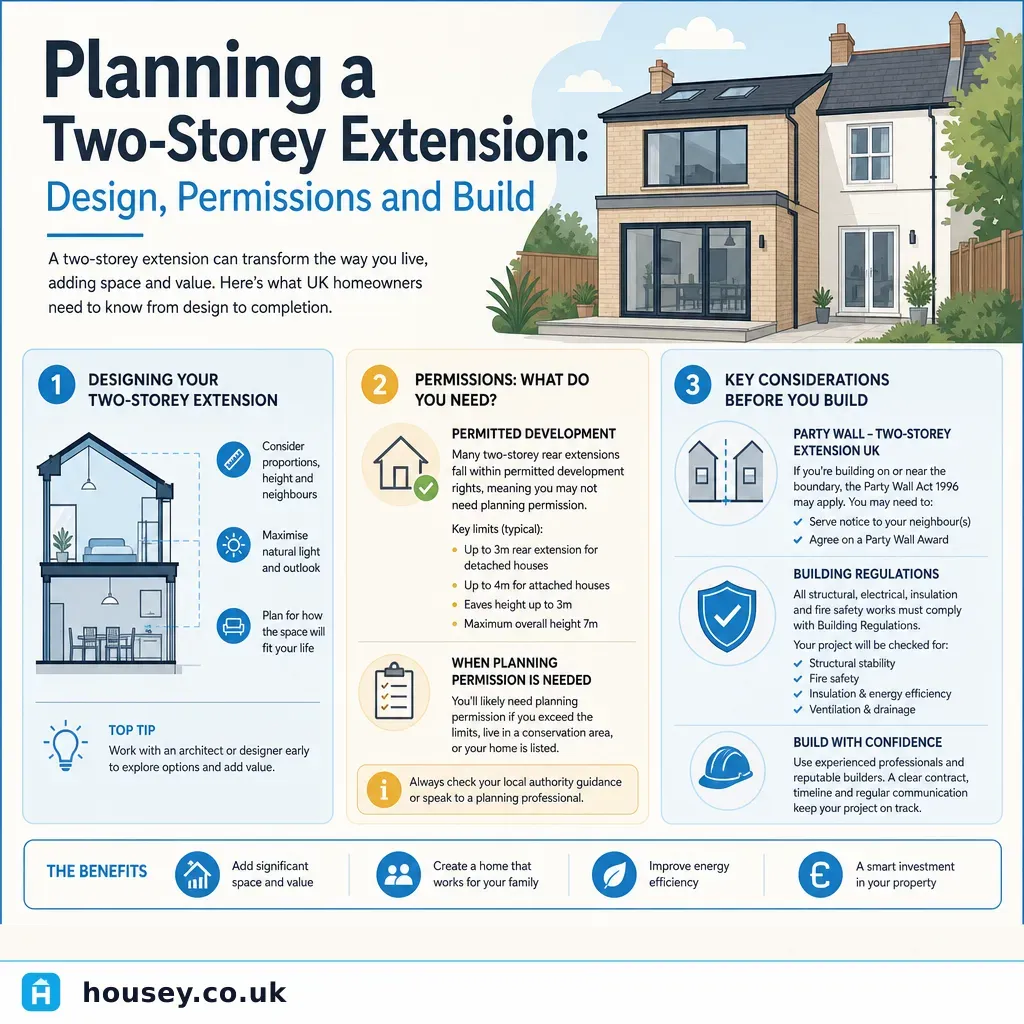 Planning & Pre-Build
Planning a Two-Storey Extension: Design, Permissions and Build
A two-storey extension usually requires full planning permission, though a rear extension may fall within Permitted Development if it projects no more than 3 metres.
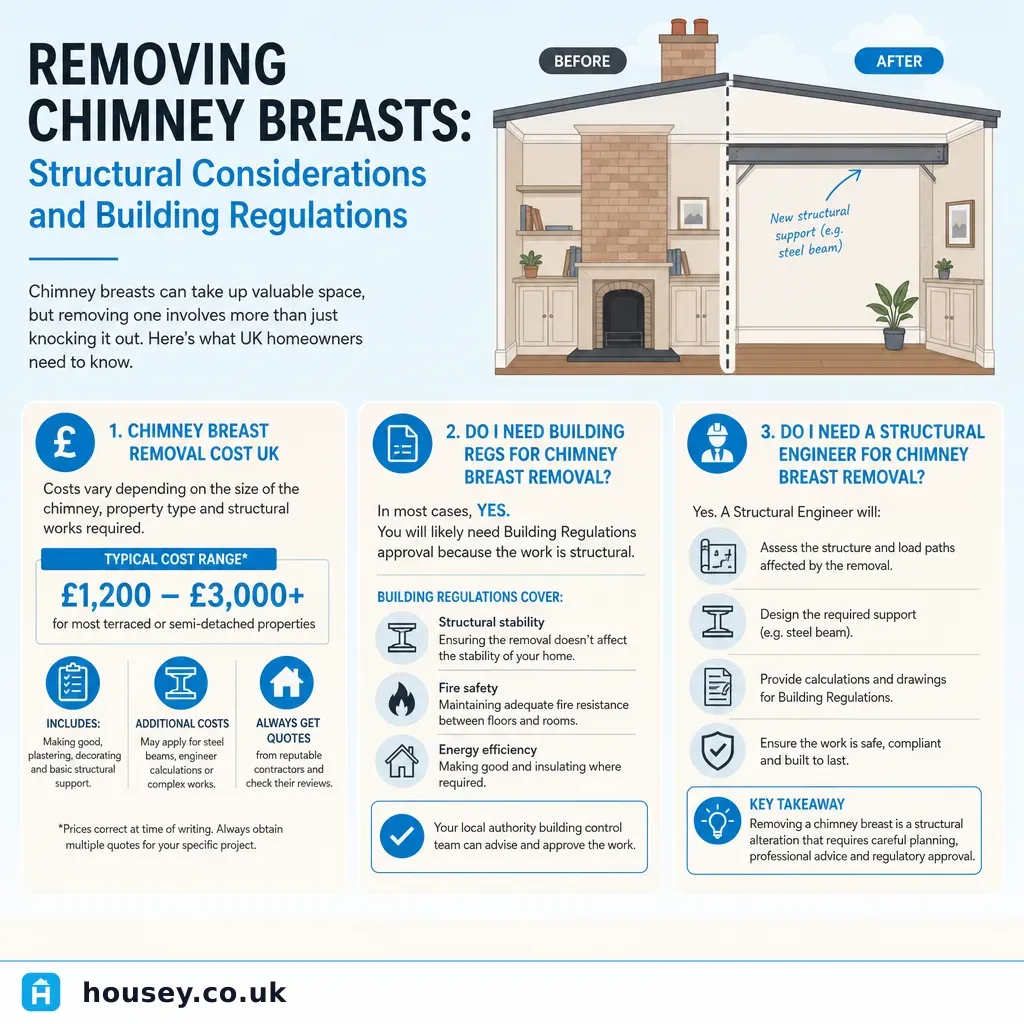 Planning & Pre-Build
Removing Chimney Breasts: Structural Considerations and Building Regulations
Removing a chimney breast in England and Wales almost always requires building regulations approval because it is structural work.
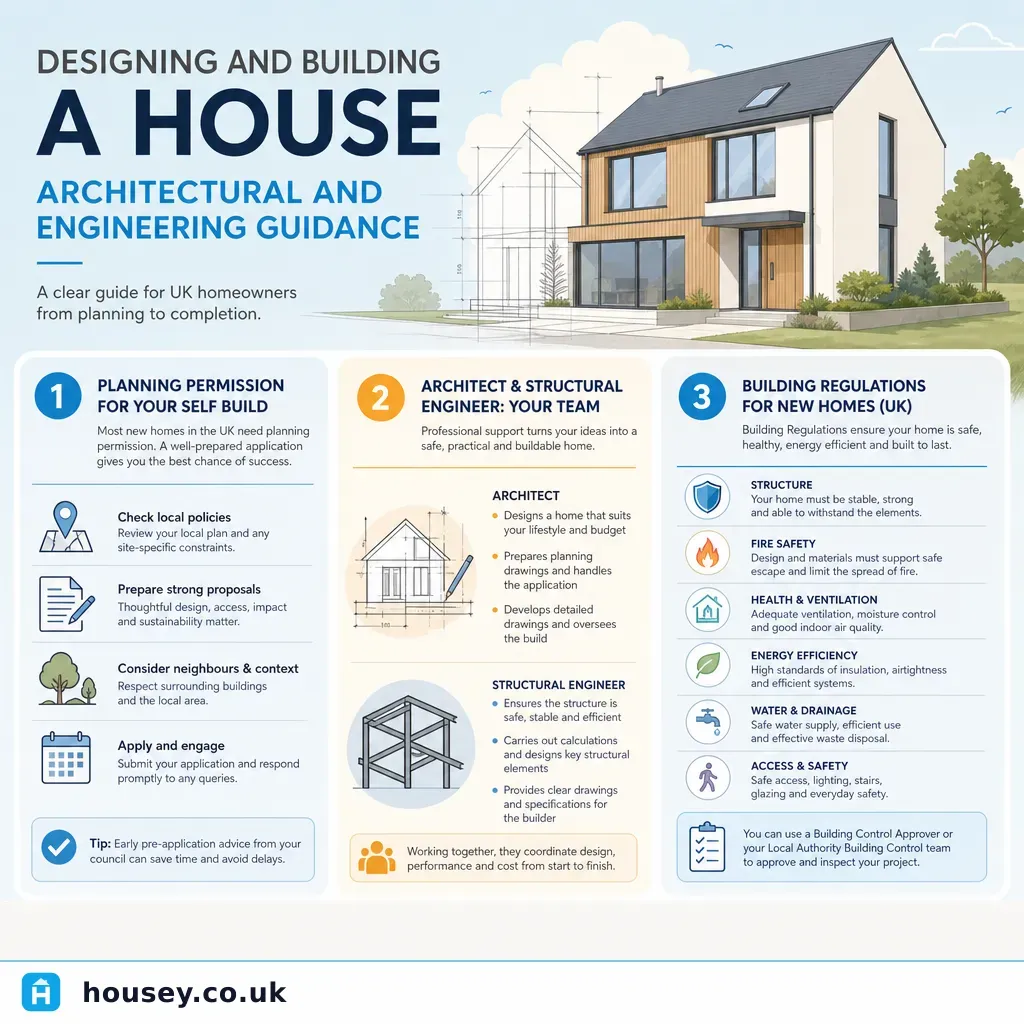 Planning & Pre-Build
Designing and Building a House: Architectural and Engineering Guidance
Building a new house in the UK requires separate planning permission and Building Regulations approval, a professional team typically including an ARB-registered architect, a structural engineer, and often a civil or geotechnical engineer.
 Planning & Pre-Build
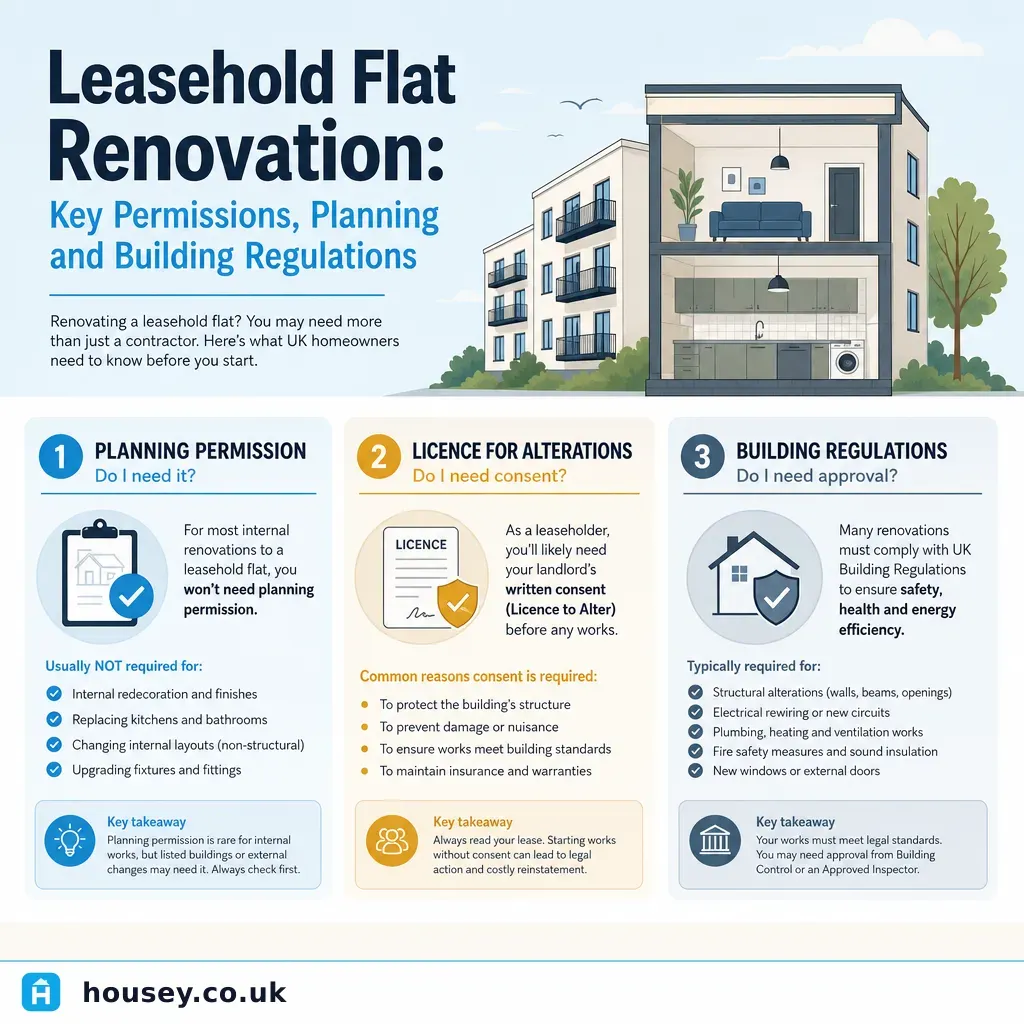
Leasehold Flat Renovation: Key Permissions, Planning and Building Regulations
Most leasehold flat renovations require written consent from your freeholder or managing agent before work begins — this is usually called a licence for alterations.
 Planning & Pre-Build
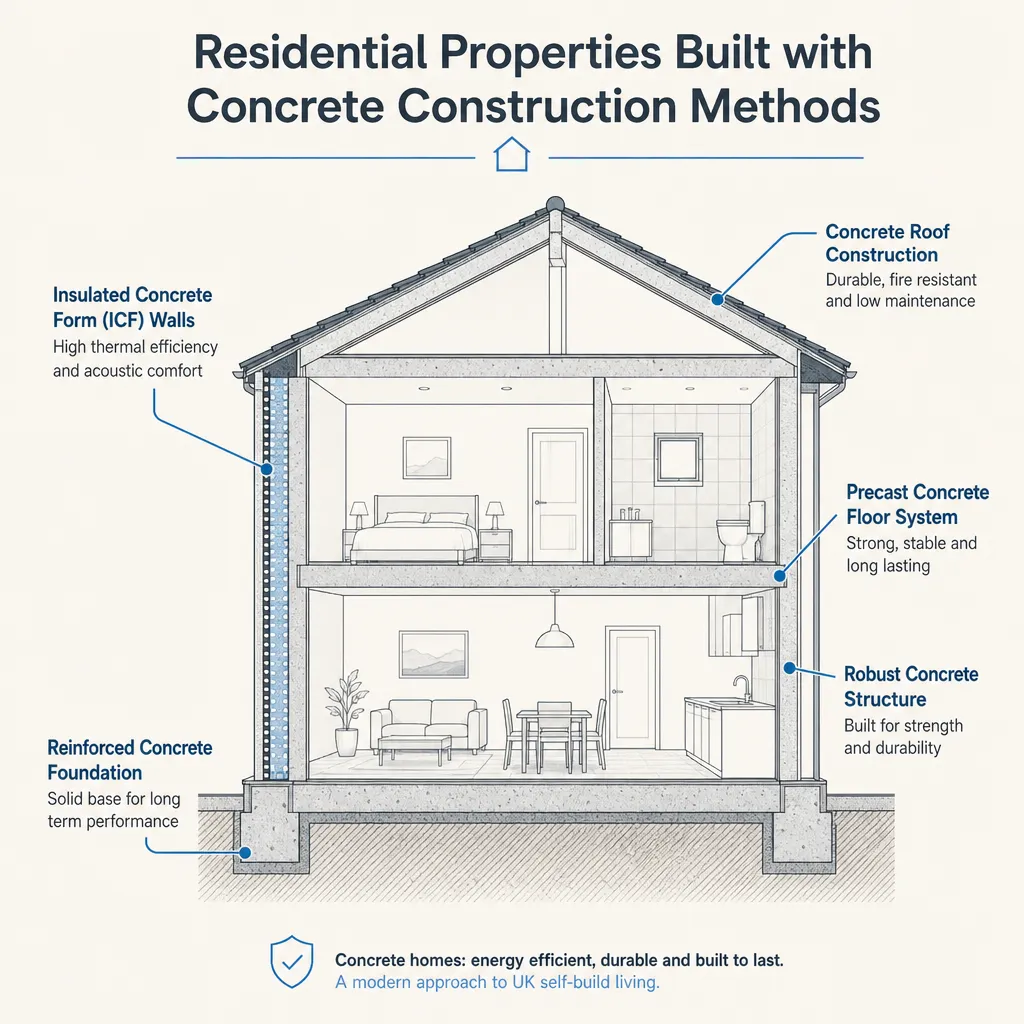
Residential Properties Built with Concrete Construction Methods
UK homes are built using several concrete methods: in-situ cast concrete, precast panel systems, insulating concrete formwork (ICF), and older non-traditional types such as Wimpey No-Fines and Laing Easiform.