When to Engage an Architect: Guide for Homeowners
By Housey · Last reviewed 11th of May 2026
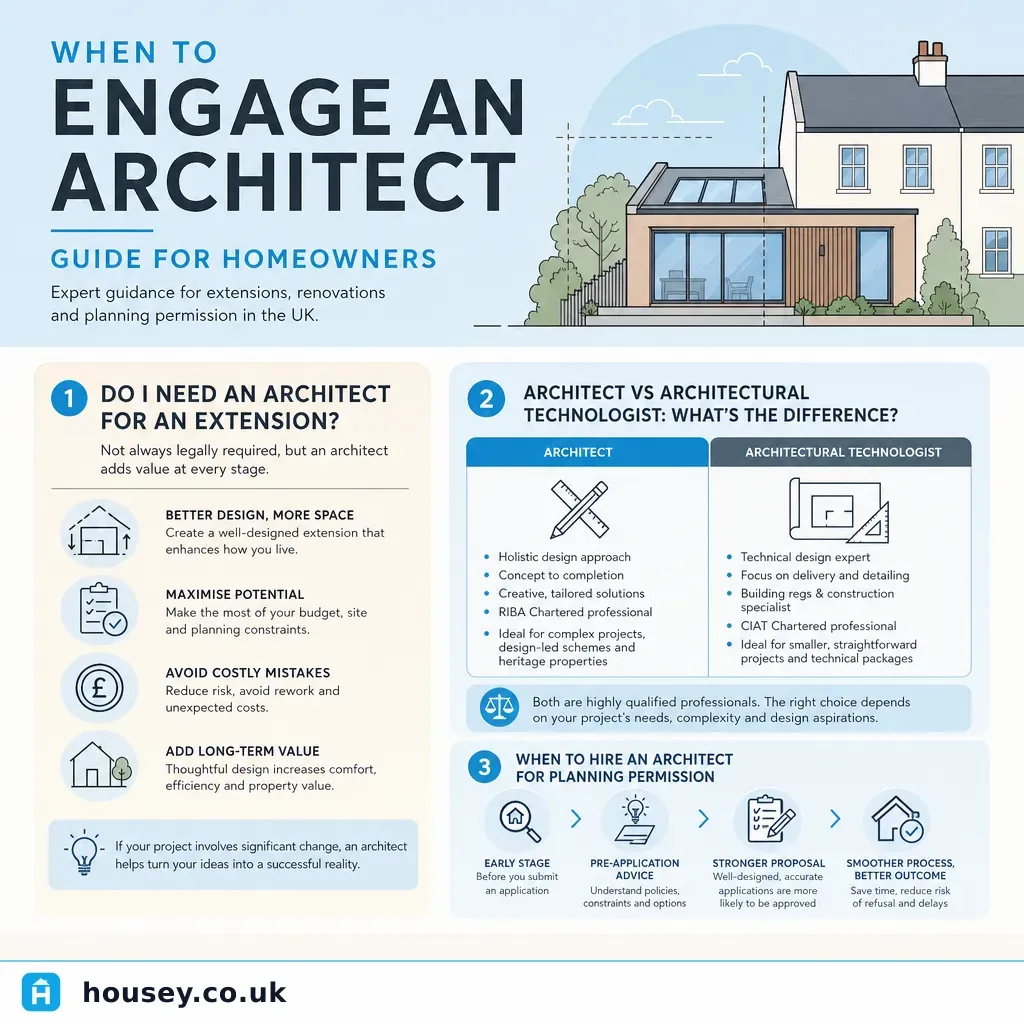
When to Engage an Architect: Guide for Homeowners
Deciding whether to engage an architect is one of the earliest and most consequential calls a UK homeowner makes when planning an extension, loft conversion, or significant renovation. The decision affects not just design quality but planning consent prospects, building control compliance, contractor management, and the overall value the project adds to the property — and getting it wrong at the outset can cost far more to correct than the professional fee itself. In a market where the title 'architect' is protected by law but engagement is rarely mandatory, knowing when to hire one — and when another professional will serve your project better — matters more than many homeowners realise.
Key points
- All practising architects in the UK must be registered with the Architects Registration Board (ARB); the title 'architect' is protected by law under the Architects Act 1997.
- RIBA (Royal Institute of British Architects) members follow a structured Plan of Work covering eight stages (0–7), from strategic definition through to post-occupancy evaluation — homeowners can commission an architect for any subset of these stages.
- Work to listed buildings (Grade I, II*, or II) and in conservation areas often requires specialist professional involvement, as permitted development rights are commonly removed and heritage consent criteria are strictly interpreted by local planning authorities.
- An architect acting as contract administrator under a JCT or similar building contract provides independent certification of payments, management of variations, and a formal snagging mechanism — protecting both homeowner and contractor.
- For some projects, a CIAT-registered architectural technologist offers a more cost-effective route to technically compliant drawings and building control sign-off, particularly for conventional permitted-development extensions where design complexity is low.
What an architect does — and at which stages
An architect's involvement can be light-touch or end-to-end. The RIBA Plan of Work divides a project into eight numbered stages:
RIBA Stage | Name | What typically happens |
|---|---|---|
0 | Strategic definition | Establish project viability; initial brief development |
1 | Preparation and briefing | Site surveys, planning research, brief agreement |
2 | Concept design | Design options, feasibility, initial planning advice |
3 | Spatial coordination | Developed design and planning application drawings |
4 | Technical design | Building regulations drawings, structural coordination |
5 | Manufacturing and construction | On-site administration, contractor management |
6 | Handover | Snagging, practical completion, documentation |
7 | Use | Post-occupancy evaluation |
Most homeowners commission architects for Stages 1–4 (design through to planning and technical drawings), with Stage 5 construction administration as an optional add-on. You are not obliged to use the same professional for all stages, though continuity generally reduces design errors and programme risk.
When you usually need an architect
- Engage an ARB-registered architect if your project involves a listed building, sits in a conservation area with removed permitted development rights, requires a new build or substantial structural alteration, involves a contentious planning application (heritage impact, overlooking, design policy compliance), or carries a construction budget above approximately £150,000.
- Consider a CIAT-registered architectural technologist for standard permitted-development loft conversions, straightforward single-storey extensions, or garage conversions where the design brief is straightforward and structural input is limited — they produce technically compliant drawings and can manage building control sign-off at a typically lower fee.
- Use a structural engineer alongside whichever designer you choose when the project involves removing load-bearing walls, underpinning, new structural openings, or any element requiring formal structural calculations.
- Check with your local planning authority (LPA) before assuming permitted development applies — Article 4 directions, Conservation Area designations, and the property's prior extension history can all remove PD rights without prior notification to the homeowner.
Which professional do you need?
Professional | Registration | Typical projects | Not ideal for |
|---|---|---|---|
Architect | ARB registered; RIBA membership optional | Complex extensions, new builds, listed buildings, contentious planning | Simple PD projects where design complexity is low and cost is the primary concern |
Architectural technologist | CIAT registered | Standard extensions, conversions, building regulations drawings | Heritage work or design-led projects requiring creative development |
Structural engineer | IStructE or ICE member | Load-bearing wall removal, foundations, structural reports | Full design drawings or planning applications |
Planning consultant | RTPI member | Contentious planning applications, enforcement appeals, PD assessments | Building design or on-site contract administration |
Design-and-build contractor | Varies | Simple extensions with a standard brief | Design innovation, planning complexity, or independent contractor oversight |
When an architect adds the most value
Complex or contentious planning applications. Local planning authorities assess design quality alongside policy compliance. An architect who understands local design guidance, the LPA's preferences, and how to engage constructively with case officers can significantly improve consent prospects — particularly on infill sites, in conservation areas, or where design policies are a material consideration.
Listed buildings and conservation areas. Alterations to listed buildings require listed building consent, assessed under strict heritage criteria by the LPA and, in significant cases, Historic England. Poorly prepared applications can result in refusal, enforcement action, or — in serious cases — criminal liability under the Planning (Listed Buildings and Conservation Areas) Act 1990. An architect with demonstrable heritage experience is strongly advisable for these projects.
Maximising space within permitted development. PD rules are technical and property-history-dependent. An architect can design to the maximum allowable envelope within PD limits, sometimes delivering meaningfully more usable space than a contractor working to a generic understanding of the rules.
Contract administration. If you are using a JCT or similar building contract, an architect acting as contract administrator provides independent certification of practical completion, management of variations, and a formal mechanism for snagging — protecting your position throughout the build without requiring adversarial confrontation with the contractor.
When an architect may not be necessary
Not every project warrants full architectural involvement. A single-storey rear extension to a 1990s semi, within permitted development limits and using conventional masonry or timber-frame construction, can often be designed adequately by a CIAT-registered architectural technologist or a reputable design-and-build contractor with in-house design capability — provided the project obtains the necessary building regulations drawings and full building control sign-off.
For projects where planning is the primary complexity rather than the design, a planning consultancy with an RTPI-accredited consultant may be the lead professional, with an architectural technologist producing the required drawings at a lower combined fee.
When to get professional help
Engage an architect or seek formal professional design advice before:
- Starting any work to a listed building, even if you believe the works are minor or potentially exempt.
- Submitting a planning application involving a contentious element — overlooking, overshadowing, heritage impact, or departure from adopted local design policies.
- Agreeing a building contract for work involving significant structural elements, where independent oversight of the contractor would protect your position.
- Discovering that previous works on your property lacked planning consent or building control approval — an architect can advise on regularisation options and the risks of leaving unconsented work undisclosed at sale.
How Housey can help
Housey connects homeowners with ARB-registered architects and CIAT-registered architectural technologists across the UK. Whether you need architecture services from initial brief through to planning drawings, or technical building regulations support for a permitted-development project, you can compare professionals and review their portfolio experience through the platform. Where planning is the primary hurdle, our planning consultancy connects you with RTPI-accredited consultants who can advise on consent prospects before you commit to design fees.
Frequently asked questions
Is it a legal requirement to use an architect for a home extension?
No — the title 'architect' is protected by the Architects Act 1997, but there is no statutory requirement to engage one for an extension. Planning and building control require technically accurate drawings, which can be produced by an ARB-registered architect, CIAT-registered technologist, or any competent designer. For listed buildings, the complexity of consent requirements makes professional involvement strongly advisable.
How much does an architect typically charge for a home extension?
Architects usually charge 8–15% of the construction cost for full services, a fixed fee per stage, or an hourly rate. Indicative UK costs, last reviewed 2026-05-11: planning drawings only for a standard extension may range from £1,500 to £5,000 or above; full-service fees on larger projects are considerably higher. Always request itemised quotes broken down by RIBA stage.
Do I need an architect if my project is permitted development?
Not necessarily. A standard permitted-development extension with conventional construction can often be handled by an architectural technologist or competent designer. However, confirming PD eligibility is complex if the property has prior extensions, is subject to Article 4 directions, or lies in a designated area. A planning consultancy can carry out a PD assessment before you commit to design fees.
Can I use the same professional for planning and building regulations?
Yes, and continuity between stages is generally beneficial — the designer understands the design intent and can coordinate with structural engineers and building control throughout. Some homeowners split the stages, using an architect for planning and a more cost-effective architectural technologist for building regulations drawings. This can work well but requires a thorough handover of all design information between stages.
Sources and further reading
- Architects Registration Board (ARB) — ARB
- RIBA Plan of Work 2020 — RIBA
- Planning permission: when you need it — GOV.UK
- Listed buildings: what is designation? — Historic England
- CIAT: Chartered Institute of Architectural Technologists — CIAT
Useful next reads
 Planning & Pre-Build
Leasehold Flat Renovation: Key Permissions, Planning and Building Regulations
Most leasehold flat renovations require written consent from your freeholder or managing agent before work begins — this is usually called a licence for alterations.
 Planning & Pre-Build
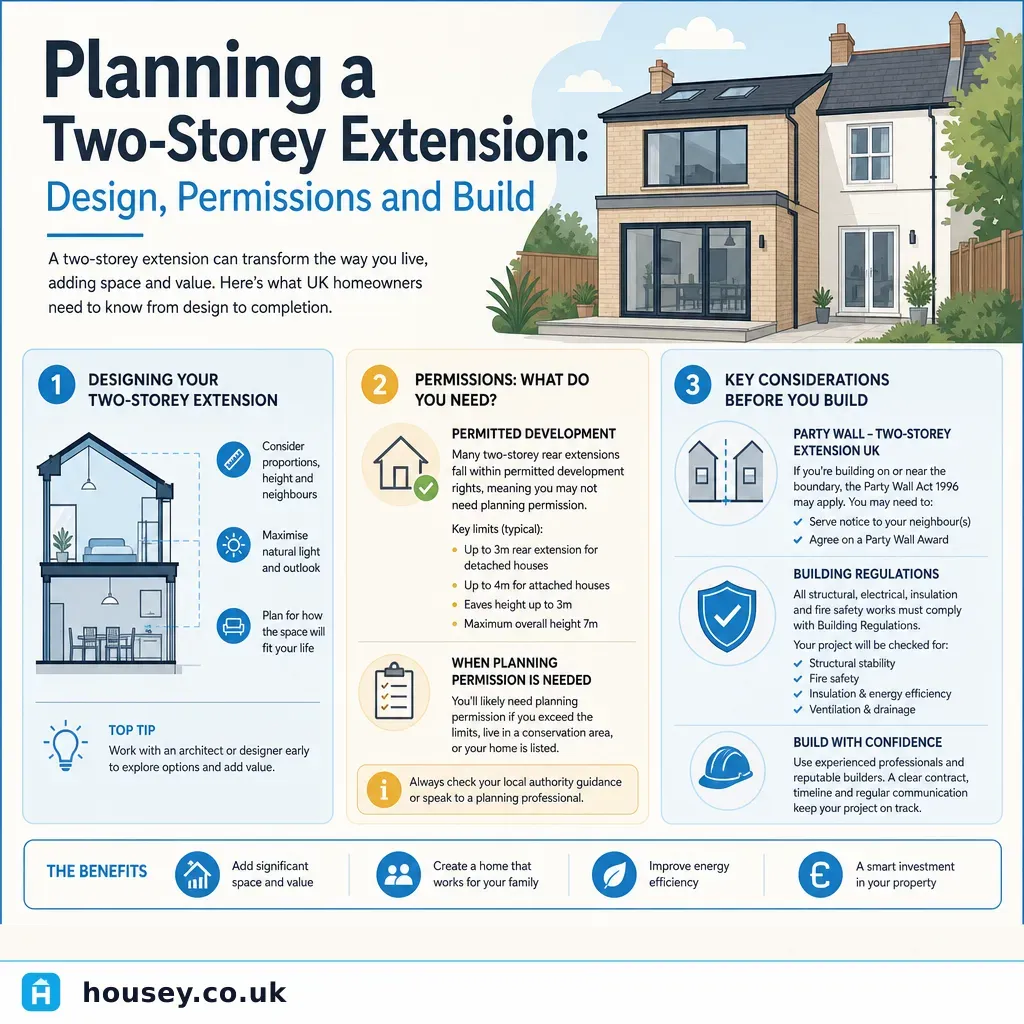
Planning a Two-Storey Extension: Design, Permissions and Build
A two-storey extension usually requires full planning permission, though a rear extension may fall within Permitted Development if it projects no more than 3 metres.
 Planning & Pre-Build
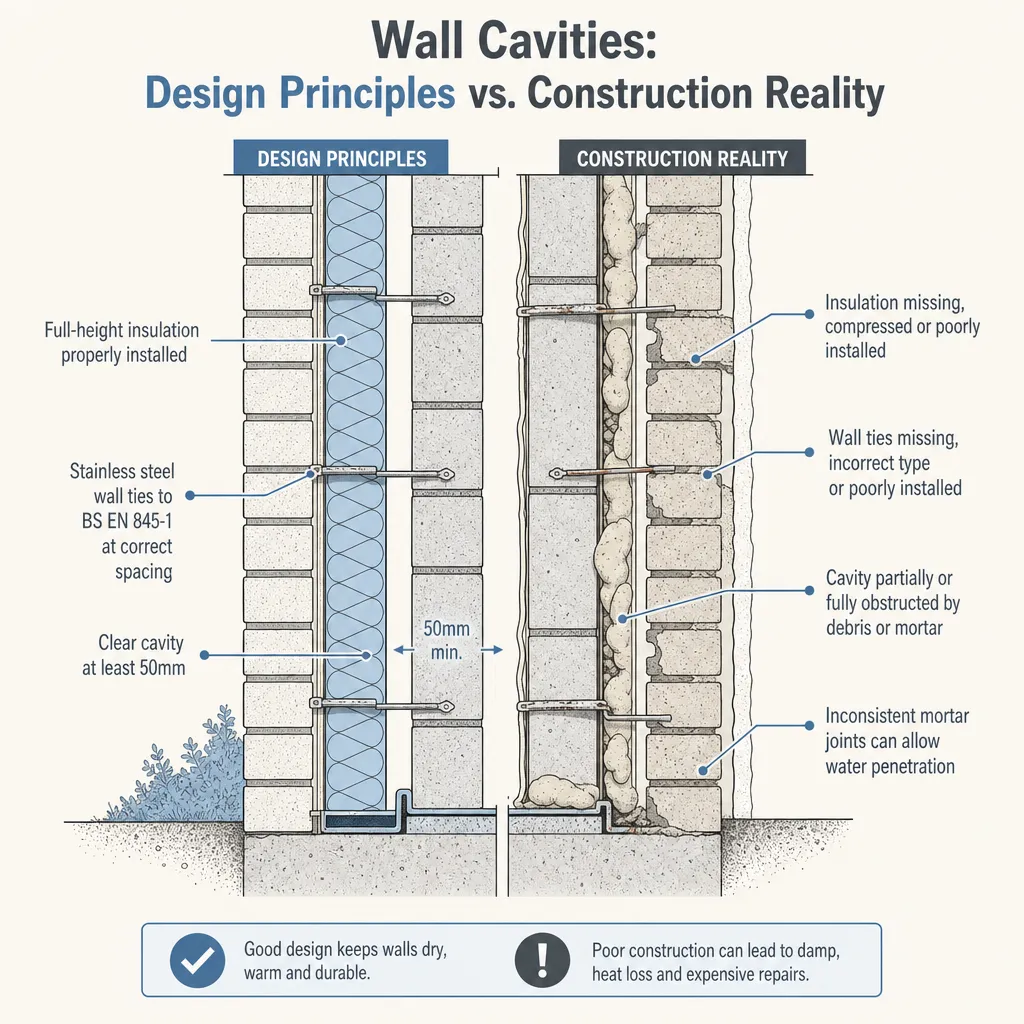
Wall Cavities: Design Principles vs. Construction Reality
A UK cavity wall is designed to resist weather, control heat loss, and structurally link two masonry leaves.
 Planning & Pre-Build
Craftsman Style Homes: Architectural Features and Design Elements
Craftsman style homes are defined by natural materials, low-pitched gabled roofs with wide eaves, covered porches, exposed timber details, and grouped casement windows.
 Planning & Pre-Build
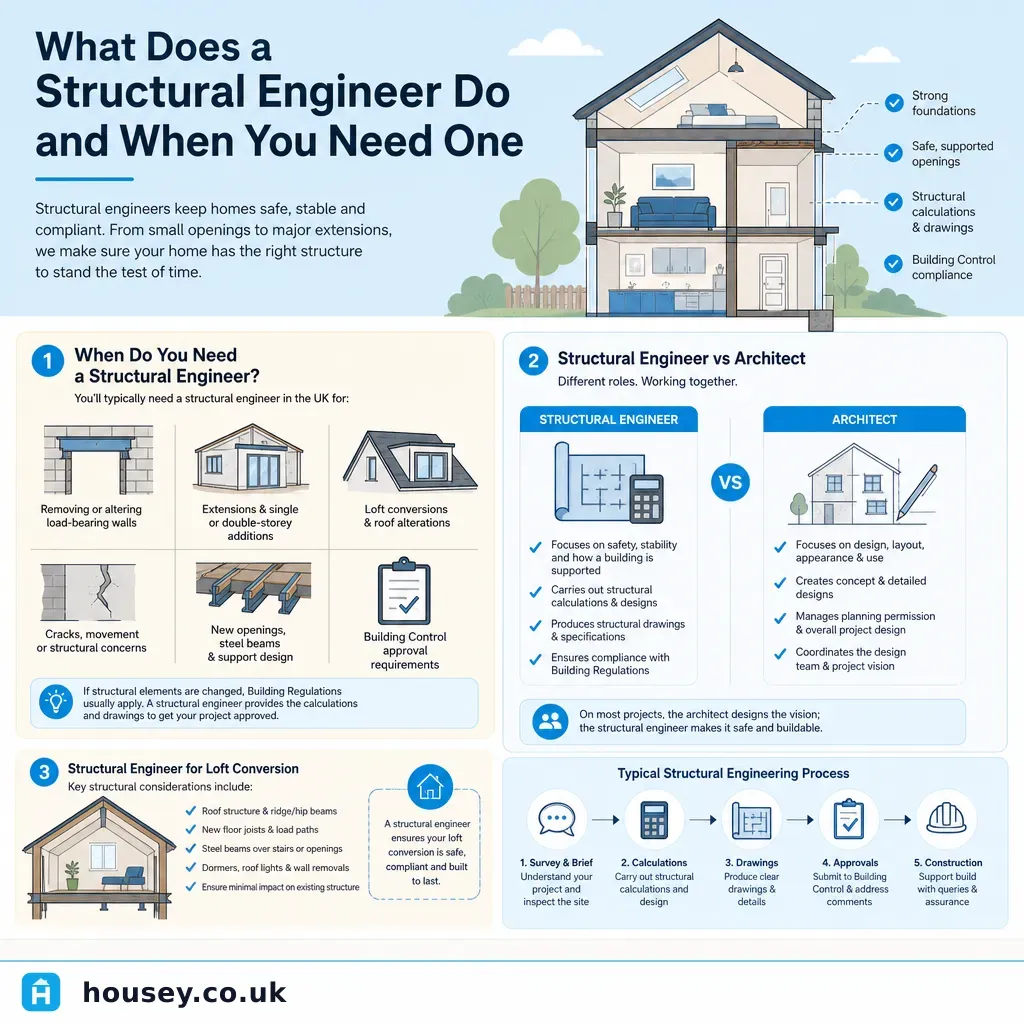
What Does a Structural Engineer Do and When You Need One
A structural engineer analyses and designs the load-bearing elements of a building — foundations, beams, columns, walls, and floors.