Designing vaulted ceilings for residential spaces
By Housey · Last reviewed 19th of May 2026
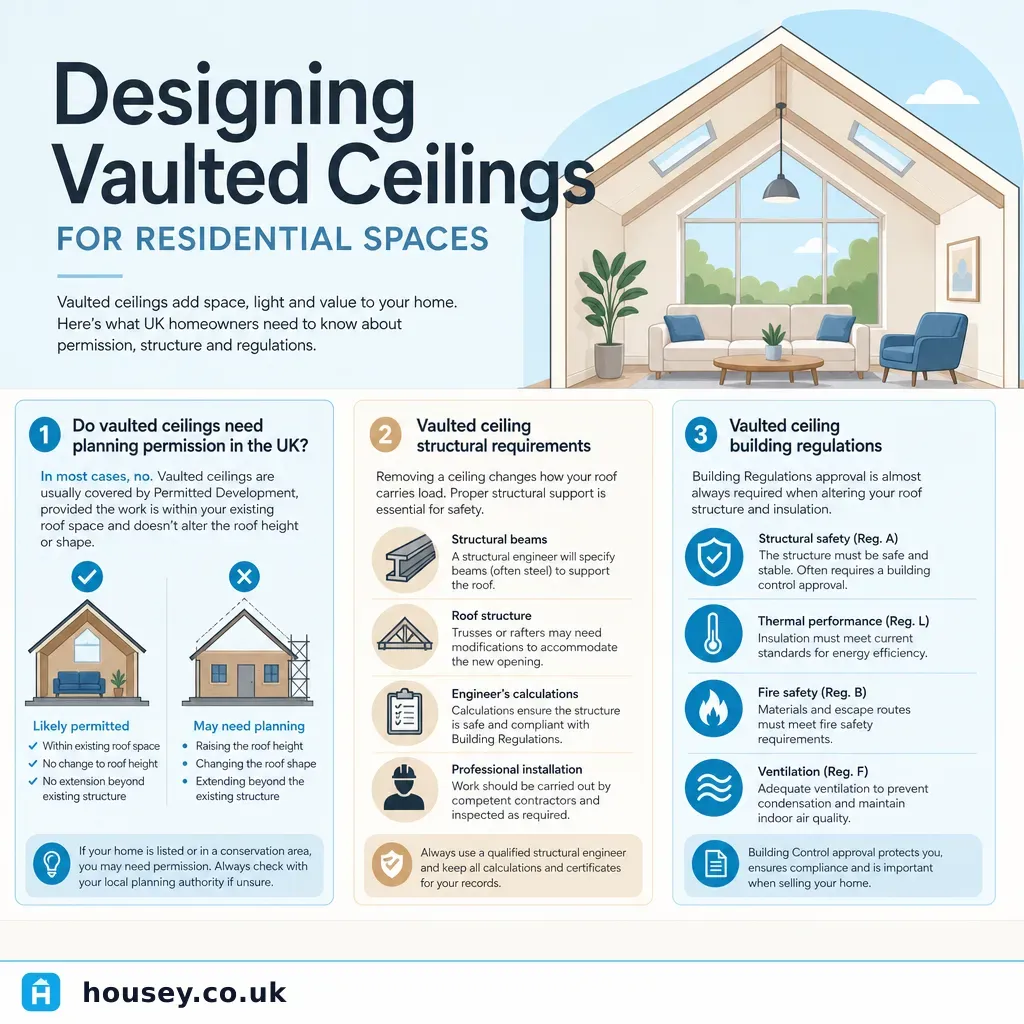
Designing vaulted ceilings for residential spaces
Vaulted ceilings — where the ceiling plane follows the pitch of the roof rather than running horizontally below it — are a sought-after feature in loft conversions, open-plan rear extensions, and barn-style renovations across the UK. The appeal is clear: greater perceived volume, improved natural light from rooflights, and a distinctive architectural quality that is difficult to achieve any other way. But creating a vaulted ceiling in an existing home requires careful structural planning, because the standard domestic roof is a triangulated engineering system — and removing its horizontal tie-members without providing a structural substitute can cause progressive and costly damage.
Key points
- A vaulted or cathedral ceiling requires the removal or restructuring of ceiling joists or collar ties that form the structural triangulation of the roof; a chartered structural engineer's calculations are always required before work begins.
- Building Regulations approval under Approved Document A (Structure) is mandatory for any alteration to a roof structure; a Full Plans application to building control before work starts is strongly recommended.
- Approved Document L 2021 requires rafter insulation to meet a U-value of 0.16 W/m²K for new dwellings; achieving this within a standard rafter depth typically requires high-performance rigid insulation or a combined between-rafter and rigid board solution.
- In an existing cut-roof, a structural ridge beam or steel purlin is usually required to carry loads previously shared by ceiling ties; this beam needs its own independent structural support at each end.
- Listed building consent is required for any structural alteration to a listed building, regardless of whether the works are visible externally.
What makes a vaulted ceiling structurally different?
A standard domestic pitched roof is triangulated: the rafters push outward against the wall plates, and the ceiling joists act as horizontal ties resisting that thrust. Remove those ties without providing a structural substitute — such as a ridge beam — and the rafters will gradually push the walls apart. This is known as roof spread, and it can progress slowly without obvious symptoms before significant structural damage appears.
There are three main structural approaches to achieving a vaulted ceiling, each with different levels of complexity and cost.
Decision tree: which structural approach suits your project?
- Choose raised collar ties if you want a partial vault with some horizontal structure retained at a higher level. This is the lower-complexity option and suits situations where a modest headroom gain is sufficient and the collar position works with the room layout.
- Choose a structural ridge beam if you want a full vault with no horizontal ties below the ridge. The ridge beam carries the full weight of the rafters and must be independently supported on posts or structural walls at each gable end. A structural engineer must design the beam size and all bearing arrangements.
- Choose a new roof structure if you are extending the property or replacing the existing roof entirely — the engineer designs a new structural system from the outset rather than adapting what is there.
- Ask a structural engineer before deciding if there are any existing signs of roof spread (cracks at wall-plate level, bowing gable walls, sticking upper-floor doors), if the building is of non-standard construction (timber frame, prefabricated, or pre-1920 complex carpentry), or if previous alterations have removed structural elements without documentation.
Planning and permitted development
Most vaulted ceiling work in existing residential properties does not require planning permission — it is classified as an internal alteration, and permitted development rights cover internal changes in England. However, there are important exceptions.
Situation | Planning or consent requirement |
|---|---|
Internal vault in an existing non-listed house | No planning permission required |
Vault as part of a dormer or loft conversion | May require planning permission depending on size and location |
Any structural alteration to a listed building | Listed building consent required regardless of external visibility |
Roof alteration visible from the street in a conservation area | Permitted development restrictions may apply |
Vault as part of a new rear extension | Planning permission depends on the extension, not the internal ceiling |
If your vaulted ceiling is part of a loft conversion, note that certain loft conversions require planning permission under Class B of the Town and Country Planning (General Permitted Development) (England) Order 2015 — particularly dormers on the principal elevation or those exceeding the permitted additional cubic volume.
Insulation and thermal performance
One of the most significant technical challenges in vaulted ceiling design is achieving adequate thermal insulation within the reduced rafter depth. Standard 100 mm rafters cannot accommodate the insulation required to meet current Part L standards without additional measures.
Insulation approach | How it works | Thermal performance | Condensation risk | Typical application |
|---|---|---|---|---|
Warm roof (insulation above and between rafters) | Continuous insulation layer keeps the roof structure warm; cold bridging minimised | Can achieve 0.16 W/m²K U-value with high-performance products | Low if vapour control layer is correctly detailed | Preferred for new build and extension vaults |
Cut-and-fill rafter insulation with ventilated void | Insulation between rafters; ventilation gap maintained above to allow the structure to breathe | Performance limited by rafter depth; often requires insulated lining board below | Ventilation gap is critical — failure leads to interstitial condensation and timber rot | Common in retrofit of existing pitched roofs |
Over-rafter rigid insulation (sarking board) | Rigid boards laid over rafters beneath roof covering; eliminates cold bridge through rafter | Effective combined U-value achievable | Low if correctly detailed | Used during reroofing or new extension construction |
Moisture management is critical in any vaulted roof construction. An architect or building services engineer should confirm the vapour control strategy and carry out a condensation risk assessment before the specification is finalised. Incorrect insulation detailing can cause interstitial condensation that rots structural timbers from within — often without any visible sign for several years.
What to expect from a structural engineer
Your structural engineer will need to inspect the existing roof, understand the proposed alteration, and complete calculations before building control can approve the work. Typically they will:
- Visit the property and inspect the existing roof structure from the loft space — clear loft access is essential.
- Record the span, rafter size and spacing, roof covering material, and condition of the existing timbers.
- Design any new beams, posts, hangers, or connections needed to replace the structural function of the removed ties.
- Produce structural calculations, sketches, and connection details for inclusion in the building control submission.
- Specify any temporary propping or construction sequence required to maintain structural stability during the alteration.
Allow 2–4 weeks for a structural engineer to complete their site visit and produce calculations. Your Full Plans application to building control should be submitted and approved before any structural timbers are cut or removed.
Indicative costs
Indicative UK costs, last reviewed 2026-05-19. Figures are illustrative only; always obtain itemised quotes from qualified professionals.
Item | Indicative range |
|---|---|
Structural engineer (design, calculations, site visits) | £1,200–£3,500 |
Building regulations Full Plans application | £400–£900 |
New ridge beam and structural steelwork (supply and install) | £3,000–£10,000+ depending on span |
Rafter insulation retrofit (warm roof approach) | £80–£200/m² of ceiling area |
Plastering and finishing to new vaulted surface | £25–£60/m² |
Important limitations
This article provides general information about vaulted ceiling design and structural principles. It does not constitute structural, planning, or building control advice. Every property has a unique roof construction, loading history, and condition — an approach suitable for one building may be wholly inappropriate for another. Pre-1920 properties with complex cut-roof carpentry and post-war prefabricated homes (such as BISF or Airey houses) may have structural characteristics requiring specialist assessment beyond a standard appointment. Always instruct a Chartered Structural Engineer (MIStructE or CEng) to inspect and assess your specific roof before any alteration work begins.
When this becomes urgent
Stop planning and seek immediate professional advice if:
- You notice cracking or separation at wall-plate level or near the ridge — this may indicate existing roof spread that predates your project.
- External walls beneath the roof show stepped or diagonal cracks, particularly near gable ends, or upper-floor doors and windows have started to stick.
- Roof timbers visible from the loft appear rotted, have been previously cut, or show evidence of insect damage — these conditions must be fully assessed and remediated before any further structural alteration proceeds.
What to ask a qualified professional
Before appointing a structural engineer or architect for a vaulted ceiling project, ask:
- Is the existing roof construction suitable for vaulting, or does the entire roof structure need to be replaced?
- What beam or support system will you specify, how large does it need to be, and how will it be supported at each end?
- What insulation strategy do you recommend to achieve Part L compliance and manage condensation risk within the rafter zone?
- Will building control require a Full Plans application, and will you prepare or review the structural drawings for submission?
- Are there Party Wall Act implications if new steelwork bears on a wall shared with a neighbour?
- What is the programme for producing structural calculations, and when should we submit to building control before construction work can begin?
When to get professional help
A vaulted ceiling project always requires a structural engineer and building control approval. Seek specialist input in addition if:
- The property is listed — listed building consent is required for any structural alteration, and reversibility of the works may be required by the local planning authority.
- The project forms part of a loft conversion, where planning permission rules and fire escape requirements are more complex.
- The existing roof is in poor condition and requires significant repair work alongside the vaulting.
- No architect has been involved in the design stage and there are no detailed drawings for the structural engineer to work from.
How Housey can help
Housey connects you with experienced architects and architectural technologists who can take a vaulted ceiling project from sketch design through to planning and building regulations submission. For compliance approval, our building control consultants can manage the Full Plans process and co-ordinate inspections at each stage of the build. Submit your project brief to compare proposals from qualified professionals working in your area.
Frequently asked questions
Do vaulted ceilings need planning permission?
In most cases, no — vaulting a ceiling is an internal alteration and does not require planning permission for a non-listed property. Exceptions include listed buildings, where listed building consent is always required for structural changes, and situations where the vaulted ceiling forms part of a loft conversion or roof alteration that itself requires planning permission.
How much does it cost to create a vaulted ceiling?
Costs vary significantly depending on the structural approach and room size. A vaulted ceiling formed with a new structural ridge beam, rafter insulation, and finished plasterwork might cost £8,000–£20,000 all-in for a typical room. Larger spans, complex steelwork, or a full roof replacement will cost considerably more. Indicative UK costs, last reviewed 2026-05-19. Always obtain itemised quotes from qualified professionals.
Do I need a structural engineer for a vaulted ceiling?
Yes, always. Removing or restructuring ceiling joists or collar ties fundamentally alters the structural behaviour of the roof system. Building control will require structural calculations under Approved Document A as part of the Building Regulations approval process. Proceeding without a structural engineer's involvement is both unsafe and non-compliant with the Building Regulations 2010.
Can I vault a ceiling in a Victorian terraced house?
Yes, in principle. Victorian terraces often have relatively shallow pitched roofs and modest rafter sections, making it more challenging to achieve adequate insulation within the rafter depth. Any new steelwork bearing on a party wall may also trigger notice obligations under the Party Wall etc. Act 1996, which must be served on the adjoining owner before work begins.
Sources and further reading
- Approved Document A — Structure — GOV.UK
- Approved Document L — Conservation of Fuel and Power — GOV.UK
- Loft conversions — planning guidance — Planning Portal
- Listed building consent guidance — Historic England
- RICS guidance on structural surveys — RICS
Useful next reads
 Planning & Pre-Build
Award-winning architectural homes: design inspiration from celebrated television projects
Award-winning UK residential architecture is defined by a clear design concept, quality of execution, and thoughtful response to site and context.
 Planning & Pre-Build
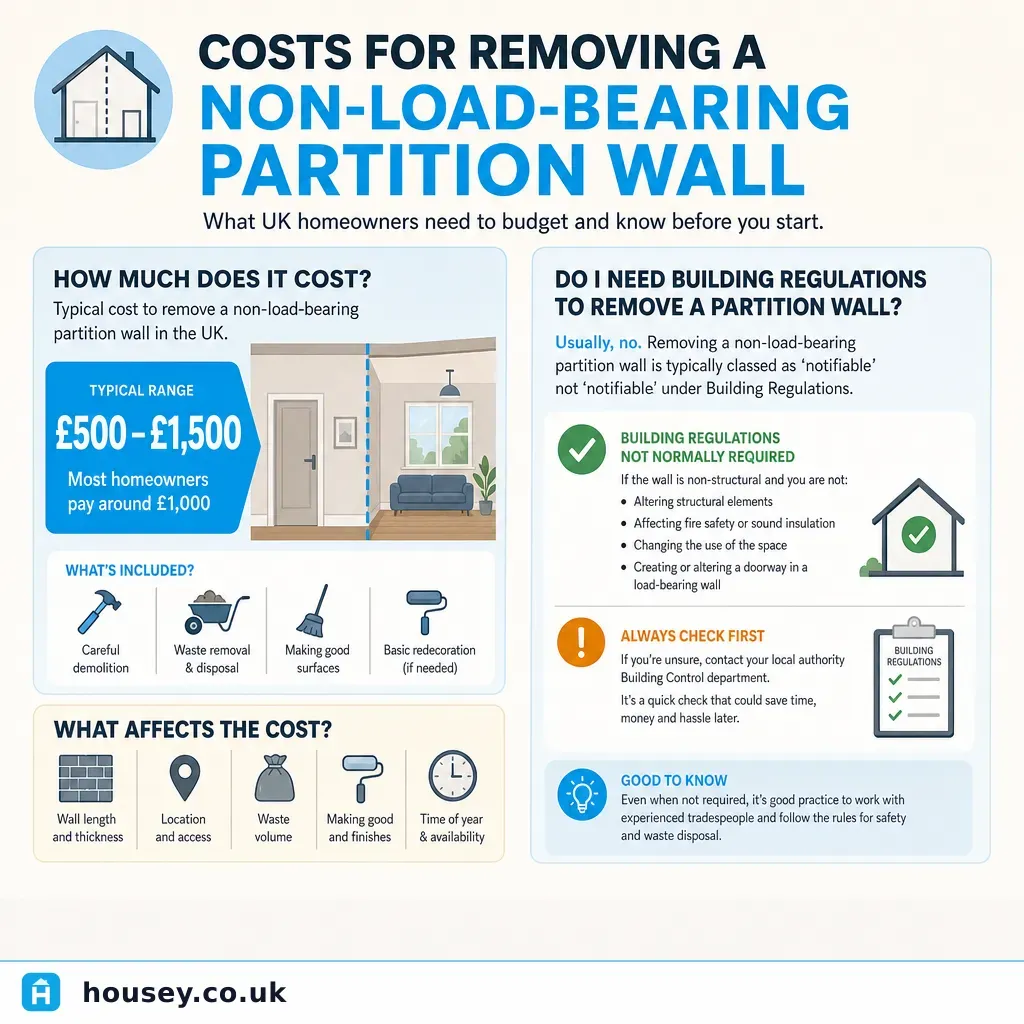
Costs for removing a non-load-bearing partition wall
Removing a non-load-bearing partition wall in a UK home typically costs £300–£1,500 in labour, plus £200–£600 or more for replastering and making good.
 Planning & Pre-Build
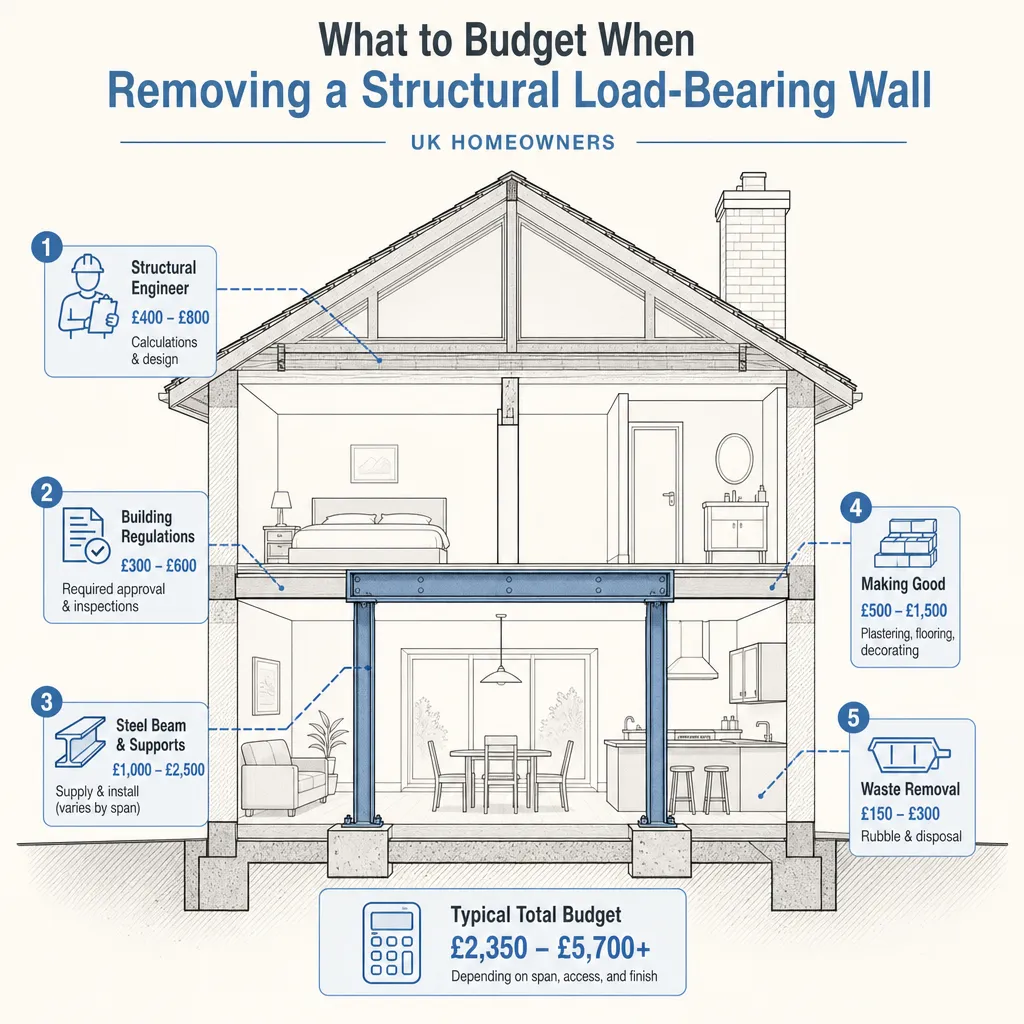
What to Budget When Removing a Structural Load-Bearing Wall
Removing a load-bearing wall in a typical UK home costs £2,500–£8,000 or more in total, covering a structural engineer's calculations, Building Regulations approval, the steel beam, builder's labour, and replastering.
 Planning & Pre-Build
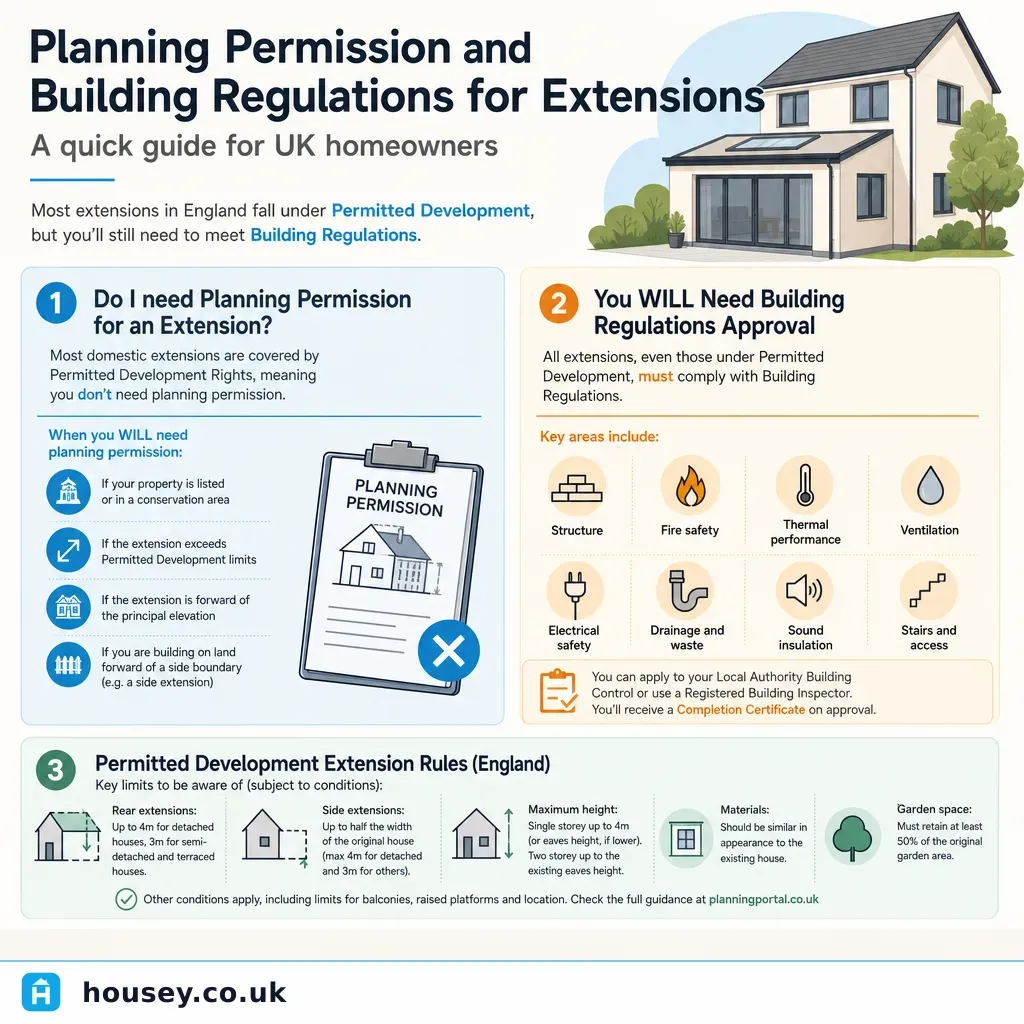
Planning Permission and Building Regulations for Extensions
UK home extensions usually require both planning permission and Building Regulations approval, though most smaller rear extensions qualify as Permitted Development under the GPDO 2015 and need no planning application.
 Planning & Pre-Build
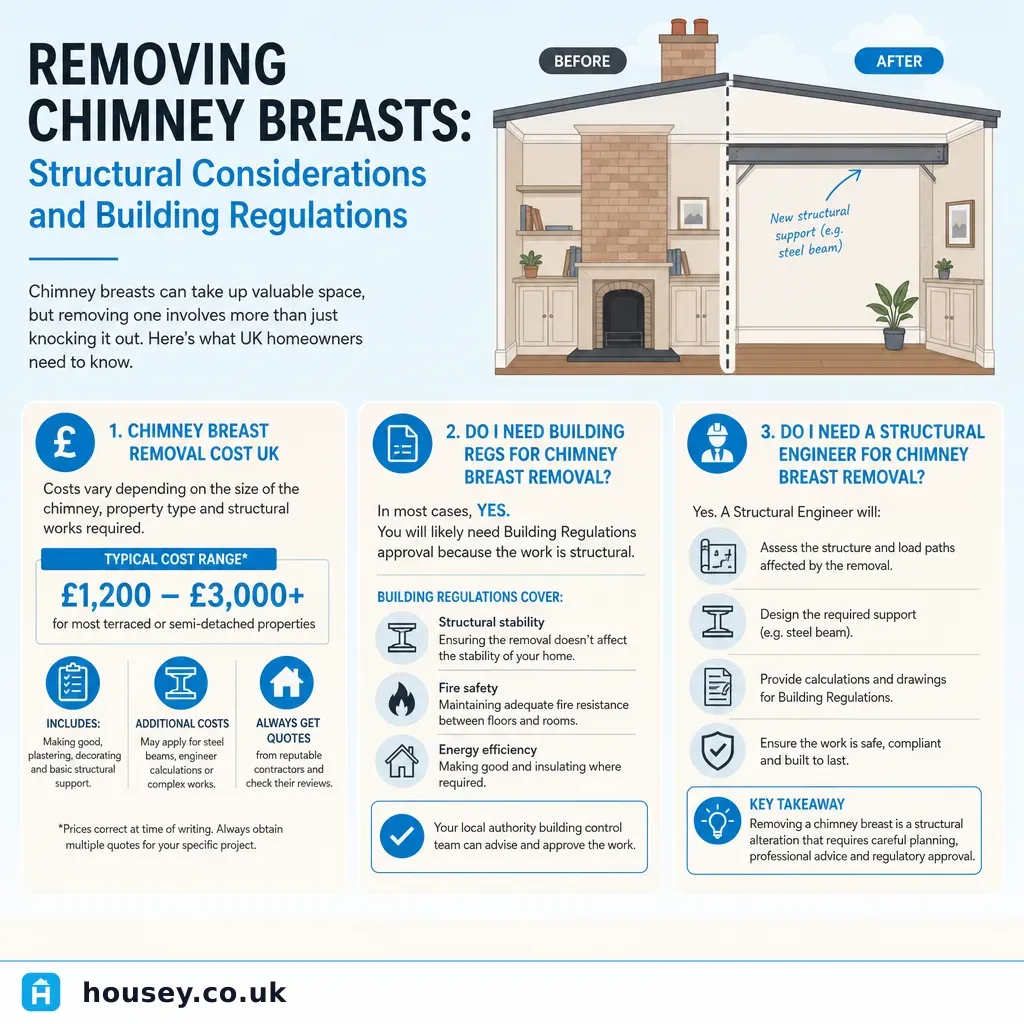
Removing Chimney Breasts: Structural Considerations and Building Regulations
Removing a chimney breast in England and Wales almost always requires building regulations approval because it is structural work.