Structural Arching in Walls: Load Distribution and Design
By Housey · Last reviewed 11th of May 2026
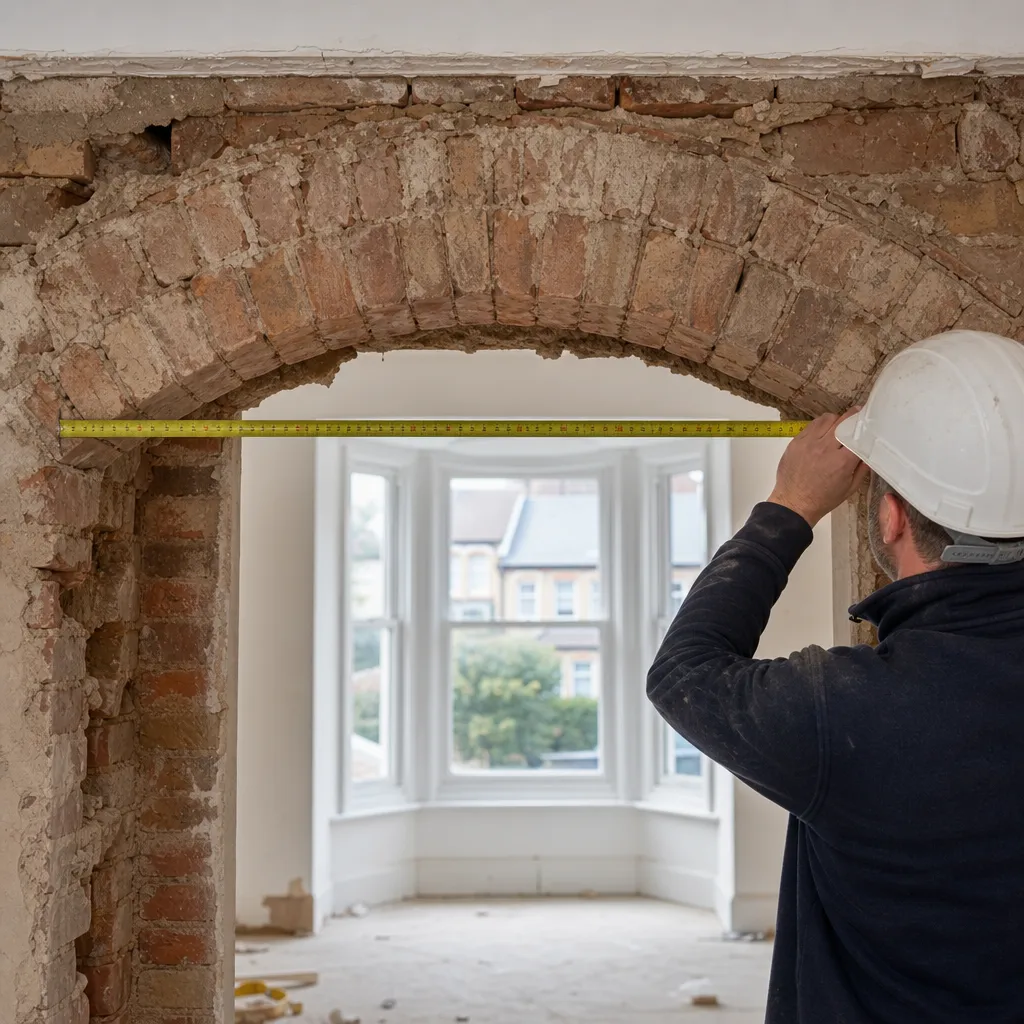
Structural Arching in Walls: Load Distribution and Design
When a wall is pierced by an opening — a doorway, window, or new passageway — the question of how loads redistribute above it becomes critical. For homeowners planning alterations to Victorian terraces, Edwardian semis, or any solid masonry property, understanding structural arching explains why buildings have stood for centuries without conventional steel lintels, and why getting load paths wrong in a residential project can have serious consequences. The topic arises most often when a contractor or designer proposes widening an existing opening, removing a chimney breast, or forming a new internal doorway in an original masonry wall.
Key points
- Structural arching action forms naturally in masonry when compressive forces redistribute around an opening in a roughly triangular or parabolic pattern, reducing the load applied to the lintel or support below.
- BS EN 1996-1-1 (Eurocode 6) and its UK National Annex are the principal masonry design standards governing arching calculations; engineers use these alongside site-specific masonry strength data.
- Building Regulations Approved Document A requires all structural elements — including walls with openings — to sustain and transmit loads to foundations without excessive deflection or failure.
- For arching to form reliably, pier widths on each side of the opening should be at least half the clear span — a widely cited rule of thumb that engineers verify by calculation for each specific case.
- In a 215 mm solid brick wall, a 900 mm doorway with 450 mm brick piers on each side is a typical scenario where arching may be assessed — but it must be verified by calculation to Eurocode 6, not assumed from appearance alone.
What is structural arching action?
When a load acts on a masonry wall above an opening, it does not fall uniformly onto the lintel below. Instead, masonry units and mortar joints redirect compressive stresses in a curved or triangular path around the gap, transmitting loads to the wall sections on either side — the abutments. This is arching action.
The arch that forms is not a decorative arch in the traditional sense; it is an invisible compressive zone within the wall fabric. In a solid masonry wall of adequate thickness and with sufficient abutment, this natural redistribution can carry a significant proportion of the load that would otherwise act on the lintel.
Two simplified models are used in structural design:
- Triangular arching model: Assumes loads above a 45° triangle rising from the corners of the opening are carried by the wall panels to either side. Only loads within that triangle land on the lintel.
- Catenary or parabolic arch model: A more nuanced approach accounting for actual stress distribution through the masonry, used in detailed calculations to Eurocode 6 (BS EN 1996-1-1).
The practical result is that a correctly specified lintel in a masonry wall with adequate abutment may be sized for a smaller portion of the total wall load than a naive calculation would suggest. Where abutment is inadequate — thin piers, closely spaced openings, or weak mortar — arching cannot form, and the lintel must carry the full load.
When does arching action apply?
Scenario | Arching likely | Notes |
|---|---|---|
Solid brick or stone masonry wall, single opening, adequate pier width | Yes | Classical condition for reliable arching |
Cavity wall with solid masonry leaves and wide piers | Partial | Each leaf may arch independently; wall ties affect load sharing |
Closely spaced openings with narrow piers | No | Piers too slender to provide adequate abutment |
Lightweight aggregate blockwork, weak or degraded mortar | Unlikely | Tensile and shear capacity of mortar joints is critical to arch formation |
Timber-frame or steel-frame walls with non-structural masonry cladding | No | The frame carries all loads; masonry is a cladding only |
Reinforced concrete or modern steel lintel already installed | Not required | Lintel is designed to carry full load regardless of arching |
This table provides general orientation only. Whether arching applies to a specific opening depends on full structural assessment of that wall.
What engineers consider when calculating arching
A structural engineer assessing arching action in a masonry wall will typically evaluate:
- Wall thickness and masonry unit type — denser, stronger bricks or stone and higher-strength mortar support more reliable arching than lightweight blockwork.
- Pier width (abutment) — the horizontal distance from the edge of the opening to the nearest structural discontinuity such as another opening, a corner, or a change in wall thickness.
- Height-to-span ratio — the wall above the opening must be tall enough to develop a compressive arch. A minimum arch rise of roughly one quarter of the clear span is often cited, though this varies with masonry type and loading.
- Vertical load above the opening — arching depends on pre-compression in the wall. Very lightly loaded walls, for instance beneath a lightweight flat roof, may not develop sufficient compressive stress to activate arching reliably.
- Horizontal restraint and movement compatibility — arching creates horizontal thrust at the abutments. Where floors or roofs restrain the wall, this thrust is absorbed. Where they do not, horizontal bowing becomes a risk.
Calculations reference BS EN 1996-1-1 and its UK National Annex. For older existing buildings, engineers also consult BRE guidance and assess the masonry's actual condition and compressive strength on site before finalising any calculation.
Common residential scenarios
Removing a chimney breast: A chimney breast removed at first-floor level interrupts load paths from the stack above. The flank walls often depend on arching to redistribute those loads. Removing the breast without engineering the support above and below is dangerous and notifiable under Building Regulations. A structural engineer must assess whether arching can be maintained in the remaining wall or whether a steel or reinforced concrete transfer structure is needed.
Creating a new doorway in a solid masonry wall: In a Victorian terrace with 215 mm solid brickwork, a new internal doorway of 900 mm clear width may partly rely on arching — provided there is at least 450 mm of uninterrupted brickwork on each side. The engineer calculates the residual load on the lintel after accounting for arching action, and specifies the lintel, bearing length, and any propping requirements accordingly.
Widening an existing opening: Widening reduces abutment on one or both sides. An opening that previously benefited from arching may no longer do so, requiring a heavier lintel or a structural steel goalpost frame. This is a common source of structural problems in under-engineered domestic extensions and loft conversion projects.
Which professional do you need?
Situation | Professional to instruct |
|---|---|
Planning any new opening in a load-bearing masonry wall | Chartered structural engineer (MIStructE or CEng registered) |
Preparing drawings for a building regulations submission | Structural engineer plus architect or architectural technologist |
Historic or listed masonry building | Structural engineer with conservation experience |
Assessing whether an existing lintel is adequate after an alteration | Structural engineer |
General layout and design planning before structural input | Architect or architectural technologist |
Important limitations
This article provides general information about structural arching principles only. It is not a substitute for structural engineering assessment. The behaviour of any specific wall depends on its exact construction, condition, current loading, and abutment geometry — none of which can be reliably determined from a guide. Structural failure in walls can occur without visible warning signs. Always instruct a qualified structural engineer before removing, altering, or loading any wall where load-bearing status is uncertain.
When to get professional help
Contact a qualified structural engineer before proceeding if any of the following apply:
- You are planning any alteration to a wall you suspect is load-bearing.
- You are widening an existing opening by more than 150 mm.
- The property was built before 1919 and likely has solid masonry walls with variable original mortar quality.
- There are existing cracks near the opening, sticking doors, or sloping floors — all potential signs of prior structural movement.
- The property is listed or in a conservation area, where heritage and planning constraints may also apply.
- A contractor has told you the work will be fine without producing engineering calculations or a structural engineer's written sign-off.
What to ask a qualified professional
- Is this wall load-bearing, and if so, what loads does it currently carry?
- Can arching action be relied upon for this opening width, or must the lintel be designed for the full load?
- What pier width is needed on each side to maintain structural integrity after the opening is formed?
- Will temporary propping be required during installation, and if so, for how long and at what positions?
- Does this alteration require building regulations approval, and will you provide drawings and calculations for submission to the building control body?
- Are there any existing cracks, defects, or signs of movement that should be addressed before the opening is created?
How Housey can help
Housey connects UK homeowners with vetted structural engineering practices and architectural technologists who understand load-path design, building regulations submissions, and residential masonry alterations. Whether you are planning a new opening, removing a chimney breast, or need engineering calculations for a building control submission, you can request and compare quotes from qualified professionals in your area.
Frequently asked questions
Does arching action mean I might not need a lintel?
In some masonry situations, arching can carry the majority of the load above an opening, reducing what the lintel must handle. In practice, a lintel is still almost always required — to carry residual loads, provide temporary construction support, and satisfy Building Regulations. Whether or not arching applies, a structural engineer should specify the lintel size before any opening is formed.
How wide can a masonry opening be before arching no longer works?
There is no fixed maximum width. The critical factors are pier width relative to span, wall height, masonry strength, and loading. Roughly, when piers narrow below half the opening span, arching becomes unreliable — but this is a rule of thumb, not a design standard. A structural engineer must calculate the specific case; do not assume arching applies without professional assessment.
Can arching action occur in timber-frame or steel-frame buildings?
No. In timber-frame and steel-frame construction, loads are carried by the structural frame. Masonry infill or cladding does not carry structural loads, so arching action does not apply. If in doubt about your building's structural system — particularly in properties built since the 1970s — ask a structural engineer to assess the construction before making any alterations.
What happens if the wall piers are too narrow to provide abutment?
Without adequate abutment, the horizontal thrust of the arch has nowhere to go, arching cannot form, and the full load falls onto the lintel — or the wall cracks and bows. In those cases the lintel must be designed for the full load, or a structural steel goalpost or transfer frame must be introduced. A structural engineer will determine which solution is appropriate.
Sources and further reading
Useful next reads
 Planning & Pre-Build
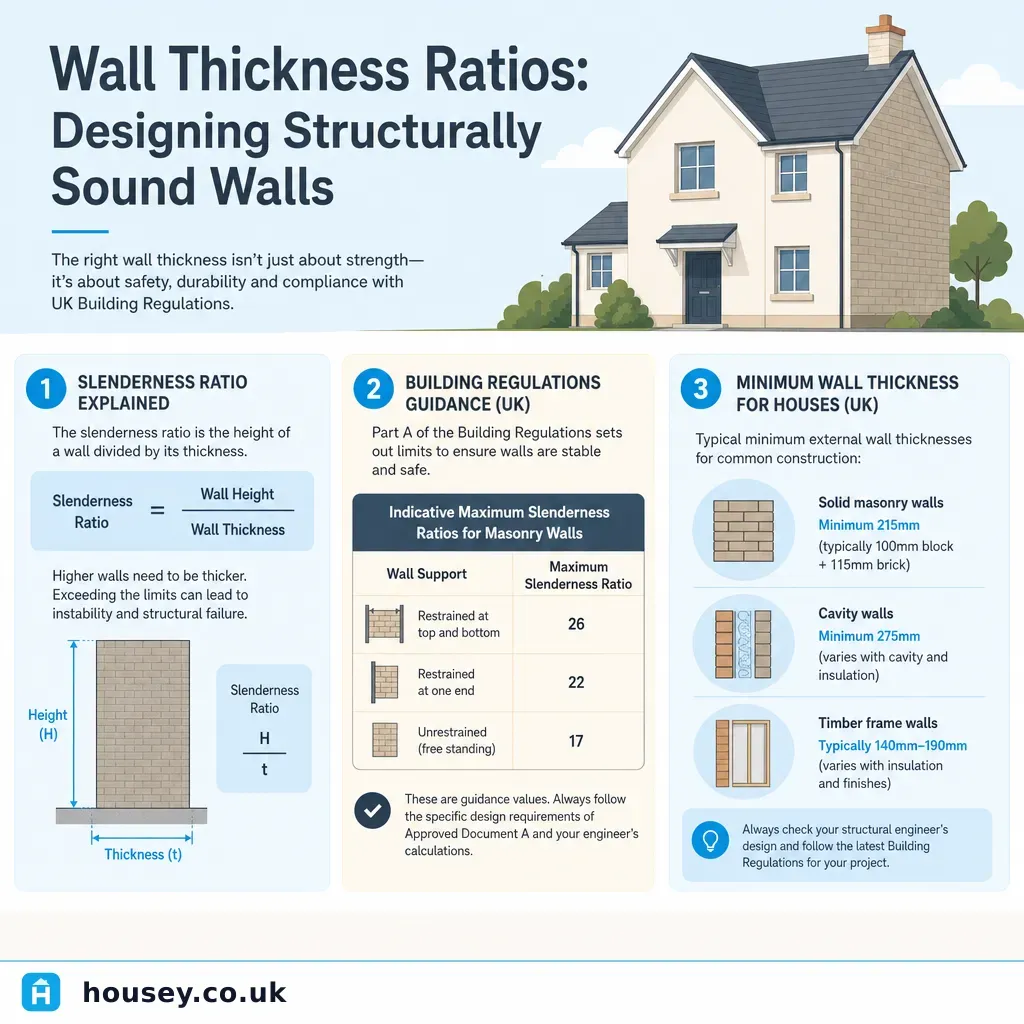
Wall Thickness Ratios: Designing Structurally Sound Walls
Wall thickness ratios — particularly the slenderness ratio (effective height divided by effective thickness) — determine whether a wall can safely carry load without buckling.
 Planning & Pre-Build
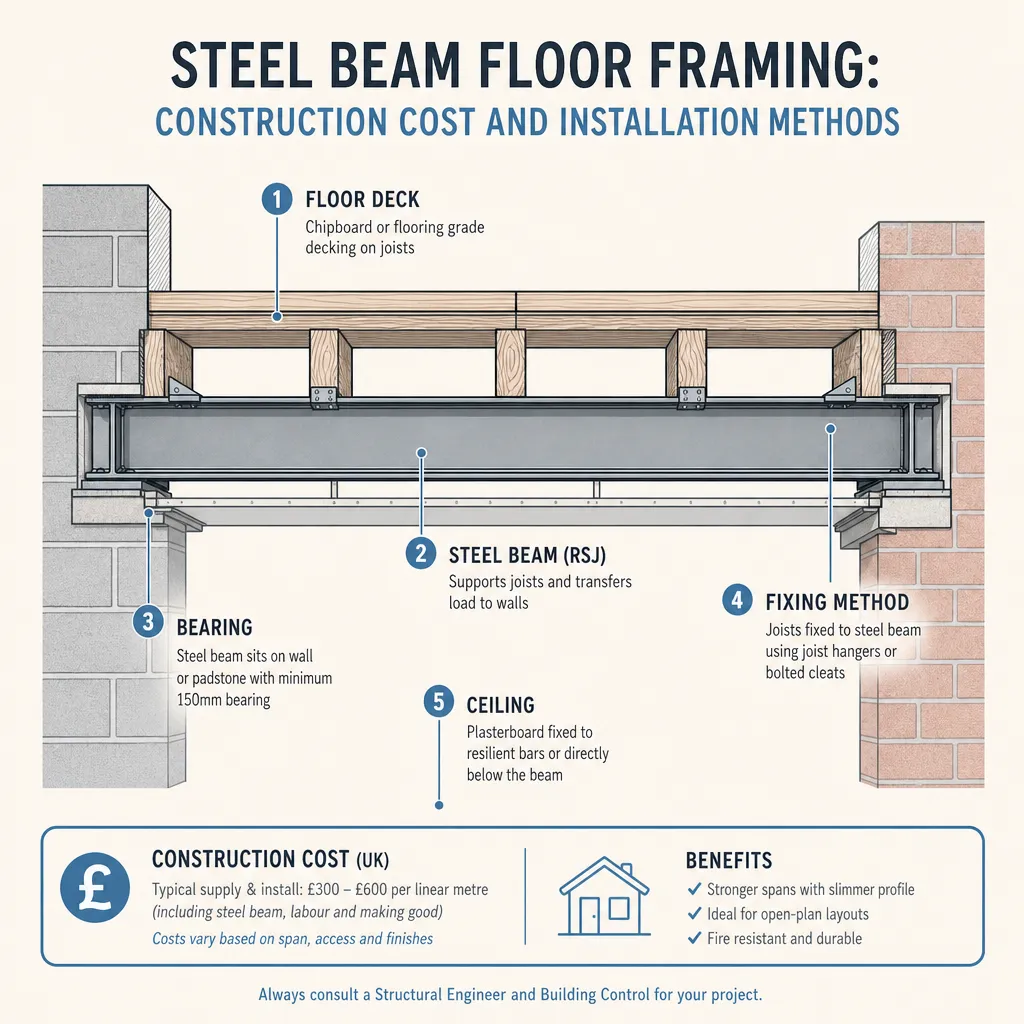
Steel Beam Floor Framing: Construction Cost and Installation Methods
Steel beam floor framing is used in UK homes when spans are too wide for timber joists, or when a load-bearing wall is removed.
 Planning & Pre-Build
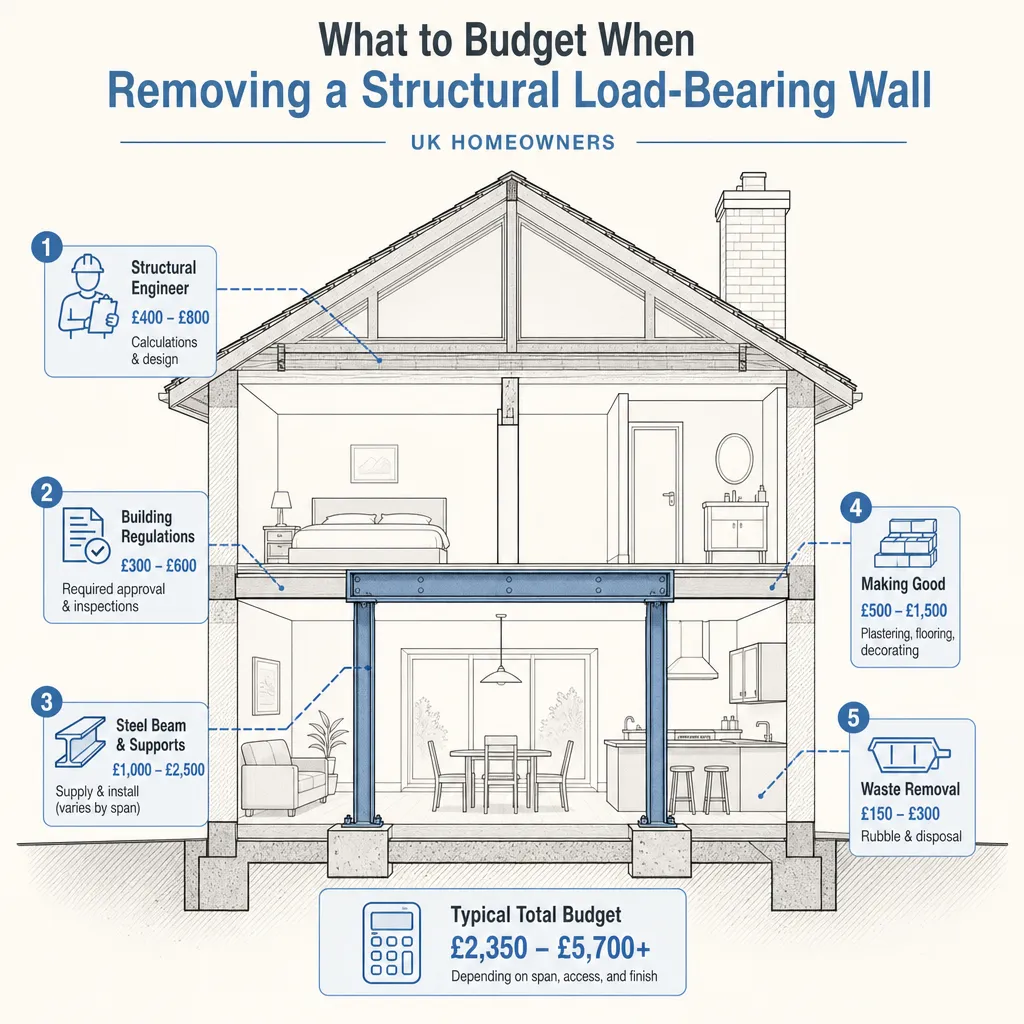
What to Budget When Removing a Structural Load-Bearing Wall
Removing a load-bearing wall in a typical UK home costs £2,500–£8,000 or more in total, covering a structural engineer's calculations, Building Regulations approval, the steel beam, builder's labour, and replastering.
 Planning & Pre-Build
Space planning and architectural design: optimising your property layout
Space planning defines how rooms, circulation routes, and services are arranged within a property to make the best use of available area.
 Planning & Pre-Build
Designing vaulted ceilings for residential spaces
Creating a vaulted ceiling in an existing home involves restructuring the roof timbers that form the structural triangle, which always requires a structural engineer's calculations and Building Regulations approval under Approved Document A.