Property Terminology Explained: Your Essential Glossary For UK Property Buyers And Sellers
By Housey · Last reviewed 10th of May 2026

Property Terminology Explained: Your Essential Glossary For UK Property Buyers And Sellers
The language of UK property transactions can feel opaque even after you have done some research. Terms that sound similar can mean very different things — completion and exchange are not the same event, and instructing a solicitor and signing contracts happen weeks or months apart. Understanding the vocabulary used by your solicitor, estate agent, surveyor, and lender allows you to follow the process clearly, ask the right questions at the right time, and spot problems before they cost you money.
Key points
- Exchange of contracts and completion are two separate events: exchange is when the sale becomes legally binding and a deposit (usually 10%) is paid; completion is when ownership transfers and you receive the keys.
- Leasehold ownership means you own the property for a fixed term but not the land beneath it; freehold means you own both the property and the land outright.
- Disbursements are third-party costs passed on by your solicitor — including Land Registry fees, Stamp Duty Land Tax, and search fees — and are separate from your solicitor's own professional fee.
- A structural survey is not a standardised term; specify RICS Level 2 (Home Survey) or RICS Level 3 (Building Survey) when instructing a surveyor to ensure a defined scope of inspection.
- Gazumping — where a seller accepts a higher offer after agreeing one with you — is legal in England and Wales; it is not legal in Scotland, where the offer process works differently.
The conveyancing process: key terms explained
Offer and acceptance
Offer: a proposal to buy at a stated price, made verbally or in writing through the estate agent. In England, Wales, and Northern Ireland, an offer is not legally binding — either party can withdraw without penalty until exchange of contracts.
Memorandum of sale: a document prepared by the estate agent once an offer is accepted, recording buyer, seller, agreed price, and respective solicitor details. It is not a legal document but triggers the start of conveyancing.
Conveyancing: the legal process of transferring property ownership from seller to buyer. A solicitor or licensed conveyancer carries out searches, checks title, raises enquiries, and manages exchange and completion. Housey can connect you with experienced conveyancing solicitors.
Instruction: formally engaging a solicitor to act on your behalf. You can instruct a solicitor before an offer is accepted, which can reduce delays once a sale is agreed.
Searches and due diligence
Searches: enquiries made by your solicitor to local authorities, water companies, and other bodies about the property and surrounding land. Standard residential searches include local authority, drainage and water, and environmental searches. Results typically take two to six weeks.
Local authority search: reveals planning history, enforcement notices, highway adoption status, and whether the property is in a conservation area or affected by a compulsory purchase order.
Environmental search: flags flood risk, ground contamination, landfill proximity, and radon potential. It is not a full environmental or ground investigation survey.
Title: the legal ownership record. Most properties in England and Wales are registered at HM Land Registry; unregistered properties require examination of historical deeds to establish ownership.
Enquiries: written questions raised by the buyer's solicitor to the seller's solicitor about the property's history, boundaries, disputes, planning compliance, and building regulations.
Surveys and valuations
Mortgage valuation: an assessment carried out on behalf of the lender to confirm the property is adequate security for the loan. It does not assess condition in detail and is not a substitute for an independent survey.
RICS Home Survey Level 2: a condition survey of a conventional residential property, covering visible defects and rated on a 1–3 scale. Suitable for standard properties in reasonable condition. Find out more about RICS Home Surveys.
RICS Home Survey Level 3 (Building Survey): a more detailed inspection covering construction, materials, and defects, with advice on repairs. Recommended for older, extended, or unusual properties.
Valuation survey: an independent assessment of a property's open-market value, distinct from a condition survey. Often required for mortgage purposes, probate, or Help to Buy redemption. See valuation surveys for more.
EPC (Energy Performance Certificate): a standardised A–G rating of a property's energy efficiency. Sellers are legally required to commission one before marketing. Valid for 10 years. Housey can help you find accredited EPC assessors.
Exchange and completion
Exchange of contracts: the point at which both parties sign identical copies of the contract and these are exchanged via their solicitors. The sale becomes legally binding. The buyer typically pays a 10% deposit at this point.
Completion: the day on which the balance of the purchase price is transferred and ownership passes to the buyer. Keys are released once funds clear — this is the day you move in.
Chain: a sequence of linked purchases and sales where each transaction depends on the others completing simultaneously. Long chains increase the risk of delays or collapse.
Chain-free: a property being sold without the seller needing to purchase another property simultaneously — for example, a second home, new-build, or probate sale. Generally considered lower-risk by buyers.
Retention: an amount withheld from the purchase price, usually held by solicitors, pending completion of agreed works or resolution of an issue identified in a survey.
Indemnity insurance: a one-off premium policy that protects the buyer and lender against risk from a specific legal defect — for example, missing planning consent or absent building regulations approval. It does not fix the defect and is not a substitute for compliance.
Ownership types compared
Tenure | What you own | Typically applies to | Watch out for |
|---|---|---|---|
Freehold | Property and land outright, indefinitely | Houses | Boundary disputes; chancel repair liability |
Leasehold | Property for a fixed term (the lease), not the land | Most flats; some houses | Short lease (under 80 years); ground rent; service charges |
Commonhold | Collective freehold of shared areas; each unit holder owns a freehold | Flats (uncommon in England and Wales) | Complex governance; still rare in practice |
Share of freehold | Leaseholders collectively own the freehold via a company | Flats in converted houses | Check articles of association; not the same as freehold |
Ground rent: an annual payment made by a leaseholder to the freeholder. Under the Leasehold Reform (Ground Rent) Act 2022, ground rents on new residential leases in England and Wales are set at a peppercorn (effectively zero). Historic ground rents on older leases may be substantial and can affect mortgage eligibility.
Service charge: a payment made by leaseholders for the management and maintenance of shared areas. Can vary significantly year to year. Always request three years of service charge accounts before exchange.
Lease extension: the process of adding years to a leasehold term. Leaseholders of flats who have owned for at least two years typically have a statutory right to extend by 90 years under the Leasehold Reform, Housing and Urban Development Act 1993. Properties with fewer than 80 years remaining on the lease attract a marriage value premium that increases cost significantly.
Key cost and financial terms
Stamp Duty Land Tax (SDLT): a tax on property purchases in England and Northern Ireland, calculated on the purchase price above thresholds. Scotland levies Land and Buildings Transaction Tax (LBTT); Wales levies Land Transaction Tax (LTT). Thresholds change — check GOV.UK for current rates, including first-time buyer and additional-dwelling reliefs.
Disbursements: costs paid by your solicitor to third parties on your behalf — Land Registry fees, search fees, Stamp Duty — and billed back to you. They are additional to your solicitor's own professional fee. Always ask for a full all-in estimate including anticipated disbursements before instructing.
Survey retention: where a mortgage lender withholds part of the loan until specified remedial works are completed, typically triggered by defects identified in their valuation.
What not to assume
- Sold STC does not mean the property is yours. Sold subject to contract means an offer has been accepted, but no legal obligation exists yet. Either party can still withdraw without penalty.
- A mortgage offer is not the same as exchange. Receiving a written mortgage offer means the lender has agreed to lend; the sale is only legally binding when contracts are exchanged.
- No chain does not mean no delays. Searches, solicitor workloads, and survey issues can all slow a chain-free purchase significantly.
- Solicitor fees in one quote may not include disbursements. Always ask for a total all-in estimate, not just the professional fee, before instructing.
- A condition survey and a mortgage valuation are not the same thing. The lender's valuation protects the lender, not you. Commission an independent RICS survey to protect your own interests.
- Indemnity insurance does not resolve planning or building control issues. It manages financial risk from the defect; it does not make the unauthorised work compliant.
When to get professional help
Property transactions involve significant financial and legal commitment. Always instruct a solicitor or licensed conveyancer — do not attempt to manage conveyancing without legal representation. In addition, seek specialist advice if:
- Your survey flags conditions rated 2 or 3 (RICS Level 2) or recommends further specialist investigation before exchange.
- Lease terms — a short lease, high ground rent, or onerous covenants — give you cause for concern.
- The title reveals a flying freehold, shared access arrangements, or missing consents for alterations.
- You are buying a leasehold property and need advice on service charge levels, major works notices, or the right to manage.
How Housey can help
Housey connects buyers and sellers with experienced conveyancing solicitors, RICS-accredited surveyors for home surveys, accredited EPC assessors, and professionals offering valuation surveys. Whether you are preparing to buy, sell, or simply need a specific report before exchange, Housey helps you find the right professional at the right stage.
Frequently asked questions
What is the difference between a solicitor and a licensed conveyancer?
A solicitor is a qualified lawyer who can handle conveyancing alongside other legal matters. A licensed conveyancer specialises in property law and can manage residential conveyancing but not other legal work. Either can act in a straightforward purchase; your choice may depend on price, firm reputation, and whether any complexity is involved.
What does gazumping mean and can I protect against it?
Gazumping is when a seller accepts a higher offer from another buyer after already accepting yours. It is legal in England and Wales until exchange of contracts. You can partially protect yourself by pushing for a quick exchange, keeping your mortgage offer and solicitor ready to move, and considering a lock-out agreement with the seller.
How long does conveyancing take?
For a straightforward purchase, conveyancing typically takes 8–16 weeks from offer acceptance to exchange, though chains, slow searches, and complex title issues can extend this significantly. Leasehold purchases often take longer due to additional enquiries required of the managing agent and freeholder.
What is a flying freehold?
A flying freehold is a part of a freehold property that overhangs or extends over another property — common in older terraced houses. Flying freeholds can complicate mortgage lending. Indemnity insurance is often required, and your solicitor should flag and advise on any flying freehold identified in the title register.
Sources and further reading
- Buying or selling your home — GOV.UK
- Search the land registry — HM Land Registry
- Stamp Duty Land Tax — GOV.UK
- Leasehold Reform (Ground Rent) Act 2022 — legislation.gov.uk
- RICS Home Survey standard — RICS
Useful next reads
 Buying & Moving
Conveyancing Glossary: Key Terms and Definitions for Property Buyers
Conveyancing involves specific legal terms that appear throughout a UK property purchase.
 Buying & Moving
Property Terminology and Listing Definitions: Buyer's Reference Guide
UK property listings and conveyancing documents use specific terms that affect buying decisions.
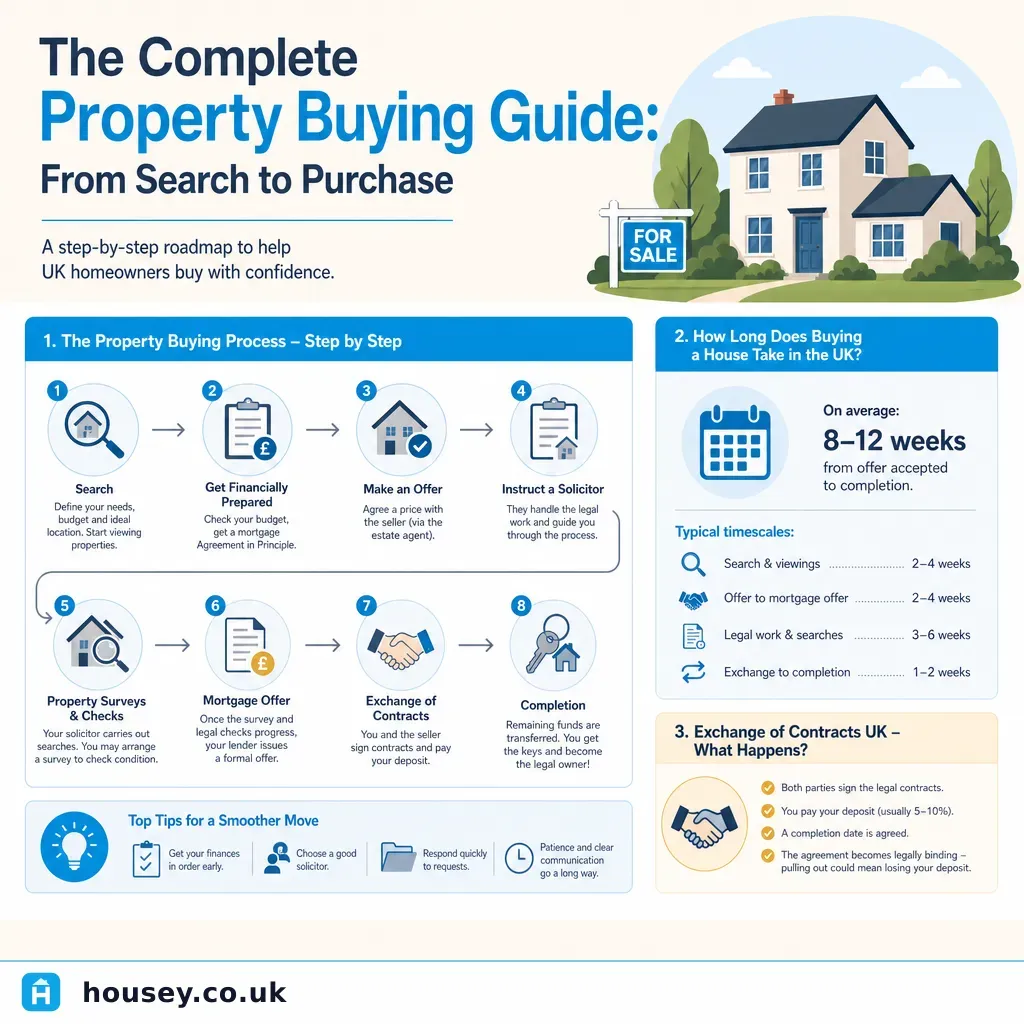 Buying & Moving
The Complete Property Buying Guide: From Search to Purchase
Buying a property in England and Wales typically takes 3–6 months from accepted offer to completion.
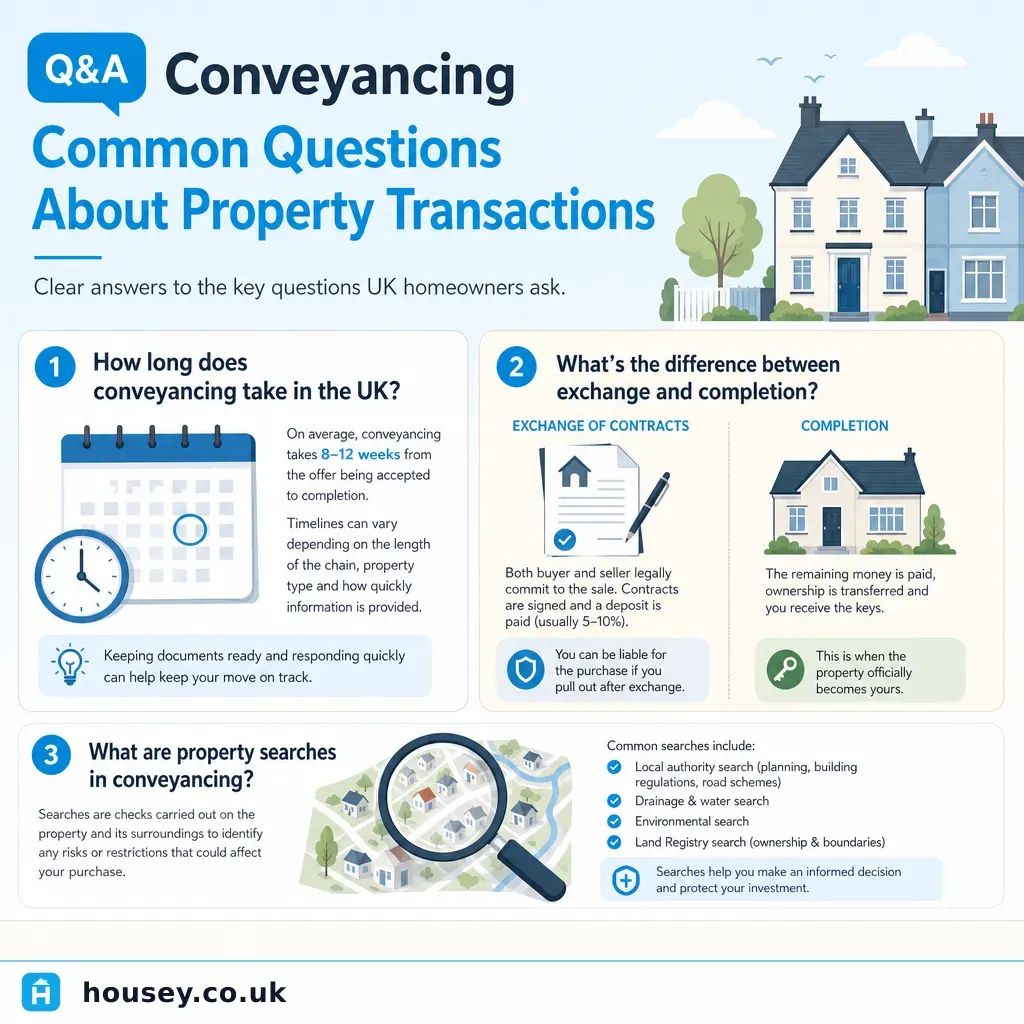 Buying & Moving
Conveyancing Q&A: Common Questions About Property Transactions
Conveyancing is the legal transfer of property ownership, typically taking 12 to 16 weeks in England and Wales.
 Buying & Moving
First-Time Home Buyer's Guide: From Search to Completion
Buying your first home in the UK typically takes 3–6 months from offer acceptance to completion.