Conveyancing Myths Debunked: What You Really Need to Know
By Housey · Last reviewed 25th of May 2026

Conveyancing Myths Debunked: What You Really Need to Know
Conveyancing is the legal process of transferring property ownership, and it sits at the heart of every UK house purchase and sale. Misunderstandings about how it works — who is responsible for what, how long it takes, and what can go wrong — are widespread, and they cost buyers and sellers time, money, and avoidable stress.
Key points
- In England and Wales, a property transaction becomes legally binding only at exchange of contracts — not when an offer is accepted or a mortgage is approved.
- A conveyancer investigates legal title; they do not visit the property or assess its physical condition — that is the role of a separately instructed surveyor.
- Local authority searches cover planning decisions, drainage, and highway information; they say nothing about the structural condition of the building.
- Leasehold transactions typically take longer and cost more than freehold, due to lease review, management pack retrieval, and Building Safety Act 2022 compliance checks.
- A no-sale-no-fee arrangement covers legal fees only; disbursements already incurred — searches, Land Registry fees — may still be charged if the transaction collapses.
Myth 1: Accepting an offer means the sale is legally binding
This is one of the most persistent misunderstandings in UK residential property. In England and Wales, no legal obligation exists until contracts are exchanged. Until that point, either party can withdraw without penalty — regardless of how much time, money, or goodwill has been expended. This is the mechanism behind gazumping (a higher offer accepted by the seller before exchange) and gazundering (a buyer reducing their offer immediately before exchange).
Scotland operates differently. Once a formal offer is accepted and missives are concluded, a legally binding contract exists — a significant practical distinction for cross-border buyers to understand.
Myth 2: The cheapest conveyancer is the best value
Low headline fees can look attractive, but the total cost of conveyancing includes disbursements — search fees, Land Registry fees, bank transfer charges, and Stamp Duty Land Tax if applicable — most of which are fixed regardless of which firm you instruct. Where firms differ is in service quality, responsiveness, and the depth of enquiries they raise.
A conveyancer who misses a restrictive covenant, fails to identify a defective title, or delays exchange due to high caseloads can cost far more than any saving on their headline fee.
Factor | Why it matters |
|---|---|
Disbursements itemised separately | Ensures total-cost comparison is like-for-like |
Qualification (solicitor vs licensed conveyancer) | Both regulated; solicitors can handle more complex legal matters |
CQS accreditation (Law Society) | Conveyancing Quality Scheme — recognised standard for process quality |
Leasehold or new-build experience | Specialist knowledge matters for complex transaction types |
Communication method and response times | Solicitor speed and availability affects the whole chain |
No-sale-no-fee terms | Clarify exactly what disbursements still apply if the sale falls through |
Myth 3: Your conveyancer checks the physical condition of the property
Conveyancers are lawyers. They investigate legal title — who owns the property, what rights and restrictions attach to it, what searches reveal about planning or drainage history, and whether any outstanding charges or disputes exist. They do not visit the property and do not assess structural condition, damp, the roof, services, or any other physical matter.
A property survey — RICS Level 2 or Level 3 depending on the property — is a separate instruction to a separate professional. Never assume your conveyancer has assessed the physical state of what you are buying.
Myth 4: Local authority searches tell you everything about the property
Local authority searches reveal information held by the council: planning decisions and conditions, listed building or conservation area status, highway adoption status, tree preservation orders, and enforcement notices. They do not reveal the physical condition of the property, whether planning permission was properly implemented in practice, drainage issues beyond a separate drainage search, or historical ground contamination beyond what an environmental search captures.
Buyers typically commission a full suite of searches — local authority, drainage and water, environmental, and sometimes mining or chancel repair searches — each covering a distinct area of risk. Your conveyancer will advise on which searches are appropriate for the location and property type.
Myth 5: Conveyancing is the same for leasehold and freehold
Leasehold transactions are materially more complex than freehold. In addition to standard conveyancing, a leasehold purchase typically involves reviewing the lease (often 50–100 pages) for onerous terms, ground rent clauses, and service charge provisions; obtaining a management pack from the freeholder or managing agent (which can take 4–6 weeks and incur a fee); checking service charge accounts and any major works planned; and confirming compliance with the Building Safety Act 2022 for relevant buildings.
Leases with fewer than 80 years remaining attract mortgage lender restrictions; under 70 years, lease extension is often an urgent priority. Budget for additional time and cost from the outset of any leasehold transaction.
What not to assume
- Do not assume progress is being made if you have not heard from your conveyancer. Chase proactively — communication standards vary widely between firms.
- Do not assume a mortgage offer means you are ready to exchange. Your conveyancer must also complete all searches, receive and review replies to all enquiries, and receive the lender's formal instruction before exchange can happen.
- Do not assume all conveyancers are equally qualified or accredited. Look for SRA or CLC regulation and, ideally, CQS accreditation from the Law Society.
- Do not assume online conveyancers are slower or less thorough. Many online firms are efficient and well-resourced; the key is whether you can reach someone who knows your file when needed.
- Do not assume your completion date is fixed before exchange. Dates agreed before exchange are aspirational. Only at exchange does the completion date become legally binding on both parties.
Important limitations
This article provides general information about residential conveyancing in England and Wales. Scottish and Northern Irish conveyancing operate under fundamentally different legal systems. This article is not legal advice. For advice specific to your transaction, always instruct a qualified and regulated solicitor or licensed conveyancer.
What to ask a qualified professional
When choosing or instructing a conveyancer, ask:
- What is the total estimated cost, including all disbursements and VAT?
- Are you regulated by the SRA or the CLC, and do you hold CQS accreditation?
- How many active files does the fee earner handling my matter typically carry at one time?
- How and how quickly will you communicate with me during the transaction?
- What is your experience with leasehold, new-build, or listed building transactions if applicable?
- If a title defect or missing consent is discovered, how is that managed and what will it cost?
When to get professional help
You should instruct a conveyancer as soon as an offer is accepted. Seek additional specialist advice if:
- The property is leasehold, particularly with a lease under 90 years remaining.
- The title has unusual features flagged by the estate agent or seller's solicitor.
- You are buying a new-build, shared ownership, or Help to Buy property.
- The property is listed or in a conservation area.
How Housey can help
Housey connects buyers and sellers with regulated conveyancers and property solicitors across the UK. Compare professionals, check accreditations, and get the right legal support for your transaction — without pressure from estate agent referral arrangements.
Frequently asked questions
What is the difference between a solicitor and a licensed conveyancer?
Solicitors are regulated by the Solicitors Regulation Authority (SRA) and can handle a wider range of legal work beyond property transactions. Licensed conveyancers are regulated by the Council for Licensed Conveyancers (CLC) and specialise specifically in property. Both are valid, regulated options for residential conveyancing. For complex matters — leasehold disputes, boundary issues, or unusual title — a solicitor's broader legal scope may be advantageous.
How long does conveyancing typically take in England and Wales?
A straightforward freehold purchase typically takes 8–12 weeks from instruction to completion. Leasehold transactions, long chains, or title complications regularly extend this to 16 weeks or more. New-build completion is largely driven by the developer's build programme. These are typical ranges — your transaction may be shorter or longer depending on specific circumstances.
What happens if the sale falls through before exchange?
If the transaction collapses before exchange, neither party has any legal obligation to proceed. Under a no-sale-no-fee arrangement, you will not owe legal fees, but disbursements already paid on your behalf — searches, Land Registry fees, bank transfer charges — may still be charged. Check your engagement letter for the exact terms before instructing.
Is Stamp Duty Land Tax handled by my conveyancer?
Yes. In England, your conveyancer is responsible for calculating and submitting your Stamp Duty Land Tax (SDLT) return to HMRC and paying any SDLT due on completion. In Scotland, Land and Buildings Transaction Tax applies; in Wales, Land Transaction Tax. SDLT thresholds and rates can change — confirm the current position with your conveyancer before exchange.
Sources and further reading
- Buying or selling your home — GOV.UK
- Conveyancing Quality Scheme — Law Society
- Council for Licensed Conveyancers — CLC
- Stamp Duty Land Tax — GOV.UK
- Buying a home — Citizens Advice
Useful next reads
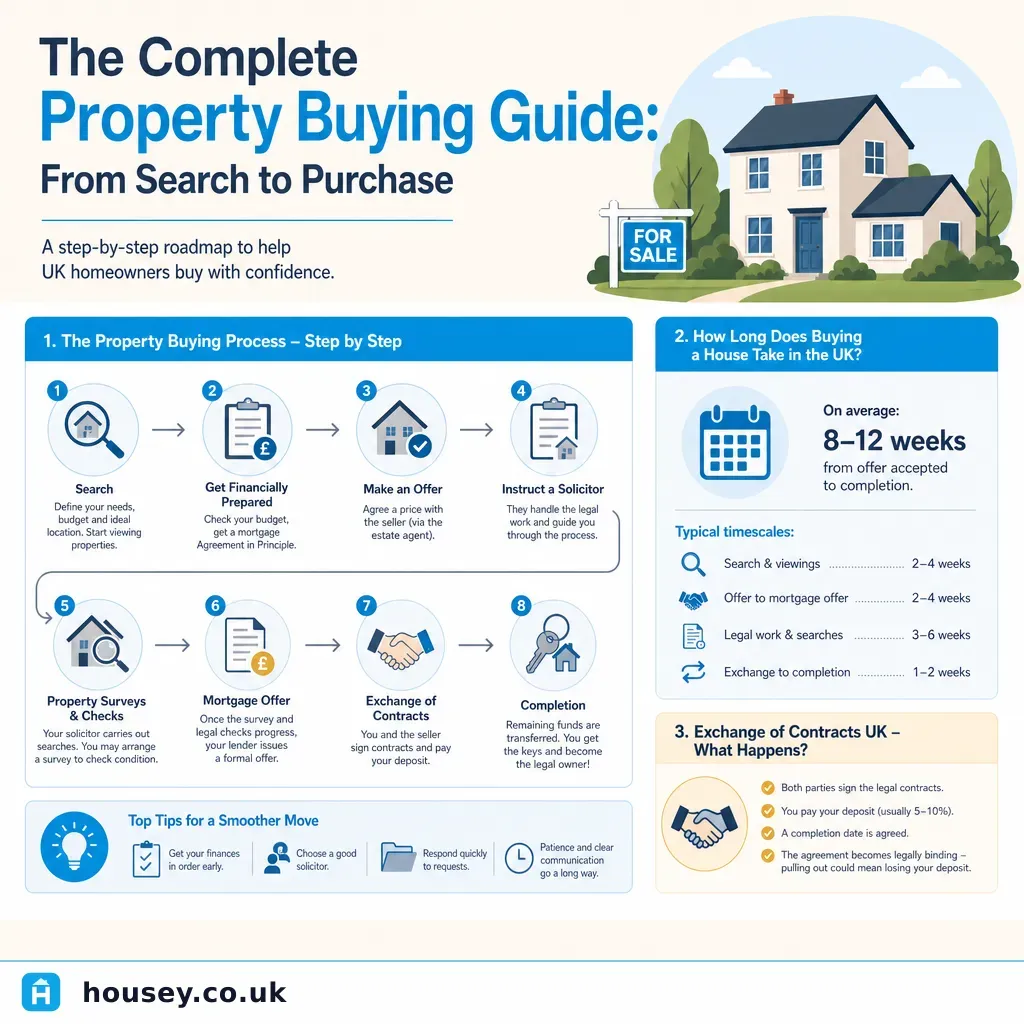 Buying & Moving
The Complete Property Buying Guide: From Search to Purchase
Buying a property in England and Wales typically takes 3–6 months from accepted offer to completion.
 Buying & Moving
Property Terminology and Listing Definitions: Buyer's Reference Guide
UK property listings and conveyancing documents use specific terms that affect buying decisions.
 Buying & Moving
Conveyancing Glossary: Key Terms and Definitions for Property Buyers
Conveyancing involves specific legal terms that appear throughout a UK property purchase.
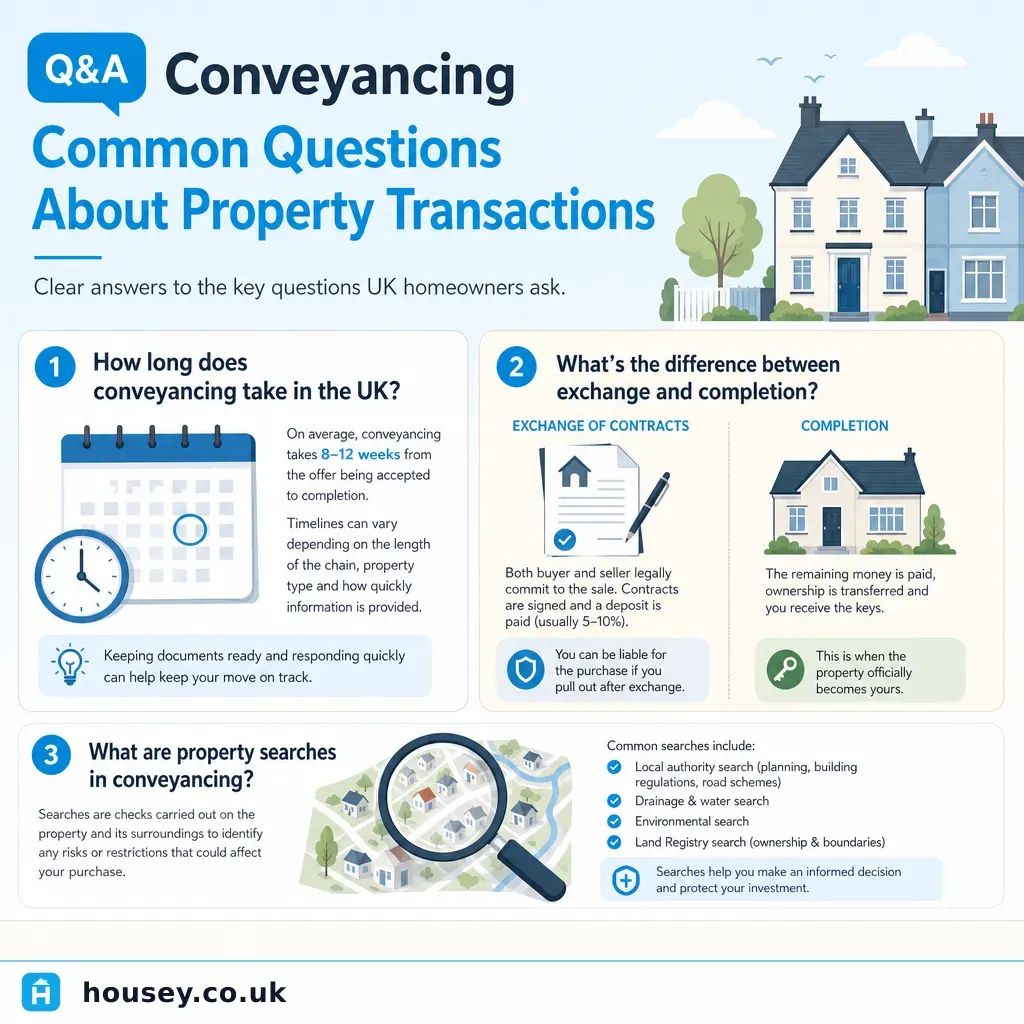 Buying & Moving
Conveyancing Q&A: Common Questions About Property Transactions
Conveyancing is the legal transfer of property ownership, typically taking 12 to 16 weeks in England and Wales.
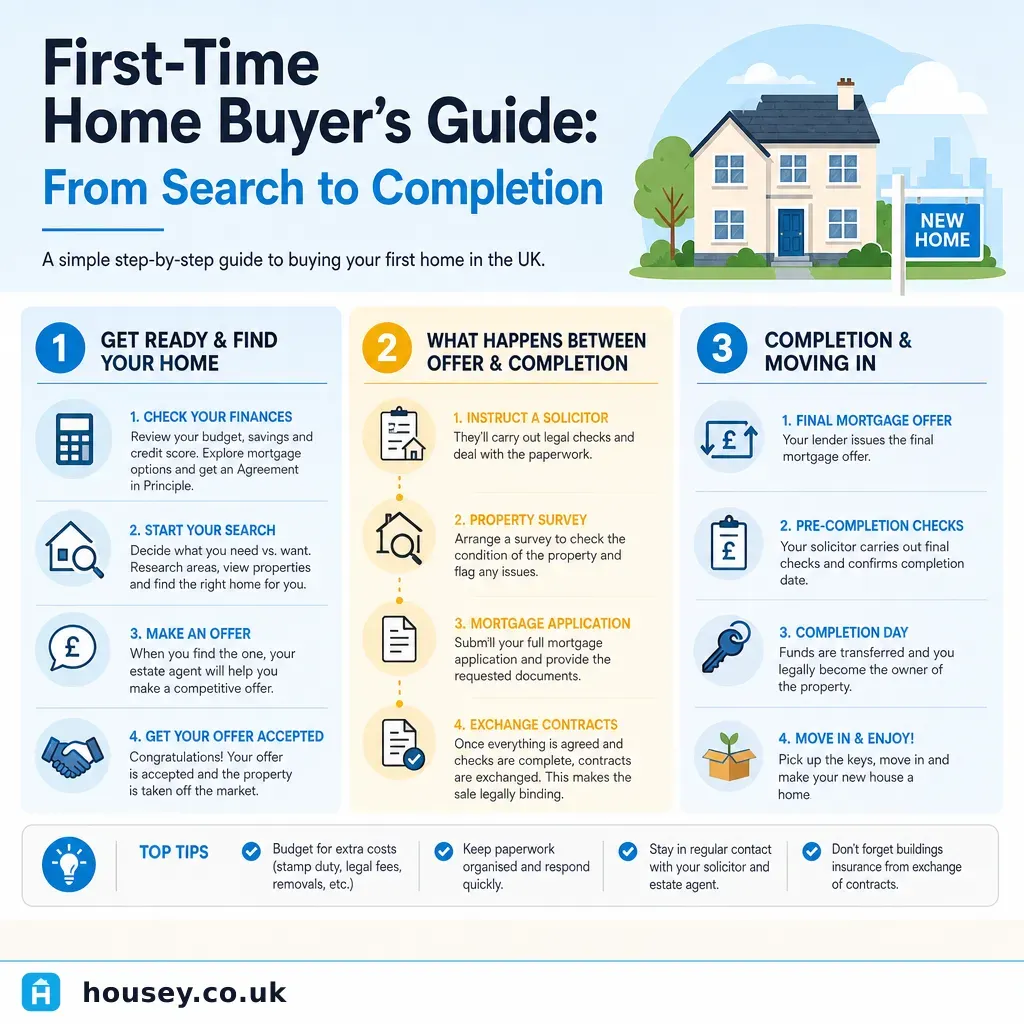 Buying & Moving
First-Time Home Buyer's Guide: From Search to Completion
Buying your first home in the UK typically takes 3–6 months from offer acceptance to completion.