Essential Questions to Understand Your Property Conveyancing Searches
By Housey · Last reviewed 24th of May 2026
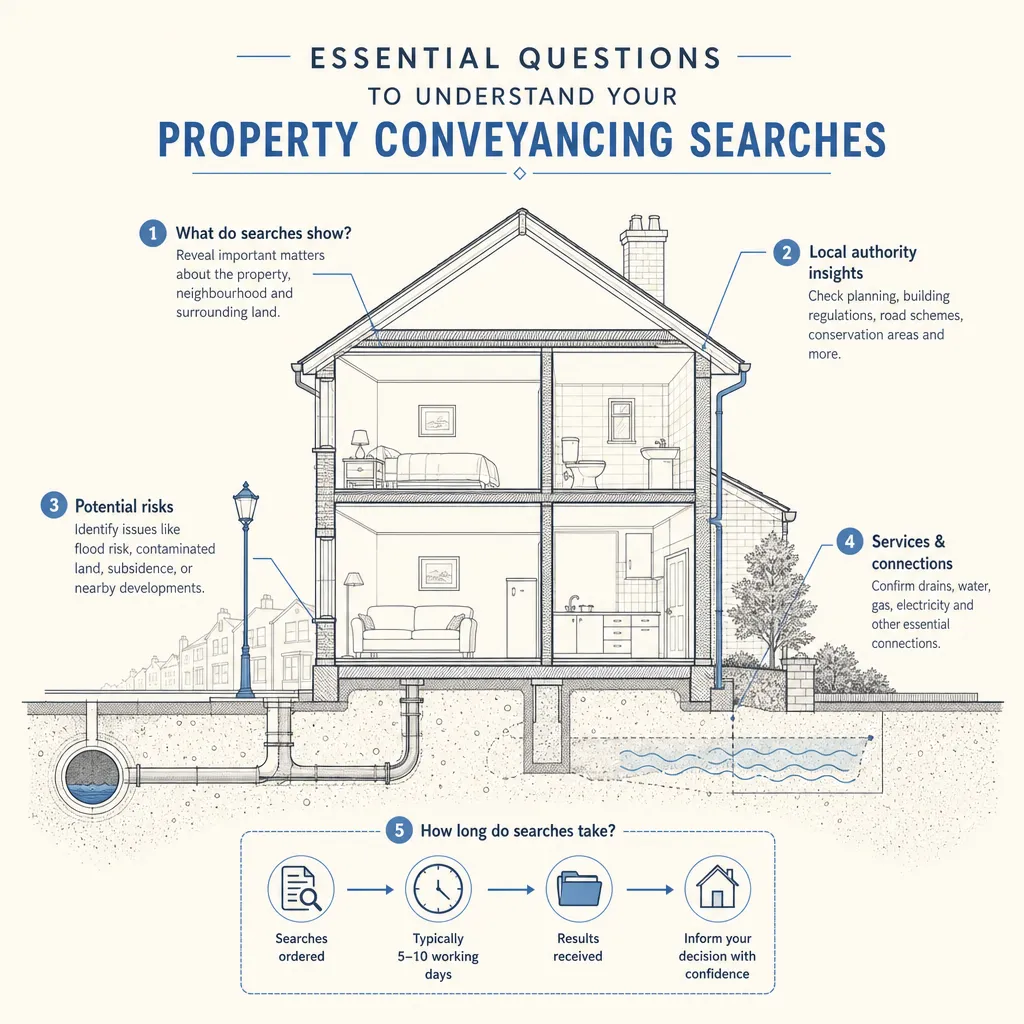
Essential Questions to Understand Your Property Conveyancing Searches
When you instruct a conveyancer for a property purchase, one of their first tasks is to commission a series of formal enquiries — called searches — to official bodies, local authorities, and environmental databases on your behalf. The results can reveal planning history, flood risk, ground contamination, and utility infrastructure issues that would not be visible during any property viewing. Many buyers receive search reports running to dozens of pages without a clear explanation of what has been found and what, if anything, they should do about it.
Key points
- A local authority search (comprising the LLC1 official certificate and CON29 enquiries) is required by almost all mortgage lenders and reveals planning permissions, enforcement notices, road adoption, tree preservation orders, and other matters recorded against the property by the local council.
- Standard residential searches in England typically include at minimum a local authority search, a water and drainage search (CON29DW, provided by the relevant water company), and a commercial environmental search covering flood risk, contaminated land, and radon.
- Environmental searches use national databases to assess risk — a property appearing in a flood zone or near a former landfill site does not automatically disqualify a purchase; the report informs the level of risk, not a binary pass or fail outcome.
- Official local authority searches can take between 5 and 30 working days, with some councils experiencing backlogs of 6–8 weeks; personal searches by accredited agents are often faster and accepted by most lenders.
- Chancel repair liability — a historic obligation to contribute to Church of England chancel repair costs — can affect some properties; an indemnity insurance policy (typically under £50) is the standard solution where the search flags a risk.
What are conveyancing searches and why are they carried out?
Conveyancing searches are formal enquiries made to official bodies and commercial databases to identify matters affecting a property that would not emerge from a physical inspection or a review of the title register alone. They are distinct from a building survey, which assesses the structural and physical condition of the property — searches concern legal, regulatory, and environmental matters affecting the land.
Most mortgage lenders require at minimum a local authority search and a water and drainage search as a condition of lending. Even cash buyers who face no lender requirement are strongly advised to commission standard searches — without them, there is no formal record of planning history, flood risk, or utility infrastructure, and any issues discovered after completion become the buyer's responsibility.
The main types of residential conveyancing search
Search type | Who provides it | What it covers | When it matters most |
|---|---|---|---|
Local authority (LLC1 + CON29) | Local authority or personal search agent | Planning permissions, enforcement notices, road adoption, tree preservation orders, listed building status | Required for almost all purchases; standard lender condition |
Water and drainage (CON29DW) | Relevant water company | Public sewer location, water main adoption, drainage records | All properties with a building; standard lender condition |
Environmental search | Commercial provider (e.g., Landmark, Groundsure) | Flood risk, contaminated land, landfill proximity, radon, ground stability | All purchases; particularly important for older or rural properties |
Coal mining search | The Coal Authority | Subsidence risk from historical mining workings | Properties in or near former coalfields: South Wales, Yorkshire, Nottinghamshire, County Durham, Staffordshire |
Chancel repair search | Commercial search provider | Historic liability to contribute to Church of England chancel repair costs | Affected parishes where liability has not been extinguished |
Tin, clay, brine, or limestone search | Regional authority or database | Ground stability risks specific to certain regions | Cornwall, Cheshire, Yorkshire Dales, parts of Derbyshire |
Standalone flood risk search | Environment Agency / commercial provider | Current flood zone, historical flood event records | Properties near rivers, coastline, or low-lying land |
Additional planning search | Local authority | Broader area planning applications beyond the property boundary | Where nearby development could affect value or use |
What search results actually show
Your conveyancer should highlight any findings that require your attention. Not every flagged result demands action:
Local authority search: An unresolved enforcement notice or a listed building condition attached to the property requires investigation — your conveyancer should raise enquiries with the seller. A planning consent recorded for a nearby road scheme is informative context but may not affect your transaction.
Environmental search: A property in Environment Agency Flood Zone 2 (medium probability) or Flood Zone 3 (high probability) warrants further discussion with your conveyancer. Zone 2 may affect buildings insurance premiums; Zone 3 may affect mortgage availability. Ground contamination flagged by the search does not confirm the site is contaminated — it identifies historical land uses that suggest a risk worth investigating further.
Water and drainage search: A public sewer running through the garden can restrict where you build and may affect consent for future extensions. A property not connected to a public sewer may rely on a private septic tank or treatment plant — check whether the relevant environmental permit is in place under the Environmental Permitting (England and Wales) Regulations 2016.
What not to assume about conveyancing searches
Several widespread misconceptions can lead buyers into poorly informed decisions.
Myth: A clear search means the property is risk-free. A local authority search only reveals matters officially recorded by the council. It does not disclose neighbour disputes, unregistered restrictive covenants, or defects in the physical structure. Searches are one layer of due diligence — not a guarantee of a problem-free purchase.
Myth: Environmental searches confirm whether the property floods. Environmental searches report flood risk drawn from national databases; they are not a site inspection or hydrological assessment. For higher-risk properties, a specialist flood risk assessment by a qualified consultant may be needed before you can rely on the results.
Myth: You don't need searches as a cash buyer. You are free to proceed without searches, but you then accept the risk of any matters they would have revealed — including planning enforcement notices, contaminated land designations, and mining subsidence. This risk remains with you on any future sale or mortgage application.
Myth: Personal searches are less reliable than official searches. Personal searches carried out by accredited agents who are members of the Council of Property Search Organisations (CoPSO) are accepted by most lenders and backed by professional indemnity insurance. They can often be returned considerably faster than official council searches.
Myth: Searches are just a formality. Search results do sometimes reveal material issues: a road-widening proposal affecting the front garden, an outstanding enforcement notice, proximity to a landfill, or a public sewer crossing the plot that would prevent a planned extension.
Questions to ask your conveyancer about searches — a homeowner checklist
Use the following checklist before searches are commissioned or when the results arrive:
- Which searches are you recommending for this property, and why?
- Are any searches specifically required by my mortgage lender?
- How long is the local authority expected to take, and will you use an official or personal search?
- Does the environmental search flag any flood risk, contamination, or radon concern requiring follow-up?
- Does the water and drainage search show public sewers crossing the plot?
- Is chancel repair liability flagged, and if so, is indemnity insurance available and what does it cost?
- Has a coal mining (or other ground stability) search been recommended given the property's location?
- Are there any unresolved planning enforcement notices or listed building conditions?
- What is the total cost of all searches, and are they refundable if the transaction does not proceed?
Important limitations
This article provides general information about conveyancing searches in England and Wales. The process differs in Scotland, where the Home Report and Property Questionnaire serve a different function, and in Northern Ireland. Search providers, turnaround times, lender requirements, and local authority fees change regularly. Nothing here constitutes legal advice. Your conveyancer is the appropriate person to advise on which searches are necessary and what the results mean for your specific property.
What to ask a qualified professional
Before exchanging contracts, confirm with your conveyancer:
- Have all recommended searches been received, reviewed, and reported to me in full?
- Do any search results require further specialist investigation before I exchange?
- Are there any matters from the searches that should be raised with the seller as pre-contract enquiries?
- Do any results affect my ability to obtain buildings insurance or a mortgage on this property?
When to get professional help
If any search result flags contaminated land, a significant planning enforcement notice, a proposed infrastructure scheme affecting the property, or a drainage restriction on future building work, ask your conveyancer to explain the full practical and legal implications before you exchange. For complex environmental or flood risk findings, a specialist consultant's assessment may be needed beyond what your conveyancer alone can advise.
How Housey can help
Understanding your search results and knowing which searches to commission is part of what a good conveyancer provides. Housey can connect you with vetted conveyancing solicitors who will explain your results clearly and advise on any follow-up steps — whether that means raising enquiries with the seller, obtaining indemnity insurance, or commissioning a specialist assessment — before you commit to exchange.
Frequently asked questions
How long do conveyancing searches take?
Turnaround times vary significantly. Official local authority searches typically take between 5 and 30 working days, though some authorities have backlogs pushing this to 6–8 weeks. Personal searches by accredited agents can often be returned within 3–5 working days. Water and drainage searches and commercial environmental searches from providers such as Landmark or Groundsure generally take 1–3 working days.
What is the difference between a local authority search and an environmental search?
A local authority search (LLC1 and CON29) covers matters recorded by the local authority: planning permissions, enforcement notices, listed building status, and road adoption. An environmental search draws on national databases to assess broader risks including flood probability, contaminated land history, landfill proximity, radon levels, and ground stability. Both are typically recommended for residential purchases in England and Wales.
Do conveyancing searches have an expiry date?
Yes. Most mortgage lenders will not accept search results older than 6 months at the point of their mortgage offer. If a transaction is significantly delayed, searches may need to be refreshed at additional cost. Some lenders will accept search insurance in lieu of updated official searches; your conveyancer can advise whether this is appropriate for your specific transaction and lender.
What happens if something adverse appears in the searches?
Your conveyancer will report the finding and explain your options. These may include raising pre-contract enquiries with the seller, obtaining an indemnity insurance policy, negotiating a price reduction, requesting evidence of remediation, or reconsidering the purchase. A flagged result does not automatically mean you should withdraw, but you must understand its implications fully before exchanging contracts.
Sources and further reading
- Property searches when buying a home — GOV.UK
- Local land charges — HM Land Registry / GOV.UK
- Flood map for planning — Environment Agency / GOV.UK
- Mining reports and ground stability — The Coal Authority
- Chancel repair liability — GOV.UK
Useful next reads
 Buying & Moving
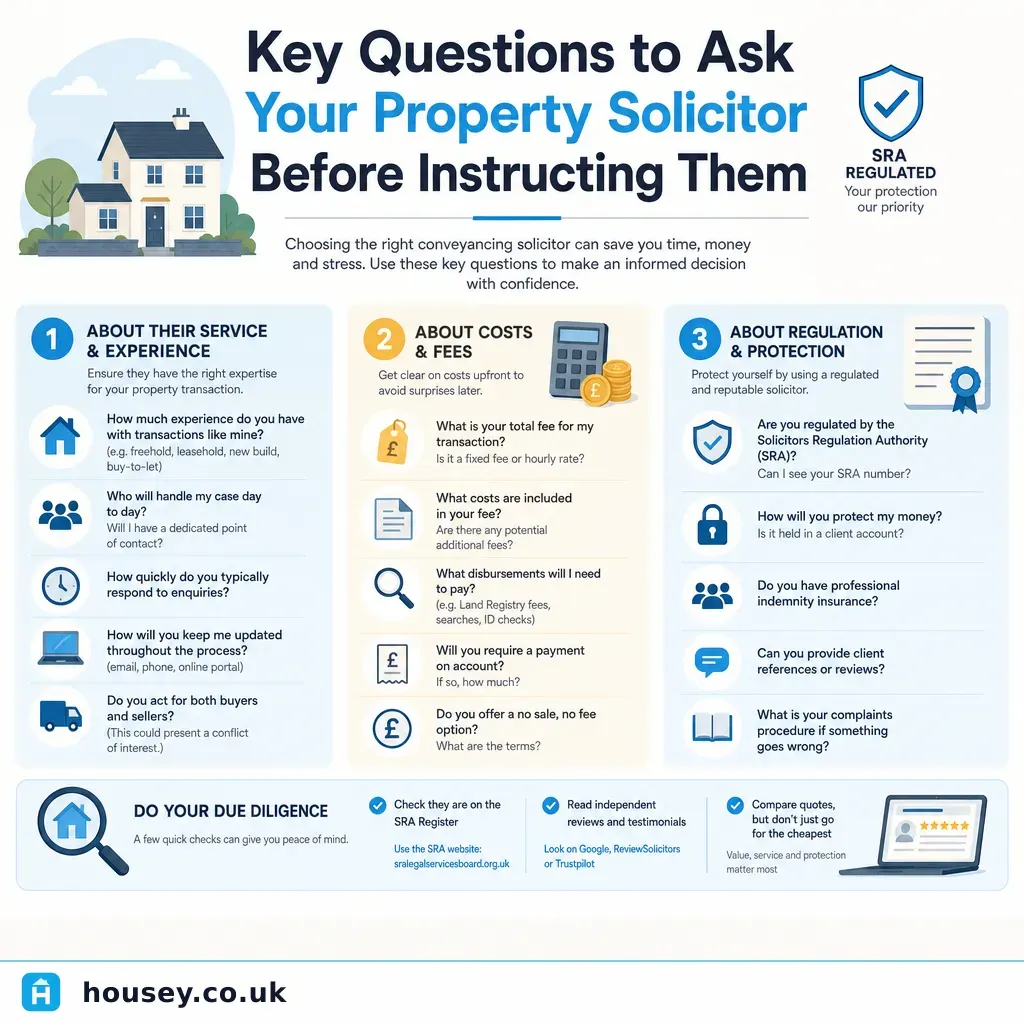
Key Questions to Ask Your Property Solicitor Before Instructing Them
Before instructing a property solicitor, ask whether they are on your mortgage lender's approved panel, whether their quote is fixed and includes VAT and all disbursements, who will personally handle your case, and what their abortive-fee policy is.
 Buying & Moving
Identifying and Resolving Delays in Property Transactions
Delays in UK property transactions most often arise from slow local authority searches, incomplete identity documents, mortgage hold-ups, leasehold complications, or a problem elsewhere in the chain.
 Buying & Moving
Conveyancing Searches for New Build Properties: What to Know
New build properties require the same core conveyancing searches as any residential purchase: local authority, drainage and water, environmental, and chancel repair.
 Buying & Moving
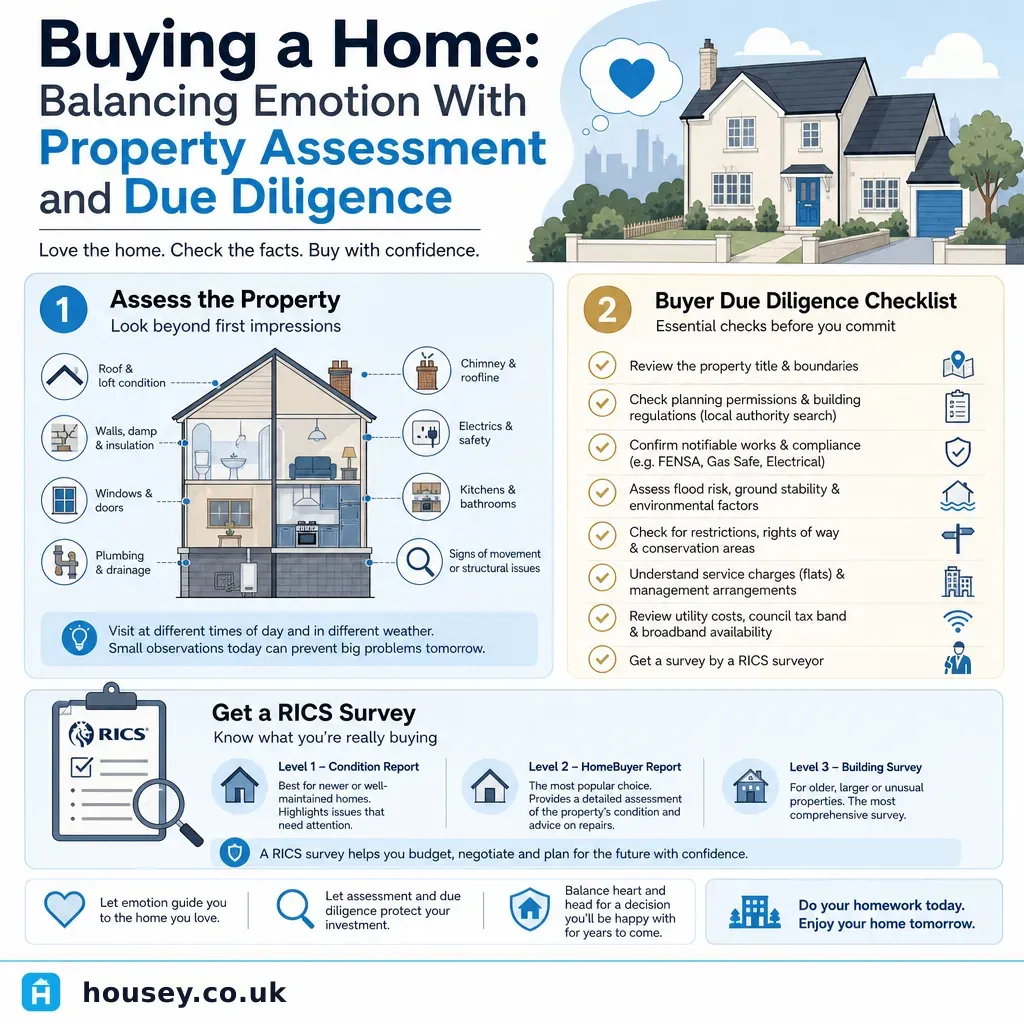
Buying a Home: Balancing Emotion With Property Assessment and Due Diligence
It's natural to feel strongly about a property, but buying decisions should be supported by a formal survey, proper searches, and independent legal advice.
 Buying & Moving
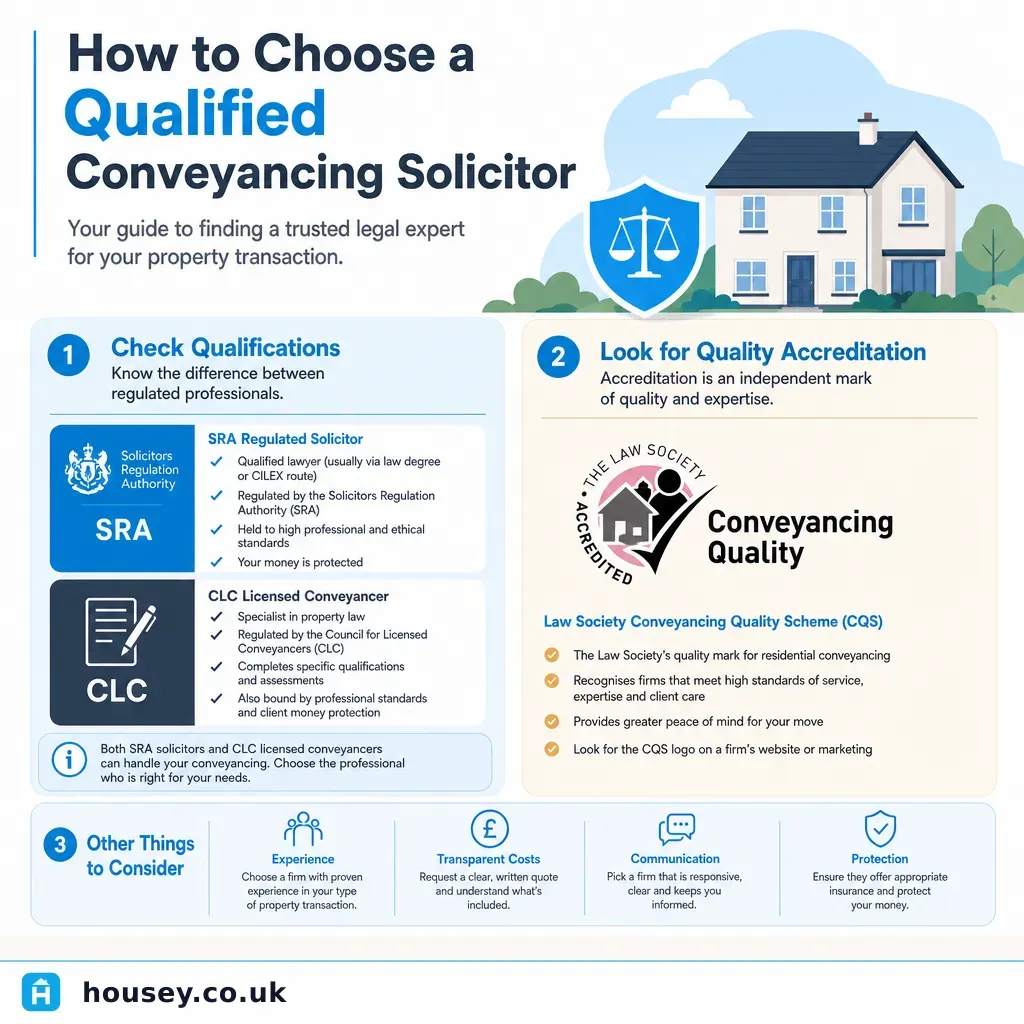
How to Choose a Qualified Conveyancing Solicitor
To choose a qualified conveyancing solicitor, verify they are regulated by the Solicitors Regulation Authority (SRA) or the Council for Licensed Conveyancers (CLC), check whether they hold Law Society CQS accreditation, and confirm they are on your mortgage lender's approved panel.