Conveyancing Searches for New Build Properties: What to Know
By Housey · Last reviewed 25th of May 2026

Conveyancing Searches for New Build Properties: What to Know
Buyers of new build homes sometimes assume that a freshly constructed property on a recently developed site carries fewer legal risks than an older home — and that conveyancing searches are therefore a formality. In practice, new build searches routinely reveal drainage issues, unresolved planning conditions, flood risk, contaminated land, and infrastructure gaps that are specific to newly developed sites and entirely invisible on a viewing. The tight exchange deadlines that developers impose can create pressure to cut corners at exactly the moment when thorough due diligence matters most.
Key points
- New build properties require the same standard searches as any residential purchase in England and Wales: local authority search (LLC1 and CON29), drainage and water search (CON29DW), environmental search, and a chancel repair liability search.
- The local authority search for a new build site should confirm the planning permission granted for the development, the conditions attached, and whether a Section 38 highway adoption agreement (Highways Act 1980) is in place for roads and footpaths.
- Section 104 adoption agreements under the Water Industry Act 1991 govern whether sewers serving the development will be adopted as public — their absence means maintenance costs can fall on residents indefinitely.
- Environmental searches on new build sites can reveal former industrial or agricultural use, landfill proximity, ground contamination, and Environment Agency flood zone classification, none of which is visible during a site visit.
- Search indemnity insurance — sometimes offered by developers to speed exchange — provides no information about the site; it insures against undiscovered problems but does not reveal what those problems might be.
What searches are carried out on a new build?
Local authority search (LLC1 and CON29)
The official local authority search covers planning permissions, enforcement notices, tree preservation orders, listed building status, highway adoption information, and certain environmental designations affecting the land. For a new build, this should confirm the planning permission for the development, any conditions attached (including reserved matters or discharge-of-condition requirements), and whether the roads and footpaths serving the site are adopted or subject to a formal adoption agreement.
Drainage and water search (CON29DW)
This search confirms whether the property is connected to the public sewer and water mains, and whether public sewers run through or near the land. On new build sites, the developer may not yet have applied for sewer adoption at the time of purchase — your solicitor should seek confirmation from the developer before exchange.
Environmental search
Provides information from the Environment Agency on flood zones, ground contamination, nearby landfill sites, subsidence risk, and historic industrial land uses adjacent to the site. New build developments on brownfield land are especially worth scrutinising — a standard environmental search will flag concerns and indicate whether specialist investigation is needed.
Chancel repair liability search
Historically, certain properties in England and Wales are subject to a legal obligation to contribute to the cost of repairing a parish church chancel. Enforced liabilities are rare, and the search is low cost — it is standard practice in most residential transactions.
Additional searches sometimes needed
Depending on the site's location and history, your solicitor may recommend:
- Coal or tin mining search (relevant to former mining areas across England and Wales)
- Drainage search for adopted highways
- Index map search (to check for nearby development proposals that could affect the property)
- Company search on the developer (to assess financial standing)
Developer timelines and the exchange pressure problem
Developers commonly require exchange of contracts within 28 days of reservation — sometimes sooner — to secure a buyer's plot or retain access to incentives. Official local authority searches can take from a few days to several weeks, depending on the local authority's current workload. This timing mismatch creates a genuine risk: a buyer can be pushed to exchange before all searches are back and reviewed.
Search indemnity insurance is the developer's typical solution: a low-cost insurance policy covering financial loss if a completed search would have revealed a material defect. It can allow exchange to proceed faster, but it provides no information about the property's planning history, drainage connections, adoption status, or contamination risk.
Full search pack vs search indemnity insurance
Factor | Full search pack | Search indemnity insurance |
|---|---|---|
Information provided | Full results from local authority, water authority, and environmental searches | None — insures against undiscovered problems, does not reveal them |
Time to exchange | Several weeks depending on local authority workload | Can allow exchange within days of reservation |
Typical cost | £200–£500 for the full pack | £50–£150 premium (varies by insurer and site) |
What the buyer learns | Specific results: planning conditions, adoption status, flood zone, contamination flags | Nothing about the specific site |
Mortgage lender acceptance | Universally accepted by all UK mortgage lenders | Most lenders accept; always confirm with your specific lender before agreeing |
Recommended for | All purchases, especially brownfield sites and complex planning situations | Lower-risk straightforward sites only, and only on your solicitor's explicit advice |
Indicative UK costs, last reviewed 2026-05-25. Costs vary by local authority and search provider.
Road and sewer adoption: a new build-specific risk
If the developer has not entered into a Section 38 (road adoption) or Section 104 (sewer adoption) agreement — or if agreements exist but the adoption process is incomplete — residents may find themselves collectively responsible for the maintenance and repair of roads, footpaths, and drainage serving their homes for years after moving in.
Before exchange, your solicitor should confirm:
- Whether a Section 38 agreement is in place and whether a financial bond or guarantee secures completion of the works if the developer fails to finish them.
- Whether a Section 104 agreement is in place for the sewers, and its current status.
- What the anticipated timeline is for adoption, and what recourse residents have if adoption is delayed.
What to ask your solicitor before exchange
- Have all searches been completed and reviewed, or are we being asked to exchange on search indemnity insurance?
- What planning conditions are attached to the development consent, and have the conditions relevant to my plot been formally discharged?
- Is the road serving my property already adopted, or is a Section 38 agreement in place with a financial bond?
- Are the sewers adopted, or is a Section 104 agreement in place — and what is its current status?
- Has the developer provided a 10-year structural warranty (NHBC Buildmark or an equivalent recognised scheme), and is it accepted by my mortgage lender?
- Are there any restrictive covenants on the title that limit how I use or alter the property?
- If the property is leasehold, what are the ground rent and service charge terms, and do any charges escalate over time?
Snagging and the search process
Conveyancing searches protect your legal and financial position — they answer questions about planning, drainage, contamination, and infrastructure. A separate new-build snagging inspection protects your physical position, identifying defects, incomplete work, and construction quality issues before or shortly after legal completion. The two processes complement each other and both are advisable on any new build purchase.
Important limitations
This article provides general information about conveyancing searches for new build properties in England and Wales. The appropriate searches for a specific site, the implications of any search results, and whether search indemnity insurance is acceptable in a particular case are all matters for a qualified solicitor or licensed conveyancer who has reviewed the specific title and development documentation. Rules differ in Scotland and Northern Ireland. Nothing in this article constitutes legal advice.
What to ask a qualified professional
- Which searches do you recommend for this specific site, and why?
- Is the developer's offer of search indemnity insurance appropriate here, or do you recommend a full search pack given the site's history?
- What did the searches reveal, and do any results require further specialist investigation before I commit to exchange?
- Is the development's planning permission clear of outstanding conditions that could affect my use or enjoyment of the property?
- Is the structural warranty provider recognised by my mortgage lender, and what does it cover in the first two years versus years three to ten?
When to get professional help
Instruct a qualified solicitor or licensed conveyancer for any new build purchase. Seek professional advice as a matter of urgency if:
- You are being pressured to exchange contracts before all searches have been completed and reviewed by your solicitor.
- The developer is offering search indemnity insurance and has not explained what it does and does not cover.
- The site is on brownfield or formerly industrial land where contamination is a plausible risk.
- The property is in or near an Environment Agency flood zone, or in an area of known ground instability.
- Roads or sewers serving the development are not yet adopted and no formal adoption agreement with a bond is confirmed.
How Housey can help
Housey can connect you with experienced conveyancing solicitors and licensed conveyancers who handle new build purchases across England and Wales, including reviewing planning conditions, adoption agreements, structural warranties, and the suitability of search indemnity insurance. Complement your legal protection with a new-build snagging inspection to identify physical defects before completion.
Frequently asked questions
Are searches always required for a new build?
Searches are almost always required by your mortgage lender and are strongly advisable for cash buyers. The specific searches depend on the site's location, previous land use, and local planning history. Your solicitor will recommend which searches are appropriate once they have reviewed the title documentation and the details of the development.
How long do conveyancing searches take for a new build?
Local authority searches are the most variable — depending on the authority, they can take from a few days to several weeks. Drainage and environmental searches often return within a few working days. If the developer's exchange deadline is tight, discuss timescales with your solicitor early in the transaction, or ask about the appropriateness of search indemnity insurance.
What is an NHBC Buildmark warranty?
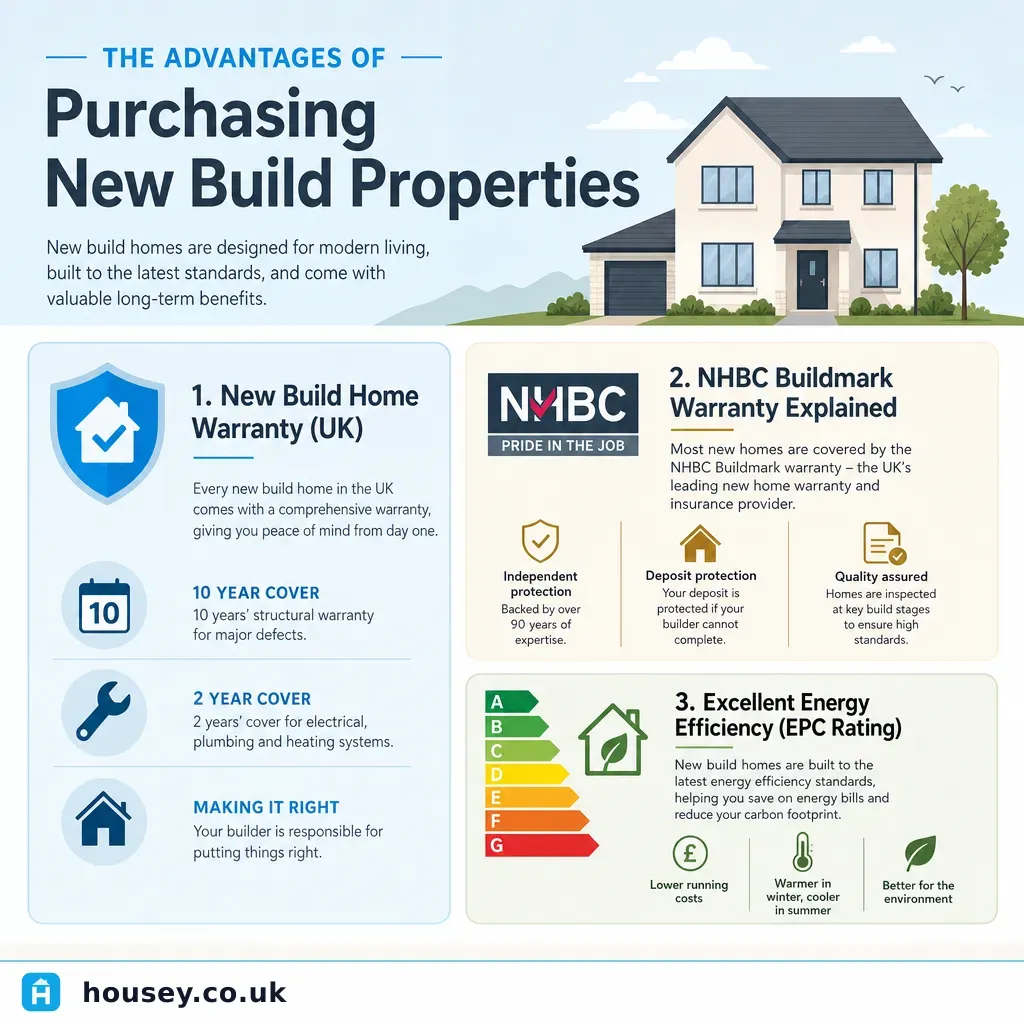
NHBC Buildmark is a 10-year structural warranty provided by the National House Building Council on most new homes in England and Wales. It covers structural defects for 10 years, and workmanship and materials defects in the first two years. Other recognised providers include Premier Guarantee and LABC Warranty, all of which are accepted by most UK mortgage lenders.
Can I negotiate with the developer on search timelines?
Some developers will allow a short extension to the exchange deadline if you explain that searches are outstanding and you can demonstrate you are otherwise ready to proceed. Raise this formally through your solicitor and early — last-minute requests carry less weight, and developers in a strong sales position are less likely to agree to extensions.
Sources and further reading
- Buying or selling your home — GOV.UK
- NHBC Buildmark warranty — NHBC
- Conveyancing protocol — Law Society
- Flood map for planning — Environment Agency / GOV.UK
- Highways Act 1980 — legislation.gov.uk
- Water Industry Act 1991 — legislation.gov.uk
Useful next reads
 Buying & Moving
Safeguarding Your Property Purchase: Fraud Prevention Strategies
Property purchase fraud in the UK most commonly involves criminals intercepting emails to redirect completion funds to fraudulent bank accounts.
 Buying & Moving
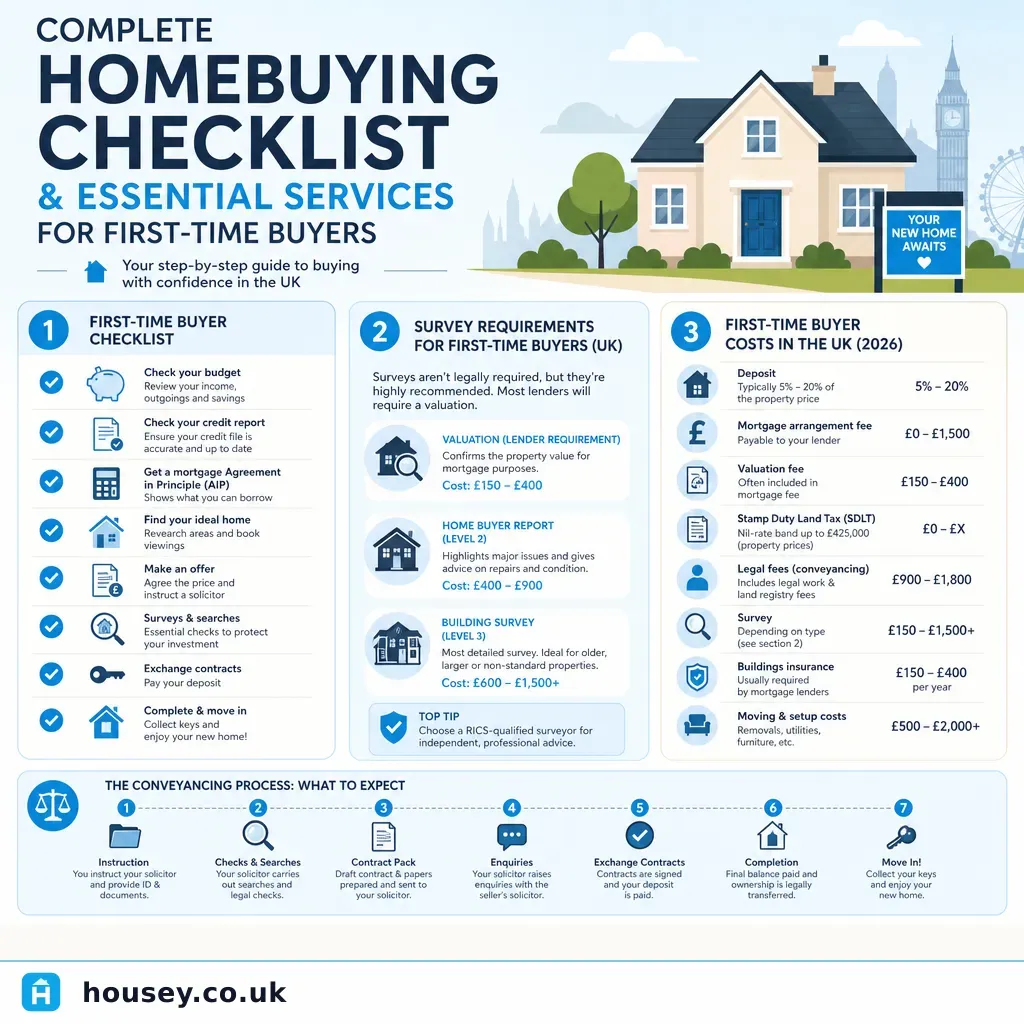
Complete Homebuying Checklist and Essential Services for First-Time Buyers
First-time buyers in the UK should commission an independent RICS Home Survey before exchange — a mortgage lender's valuation does not protect you.
 Buying & Moving
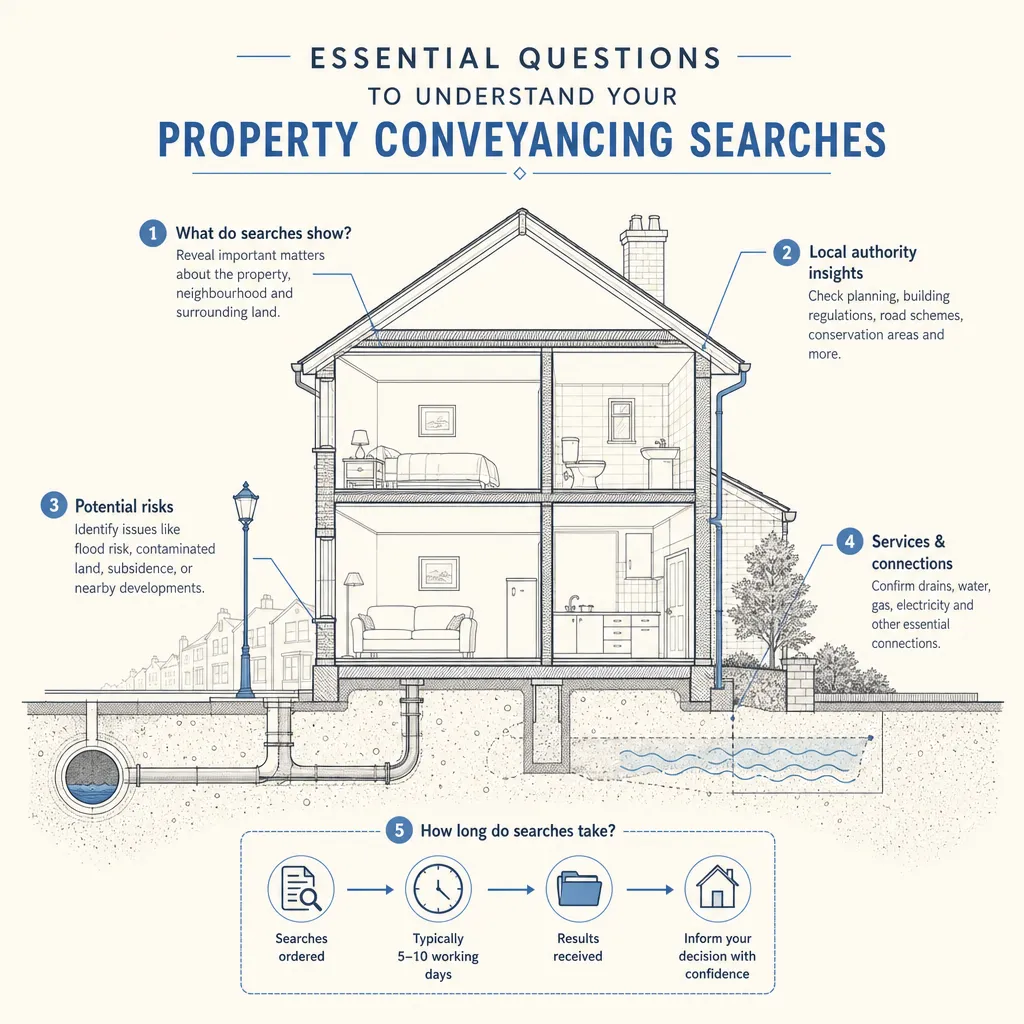
Essential Questions to Understand Your Property Conveyancing Searches
Conveyancing searches are formal enquiries to official bodies revealing planning history, flood risk, drainage infrastructure, and environmental hazards affecting a property.
 Buying & Moving
How Recent Regulatory Changes Affect Home Buyers
Recent UK regulatory changes affecting home buyers include the reversion of Stamp Duty thresholds in April 2025, the Leasehold and Freehold Reform Act 2024, and ongoing implementation of the Building Safety Act 2022.
 Buying & Moving
The Advantages of Purchasing New Build Properties
New build homes in the UK typically come with a 10-year NHBC Buildmark warranty, covering defects for the first 2 years and structural issues for years 3–10.