What to budget for converting a front garden to a driveway
By Housey · Last reviewed 5th of May 2026
What to budget for converting a front garden to a driveway
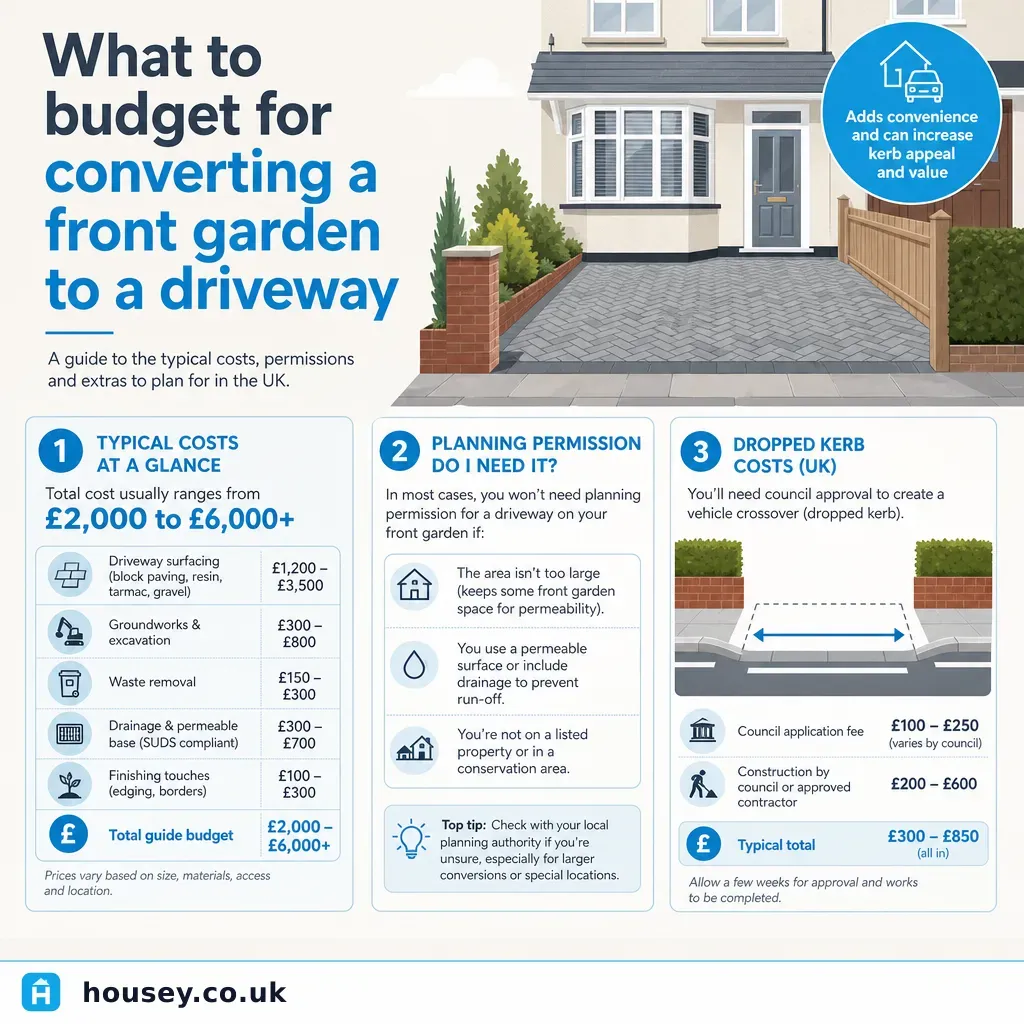
Converting a front garden to a driveway is one of the most practical home improvements available to UK homeowners without off-street parking, yet the true total cost is rarely what it first appears. Beyond the surface material, a typical project involves excavation, sub-base preparation, edging, drainage, and — in most cases — a dropped kerb application through the local council. Getting the budget right from the start means understanding each of these elements before inviting your first quote.
Key points
- Under the Town and Country Planning (General Permitted Development) (England) Order 2008, any new impermeable hard standing over 5m² in a front garden requires planning permission unless rainwater drains to a permeable area or soakaway rather than the highway.
- A dropped kerb (vehicle crossing) must be approved by the local highway authority before work begins; total costs including council fees typically range from £800 to £2,000.
- Indicative UK surface costs per m² (supply and install, last reviewed 2026-05-05): gravel £25–£50, tarmac £40–£70, concrete £50–£80, block paving £60–£100, resin-bound £70–£110.
- Trees with Tree Preservation Orders (TPOs) or within conservation areas must not be disturbed without consent — enforcement action can require full reinstatement of the garden at the homeowner's cost.
- Scotland, Wales, and Northern Ireland operate under different permitted development rules; always check with your local planning authority before committing to a contractor.
How much does converting a front garden to a driveway cost?
Total project cost depends on the size of the area, the surface material chosen, ground conditions, and whether demolition of existing walls or garden structures is required. The dropped kerb is a separate cost that many initial quotations do not include.
Indicative surface costs per m² — supply and install (last reviewed 2026-05-05)
Surface material | Cost per m² | Permeable? | Notes |
|---|---|---|---|
Gravel / shingle | £25–£50 | Yes | Lowest upfront cost; needs periodic topping up; can spread onto footway |
Tarmac (asphalt) | £40–£70 | Usually no | Fast to lay; smooth finish; porous grade available |
Concrete | £50–£80 | No | Durable; requires 28-day cure before full vehicle use |
Block paving | £60–£100 | Can be | Permeable if laid with open joints on permeable bedding |
Resin-bound aggregate | £70–£110 | Yes | Smooth decorative finish; requires sound concrete or tarmac base |
Porcelain or natural stone | £90–£150+ | Usually no | Premium finish; must be specified for vehicle loading |
All figures are indicative only. Request at least three itemised written quotes for your specific site. Costs vary by region, access, ground conditions, and contractor.
For a typical semi-detached house with a 25–35m² front garden, total project costs (including excavation, 150mm compacted Type 1 granular sub-base, surface, edging, and drainage) commonly fall in these ranges:
- Gravel: £1,500–£2,500
- Tarmac: £2,000–£3,500
- Block paving: £2,500–£4,500
- Resin-bound: £3,000–£5,000
These figures exclude the dropped kerb (add £800–£2,000) and any demolition costs for existing walls or steps.
Planning permission and permitted development
For most properties in England, converting a front garden to a driveway falls under permitted development — planning permission is not needed — provided the following conditions are met:
- The surface is permeable (gravel, permeable block paving, porous asphalt), or rainwater drains to a lawn, border, or soakaway rather than directly to the highway.
- The hard standing does not exceed 5m² if using an impermeable surface without drainage to a permeable area.
- The property is not subject to an Article 4 Direction removing householder permitted development rights.
If your property is in a conservation area, permitted development rights for front garden hard standing are restricted. Check with your local planning authority (LPA) before starting work. Enforcement notices for unauthorised hard standing can require reinstating the garden at the homeowner's cost.
Scotland, Wales, and Northern Ireland have their own householder permitted development rules. Do not assume England's framework applies — check with your devolved planning authority before proceeding.
The dropped kerb: what it costs and how it works
Driving across a public footway without a lawful vehicle crossing is an offence under section 184 of the Highways Act 1980. An unauthorised crossing may also affect motor insurance if a vehicle is damaged while crossing the pavement.
The process for obtaining a dropped kerb:
- Apply to your local highway authority (usually the council highways department) for a vehicle crossing licence.
- The council inspects the proposed location, checking sightlines, proximity to junctions, underground services, and gradient.
- The council arranges construction through its own team or an approved contractor — most authorities do not permit homeowners to carry out this work themselves.
- You pay the council's fee, which varies by authority and covers inspection, temporary traffic management, and construction of the kerb drop and footway crossing.
Indicative costs (last reviewed 2026-05-05):
- Council application and inspection fee: £300–£800
- Construction cost (where billed separately by the authority): £500–£1,500
- Total: approximately £800–£2,000
Waiting times vary between 4 and 16 weeks depending on the council. Secure approval before booking your driveway contractor — the timeline can affect your entire project schedule.
Worked example: 1960s semi-detached in the East Midlands
To illustrate realistic total costs, the following worked example is based on a typical project scope.
Property: A 1960s semi-detached house in the East Midlands with a 30m² front garden, a low boundary wall, no existing dropped kerb, and on-street parking only.
Item | Indicative cost |
|---|---|
Demolish and remove low boundary wall | £300–£600 |
Dropped kerb (council application and construction) | £900–£1,400 |
Excavation and removal of topsoil to 300mm depth | £600–£900 |
150mm compacted Type 1 granular sub-base | Included in driveway quote |
Permeable block paving (30m²) | £1,800–£3,000 |
Edging, drainage channel, and site tidy | £300–£600 |
Estimated total | £3,900–£6,500 |
Indicative UK costs, last reviewed 2026-05-05. Costs in London and the South East typically run 20–40% higher. Always obtain itemised quotes for your specific site and specification.
What to ask before accepting a quote
- Is the quote for the full scope — including excavation, sub-base, surface, edging, drainage, and VAT — or is it for the surface layer only?
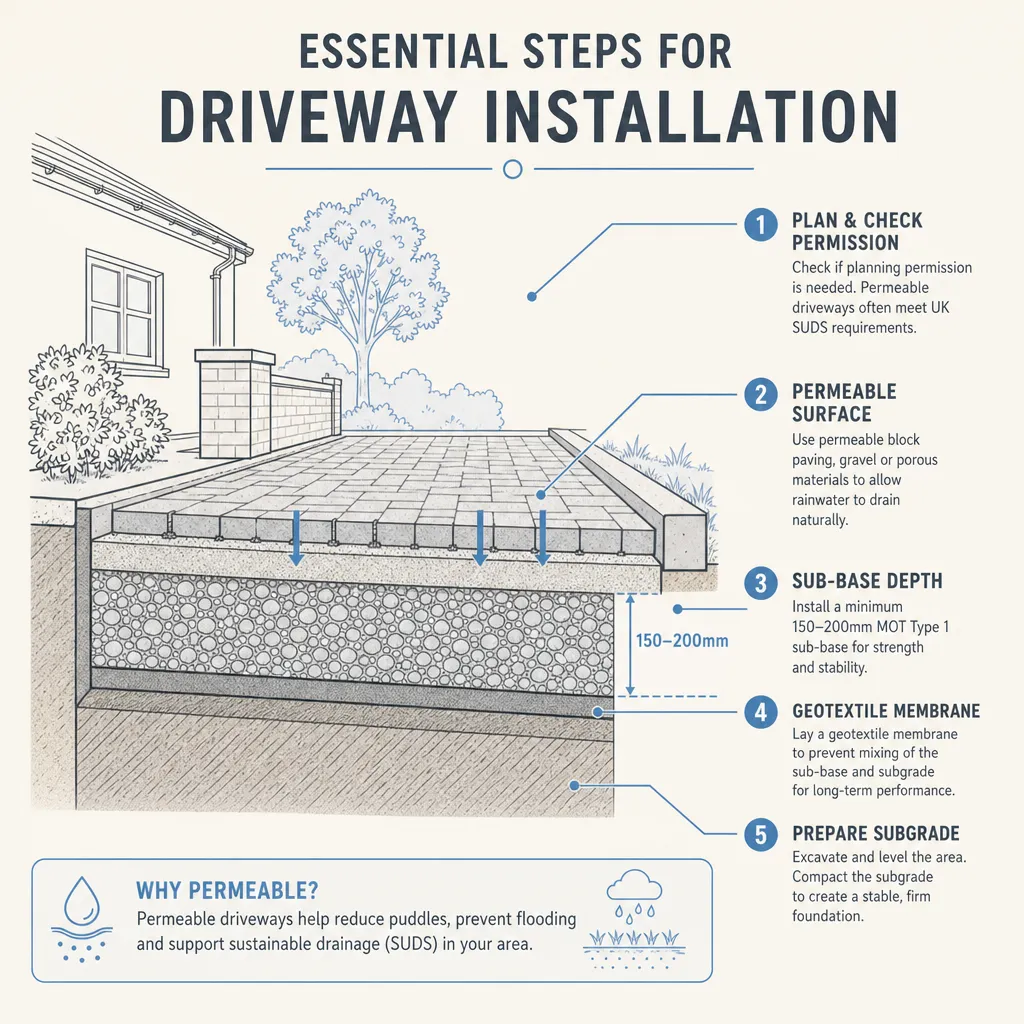
- What is the sub-base specification (depth and material)? A 150mm compacted Type 1 granular sub-base is standard for residential car use.
- Is the chosen surface permeable, or will planning permission be required before work starts?
- Who is responsible for the dropped kerb application, and is that cost included in the quotation?
- What happens if underground services (gas, water, electricity, or telecoms) are encountered during excavation?
- What warranty is offered on materials and workmanship?
- Is the contractor registered with a recognised trade body such as BALI (British Association of Landscape Industries) or a manufacturer's approved installer scheme?
When to get professional help
For straightforward front garden conversions on level ground without existing structures or underground complications, a reputable driveway contractor can manage the full project. Seek specialist input if:
- Trees are within or near the planned driveway area — consult a qualified arborist before excavating near roots; damage to trees protected by a TPO can carry significant legal and financial consequences.
- The garden slopes significantly toward the house — an experienced groundworker or drainage engineer should design the drainage falls to prevent water ingress.
- Unusual ground conditions appear during initial digging, such as soft spots, made ground, or unexpected materials.
- The property is listed or in a conservation area — contact your local planning authority and potentially a heritage consultant before starting any work.
How Housey can help
Housey can connect you with experienced driveway installers and groundworkers who can assess your site, advise on surface options and drainage, and provide itemised written quotes. If demolition of a wall or garden structure is required, you can also request quotes from demolition contractors as part of the same project.
Frequently asked questions
Do I need planning permission to convert my front garden to a driveway?
In England, planning permission is generally not required if the new surface is permeable — such as gravel or permeable block paving — or if rainwater drains to a lawn or soakaway rather than the highway. Impermeable surfaces over 5m² in a front garden do require permission. Rules differ in Scotland, Wales, and Northern Ireland, so always check with your local planning authority.
How long does a front garden driveway conversion take?
The main driveway work typically takes 2–5 days. The dropped kerb application adds 4–16 weeks depending on your local council. Secure the dropped kerb approval before booking a driveway contractor — the timeline can significantly affect your overall project schedule, and the crossing must be in place before the driveway is legally used.
Can I use my front garden as a driveway without a dropped kerb?
No. Driving over a public footway without a lawful vehicle crossing is an offence under the Highways Act 1980. An unapproved crossing may also affect your motor insurance if a vehicle is damaged crossing the pavement. Apply to your local highway authority for a vehicle crossing licence before any driveway work begins.
What is the most cost-effective surface for a front garden driveway?
Gravel is the lowest upfront cost and is inherently permeable, which typically avoids planning permission issues. However, it needs periodic topping up and can spread onto the pavement. Tarmac offers good durability at a moderate cost. Block paving costs more upfront but requires less maintenance over time and can enhance kerb appeal.
Sources and further reading
- Permitted development rights for householders: technical guidance — GOV.UK
- Town and Country Planning (General Permitted Development) (England) Order 2008 — legislation.gov.uk
- Highways Act 1980, section 184: vehicle crossings over footways — legislation.gov.uk
- Tree Preservation Orders and trees in conservation areas — GOV.UK
- Sustainable drainage systems (SuDS) guidance — GOV.UK
Useful next reads
 Improvement & Build
Essential Steps for Driveway Installation
Installing a driveway in England requires planning permission only when using an impermeable surface (standard tarmac, concrete, or block paving) on a front garden area over 5 m².
 Improvement & Build
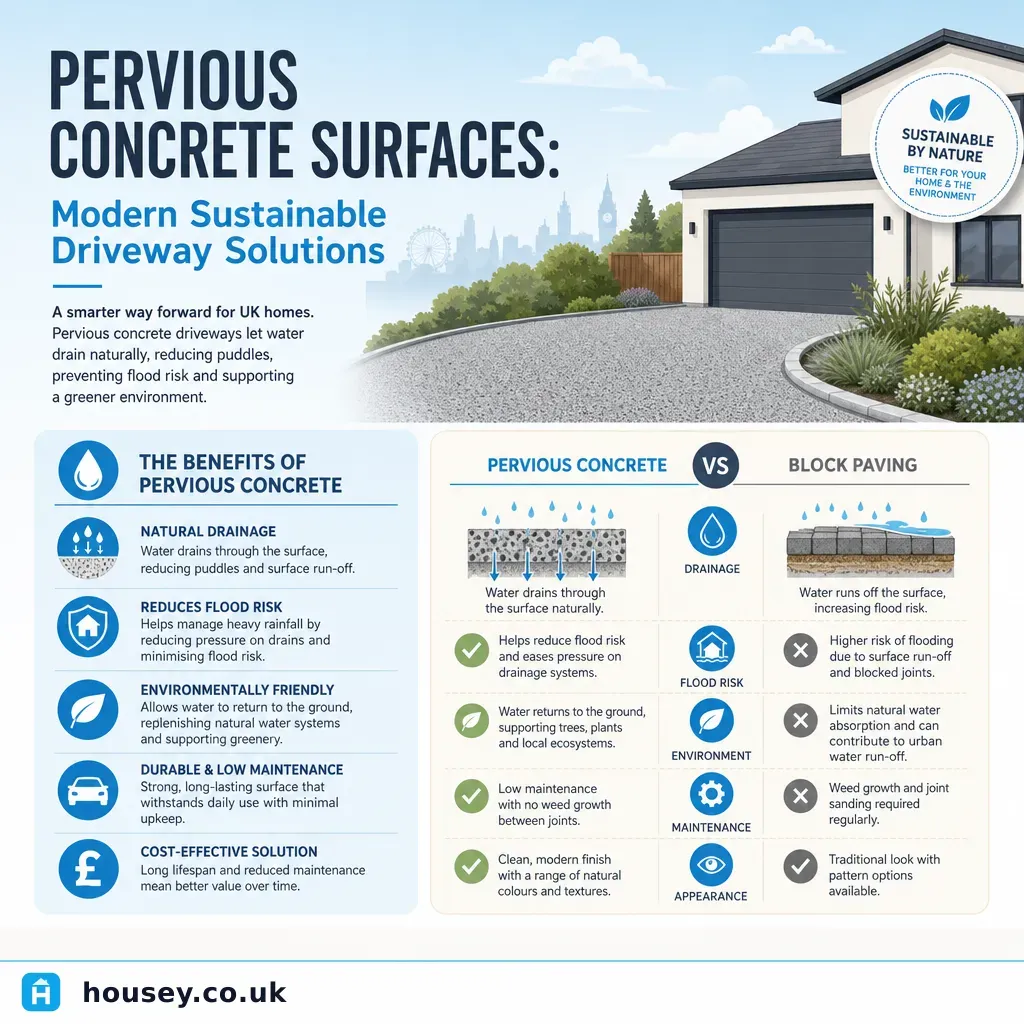
Pervious Concrete Surfaces: Modern Sustainable Driveway Solutions
Pervious concrete (also called porous or no-fines concrete) is a specialist concrete mix with large voids that allow rainwater to pass through the surface and into the sub-base below.
 Improvement & Build
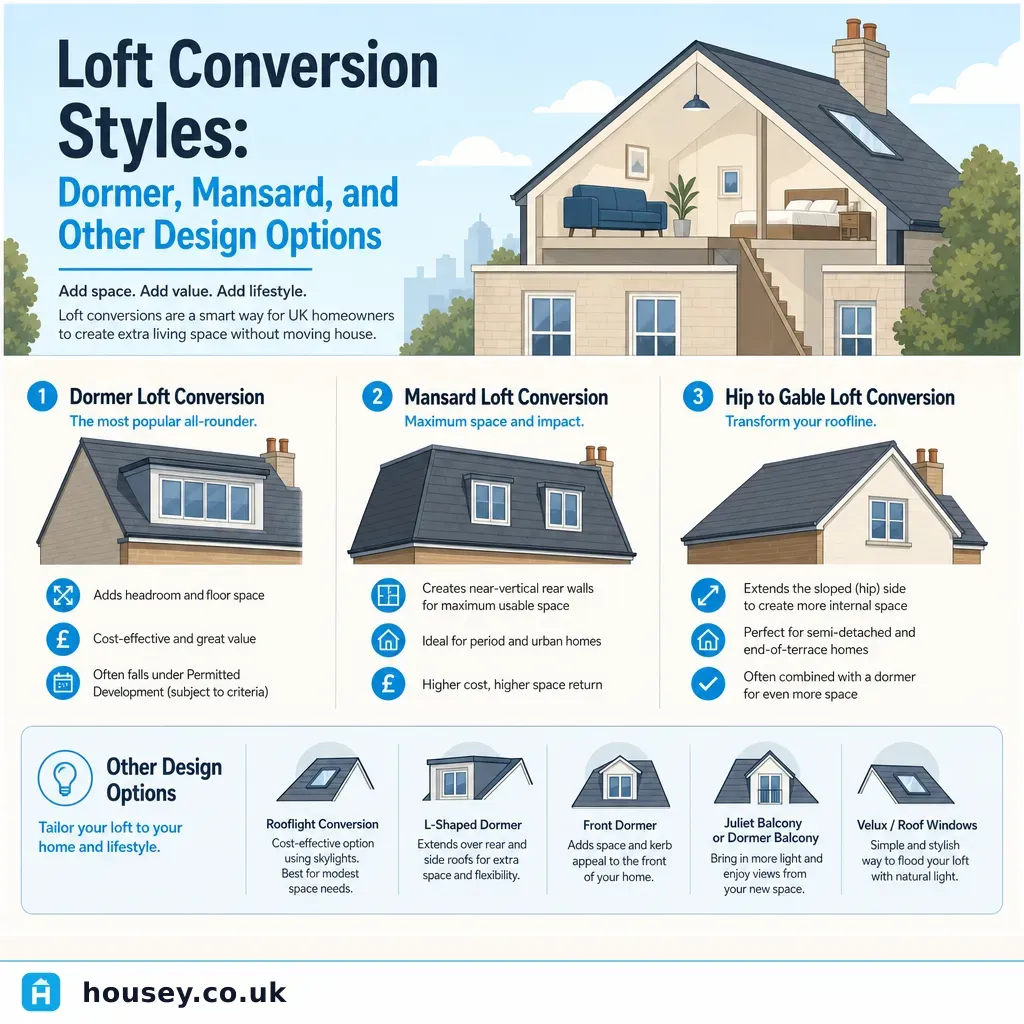
Loft Conversion Styles: Dormer, Mansard, and Other Design Options
The main loft conversion types in the UK are rooflight, dormer, hip-to-gable, and mansard.
 Improvement & Build
Guide to Replacing Timber Sash Windows with Authentic Restoration
Restoring a timber sash window typically costs £150–£400 per window; full replacement costs £800–£2,500.
 Improvement & Build
Planning a Roof Replacement Project
A roof replacement project involves stripping the existing covering, renewing the sarking felt and battens, and laying new tiles, slates, or a flat-roof membrane.